

Key Takeaways
- AI Lead Intelligence reveals who is interested in your services before they fill out a form. This gives your sales team a head start on conversations competitors don’t know about.
- Anonymous visitor identification unmasks the companies visiting your website, so you can see which prospects are researching you right now without waiting for them to self-identify
- Intent signals tracked across platforms, search behaviour, and engagement patterns predict which prospects are most likely to buy, so you focus time and budget on the highest-probability opportunities.
- Buying committee mapping identifies every decision-maker and influencer involved in the purchase, so your outreach and content reach the full group, not just one contact.
- The investment ranges from $1,500 to $3,000/month, depending on the number of signals tracked, the volume of visitor identification, and the depth of integration with your CRM and ecosystem.
One Sentence Summary: AI Lead Intelligence tells you who is interested, how interested they are, and when to engage them. It does this by tracking intent signals, identifying anonymous visitors, and mapping buying committees before prospects ever raise their hand.
Investment Range: $1,500 – $3,000/month
Annual Commitment: 20% off the monthly rate
Multi-Module Discount: 10-15% off when combined with other active AI Growth Modules
Requires: Level 0 (Website Foundation) + Level 2 (Landing Pages and Automation) active.
Timeline to first results: Anonymous visitor identification begins producing data within the first week. Intent signal tracking reaches meaningful pattern recognition at 30-60 days. Predictive scoring accuracy improves continuously from month 2 onward.
What This Module Is
Right now, companies are visiting your website, reading your content, viewing your pricing page, and leaving without filling out a form. You never know they were there. You never know, they were interested. You never know, they were comparing you to a competitor.
AI Lead Intelligence addresses this challenge.
This module identifies site visitors, even when they don’t convert. It tracks buying intent signals across platforms, predicts which prospects are close to a decision, maps the full buying committee inside target accounts, and monitors competitor activity. You know when prospects are evaluating alternatives.
The result: your sales team knows who to call, when to call, and what to say before the prospect ever picks up the phone or fills out a form. That head start is the difference between winning the deal and finding out about it after a competitor has already closed it.
Why Most Leads Are Invisible Without This Module
Here’s what’s actually happening on your website right now that you can’t see.
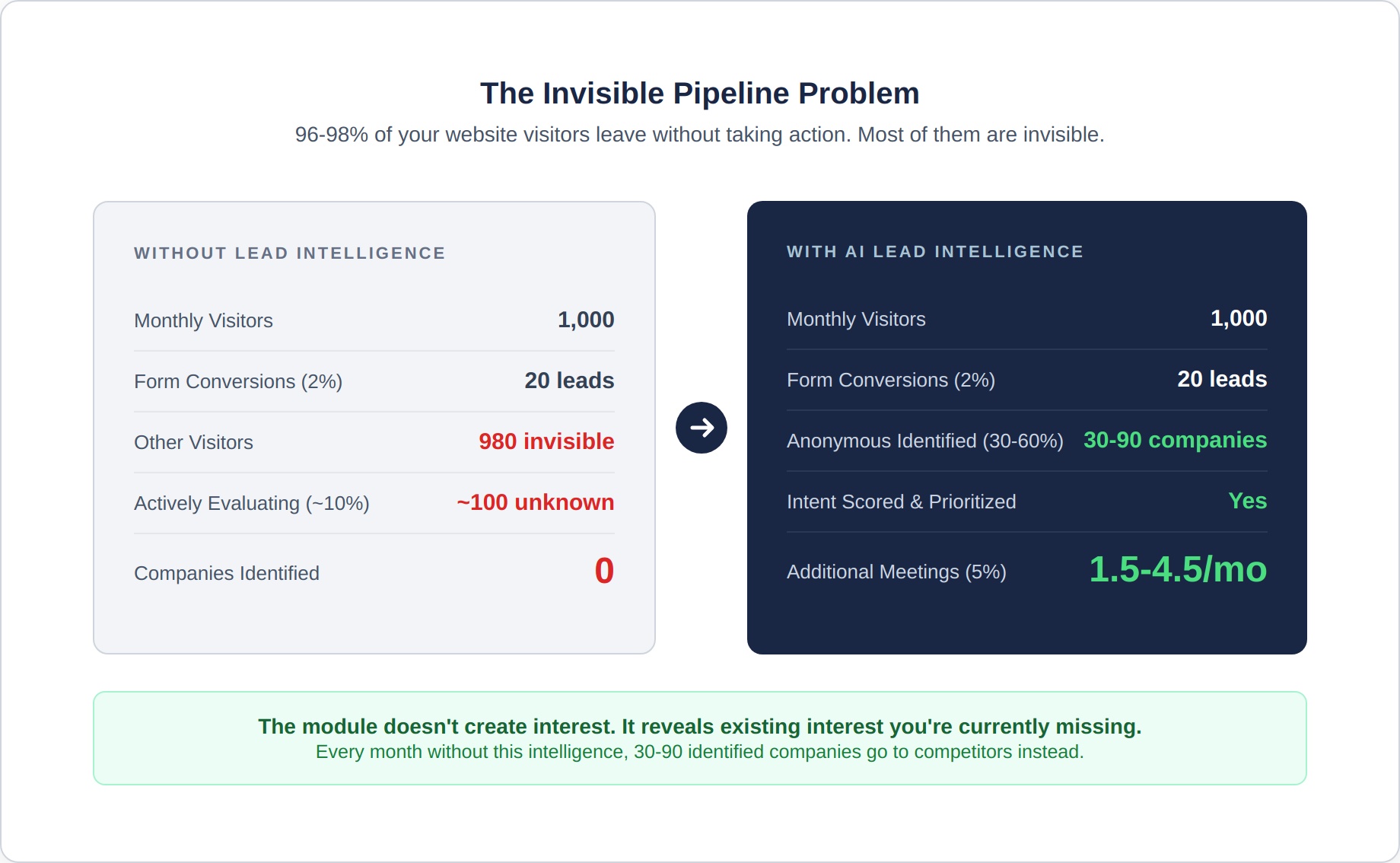
Industry data shows that 96-98% of website visitors leave without taking action. With 1,000 visitors per month, that means 960-980 people visited, browsed, and left. You don’t know who they were or what they wanted.
Some visitors just browse. But some are actively evaluating your services. They read your pricing, viewed three case studies, and compared your service pages to a competitor. They spent 8 minutes on your site, then left to think it over, got busy, and never came back.
Without AI Lead Intelligence, interested and reachable prospects remain invisible.
With AI Lead Intelligence, you see the company name, the pages they viewed, how long they spent, what they were most interested in, and whether their behaviour matches the patterns of prospects who eventually buy. Your sales team can reach out the next day with a message that references what the prospect was researching.
Prospects may wonder how you anticipated their interest. AI Lead Intelligence provides that capability.
What You Get
Anonymous Visitor Identification
The core capability that makes everything else possible:
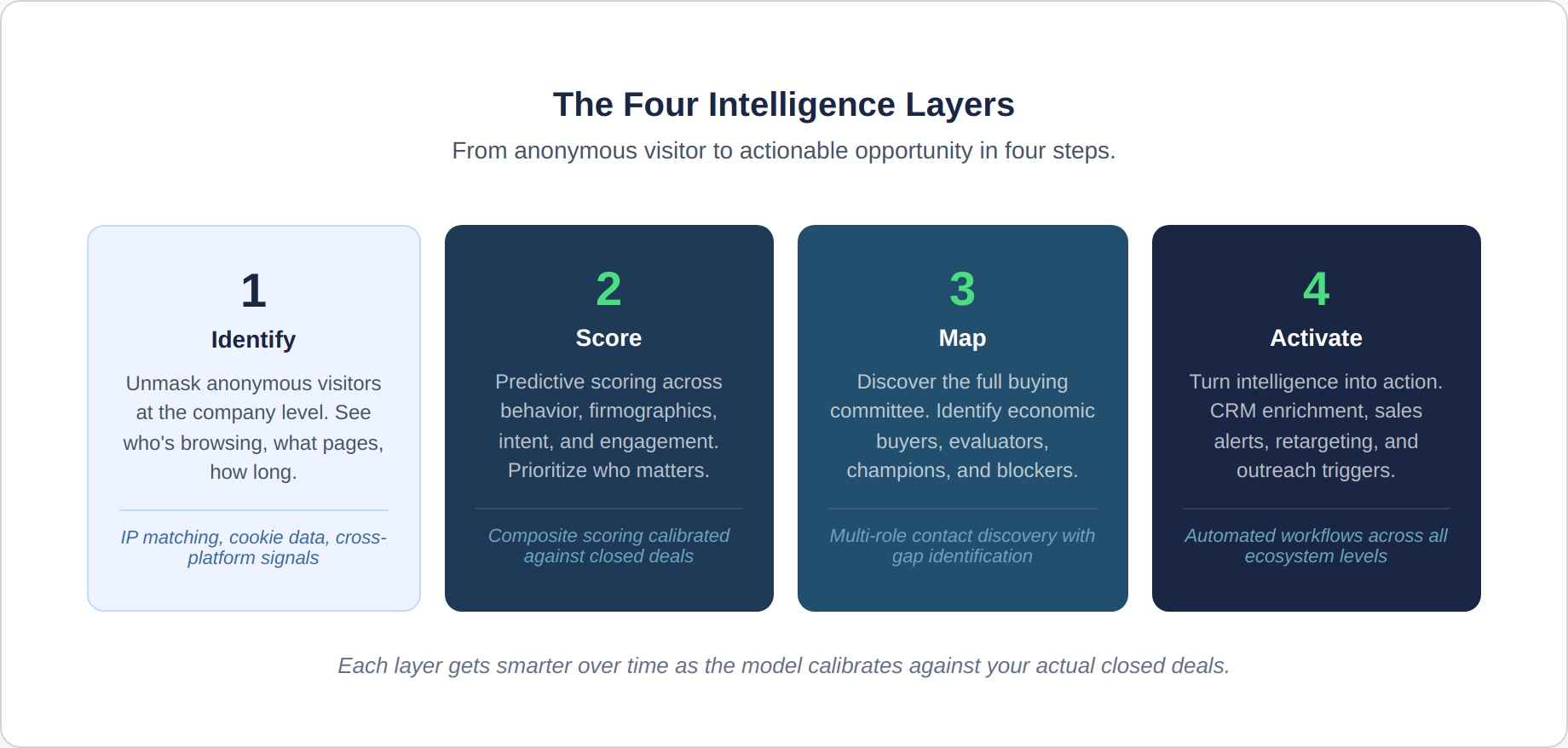
- Company-level identification reveals which organizations are visiting your website, even when individual visitors don’t fill out a form. Identification is based on IP matching, cookie data, and cross-platform signals.
- Page-level tracking shows which pages each company viewed, in what order, and for how long. A company that only views your homepage tells you little. A company that is actively evaluating your pricing page, three service pages, and two case studies.
- Visit frequency tracking identifies companies that return multiple times over days or weeks, indicating sustained interest and active evaluation.
- Individual identification, when possible, connecting anonymous visits to known contacts when the visitor has previously engaged with your ecosystem through Level 2 forms, Level 3 email clicks, or Level 1 social engagement.
- Real-time alerts notifying your team when a high-value target account visits your site so outreach can happen while interest is fresh, not days later.
What visitor identification does not do: It does not identify every individual person by name from an anonymous visit. It identifies the company and, in some cases, the department or role. Individual identification occurs when a visitor has previously interacted with your ecosystem, or when cross-platform signals provide sufficient data to match. We’re transparent about what’s possible and what’s not.
Intent Data Tracking
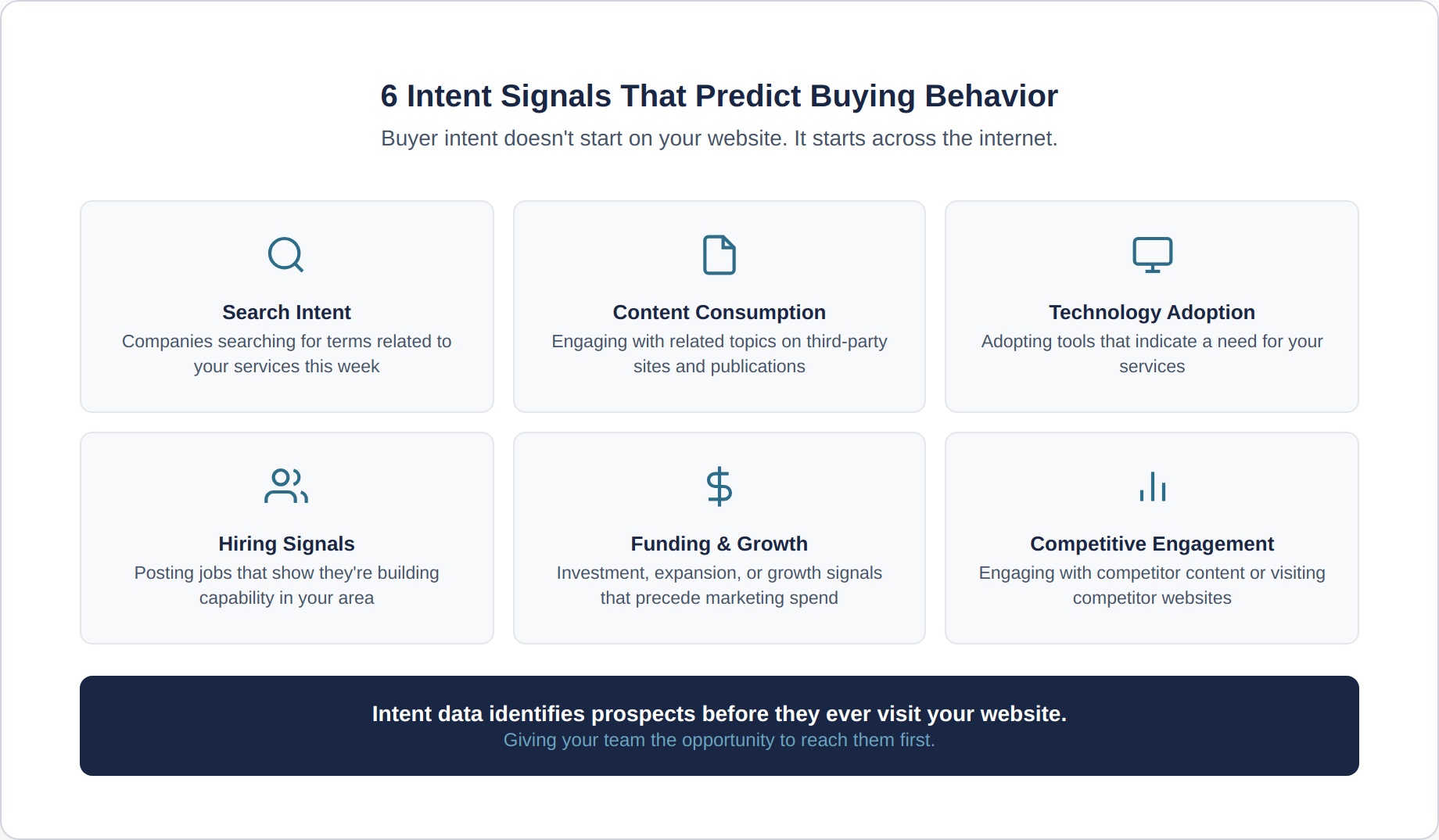
Buyer intent doesn’t start on your website. It starts across the internet. AI Lead Intelligence tracks these signals:
- Search intent signals monitoring when companies in your target market begin searching for terms related to your services. A company that starts searching for “B2B lead generation agency” this week shows buying intent, regardless of whether they’ve visited your site yet.
- Content consumption signals track when target accounts engage with related topics across third-party sites, industry publications, and review platforms.
- Technology adoption signals detect when companies adopt or drop technologies that indicate a need for your services. A company that just implemented a new CRM may need marketing support to fill the pipeline it’s designed to manage.
- Hiring signals monitor job postings that show a company is building capability in your area. If they are hiring a VP of Marketing, they may be preparing to invest in the marketing infrastructure you provide.
- Funding and growth signals track when companies get investment, announce expansion, or show signs of growth. These events typically come before marketing investment.
- Competitive engagement signals detecting when prospects are engaging with competitor content, visiting competitor websites, or showing comparison-shopping behaviour.
What intent data tells you that website analytics alone cannot: A company may never visit your website, but show strong buying intent through search behaviour and content consumption. Intent data identifies these prospects before they ever find you, giving NeuroReach AI (Module 1) or your sales team the opportunity to reach them first.
Predictive Lead Scoring
Not all signals are equal. Predictive scoring turns raw data into prioritized action.
- Behavioural scoring assigns point values to specific actions: pricing page views score higher than blog post views. Multiple visits score higher than single visits. Case study views score higher than general browsing.
- Firmographic scoring means rating prospects based on company details that match your Ideal Customer Profile (ICP), such as operating in your target industry, at the right size, located where you sell, or using technologies that suit your services.
- Intent scoring is rating prospects based on the strength and timing of their buying signals. For example, when a company is actively searching for your service, they score higher than if they occasionally read related articles.
- Engagement scoring weights prospects based on their interactions with your ecosystem. Email opens, social engagement, content downloads, and video views all count.
- Composite scoring combines all four dimensions into a single prioritization score that indicates which prospects deserve attention first.
- Score decay automatically reduces scores for prospects who go quiet over time, so your team’s focus stays on active opportunities rather than stale data.
- Threshold alerts trigger notifications when a prospect crosses a defined score threshold, indicating they’ve moved from passive awareness to active evaluation.
Predictive scoring improves over time. The model calibrates against your actual closed deals. As more data accumulates, it becomes more accurate. Month 1 scoring is hypothesis-based. By month 6, the model reflects your market’s buying patterns.
Buying Committee Mapping
B2B purchase decisions rarely involve a single person. AI Lead Intelligence maps the full group:
- Contact discovery finds multiple stakeholders at target accounts in various roles and departments.
- Role classification categorizes contacts as economic buyers (budget authority), technical evaluators (capability assessment), end users (day-to-day implementation), champions (internal advocates), and blockers (likely objectors).
- Engagement tracking per contact shows which members of the buying committee have engaged with your content, visited your website, or interacted with your outreach.
- Gap identification reveals which buying committee roles have not been reached. This informs NeuroReach AI (Module 1) to target Level 6 account-based advertising. Relationship mapping showing connections within the same company and to people in your existing network who could provide warm introductions.
Why this matters: A prospect who loves your approach but can’t get budget approval because the CFO has never heard of you will stall. Committee mapping ensures every influence point in the decision is reached, not just the person who happened to find your website first.
Competitor Intelligence Monitoring
Knowing what your competitors are doing gives you a strategic advantage:
- Competitor website monitoring tracks changes to competitor positioning, pricing, services, and messaging so you can differentiate proactively.
- Competitor content monitoring identifies what competitors are publishing, which topics they’re targeting, and where gaps exist that your content can fill.
- Market share signals tracking when prospects engage with competitors alongside your content, indicating active comparison shopping.
- Win/loss intelligence that correlates competitor engagement signals with deal outcomes to understand which competitive factors influence buying decisions.
- Competitive alert triggers notify you when a high-priority prospect shows significant engagement with a specific competitor, enabling faster response.
Website Visitor Activation
Identification without action is just surveillance. This module includes activation workflows that turn intelligence into engagement:
- Automated CRM enrichment adds identified companies and contacts to your CRM with full firmographic data, engagement history, and scoring without manual data entry.
- Sales team alerts triggering notifications when high-score visitors are identified, with full context on pages viewed and engagement patterns.
- NeuroReach AI integration (if Module 1 is active) automatically adds high-intent identified visitors to targeted outreach sequences with messaging tailored to what they were researching.
- Level 6 retargeting integration (if Level 6 is active), adding identified companies to account-targeted advertising campaigns.
- Level 2 automation triggers activating specific landing pages or email sequences when identified visitors match certain behavioural patterns.
- Weekly intelligence brief delivered to your team summarizing which target accounts showed activity, what they were researching, and recommended next steps.
What the Sales Team Actually Experiences
Here’s how AI Lead Intelligence changes your team’s daily workflow:
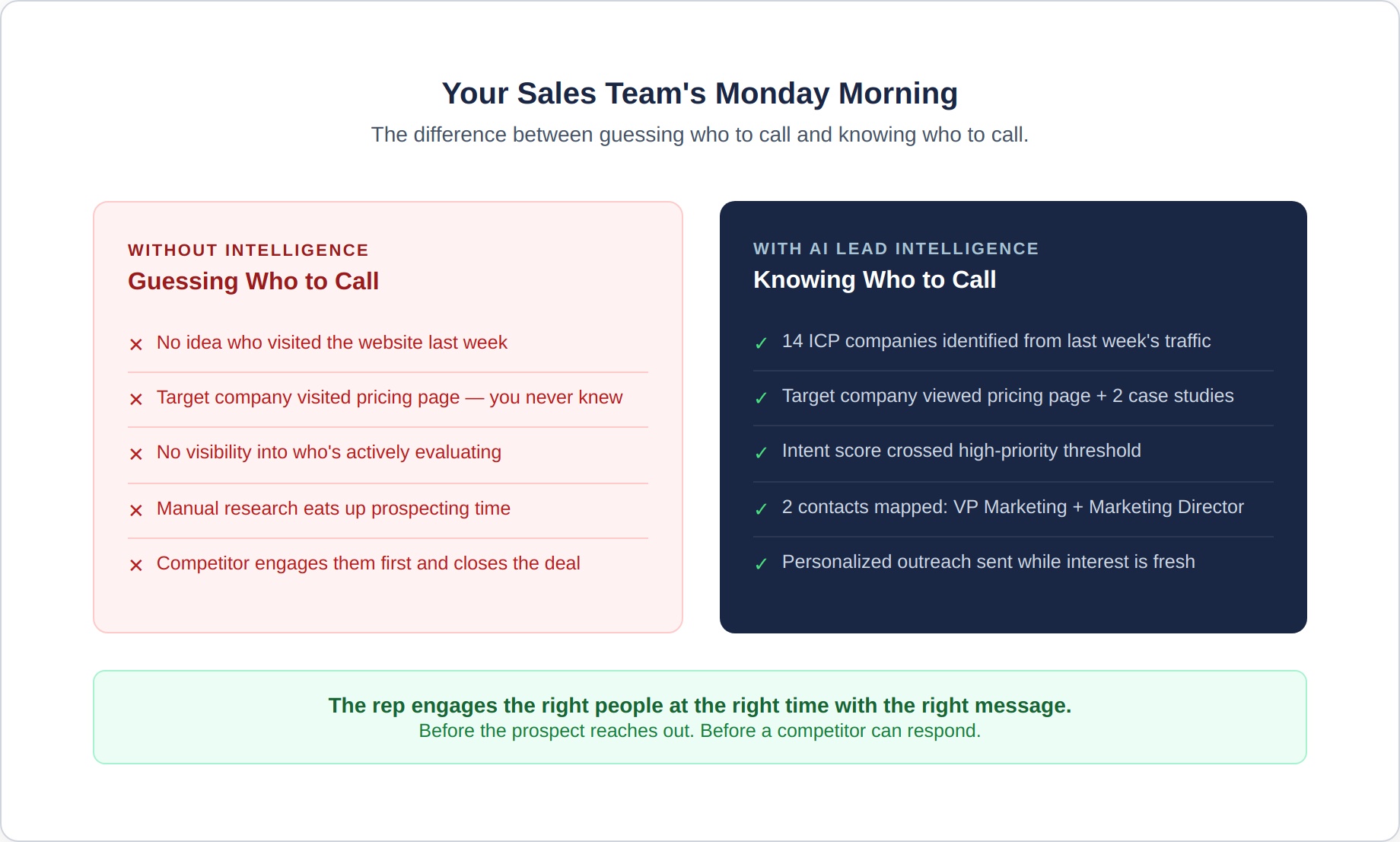
Monday, 8:15 AM: Your sales rep opens the weekly intelligence brief. It shows that 14 companies matching your ICP visited your website last week. Three of them viewed the pricing page and spent more than 5 minutes on the site. One of them is a company the rep has been trying to reach for months.
Monday, 8:30 AM: The rep opens the CRM and sees that the target company visited the pricing page on Wednesday, returned on Friday to read two case studies, and their intent score crossed the high-priority threshold over the weekend. The CRM shows two contacts at the company: a VP of Marketing and a Marketing Director. The VP hasn’t interacted with any content. The Director clicked a Level 3 newsletter link two weeks ago.
Monday, 8:45 AM: The rep sends a personalized email to the Marketing Director referencing the case study they most recently viewed: “I noticed you might be evaluating lead generation approaches. We recently helped a company in your space improve its conversion rate from 2% to 8%. Would it be helpful to walk through what that looked like?”
Monday, 9:00 AM: If NeuroReach AI (Module 1) is active, an outreach sequence is triggered for the VP of Marketing with messaging on the strategic impact of lead-generation systems on revenue predictability. Both contacts at the same company are now being engaged simultaneously through different channels with role-appropriate messaging.
Monday, 3:00 PM: A real-time alert fires. A new company just viewed the pricing page and downloaded a Level 3 lead magnet. Their intent score spiked. The rep sees the notification and follows up within 30 minutes while interest is at its peak.
Without AI Lead Intelligence: The rep has no idea that any of this happened. The target company visits the site, leaves, and eventually hires a competitor. The lead magnet download gets processed through normal automation without urgency.
With AI Lead Intelligence, the rep engages the right people at the right time with the right message, before the prospect reaches out and before a competitor can respond.
How AI Lead Intelligence Connects to the Ecosystem
This module doesn’t operate in isolation. It feeds and is fed by every active level:
Feeds NeuroReach AI (Module 1): High-intent visitors are prioritized outreach targets, with messaging tailored to what they were researching.
Feeds Level 6 (Paid Advertising): Identified companies become account-targeted ad audiences. Prospects actively researching your services see retargeting ads that reinforce what they’ve been browsing.
Feeds Level 2 (Landing Pages): Behavioural data reveals which visitor types convert and which don’t, informing landing page optimization and offer development.
Feeds Level 3 (Email Marketing): Identified contacts who subscribe to newsletters are enriched with firmographic and intent data, improving segmentation and personalization.
Fed by Level 0 (Website): The module tracks visitor behaviour on your website. A better website with more pages, more content, and clearer conversion paths produces richer visitor data.
Fed by Level 4 (Content): More articles targeting more keywords bring more qualified visitors to the site, giving the module more data to work with and more intent signals to track.
Fed by Level 1 (Social Media): Social engagement data adds context to visitor profiles. A company whose employees engage with Level 1 content AND visit the website shows stronger intent than either signal alone.
What Determines Where You Fall in the Price Range
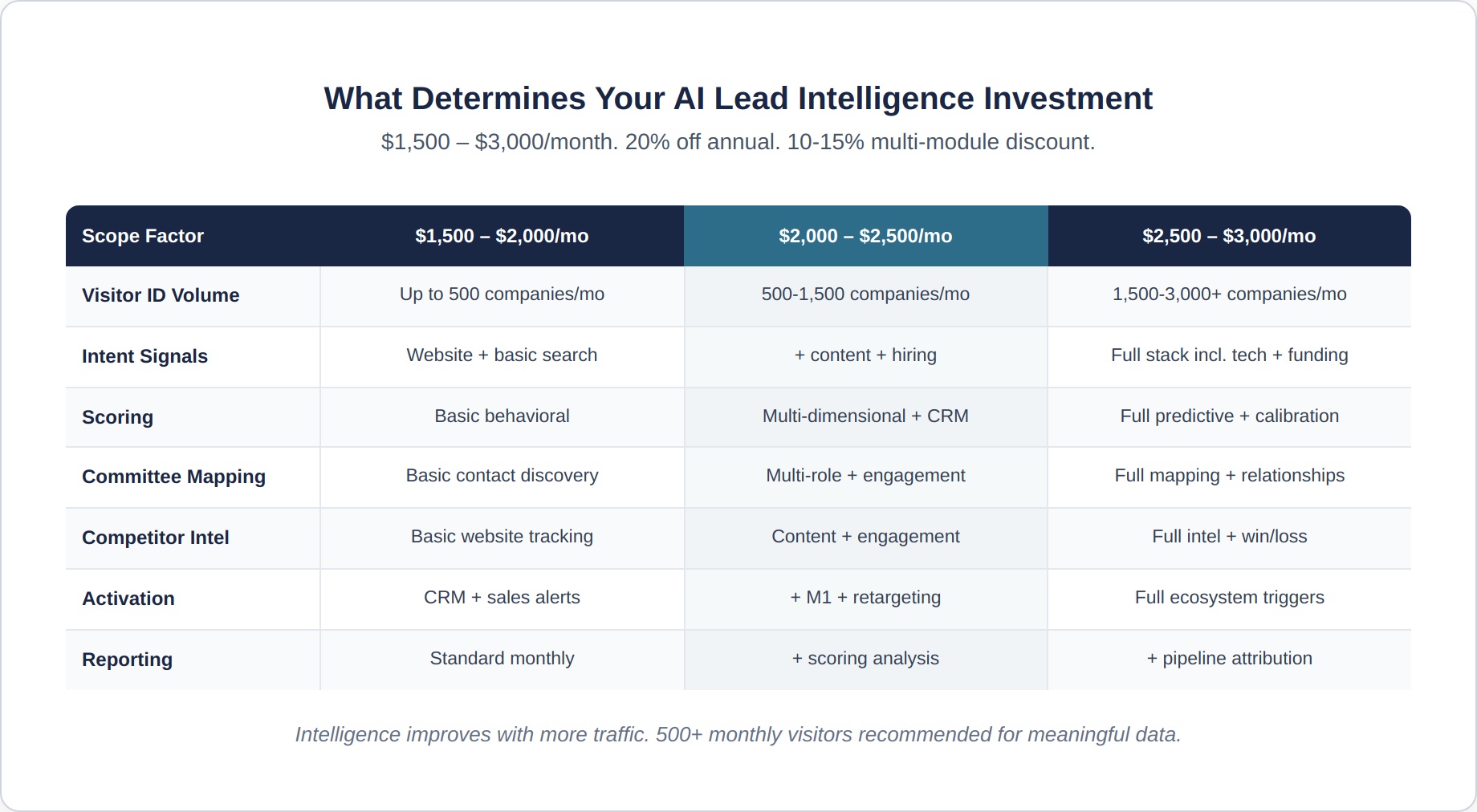
How Long Before You See Results
Week 1: Anonymous visitor identification is configured and begins producing data. You immediately see which companies are visiting your website. The first intelligence is available within days.
Week 2-4: Intent signal tracking is connected and begins accumulating data. Search intent, content consumption, and hiring signals are flowing. Initial visitor profiles begin to build context beyond page views alone.
Month 1: Predictive scoring is configured with an initial hypothesis-based model. First high-score alerts fire. Sales team begins engaging with intelligence-informed outreach. Buying committee mapping is starting to populate for target accounts.
Month 2: Pattern recognition improves. The scoring model begins showing which signal combinations actually predict sales conversations. Competitor monitoring reveals active comparison-shopping patterns. Weekly intelligence briefs become a core part of the sales team’s workflow.
Month 3: The system stabilizes at a predictable level of intelligence production. Scoring accuracy improves as the model is calibrated against actual sales outcomes. Activation workflows are refined based on which triggers produce the best results. The sales team has developed a rhythm of intelligence-driven outreach.
Months 4-6: Compounding intelligence. The longer the module runs, the more data it accumulates and the more accurate its predictions become. Scoring models reach high accuracy. Committee maps are comprehensive for priority accounts. The team consistently engages prospects earlier in their buying process than competitors.
Month 6+: AI Lead Intelligence is a structural advantage. Your sales team knows about opportunities before competitors do. Pipeline includes prospects who never filled out a form but were identified and engaged through intelligence. The module produces a steady stream of qualified opportunities that wouldn’t exist without it.
Why This Investment Makes Sense
Consider what’s already happening on your website that you’re missing.
If your site receives 1,000 visitors per month and 2% convert through forms, you’re seeing 20 leads. The other 980 visitors are invisible. Some were unqualified. But industry benchmarks suggest 10-15% of B2B website visitors are actively evaluating solutions. That means 100-150 qualified visitors per month that you never knew about.
AI Lead Intelligence identifies 30-60% of those anonymous visitors at the company level. That’s 30-90 additional companies your sales team can engage with each month proactively. If even 5% of those identified companies convert to meetings through intelligence-informed outreach, that’s 1.5-4.5 additional meetings per month from visitors who would have otherwise disappeared.
At your average deal size, those meetings represent a pipeline that has always been there but has remained invisible. The module doesn’t create interest. It reveals an existing interest and gives you the opportunity to act on it before a competitor does.
The math also works in reverse: every month you don’t have this intelligence, you’re losing 30-90 identified companies that a competitor with similar tools might be engaging first.
What This Module Solves
AI Lead Intelligence solves the invisible pipeline problem. Most B2B companies have far more interested prospects than they know about because the vast majority of website visitors never identify themselves. This module reveals who they are, how interested they are, and when to engage them, turning anonymous traffic into actionable intelligence that your sales team can convert.
What This Module Does NOT Include
- Outbound outreach to identified prospects (Module 1: NeuroReach AI)
- AI chatbots or interactive tools on your website (Module 3: AI Conversion Tools)
- Sales call preparation or CRM automation (Module 4: AI Sales Acceleration)
- Content optimization or repurposing (Module 5: AI Content Engine)
- Email nurture optimization (Module 6: AI Nurture and Retention)
- Landing page creation (Level 2)
- Paid advertising management (Level 6)
AI Lead Intelligence identifies and scores. Other modules and levels engage, convert, and nurture.
What You Need to Provide
- Onboarding conversation (45-60 minutes): We align on your ICP, target accounts, sales team workflow, CRM setup, and which ecosystem levels are active
- Website tracking access: We install identification and tracking scripts on your Level 0 website
- CRM access: Integration to enrich and create records automatically
- Target account list (if applicable): Priority companies you want monitored and alerted on
- Sales team briefing (30 minutes): How to read intelligence reports, respond to alerts, and use scoring data
- Monthly report review (20-30 minutes): Review intelligence data and align on adjustments
- Sales feedback (ongoing): Which identified companies converted and which didn’t, so the scoring model improves.
Total monthly time commitment: approximately 2-3 hours
Who Manages This
Rod Agatep personally oversees the intelligence strategy, scoring model design, and activation workflow configuration for every AI Lead Intelligence engagement. With 27 years of experience in B2B marketing, Rod ensures the intelligence produced is strategically actionable rather than just another dashboard of data nobody uses.
Every configuration is designed under Rod’s direct supervision to integrate with your specific ecosystem levels and sales process. The scoring models, alert thresholds, and activation triggers are built around how your team actually works, not around platform defaults.
AI Lead Intelligence Readiness Assessment
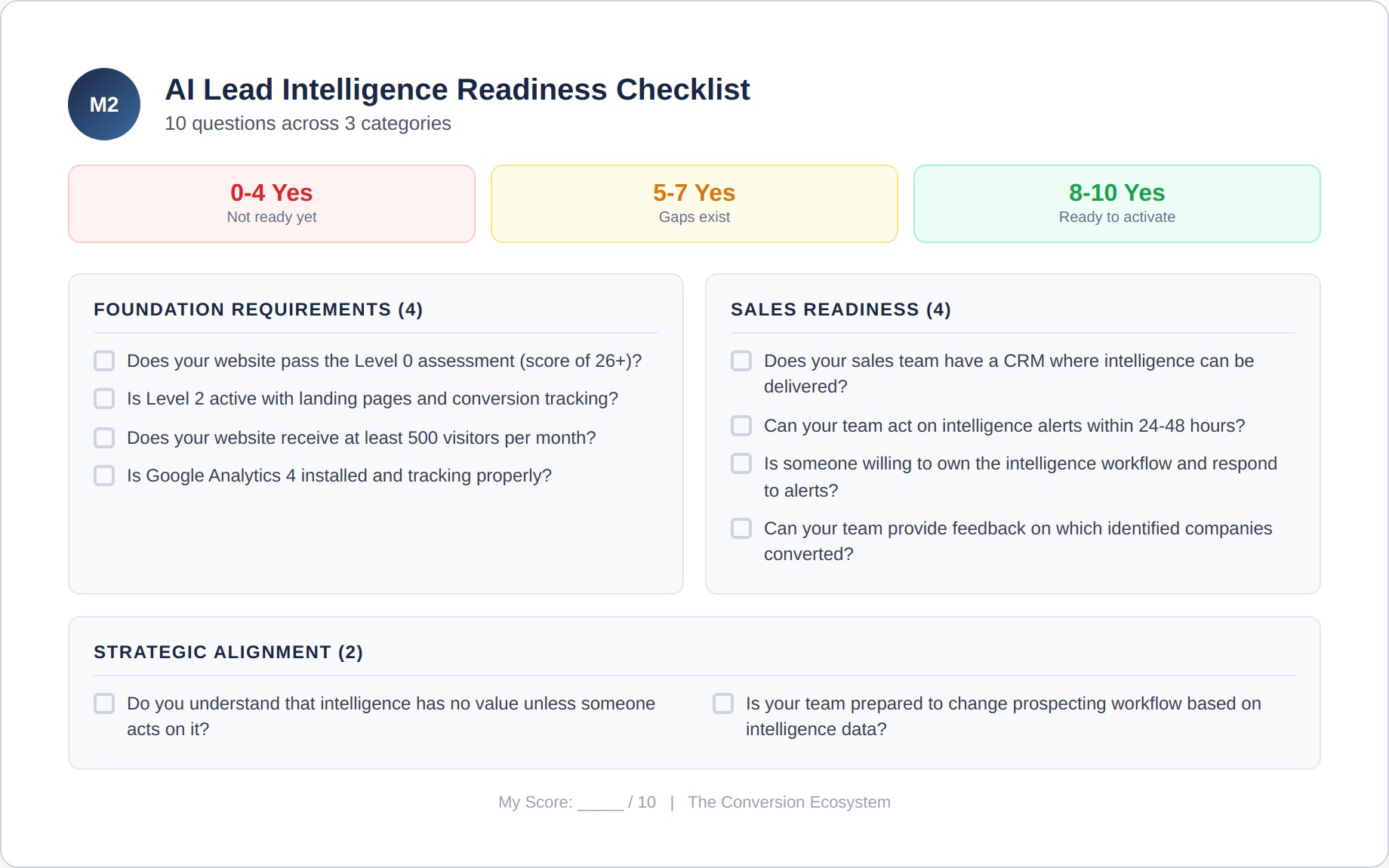
Scoring
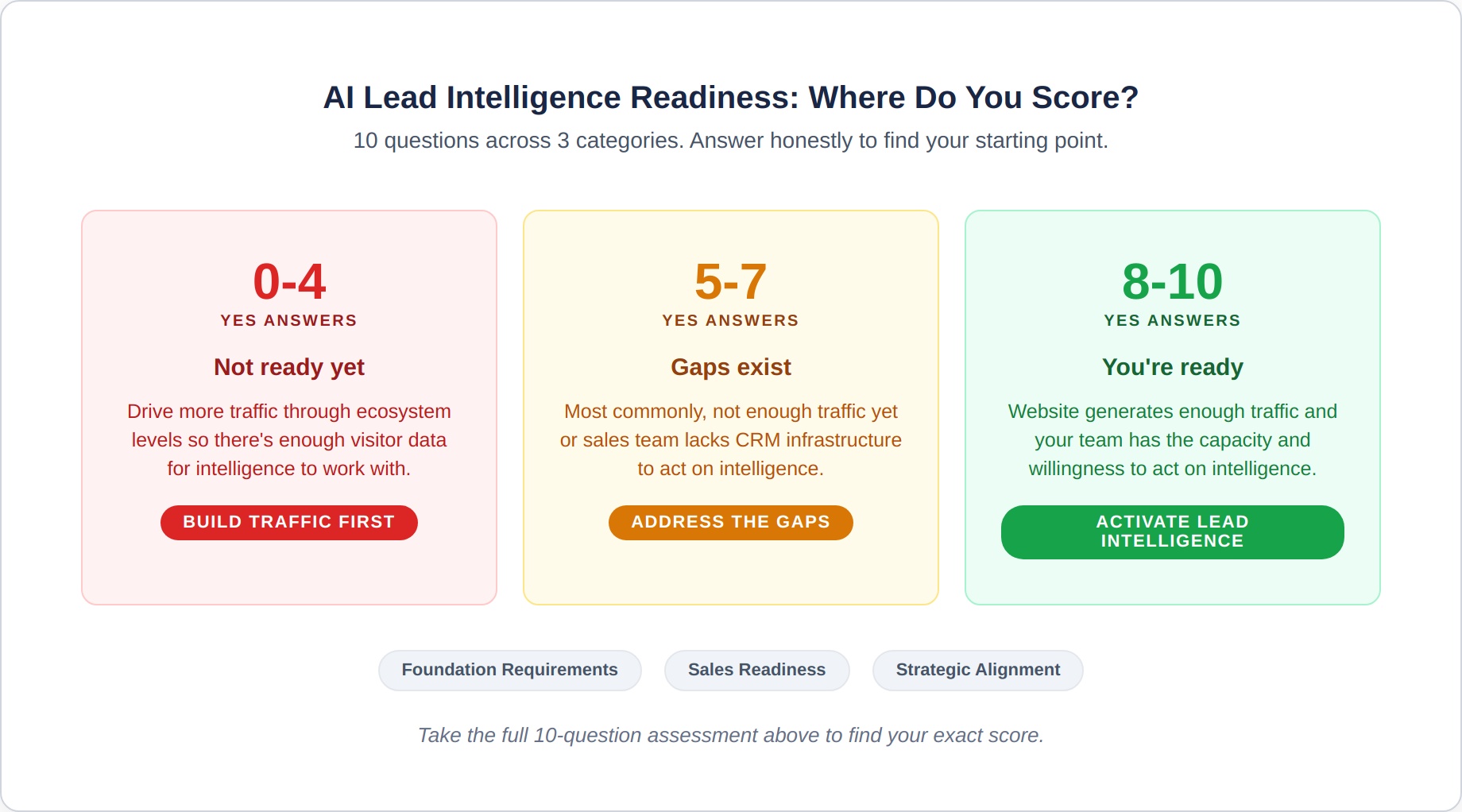
8-10 YES answers: You’re ready. Your website generates enough traffic, and your team has the capacity and willingness to act on intelligence.
5-7 YES answers: Gaps exist. Most commonly, the website doesn’t receive enough traffic yet (build Levels 1 and 4 further), or the sales team lacks CRM infrastructure.
4 or fewer YES answers: AI Lead Intelligence won’t produce meaningful value yet. Focus on driving more traffic through ecosystem levels so there’s enough visitor data for intelligence to work with.
Pricing Summary
| Option | Investment |
|---|---|
| AI Lead Intelligence monthly | $1,500 – $3,000/month |
| Annual commitment | 20% off monthly rate |
| Combined with other AI Growth Modules | 10-15% multi-module discount |
What’s included: Anonymous visitor identification, multi-source intent data tracking, predictive lead scoring with continuous calibration, buying committee mapping, competitor intelligence monitoring, website visitor activation workflows, CRM enrichment and integration, real-time alerts, weekly intelligence briefs, monthly performance reporting, and quarterly strategy reviews.
What’s not included: Outbound outreach (Module 1), website chatbots or interactive tools (Module 3), sales call preparation (Module 4), content production (ecosystem levels), landing pages (Level 2), or paid advertising (Level 6).
Next Step
If you’re not sure whether AI Lead Intelligence is the right module, whether your website traffic supports meaningful intelligence, or whether your sales team is ready to act on the data, the fastest way to find out is a conversation.
We’ll review your current traffic, assess your CRM infrastructure, evaluate your sales team’s workflow, and tell you honestly whether this module will produce actionable intelligence now or whether other ecosystem work should come first.
No pitch. No pressure. Just clarity on where you stand and what to do next.
Frequently Asked Questions
How is this different from Google Analytics?
Google Analytics tells you how many people visited your website and what pages they viewed. It does not tell you which companies those visitors represent, what their intent level is, whether they’re actively evaluating solutions, who the decision-makers are at those companies, or what signals they’re showing across other platforms. AI Lead Intelligence turns anonymous traffic data into identified companies with enriched profiles, intent scores, and buying committee maps.
Is anonymous visitor identification legal?
Yes. Company-level identification uses business IP matching and publicly available data to identify organizations, not individuals. This is comparable to seeing a company name on caller ID. Individual identification occurs only when the visitor has previously interacted with your ecosystem (e.g., filled out a form, clicked an email, etc.) and has consented to tracking through those interactions. All identification practices comply with GDPR, CCPA, and applicable privacy regulations.
What if my website doesn’t get much traffic yet?
AI Lead Intelligence performs well at any traffic level but delivers greater value with more visitors. At 500+ visitors per month, the module generates meaningful weekly intelligence. Below 500 visitors, the data accumulates more slowly, but it can still identify high-value target accounts worth engaging. If traffic is very low, we recommend building Levels 1 and 4 further before activating this module.
How does this work with NeuroReach AI (Module 1)?
They’re designed to work together. AI Lead Intelligence identifies who’s interested and scores their intent. NeuroReach AI reaches out to them with messaging tailored to their research. Together, they create a system that identifies prospects before they raise their hand and engages them with relevant outreach while their interest is fresh. Activating both qualifies for a multi-module pricing discount.
Does this replace my CRM?
No. AI Lead Intelligence feeds your CRM with enriched data, not replaces it. It automatically creates and updates CRM records with company information, engagement data, intent scores, and buying committee contacts. Your CRM remains the system of record. The module makes it dramatically more informed.
How accurate is the visitor identification?
Company-level identification typically matches 30-60% of business visitors, depending on your traffic profile. Consumer traffic, VPN usage, and mobile visits reduce identification rates. Accuracy is highest for prospects visiting from office networks during business hours. We’re transparent about match rates and report them monthly, so you know exactly what the module is producing.
What are the cancellation terms?
Month-to-month with 30 days’ notice. Annual at 20% off with a 12-month term. The early termination fee equals the discount on the completed months. You retain all CRM data, scoring models, and intelligence produced during the engagement. Tracking scripts can be removed or maintained at your discretion.
Do I own the data?
Yes. Every identified company, every contact, every intent score, every buying committee map, and every intelligence report belongs to you. CRM records created by the module remain in your CRM permanently. There are no data expiration or holdback clauses.