

My Exact Digital Marketing System: The Omnipresent Conversion Ecosystem (Step by Step)
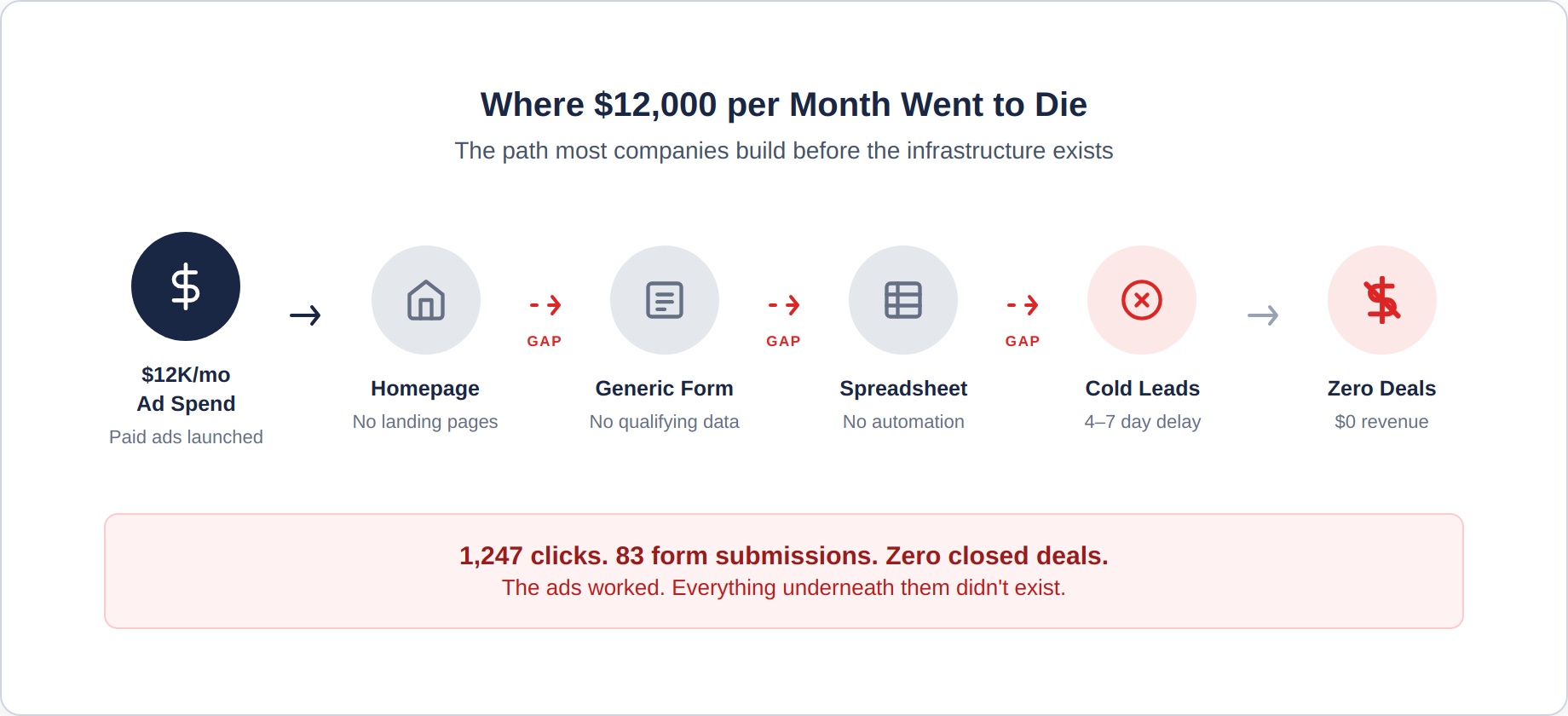
Your founder, after seeing your competitor’s LinkedIn ads for the third week in a row, urgently approved a twelve-thousand-dollar monthly ad budget. The sharp-looking, well-targeted ads were driving visibility—and your founder wanted results immediately.
Six weeks later, the ad spend had produced 1,247 clicks, 83 form submissions, and zero closed deals. Not a low close rate. Zero.
Your marketing lead reviewed the data and identified the problem. The ads sent traffic to the homepage instead of a dedicated landing page because no landing pages existed. Of the 83 form submissions, 61 came through a generic ‘Contact Us’ form that collected no qualifying information. These submissions entered no email sequence because no automation was set up. They sat in a spreadsheet for four to seven days before a sales rep reviewed them. By then, most leads had gone cold.
The diagnosis: “We spent twelve thousand dollars driving traffic into a system that has no infrastructure to convert it. The ads worked. Everything underneath them didn’t exist.”
The company jumped to Level 6 of digital marketing and paid advertising, skipping Levels 0 through 5. There were no conversion-focused landing pages, email sequences, lead magnets, a content library, an SEO presence, or a trust-building video. The result was predictable: money was spent, activity was generated, but revenue stayed the same.
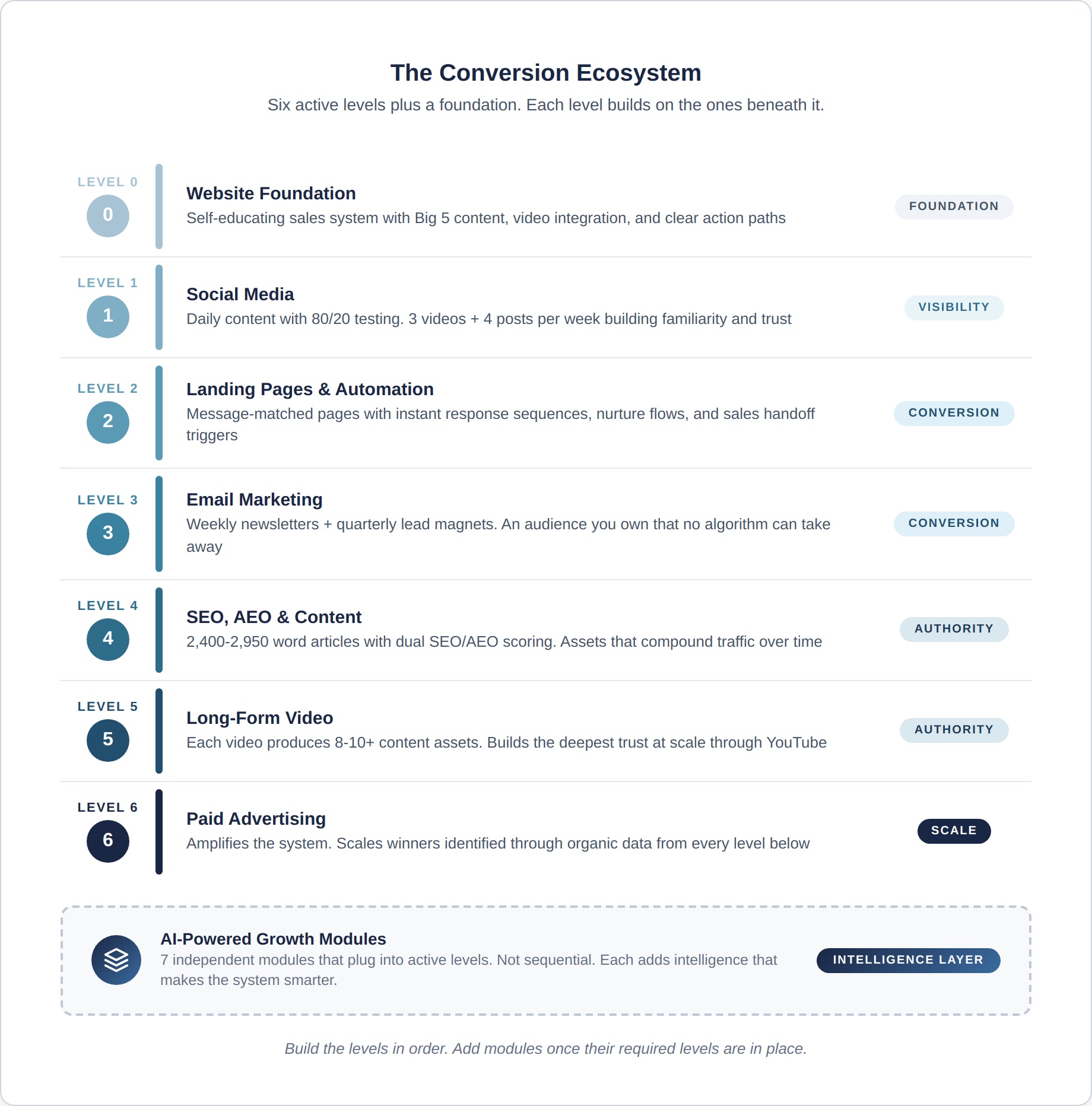
Digital marketing has seven levels, a foundation plus six active levels, and each level builds on the ones beneath it. Level 0 is your website. Level 1 is social media. Level 2 is landing pages and automation. Level 3 is email marketing. Level 4 is SEO, AEO, and content. Level 5 is long-form video. Level 6 is paid advertising. Beyond the levels, AI-Powered Growth Modules plug into specific levels to add intelligence and automation. But if you skip a level, and everything above it underperforms. An effective digital marketing system must be built in a specific order.
Let me explain the progression. I’ll outline what each level does, why order matters, what breaks when steps are skipped, and how AI modules help once the foundation is in place. Read on.
Level 0: Why Your Website Is the Foundation Everything Sits On
Every level of digital marketing drives people to one place: your website. Social media posts link to it. Ads point to it. Emails reference it. SEO rankings lead to it. Content lives there. Your website must be credible, clear, and ready to convert. It should show who you are, what problem you solve, and what the visitor should do next.
The most common Level 0 failure is designing a website to act as a digital brochure. An inexperienced digital marketer focuses on building the homepage to describe the company’s history, creating service pages to list capabilities, and creating a navigation system that follows the company’s structure. There’s no clear step from ‘I’m interested’ to ‘I want to talk.’
A website built for conversion does several things:
- It clearly outlines the company’s positioning. That is who it’s for, what problem it solves, and why it’s different.
- It answers five buyer questions: cost and pricing, problems and risks, comparisons, best options, and reviews.
- The About page reduces risk by explaining why you exist, who you serve best, and what sets you apart.
- It integrates different information modalities, including video, so buyers can read, listen to, or watch the information that is important to them.
- It gives a clear next step, like contact forms, booking pages, and quote requests, so every visitor has a next step for their readiness.
The website isn’t a brochure. It’s a self-educating sales system. If someone can land on your site, read your content, understand your pricing, see proof, and feel confident, then your sales calls become shorter, easier, and higher-converting. That’s what Level 0 builds.
Many businesses make the mistake of seeing the website as a one-time project. They launch it and move on. Over time, the site becomes outdated, misaligned with current messages, and disconnected from future marketing activities.
Level 1: How Social Media Creates Your First Layer of Visibility
Once the website is credible, Level 1 creates visibility and drives people to it. Social media is where your audience already spends time. There, they find new ideas, assess expertise, and form opinions about who understands their problem.
Here comes the good part. Social media is not about going viral or building a huge following. Instead, it’s about a daily presence that draws buyers’ attention. For B2B companies, that’s LinkedIn during working hours and Instagram during off-hours. The goal is to create content that showcases your authority, offers perspectives, and builds familiarity. That familiarity is needed so buyers recognize your company.
Level 1 means daily content: 3 videos per week and 4 image or text posts. Every video is scripted and professionally edited with captions, branded elements, and platform-optimized formatting. The content mix includes thought leadership, educational insights, proof and results, and engagement-driven posts that start conversations.
The key at Level 1 is the 80/20 testing framework. In Month 1, test everything: topics, formats, angles. In Month 2, look for signals and find out what works. In Month 3, focus on the 20% producing 80% of the results. This cycle never stops. Daily postings speed up learning because 28-30 data points a month reveal patterns in 60-90 days. Companies posting just 3 times a week need 4-6 months to get the same data.
In my experience, the Level 1 mistake that costs companies the most isn’t being absent from social media. It’s treating social media as a broadcast medium rather than a trust-building mechanism. What companies do is they post company announcements, share press releases, and promote services. None of this builds familiarity or authority. Effective Level 1 execution looks like a knowledgeable person sharing insights about problems the audience cares about, consistently, in their own voice, every single day.
Level 2: Where Landing Pages and Automation Build Your Sales Infrastructure
Here, digital marketing shifts from visibility to conversion. Landing pages serve one goal: convert interested visitors into leads. Unlike homepages, which serve many audiences, landing pages focus on one offer, one audience, and one action.
But landing pages alone don’t deliver results. What makes Level 2 transformative is the automation that follows. When someone fills out a landing page form, an automated sequence starts. A welcome email comes within 60 seconds. Then, follow-up messages provide value and maintain engagement until the lead is ready for sales. This automation handles follow-up that would otherwise depend on a sales rep checking a spreadsheet.
Every landing page is built around message match: the page must continue the exact conversation the traffic source started. When an ad says one thing and the landing page says another, the buyer bounces. When the messaging aligns, conversion rates climb.
The automation goes beyond a simple welcome email. Level 2 includes welcome and delivery sequences, nurture sequences for leads who aren’t ready yet, re-engagement sequences for leads who go quiet, and sales handoff triggers that notify your team the moment a lead takes a high-intent action. Research shows that responding to a lead within 5 minutes makes you 21 times more likely to qualify them than responding after 30 minutes. Level 2 automation handles immediate responses while ensuring human follow-up occurs at the right moment.
Without question, Level 2 is where most companies’ marketing stops being a collection of activities and starts becoming a system. The landing page captures intent. The automation nurtures that intent into readiness. Together, they create a marketing infrastructure that works around the clock without depending on individual effort.
The mistake at this level is building landing pages that try to do too much. They include navigation menus that let visitors wander off. They present multiple offers, diluting focus. They ask for too much information too soon. And the follow-up sequences, when they exist at all, are generic rather than specific to the visitor’s expressed interest.
Level 3: How Email Marketing Through Newsletters and Lead Magnets Builds an Audience You Own
Level 3 shifts from capturing existing demand to generating and nurturing new demand. Lead magnets, meaning valuable resources offered in exchange for contact information, build a list of people who have identified themselves as interested in the problem you solve. Newsletters maintain ongoing engagement with that list, keeping the company top of mind during the long evaluation periods that B2B purchases typically involve.
The strategic significance of Level 3 is ownership. Social media visibility depends on platforms where you can only see your followers’ user profiles. If an algorithm changes, Reach declines. It’s also possible that accounts get restricted. Your email list is an audience you own. Nobody can change the algorithm on your email database. The subscribers are yours to engage with directly, on your schedule, with your message.
Level 3 includes weekly newsletters written in your voice, delivering genuine value that subscribers would miss if they unsubscribed. Each newsletter is 400-800 words, long enough to deliver real insight, short enough to read in 3-5 minutes. Quarterly lead magnets are created as substantial resources, not thin PDFs, with enough depth and quality that buyers consider them better than what many consultants charge for.
One of Level 3’s most powerful functions is giving Level 2 leads a second life. When a lead enters Level 2 through a landing page but doesn’t convert to a sales conversation, they don’t disappear. They flow into Level 3’s newsletter audience, where weekly contact keeps the relationship warm until the timing is right. Many of your best future clients are in this pool.
A Level 3 mistake is treating the newsletter as a promotional vehicle. Companies need to stop sending emails with announcements and news.
Until businesses change, subscribers will keep ignoring the emails. It’s great if the list grows, but if open rates decline, the list becomes useless. Effective newsletters provide insights, frameworks, perspectives, and analysis that the reader would miss if they unsubscribe. The selling happens because consistent delivery of value builds trust and authority, making the reader choose this company when they’re ready to buy.
Level 4: Why SEO, AEO, and Blogging Create Assets That Compound Over Time
Level 4 is the long game, and it’s one of the most valuable levels in the entire progression because it creates assets that compound in value over time. Search engine optimization, answer engine optimization for AI-driven search platforms, and consistent content creation produce articles that generate traffic for months and years after publication. Unlike paid advertising, which stops producing the moment you stop spending, Level 4 content continues to work for you.
We create every article for specific standards to ensure it gets picked up. Articles are 1500-3000 words in length. It’s comprehensive, contains keyword-targeted content, and has between 4-7 custom images and diagrams, question-based headings optimized for both search featured snippets and AI answer extraction, AEO quick-answer blocks that AI platforms can cite directly, and FAQ sections that capture long-tail searches. Each article receives dual SEO and AEO audit scores, with each dimension scored independently.
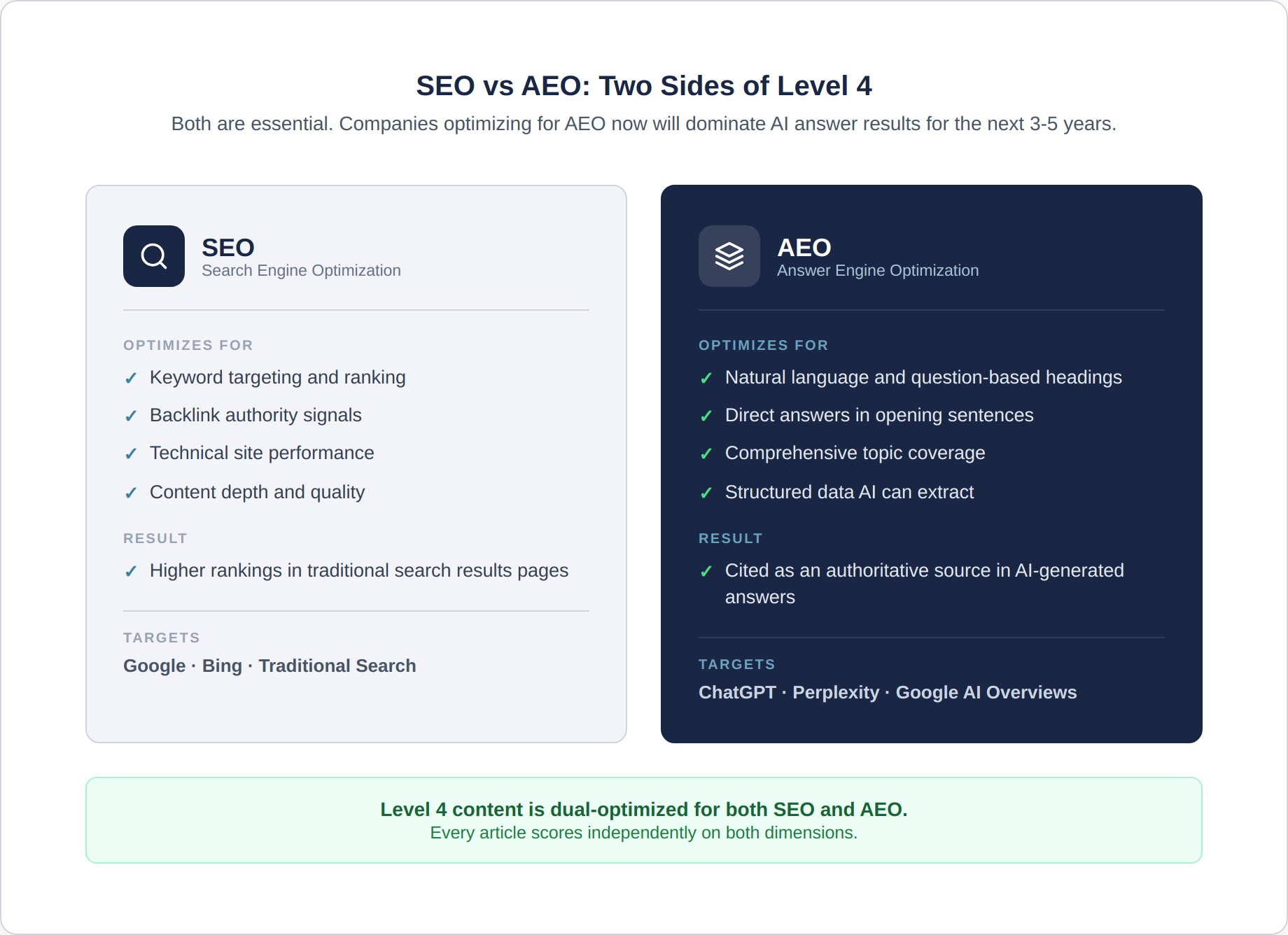
What Is the Difference Between SEO and AEO?
The landscape of search has expanded beyond traditional Google rankings. SEO focuses on ranking in traditional search results through keyword optimization, content quality, backlinks, and technical factors. AEO focuses on structuring content so that AI systems like ChatGPT, Perplexity, and Google’s AI Overviews can extract clear, authoritative answers from it.
AEO means writing in natural language, using question-based headings, providing direct answers in the first few sentences of each section, and covering topics comprehensively enough that AI systems recognize the content as a reliable source. Companies that optimize for AEO now will dominate AI-generated answers for the next 3-5 years. Companies that wait will find those positions already occupied by competitors who moved first.
Level 4 content feeds the entire ecosystem. Each article generates 3-5 social media posts for Level 1, becomes newsletter content for Level 3, identifies video topics for Level 5, includes CTAs to Level 2 landing pages, and informs messaging across every level through performance data showing which topics your audience actually engages with.
The mistake at Level 4 is writing content for search engines rather than for buyers. Companies stuff keywords, produce thin articles that don’t say anything original, and prioritize volume over depth. To win at Level 4, you must treat every article as a trust-building asset that provides experience-based insight.
Level 5: How Long-Form Video Establishes Category Authority
Video builds trust faster because it combines verbal communication, visual demonstrations, body language, and a brand ambassador’s personality in a format that allows a prospect to connect with your company. When a buyer watches you explain a complex topic for 15 minutes, they’re not just absorbing information. They’re assessing your thinking, evaluating how you communicate, and deciding whether you’re someone they’d want to work with. That depth of trust typically requires 3-4 in-person meetings to develop.
Level 5 sits here for a specific reason: it needs the infrastructure from Levels 0 through 4 to be effective. Here is what happens: Video content drives traffic to your website (Level 0). It performs best when distributed through social channels (Level 1). It converts viewers into leads when paired with landing pages (Level 2). It helps with creating email content and creating lead magnets (Level 3). And it generates SEO value through blog posts derived from video topics, providing engagement signals that search engines increasingly value (Level 4).
When scripted correctly, every long-form video produces 10+ content assets: the full YouTube video, 5 short-form clips for Level 1 social platforms, audio for podcast distribution, full transcripts published on the website for SEO, blog post drafts from the transcript for Level 4, quote graphics for social posts, newsletter features for Level 3, and sales enablement assets that reps can share during follow-up.
Not many companies know this, but YouTube is the second-largest search engine in the world. And it’s the only video platform where content compounds over time. A video published in month 1 often generates more views in month 12 than it did in month 1 because of YouTube’s algorithm.
The mistake that businesses make at Level 5 is waiting for perfection. This makes companies delay producing videos because they think they need the perfect setup. From studio, to lights, to scripts. The buyers who matter most don’t care about production quality. They care about whether the person on camera knows what they’re talking about and whether the content addresses their actual concerns. A founder speaking directly into a camera about a problem they’ve solved hundreds of times builds more trust than a professionally produced corporate video with generic messaging.
Level 6: Why Paid Ads Only Work When They Amplify a Complete System
This is where many companies make a huge mistake. All paid ads do is amplify your current situation. It takes whatever system you currently have and puts it in front of a larger audience. When the system is solid, meaning strong landing pages, working automation, proven messaging, and content that builds trust, paid advertising through platforms like Google Ads, LinkedIn Ads, or Meta Ads accelerates growth. When the system is weak, paid advertising accelerates wasted ad spend.
The reason Level 6 sits at the top of the progression is also structural. Paid ads need optimized landing pages (Level 2). They need email automation to nurture leads who aren’t ready to buy (Levels 2 and 3). They need a content library that builds credibility (Level 4). They need a video that builds trust when prospects are evaluating the business (Level 5). They need the brand familiarity that daily social media creates (Level 1). And they need a website that converts curiosity into engagement (Level 0).
Every Level 6 campaign is built on data from the lower levels rather than guesses. Level 1 social engagement data shows which messaging angles resonate. Level 2 landing page data shows which offers convert. Level 3 lead magnet data shows which resources your audience values. Level 4 article data shows which keywords attract qualified traffic. Level 5 video data shows which content builds the deepest trust. Paid advertising scales the winners identified through organic channels.
After working with teams across industries, the Level 6 mistake goes beyond running ads without infrastructure. It’s also measuring ads by the wrong metrics. Companies evaluate paid advertising based on cost per click or cost per lead without following those leads through to revenue. An ad campaign that produces leads at $10 each looks efficient until the data reveals that those leads convert to customers at 1%, while organic leads from Level 4 content convert at 8%. Cheap leads are the most expensive when measured by cost per acquired customer.
Beyond the Levels: AI-Powered Growth Modules
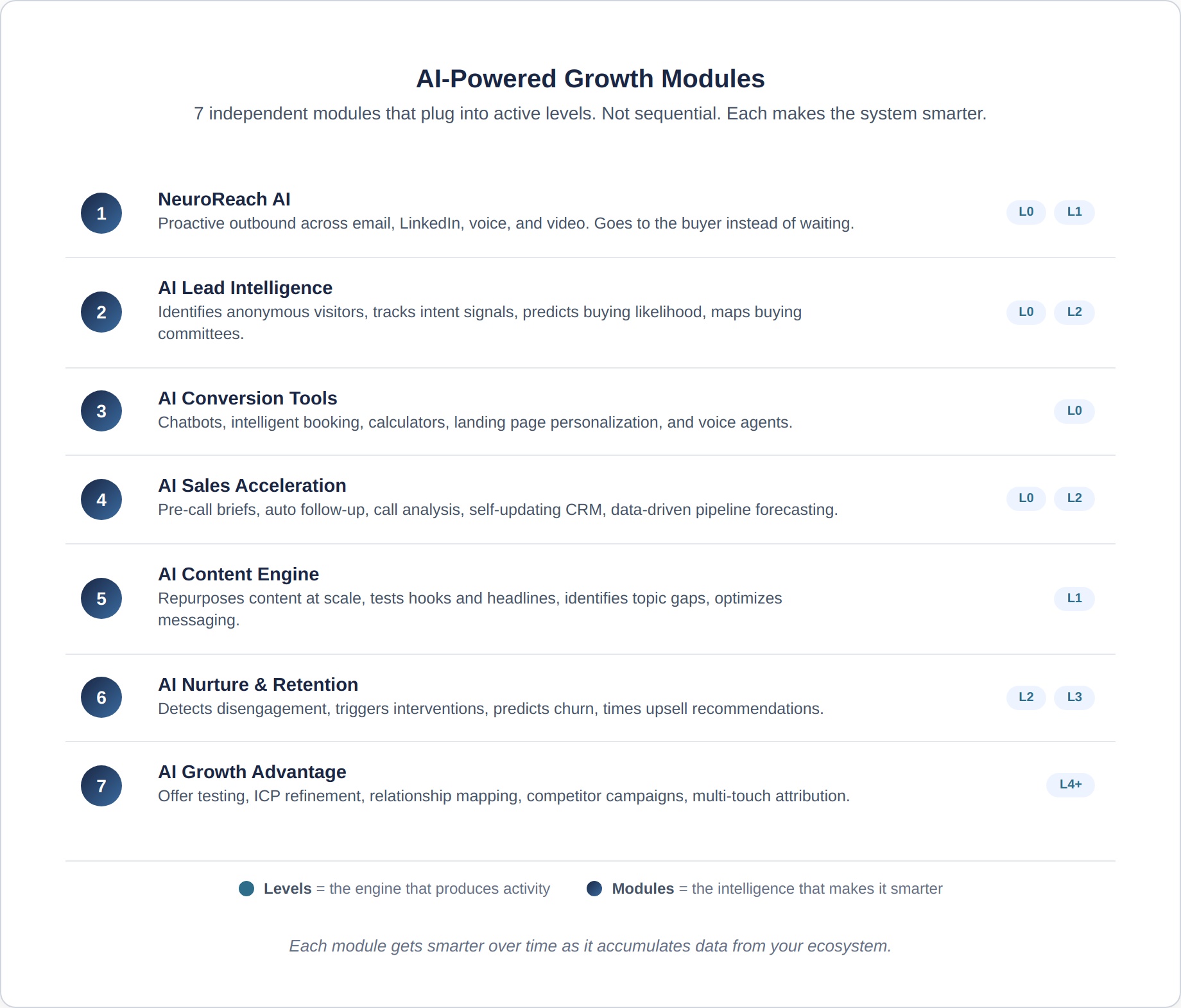
Once the Omnipresent Conversion Ecosystem levels are in place, AI-Powered Growth Modules add intelligence that makes specific parts of the system dramatically faster, smarter, and more effective. These are not a seventh level. They don’t follow the sequential rule. They are independent enhancements that plug into whichever levels are active.
Think of it this way: the levels are the engine that produces marketing activity. The modules are the intelligence layer that makes the engine smarter.
A client running Levels 0-6 without modules has a complete, effective, profitable marketing system. A client running Levels 0-6 with modules has a marketing system that thinks, learns, and adapts faster than any competitor relying solely on manual execution.
Module 1: NeuroReach AI
Proactive outbound outreach that identifies your ideal prospects, researches their specific situation, and delivers personalized multi-channel sequences across email, LinkedIn, voice, and video. This is the only module that goes to the buyer instead of waiting for the buyer to come to you. When a prospect receives your message and researches you, they find six levels of content and credibility that all confirm what the message demonstrated. The outreach opens the door. The ecosystem closes it.
Requires: Level 0 + Level 1 active.
Module 2: AI Lead Intelligence
Identifies anonymous website visitors, tracks intent signals across platforms, predicts which prospects are most likely to buy, and maps buying committees inside target accounts. This module tells your sales team who to focus on and when to engage before the prospect ever fills out a form.
Requires: Level 0 + Level 2 active.
Module 3: AI Conversion Tools
Turns your website and landing pages into active sales assistants with AI chatbots that qualify visitors in real time, intelligent appointment booking, interactive calculators and assessments, AI-powered landing page personalization, and voice agents that capture inbound leads. Every digital touchpoint actively works to convert rather than passively collecting form submissions.
Requires: Level 0 active.
Module 4: AI Sales Acceleration
Eliminates the research, admin, follow-up, and data entry that consume your sales team’s time. Pre-call briefs arrive automatically with full prospect context. Post-call follow-up fires without the rep having to type a word. Call transcription and analysis reveal what your best reps do differently. CRM updates itself. Pipeline forecasting becomes data-driven rather than gut-driven.
Requires: Level 0 + Level 2 active.
Module 5: AI Content Engine
Turns every sales call, video, article, newsletter reply, and social comment into content fuel. Repurposes content across formats at scale. Test hooks and headlines to find what captures attention. Identifies topic gaps your competitors haven’t covered. Continuously optimizes messaging based on performance data from every channel.
Requires: Level 1 active.
Module 6: AI Nurture and Retention
Detects when leads are losing interest and clients are at risk, then automatically triggers the right intervention. It starts with behaviour-triggered nurturing replacing email blasts, churn-prediction flags that notify you about at-risk clients, and upsell recommendations timed to when clients are most receptive. When done correctly, no lead silently dies, and no client quietly leaves.
Requires: Level 2 + Level 3 active.
Module 7: AI Growth Advantage
The unfair advantage layer. Offer testing at scale, ICP refinement based on who actually buys, relationship mapping across your network, referral timing, partner identification, multi-touch attribution modelling, competitor steal campaigns, and micro-campaign builders that test new approaches rapidly. This module creates compounding strategic advantages that competitors can’t see, replicate, or reverse-engineer.
Requires: Level 4+ active.
How Modules and Levels Work Together
Each module has specific level requirements because the module enhances those levels. Module 3 (AI Conversion Tools) requires Level 0 because it enhances your website. Module 6 (AI Nurture and Retention) requires Levels 2 and 3 because it enhances your automation and email system. But Module 3 doesn’t require Module 6, and Module 6 doesn’t require Module 3. They’re independent.
Modules can be activated at any time once their required levels are met. A client running Levels 0-2 can activate Module 3 right now. A client running the full Level 0-6 ecosystem can activate any or all modules.
The modules produce compounding returns over time. Each module gets smarter as it accumulates data from your ecosystem. A module activated in month 1 performs better in month 6 because it’s learned from 6 months of your specific audience, messaging, and conversion patterns.
The Bottom Line
Digital marketing has a natural progression. Each level builds on the levels beneath it, and even though businesses think skipping levels saves time, it actually wastes time and the money invested in that level. It guarantees underperformance. The companies that build in sequence, from website foundation through social visibility through conversion infrastructure through owned audience through search presence through video authority through paid amplification, create marketing systems where every level strengthens every other level. AI Growth Modules then add the intelligence layer that makes the entire system think, learn, and adapt.
The companies that jump to whatever tactic is trending spend money to activate a system with no foundation for producing results. The most visible, most valuable, and most trusted business in your market is the one that builds all six levels on a solid foundation and then enhances them with the AI intelligence that creates compounding advantages competitors can’t replicate. Building in order takes longer to start. It compounds faster and lasts indefinitely.
What to Do If Your Marketing Feels Like It Should Be Working but Isn’t
Before increasing ad spend, you need to assess your digital marketing.
Ask yourself these questions:
- If you traced every marketing dollar, would you find gaps where landing pages don’t exist, follow-up sequences aren’t built, content libraries are empty, and email lists are neglected?
- When leads enter your system, do they progress through a complete path from initial engagement through nurture to sales readiness, or do they enter at one level and fall into a gap where the next level should be?
- If you turned off all paid advertising and outbound outreach tomorrow, would organic traffic, email engagement, and social presence continue to generate leads, or would lead flow stop entirely?
Most companies respond to underperforming marketing by adding ad spend, deploying AI tools, and launching aggressive outbound campaigns. That response amplifies whatever exists underneath. When the infrastructure is solid, amplification works. When the infrastructure has gaps, amplification wastes budget on a larger scale.
Better approach:
- Audit your marketing across all six levels.
- Identify your current marketing level.
- Build the next level properly before moving on.
- Only when each level is solid should you add the AI Growth Modules that enhance what you need most.
This sequential approach feels slower in the short term, but it produces a system in which every level reinforces every other level and every module makes the system smarter, creating the compounding effect that scattered investment at higher levels cannot.
This is why sequential infrastructure is central to the Omnipresent Conversion Ecosystem. A complete digital marketing strategy designed to turn traffic into customers predictably and repeatedly. Where each level is built on the solid foundation of the levels beneath it. Where no tactic is deployed before the marketing infrastructure it depends on is in place. Paid amplification operates within a system that has the landing pages, content, email sequences, and trust assets to convert the attention it generates. Where AI Growth Modules add intelligence that makes the system learn, adapt, and compound faster. Where marketing investment compounds because every level strengthens every other level in the progression, and every module makes the entire system smarter.
If you want help identifying which levels of your digital marketing have gaps, building the foundational levels that make every higher-level tactic more effective, determining which AI Growth Modules would produce the highest impact, or require a strategy to build a complete Omnipresent Conversion Ecosystem, reach out. We can help you build a system that maximizes your marketing spend.
Frequently Asked Questions
What are the levels of the Omnipresent Conversion Ecosystem?
The Omnipresent Conversion Ecosystem has seven levels: One foundational level and six growth levels. Level 0 (website foundation), Level 1 (social media), Level 2 (landing pages and automation), Level 3 (email marketing with newsletters and lead magnets), Level 4 (SEO, AEO, and content), Level 5 (long-form video), and Level 6 (paid advertising). Each level builds on the previous ones. Beyond the levels, seven AI-Powered Growth Modules can be activated independently to add intelligence and automation to specific parts of the system.
Can you skip levels in the Omnipresent Conversion Ecosystem?
No. Skipping levels causes every tactic above the gap to underperform because it lacks the infrastructure it depends on. Paid ads without landing pages waste budget. Content without a website to publish on and an email list to distribute through limits impact. The sequence exists because each level creates the conditions the next level requires.
What are AI Growth Modules?
AI Growth Modules are independent AI-powered enhancements that plug into specific levels of the Omnipresent Conversion Ecosystem. There are seven modules: NeuroReach AI (outbound outreach), AI Lead Intelligence, AI Conversion Tools, AI Sales Acceleration, AI Content Engine, AI Nurture and Retention, and AI Growth Advantage.
What is the difference between SEO and AEO?
SEO optimizes content for traditional search engine rankings through keywords, backlinks, and technical factors. AEO, or answer engine optimization, optimizes content so AI platforms like ChatGPT, Perplexity, and Google’s AI Overviews can extract answers from it. Both are part of Level 4 and require a specific structure.
Why should paid ads come after content marketing?
Paid ads amplify whatever system exists. When landing pages, email automation, content, and video are in place, ads drive traffic into a system designed to convert it. Without that infrastructure, ads waste money, and traffic doesn’t convert. Measuring ads by cost per click rather than cost per acquired customer hides the true cost of running ads before the foundation is built.
How long does it take to build the full Omnipresent Conversion Ecosystem?
Most B2B companies can build Levels 0 through 3 in two to four months with focused effort. Level 4 begins producing results in three to six months and compounds over time. Level 5 can start once comfort on camera is established through Level 1 video, typically three to six months in. Level 6 can be activated once the infrastructure is solid, typically six to twelve months into the build sequence. AI Growth Modules can be added at any point once their required levels are in place.
What is an omnipresent conversion ecosystem?
A conversion ecosystem is a complete digital marketing strategy designed to turn traffic into customers predictably and repeatedly. It encompasses six active levels, plus a foundation, built in automation, along with AI-Powered Growth Modules that add intelligence.
What is the biggest mistake in digital marketing strategy?
The biggest mistake is jumping to advanced tactics like paid advertising or AI outreach before building the foundational levels underneath them. When traffic is increased without conversion infrastructure, it wastes marketing dollars and gives the illusion that marketing “doesn’t work”.
What does Level 0 include in the Omnipresent Conversion Ecosystem?
Level 0 is the website foundation. It includes a conversion-optimized website with Big 5 content (cost, problems, comparisons, best-of, reviews), an About page built to reduce risk, video integration, clear action paths, SEO-written content on every page, and technical setup including Google Analytics, Tag Manager, and Search Console. It’s a self-educating sales system that lets buyers answer every question before the first conversation.
How do AI Growth Modules differ from the levels?
Levels are sequential: each one must be built before the next. They produce the marketing activity (content, emails, videos, ads). Modules are independent: each enhances specific levels without requiring any others. They add intelligence that makes the levels smarter (predicting which leads will buy, personalizing experiences, optimizing messaging, and identifying strategic advantages). Levels are the engine. Modules are the intelligence.