
High-Converting Landing Pages: The Conversion Layer That Determines Whether Your Marketing Investment Produces Revenue or Just Produces Clicks
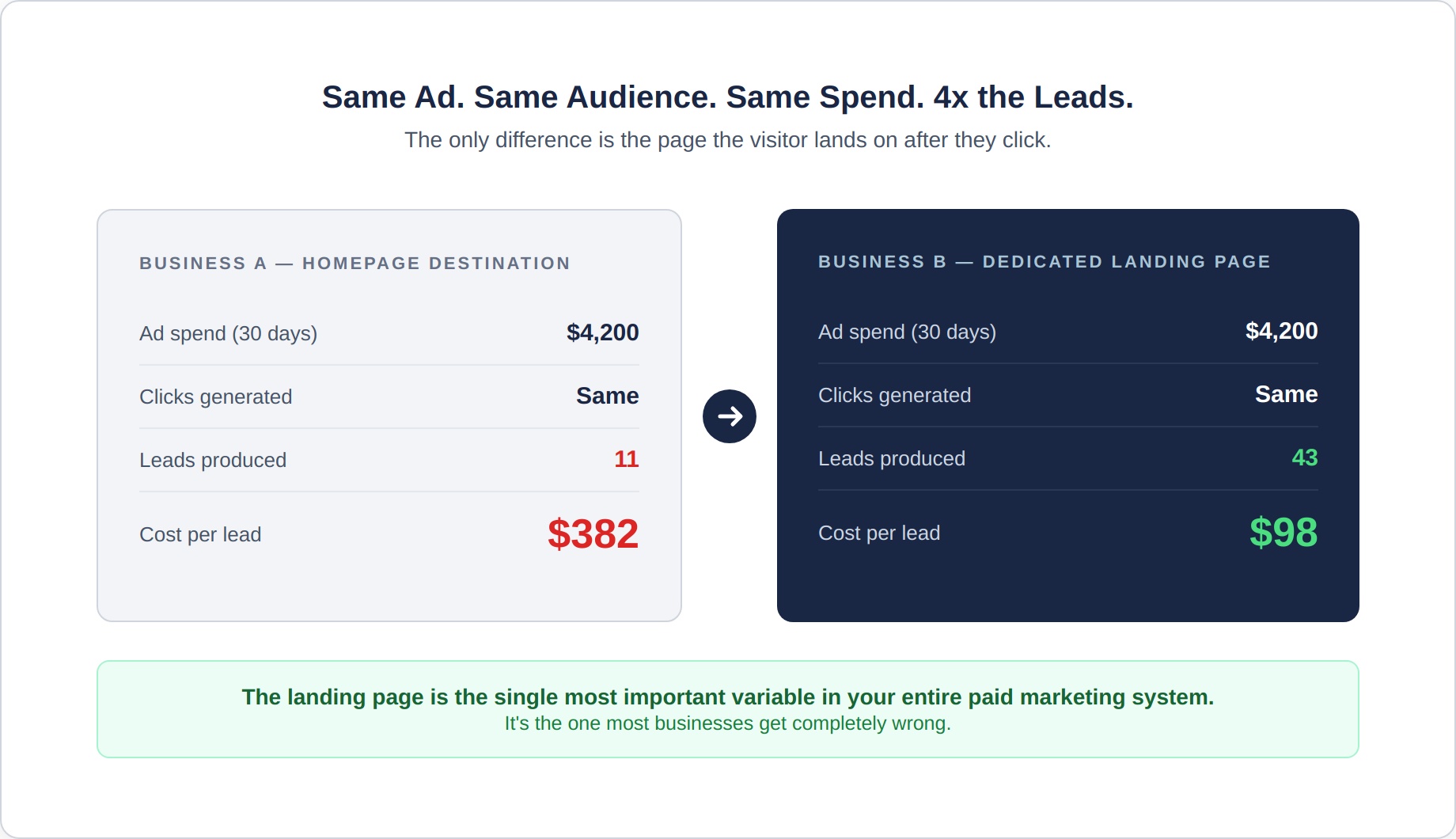
Two businesses are running the exact same Google Ads campaign. Same keywords. Same budget. Same geographic targeting. Same industry. Business A sends every click to their homepage. Business B sends every click to a dedicated landing page built specifically for the campaign. After 30 days, Business A has spent $4,200 and generated 11 leads, a cost per lead of $382. Business B has spent $4,200 and generated 43 leads, a cost per lead of $98. Same ad. Same audience. Same spend. The only difference is the page the visitor lands on after they click. That page, the landing page, is the single most important variable in your entire paid marketing system, and it’s the one most businesses get completely wrong.
The industry average landing page conversion rate is 2.35 percent. That means for every hundred people you pay to send to a page, roughly 98 leave without doing anything. They clicked the ad because it was relevant. They arrived with interest. And then the page failed them. It didn’t continue the conversation the ad started. It offered too many choices and not enough clarity. It asked for trust before earning it. It buried the call to action below three screens of content nobody reads. The visitor didn’t leave because they weren’t interested. They left because the page didn’t give them a clear, compelling, frictionless path to take the action they were already considering when they clicked.
After 27 years of building marketing systems and testing hundreds of landing pages across dozens of industries, I can tell you that the gap between a 2 percent conversion rate and a 12 percent conversion rate comes down to a handful of deliberate decisions that most businesses never make because nobody showed them what actually drives conversion. It’s not design trends. It’s not clever copywriting tricks. It’s structural decisions about message alignment, proof placement, friction reduction, and singular focus that transform a page from a generic information dump into a conversion-optimized machine. Those decisions are learnable, testable, and repeatable once you understand the principles behind them.
Here’s the complete breakdown of how high-converting landing pages work as the conversion layer in your marketing system, the exact elements that separate pages that waste ad spend from pages that multiply it, and the framework for building landing pages that turn every traffic source into a measurable lead generation engine, so read on.
The Invisible Bleed: How Landing Page Failures Drain Marketing Budgets Without Anyone Noticing
The most dangerous thing about a bad landing page is that it doesn’t look broken. The page loads. It has content. It has a form. The business owner glances at it and thinks it’s fine. But ‘fine’ is costing them thousands of dollars a month in unconverted traffic, and because the traffic metrics look healthy, nobody identifies the page as the problem. The Google Ads dashboard shows clicks are coming in. The analytics show visitors are arriving. The conclusion is that the ads must be the issue because the leads aren’t materializing. So the business tweaks the ads, changes the targeting, adjusts the budget, and the real problem, the page those visitors land on, never gets addressed.
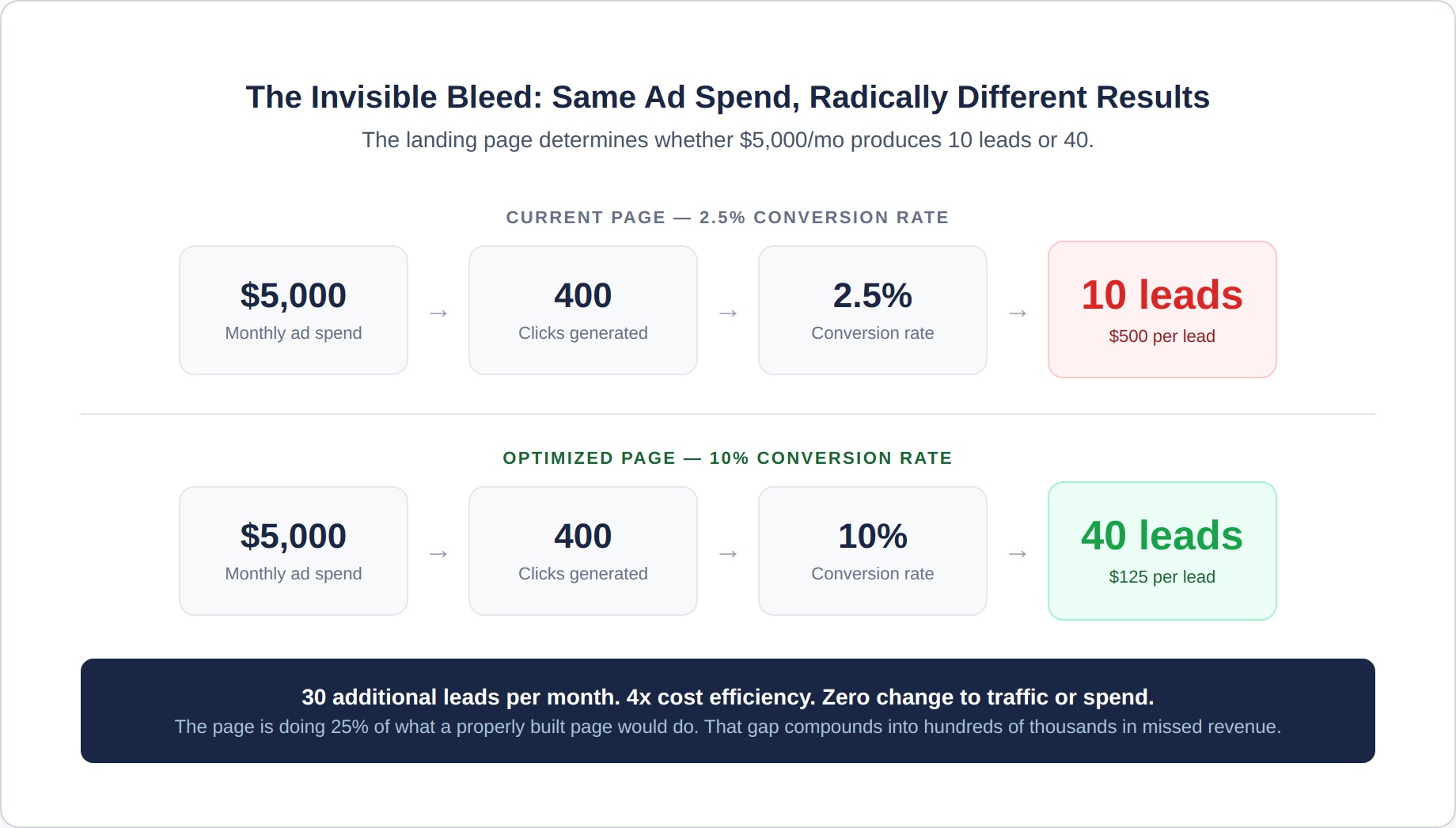
The financial math makes this painful when you actually calculate it. A business spending $5,000 per month on paid advertising generating 400 clicks at a 2.5 percent conversion rate produces 10 leads per month. Their cost per lead is $500. If the landing page were optimized and converting at 10 percent, that same $5,000 and 400 clicks would produce 40 leads at $125 each. The business isn’t short 30 leads because of bad ads or weak targeting. They’re short 30 leads because the landing page is doing 25 percent of what a properly built page would do. That gap, 30 lost leads per month at whatever their customer lifetime value is, compounds into hundreds of thousands of dollars in missed revenue over a year. And most businesses never realize it because the landing page looks fine on the surface.
The problem extends beyond paid advertising. Every marketing channel that drives website traffic is affected by landing page quality. Email campaigns that link to generic pages instead of offer-specific landing pageslose engagement at the click-through. Social media campaigns that send traffic to the homepage instead of a conversion-focused page waste the audience attention the content earned. Even organic search visitors who arrive on blog content lose their conversion potential when the content page offers no relevant next step. High-converting landing pages aren’t just a paid ads optimization. They’re the conversion layer that determines the return on every marketing channel in your system.
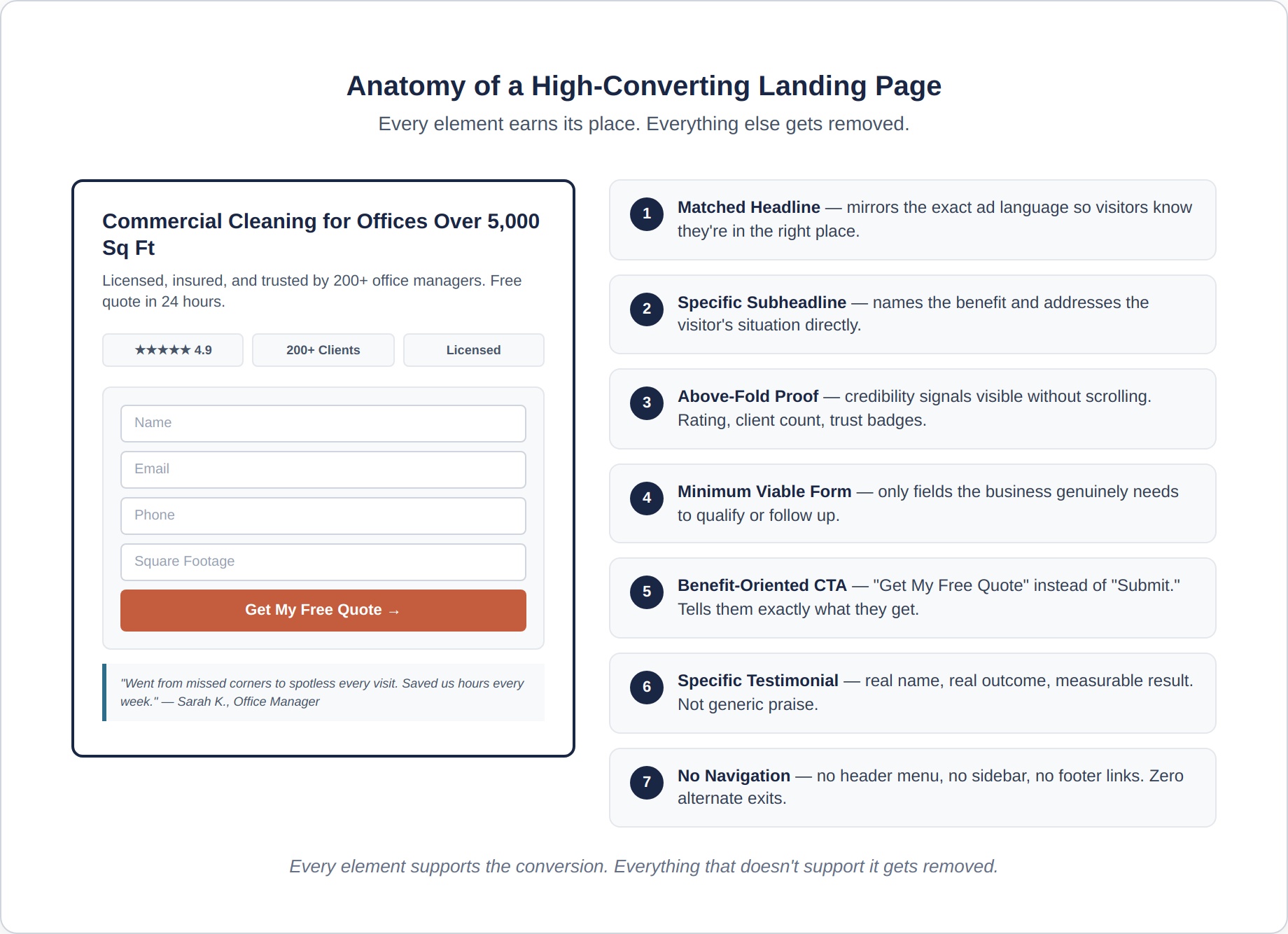
Here’s what the shift looks like in practice. Your Google Ads campaign for ‘commercial cleaning services’ sends every click to a landing page with a headline that says ‘Commercial Cleaning for Offices Over 5,000 Square Feet — Licensed, Insured, Free Quote in 24 Hours.’ The subheadline addresses the specific pain point: businesses that are frustrated with unreliable cleaning services that miss corners and can’t keep a consistent schedule. Below the fold, three client testimonials from office managers at similar-sized companies with specific satisfaction metrics. A single form with four fields: name, email, phone, and square footage. One CTA button that says ‘Get My Free Quote.’ No navigation. No sidebar. No footer links. Every element on the page serves one purpose: turning the visitor who clicked that ad into a lead.
The same principle applies across every channel. Your email campaign promoting a marketing audit links to a page that continues the email’s narrative, with the audit offer prominently featured and the email’s specific language reflected in the headline. Your LinkedIn Ad targeting CFOs links to a page with enterprise-appropriate proof points, a professional tone, and a form that asks qualifying questions relevant to CFO-level decision-making. Your Facebook ad for a free checklist links to a page that delivers the checklist in exchange for an email, with the exact visual from the ad mirrored on the page so the visitor instantly recognizes they’re in the right place. Each page is built for the specific audience arriving from the specific channel with the specific expectations that channel created.
Businesses that build this kind of campaign-specific landing pages infrastructure see conversion rates between 8 and 15 percent across their primary campaigns, compared to the 2 to 4 percent they were getting when sending traffic to generic pages. The cost per lead drops proportionally. The lead quality improves because the page pre-qualifies visitors through specific messaging that attracts ideal prospects and filters out poor fits. Sales conversations start at a higher level because the landing page already communicated the offer, the proof, and the value proposition before the lead ever spoke to anyone. The landing page does the work of a first sales meeting in 60 seconds, which is why it’s the highest-ROI asset in the entire marketing stack when it’s built correctly.
How to Build Landing Pages That Convert Traffic Into Leads at 3 to 5 Times the Rate of Generic Pages
A high-converting landing page isn’t designed by intuition. It’s engineered using principles that have been validated across millions of page views and thousands of A/B tests. Every element either increases or decreases the probability that a visitor completes the conversion action. There is no neutral content on a landing page. Here’s how to build each component so it contributes to conversion rather than undermining it.
Match the Headline to the Traffic Source So the Visitor Knows They’re in the Right Place
The headline is the first thing the visitor sees and it determines whether they stay or leave within the first 2 to 3 seconds. The message match principle is the single most important concept in landing page design: the headline on the page must mirror the language, promise, or offer that the visitor clicked on to arrive. If the Google Ad says ‘Get a Free SEO Audit for Your Business,’ the landing page headline needs to say something nearly identical. Not ‘Welcome to Our Agency.’ Not ‘Full-Service Digital Marketing Solutions.’ The specific promise that earned the click must be the first thing the visitor reads when the page loads.
Message match works because it creates instant cognitive confirmation. The visitor’s brain is carrying the expectation created by the ad, email, or social post they just clicked. When the landing page headline matches that expectation, the brain says ‘yes, this is what I was looking for’ and the visitor relaxes into the page. When the headline doesn’t match, the brain says ‘wait, this isn’t what I expected’ and the visitor’s trust drops immediately. That trust drop happens in under 3 seconds, before the visitor has read a single line of body copy or seen a single proof element. The headline determines whether anything else on the page gets a chance to do its job.
Testing different headlines is also the highest-leverage A/B testing you can do on any landing page. A headline change alone can swing conversion rates by 20 to 50 percent because it’s the element with the most influence on whether a visitor engages with the rest of the page. Start every landing page project by writing at least three headline variations and test them against each other within the first two weeks of launch. The data will tell you which promise or framing resonates most with your specific audience from your specific traffic source, and that insight applies to your ad copy and email copy as well, creating alignment across the entire click-to-conversion path.
Remove Every Element That Doesn’t Directly Support the Conversion Action
A high-converting landing page has one job: get the visitor to complete one specific action. Every element on the page either supports that action or competes with it. Navigation menus compete with it because they offer alternative destinations. Footer links compete with it because they pull attention downward away from the form. Sidebar content competes with it because it introduces topics unrelated to the offer. Links to other pages, blog posts, or social profiles all compete with the single conversion action the page exists to produce.
The principle is called singular focus, and it’s counterintuitive for business owners who want to showcase everything their company offers. They think more information equals more conversions. The opposite is true. More choices equal more friction. More navigation equals more exits. More content about topics unrelated to the specific offer equals more confusion about what the visitor is supposed to do. The highest-converting pages I’ve built over 27 years are almost always the most stripped-down: one headline, one subheadline, one set of proof points, one form, one button. Everything that doesn’t serve the conversion is removed because everything that doesn’t serve the conversion is a potential exit point.
This doesn’t mean the page should be empty or devoid of content. It means every piece of content should be in service of the same goal. The headline introduces the offer. The subheadline explains the benefit. The proof section validates the claim. The benefit bullets address objections. The form captures the lead. The CTA button tells them exactly what happens next. The page can be long or short depending on the complexity of the offer and the awareness level of the audience. But regardless of length, every paragraph, every image, and every design element must be answerable to the question: does this help the visitor convert? If the answer is no, it doesn’t belong on the page.
Position Social Proof Where It Addresses the Visitor’s Doubt at the Moment They Feel It
Social proof, which includes testimonials, case study results, client logos, review scores, and trust badges, is the element that converts interest into action. A visitor can be intrigued by your headline and interested in your offer, but the decision to enter their contact information into a form is a trust decision. They’re asking themselves: is this business legitimate? Will they actually deliver what they’re promising? Have other people like me gotten good results? Social proof answers all three questions simultaneously, but only if it’s placed where the visitor encounters it at the right moment in their decision process.
The most effective placement puts a credibility signal above the fold, visible without scrolling. This can be a client logo bar, a review aggregate score, or a short testimonial headline. That above-the-fold content proof doesn’t need to be detailed. It just needs to signal that other businesses or people have trusted this company. The detailed proof, the full testimonials with specific results and real names, should appear below the fold near the form or CTA. This placement works because the visitor who scrolls down to the form area is in active consideration mode. They’re evaluating whether to commit. That’s the moment detailed proof has the most influence on their decision.
The specificity of your proof matters more than the volume. Three testimonials with specific results, named companies, and real outcomes outperform twenty generic quotes that say ‘great service, would recommend.’ If a testimonial says ‘we went from 8 leads per month to 47 in 90 days,’ that specific claim creates more trust than ‘they really helped our business grow.’ Numbers, percentages, dollar amounts, and timeframes are the trust signals that move skeptical visitors past their hesitation. Include them whenever possible. Businesses that add specific, results-oriented social proof to their landing pages typically see conversion rates increase by 15 to 30 percent from that single change.
Optimize the Form to Capture the Lead With Minimum Friction and Maximum Qualification
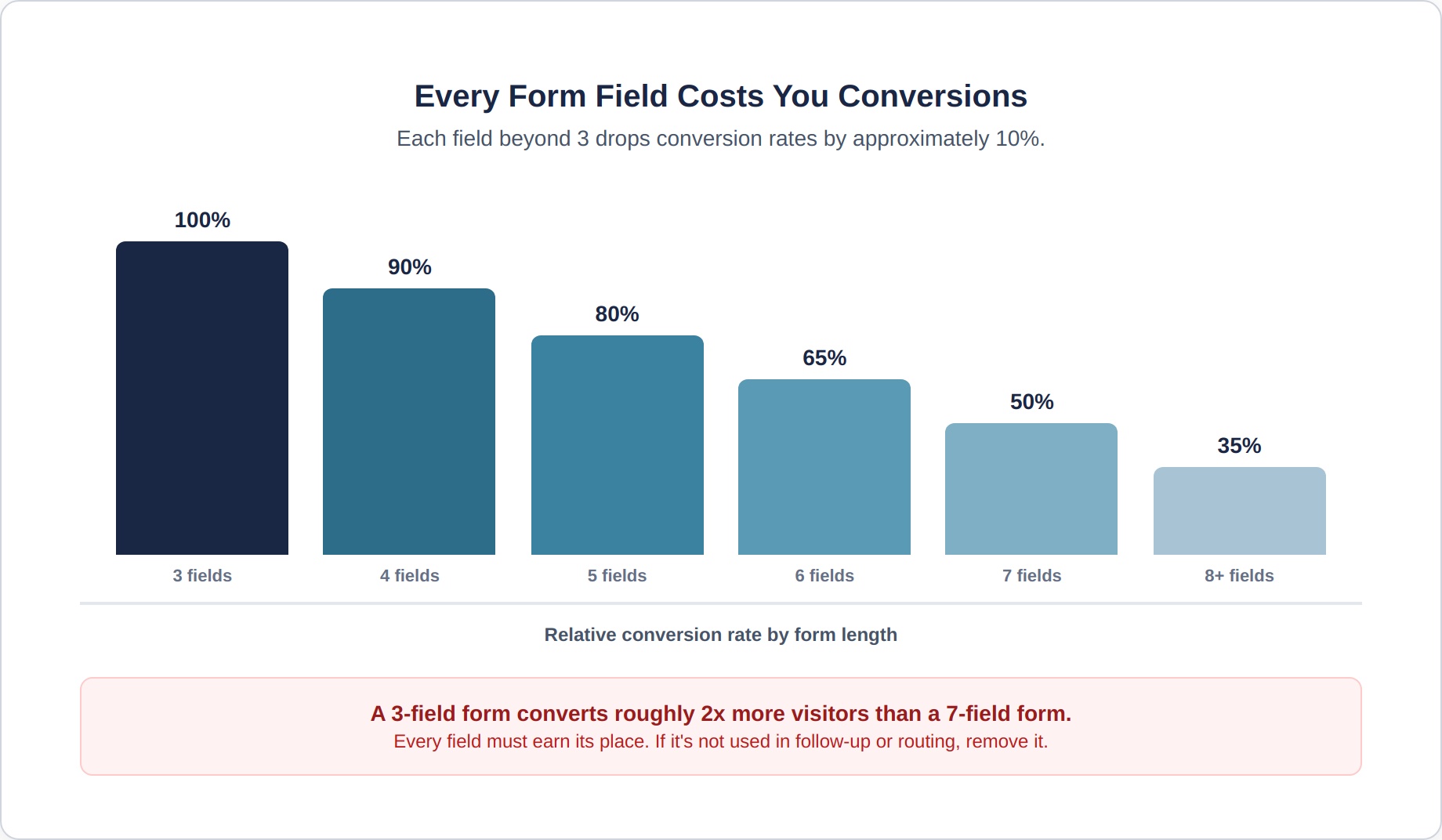
The form is where conversion either happens or doesn’t, and every field you add reduces the probability that it happens. Research consistently shows that each additional form field beyond three drops conversion rates by approximately 10 percent. A three-field form converts roughly twice as many visitors as a seven-field form. That doesn’t mean every form should have three fields. It means every field needs to earn its place by providing data that the business genuinely needs to qualify or follow up with the lead. If a field isn’t used in the first 48 hours of follow-up or doesn’t influence how the lead gets routed, it shouldn’t be on the form.
The form optimization strategy depends on the offer and the traffic source. For a low-commitment offer like a downloadable guide or checklist, name and email are usually sufficient. Adding phone number to a low-commitment offer can drop conversion rates by 20 to 30 percent because it feels like too much to give for a free resource. For a high-commitment offer like a consultation or assessment, name, email, phone, and one or two qualifying questions are appropriate because the visitor expects a more serious exchange for a more valuable outcome. The qualifying questions serve double duty: they improve lead quality by filtering out poor fits, and they give your sales team context that makes the follow-up conversation more relevant and more productive.
Form design details that seem minor have measurable impact. Placing the form above the fold on short pages and at a natural break point on longer pages ensures it’s visible when the visitor is ready to act. Using specific, benefit-oriented button text like ‘Get My Free Audit’ instead of generic text like ‘Submit’ increases click rates by 20 to 40 percent because it reminds the visitor what they’re getting. Adding a privacy line like ‘We will never share your information’ below the form reduces hesitation for visitors concerned about spam. Each of these micro-optimizations adds a few percentage points, and together they compound into the kind of conversion rate gap that separates landing pages producing 10 leads a month from landing pages producing 40.
Design for Mobile First Because the Majority of Your Paid Traffic Arrives on a Phone
More than 60 percent of landing page traffic from paid social channels and over 50 percent from paid search arrives on mobile devices. If your landing page was designed on a desktop monitor and the mobile experience is an afterthought, you’re delivering a degraded experience to the majority of your visitors. Mobile-first design means building the page for a phone screen first and then expanding it for desktop, not the other way around. The mobile layout should be clean, fast-loading, and completable with thumb taps. No pinching. No horizontal scrolling. No tiny text that requires zooming.
The mobile form experience is especially critical. Form fields need to be large enough to tap accurately. The keyboard type should match the field: email keyboard for email fields, numeric keyboard for phone fields. Auto-capitalize should be enabled for name fields. The form should be visible without excessive scrolling on a standard phone screen, which usually means keeping it to three or four fields maximum on mobile even if the desktop version asks for more. The CTA button should be full-width on mobile and positioned so the visitor can tap it with their thumb without awkward reaching. These details sound minor but they’re the difference between a mobile conversion rate that matches desktop and one that runs 50 percent lower.
Page speed on mobile is non-negotiable. Every second of load time beyond 3 seconds costs you approximately 7 percent of your conversions. A page that takes 6 seconds to load on a mobile connection has already lost over 20 percent of its potential leads before a single visitor reads a word. Google Ads factors landing page speed into Quality Score, which means slow pages also pay more per click. Compress images, eliminate unnecessary scripts, use lazy loading for below-fold content, and test load speed on actual mobile devices, not just desktop simulation tools. The speed of the page is part of the conversion rate because a page that doesn’t load fast enough never gets the chance to convert.
Build Separate Landing Pages for Every Major Campaign Because Context Determines Conversion
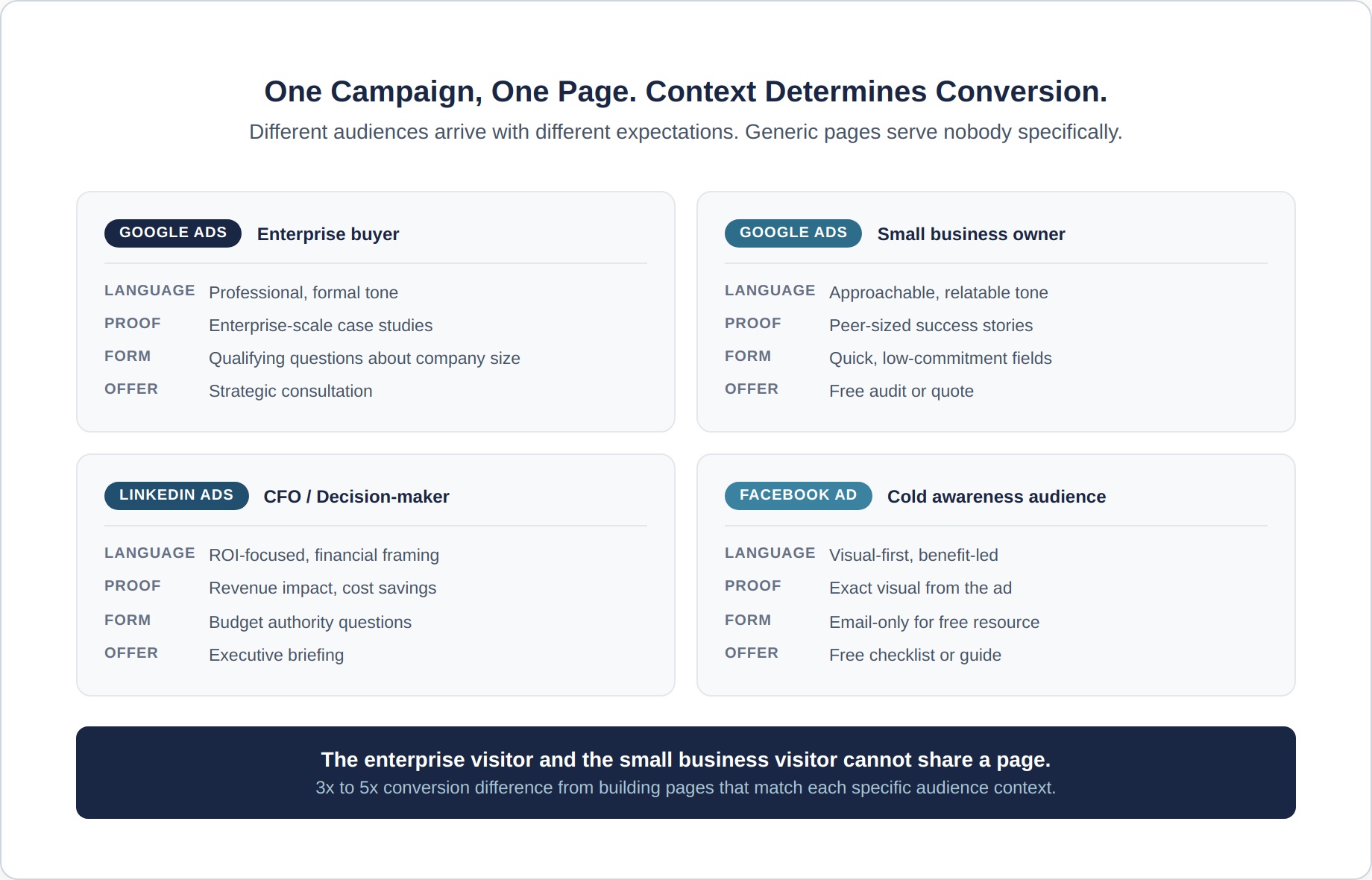
This is the principle that separates businesses running real landing page architecture from businesses running a website with a contact page. Every marketing campaign with a distinct audience, a distinct offer, or a distinct message needs its own landing page. A Google Ads campaign targeting ‘enterprise marketing solutions’ and a campaign targeting ‘small business marketing help’ cannot share a page because the visitors arrive with completely different expectations, different pain points, and different trust thresholds. The enterprise visitor expects professional language, enterprise-scale proof, and a form that asks qualifying questions about company size. The small business visitor expects approachable language, relatable examples, and a form that feels quick and low-commitment.
The same logic applies across channels. Your LinkedIn Ad targeting CFOs needs a different landing page than your Facebook Ad targeting business owners, even if the underlying service is the same, because the audience context is different and the proof that resonates is different. Your email campaign for warm subscribers needs a different page than your Google Ad for cold searchers because the relationship context is different. Warm subscribers already trust you and need a specific reason to take the next step. Cold searchers don’t trust you yet and need credibility established before they’ll consider giving you their information.
Businesses that build campaign-specific landing pages for every major traffic source consistently outperform businesses that use one or two generic pages for everything. The performance gap is typically 3x to 5x in conversion rate, which translates directly to 3x to 5x more leads from the same ad spend. The investment in building additional pages pays for itself within the first week of the campaign running because the improved conversion rate reduces cost per lead so dramatically. Building five landing pages instead of one isn’t five times the work. Each page follows the same structural framework. The differentiation is in the headline, the proof selection, the form fields, and the tone, all of which adapt to the specific audience and channel each page serves.
How Quickly High-Converting Landing Pages Start Impacting Your Marketing ROI
A single well-built landing page can go from concept to live in one to two weeks. That includes the strategic work of defining the audience, the offer, and the message match, writing the copy, designing the layout, building the page, connecting the form to the CRM, setting up conversion tracking, and implementing the follow-up trigger. The page starts producing results the moment traffic hits it. If you’re running paid campaigns that are currently sending traffic to a homepage or generic page, the conversion improvement is often visible within the first 48 hours of switching to a dedicated landing page because the traffic is already flowing and the page immediately performs better.
For businesses running multiple campaigns, building the full landing page architecture typically takes four to eight weeks. The highest-spend or highest-traffic campaign gets its page first. Then the next highest. The optimization compounds as each page goes live because every new dedicated page captures leads that were previously being lost to generic pages. By week six, most businesses have their core campaigns covered and are already seeing meaningful improvements in overall cost per lead and lead quality across their marketing system.
The testing and optimization phase runs continuously after launch. A/B testing headlines, CTA text, form length, proof placement, and page length against conversion data produces incremental improvements that compound over time. Most pages reach their peak performance after two to three rounds of testing over 60 to 90 days. But even the first version of a well-built dedicated landing page dramatically outperforms the generic alternative it replaced. The testing phase makes a good page great. The initial build makes a waste-producing generic page into a conversion-producing dedicated page. The biggest jump in performance happens at that first step.
Why Getting the Landing Page Foundation Right Prevents the Most Expensive Mistake in Paid Advertising
The most expensive mistake in paid advertising is not a bad keyword strategy. It’s not a weak ad. It’s not even targeting the wrong audience. The most expensive mistake is spending real money to generate real clicks from real prospects and then sending those clicks to a page that can’t convert them. Every dollar of ad spend that generates a click to a page that doesn’t convert is a dollar wasted twice: once for the click you paid for, and once for the customer you would have gained if the page had done its job. That double cost compounds across every campaign, every channel, and every month the page remains unoptimized.
A poorly built landing page also corrupts the data that every other optimization depends on. If your page converts at 2 percent when a proper page would convert at 10 percent, every decision you make based on that 2 percent is distorted. You might conclude a keyword doesn’t work when the keyword was generating perfect traffic to a broken page. You might cut a campaign that was actually producing your most qualified visitors because the page failed them and the conversion data made the campaign look unproductive. Bad landing pages don’t just lose leads. They generate misleading data that causes bad decisions everywhere else in the marketing system.
I’ve seen businesses spend $50,000 over a year on campaigns producing mediocre results, then double their lead volume within 30 days by building proper landing pages for the same campaigns without changing a single thing about the ads, the keywords, or the budget. The traffic was always there. The intent was always there. The page was the bottleneck. Fixing the page unlocked the results that were sitting inside the traffic all along. That’s why I always tell clients: fix the landing pages before you optimize anything else, because every other optimization produces diminished returns if the conversion layer is broken.
Three Patterns That Keep Landing Pages From Converting at Their Potential
The Homepage Substitution
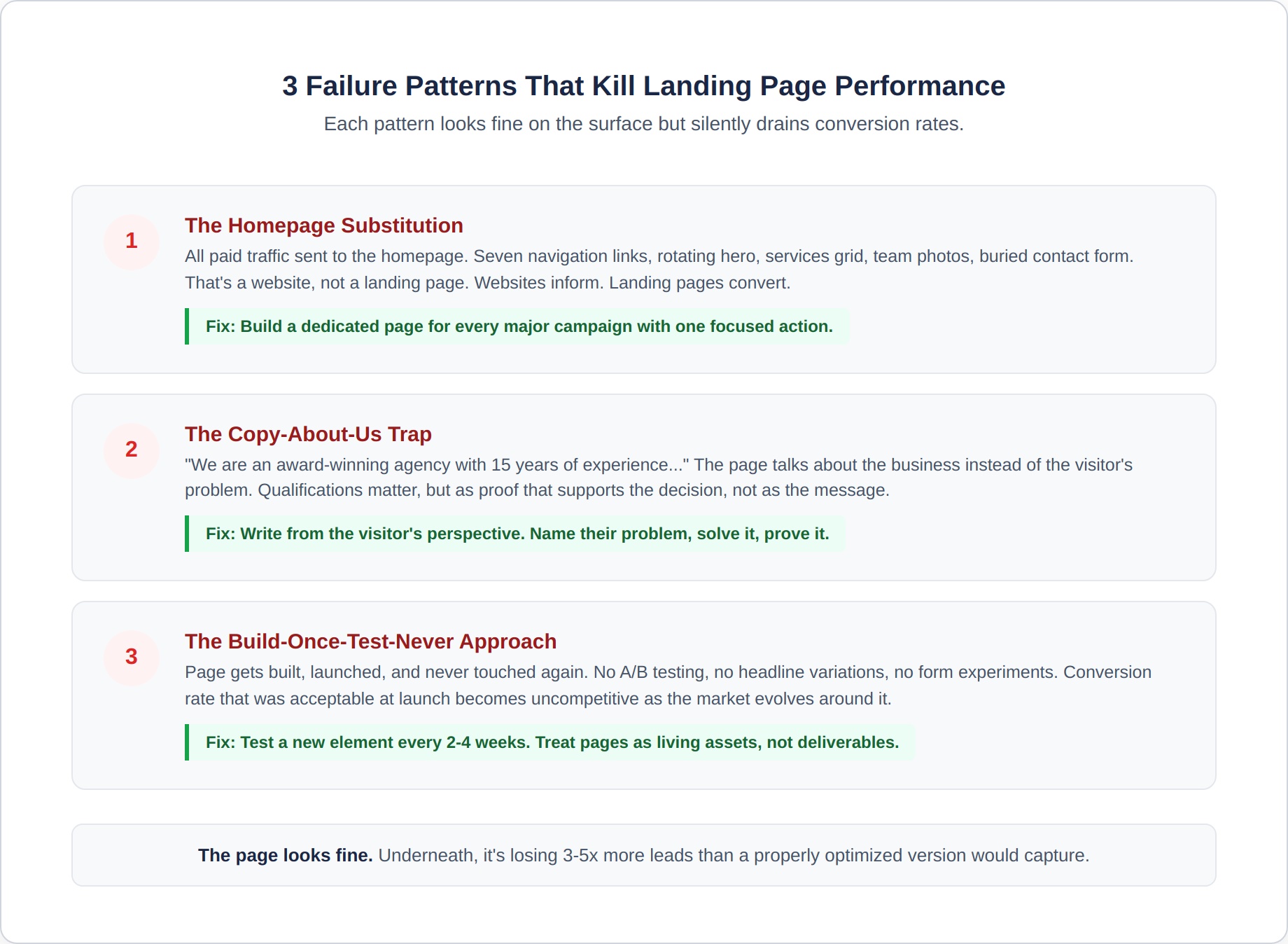
The most common landing page failure isn’t a bad landing page. It’s the absence of a landing page entirely. The business sends all paid traffic to their homepage and calls it a campaign. The homepage has a navigation bar with seven links, a hero banner that rotates through three different messages, a section about the company’s history, a services grid, a blog preview, a team photo section, and a contact form buried at the bottom. That’s not a landing page. That’s a website. And a website’s job is to inform and explore. A landing page’s job is to convert. Those are fundamentally different purposes that require fundamentally different design decisions.
The homepage substitution persists because it’s easy. Building a dedicated landing page requires work. You have to define the offer, write specific copy, choose relevant proof, design a focused layout, and connect the form to tracking and automation. Sending traffic to the homepage requires none of that. But the cost of that convenience is measured in conversion rates that run 3x to 5x lower than what dedicated pages produce. For a business spending $5,000 per month on ads, that convenience is costing them somewhere between 20 and 35 additional leads every month. At any reasonable customer lifetime value, that’s a staggering amount of revenue lost to a decision that felt like it was saving time and money.
The Copy-About-Us Trap
The second failure pattern is landing page copy that talks about the business instead of talking about the visitor’s problem. ‘We are an award-winning agency with 15 years of experience delivering innovative solutions across multiple verticals.’ That sentence is about the business. It says nothing to the visitor about their situation, their pain, or the outcome they’re looking for. Compare it to: ‘Your marketing is generating traffic but not leads. We fix that. In the past 12 months, we’ve helped 23 businesses like yours double their conversion rates without increasing ad spend.’ The second version is about the visitor. It names their problem, offers a solution, and provides specific proof in three sentences.
Landing pages that convert are written from the visitor’s perspective, not the business’s perspective. The headline names the visitor’s problem or desired outcome. The subheadline explains how that problem gets solved. The proof section shows other people like them getting the result they want. The CTA tells them what happens when they take the next step. The entire page is a conversation about the visitor’s situation, not a presentation about the business’s qualifications. Qualifications matter, but they matter as proof that supports the visitor’s decision, not as the central message that drives it. The businesses that flip this perspective, from ‘let me tell you about us’ to ‘let me solve your problem,’ see immediate improvements in conversion rates because the page finally speaks the language the visitor is thinking in.
The Build-Once-Test-Never Approach
The third failure pattern is treating landing pages as a finished product rather than a living asset. A business builds a landing page, launches it, and never touches it again. No A/B testing. No headline variations. No form length experiments. No mobile experience checks after the first build. The page runs for six months or a year while the campaigns it serves evolve, the audience shifts, and competitors improve their own pages. The conversion rate that was acceptable at launch gradually becomes uncompetitive, and the business either doesn’t notice because they aren’t checking, or attributes the decline to changes in the ad platform rather than staleness in the landing page.
High-converting landing pages require ongoing testing because the conversion rate is always improvable and the conditions are always changing. A headline that resonated six months ago might not resonate with today’s audience because the competitive messaging has shifted. A proof element that was compelling has become stale because the case study is outdated. A form that converts well on desktop has become a friction point on mobile because the latest phone OS changed how form fields render. A/B testing a new element every two to four weeks keeps the page optimized against current conditions. The businesses that sustain high conversion rates long-term are the ones that treat their landing pages as an active optimization project, not a one-time deliverable.
What 27 Years of Building and Testing Landing Pages Teaches You That Templates Never Will
Templates give you a layout. They don’t give you strategy. After nearly three decades of building landing pages across industries from SaaS to home services to professional consulting to ecommerce, the insight I bring has nothing to do with which template to use and everything to do with understanding the psychology of what makes a specific visitor from a specific source take a specific action on a specific page. That understanding comes from testing hundreds of variations and seeing the patterns in what works, what fails, and what depends entirely on context.
When I build a landing page, the page is designed as part of the complete marketing system, not as an isolated asset. The headline is aligned with the ad copy that drives the traffic. The proof elements are selected based on what objections this specific audience carries into the buying decision. The form fields are chosen based on what the sales team and automation system need to follow up effectively. The follow-up sequence that triggers after conversion is specific to the landing page’s offer and audience. The retargeting campaign that captures non-converters shows creative that references the landing page they visited. Every element connects forward and backward to the broader system because a landing page that operates in isolation captures a fraction of the value a connected page generates.
The practical advantage of this approach is that every landing page I build produces compound returns. The page generates leads directly. The data it captures improves the CRM’s ability to personalize follow-up. The conversion rate data informs ad copy and targeting decisions. The retargeting audiences built from non-converters create second and third chances to capture the same visitor. The page itself becomes a testing platform that reveals what messaging resonates most strongly with each audience segment, insights that improve every other marketing asset in the system. A landing page built in isolation generates leads. A landing page built as part of a system generates leads, intelligence, and compounding returns across every connected channel.
High-Converting Landing Pages as the Conversion Layer in an Omnipresent Marketing System
How Landing Pages Connect Every Traffic Source to Every Business Outcome
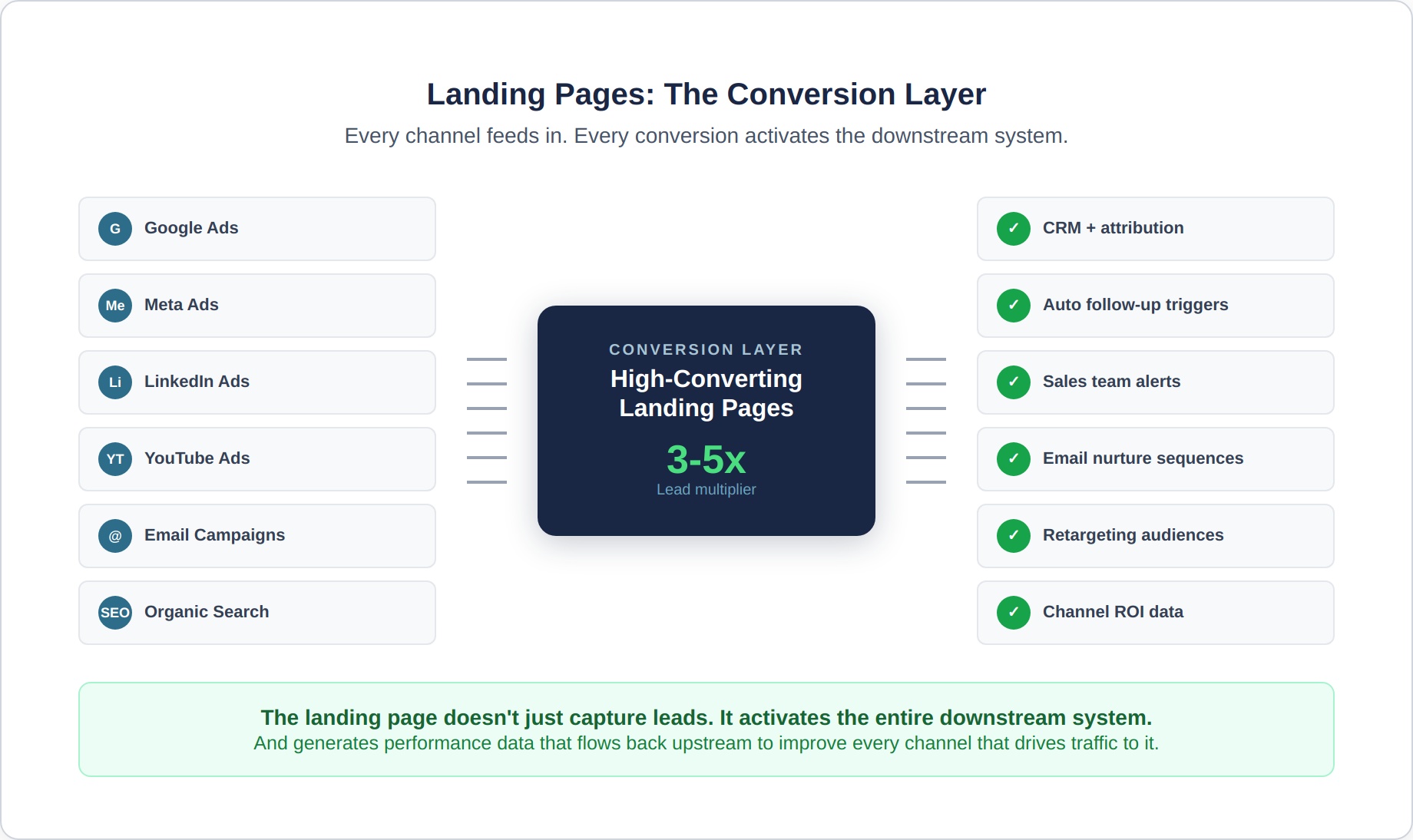
High-converting landing pages operate as the conversion layer in your interconnected marketing system. Every other channel generates attention and drives traffic. The landing page is where that attention converts into a measurable business outcome. Google Search Ads drive high-intent visitors to keyword-matched pages. Meta Ads deliver awareness-stage audiences to offer-specific pages. LinkedIn Ads send decision-makers to professional proof-centered pages. YouTube Video Ads build trust that visitors validate on the landing page they click through to. Email campaigns direct warm subscribers to pages that continue the nurture conversation. Content marketing and SEO attract organic visitors to content pages with embedded conversion paths. Every channel depends on the landing page to complete the transaction.
The data flow from landing pages feeds the entire marketing ecosystem. Every conversion captures source attribution that tells you which channel and campaign produced the lead. That attribution data informs budget allocation across all channels. Every form submission triggers CRM entry with full context, which activates the right follow-up sequence, notifies the sales team with relevant details, and adds the contact to the appropriate nurture track. Non-converting visitors get added to retargeting audiences across Google Display, Facebook, Instagram, YouTube, and LinkedIn. The landing page is the funnel point through which every marketing interaction produces either a conversion or a retargetable audience member. Nothing is wasted.
That’s what an omnipresent marketing system looks like when high-converting landing pages are the conversion layer. Every channel sends traffic to a page engineered to convert that specific traffic. Every conversion enters a system that follows up automatically, routes intelligently, and tracks attribution completely. Every non-conversion enters a retargeting system that re-engages the visitor across every platform they use. The landing pages don’t just capture leads. They activate the entire downstream system that turns those leads into revenue. And the performance data they generate flows back upstream to improve every channel that drives traffic to them. The conversion layer is where the whole system earns its return.
The Bottom Line
Every marketing dollar you spend eventually sends a person to a page. That page either converts them into a lead or lets them disappear. High-converting landing pages are the conversion layer that determines the return on every other marketing investment your business makes. When every campaign has its own dedicated page with matched messaging, focused design, specific proof, optimized forms, fast mobile performance, and connection to your CRM and follow-up systems, the same traffic and the same budget produce 3 to 5 times more leads. That multiplier effect makes landing page optimization the single highest-ROI investment in your entire marketing system because it amplifies the return of every channel, every campaign, and every dollar simultaneously. The traffic is already there. The intent is already there. The only question is whether the page that receives them is built to convert or built to lose.
What to Do If Your Ads Are Getting Clicks But Your Pipeline Isn’t Getting Leads
Start with a five-minute audit. Open your highest-spend paid campaign and click the ad yourself. Look at the page you land on. Does the headline match what the ad said? Is there a single, clear conversion action or multiple competing options? Can you see social proof, a real testimonial or specific result, without scrolling? Now look at the form. How many fields does it have? Does the button text tell you what you get when you click, or does it say something generic like ‘Submit’? Finally, open the same page on your phone. How long does it load? Can you fill out the form without zooming? Is the CTA button easy to tap? If any of those checks failed, the page is costing you leads that your ad already earned.
If you’re sending paid traffic to your homepage or a generic services page, the improvement from building a single dedicated landing page is so dramatic that it typically pays for itself within the first week of launching. The conversion rate jump from a generic destination to a matched, focused landing page is consistently 3x to 5x across industries. That means the leads you’ve been losing, the ones who clicked the ad and then disappeared, start converting immediately when the page finally gives them a clear, compelling, frictionless path to take the action they were already considering when they clicked.
What you need is a landing page system designed to convert every major traffic source your marketing generates. Where every paid campaign has a dedicated, conversion-optimized landing page with a headline that matches the ad, proof that builds trust in seconds, and a form that captures the lead with minimum friction. Where every email campaign clicks through to a page that continues the conversation the email started. Where every content piece includes an embedded conversion path so organic visitors never reach a dead end. Where every form submission enters your CRM with full source attribution, triggers the right automated follow-up sequence, and notifies your sales team with complete context. Where non-converters enter a multi-platform retargeting system that brings them back across Google, Facebook, Instagram, YouTube, and LinkedIn. And where every landing page connects to your complete omnipresent marketing ecosystem so that no click is wasted, no lead is lost, and every marketing dollar produces its maximum possible return.
If you want help building high-converting landing pages that turn your ad clicks into qualified leads, creating the campaign-specific page architecture that multiplies the return on every traffic source, or connecting your landing pages to a complete marketing system that converts, tracks, and follows up on every visitor who enters your ecosystem, reach out. This is where wasted clicks become captured leads, and where the traffic your marketing already generates starts producing the revenue it was always capable of delivering.