

Key Takeaways
- Email marketing builds an audience you own. It works independently of social media algorithms, platform changes, or ad spend. This makes it one of the most valuable business assets in your entire marketing system.
- Weekly newsletters and quarterly lead magnets keep your company top of mind. This shortens sales cycles and builds trust with consistent value.
- Leads that don’t convert in Level 2 move into Level 3 nurture. They then subscribe to your newsletter for weekly updates. This builds trust and keeps your solution top of mind until they’re ready to act.
- The email list you build at Level 3 is a compounding asset—each new subscriber lowers your cost per contact over time, rapidly increasing the value of your audience as the list grows.
- Monthly investment ranges from $1,500 to $3,500, depending on newsletter frequency, lead magnet production, list size, and segmentation complexity. Contact us for a personalized quote.
One Sentence Summary: Email marketing gives you a direct audience and nurtures it with newsletters and lead magnets, so your company stays on buyers’ minds until they’re ready to buy.
Annual Commitment: 20% off the monthly rate
Stacking Discount: Pricing decreases as levels are added (see Conversion Ecosystem pricing table)
Timeline to first results: Newsletters produce engagement from week one. Lead magnets begin generating new leads immediately upon launch. List growth and nurture impact on the pipeline becomes measurable at 60-90 days.
What This Level Is
Level 3 is where you stop renting attention and take ownership of your audience.
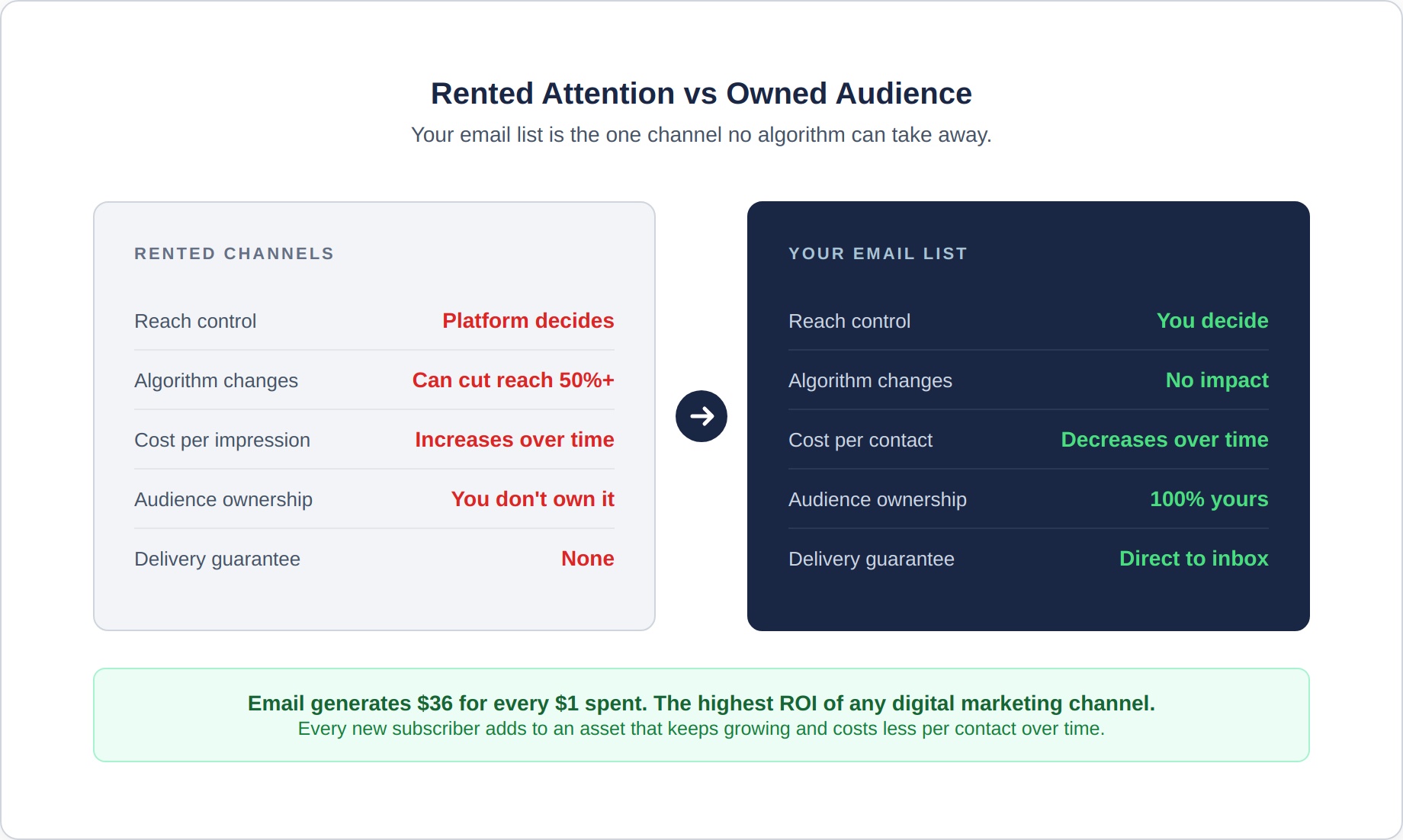
Social media reaches people on platforms you don’t control. Algorithms change. Reach declines. Accounts get restricted. One platform policy update can cut your visibility in half overnight, and there is nothing you can do about it.
Your email list is an audience you control. Algorithms or platforms can’t limit your reach. Subscribers receive your message directly, on your schedule, as long as they choose to remain.
Level 0 built your website. Level 1 created daily visibility. Level 2 gave visitors a path to convert and automate the follow-up. Level 3 expands your reach by growing a list of people who have shown interest and by maintaining a relationship with them through weekly trust-building content.
In a world of social media, AI, and ever-emerging platforms, email stands out. It consistently delivers the highest ROI of any digital marketing channel. The data has not changed in over a decade. Email generates $36 for every $1 spent across industries. In B2B, returns are often higher. Deal sizes are larger, and trust-building email enables direct communication. This shortens sales cycles.
Here’s why email works when other channels fluctuate:
Inbox access is permission-based. When someone subscribes to your newsletter or downloads your lead magnet, they give you explicit permission to appear in their inbox. That permission creates a different dynamic than an ad that interrupts or a social post that gets algorithmically filtered. The buyer chose to hear from you.
Email reaches buyers during decision windows. Social media is consumed passively as you scroll. Email is consumed actively during work. When a B2B buyer opens your newsletter on a Tuesday morning at their desk, they’re in a business decision mindset. That context matters.
Email compounds over time. Every new subscriber adds to an asset that keeps growing. A newsletter sent today reaches your entire list. Next month’s newsletter will also reach everyone who subscribed in the meantime. The audience compounds in a way that social media impressions do not.
Email survives platform changes. LinkedIn algorithm changes affect your social reach. Google search ranking shifts affect your organic traffic. Increased ad costs hurt your paid performance. Your email list is immune to all these changes. It stays in your database, waiting for your next message, no matter what platforms do.
What You Get
Lead Magnet Strategy and Creation
Lead magnets help grow your email list by offering valuable resources in exchange for contact information. They create a mutually beneficial exchange: buyers receive something useful, while you gain permission to engage with them through email.
Quarterly lead magnet production includes:
Each quarter, we create one new lead magnet from scratch. It is designed for your specific buyer profile. Each feels genuinely valuable and is specific enough to attract the right audience, not just anyone.
Lead magnet types we create:
- Guides and playbooks (10-20 pages) that walk the buyer through a specific process, framework, or decision they’re facing
- Checklists and cheat sheets (1-3 pages) that provide an immediately useful tool the buyer can apply to their situation today.
- Assessments and scorecards help buyers diagnose their own situation. They see where they stand. These tools naturally position your services as the solution to the gaps the assessment reveals.
- Templates and toolkits offer a practical head start for buyers, demonstrating your expertise through thoughtful structure and actionable content.
- Industry reports and benchmarks offer data and insights buyers can’t find elsewhere. These positions you as the authoritative market source.
Each lead magnet includes:
- We research which specific resource would be most valuable to your target audience. This is based on sales conversation data, search trends, and competitor gap analysis.
- Content writing meets the same quality and depth you’d find in a paid resource. We don’t use thin PDFs full of filler just to justify the download.
- Professional design and formatting to make the resource look and feel premium.
- Landing page creation through Level 2 infrastructure with a dedicated conversion page matched to the lead magnet topic.
- Delivery automation through Level 2 sequences with a welcome series triggered upon download.
What a real lead magnet looks like:
Most lead magnets are disappointments. The buyer trades their email address for a 3-page PDF that could have been a blog post. They feel tricked. They unsubscribe. They associate your brand with low-value bait.
Level 3 lead magnets set a higher standard. For example, we often create a detailed 14-page assessment guide with a 30-question self-diagnostic, a scoring rubric, a priority matrix, and real industry benchmark data—each project takes 2-3 weeks. Clients often comment that these are more valuable than what some consultants charge $500 for.
This high standard is intentional. Your lead magnet is the buyer’s first impression of your expertise. A comprehensive free resource signals that your paid services are exceptional. If the free resource lacks depth, prospects may assume the same about your other offerings.
Newsletter Strategy and Execution
Your newsletter is the ongoing relationship-building engine that keeps your company top of mind with buyers week after week. It is not a promotional vehicle. It is a trust-building tool.
Weekly newsletter includes:
- 4 newsletters per month (weekly send) written around buyer concerns, industry insights, and your company’s perspective on the topics that matter to your audience
- Each newsletter is 400-800 words — long enough to deliver genuine value, short enough to be read in 3-5 minutes during a busy workday.
- Content is written in your voice using the same approach as Level 1: we study how you communicate and produce content that sounds like you, not like a marketing team.
- Every newsletter includes one clear CTA that gives readers a natural next step without feeling pushy — sometimes it’s a link to a new blog post, sometimes it’s a lead magnet, sometimes it’s an invitation to book a call, always matched to the content’s topic.
What newsletters actually cover:
This is not a company update email. Nobody wants to read about your new hire, your office renovation, or your company anniversary. Your newsletter delivers value that the reader would miss if they unsubscribed.
- Insights from your work that help the reader think about their own business differently, drawn from the same expertise that Level 1 social content is built on
- Frameworks and mental models that give readers tools to evaluate their own situation
- Industry perspectives that demonstrate your awareness of market trends and how they affect your audience
- Answers to common questions that your sales team hears repeatedly, addressing concerns before the buyer ever reaches out
- Curated recommendations when relevant external resources, tools, or approaches would genuinely help your reader
What the subject lines actually look like:
Subject lines determine whether your newsletter gets opened or ignored. Here are examples of the kind of subject lines Level 3 produces:
- “The $32,000 mistake I see B2B companies make every quarter.”
- “Why your best leads ghost after the first call (and how to fix it).”
- “The one question that tells you if your marketing is actually working.”
- “I audited 12 B2B websites this month. Here’s what they all got wrong.”
- “Your landing page isn’t broken. Your offer is.”
- “The follow-up email that books 3x more calls (template inside)”
- “What I’d do differently if I were rebuilding my marketing from scratch.”
- “Stop measuring leads. Start measuring this instead.”
Each subject line is specific, curiosity-driven, and promises value the reader can use. Generic subjects like “Monthly Update” or “Newsletter #14” never appear.
What a typical month of newsletters looks like:
- Week 1: A specific insight from a recent client situation (anonymized) that reveals a pattern most readers would recognize in their own business
- Week 2: A framework or checklist the reader can apply to a specific challenge they’re facing, demonstrating your thinking process
- Week 3: Your perspective on something happening in the industry that most people are thinking about but few are articulating clearly.
- Week 4: A deeper exploration of a question your sales team keeps hearing, answering it thoroughly enough that readers who eventually become clients arrive already understanding your position
How the Newsletter Voice Develops
Buyers worry that outsourced content won’t sound like them. Here’s how we solve that:
Month 1 involves the closest collaboration. We write based on the onboarding conversation. You review every newsletter and provide specific feedback: “I wouldn’t say it this way, I’d say it like this,” or “This point needs more edge,” or “Add the story about the client who tried X, and it failed.” The revisions refine our understanding of your voice rapidly.
In Month 2, the voice starts locking in. Reviews get faster. You’re making minor adjustments rather than directional changes. The content feels 80-90% like you on the first draft.
From Month 3 onward, the voice is established. Most clients approve newsletters in under 5 minutes because the content sounds like them without significant editing. Ongoing input from sales conversations and quarterly strategy calls keeps the content evolving with the business, so the voice stays current even as your thinking develops.
The result: subscribers believe you write every word yourself. That authenticity is preserved throughout the engagement.
Send Time Optimization
When your newsletter lands in the inbox, it matters. We don’t guess at timing.
During the first month, we test send times across the days and hours most likely to produce opens for your specific audience. Tuesday through Thursday mornings typically perform best for B2B, but every audience has specific patterns.
By month 2, we’ve identified the optimal send window for your list based on actual open data. Newsletters are sent when your specific subscribers are most likely to be at their desks, checking email.
Ongoing optimization adjusts timing based on seasonal patterns, industry rhythms, and shifts in subscriber behaviour. Some audiences open earlier in Q1 and later in Q4. We adjust as the data evolves.
What Happens When Someone Replies
Newsletter replies are often the highest-quality leads in the entire system because the buyer initiated the conversation. Level 3 includes a clear protocol for handling them:
- All replies are routed to your inbox, so you see them immediately. The newsletter comes from your email address, not a no-reply address, because real conversations start through replies.
- You personally respond to genuine questions or conversation starters. These are warm leads who self-identified by reaching out.
- We flag high-intent replies when a subscriber’s response indicates buying interest: asking about pricing, requesting a call, or describing a problem that matches your service.
- Sales team notification when a reply indicates the subscriber is ready for a conversation, the same handoff process from Level 2 applies, so no warm lead slips through.
- Reply to the data feeds content strategy. When multiple subscribers reply about the same topic, it signals high interest that informs future newsletter content, lead magnet topics, and Level 1 social content.
On average, well-written B2B newsletters generate 2-5 direct replies per send. Over a month, that’s 8-20 warm conversations initiated by the buyer. These convert at dramatically higher rates than any outbound or advertising channel because the buyer chose to engage.
List Segmentation
Not every subscriber is the same. Treating them the same results in generic emails that resonate with no one. Level 3 includes segmentation that ensures different buyers receive content matched to their specific situation.
Segmentation criteria include:
- Lead source: Where did they enter the list? A lead magnet download indicates different interests than a newsletter sign-up or a Level 2 landing page conversion.
- Engagement level: Active readers who open and click every week receive different treatment than subscribers who haven’t opened in 60 days
- Buyer stage: Someone who downloaded an assessment is at a different stage than someone who attended a webinar or requested a quote
- Industry or company type: If your business serves multiple industries, segmentation ensures each industry receives content relevant to its specific context
- Behaviour signals: What pages have they visited on your website? What links have they clicked in previous emails? What content topics do they engage with most?
How segmentation works for multiple buyer personas:
If your business sells to different types of buyers, segmentation handles this in one of two ways, depending on your list size:
- For lists under 2,000 subscribers: A single newsletter with universal value that resonates across personas, supplemented by persona-specific lead magnets that attract the right segments. The newsletter content focuses on shared challenges, while lead magnets address specific situations.
- For lists over 2,000 subscribers: Persona-specific content variations within the same send, where sections or CTAs change based on the subscriber’s segment. Or fully separate newsletter tracks for distinct personas when the audiences are different enough to warrant it.
We recommend the simplest approach that serves your audience effectively and add complexity only when the data shows it’s needed.
List Hygiene and Deliverability
A growing list is only valuable if your emails actually reach the inbox. Level 3 includes ongoing list maintenance that protects your sender reputation and maximizes deliverability:
- Monthly bounce cleanup, removing invalid addresses that hurt your sender score
- Engagement-based cleaning, identifying and managing subscribers who haven’t opened in 90+ days, to prevent your emails from being flagged as unwanted
- Unsubscribe management processing opt-outs immediately and ensure compliance with CAN-SPAM, GDPR, and CASL requirements.
- Spam trap monitoring, watching for signs that your sending domain or IP has been flagged.
- Deliverability testing periodically checks inbox placement across major email providers (Gmail, Outlook, Yahoo) to ensure your emails land in the primary inbox rather than the promotions or spam folders.
- Sending domain authentication, configuring SPF, DKIM, and DMARC records, so email providers trust your sending identity.
Many businesses build large email lists that produce poor results because 30-40% of their list is inactive, their sender reputation has degraded, and half their emails land in spam folders. Level 3 prevents this by maintaining list health from day one.
Re-Engagement Strategy for Dormant Lists
If you have an existing email list that hasn’t been contacted in months or longer, Level 3 includes a structured re-activation process before regular newsletters begin:
Week 1: List cleaning. We remove obviously invalid addresses, duplicates, and contacts that are clearly no longer relevant. This protects the sender’s reputation before a single email is sent.
Week 2: Soft re-introduction. A carefully crafted email to the cleaned list that reintroduces who you are, acknowledges the communication gap, and offers clear value for staying subscribed. No hard sell. No pressure. Just: “We’re starting something new. Here’s what you’ll get. Stay if it’s useful. Unsubscribe if it’s not.”
Week 3-4: Value-first sequence. 2-3 emails delivering genuine value with no ask, demonstrating the quality of what the newsletter will become. Each email gives recipients a reason to stay and an easy way to leave.
Week 5+: Regular cadence begins for contacts who remained engaged through the reactivation. Contacts who didn’t open any of the reactivation emails are moved to a separate list for one final attempt before removal.
Expected results: Typically, 30-50% of a dormant list re-engages through this process. The remaining 50-70% is removed, which feels like a loss but actually improves everything: better sender reputation, higher open rates, more accurate engagement data, and a cleaner foundation for growth.
Opt-In Forms and List Growth
Level 3 includes strategic placement of email capture points across your digital presence:
- Website opt-in forms placed on high-traffic pages with offers matched to the page content rather than generic “subscribe to our newsletter” boxes
- Blog and content CTAs (when Level 4 is active) with lead magnets relevant to the article topic
- Exit-intent and scroll-trigger forms that appear at strategic moments without being aggressive or intrusive
- Social media integration, coordinating with Level 1 to drive followers toward email subscription through exclusive content or lead magnets.
- Landing page integration with Level 2, ensuring every conversion point feeds the email list appropriately.
Each opt-in form is designed around a specific value exchange. “Subscribe to our newsletter” converts poorly because it’s vague. “Get the weekly marketing insight that 2,000 B2B leaders read every Tuesday” converts well because it’s specific, valuable, and creates the expectation of quality.
Where Unconverted Level 2 Leads Go
One of Level 3’s most valuable functions is giving unconverted leads a second life.
When a lead enters Level 2 via a landing page, completes the welcome and nurture sequences, but doesn’t convert to a sales conversation, they don’t disappear. They flow into Level 3’s newsletter audience, where they continue to receive weekly, value-driven content that keeps your presence top of mind.
Many of your best future clients are in this pool. They were interested enough to convert on a landing page. They engaged with your nurture sequence. They just weren’t ready yet. Level 3 keeps the relationship alive through ongoing value delivery until the timing is right.
Without Level 3, these leads die in your CRM. With Level 3, they receive a weekly reminder that you exist, you’re knowledgeable, and you’re available when they’re ready. Some of them will re-engage months later and become your highest-value clients because the trust was built slowly over time.
Holiday and Seasonal Strategy
Not every week is the same. Level 3 accounts for the rhythms of the business year:
- During holiday weeks (Christmas, New Year’s, major national holidays), newsletters are either paused or sent with lighter, reflective content that matches the mood. We don’t pretend it’s a normal Tuesday when everyone is off.
- Low-engagement periods (typically late December and mid-August): Send cadence may shift, or content may be adjusted to account for lower attention. We’d rather send one excellent newsletter during a slow week than a mediocre one that trains subscribers to skip your emails.
- Industry-specific timing: If your industry has seasonal peaks (tax season, budget planning, annual conferences), newsletter content aligns with what your audience is thinking about during those periods.
- Year-end and year-start: These periods often produce the highest engagement for planning-oriented content. We use them strategically for your most valuable insights.
The cadence is consistent. The content adapts to reality.
Monthly Reporting
Every month, you receive a clear report covering:
- Newsletter performance: open rates, click rates, reply rates, and engagement trends across the month
- List growth: new subscribers by source, unsubscribes, and net list growth
- Segmentation health: subscriber distribution across segments and engagement levels per segment
- Lead magnet performance: downloads, conversion rates, and lead quality from each active lead magnet
- Deliverability metrics: inbox placement rates, bounce rates, and sender reputation score
- Content analysis: which newsletter topics produced the highest engagement, and which underperformed
- Reply analysis: how many direct replies were received, what topics triggered them, and which led to sales conversations
- Pipeline contribution: how many email subscribers entered sales conversations, and how they compare to other lead sources
- Recommendations: content adjustments, segmentation refinements, and new lead magnet opportunities for next month
The metrics that actually matter:
Open rates are becoming less reliable as an indicator due to Apple Mail Privacy Protection, which pre-loads emails and inflates open counts. We track open rates as a directional signal but make strategic decisions based on more reliable metrics:
- Click rates show genuine engagement because the subscriber took an intentional action.
- Reply rates show the deepest engagement because the subscriber initiated a conversation.
- Pipeline contribution is the ultimate metric, but takes 3-6 months to measure meaningfully.
- List growth rate indicates whether the audience asset is building momentum or stalling.
We report everything. We make decisions based on the metrics that actually predict business outcomes.
Quarterly Lead Magnet Review
Every 90 days, we evaluate lead magnet performance and plan the next quarter:
- Download analysis: which lead magnets produced the most downloads, and which attracted the highest-quality leads.
- Conversion path analysis: how lead magnet downloaders progress through nurture and into sales conversations
- Competitor newsletter analysis: what competitors are sending, what’s working for them, and how your newsletter differentiates in the subscriber’s inbox
- Content gap assessment: what topics or resources are missing that your audience is searching for
- Refresh decisions: whether existing lead magnets need updating based on market changes, new data, or declining download rates
- Next quarter planning: selecting and scoping the next lead magnet based on data, sales feedback, and market opportunity
What a Subscriber Actually Experiences
Here is what the email relationship feels like from the buyer’s side when Level 3 is working.
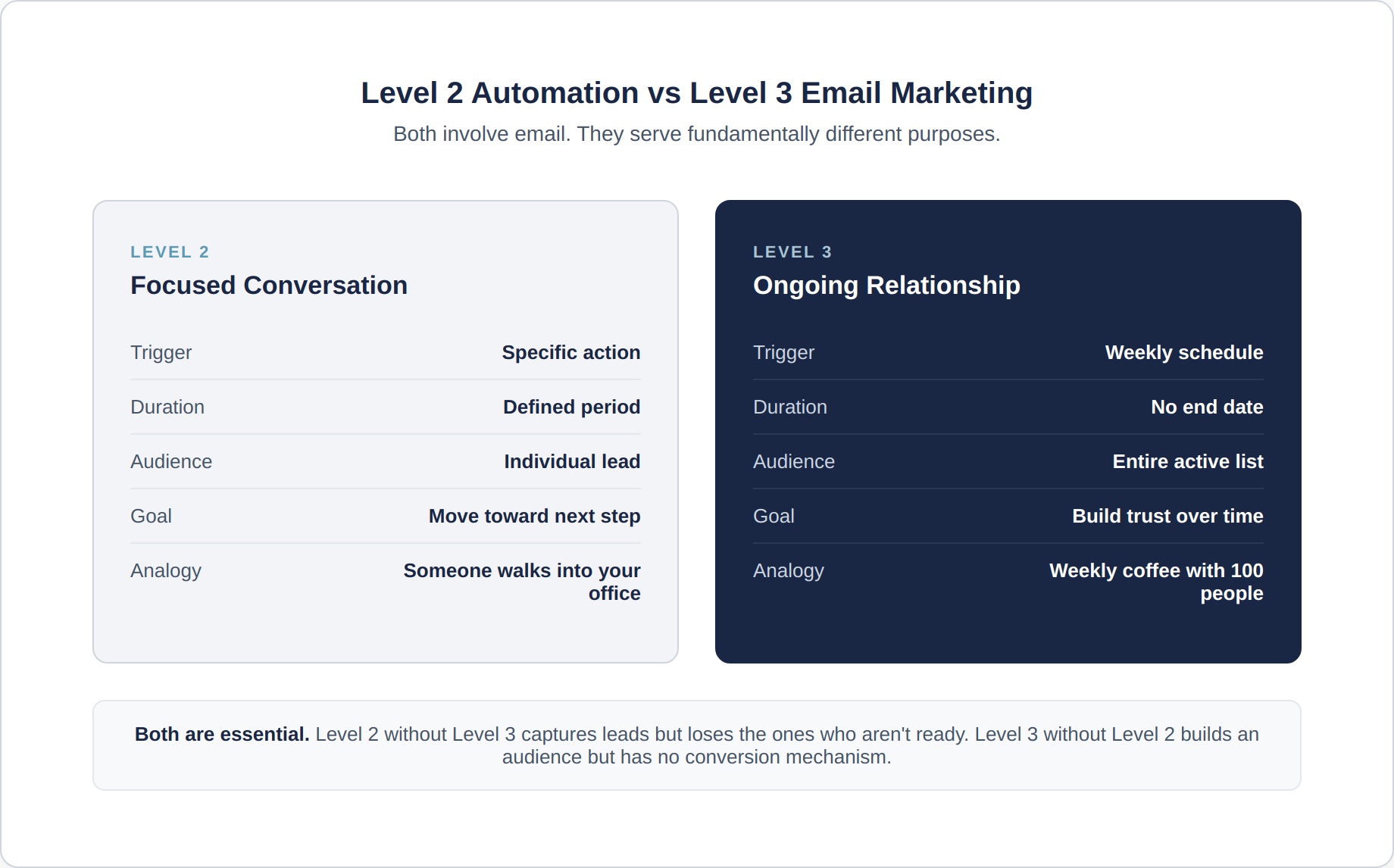
Week 1: The buyer downloads a marketing assessment from a Level 2 landing page they found through a Level 1 LinkedIn post. They receive the assessment immediately, plus a welcome email explaining what to expect: “Every Tuesday, I send a 4-minute read with one insight about B2B marketing that you can actually use. No fluff. No pitches. Just the stuff I’d tell you if we were having coffee.”
Week 2: Tuesday morning at 9:12 AM, the first newsletter arrives. The subject line reads: “The $32,000 mistake I see B2B companies make every quarter.” They open it. It’s concise, specific, and genuinely useful. They think: “This is better than most of the marketing content I read.” They click a link to a related resource on the website.
Week 4: The buyer has now received 3 newsletters. They’ve opened all of them. They’ve clicked on two. They forwarded one to a colleague with the note “You should subscribe to this.” They’re starting to associate your name with useful, practical thinking about their problem.
Week 8: The buyer receives a newsletter that addresses the exact challenge they brought up in a team meeting that morning. They think: “It’s like this person is reading my mind.” They hit reply and write: “Quick question — does this apply to companies our size? We’re about 40 people.” You now have a warm conversation started by the buyer, not by your sales team.
Week 12: The buyer’s company decides it’s time to address the problem your newsletter has been educating them about for 3 months. When someone asks, “Who should we talk to?”, your name comes up immediately because you’ve been in their inbox every week demonstrating expertise. They don’t need to search. They don’t need to compare. They already know who to call.
That progression from stranger to trusted advisor happened without a single sales call. The newsletter did the trust-building work over 12 weeks of consistent, valuable contact. By the time the buyer reaches sales, the hard work is done.
How Level 3 Differs From Level 2 Automation
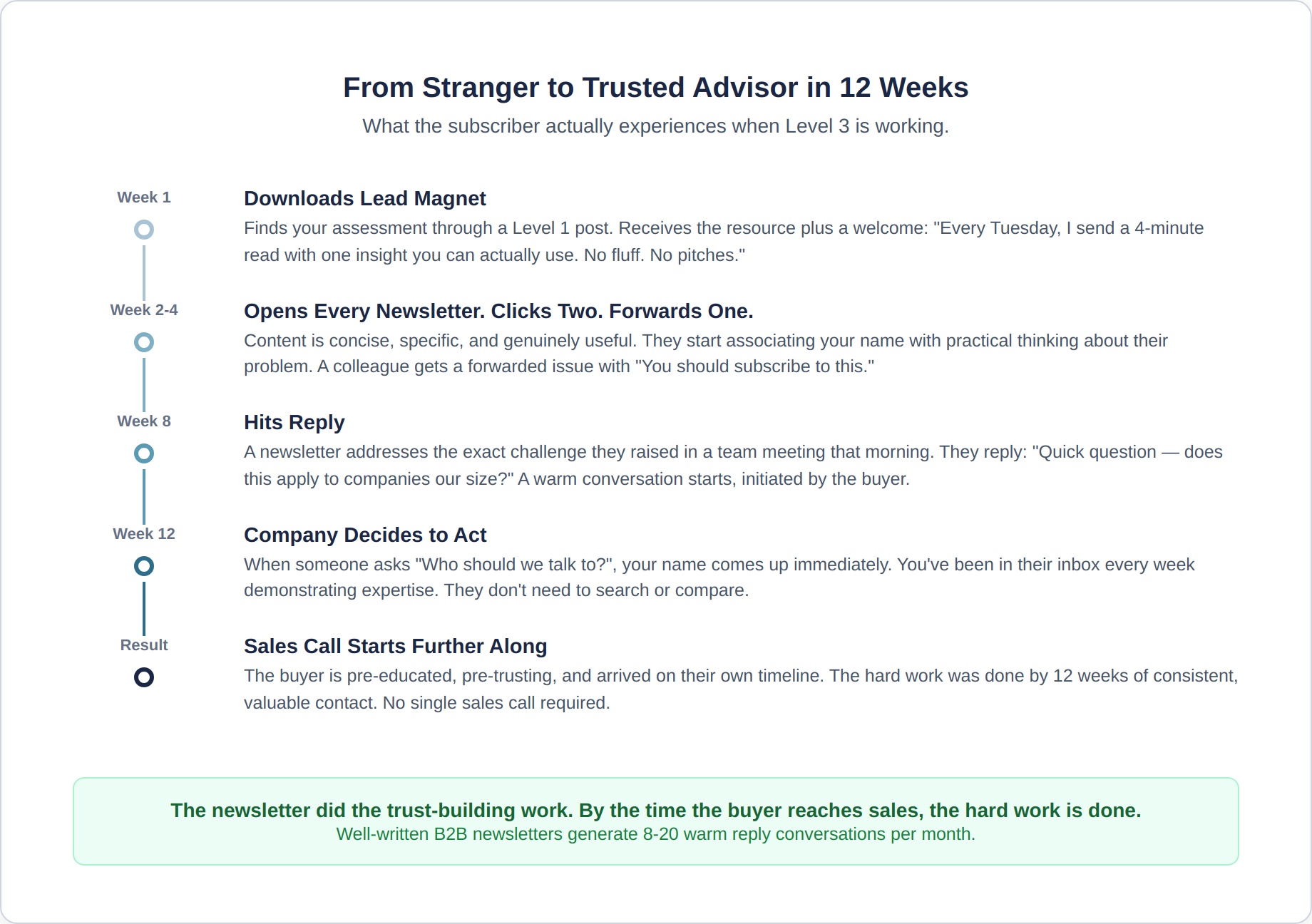
Level 2 and Level 3 both involve email, but they serve fundamentally different purposes:
Level 2 automation is triggered by specific actions. A buyer fills out a form and receives a defined sequence of emails over a set period. The sequence has a beginning and an end. It’s designed to move a specific lead toward a specific next step within a defined timeframe.
Level 3 email marketing is ongoing and relationship-based. It’s not triggered by a single action. It’s a continuous stream of value delivered to your entire audience on a consistent schedule. There is no end date. It runs as long as the subscriber stays on the list.
Think of it this way: Level 2 is the focused conversation you have with someone who just walked into your office. Level 3 is the weekly coffee meeting you have with 100 people simultaneously, keeping the relationship warm and your expertise visible until each one is ready for a focused conversation.
Both are essential. Level 2 without Level 3 captures leads but loses the ones who aren’t ready yet. Level 3, without Level 2, builds an audience but has no focused conversion mechanism to capture intent when it appears.
How Level 3 Data Informs the Entire Ecosystem
Level 3 doesn’t just send emails. It generates intelligence that makes every other level smarter.
Newsletter engagement data reveals what your audience actually cares about. When a newsletter topic produces 2x the normal click rate, that signal ripples across the system:
- Level 1 social content shifts toward the topics that newsletter data shows are resonating
- Level 2 landing pages get new offers built around the themes that produced the highest engagement.
- Level 4 blog content (when active) prioritizes the topics that newsletter subscribers clicked on most.
- Level 5 video content (when active) uses newsletter engagement as a topic testing ground before investing in long-form production.
Low-performing topics get deprioritized across all channels. If a newsletter about a specific topic produces below-average engagement, we don’t just stop writing about it. We reduce the prominence of that topic across social media, landing pages, and content. The data from Level 3 creates a closed-loop system where audience behaviour drives content strategy everywhere.
Reply patterns reveal the conversations your audience wants to have. When multiple subscribers reply about the same topic, it signals an unmet need that can become a new lead magnet, landing page offer, social content series, or blog content cluster.
How Level 3 Connects to the Ecosystem
Email marketing amplifies and is amplified by every other level in the system:
- Level 1 social media drives newsletter subscriptions and lead magnet downloads by promoting exclusive email content to social followers.
- Level 2 landing pages capture the leads that Level 3 nurtures long-term, and Level 3 gives Level 2 more offers (lead magnets) to build landing pages around.
- Level 4 blog content provides material for newsletters and creates additional opt-in opportunities through content-specific lead magnets.
- Level 5 video content feeds newsletter content through video summaries, exclusive clips, and behind-the-scenes insights shared with email subscribers first.
- Level 6 paid ads can target custom audiences built from email subscriber segments, and newsletters can warm audiences before they see ads.
- Level 7 AI outreach benefits from email engagement data that reveals which contacts are most active and which topics resonate, informing outbound targeting and messaging
The email list you build at Level 3 becomes one of the most valuable assets in the entire ecosystem. It’s the one channel where you have direct, permission-based access to your audience, regardless of what any platform, algorithm, or competitor does.
What Unsubscribing Actually Means
Buyers sometimes worry that building an email list and then having people unsubscribe damages the relationship or indicates failure. It doesn’t.
Unsubscribing from the newsletter doesn’t mean unsubscribing from the relationship. A contact who unsubscribes from your newsletter may still follow you on LinkedIn, visit your website, engage with your Level 1 content, or respond to direct outreach. The email list is one touchpoint, not the entire relationship.
Healthy unsubscribe rates indicate that the list is self-qualifying. Subscribers who leave were unlikely to become clients. The subscribers who stay are the ones finding genuine value, and those are the people worth nurturing. Typical unsubscribe rates for well-written B2B newsletters are 0.1-0.3% per send, meaning 99.7%+ of your list stays with each email.
The value of weekly contact with subscribers who stay far exceeds the loss of the few who don’t. A list of 900 engaged subscribers outperforms a list of 3,000 disengaged ones in every metric that matters: open rates, click rates, reply rates, and pipeline contribution.
What Determines Where You Fall in the Price Range
Level 3 – Email Marketing & Nurture
Consistent communication and relationship-building systems that turn leads into buyers and keep your audience engaged over time.
| Scope Factor | Lower ($1,500–$2,200/mo) | Mid ($2,200–$2,900/mo) | Upper ($2,900–$3,500/mo) |
|---|---|---|---|
| Newsletter Frequency | 1x per week | 2x per week | 2–3x per week |
| Audience Segmentation | Basic list segmentation | Behavior-based segmentation | Advanced dynamic segmentation across multiple criteria |
| Email Content Depth | Single-angle educational emails | Educational + trust-building + light conversion | Full funnel emails (education, authority, conversion, re-engagement) |
| Automation Support | Newsletter only | Newsletter + support for key sequences | Full coordination with Level 2 automation ecosystem |
| Personalization | Name and basic fields | Behavior-based personalization | Dynamic personalization based on engagement and lifecycle stage |
| Content Sources | Repurposed Level 4 content | Repurposed + original email-first insights | Fully integrated with content, sales, and ecosystem data |
| Engagement Optimization | Basic subject line testing | Ongoing optimization of open and click rates | Full performance optimization with retention and conversion focus |
| Re-Engagement Strategy | Not included | Basic re-engagement campaigns | Full re-engagement system with multiple touchpoints |
| Lead Warming | General nurture | Segmented nurture by interest | Behavior-driven warming aligned with buying signals |
| Performance Tracking | Open and click rates | Engagement trends and segmentation insights | Full lifecycle tracking tied to conversions and revenue |
What This Level Solves
Level 3 solves the problem of losing buyers during the gap between initial interest and purchase readiness. In B2B, that gap is often weeks or months. Without a mechanism to maintain presence during that period, interested buyers forget about you, get distracted by competitors, or simply move on because nobody kept the conversation going.
Level 3 fills that gap with a consistent, valuable relationship that keeps your company top of mind, builds trust incrementally through weekly contact, and ensures that when the buyer is finally ready to act, your name is the first one they think of.
What This Level Does NOT Include
- Website pages or website changes (Level 0)
- Social media content creation or management (Level 1)
- Landing page creation or campaign-specific automation sequences (Level 2 — though Level 3 lead magnets are delivered through Level 2 infrastructure)
- Blog content, SEO articles, or long-form written content beyond lead magnets (Level 4)
- Video production (Level 5)
- Paid advertising management (Level 6)
- AI outreach or automation (Level 7)
Level 3 builds and nurtures the owned audience. The levels around it provide visibility, conversion infrastructure, content, and amplification that drive audience growth and engagement.
What You Need to Provide
- Onboarding conversation (60 minutes): We learn about your audience, their concerns, the questions they ask most frequently, and the topics you have the strongest perspectives on
- Voice and perspective input: Similar to Level 1, we need to understand how you think about your industry so newsletters sound like you. This is established during onboarding and refined over the first month through closer collaboration and feedback.
- Lead magnet input (30-45 minutes per quarter): A strategy conversation where we align on the next lead magnet topic, format, and target audience. You provide subject matter expertise. We handle the writing, design, and production.
- Newsletter review (10-15 minutes per week): Review each newsletter before it sends. Most clients approve within minutes once the voice is established, typically by month 2-3.
- Reply management: You respond personally to subscriber replies that warrant a human response. We flag high-intent replies and route them through the sales notification process.
- Monthly report review (20-30 minutes): Review performance data and align on adjustments.
- Sales feedback (as needed): Sharing what you’re hearing in sales conversations so newsletter content stays relevant to what buyers actually care about.
Total monthly time commitment: approximately 2-3 hours, with the largest investment being the quarterly lead magnet strategy session.
How Long Before You See Results
Week 1: First newsletter sends to your existing contacts and any Level 2 leads that have accumulated. Open rates and click rates establish baseline engagement.
Month 1: Newsletter cadence is established. Subscribers begin recognizing your weekly email. Send time optimization begins. Lead magnet launches through Level 2 landing pages and begins generating new subscribers. First replies come in.
Month 2: List growth becomes visible as social media promotion, website opt-ins, and lead magnet downloads add subscribers weekly. Newsletter engagement patterns emerge, showing which topics resonate most. Reply rate establishes a pattern.
Month 3: The compounding effect begins. The list is measurably larger than when you started. Segmentation data reveals which subscribers are most engaged. The first subscribers who entered through lead magnets 8-10 weeks ago begin showing buying signals as the trust built through weekly contact reaches the threshold where action feels safe. Newsletter data starts informing content strategy across all active levels.
Months 4-6: Newsletter becomes a recognized asset. Subscribers forward issues to colleagues. Reply rates increase as readers feel comfortable engaging directly. The sales team reports that prospects reference newsletter content in their conversations. The pipeline contribution from email becomes trackable and meaningful.
Month 6+: The email list is one of your strongest business assets. New subscribers join weekly. Engaged subscribers move toward sales conversations on their own timeline. The weekly newsletter produces a steady, predictable flow of warm contacts who are pre-educated and pre-trusting when they reach sales. Level 3 data is actively shaping content strategy across the entire Conversion Ecosystem.
Why This Investment Makes Sense
Consider the lifetime value of an email subscriber compared to that of other marketing channels.
A social media follower sees your content when the algorithm decides to show it. An email subscriber sees your content every single week because you deliver it directly to their inbox.
A paid ad impression lasts for the duration of the ad spend. An email subscriber stays on your list for months or years, receiving your message every week at no additional cost per impression.
A cold outreach contact requires a new message every time. An email subscriber receives your next newsletter automatically without any incremental effort.
At a monthly investment of $1,500-$3,500, Level 3 builds an audience asset that grows each month, costs less per contact as the list grows, and produces warm leads that convert at higher rates than any cold channel because trust was built before the sales conversation started.
A list of 1,000 engaged subscribers, at even a modest 2% conversion rate to sales conversations over a year, produces 20 warm conversations from people who already know you, trust your expertise, and chose to engage on their own timeline. At an average B2B deal size of $20,000, that’s $400,000 in potential pipeline from a single channel, at a cost less than a part-time hire.
Who Manages This
Rod Agatep personally oversees the newsletter strategy, lead magnet direction, and content quality of every Level 3 engagement. With 27 years of experience in B2B marketing, Rod understands the difference between email that gets opened and email that gets archived, between newsletters that build trust and newsletters that train subscribers to ignore you.
Every newsletter is developed under Rod’s direct supervision with content aligned to your positioning, your voice, and the strategic direction established across the Conversion Ecosystem. Lead magnets are developed with the same depth and quality standard as content you would charge for, because the value of the resource determines whether the subscriber trusts you enough to keep reading.
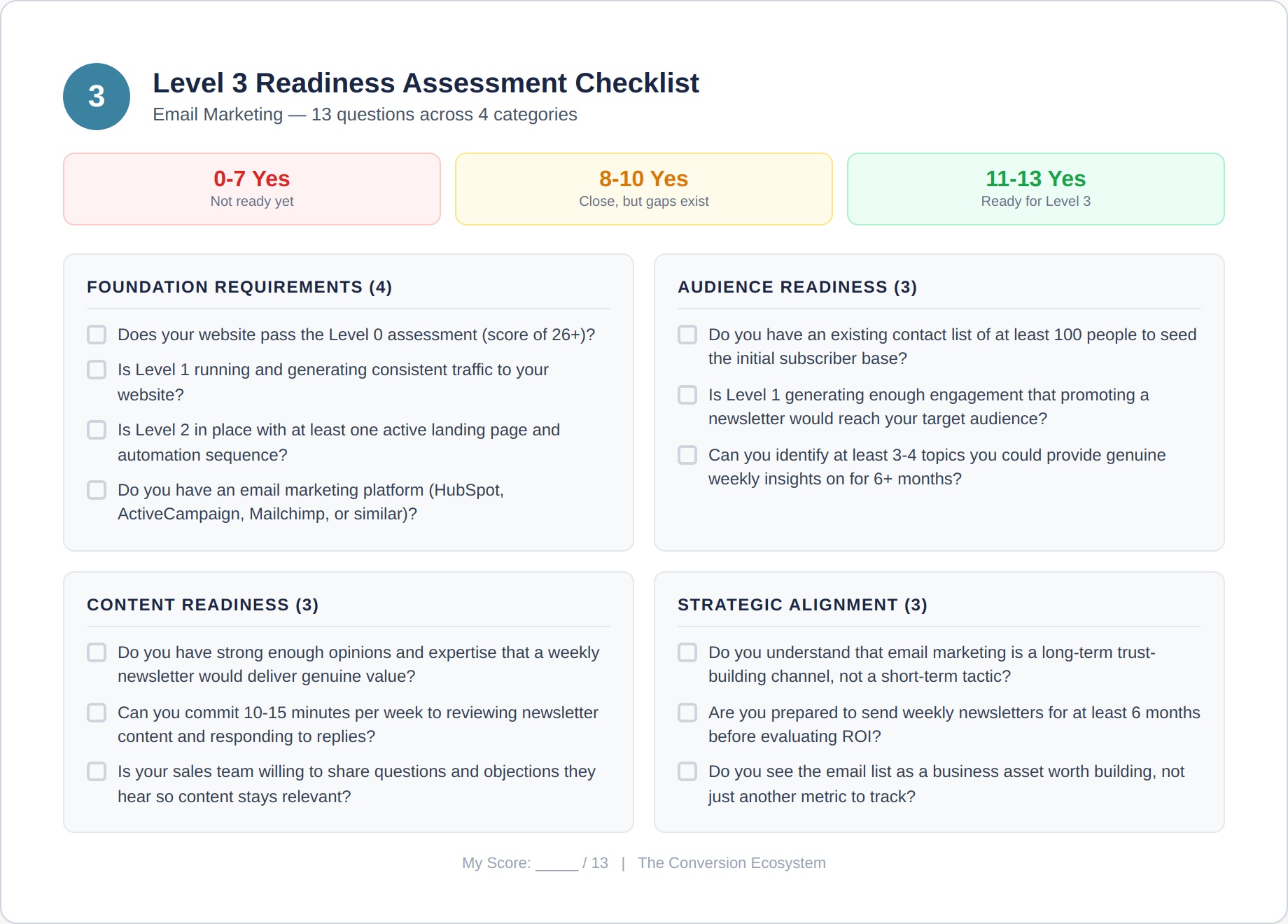
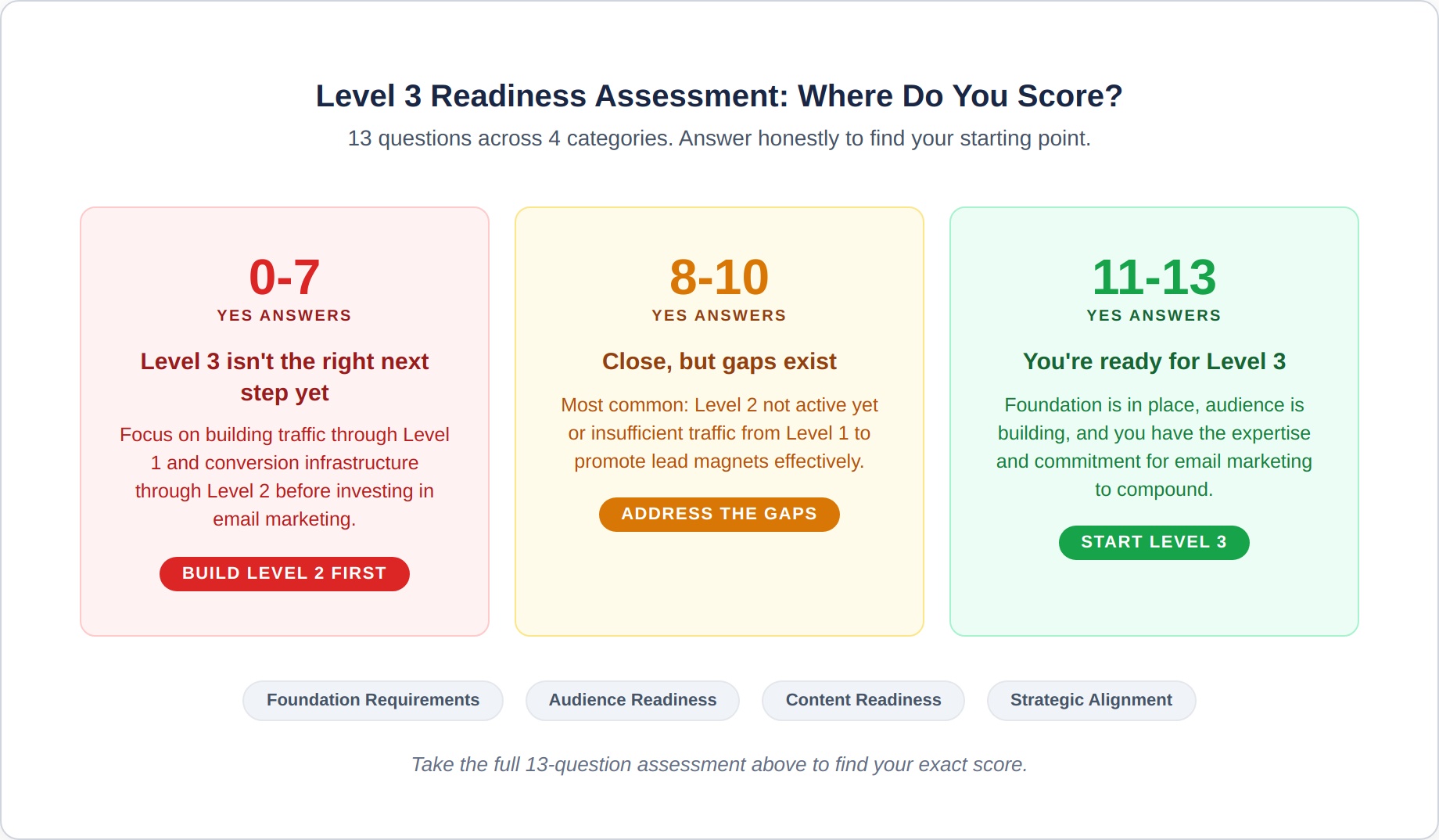
Level 3 Readiness Assessment
Scoring
11-13 YES answers: You’re ready for Level 3. Your foundation is in place, your audience is building, and you have the expertise and commitment needed for email marketing to compound.
8-10 YES answers: Close, but gaps exist. The most common gaps are Level 2 not being active yet (meaning no conversion infrastructure to capture subscribers) or insufficient traffic from Level 1 to promote lead magnets effectively. Address those first.
7 or fewer YES answers: Level 3 isn’t the right next step yet. Focus on building traffic through Level 1 and conversion infrastructure through Level 2 before investing in email marketing.
When to Move to Level 4
You’re ready for Level 4 (SEO, AEO, and Content) when:
- Level 3 has been running for at least 60-90 days with consistent newsletter engagement.
- Your email list is growing, and subscribers are engaging with content weekly.
- Newsletter engagement data has revealed which topics your audience cares about most, giving you a data-driven starting point for blog content strategy.
- You want to create a content library that generates organic search traffic and feeds the newsletter with deeper material.
- You’re ready to build search visibility that compounds over time rather than depending entirely on social media and email for traffic.
Level 3 builds the audience. Level 4 builds the content library that attracts new audience members through search while providing the newsletter with a continuous stream of high-quality material to share. Together, they create a content engine where blog articles feed newsletters, newsletters drive traffic to articles, and both build the authority that makes every other level more effective.
Pricing Summary
| Option | Investment |
|---|---|
| Level 3 monthly | $1,500 – $3,500/month |
| Level 3 annual commitment | 20% off monthly rate |
| Level 3 stacked with other levels | See Conversion Ecosystem pricing table |
What’s included: Newsletter strategy and writing (weekly), lead magnet strategy and creation (quarterly), list segmentation, list hygiene and deliverability management, opt-in form strategy and placement, send time optimization, reply handling protocol, dormant list re-activation (if needed), monthly performance reporting, quarterly lead magnet review, competitor newsletter analysis, and integration with Levels 1, 2, and above.
What’s not included: Landing page creation for lead magnets (Level 2), social media promotion of lead magnets (Level 1), blog content beyond lead magnets (Level 4), video production (Level 5), paid advertising (Level 6), or AI outreach (Level 7).
The Conversion Ecosystem Rule
Every level below your active level must be in place. Level 3 requires Levels 0 (website foundation) and 1 (social media to generate traffic), and ideally Level 2 (landing pages to capture and deliver lead magnets). Email marketing without traffic to drive subscriptions and without a conversion infrastructure to deliver lead magnets builds a system with no fuel. The foundation, visibility, and conversion layers must be active before the audience-building layer produces meaningful results.
Next Step
If you’re not sure whether Level 3 is the right next investment, whether your current list is healthy enough to build on, or whether your traffic and conversion infrastructure are ready to support email marketing, the fastest way to find out is a conversation.
We’ll review your current email setup, assess your list health, evaluate your Level 1 and Level 2 performance, and tell you honestly whether Level 3 will produce results now or whether other levels should come first.
No pitch. No pressure. Just clarity on where you stand and what to do next.
Frequently Asked Questions
How is this different from just sending a monthly email blast?
Most email blasts are promotional, infrequent, and sent to an unsegmented list. Level 3 is a strategic, weekly trust-building system with content written specifically for your buyer profile, segmented based on subscriber behaviour and interests, optimized for deliverability, and integrated with every other level of the Conversion Ecosystem. A monthly blast reminds people you exist. A weekly newsletter makes them trust you.
I already have an email list, but I never email them. Can we start from there?
Yes, with a structured re-activation process. We clean the list, send a soft re-introduction, deliver a value-first sequence over 2-3 weeks, and then begin the regular cadence with contacts who re-engaged. Typically, 30-50% of a dormant list reactivates through this process. Removing the unengaged contacts improves every metric for the remaining contacts.
How big does my list need to be to start?
There is no minimum size. Even a list of 100 contacts is worth nurturing if those contacts represent genuine potential buyers. The newsletter builds trust with existing contacts while lead magnets and opt-in forms grow the list over time. Starting with a small, engaged list is better than waiting until you have thousands of contacts, because the weekly cadence compounds value from day one.
Won’t people unsubscribe if I email them every week?
Some will. That’s healthy. Subscribers who unsubscribe from a valuable weekly newsletter were never going to become clients. The subscribers who stay are the ones who find your content genuinely useful, and those are exactly the people you want to nurture. Typical unsubscribe rates for well-written B2B newsletters are 0.1-0.3% per send, meaning 99.7%+ of your list stays with each email. The subscribers who left were never going to become clients. The subscribers who stay are finding genuine value, and those are the people worth nurturing. The value of weekly contact with engaged subscribers far exceeds the loss of the few who self-select out.
What’s the difference between the newsletter and the Level 2 nurture sequences?
Level 2 sequences are triggered by specific actions, run for a defined period, and are designed to move a specific lead toward a specific next step. The newsletter is ongoing, sent to your entire active list weekly, and designed to build trust over time without a defined endpoint. Level 2 is the focused follow-up. Level 3 is the continuous relationship. Leads that complete Level 2 sequences without converting flow into the Level 3 newsletter, where the relationship continues.
Can I write the newsletter myself and have you handle everything else?
Yes. Some clients prefer to write their own newsletter because they enjoy it or because their voice is difficult to replicate. In that arrangement, we handle strategy, editing, formatting, list management, segmentation, lead magnet creation, deliverability, and reporting while you provide the written content. This typically reduces the monthly investment to the lower end of the range.
What if I run out of things to write about?
You won’t. Your sales team hears questions every week. Your industry constantly produces news and trends. Your clients face challenges that evolve over time. The onboarding process maps out 6+ months of content themes before the first newsletter sends. The quarterly strategy refresh adds new topics based on what the data shows your audience is engaging with. In 27 years of building content systems, running out of material has never been the actual problem. Finding time to produce it is why Level 3 exists.
Do subscribers know the newsletter is written by a team rather than me personally?
The newsletter is written in your voice and represents your perspective. Whether you disclose that a team supports the production is your choice. Many business leaders have teams that support their communication across every channel. The key is that the insights, opinions, and expertise in the newsletter are genuinely yours. We capture your thinking and translate it into consistent, polished content. The voice is real. The production support is what makes weekly consistency possible.
What email platform do you recommend?
For most B2B companies at this stage, HubSpot or ActiveCampaign provides the best balance of capability, automation features, and value. Mailchimp works for simpler setups. If you already have a platform, we work within it. If you need to select one, we recommend the best fit during onboarding based on your list size, segmentation needs, and integration requirements. Platform costs are separate from the Level 3 investment.
What are the cancellation terms?
Month-to-month engagements can be cancelled with 30 days’ notice. Annual commitments receive the 20% discount in exchange for a 12-month term. Early termination of annual commitments is subject to a fee equal to the discount received on months already completed. You retain full ownership of your email list, all newsletter content, all lead magnets, and all automation configurations, regardless of how or when the engagement ends.
Do I own the content and the list?
Everything belongs to you. Every newsletter, every lead magnet, every automation sequence, and the email list itself. There are no licensing restrictions, content holdback clauses, or disputes over list ownership. If you cancel, you keep everything and can continue sending newsletters independently or with another provider.