
Key Takeaways
- Landing pages convert visitors into leads by focusing on one audience, one problem, one offer, and one action.
- Email automation enables prompt follow-up, keeping leads engaged from the start.
- Level 2 shifts marketing from visibility to systematically capturing and nurturing demand.
- Without landing pages and automation, leads lack a clear conversion path and engagement system.
- Investment: $2,000–$4,500 one time, plus a monthly optimization fee of $500–$1,500/month, depending on landing page volume, sequence complexity, and integration scope. Annual commitment: 20% off the monthly rate. Add more levels to get lower pricing. See the Conversion Ecosystem pricing table for exact rates.
Once Sentence Summary: Landing pages and automation form your sales infrastructure. These tools capture interest from earlier Levels automatically until a buyer is ready for a conversation.
Investment Range: $2,000 – $4,500 one time with a monthly optimization fee of $500-$1500/month (depending on page volume, automation complexity, and integration scope)
Annual Commitment: 20% off the monthly rate
Add more levels to unlock lower pricing. Contact us today or see the Conversion Ecosystem pricing table for exact rates.
Landing pages start converting as soon as they launch. Automation sequences reach full effectiveness in 60-90 days while they are tested and refined.
What This Level Is
Level 2 is where your marketing transitions from visibility to conversion. It is the infrastructure that turns attention into action and interest into a pipeline.
Level 0 gave you a website that explains your value. Level 1 gets you in front of buyers daily. Now buyers know you. They’ve seen your videos, read your posts, and some have clicked on your website. They’re interested.
But interest isn’t enough. Interest without a conversion mechanism disappears. The buyer meant to come back but forgot. They were going to reach out, but got busy. They liked what they saw but didn’t have a clear, specific next step. It did not feel easy to take in that moment.
Level 2 gives every interested buyer a focused, easy path to act now and keeps engagement warm automatically until sales engage.
Why Most Leads Go Cold Without This Level
Here’s what happens in most B2B companies without Level 2 in place.
A buyer sees your social media. They visit your site and see only a generic ‘Contact Us’ form. They think, ‘I’m not ready to talk yet. I just wanted to learn more.’ They leave and never come back.
Or they do fill out the form. A notification goes to someone’s inbox. That someone is busy. Three days pass. They finally sent a response. The buyer has moved on. The moment of interest has passed.
The buyer downloads something from your site and receives a single confirmation email. Afterward, there’s no follow-up, nurturing, or additional engagement. Their information waits in a spreadsheet for an inconsistent, often delayed, manual review. The buyer journey stops abruptly after the initial download.
Level 2 fixes these failures. It creates dedicated pages designed to convert at peak interest. It uses automated sequences to keep leads engaged, without relying on a person to follow up.
hink about what happens to the website traffic you already get.
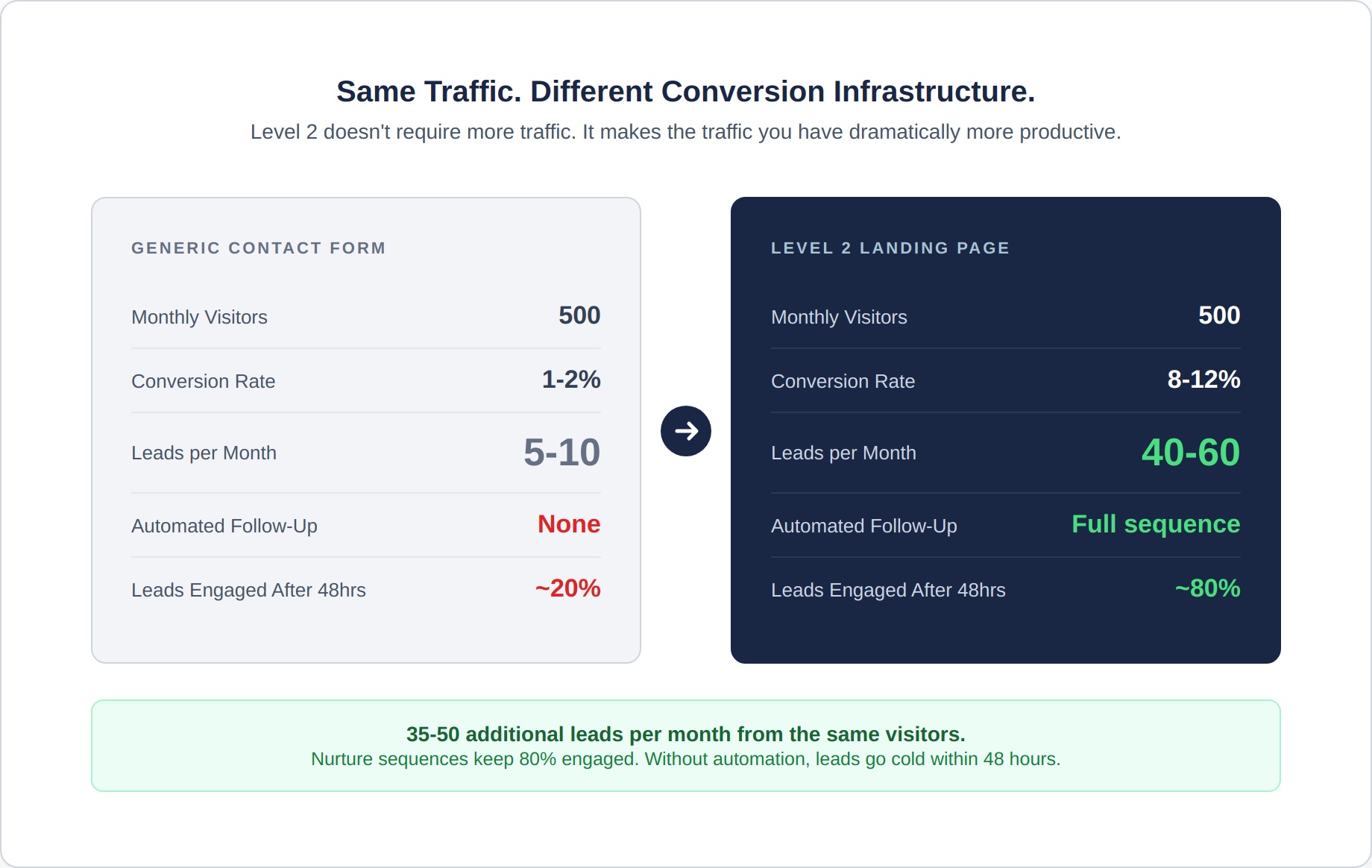
If Level 1 brings 500 monthly website visits from social, and your site converts at 1-2% with a generic form, you get 5-10 leads from 500 visitors. That leaves 490-495 interested people who take no action.
A focused landing page at 8-12% conversion turns 500 visits into 40-60 leads. Same visitors and spend—only the conversion-focused page changes, not the form.
Now add automated follow-up. Of those 40-60 leads, nurture sequences keep 80% engaged. These are leads not yet ready for sales, warming them over weeks. Without automation, leads go cold within 48 hours.
At your average deal size, those 30-50 additional leads per month represent a significant pipeline you’re currently losing. Level 2 doesn’t require more traffic. It makes the traffic you already have dramatically more productive.
What the Buyer Experience Actually Looks Like
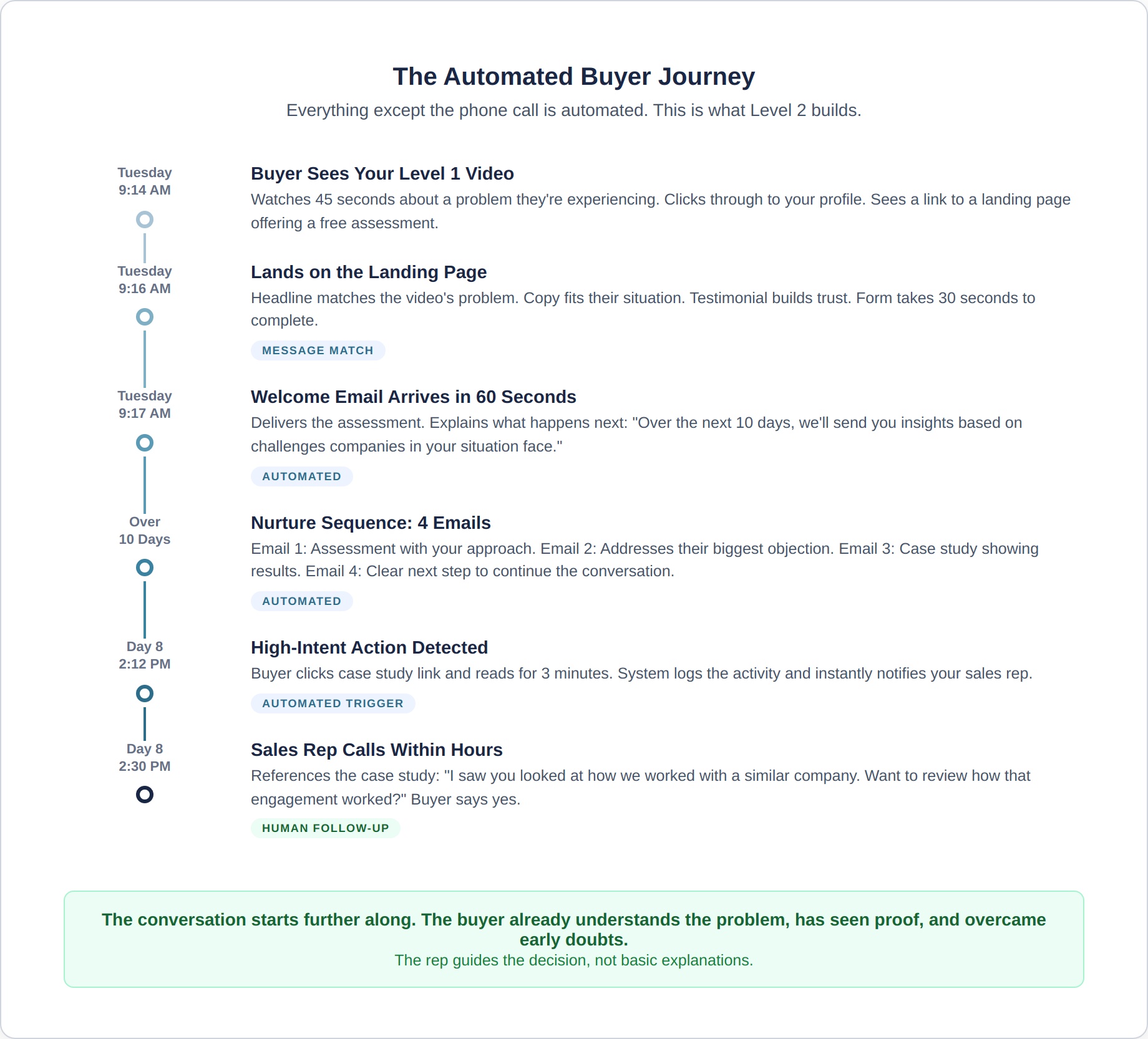
When Level 2 is implemented, the buyer’s journey follows a clear sequence. Each step builds engagement in a structured way, guiding the buyer from their initial interest to a conversation. Every interaction is linked to their previous actions, so buyers feel supported at every stage of the process.
Tuesday, 9:14 AM: The buyer sees your LinkedIn video from Level 1 about a problem they’re experiencing. They watch for 45 seconds. They click through to your profile. They see a featured link to a landing page offering a free assessment.
Tuesday, 9:16 AM: The buyer lands on the page. The headline matches the video’s problem. The copy fits their situation. They see a relevant testimonial. The form has three questions and takes 30 seconds to complete.
Tuesday, 9:17 AM: Within 60 seconds, they receive an email delivering the assessment. The email also explains what happens next: “Over the next 10 days, we’ll send you a short series of insights based on the challenges most companies in your situation face. No spam. No pressure. Just the information you’d want before deciding whether a conversation makes sense.”
From Tuesday to next Friday, the buyer receives 4 emails over 10 days. The first delivers the assessment with an explanation of your approach. The third email addresses the biggest objection relevant to their company. The fourth shares a case study showing results. Finally, the fifth email provides a clear next step to continue the conversation, each message building on the last to guide the buyer.
Next Wednesday: The buyer clicks the case study link in the fourth email and reads for 3 minutes. The system logs this activity and instantly notifies your sales rep.
Next Wednesday at 2:30 PM: Your rep will call within 4 hours. They reference the case study: ‘I saw you looked at how we worked with a similar company. Their case matches your assessment. Want to review how that engagement worked?’
The buyer says, “I was just reading that. Yes, let’s talk.”
Now, the conversation starts further along. The buyer understands the problem, has seen proof, and already overcame early doubts. The rep guides the decision, not basic explanations.
That entire experience, except for the phone call, was automated. That is what Level 2 builds.
What You Get
Conversion-Focused Landing Pages
Level 2 includes monthly landing pages for specific audiences and offers. These are not website pages. They are standalone conversion tools for one task.
Each landing page includes:
- Single-focus architecture: one audience, one problem, one offer, one call to action. All distractions are removed.
- Buyer-specific messaging is written around a specific problem the target audience faces now.
- Psychological sequencing moves a potential buyer from “this is my problem” to “this approach makes sense” to “I’m ready.”
- Objection-aware copy addresses buyer hesitations. This is built into the page, so doubts are resolved before the form appears.
- Strategic trust elements appear as doubt arises—testimonials, case studies, results, and credentials ease buyer concerns.
- Optimized forms reduce friction by setting clear expectations and outcome-specific text.
- Mobile-responsive design is standard. Over 60% of B2B decision-makers research with their phones at some point.
- We integrate conversion tracking via Google Analytics 4 and your CRM. Every lead is measured and attributed.
Monthly landing page volume:
| Range | Pages Per Month | Use Case |
|---|---|---|
| Lower ($1,500-$2,800/mo) | 1-2 new pages | Single offer with variations for different audiences |
| Mid ($2,800-$3,600/mo) | 2-3 new pages | Multiple offers or campaign-specific pages |
| Upper ($3,600-$4,500/mo) | 3-4 new pages | Full campaign support with audience segmentation |
We build our landing pages using software such as Unbounce or WordPress, but we can also use your existing CMS if needed.
Why Message Match Makes or Breaks Landing Pages
A landing page works because something convinced the buyer to visit—a post, ad, email, or link. The landing page must deliver exactly what the source promised.
If your ad says “Get a free marketing assessment for B2B services,” but your page uses a generic “grow your business” headline, the buyer hesitates. ‘Is this the same company? Did I click the wrong thing?’ That confusion kills conversions.
Each Level 2 landing page continues the conversation your traffic source started. The headline connects to what brought buyers to your page.
- The language matches the tone and framing of the source.
- The offer is exactly what was promised, not a bait-and-switch to something broader.
- Ensure buyers feel confident they’re in the right place within 3 seconds. Prompt them clearly: take the next step now to convert. Act today.
This principle applies to all sources: Level 1 social, Level 6 ads, Level 7 outbound, and others. We match pages to traffic sources, not generic visitors.
Landing Page Types We Build
Different situations require different page structures. Level 2 covers all of them:
- Lead magnet pages where visitors exchange their contact information for a valuable resource (guide, checklist, assessment, template, toolkit)
- Consultation or call booking pages where ready buyers schedule a conversation directly, with clear expectations about what the call involves and what happens after
- Webinar or event registration pages designed to maximize sign-ups while setting accurate expectations about the content and value
- Quote or proposal request pages for buyers who want specific pricing before committing to a conversation
- Assessment or diagnostic pages where buyers answer questions that both qualify them and deliver value, creating an exchange that feels helpful rather than transactional
- Campaign-specific pages aligned to paid ads, email campaigns, or outbound sequences, so the landing page continues the exact conversation the traffic source started.
Email Automation Sequences
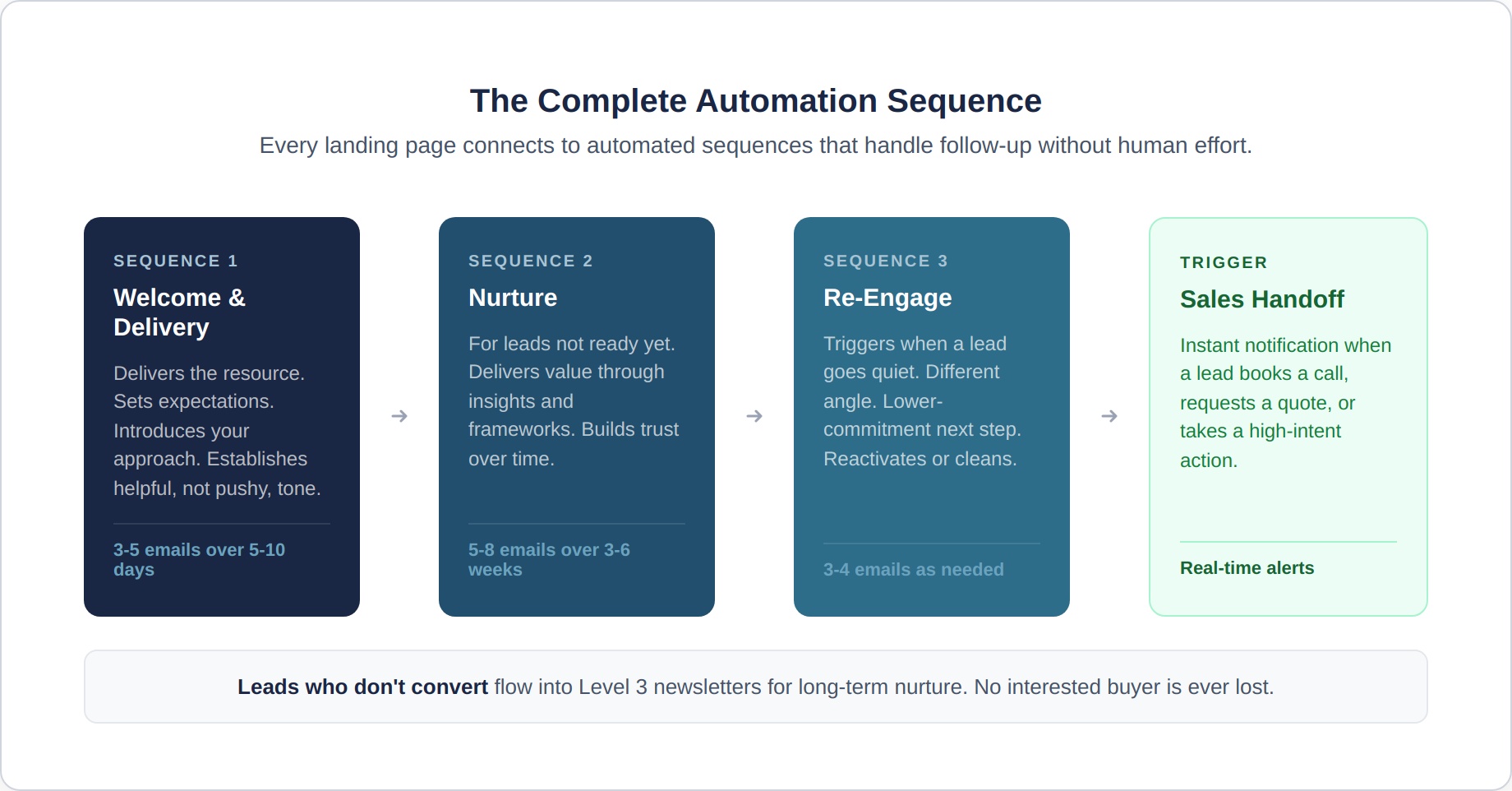
Every landing page connects to automated email sequences that handle follow-up without relying on anyone remembering to send an email.
For each landing page, we build:
- *Welcome and Delivery Sequence (3-5 emails over 5-10 days)**Triggered immediately after form submission. Delivers on what was promised, sets expectations for what comes next, introduces your approach, and establishes the tone for the relationship.
What the emails actually cover:
- Email 1 (immediate): Delivers the resource or confirms the action. Explains exactly what happens next. Sets the tone: helpful, not pushy.
- Email 2 (day 2-3): Introduces your perspective on the problem the buyer is researching. Provides one genuine insight that demonstrates expertise.
- Email 3 (day 5-6): Addresses the number one objection that buyers in this situation carry. Reframes the concern with evidence.
- Email 4 (day 7-8): Shares a specific example or case study from a company similar to the buyer.
- Email 5 (day 10): Offers the next step for buyers who are ready. Clear, specific, low-pressure.
- *Nurture Sequence (5-8 emails over 3-6 weeks)**For leads who completed the welcome sequence but aren’t ready for a sales conversation yet. Each email delivers value through insights, frameworks, and perspectives that build trust and keep your company top of mind with buyers.
What the emails actually cover:
- Specific challenges the buyer is likely facing at this stage of their evaluation
- Frameworks and perspectives that help the buyer think about their problem differently
- Proof points that build confidence without being salesy
- Educational content that positions you as the knowledgeable guide
- Periodic invitations to take the next step, always with a clear explanation of what that step involves
- *Re-engagement Sequence (3-4 emails)**For leads who went quiet. Triggers when a lead hasn’t opened or clicked in a defined period. Re-establishes relevance with a different angle, offers a lower-commitment next step, and either reactivates the lead or cleans them from the active pipeline.
Sales Handoff TriggersAutomated notifications to your sales team when a lead takes a high-intent action: books a call, requests a quote, downloads a bottom-of-funnel resource, or revisits key pages after a period of inactivity. These triggers ensure sales engagement at the moment of peak interest rather than days later.
All sequences are built in HubSpot, ActiveCampaign, Mailchimp, or your existing email platform.
The Difference Between Good Automation and Bad Automation
Buyers have been burned by bad automation. They’ve downloaded a PDF and received 47 aggressive sales emails. They’ve filled out a form and been called 6 times in 2 days. They’ve entered a sequence that has nothing to do with what they’re interested in.
That’s not what Level 2 builds. Here is the difference:
Bad automation feels like spam. It pushes for the sale in every email. It treats every lead the same, regardless of what they did or what they’re interested in. It sends emails on the company’s schedule, regardless of the buyer’s readiness. It makes the buyer regret filling out the form.
Good automation feels like a helpful follow-up from someone who understood what you were looking for. It delivers value before it asks for anything. It adjusts based on what the buyer actually does, sending different content to someone who clicked a case study than to someone who hasn’t opened an email in two weeks. It lets the buyer decide when they’re ready. It makes the buyer glad they filled out the form.
Every sequence we build is designed to make the buyer think: “This company actually understands my situation” rather than “How do I unsubscribe from this?”
What Happens to Leads Who Don’t Convert Through the Sequence
Not every lead converts within the nurture window. That’s expected. The question is what happens to them.
Leads who complete the full nurture and don’t convert are categorized as “not ready yet” rather than “not interested.” They move into a long-term nurture track that maintains presence through monthly or bi-monthly value-focused emails. When Level 3 (Email Marketing) is active, these leads flow into your newsletter audience, where ongoing content continues building trust at a lower frequency until they re-engage.
Leads who actively disengage (unsubscribe, mark as spam, or explicitly decline) are removed from all sequences and flagged in your CRM so sales doesn’t contact them inappropriately.
Leads who go quiet but don’t disengage receive the re-engagement sequence. If they respond, they re-enter the appropriate nurture track. If they don’t, they move to the long-term nurture list rather than receiving ongoing active sequences.
The system distinguishes between “not interested” and “not ready yet” because treating both groups the same would waste opportunities. Many of your best future clients are in the “not ready yet” category. Level 2 keeps them warm until they are.
CRM Integration
Level 2 connects your landing pages and automation to your sales pipeline so leads flow seamlessly from marketing to sales:
- Automatic lead creation in your CRM when a form is submitted
- Lead source tracking so every lead is tagged with the landing page, campaign, and traffic source that produced it
- Stage assignment based on the action the lead took, so your pipeline reflects actual buyer behaviour
- Activity logging so sales can see every email the lead received, every page they visited, and every action they took before the conversation
- Custom field mapping ensures the information collected on forms flows into the correct CRM fields without manual data entry.
Response Time: Why Speed Matters
Research consistently shows that responding to a lead within 5 minutes makes you 21 times more likely to qualify them than responding after 30 minutes. After an hour, the odds drop dramatically. After 24 hours, most leads are effectively cold regardless of how interested they were when they filled out the form.
Level 2 automation handles the immediate response automatically. The welcome email arrives within 60 seconds. The nurture sequence begins without delay. The buyer feels acknowledged instantly.
But when a lead takes a high-intent action, like booking a call, requesting a quote, or clicking a bottom-of-funnel link, human follow-up speed still matters. Level 2 builds the notification triggers that alert your sales team in real time. Your team’s job is to respond to those notifications fast.
If your team can’t consistently follow up on high-intent leads within 24 hours, the best landing page in the world won’t fix the conversion gap. We assess follow-up capacity during onboarding and build the notification system around what your team can realistically handle.
A/B Testing and Optimization
Landing pages are not finished when they go live. The first version is a hypothesis. Testing makes it better.
Level 2 includes ongoing optimization:
- Headline testing to identify which message framing produces the highest conversion
- CTA testing to determine which outcome language drives the most action
- Form testing to find the optimal balance between information collected and conversion friction
- Trust element testing to identify which proof points have the most impact at which positions on the page
- Layout testing to determine the most effective sequence of elements for your specific audience
Testing requires meaningful traffic volume. For pages receiving fewer than 500 visitors per month, we focus on strategic refinement based on qualitative data and conversion patterns rather than statistical A/B tests. For pages receiving higher traffic, we run structured tests that produce statistically significant results.
Page and Sequence Maintenance
Level 2 is not a set-it-and-forget-it service. Active maintenance keeps everything performing:
- Monthly performance review of all active landing pages and sequences with optimization recommendations
- Quarterly audit of every active page and sequence to ensure messaging still aligns with your current positioning, offers, and market conditions
- Offer change updates: when your pricing, packaging, or positioning evolves, we update existing pages and sequences to reflect the changes so nothing is out of date.
- Sequence refresh: when email performance data indicates fatigue or declining engagement, we refresh copy, adjust timing, or restructure the sequence based on what the data shows
- Broken link and technical monitoring to ensure every form, every redirect, and every CRM integration continues functioning correctly
Integration With Level 1 Content
Level 2 doesn’t wait passively for traffic. It coordinates actively with Level 1 to drive visitors to landing pages:
- 2-3 Level 1 social posts per month include direct CTAs pointing to specific landing pages, timed to align with the content themes that build toward the offer
- Video CTAs in Level 1 videos reference and direct viewers to landing pages (“If you want to see how this applies to your business, I built a free assessment. Link is in the comments.”)
- LinkedIn’s featured section is configured to showcase your highest-converting landing pages.
- Content calendar coordination ensures Level 1 social content builds narrative momentum toward the landing page offer over the course of a week, rather than dropping a random link with no context.
Privacy and Compliance
All Level 2 sequences are built with email compliance standards in mind:
- CAN-SPAM compliance for US-based sending, including physical address, clear sender identification, and easy unsubscribe in every email
- GDPR considerations for contacts in the EU, including consent-based opt-in mechanisms and data handling that respects privacy requirements
- CASL compliance for Canadian contacts where applicable
- Unsubscribe management is built into every sequence with immediate processing, so contacts who opt out never receive another automated email.
- Double opt-in option available for businesses that want an additional layer of consent verification
We configure compliance based on where your audience is located and what regulations apply. If you’re unsure about your compliance requirements, we assess this during onboarding and build the appropriate safeguards into every sequence.
Monthly Reporting
Every month, you receive a clear report covering:
- Landing page performance: visitors, conversion rate, and leads generated per page
- Sequence performance: open rates, click rates, and progression through each automated sequence
- Lead quality assessment: how leads from landing pages perform in sales conversations compared to other sources
- CRM pipeline contribution: how many landing page leads entered the pipeline, reached proposal stage, and closed
- A/B test results: what was tested, what won, and what changes are being implemented
- Response time tracking: average time between lead notification and sales follow-up
- Lead disposition: how many leads converted, how many are in nurture, how many re-engaged, and how many disengaged
- Recommendations: new page opportunities, sequence adjustments, and optimization priorities for next month
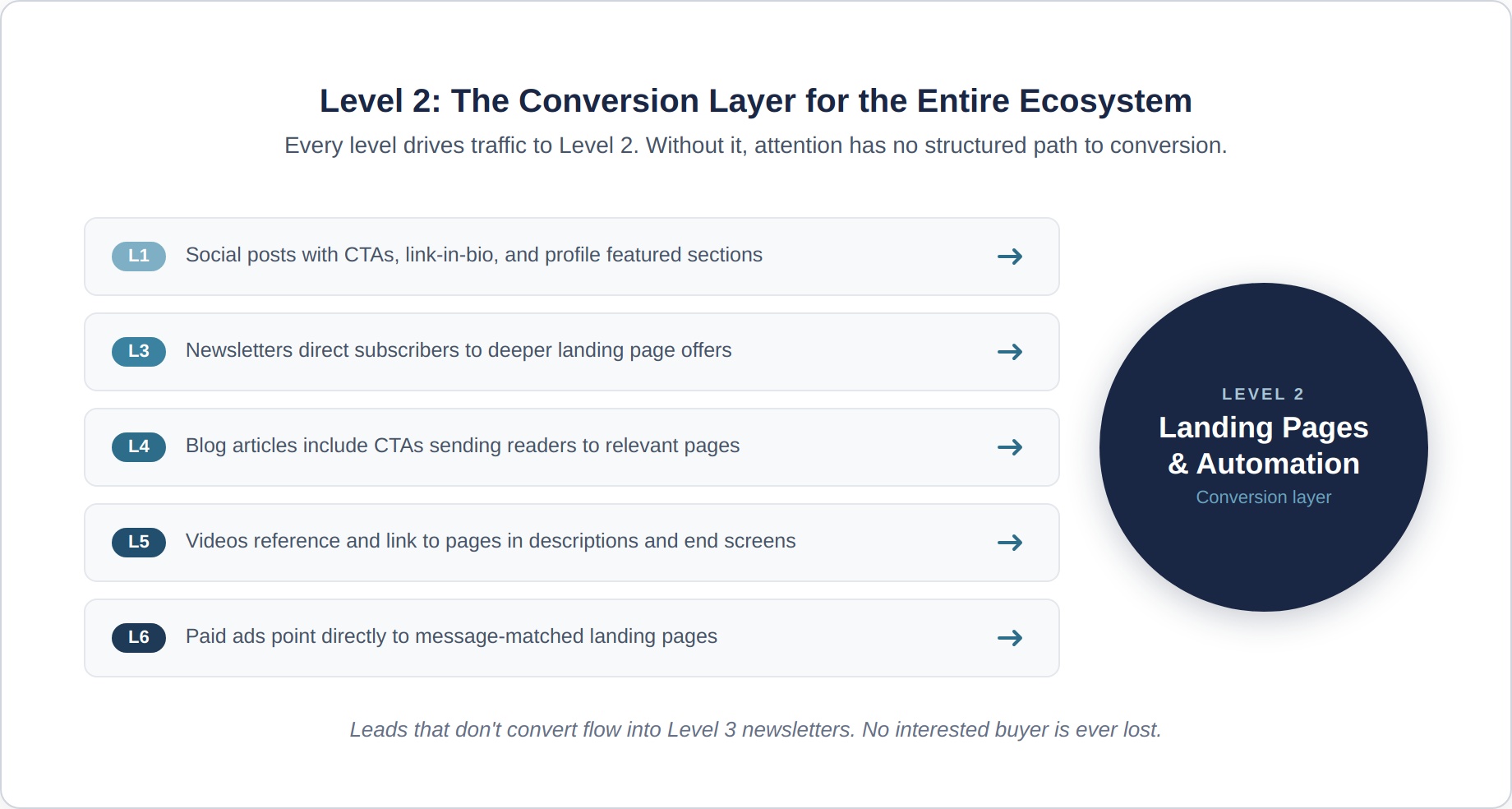
How Level 2 Connects to the Ecosystem
Landing pages and automation don’t operate in isolation. They serve as the conversion layer for everything happening across the ecosystem:
- Level 1 social media content drives traffic to landing pages through coordinated CTAs, link-in-bio, and profile featured sections
- Level 3 newsletters direct engaged subscribers to specific landing pages for deeper offers.
- Level 4 blog content includes CTAs that send readers to relevant landing pages.
- Level 5 video content references and links to landing pages in descriptions and end screens
- Level 6 paid ads point directly to landing pages built to match the specific ad messaging.
- Level 7 AI outreach links to landing pages in outbound sequences
Level 2 is the infrastructure every other level uses to capture demand. Without it, every level generates attention with no structured path to conversion. Leads that don’t convert through Level 2 sequences flow into Level 3’s long-term nurture through newsletters, ensuring no interested buyer is ever lost to the system.
What Determines Where You Fall in the Price Range
Level 2 – Landing Pages & Automation
Focused conversion pages and automated follow-up systems that turn attention into leads and leads into sales conversations.
| Scope Factor | Lower ($2,000–$2,800/mo) | Mid ($2,800–$3,600/mo) | Upper ($3,600–$4,500/mo) |
|---|---|---|---|
| Landing Pages Per Month | 1–2 new pages | 2–3 new pages | 3–4 new pages |
| Automation Sequences | Welcome + nurture per page | Welcome + nurture + re-engagement per page | Full sequence suite with behavioral triggers |
| CRM Integration Complexity | Basic integration with standard fields | Custom field mapping and stage automation | Advanced routing, scoring, and multi-pipeline setup |
| A/B Testing Scope | Qualitative refinement | Structured testing on primary pages | Full testing program across all active pages |
| Page Complexity | Standard single-offer pages | Multi-section pages with advanced trust elements | Dynamic or personalized pages with segmented content |
| Existing Pages Maintained | New pages only | New pages + optimization of up to 2 existing pages | New pages + optimization of up to 4 existing pages |
| Level 1 Coordination | Basic CTA integration | Coordinated content calendar with landing page alignment | Full social-to-landing-page campaign coordination |
| Lead Capture Flow | Basic forms and follow-up | Optimized forms with segmented follow-up | Advanced capture flow with multi-step qualification |
| Offer Types Supported | Single core offer | Multiple offers or audience-specific pages | Full campaign support across multiple offers and segments |
| Conversion Tracking | Basic tracking setup | Enhanced tracking with source attribution | Full funnel tracking tied to CRM and sales pipeline |
What This Level Solves
Level 2 solves the problem of generating interest that never converts. It bridges the gap between “I’ve heard of this company” and “I’m talking to their sales team” by providing dedicated conversion points for every offer and automated follow-up that keeps every lead engaged until they’re ready.
Without Level 2, leads leak out of the system between social media and sales. With Level 2, every interested buyer has a clear path to convert, a system that maintains engagement without depending on human effort, and a handoff process that ensures sales engage at the right moment with the right context.
What This Level Does NOT Include
- Website pages or website changes (Level 0)
- Social media content creation or management (Level 1 – though Level 1 CTAs are coordinated with Level 2 landing pages)
- Newsletter creation, ongoing email marketing, or lead magnet content creation (Level 3 – though lead magnet delivery pages and sequences are included in Level 2)
- Blog content, SEO articles, or long-form written content (Level 4)
- Video production (Level 5)
- Paid ads management (Level 6 – though landing pages built in Level 2 are designed to receive paid traffic)
- AI outreach or automation (Level 7)
Level 2 builds the conversion infrastructure. The levels around it drive traffic to it and build on what it captures.
What You Need to Provide
- Onboarding conversation (60 minutes): We learn about your offers, your buyers, the objections your sales team encounters most frequently, and your current CRM and email platform setup
- Offer clarity: You need to know what you’re offering on each landing page. We write the copy and build the page, but you define what the buyer receives (consultation, resource, assessment, quote)
- CRM and email access: We need admin or integration access to your CRM and email platform to build sequences and connect tracking
- Landing page review (15-20 minutes per page): Review each landing page before launch, provide feedback on messaging and positioning
- Sequence review (15-20 minutes per sequence): Review automated email sequences before activation
- Sales team coordination (30 minutes during onboarding): Brief your sales team on how leads will arrive, what context they’ll have, and what response time is expected
- Monthly report review (20-30 minutes): Review performance data and align on next month’s priorities
Total monthly time commitment: approximately 2-3 hours
How Long Before You See Results
Immediately: Landing pages begin converting the day they go live if traffic is being directed to them from Level 1, existing marketing, or direct channels.
Week 1-2: First leads flow through the automation sequences. Welcome sequences deliver resources and set expectations. Sales receives handoff notifications for high-intent actions.
Month 1: Initial conversion data reveals baseline performance. First optimization opportunities are identified. Nurture sequences begin producing engaged leads who progress toward sales readiness.
Month 2: A/B testing begins on the highest-traffic pages. Sequence refinement based on open rates, click rates, and sales feedback on lead quality. Conversion rates begin to improve as data-driven adjustments are implemented.
Month 3: The system stabilizes. Conversion rates are known and predictable. Sales feedback loop is established. The landing page and automation infrastructure become the reliable conversion layer on which every other marketing activity depends.
Pages and sequences improve continuously from this point. Each month’s testing and refinement compound the previous month’s learning, producing better conversion rates and better lead quality over time.
Who Builds This
Rod Agatep personally directs the strategy, messaging architecture, and conversion design of every Level 2 engagement. With 27 years of experience building conversion systems for B2B companies, Rod understands the difference between a landing page that looks professional and one that produces a pipeline.
Every page is built on proven conversion frameworks refined across hundreds of client engagements. The copy, structure, sequencing, trust placement, and form optimization all reflect what actually works in B2B rather than what landing page templates suggest.
Level 2 Readiness Assessment
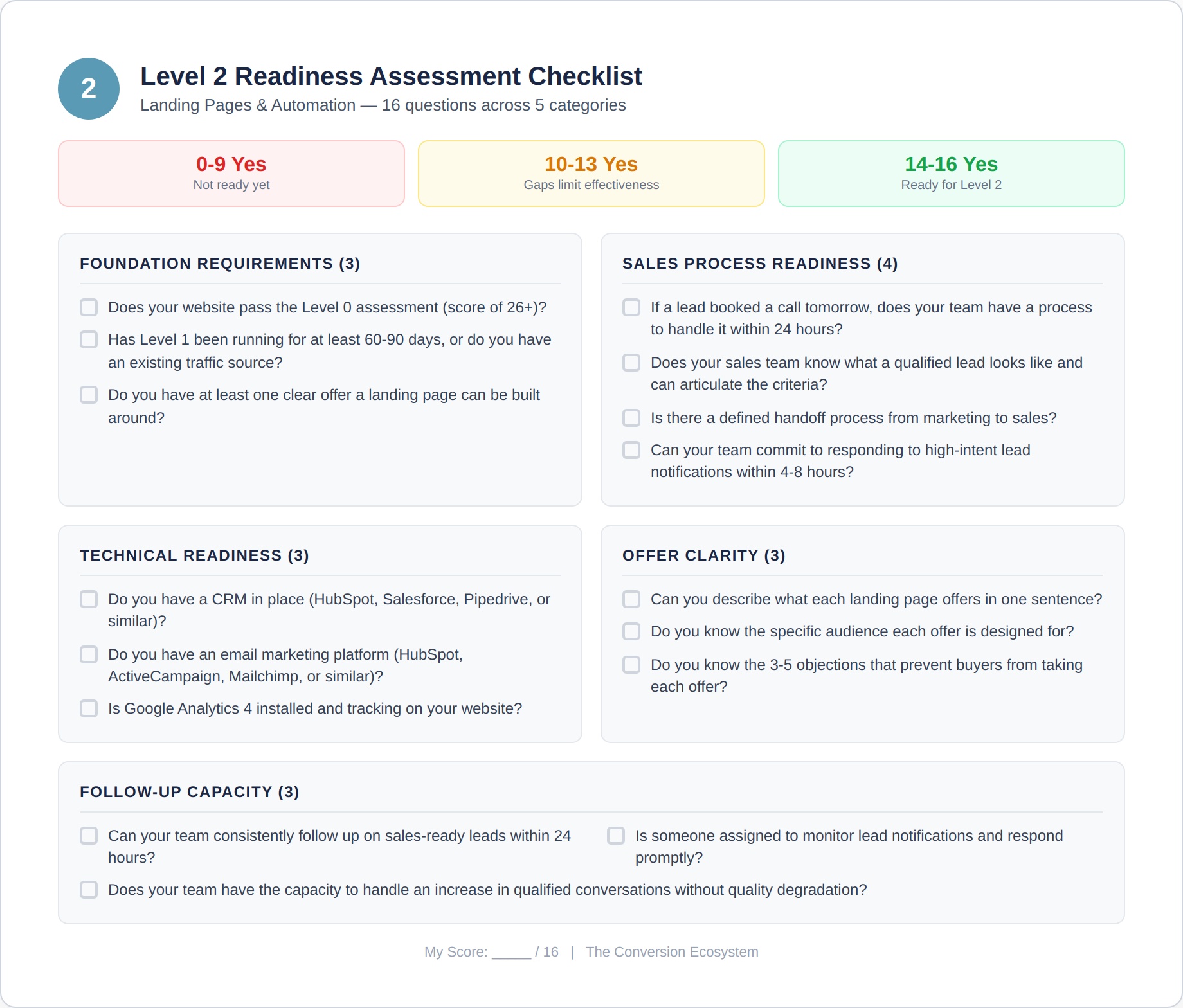
Scoring
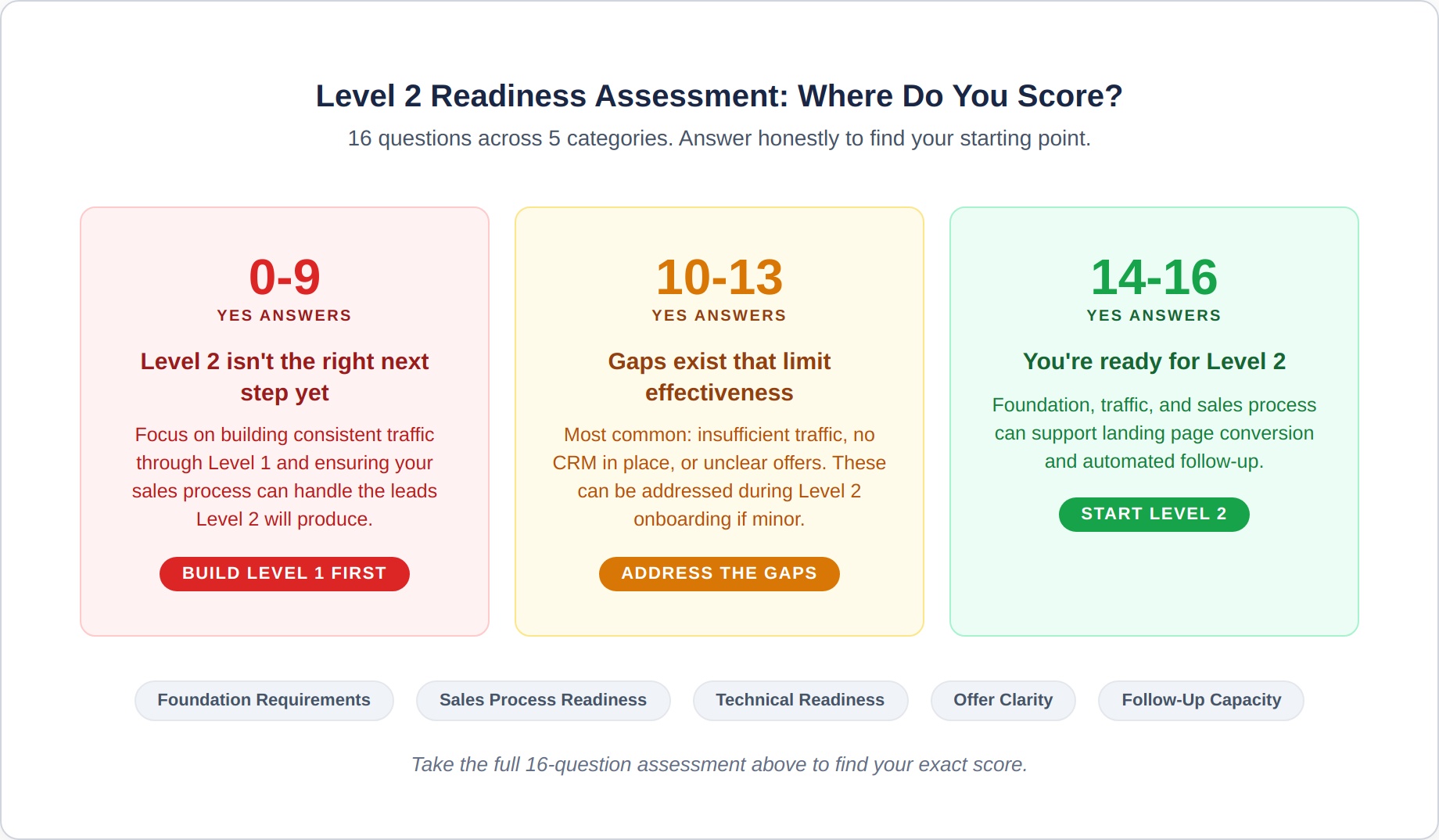
14-16 YES answers: You’re ready for Level 2. Your foundation, traffic, and sales process can support landing page conversion and automated follow-up.
10-13 YES answers: Gaps exist that will limit Level 2 effectiveness. The most common gaps are insufficient traffic (Level 1 hasn’t had time to build), no CRM in place, or unclear offers. These can be addressed during the Level 2 onboarding process if they’re minor.
9 or fewer YES answers: Level 2 isn’t the right next step yet. Focus on building consistent traffic through Level 1 and ensuring your sales process is ready to handle the leads Level 2 will produce.
When to Move to Level 3
You’re ready for Level 3 (Email Marketing) when:
- Level 2 landing pages are live and converting consistently.
- Your automation sequences are producing engaged leads who progress through the nurture.
- You have leads completing nurture sequences who aren’t converting yet, but remain interested, creating a pool of warm contacts that would benefit from ongoing newsletter engagement.
- You’re capturing leads but want to build a broader owned audience beyond those who convert on specific offers.
- You want to create lead magnets and ongoing content that gives Level 2 landing pages more offers to promote
- Your sales team reports that nurtured leads who come through sequences arrive better prepared than cold leads.
Level 2 captures demand at specific points in time. Level 3 builds an audience you own and nurtures it continuously through newsletters and lead magnets. Together, they create a pipeline that doesn’t depend on any single campaign or traffic source. Leads that don’t convert through Level 2 sequences flow naturally into Level 3’s ongoing nurture.
Pricing Summary
| Option | Investment |
|---|---|
| Level 2 monthly | $2,000 – $4,500/month |
| Level 2 annual commitment | 20% off monthly rate |
| Level 2 stacked with other levels | See Conversion Ecosystem pricing table |
What’s included: Landing page strategy, design, copywriting, development, email automation sequences (welcome, nurture, re-engagement), CRM integration, message-match alignment with traffic sources, A/B testing, compliance configuration, page and sequence maintenance, conversion tracking, sales team coordination, and monthly performance reporting.
What’s not included: Paid advertising driving traffic to the pages (Level 6), lead magnet content creation (Level 3), video production (Level 5), social media content (Level 1), or website changes (Level 0).
The Conversion Ecosystem Rule
Every level below your active level must be in place. Level 2 requires a Level 0 website that passes the readiness assessment and, ideally, a Level 1 website that generates consistent traffic. Landing pages without traffic are infrastructure waiting for visitors. The foundation and the visibility layer must be active before the conversion layer produces meaningful results.
Next Step
If you’re not sure whether Level 2 is the right next investment, whether your traffic is sufficient to support landing pages, or whether your sales process is ready to handle the leads Level 2 will produce, the fastest way to find out is a conversation.
We’ll review your current conversion infrastructure, assess your traffic sources, evaluate your CRM and email setup, and tell you honestly whether Level 2 will produce results now or whether other levels should come first.
No pitch. No pressure. Just clarity on where you stand and what to do next.
Frequently Asked Questions
How is this different from just adding a form to my website?
A website contact form is a single, generic conversion point that asks the same thing of every visitor, regardless of their situation or readiness level. Level 2 creates dedicated conversion tools for specific audiences with specific offers, each designed around the psychology of that particular buyer at that particular stage, with automated follow-up that maintains engagement for weeks after the initial conversion. A contact form converts at 1-2%. A well-built landing page with automation converts at 5-15% and continues to work on the lead long after the form is filled out.
Do I need to create the lead magnets and resources myself?
The content of lead magnets (guides, checklists, assessments) is part of Level 3. Level 2 builds the landing pages that deliver them and the automation sequences that follow up after download. If you already have resources, we build pages and sequences around them. If you need resources created, Level 3 covers that. You can start Level 2 with consultation booking pages and assessment pages that don’t require pre-built resources.
What if I don’t have much traffic yet?
Landing pages work with any amount of traffic, but they produce measurable results faster with more visitors. If Level 1 is still building your audience, Level 2 can be started simultaneously, with the understanding that conversion volume will grow as traffic grows. Even in low-traffic periods, having the conversion infrastructure in place means you’re capturing every interested visitor rather than losing them. And when Level 6 paid ads eventually come online, the landing pages are already built and tested.
Can you build landing pages for campaigns I’m already running?
Yes. If you’re running paid ads, email campaigns, or outbound sequences that point to your general website, redirecting that traffic to dedicated landing pages aligned with the specific campaign messaging is one of the fastest ways to improve conversions. We build pages specifically matched to the messaging and audience of your existing campaigns.
How many landing pages do I actually need?
Most B2B companies need 3-5 core landing pages to cover their primary conversion points: a main consultation or call-booking page, 1-2 lead-magnet pages, and 1-2 campaign-specific pages. The monthly page creation in Level 2 builds this library over time while continuously testing and optimizing existing pages. After 3-4 months, most companies have a complete conversion infrastructure in place. Pages are added as new offers, campaigns, or audience segments are identified.
What email platform do you work with?
We build automation sequences in HubSpot, ActiveCampaign, Mailchimp, or most major email platforms. If you don’t have an email platform yet, we recommend one during onboarding and include setup as part of the Level 2 engagement. Platform costs are separate from the Level 2 investment and typically range from $20 to $300/month, depending on list size and features.
What happens to old landing pages when new ones are built?
Old landing pages stay active and continue converting. Level 2 is additive. Each month, your conversion infrastructure grows while existing pages are monitored, maintained, and optimized alongside new pages. Over time, you build a library of conversion tools that covers every offer, every audience segment, and every stage of buyer readiness.
How do landing pages work with my existing website?
Landing pages can be built on your existing website platform or on a dedicated landing page platform like Unbounce. They typically live on your domain (yourdomain.com/offer-name) and share your visual branding but operate independently from your website navigation. This allows them to be focused conversion tools without the distractions that website navigation creates.
What if leads fill out the form but never respond to sales?
This is one of the most common problems Level 2 solves. The automation sequences maintain engagement between form submission and sales contact. Instead of a lead going cold during a response gap, they receive a welcome sequence that delivers value, sets expectations, and keeps your company top of mind. Sales handoff triggers also alert your team at the moment of peak engagement rather than relying on manual list reviews. If leads consistently don’t respond to sales despite the automation, we diagnose whether the issue is response time, sequence messaging, or offer-to-sales alignment and adjust accordingly.
Is there a minimum contract period?
Level 2 is available month-to-month or with an annual commitment at 20% off. Month-to-month engagements can be cancelled with 30 days’ notice. Annual commitments receive the discount in exchange for a 12-month term. Early termination of annual commitments is subject to a fee equal to the discount received on months already completed.
Do I own the landing pages and automation sequences?
Yes. Everything built during Level 2 belongs to you. Landing pages, email sequences, form configurations, CRM integrations, and all content. If you cancel, the pages stay live, the sequences keep running, and you retain full ownership and access. There are no licensing restrictions or content holdback clauses.