

Key Takeaways
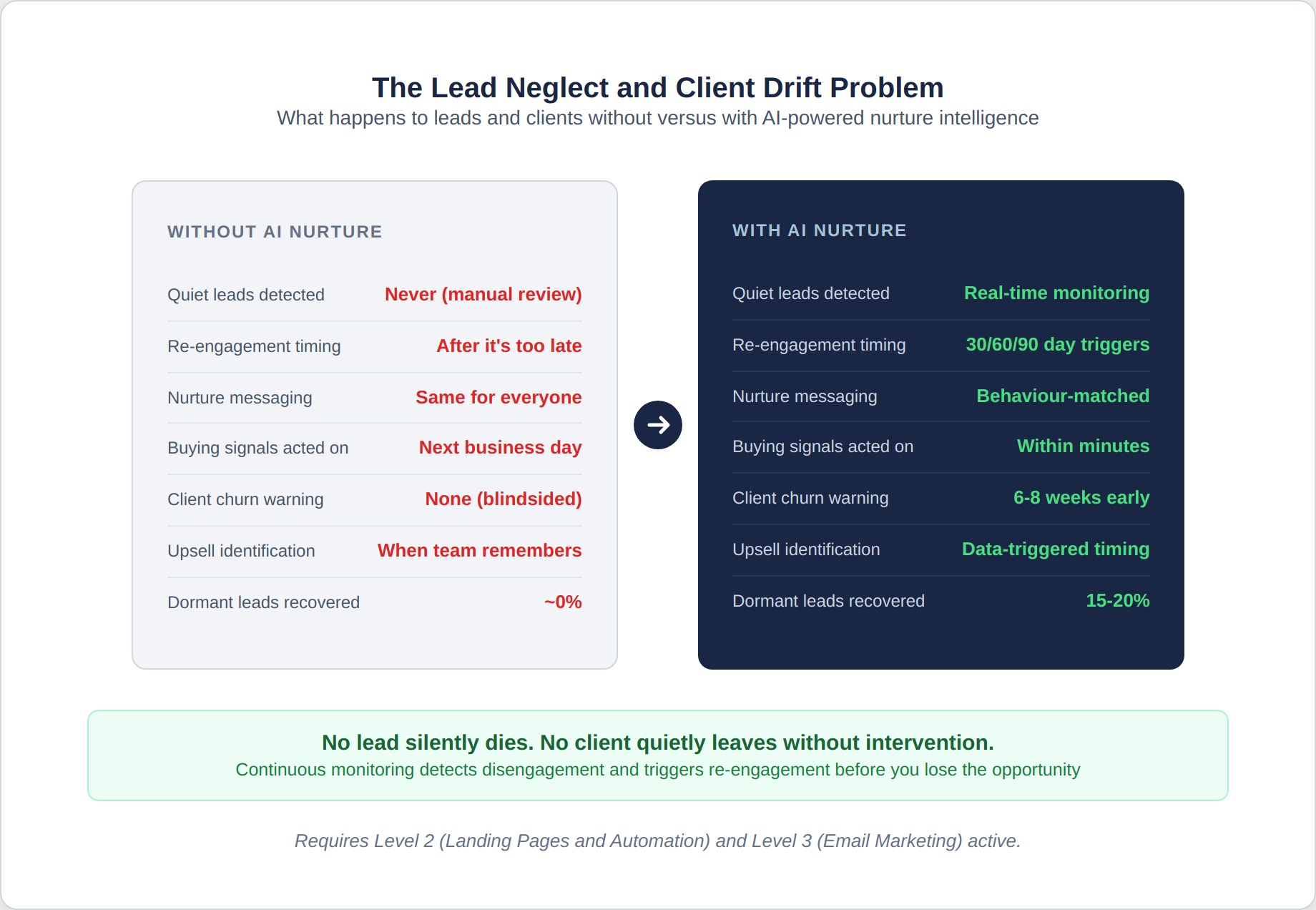
- AI Nurture and Retention ensures no lead silently dies in your CRM, and no client quietly leaves without intervention by detecting disengagement and automatically triggering re-engagement before you lose the opportunity.
- Churn prediction identifies at-risk clients weeks or months before they cancel by analyzing behavioural patterns that correlate with departure, giving your team time to intervene while the relationship is still recoverable.
- Behaviour-triggered nurture replaces scheduled email blasts with intelligent sequences that respond to what each lead actually does, sending the right message at the right moment based on engagement signals rather than arbitrary timelines.
- Upsell and cross-sell recommendations are timed to when clients are most receptive based on usage patterns, satisfaction signals, and lifecycle stage, rather than when your team remembers to ask.
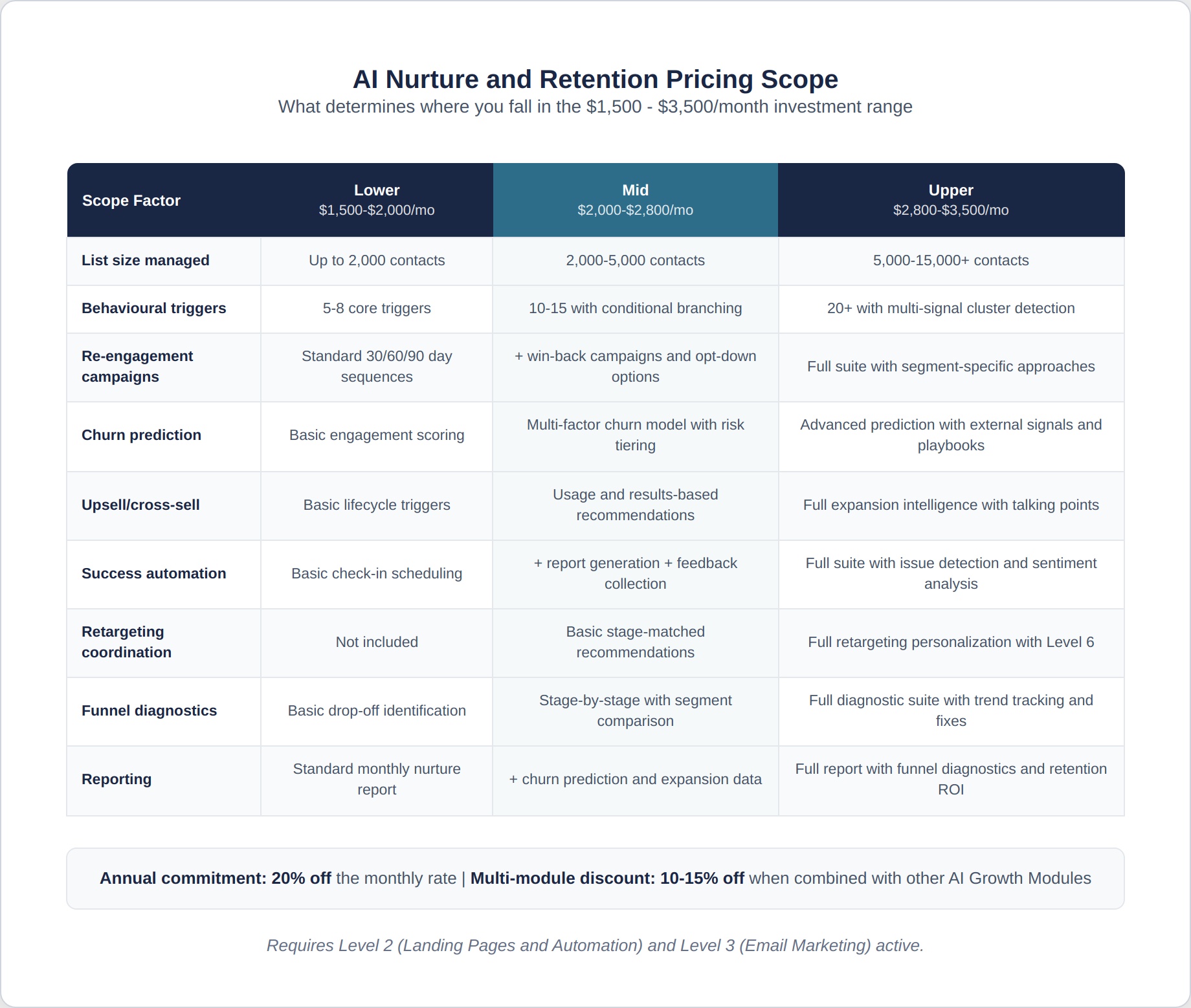
- The investment ranges from $1,500 to $3,500/month, depending on list size, segmentation complexity, number of behavioural triggers, and depth of retention intelligence.
One Sentence Summary: AI Nurture and Retention detects when leads are losing interest, and clients are at risk, then automatically triggers the right intervention at the right moment to keep relationships alive and revenue growing.
Investment Range: $1,500 – $3,500/month
Annual Commitment: 20% off the monthly rate
Multi-Module Discount: 10-15% off when combined with other active AI Growth Modules
Requires: Level 2 (Landing Pages and Automation) + Level 3 (Email Marketing) active.
Timeline to first results: Behaviour-triggered nurture sequences begin responding to lead activity within the first week. Re-engagement campaigns activate within 30 days. Churn prediction reaches reliable accuracy at 60-90 days as the model calibrates against your specific client patterns.
What This Module Is
Your Conversion Ecosystem generates leads through Levels 1-6. It captures them through Level 2 landing pages and Level 3 email marketing. Those systems work. Leads enter your pipeline. Subscribers join your newsletter. Clients sign contracts.
But here’s what happens after:
Some leads engage enthusiastically for two weeks, then go quiet. They’re still in your CRM and on your email list, but they stopped opening, clicking, and visiting. Without intervention, they become a name in a database that never converts.
Some clients start strong and then gradually disengage. They stop opening reports. They miss monthly calls. They stop responding to emails. They don’t complain. They don’t raise concerns. They just quietly drift until one day they cancel, and your team says, “I didn’t see that coming. ” Both of these failures happen because disengagement isn’t caught in time—by the time anyone notices, it is often too late. This urgent problem can cost countless opportunities unless proactively addressed.ibAI Nurture and Retention combats this urgent challenge by continuously monitoring every lead and client for disengagement signals, then initiating the right intervention at exactly the right time—before it’s too late. Immediate action could mean the difference between a conversion and a lost opportunity.
The system doesn’t wait for someone on your team to manually review a list. It doesn’t take long to notice that a lead went quiet three weeks ago. It notices in real time and acts immediately.
The Hidden Cost of Lead Neglect and Client Drift
Before looking at what this module includes, consider what neglect is actually costing your business right now.
Lead neglect: If your Level 2 landing pages capture 50 leads per month and 30% of them go quiet after the initial nurture sequence ends, that’s 15 leads per month that entered your system interested and left without converting because nobody maintained the relationship. Over 12 months, that’s 180 leads your marketing paid to acquire that your system failed to convert. At even a 10% eventual conversion rate from sustained nurture, those 180 leads represent 18 deals your business never closed.
Industry data shows that acquiring a new client costs 5-7x more than retaining an existing one. If your business loses 2-3 clients per year that could have been saved through earlier intervention, the replacement cost far exceeds the cost of a retention system that identifies risk before cancellation.
Your existing clients represent the highest-probability source of extra revenue. They already trust you and have experienced your work. But if nobody identifies when they’re ready for more services or when their situation calls for expanding the engagement, those opportunities go to competitors who happen to ask at the right time.
AI Nurture and Retention addresses all three by turning passive lead management and reactive client service into an active, intelligent system that continuously monitors, predicts, and intervenes.
What You Get
Behaviour-Triggered Lead Nurture
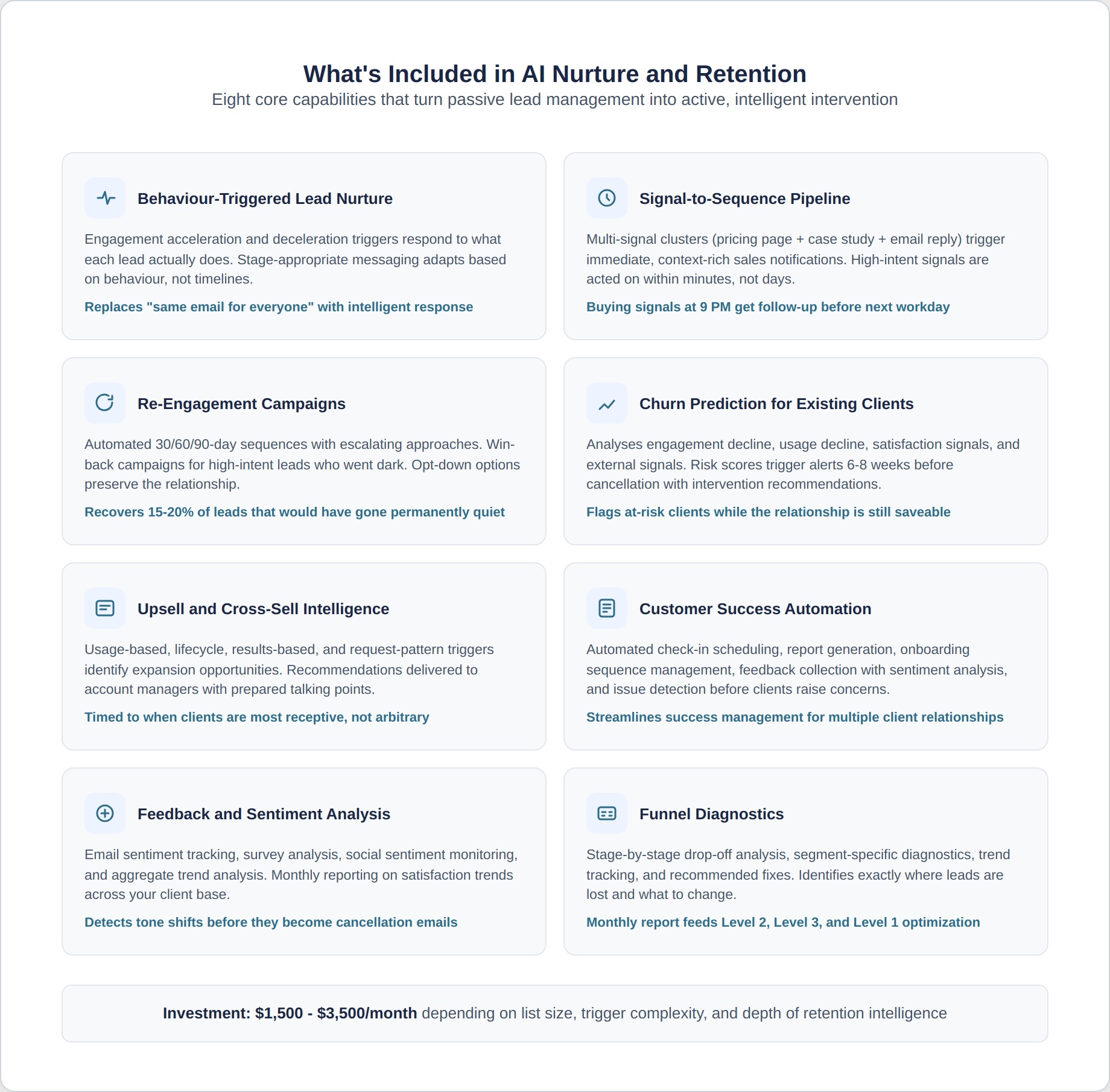
Level 2 automation sequences are triggered by specific actions and run for a set period. Level 3 newsletters maintain weekly contact. AI Nurture and Retention adds a layer of intelligence that responds to each lead’s actions.
Engagement acceleration triggers:
- When a quiet lead suddenly visits your pricing page, the system triggers a specific sequence. This sequence addresses the buying signals identified by pricing research.
- When a lead clicks three links in a single newsletter, the system recognizes heightened interest and triggers a more direct offer or conversation invitation.
- When a lead watches a Level 5 video for 80%+ of its duration, the system sends a follow-up that builds on the specific topic covered in the video.
- When a lead visits the same service page multiple times in a week, the system triggers a case study delivery or consultation offer relevant to that service.
Engagement deceleration triggers:
- When a lead who previously opened every newsletter skips two in a row, the system triggers a re-engagement message before the gap widens.
- When a lead who downloaded a lead magnet 30 days ago hasn’t taken any action since, the system sends a different angle on the same topic rather than repeating the original offer.
- When a lead’s engagement score drops below a threshold, the system shifts them to a different nurture track with fresh messaging rather than continuing the same sequence that stopped working.
Stage-appropriate messaging:
- Early-stage leads receive educational content that builds awareness without pressuring them to commit.
- Mid-stage leads who’ve consumed significant content receive comparison and evaluation content that helps them make a decision.
- Late-stage leads who’ve shown buying signals receive direct offers with urgency-appropriate messaging.
- Each lead progresses through stages based on their actual behaviour, not a predetermined timeline.
Signal-to-Sequence Pipeline
The most powerful capability: connecting real-time behavioural signals to specific nurture actions without human intervention.
How it works:
Every interaction a lead has with your ecosystem generates signals: website visits, email opens, social engagement, content downloads, video views, chatbot conversations, and ad clicks. Each signal carries a different weight and a different meaning.
AI Nurture and Retention processes these signals continuously. It maps them to specific sequences.
- High-intent signal cluster (pricing page visit + case study download + email reply in the same week) → triggers immediate sales notification with full context.
- Evaluation signal cluster (3+ article reads + video view + newsletter engagement over 2 weeks) → triggers mid-funnel sequence with comparison content and social proof.
- Cooling signal cluster (declining open rates + no website visits in 30 days + no social engagement) → triggers re-engagement sequence with a new angle.
- Re-engagement signal (lead who was quiet for 60 days suddenly opens a newsletter and clicks a link) → triggers a personal follow-up that acknowledges the gap without pressure.
The system processes signals faster than any human could and responds within minutes. A lead demonstrating buying signals at 9 PM on a Tuesday gets the appropriate follow-up before the next workday.
Website Visitor Activation
When Module 2 (AI Lead Intelligence) is active, visitor identification data feeds directly into nurture triggers:
- Known contacts who return to your website after being inactive trigger a “welcome back” sequence. This sequence references what they were interested in before.
- Known contacts who visit new service pages they haven’t seen before trigger related content delivery. This delivery aligns with their new interest area.
- Known contacts who visit competitor comparison content trigger messaging that addresses competitive positioning. This messaging is proactive.
Without Module 2, visitor activation works only with identified contacts (those who’ve previously filled out a Level 2 form or clicked a Level 3 email link and can be recognized via cookies).
Re-Engagement Campaigns
For leads who have gone quiet, automated re-engagement campaigns offer multiple paths back:
30-day quiet trigger:
- A light-touch message offers new content related to the lead’s original interest. This message avoids mentioning that they haven’t opened emails.
- Tone: “We published something you might find useful,” not “We noticed you haven’t been opening our emails.”
- Goal: re-establish a single click that signals continued interest
60-day quiet trigger:
- A different approach entirely: new angle, new offer, new format
- May include a short assessment or quiz that re-engages through interaction rather than passive reading
- Goal: break the pattern of non-engagement with something that feels fresh
90-day quiet trigger:
- A direct, honest message: “We’ve been sending weekly insights, but want to make sure they’re still relevant to you. Here’s what’s new since we last connected. If your priorities have shifted, reply and let us know — we’d rather send you the right stuff than the wrong stuff.”
- Includes easy opt-down option (less frequent emails rather than full unsubscribe)
- Goal: either reactivate or clean the list, because 90 days of non-engagement usually means the lead has moved on or their situation has changed
Win-back campaign (for leads who previously showed high intent but went dark):
- Specialized 3-5 email sequence specifically for leads who were close to converting but dropped off
- References their specific previous engagement without being creepy: acknowledges interest without surveillance language
- Offers a lower-commitment re-entry point: a 15-minute check-in call instead of a full consultation, or an updated resource instead of a repeat offer
- Timing: triggered 4-6 months after a high-intent lead goes quiet, giving them enough time that their situation may have changed
Retargeting Personalization
When Level 6 (Paid Advertising) is active, AI Nurture and Retention enhances retargeting by matching ad messaging to the lead’s nurture stage:
- Leads in early nurture see awareness-building retargeting ads featuring educational content.
- Leads in mid-stage nurture see retargeting ads with case studies and comparison content.
- Leads showing buying signals see retargeting ads with direct offers and urgency-appropriate messaging.
- Leads in re-engagement receive retargeting ads with fresh angles that match the re-engagement email messaging.
This coordination ensures the lead’s experience across email and advertising feels cohesive rather than random.
Churn Prediction for Existing Clients
The highest-value capability for companies with recurring revenue or ongoing client relationships:
Behavioural signals that predict churn:
- Engagement decline: Client stops opening reports, misses scheduled calls, and reduces communication frequency. Each behaviour alone may mean nothing. The pattern together predicts departure.
- Usage decline: Client reduces their usage of deliverables, stops requesting revisions, and doesn’t review monthly reports. They’re disengaging from the work.
- Satisfaction signals: Response times to your team’s messages lengthen. Tone in communications becomes shorter or more formal. Questions about contract terms or cancellation policies appear.
- External signals: Client posts a job listing for the role your service fills. Client engages with competitor content. Client’s company shows signs of budget pressure (layoffs, restructuring, funding issues).
How the prediction model works:
- AI analyzes the behavioural patterns of clients who previously churned to identify which signals appeared before departure.
- The model assigns risk scores to current clients based on how closely their behaviour matches pre-churn patterns.
- Risk levels are categorized as low, moderate, high, and critical.
- Risk score changes trigger specific actions:
-
- Moderate risk: Alert the account manager with a behavioural summary and recommended outreach talking points
- High risk: Alert the account manager plus leadership with an intervention recommendation
- Critical risk: Immediate alert with full behavioural analysis and a safe strategy recommendation
What this looks like in practice: Instead of a client cancelling and your team saying “I had no idea they were unhappy,” the system alerts you 6-8 weeks before the cancellation would have happened, with specific data on what changed and a recommended approach for the save conversation. Your team reaches out proactively: “I wanted to check in because I want to make sure we’re delivering what matters most to you right now. Has anything changed on your end that we should adjust for?”
The client, who was quietly drifting toward cancellation, feels seen and valued. The conversation that follows either saves the relationship or, at the very least, gives you honest feedback on what went wrong.
Upsell and Cross-Sell Recommendations
Your existing clients are the highest-probability revenue source. AI identifies when they’re ready for more:
- Usage-based triggers: When a client’s engagement with specific deliverables increases (watching more videos, requesting more content, asking questions about topics covered by a different service level), the system flags them as potential upsell candidates for the relevant level or module.
- Lifecycle triggers: At specific milestones (6 months, 12 months, annual review), the system generates a personalized recommendation based on the client’s results and the logical next level in their ecosystem progression.
- Results-based triggers: When client metrics improve (conversion rates up, traffic growing, pipeline increasing), the system identifies which additional level or module would produce the highest incremental impact based on their current performance.
- Request-pattern triggers: When a client asks questions that consistently fall outside their current scope, the system recognizes the pattern and recommends the appropriate expansion.
Delivery: Upsell recommendations are delivered to the account manager as prepared talking points and supporting data, not as automated emails to the client. Expansion conversations should be human-led and value-driven, not automated and salesy. AI provides the intelligence. The human provides the relationship.
Customer Success Automation
For companies managing multiple ongoing client relationships, AI streamlines the success management workflow:
- Automated check-in scheduling triggered by engagement patterns and milestone dates
- Report generation, compiling client performance data into formatted review documents without manual assembly.
- Onboarding sequence management, ensuring new clients receive the right information at the right time during their first 90 days.
- Feedback collection through automated surveys timed to key milestones, with sentiment analysis on responses.
- Issue detection, identifying when deliverable quality, communication frequency, or result metrics deviate from norms and alerting the team before the client raises concerns.
Feedback and Sentiment Analysis
Understanding how clients and leads feel about their experience, not just what they do:
- Email sentiment tracking: AI analyzes the tone of client emails and replies over time, detecting shifts from positive to neutral to negative that may indicate satisfaction issues
- Survey analysis: When feedback is collected through NPS surveys, project reviews, or check-in forms, AI categorizes responses, identifies themes, and flags concerning patterns
- Social sentiment monitoring: If clients discuss your services on social media or review platforms, AI detects and alerts your team
- Aggregate trend analysis: Monthly reporting on overall sentiment trends across your client base, identifying whether satisfaction is improving, stable, or declining
Funnel Diagnostics
AI continuously analyzes where leads drop off in your conversion and nurture funnel:
- Stage-by-stage analysis: Which stage of your Level 2 automation sequence loses the most leads? Which newsletter topics correlate with unsubscribes? Which point in the buyer journey has the highest abandonment rate?
- Segment-specific diagnostics: Do leads from Level 6 paid ads drop off at different points than leads from Level 4 organic content? Do specific industries or company sizes show different funnel patterns?
- Trend tracking: Is funnel performance improving or degrading over time? Are specific stages getting better while others get worse?
- Recommended fixes: For each identified drop-off point, AI suggests specific changes to messaging, timing, offers, or content that address the likely cause based on behavioural patterns
Deliverable: Monthly funnel diagnostic report showing exactly where leads are lost, why they’re likely lost, and what to change. These recommendations feed directly into Level 2 landing page optimization, Level 3 newsletter refinement, and Level 1 content strategy.
What a Lead Actually Experiences
Here’s the difference between standard nurture and AI-powered nurture from the lead’s perspective:
Standard Nurture (Level 2 + Level 3 Without Module 6)
Week 1-3: Lead downloads a guide. Receives 5 welcome emails over 10 days. Reads the first three. Skims the fourth. Doesn’t open the fifth.
Week 4: Lead enters the newsletter. Receives weekly emails. Opens the first one. Doesn’t open the next two.
Week 6: Lead is still on the list, but effectively disengaged. Nobody notices. The newsletter keeps arriving. The lead keeps ignoring it.
Month 3: Lead is still on the list. Still not opening. Still not clicking. Technically a “subscriber” but functionally lost.
Month 6: Lead unsubscribes during an inbox cleanup. Or worse, it marks the newsletter as spam. A lead that marketing paid to acquire and initially engaged is gone permanently.
AI-Powered Nurture (With Module 6)
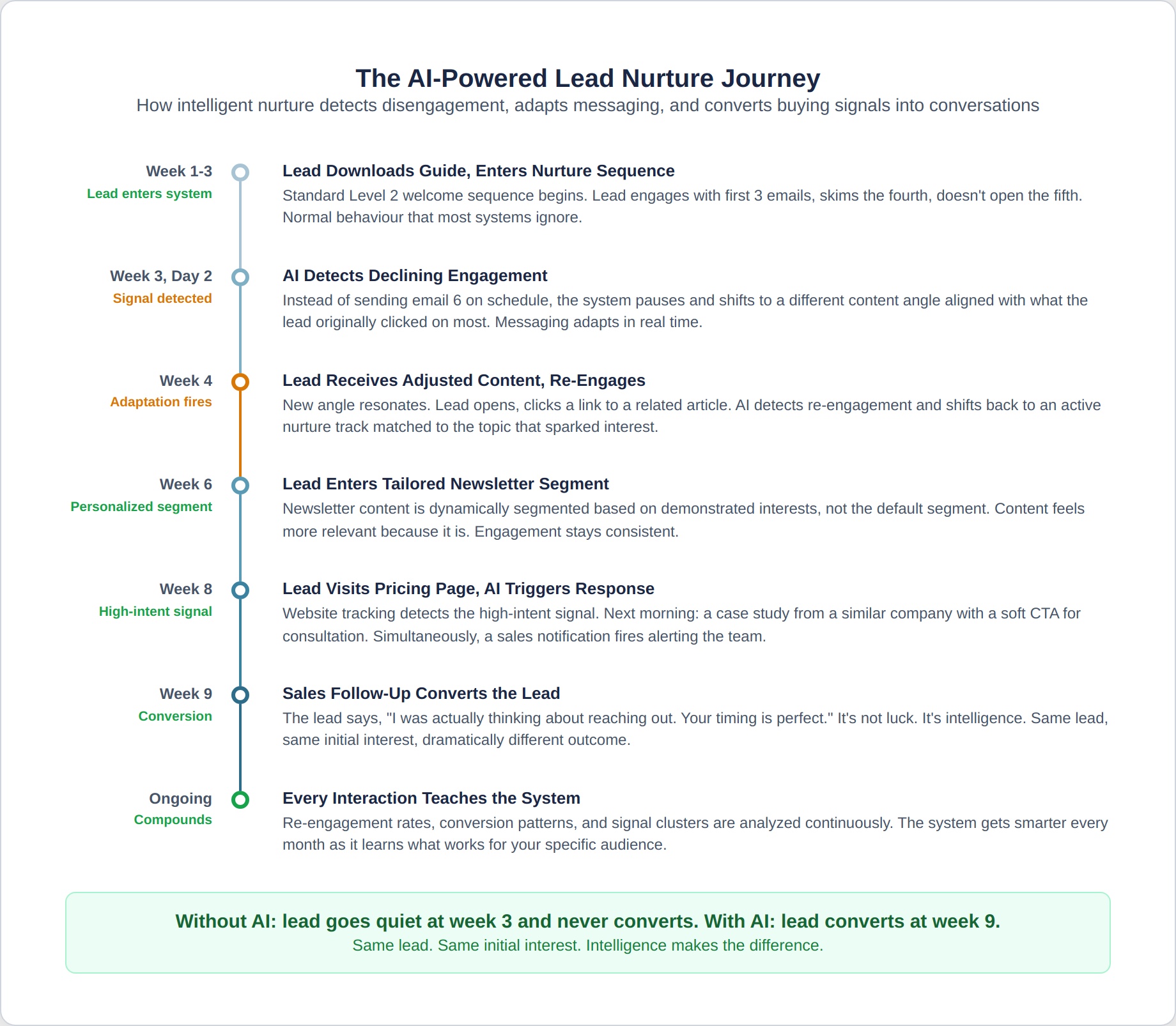
Week 1-3: Same start. Lead downloads a guide. Receives welcome emails. Engages with the first three. Skims the fourth.
Week 3, Day 2: AI detects declining engagement (opened but didn’t click email 4, didn’t open email 5). Instead of sending email 6 on schedule, the system pauses and shifts to a different content angle that aligns with what the lead originally clicked on most.
Week 4: Lead receives the adjusted content. Opens it. Clicks a link to a related article. AI detects re-engagement and shifts back to an active nurture track, with content matched to the topic that sparked interest.
Week 6: Lead enters the newsletter on a tailored segment based on their demonstrated interests, not the default segment. Newsletter content feels more relevant because it is.
Week 8: Lead visits the pricing page (detected by website tracking). AI recognizes the high-intent signal and triggers a specific email the next morning: a case study from a company similar to theirs with a soft CTA for a consultation. Simultaneously, a sales notification fires, alerting the team that this lead is showing buying signals.
Week 9: Sales follow-up. The lead says, “I was actually thinking about reaching out. Your timing is perfect.” It’s not luck. It’s intelligence.
The difference: The first scenario loses the lead through passive neglect. The second scenario detects disengagement immediately, adapts the approach, re-engages the lead, and converts the buying signal into a sales conversation. Same lead. Same initial interest. Dramatically different outcome.
What a Client Actually Experiences
Here’s how churn prediction changes the client retention experience:
Without Module 6
Month 1-8: Client is engaged. Opens reports. Attends calls. Provides feedback. Everything seems fine.
Month 9: Client starts missing calls. Stops opening reports. Response times lengthen. Nobody on your team notices because they’re busy with other clients and new business.
Month 10: Client sends a cancellation email. Your team is blindsided. “What happened? They seemed happy.”
Post-mortem reveals: The client’s priorities shifted at month 8 when new leadership arrived. The new VP had different goals that your engagement wasn’t addressing. Nobody asked. Nobody adapted. The client quietly decided to move on.
With Module 6
Months 1-8: Same. Client is engaged and satisfied.
Month 8, Week 3: Churn prediction flags the client as moderate risk. Engagement score declined: missed one call, report open rate dropped, and email response time increased. AI alert reaches the account manager with a behavioural summary and suggested outreach.
Month 8, Week 4: Account manager reaches out: “I wanted to check in and make sure our work is aligned with where you’re headed. Has anything changed on your end that we should factor in?”
Client responds: “Actually, yes. We have a new VP who has different priorities. I wasn’t sure how to bring it up.”
Month 9: Engagement is restructured to align with the new VP’s goals. The client stays. The relationship deepens because you demonstrated awareness and responsiveness that the client didn’t expect.
The difference: Same client. Same shift in priorities. In the first scenario, you lose a client and the revenue they represent. In the second scenario, you retain the client because AI detected the warning signs 6-8 weeks before cancellation and your team intervened while the relationship was still saveable.
How AI Nurture and Retention Connect to the Ecosystem
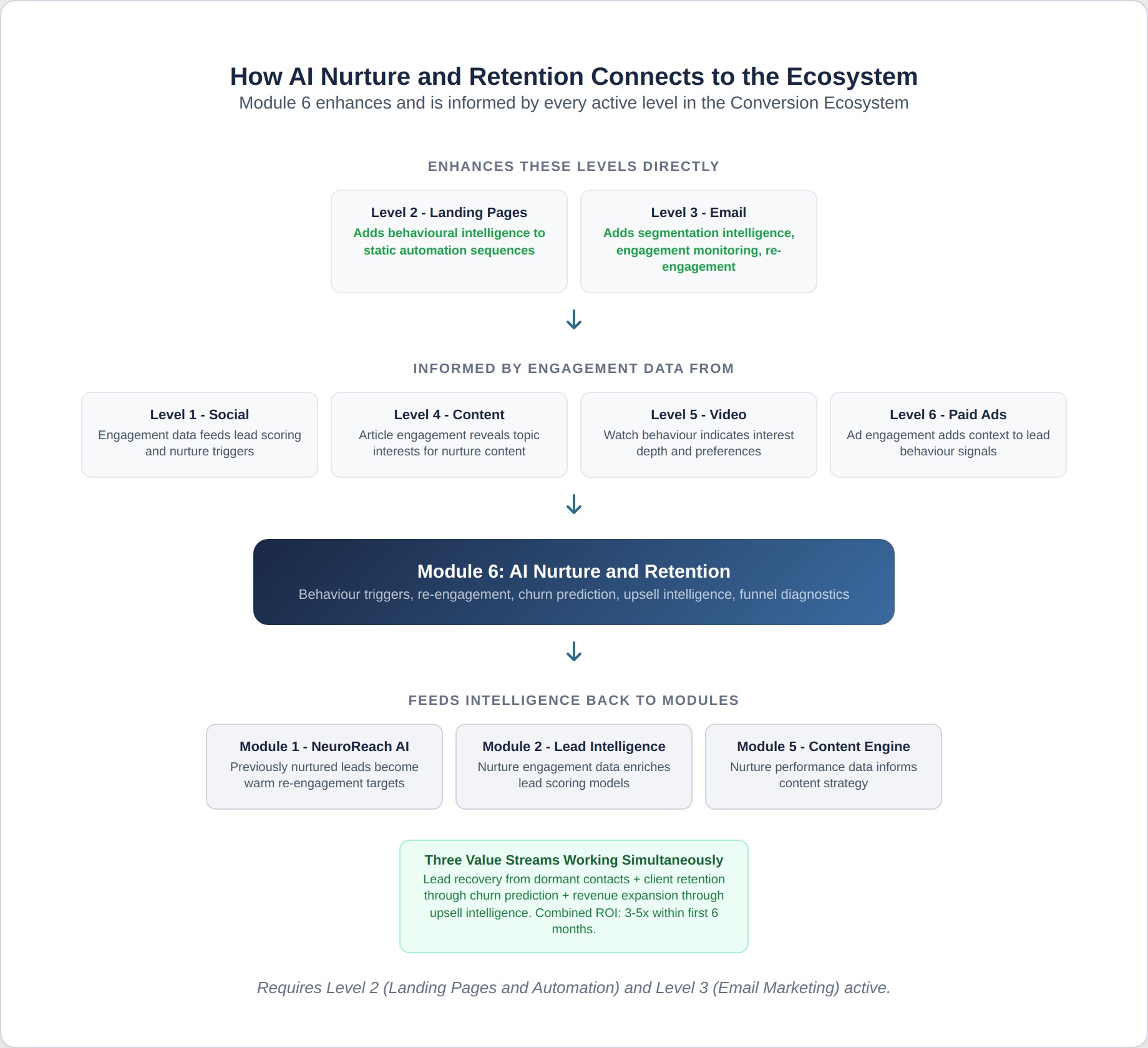
This module enhances and is informed by every active level:
Enhances Level 2 (Landing Pages and Automation): Adds behavioural intelligence to static automation sequences. Leads that complete Level 2 sequences without converting don’t disappear. They enter AI-managed nurture tracks.
Enhances Level 3 (Email Marketing): Adds segmentation intelligence, engagement monitoring, and re-engagement automation to the newsletter infrastructure. Subscribers are dynamically segmented based on behaviour rather than static categories.
Informed by Level 1 (Social Media): Social engagement data feeds into lead scoring and nurture triggers. A lead who engages with Level 1 social content and visits the website shows different intent than one who only opens emails.
Informed by Level 4 (Content): Article engagement data reveals which topics each lead cares about, informing nurture content selection.
Informed by Level 5 (Video): Video watch behaviour indicates interest depth and topic preferences that shape nurture sequences.
Informed by Level 6 (Paid Ads): Ad engagement data adds context to lead behaviour. A lead who clicks a retargeting ad and then visits the pricing page shows stronger intent than either signal alone.
Feeds Module 1 (NeuroReach AI): Leads who were previously nurtured and showed interest but didn’t convert become warm re-engagement targets for outreach.
Feeds Module 2 (AI Lead Intelligence): Nurture engagement data enriches lead scoring models, improving prediction accuracy.
Feeds Module 5 (AI Content Engine): Nurture performance data (which topics re-engage leads, which angles recover dormant contacts) informs content strategy across all channels.
What Determines Where You Fall in the Price Range
How Long Before You See Results
Week 1: Behaviour-triggered nurture sequences go live. Leads engaging with your ecosystem begin receiving intelligent, responsive follow-up immediately. Your team starts seeing real-time alerts for high-intent signals.
Week 2-4: Re-engagement campaigns activate for leads who’ve been quiet for 30+ days. First re-engagement responses come in, recovering leads that were effectively lost. CRM data begins to be enriched with behavioural context.
Month 1: Initial signal-to-sequence mapping is operational. Leads experience responsive nurture that adapts to their behaviour. The first wave of re-engaged leads enters the active pipeline. The churn prediction model begins calibrating against your client base.
Month 2: Churn prediction reaches initial reliability. First at-risk client alerts fire based on behavioural patterns. Upsell triggers identify initial expansion opportunities. Funnel diagnostics produce a first-drop-off analysis with recommended fixes.
Month 3: The system stabilizes. Behaviour-triggered nurture produces measurable outcomes that differ from static sequences. Re-engagement campaigns have recovered a quantifiable number of leads. Churn prediction has been validated against at least one real client situation. The funnel is being optimized based on diagnostic data.
Months 4-6: Compounding intelligence. The churn model becomes more accurate as it accumulates more data. Trigger sequences are refined based on what produces the best re-engagement rates. Upsell timing improves as the model learns which signals actually predict expansion readiness. The gap between your retention rate and industry average widens.
Month 6+: AI Nurture and Retention is a structural advantage. Leads are nurtured intelligently rather than generically. At-risk clients are identified and saved before they cancel. Expansion opportunities are surfaced at the right moment. Your funnel is continuously optimized based on behavioural data. The system gets smarter every month because every interaction teaches it something about your specific audience and client base.
Why This Investment Makes Sense
The math works from three directions simultaneously:
Lead recovery: If AI Nurture and Retention re-engages 15-20% of leads that would have gone permanently quiet, and even 10% of those re-engaged leads eventually convert, the module produces a pipeline from leads you’ve already paid to acquire. No additional marketing spend. No additional traffic. Just better stewardship of the leads you have.
Client retention: If churn prediction and proactive intervention save even 1-2 clients per year that would have otherwise cancelled, the retained revenue covers the module investment multiple times over. For a client paying $5,000/month, saving one client for 6 additional months represents $30,000 in retained revenue from a module that costs $1,500-$3,500/month.
Revenue expansion: If upsell and cross-sell intelligence identifies 2-3 expansion opportunities per year that your team would have otherwise missed, the incremental revenue from those expansions adds to the ROI. Existing clients who expand their engagement are the most profitable source of revenue in any business.
Combined, these three value streams typically produce 3-5x return on the module investment within the first 6 months.
What This Module Solves
AI Nurture and Retention solves the problem of passive lead management and reactive client service. Most B2B companies acquire leads and hope they convert, then serve clients and hope they stay. Hope is not a strategy. This module replaces hope with intelligence: continuous monitoring, predictive analysis, and automated intervention that ensures no lead goes quietly cold and no client drifts silently toward the exit.
What This Module Does NOT Include
- Outbound outreach to new prospects (Module 1: NeuroReach AI)
- Anonymous visitor identification (Module 2: AI Lead Intelligence — though visitor data enhances nurture triggers when active)
- Website chatbots or interactive tools (Module 3: AI Conversion Tools)
- Sales call preparation or CRM automation (Module 4: AI Sales Acceleration)
- Content production or repurposing (Module 5: AI Content Engine)
- Email newsletter writing or lead magnet creation (Level 3 — though this module enhances Level 3’s infrastructure)
- Landing page creation (Level 2 — though this module optimizes Level 2’s nurture sequences)
AI Nurture and Retention adds intelligence to existing nurture and retention systems. Other modules and levels build the infrastructure and produce the content it works with.
What You Need to Provide
- Onboarding conversation (60 minutes): We map your current nurture sequences, client management workflow, CRM structure, and identify the behavioural signals most relevant to your business
- CRM access: Integration to monitor engagement data, create behavioural triggers, and update lead and client records
- Email platform access: Integration to deploy triggered sequences and enhance existing automation
- Client history data: Historical information about past client churn (who left, when, and any known reasons) to calibrate the churn prediction model
- Account manager briefing (30 minutes): How to interpret and act on churn alerts, expansion recommendations, and re-engagement notifications
- Monthly report review (20-30 minutes): Review nurture performance, churn predictions, and funnel diagnostics
- Ongoing feedback: When a re-engaged lead converts or a flagged client cancels or stays, that outcome data improves the model
Total monthly time commitment: approximately 2-3 hours
Who Manages This
Rod Agatep personally oversees the nurture intelligence strategy, churn prediction model design, and retention workflow architecture for every Module 6 engagement. With 27 years of experience in B2B client relationships and marketing systems, Rod ensures the intelligence produced is actionable rather than theoretical.
Every behavioural trigger, every re-engagement sequence, every churn prediction model, and every expansion recommendation is configured under Rod’s direct supervision to align with your specific business model, client relationship patterns, and revenue structure.
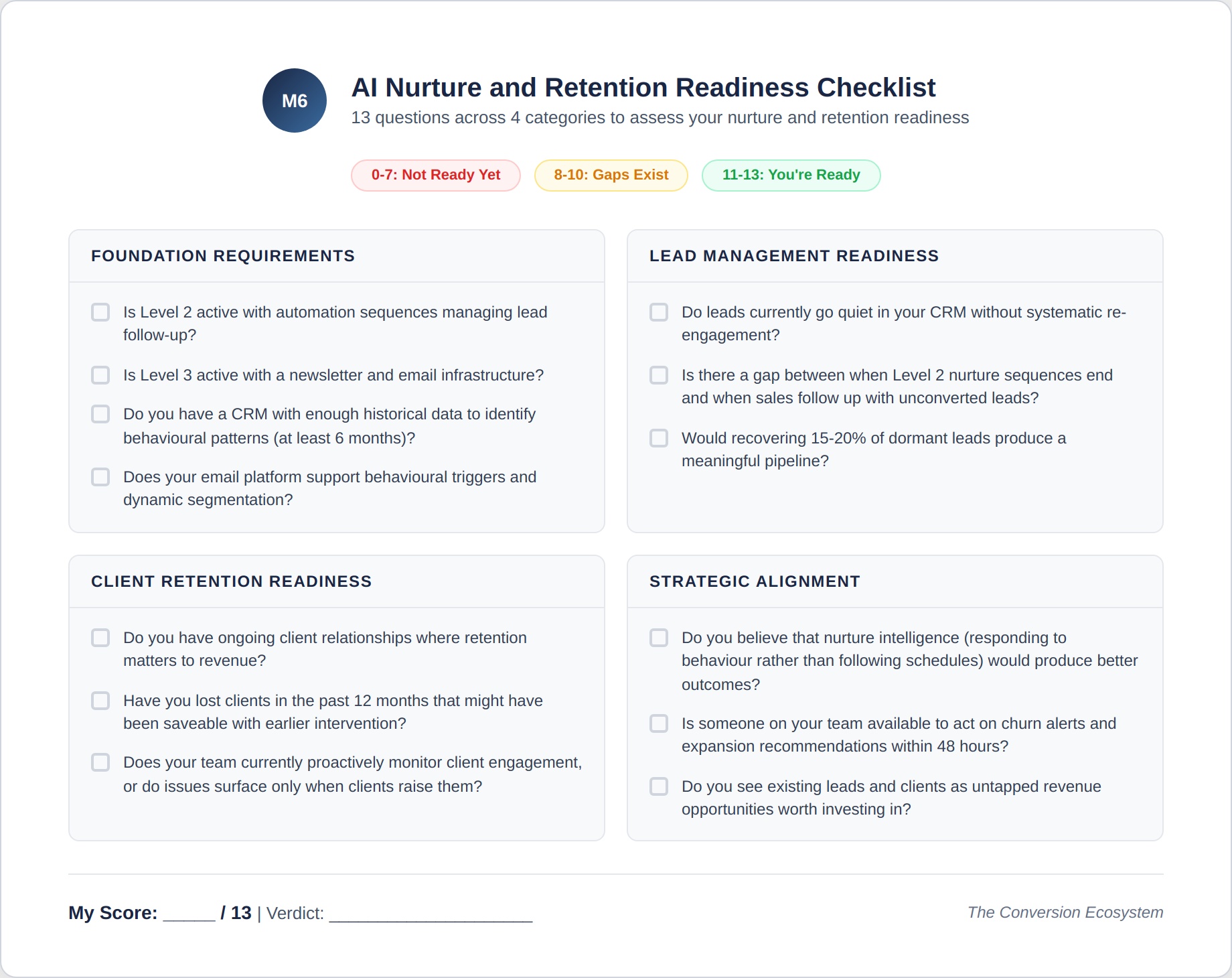
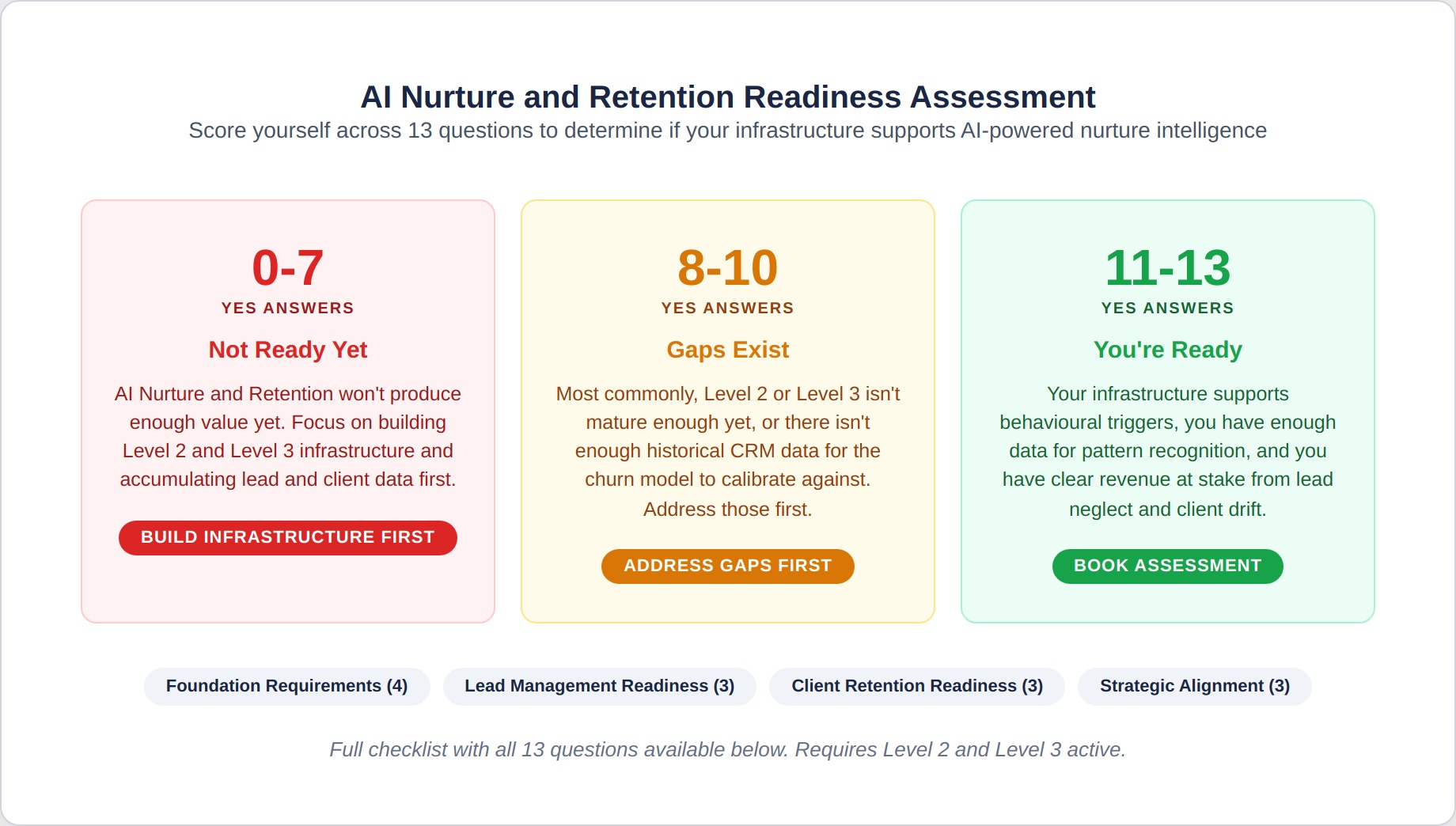
AI Nurture and Retention Readiness Assessment
Scoring
11-13 YES answers: You’re ready. Your infrastructure supports behavioural triggers, you have enough data for pattern recognition, and you have clear revenue at stake from lead neglect and client drift.
8-10 YES answers: Gaps exist. Most commonly, Level 2 or Level 3 isn’t mature enough yet, or there isn’t enough historical CRM data for the churn model to calibrate against. Address those first.
7 or fewer YES answers: AI Nurture and Retention won’t produce enough value yet. Focus on building your Level 2 and Level 3 infrastructure and accumulating lead and client data before adding the intelligence layer.
Pricing Summary
| Option | Investment |
|---|---|
| AI Nurture and Retention monthly | $1,500 – $3,500/month |
| Annual commitment | 20% off monthly rate |
| Combined with other AI Growth Modules | 10-15% multi-module discount |
What’s included: Behavior-triggered lead nurture sequences, signal-to-sequence pipeline configuration, re-engagement campaigns (30/60/90 day + win-back), website visitor activation triggers, retargeting personalization coordination (with Level 6), churn prediction model design and calibration, upsell and cross-sell recommendation engine, customer success automation, feedback collection and sentiment analysis, funnel diagnostics with recommended fixes, monthly performance reporting, and quarterly strategy reviews.
What’s not included: Outbound outreach (Module 1), visitor identification (Module 2), website chatbots (Module 3), sales call automation (Module 4), content production (Module 5), email newsletter writing (Level 3), landing page creation (Level 2), or paid advertising management (Level 6).
Next Step
If you’re not sure whether AI Nurture and Retention is the right module, whether your lead and client data support behavioural intelligence, or whether your infrastructure is ready, the fastest way to find out is to have a conversation.
We’ll review your current nurture sequences, assess the depth of your CRM data, evaluate your client retention patterns, and tell you honestly whether this module will produce meaningful results for your situation.
No pitch. No pressure. Just clarity on where you stand and what to do next.
Frequently Asked Questions
How is this different from the automation already in Level 2 and Level 3?
Level 2 automation is trigger-based and finite: a lead fills out a form and receives a defined sequence that ends. Level 3 newsletters are schedule-based: every subscriber gets the same weekly email. AI Nurture and Retention adds behavioural intelligence on top of both: responding to what each lead actually does, adapting messaging based on engagement patterns, detecting disengagement before it becomes permanent, and continuously optimizing the funnel based on where leads drop off and why. Think of it as the brain that makes your existing nurture infrastructure smarter.
Does churn prediction actually work?
It does, with a calibration period. The model needs 2-3 months of data to reach reliable accuracy. After that, it identifies at-risk clients with greater precision as it learns from each correct and incorrect prediction. No prediction model is 100% accurate, but consistently flagging at-risk clients 6-8 weeks before cancellation gives your team enough time to intervene in the majority of cases. Even saving 50% of flagged clients produces significant retained revenue.
What if we don’t have many clients yet?
Churn prediction requires a minimum client base to be meaningful (typically 15-20 active clients). If your client count is below that, the module still produces significant value through lead nurture intelligence, re-engagement campaigns, and funnel diagnostics. The churn prediction component can be activated later as your client base grows.
Won’t leads feel surveilled if nurture responds to their behaviour?
Good behavioural nurture doesn’t feel like surveillance. It feels like relevance. When a lead visits your pricing page and receives a case study the next morning, they don’t think “they’re tracking me.” They think “that’s exactly what I was looking for.” The key is that every triggered message delivers genuine value matched to the behaviour that triggered it. Creepy is “we noticed you visited our pricing page at 9:47 PM.” Helpful is “here’s a case study from a company similar to yours that shows the ROI of this approach.” We never reference the tracking itself. We just deliver the right content at the right time.
How does this work with Module 2 (AI Lead Intelligence)?
They complement each other powerfully. Module 2 identifies anonymous visitors and tracks intent signals. Module 6 responds to those signals with intelligent nurture. A known contact who visits your website (detected by Module 2) and shows declining engagement (detected by Module 6) triggers a coordinated response that neither module could produce on its own. Activating both qualifies for a multi-module discount.
Can the system handle different nurture tracks for different segments?
Yes. Behavioural triggers and nurture sequences are segment-aware. A lead from a specific industry receives different re-engagement content than a lead from a different industry. A high-value prospect showing buying signals receives different treatment than an early-stage lead. The segmentation infrastructure from Level 3 is enhanced with behavioural intelligence, so every lead’s experience feels personalized to their specific situation and engagement pattern.
What are the cancellation terms?
Month-to-month with 30 days’ notice. Annual at 20% off with a 12-month term. The early termination fee equals the discount on the completed months. You retain all behavioural trigger configurations, nurture sequences, churn prediction models, funnel diagnostic data, and re-engagement campaign assets. Everything continues operating within your email and CRM platforms.
Do I own the models and data?
Yes. Every behavioural model, every trigger configuration, every churn prediction algorithm calibrated to your data, and every piece of intelligence produced belongs to you. If the engagement ends, the models and configurations remain operational in your systems. There are no model-removal clauses or data-expiration terms.