
Key Takeaways
- Paid advertising will only accelerate your current situation. It should never be used as your foundation. If you don’t have your foundation set, it just magnifies what is not working. If you have Level 1-5 set up, paid ads will amplify your efforts by putting proven messaging, offers, and content in front of more people.
- Because of the foundation built, every campaign uses data from the lower levels. This includes the proven topics from Level 1, tested conversion pages from Level 2, validated offers from Level 3, high-performing content from Level 4, and trust-building videos from Level 5, meaning Level 6 starts with winners rather than guesses.
- The difference between companies that waste money on ads and those that profit from them lies in what happens after the click. This is why Levels 0-5 must be in place before Level 6 makes financial sense.
- Ad performance data provides feedback for the organic strategy. This creates rapid A/B testing where paid traffic reveals which headlines, audiences, and messaging angles work best. It is these insights that help a business improve content, social posts, and emails across the other levels.
- The investment ranges from $2,500 to $6,000/month in management fees plus ad spend (typically $3,000-$20,000+/month), depending on platform count, campaign complexity, and budget under management.
Paid advertising accelerates your marketing by putting your best content, offers, and messaging in front of more qualified buyers faster than organic channels alone.
Management fee: $2,500 – $6,000/month (plus ad spend).
Ad spend: Typically $3,000 – $20,000+/month based on market, goals, and lead capacity.
Annual Commitment: 20% off the monthly management fee
Stacking Discount: Pricing decreases as levels are added (see Conversion Ecosystem pricing table)
Timeline to first results: Initial campaigns launch within 2-3 weeks of onboarding. Meaningful performance data emerges at 30-60 days. Optimized, predictable campaign performance stabilizes at 60-90 days.
What This Level Is
Level 6 is the accelerant. It takes everything proven through Levels 1-5 and puts it to work.
By the time you reach Level 6, you know what works. You know which topics your audience engages with because Level 1 tested them daily. You know which landing pages convert because Level 2 built and optimized them. You know which offers your audience wants because Level 3 lead magnets proved it. You know which content attracts qualified traffic because Level 4 articles ranked for it. You know which videos build trust because Level 5 measured the retention.
Level 6 doesn’t guess. It takes the winning elements from every level and pays to put them in front of more people, faster. That’s why it works. And that’s why doing it before the lower levels are in place is the single most expensive mistake in digital marketing.
Most companies start with paid advertising. They buy Google Ads or run LinkedIn campaigns before they have a website that converts, before they have landing pages that capture, before they have automation that follows up, before they have content that builds trust.
The result is predictable and expensive.
They pay for clicks that land on a website with no clear conversion path. Visitors browse, get confused, and leave. The few who fill out a generic contact form are added to a CRM, where no one follows up for 3 days. By then, the lead is cold. The company looks at the ad dashboard, sees clicks and impressions, and concludes “digital advertising doesn’t work for our business.”
The advertising worked. The click happened. The visitor arrived. Everything after the click failed.
Level 6 comes last because it amplifies whatever system it points to. If the system converts, paid traffic produces profitable leads at scale. If the system is broken, paid traffic provides expensive proof of it faster.
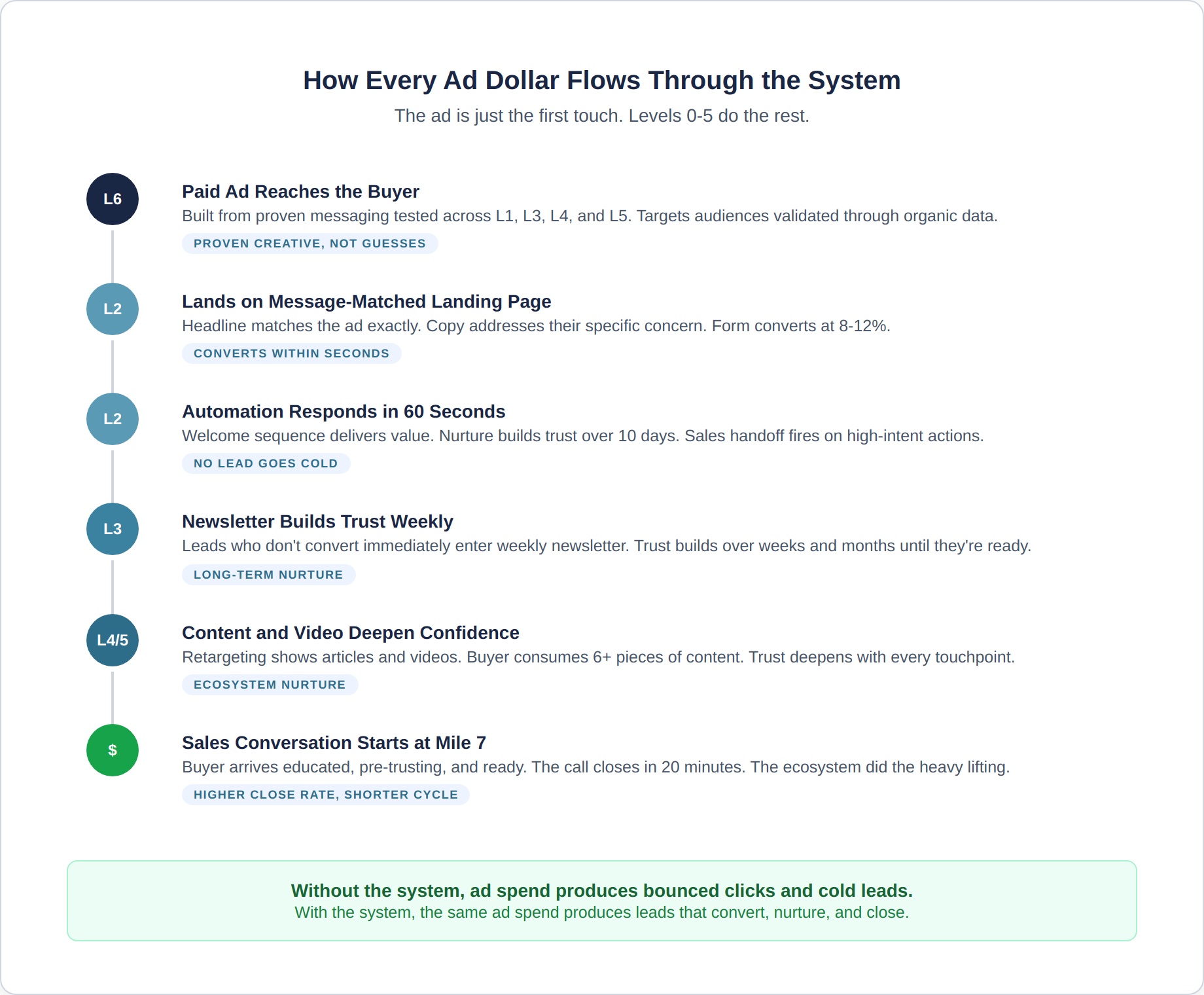
Every dollar of ad spend flows through the same system, Levels 0-5 built:
- The ad sends the buyer to a Level 2 landing page that matches the ad messaging exactly.
- The landing page converts the buyer into a lead with a Level 2 automation sequence that maintains engagement.
- The buyer receives Level 3 newsletters that build trust over time.
- The buyer discovers Level 4 articles and Level 5 videos that deepen their confidence.
- The buyer arrives at the sales conversation having been nurtured by the entire ecosystem, not just a single ad click.
That’s why Level 6 produces different results than advertising without the system. The ad is just the first touch. The system does the rest.
What You Get
Platform Strategy
Not every advertising platform deserves your budget. Level 6 starts by identifying where your specific buyers can be reached most efficiently and allocating budget accordingly.
Platforms we manage:
Google Ads (Search and Display)
- Search campaigns targeting buyers actively searching for your services, the highest-intent traffic available, because the buyer is telling you what they want through their search query.
- Display campaigns for retargeting visitors who engaged with your website, content, or landing pages but didn’t convert, keeping your brand visible during their evaluation period
- YouTube ads promote your Level 5 videos to targeted audiences, building trust with the same video content that performs organically, while reaching buyers who haven’t yet discovered your channel.
LinkedIn Ads
- Sponsored content promoting your best-performing Level 1 posts and Level 4 articles to targeted professional audiences beyond your organic reach
- Lead gen forms that capture contact information directly within LinkedIn without requiring the buyer to leave the platform
- InMail campaigns for targeted outreach to specific decision-makers at specific companies
- Retargeting shows ads to professionals who visited your website or engaged with your LinkedIn content.
Meta Ads (Facebook and Instagram)
- Retargeting campaigns keep your brand top of mind for buyers who’ve already engaged with your website or social content.
- Lookalike audience campaigns find new buyers who share characteristics with your existing clients and engaged audience.
- Content promotion amplifying your highest-performing content to build awareness before direct lead generation
The platform mix is determined by your data, not assumptions. During onboarding, we analyze where your current leads come from, where your buyer profile spends time, and where the competitive landscape offers the best opportunity. Most B2B companies start with Google Search (highest intent) plus LinkedIn (most precise B2B targeting) and expand from there based on results.
Campaign Architecture Built on Proven Data
Every campaign starts with data from the lower levels, not guesses:
From Level 1: Which messaging angles, topics, and hooks generated the most engagement and profile visits? These become an ad creative theme.
From Level 2: Which landing pages convert at the highest rates? These receive the paid traffic. Which offers produce the highest-quality leads? These become the ad offers.
From Level 3: Which lead magnets generate the most downloads and the best downstream pipeline contribution? These become promoted offers.
From Level 4: Which articles attract the most qualified organic traffic? These inform keyword targeting and content promotion strategy.
From Level 5: Which videos produce the highest retention and the most website click-throughs? These become promoted video content and YouTube ad creative.
From sales team intelligence: Which lead sources produce the highest close rates? Which buyer segments convert fastest? This data shapes targeting and budget allocation.
This means Level 6 campaigns start with proven creative, offers, landing pages, and audience signals. The testing phase is compressed because you’re not starting from zero. You’re scaling what already works.
Campaign Types We Run
**Search Intent Campaigns (Google Ads)**Targeting buyers who are actively searching for solutions you provide. These campaigns capture existing demand rather than creating awareness from scratch.
- Service keyword campaigns targeting searches like “B2B marketing agency,” “lead generation services,” or industry-specific service queries
- Problem keyword campaigns targeting searches like “why aren’t my marketing leads converting” or “how to fix inconsistent lead flow.”
- Competitor keyword campaigns targeting buyers searching for your competitors by name, presenting your offering as an alternative
- Cost and pricing keyword campaigns targeting the exact queries your Level 4 articles rank for, doubling visibility with both organic and paid results
**Retargeting Campaigns (All Platforms)**Retargeting is the highest-ROI advertising activity because it reaches people who already know you. They’ve visited your website, watched your videos, engaged with your content, or downloaded your lead magnets, but haven’t taken the next step yet.
- Website visitor retargeting shows ads to anyone who visited your site in the past 30-90 days.
- Video viewer retargeting shows ads to people who watched 50% or more of your Level 5 YouTube videos.
- Engagement retargeting shows ads to people who engaged with your Level 1 social content.
- Landing page abandonment retargeting specifically targeting visitors who reached a Level 2 landing page but didn’t convert
- Sequential retargeting where ads tell a story over time: first ad builds awareness, second addresses an objection, third presents the offer
Remarketing list segmentation ensures different audiences see different messages based on their behaviour:
- Visitors who viewed your pricing page see ads with ROI messaging and case studies because they’re evaluating cost.
- Visitors who only read a blog post see ads promoting a related lead magnet because they’re still in awareness mode
- Visitors who started but didn’t complete a form see ads addressing the specific hesitation that likely stopped them
- Visitors who engaged deeply across multiple pages see direct consultation offers because their behaviour signals high intent.
This segmented approach mirrors Level 3’s email segmentation philosophy: different buyers at different stages receive different messages because treating everyone the same wastes budget on messages that don’t match where the buyer actually is.
Content Amplification CampaignsPromoting your highest-performing organic content to reach qualified audiences beyond your current organic reach:
- Article promotion, putting your best Level 4 articles in front of targeted audiences on LinkedIn and through Google Display
- Video promotion amplifying your top Level 5 videos through YouTube ads and LinkedIn video promotion
- Lead magnet promotion driving targeted traffic to Level 3 lead magnet landing pages through all platforms
- Newsletter growth campaigns promoting your Level 3 newsletter to audiences who match your subscriber profile
Direct Lead Generation CampaignsDriving qualified traffic directly to Level 2 landing pages with specific conversion offers:
- Consultation booking campaigns for high-intent buyers ready for a conversation
- Assessment or diagnostic campaigns for mid-funnel buyers who want to evaluate their situation
- Webinar or event campaigns for awareness-stage buyers who aren’t ready for a direct conversation but will invest time in learning
Ad Creative Development
Level 6 includes the creation of all ad creatives needed across platforms:
- Ad copywriting for text ads, sponsored content, and InMail messages, written to match the voice and positioning established across all levels.
- Image ad design using your established visual identity for consistent brand presentation across platforms
- Video ad editing, cutting your existing Level 5 videos into platform-specific ad formats (6-second bumpers, 15-second pre-rolls, 30-second mid-rolls)
- Carousel and document ad creation for LinkedIn, using proven frameworks from Level 1 social content
- A/B test variations with multiple headlines, descriptions, images, and CTAs for every campaign, so performance can be optimized through data rather than assumptions
- Dynamic ad creation where ad elements automatically adjust based on the viewer’s characteristics or behaviour
Ad Fatigue Management and Creative Refresh Cycles
Ad fatigue occurs when the same audience sees the same ad repeatedly until they stop noticing it. In B2B advertising with focused audiences, this typically happens within 4-8 weeks, depending on audience size and ad frequency.
How we prevent and manage fatigue:
- Frequency monitoring, tracking how many times each audience member has seen each ad. When frequency reaches thresholds that historically precede performance decline, creative rotation begins.
- Proactive creative refresh replacing ads before fatigue sets in, rather than waiting for performance to degrade. New creative variations are always in development, so refreshes don’t cause campaign gaps.
- The content engine advantage: Because Levels 1, 4, and 5 continuously produce new content, you never run out of fresh creative to rotate into campaigns. Most companies running ads without a content engine exhaust their creative within 2-3 months and either reuse stale ads or scramble to produce new ones. Your ecosystem produces fresh material weekly, giving Level 6 an unlimited supply of tested creative to work with.
- Creative performance tracking, identifying which ad variations produce the best results at each stage of their lifecycle, and using those patterns to inform the next round of creative
Budget Management and Allocation
Your ad spend is separate from the management fee and remains fully under your control.
How budget allocation works:
- We recommend a starting budget based on your market, your goals, your landing page conversion rates, and your sales team’s capacity to handle leads.
- Budget is allocated across platforms and campaigns based on expected ROI, with the highest-converting channels receiving the largest share.
- Budget shifts monthly based on performance data. Campaigns producing leads at low cost get more budget. Campaigns underperforming get adjusted or paused.
- You approve all budget changes before they’re implemented. We recommend. You decide.
- There’s no minimum ad spend required by us. However, meaningful results on most platforms require at least $3,000/month in ad spend. Below that, the data accumulates too slowly for effective optimization.
Typical budget allocation for a B2B company starting Level 6:
- 40-50% to Google Search (highest intent, most predictable)
- 20-30% to LinkedIn (most precise B2B targeting)
- 15-20% to retargeting across all platforms (highest ROI per dollar)
- 5-15% to content amplification and testing
Allocation evolves as data shows which channels produce the best results for your specific business.
Seasonality and Budget Flexibility
B2B markets have seasonal patterns that affect ad performance. Level 6 accounts for these rhythms:
- High-demand periods (typically Q1 planning season and Q4 budget allocation) often produce lower cost per lead because buyer intent is higher. We recommend increasing the budget during these windows to capture more demand at efficient rates.
- Lower-demand periods (typically mid-summer and late December) often produce a higher cost per lead because fewer buyers are actively searching. We reduce acquisition campaign budgets during these windows and maintain retargeting to keep warm audiences engaged.
- Budget shifting from slow months to high-performing months is built into the strategy. If August produces fewer high-quality leads at a higher cost, that budget is better deployed in September, when activity increases.
- Holiday strategy: During December and major holidays, competition often drops as other advertisers pause their campaigns. This can create opportunities for lower-cost traffic if your sales team is available to handle leads. We assess your specific situation and recommend whether to reduce, maintain, or capitalize.
- Industry-specific patterns are identified during onboarding and refined as data accumulates. If your buyers are most active during conference season, trade show periods, or fiscal year transitions, campaigns are timed to align with those periods.
The Learning Phase: What to Expect When Campaigns Launch
When new campaigns launch on Google and Meta, the platforms enter a “learning phase” in which the algorithms experiment with who to show your ads to and when. This is normal and expected, but it creates temporary volatility that can alarm clients who aren’t prepared for it.
What happens during the learning phase:
- Performance is erratic for the first 7-14 days. Cost per click and conversion rates fluctuate significantly as the algorithm gathers data about which audiences respond to your ads.
- Cost per lead may be 2-3x higher than eventual optimized levels during this period. This is not a sign that the campaign isn’t working. It’s a sign that the algorithm is still calibrating.
- Making changes during the learning phase resets it. Adjusting bids, budgets, targeting, or creative during the first 7-14 days restarts the calibration process and extends the volatility. We resist the urge to “fix” campaigns during this period unless something is fundamentally wrong.
- After the learning phase exists, performance stabilizes, and optimization begins. This is when the real data emerges, and strategic adjustments become meaningful.
We explain this during onboarding so you understand why the first two weeks don’t represent long-term performance and why patience during this window is critical to eventual results.
Landing Page Coordination With Level 2
Every ad points to a landing page specifically built or optimized for that campaign’s traffic:
- Message match verification ensures the ad promise and the landing page headline align, so buyers never experience a disconnect.
- Campaign-specific landing page variations when different ad audiences need different messaging, trust elements, or offers
- Conversion tracking integration connects ad platforms to landing pages so every conversion is attributed to the specific campaign, ad set, and ad that produced it.
- Landing page performance feedback where conversion rate data from paid traffic informs Level 2 optimization priorities
If Level 2 landing pages need adjustments to perform better with paid traffic, those adjustments are coordinated between Level 2 and Level 6. The two levels work as a unified conversion system rather than separate functions.
Conversion Tracking and Attribution
Understanding which campaigns produce revenue, not just clicks, requires proper tracking:
- Full-funnel tracking from ad click through landing page conversion through CRM pipeline to closed deal.
- UTM parameter strategy tagging every ad link so traffic sources, campaigns, and ad variations are tracked in Google Analytics and your CRM
- Offline conversion tracking feeds CRM data back to ad platforms so algorithms can optimize for leads that actually become clients, not just leads that fill out forms.
- Cross-platform attribution: understanding how a buyer who sees a LinkedIn ad later searches on Google and finally converts through a retargeting ad should be attributed across the channels that influenced the decision.
- Revenue attribution connects closed deals back to the campaigns that originated or influenced them, so ROI calculations use real revenue, not estimated lead values.
- Platform vs CRM discrepancy management: Ad platforms and CRM systems often report different conversion numbers due to attribution windows, tracking methodology, and data lag. We reconcile these discrepancies monthly, so your reports reflect reality rather than platform-inflated metrics.
Privacy, Cookies, and Tracking Changes
The advertising landscape is shifting amid privacy regulations and the deprecation of cookies. Level 6 stays current and adapts:
- iOS privacy changes (App Tracking Transparency) have significantly reduced Meta’s ability to track conversions from iPhone users. We use Conversions API (server-side tracking) to maintain measurement accuracy beyond what pixel-based tracking alone can provide.
- Cookie deprecation is gradually reducing the effectiveness of third-party cookie-based retargeting across all platforms. We build first-party data strategies using your Level 3 email list and Level 2 CRM data to maintain targeting effectiveness independent of cookies.
- Server-side tracking through Google Tag Manager server containers and platform-specific conversion APIs maintains measurement accuracy that client-side tracking alone cannot.
- Consent management ensures that tracking and retargeting comply with GDPR, CCPA, and other privacy regulations based on where your audience is located.
- Ongoing adaptation: Privacy regulations and platform tracking capabilities change regularly. Level 6 monitoring includes staying current with these changes and adjusting tracking, targeting, and attribution methods as the landscape evolves, so your campaigns maintain effectiveness regardless of platform policy changes.
Brand Safety and Placement Controls
Where your ads appear matters as much as who sees them:
- Google Display and YouTube placement exclusions prevent your ads from appearing alongside inappropriate, low-quality, or brand-damaging content. We maintain exclusion lists covering sensitive categories, controversial content, and low-quality sites.
- Content category restrictions on Google Display, ensuring your ads appear in professional, relevant contexts that align with your brand positioning
- LinkedIn is inherently brand-safe due to its professional environment, but ad format and placement selection still affect how your brand is perceived.
- Weekly placement auditing, reviewing where ads appeared, and excluding any new sites or channels that don’t meet brand standards
- YouTube channel exclusions prevent your ads from running before or alongside videos from channels that don’t align with your brand.
How Ad Performance Data Feeds Back Into Organic Strategy
Level 6 doesn’t just consume data from the lower levels. It produces data that makes every lower level smarter:
- Headline testing at paid speed: Ad headlines generate click-through data within days, not months. When an ad headline outperforms others by 2-3x, that messaging angle is applied to Level 4 article titles, Level 1 post hooks, and Level 3 email subject lines.
- Audience insights inform targeting across all levels: Ad data reveals which job titles, company sizes, industries, and geographic regions convert at the highest rates. These insights refine Level 1 social targeting, Level 3 segmentation, and Level 7 outbound targeting.
- Offer testing at scale: Paid traffic quickly reveals which offers (consultation, assessment, guide, webinar) produce the highest conversion rates and best lead quality. Those insights determine which offers Level 2 landing pages promote most prominently.
- Creative fatigue patterns reveal content preferences: When certain ad formats or visual styles maintain engagement longer than others, those preferences inform creative direction across Level 1 social posts and Level 5 video thumbnails.
- Paid advertising becomes a rapid testing lab for the entire ecosystem. Because you control the traffic volume, you can test messaging hypotheses in days that would take months to test organically. The winners get applied everywhere.
Ongoing Optimization
Paid advertising is never set-and-forget. Level 6 includes continuous optimization:
- Weekly bid and budget adjustments based on performance data
- Ad creative rotation, replacing underperforming ads with new variations before fatigue sets in.
- Audience refinement, narrowing or expanding targeting based on which segments produce the best lead quality and close rates.
- Negative keyword management (Google Ads) prevents your ads from showing for irrelevant searches that waste budget.
- Placement auditing (Display and YouTube), ensuring ads appear in appropriate contexts that don’t harm your brand.
- Daypart and device optimization, adjusting when and where ads show based on when your audience is most likely to convert
- Landing page recommendations when ad data reveals conversion bottlenecks that Level 2 can address
- Competitor monitoring tracking when competitors enter or exit your ad auctions, and how their activity affects your costs and positioning
Competitor Ad Intelligence
Understanding what your competitors are doing with paid advertising informs your strategy:
- Competitor ad creative monitoring showing you what ads your competitors are running, what messaging they use, and which platforms they’re active on
- Estimated competitor spend provides approximate budget levels for competitors, so you can understand the competitive landscape.
- New competitor alerts identify when a new competitor enters your ad auctions or when an existing competitor significantly changes their approach.
- Competitive gap analysis, identifying keywords, audiences, or messaging angles your competitors aren’t targeting that represent opportunities.
- Strategic response planning, determining whether to compete directly on contested keywords, differentiate through messaging, or pursue uncontested opportunities based on competitive activity.
This intelligence is included in quarterly strategy reviews and flagged between reviews when significant competitive shifts occur.
Monthly Reporting
Every month, you receive a comprehensive report covering:
- Campaign performance by platform: impressions, clicks, click-through rate, cost per click, conversions, cost per lead, and conversion rate
- Lead quality analysis: how ad-generated leads perform in sales conversations compared to organic leads.
- Pipeline contribution: how many ad-generated leads entered the pipeline, reached proposal stage, and closed
- Revenue attribution: which campaigns produced closed revenue and what the actual ROI is, not just estimated
- Budget efficiency: cost per lead and cost per opportunity by campaign, platform, and audience segment
- Ad creative performance: which ads, headlines, images, and CTAs produce the best results with fatigue indicators for each
- Retargeting effectiveness: how retargeting audiences move through the funnel compared to cold audiences, segmented by behaviour
- Audience insights: which segments, job titles, company sizes, and industries convert best, with implications for the broader ecosystem
- Competitive intelligence: changes in competitor ad activity, bidding patterns, and messaging
- Privacy and tracking health: any tracking degradation, consent rate changes, or platform policy updates affecting measurement
- Organic strategy recommendations: insights from ad data that should be applied to Levels 1, 2, 3, 4, and 5
- Recommendations: budget reallocation, new campaign opportunities, creative refreshes, and strategic adjustments for next month
Reporting transparency and access:
You have direct access to all ad platform dashboards at all times. You can see real-time performance data without waiting for monthly reports. We provide login credentials and a brief orientation during onboarding so you can check performance at any time. The monthly report synthesizes the data into strategic insights, but you never have to wait for us to tell you what’s happening.
Quarterly Strategy Review
Every 90 days, we conduct a comprehensive paid advertising review:
- Full ROI analysis calculating actual return on ad spend using closed-deal data, not just lead counts.
- Channel evaluation assessing which platforms produce the highest-quality leads and best ROI to inform budget reallocation.
- Audience performance analysis evaluating which targeting segments, company sizes, industries, and job titles produce the best results.
- Creative fatigue assessment, identifying which ad creatives need refreshing based on declining engagement and frequency data
- Competitive landscape review assessing how competitor ad strategies have shifted and how to maintain positioning
- Seasonality planning, reviewing upcoming seasonal patterns, and adjusting budget allocation for the next quarter.
- Scale assessment evaluating whether the budget can be increased profitably or whether the current spend has reached efficient saturation.
- Privacy and tracking review assessing any changes to platform tracking capabilities, and ensuring measurement remains accurate.
- Organic strategy feedback summarizing all insights from ad data that should be applied across the ecosystem
- Next quarter planning new campaign launches, budget adjustments, platform expansion or consolidation, and creative strategy
AI Client Acquisition System
The AI client acquisition system is the most comprehensive AI service offering because it integrates multiple AI components into a single coordinated system that identifies, engages, qualifies, nurtures, and converts prospects with minimal manual intervention. This is not a single tool. It’s an interconnected system that combines prospecting intelligence, automated outreach, lead scoring, CRM orchestration, and conversion optimization into one pipeline that operates continuously. Pricing reflects the scope and complexity of connecting multiple AI components into a unified acquisition engine.
A focused acquisition system built around a single channel with AI prospecting feeding automated outreach with CRM integration and basic scoring falls toward the lower end. A comprehensive multi-channel acquisition system with AI prospecting across multiple signal sources, personalized outreach across email, LinkedIn, and phone, AI-powered lead scoring that adapts based on engagement patterns, multi-stage nurture with behavioral triggers, and full closed-loop CRM integration where deal outcomes refine every upstream component falls toward the higher end. The system’s power comes from the connections between components, not the components themselves.
Typical investment range: $5,000 to $12,000 for initial system design, component configuration, integration architecture, and deployment, plus $1,500 to $4,000 per month for platform costs, data sources, ongoing optimization, and model refinement. This is typically the highest-investment AI service because it encompasses the broadest scope and produces the most direct revenue impact.
What affects where you fall in the range: number of channels the system operates across, complexity of the prospect identification and scoring model, depth of personalization in automated outreach, number of nurture stages and behavioral triggers, completeness and quality of your existing CRM data, number of integrations required between AI components and your existing tools, and whether the system is being deployed alongside other AI components that share infrastructure and reduce per-component costs.
What the Buyer Experience Looks Like With Paid Advertising
Here’s what a buyer experiences when Level 6 is integrated with the full ecosystem.
Tuesday, 2:15 PM: A marketing director searches Google for “how much does lead generation cost for B2B.” Your Level 4 article appears in organic results, AND your Google Ad appears at the top. She clicks the ad.
Tuesday, 2:16 PM: She lands on a Level 2 landing page specifically built for this campaign. The headline matches her search query. The page addresses her exact concern about cost. She downloads a pricing guide (Level 3 lead magnet). She enters the Level 2 automation sequence.
Wednesday through Friday: She receives the first two emails of the welcome sequence. On Thursday, she sees your retargeting ad on LinkedIn while scrolling her feed. The ad features a 60-second clip from a Level 5 video about lead generation ROI. She watches the full clip. The retargeting ad differs from what a first-time visitor would see because her audience segment consists of people who have already downloaded a resource.
The following Monday, she sees a LinkedIn sponsored post promoting your Level 4 article about why cheap marketing costs more in the long run. She clicks and reads the full article. At the bottom, a CTA invites her to book a call.
The following Wednesday, she receives email 4 of the nurture sequence, which includes a link to the full Level 5 video. She watches for 14 minutes. That evening, a sequential retargeting ad appears on Instagram. It’s the third ad in the sequence: the first built awareness, the second addressed an objection, and this one presents the consultation offer with a client result as proof.
The following Thursday, she books a call through the Level 2 booking page.
The following Monday at 10:00 AM: Your sales rep joins the call. The buyer has consumed 6+ pieces of content, watched a 14-minute video, downloaded a guide, and been nurtured through 4 emails. She says, “I’ve seen your stuff everywhere over the past two weeks. I feel like I already know your approach. Let’s talk about whether this makes sense for us.”
That call closes in 20 minutes. The buyer felt like she discovered you organically, even though the first touch was a paid ad. Every subsequent touchpoint was orchestrated by the ecosystem. The paid ad opened the door. The system closed it.
Why Most Companies Waste Money on Ads (And How Level 6 Prevents It)
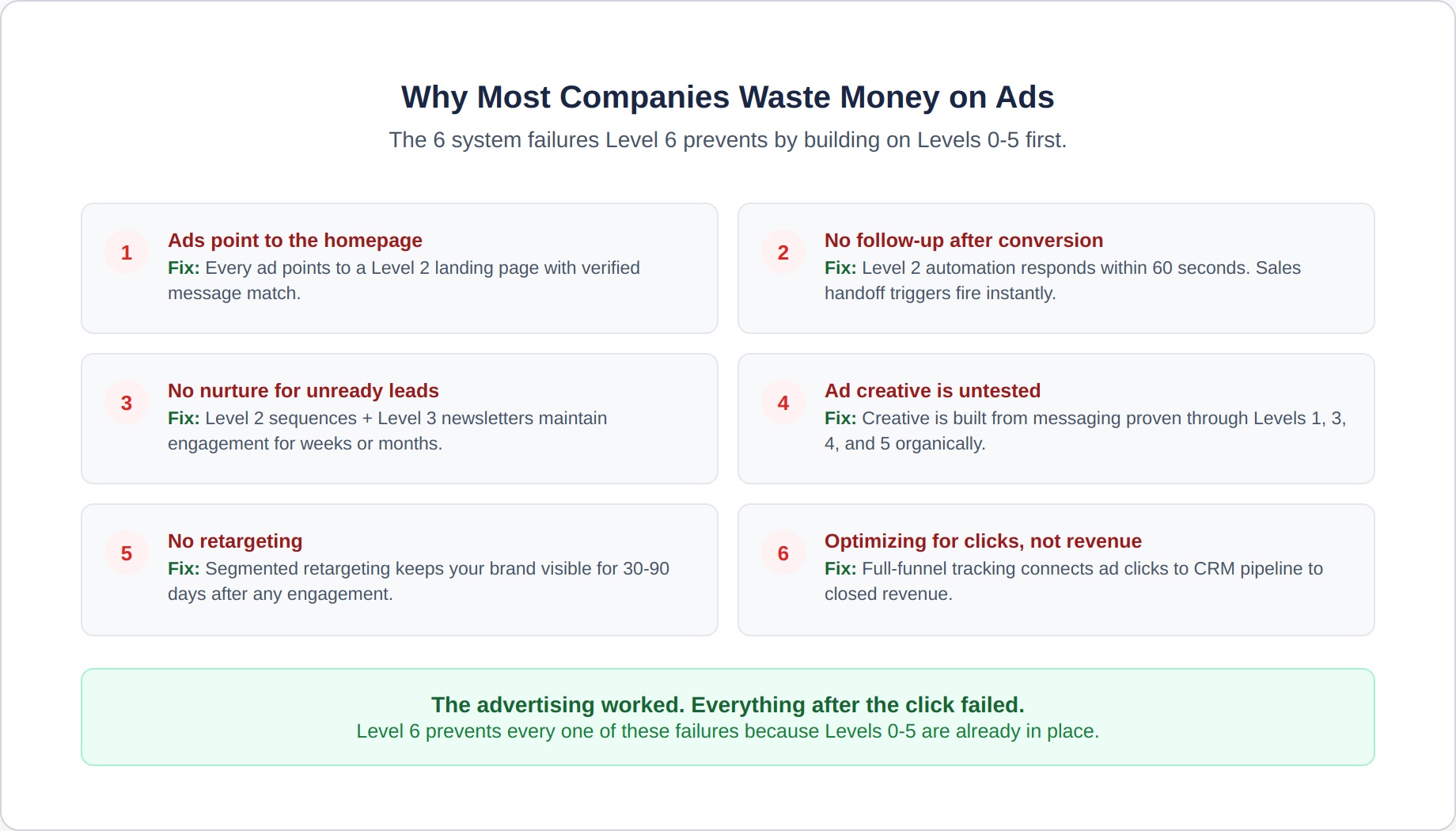
The most common advertising failures aren’t platform problems or targeting problems. They’re system problems:
Failure 1: Ads point to the homepage. The buyer clicks an ad for a specific service and lands on a general homepage with no clear path back to the specific service they clicked. They bounce. The click was wasted.
Level 6 prevention: Every ad points to a Level 2 landing page built specifically for that campaign, with message match verified before launch.
Failure 2: No follow-up after conversion. A buyer fills out a form. Nobody responds for 3 days. The lead is cold.
Level 6 prevention: Level 2 automation responds within 60 seconds. Sales handoff triggers notify the team immediately for high-intent actions.
Failure 3: No nurture for leads not ready to buy. A buyer downloads a resource but isn’t ready for a conversation. Without nurture, they forget about you. The lead cost is wasted.
Level 6 prevention: Level 2 nurture sequences and Level 3 newsletters maintain engagement for weeks or months until the buyer is ready.
Failure 4: Ad creative is untested. The company runs ads with messaging they haven’t validated. If it doesn’t resonate, they’ve spent thousands discovering what could have been tested organically for free.
Level 6 prevention: Ad creative is built from messaging proven through Levels 1, 3, 4, and 5. The testing was done organically. Paid advertising scales the winners.
Failure 5: No retargeting. A buyer visits the website, doesn’t convert, and never sees the company again. They convert with a competitor who stayed visible.
Level 6 prevention: Segmented retargeting keeps your brand visible across platforms for 30-90 days after any website visit or content engagement, with different messages for different audience segments based on their behaviour.
Failure 6: Optimizing for clicks instead of revenue. The ad platform reports impressive click volumes, and the team celebrates. But none of those clicks become clients. The campaign “worked” by platform metrics and failed by business metrics.
Level 6 prevention: Full-funnel tracking connects ad clicks to the CRM pipeline to closed revenue. Optimization decisions are based on which campaigns produce clients, not which produce clicks.
Audience Building as a Long-Term Asset
Beyond immediate lead generation, paid advertising builds audience data that becomes increasingly valuable over time:
- Retargeting audiences grow with every visitor. Every person who visits your website, watches a video, or engages with your content is added to retargeting pools that grow in value as they expand. A retargeting audience of 5,000 past visitors converts at 3-5x the rate of cold traffic at a fraction of the cost.
- Lookalike audiences improve as source data expands. The more clients and engaged leads in your CRM, the better the platforms’ algorithms can find new people who match their characteristics. A lookalike audience built on 100 clients is dramatically more effective than one built on 20.
- Pixel and conversion data accumulate behavioural signals that make future targeting more precise. The longer your tracking pixels run, the more the platforms understand who converts and when, automatically improving targeting without manual adjustment.
- This audience data persists even during campaign pauses. If you pause campaigns temporarily, the audiences you’ve built remain in the platforms and can be reactivated when campaigns resume. The data doesn’t expire for 90-180 days, depending on the platform.
The audience you build through Level 6 is a strategic asset that compounds as content and email lists do. It’s not just about the leads you generate today. It’s about the targeting intelligence you build for every campaign you run in the future.
What Ad-Generated Leads Actually Look Like Compared to Organic
This is an honest conversation every buyer should have before investing in paid advertising.
Ad-generated leads often behave differently from organic leads. Understanding this prevents frustration and helps set accurate expectations:
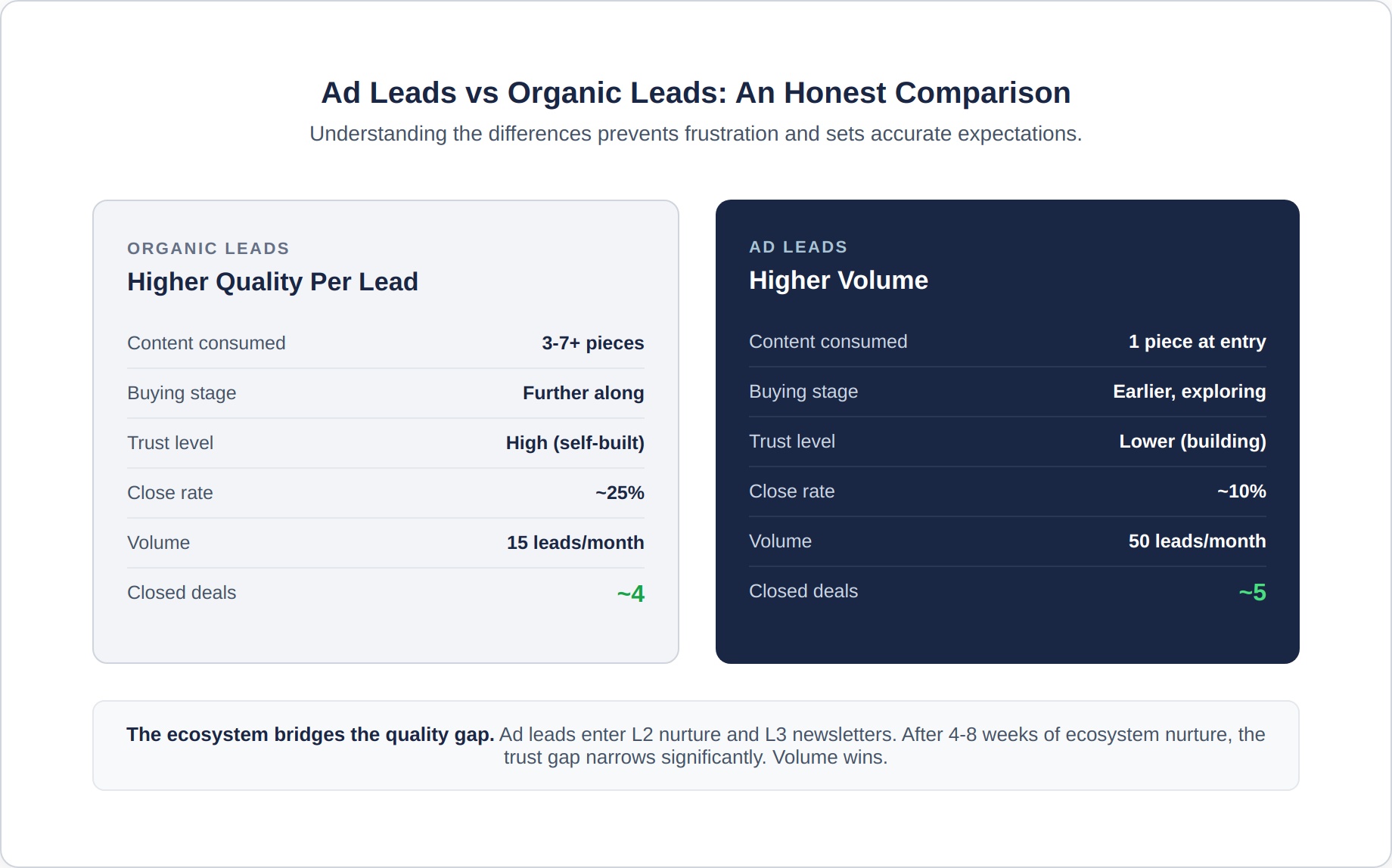
- Ad leads haven’t consumed as much content before converting. An organic lead who found your Level 4 article through search, read three other articles, watched a video, and then booked a call has built deep trust. An ad lead who clicked one ad and filled out one form has not.
- Ad leads may be earlier in the buying process. They responded to a compelling offer but may still be exploring options. Organic leads who found you through their own research tend to be further along in the sales cycle.
- Ad lead conversion rates to closed deals are typically lower than organic lead conversion rates. This is normal and expected.
However, here’s why this doesn’t mean ad leads are less valuable:
- Ad leads arrive in volume that organic can’t match. 50 ad leads at a 10% close rate produce 5 clients. 15 organic leads at a 25% close rate produce 3.75 clients. Volume matters.
- The ecosystem bridges the quality gap. Ad leads who don’t convert immediately enter Level 2 nurture sequences and Level 3 newsletters. Over 4-8 weeks, they consume the same content that organic leads consumed before converting. By the time they reach sales, the quality gap has narrowed significantly.
- Retargeting specifically addresses the trust gap. Sequential retargeting shows your best content to ad leads over time, building the same familiarity and trust that organic leads build through self-directed research. The ecosystem makes ad leads smarter over time.
The key insight: paid advertising produces leads at the top of the funnel. Levels 2, 3, 4, and 5 move those leads through the same trust-building journey that organic leads travel voluntarily. The destination is the same. The starting point is different.
What Scaling Actually Looks Like
When campaigns are profitable, and you want to grow faster, scaling is the next step. Here’s how it works in practice:
What different budget levels typically produce for a B2B company:
- $5,000/month in ad spend: Enough for 1-2 focused campaigns on a single platform. Produces a steady stream of leads (typically 30-60 per month, depending on your market). Good for proving the model and establishing baseline metrics.
- $10,000-$15,000/month: Enough for a multi-platform presence with search, retargeting, and content amplification running simultaneously. Produces higher volume (typically 80-150 leads per month) with the ability to test multiple audiences and offers.
- $20,000-$30,000+/month: Full multi-platform coverage with aggressive acquisition, comprehensive retargeting, and scaled content promotion. Produces significant pipeline (150-300+ leads per month) with sophisticated audience segmentation and sequential campaigns.
How scaling decisions are made:
- We initiate the conversation when data shows campaigns have room to grow profitably. If the cost per lead is below the target and the conversion rates are strong, we recommend testing a budget increase.
- Scaling happens gradually: 20-30% budget increases per month, monitored weekly for performance stability. Large, sudden increases often degrade performance because the platforms need time to find more high-quality traffic at the expanded budget.
- Diminishing returns are real. At some point, increasing the budget stops producing proportional results because you’ve saturated the most responsive audience segments. We identify this threshold and recommend either maintaining the budget at the efficient level or expanding to new platforms and audiences.
- Sales capacity is the most common scaling constraint. Most companies hit a lead-handling ceiling before they hit an ad-platform ceiling. If your team can handle 50 leads per month, but campaigns could produce 100, scaling the budget would waste money on leads that don’t get followed up on. We monitor this actively and align the budget with your team’s actual capacity.
What Determines Where You Fall in the Management Fee Range
Level 6 – Paid Advertising & Retargeting
High-intent traffic and demand capture systems designed to convert existing attention into pipeline, not just clicks.
| Scope Factor | Lower ($2,000–$3,000/mo) | Mid ($3,000–$4,500/mo) | Upper ($4,500–$7,500/mo) |
|---|---|---|---|
| Platforms Managed | 1 platform (Google or Meta) | 2 platforms (Google + Meta or LinkedIn) | 3+ platforms (Google, Meta, LinkedIn, YouTube) |
| Campaign Structure | Single funnel (search or basic ads) | Dual funnel (search + retargeting) | Full funnel (awareness, retargeting, conversion) |
| Traffic Type Focus | High-intent search only | Search + retargeting traffic | Search + retargeting + demand generation |
| Retargeting Strategy | Basic visitor retargeting | Segmented retargeting by behavior | Lifecycle retargeting tied to nurture and intent signals |
| Audience Targeting | Standard keyword or interest targeting | Custom audiences + lookalikes | Account-based + intent-driven targeting |
| Creative & Messaging | Core ad copy | Ad copy + visual variations | Full creative system aligned to funnel stages |
| Landing Page Alignment | Basic page matching | Aligned with Level 2 landing pages | Fully integrated with ecosystem messaging and offers |
| Optimization Approach | Manual adjustments | Structured weekly optimization | Data-driven scaling with performance modeling |
| Testing Depth | Limited A/B testing | Ongoing ad and audience testing | Full testing across funnel, creatives, and segments |
| Conversion Tracking | Basic tracking (leads) | Enhanced tracking with attribution | Full funnel tracking tied to CRM and revenue |
| Pipeline Visibility | Clicks and leads | Leads + cost per opportunity | Full pipeline + ROI visibility |
How Long Before You See Results
Week 1-2: Campaigns are built, tracking is configured, and ads go live. Platforms enter the learning phase. Performance is volatile. Cost per lead may be higher than the eventual optimized levels. This is normal. Changes are minimal during this period to let algorithms calibrate.
Month 1: Learning phase exists. First conversions flow through the system at stabilizing costs. Initial cost-per-lead data reveals which campaigns and audiences perform best. Retargeting audiences begin building from website visitors and content engagers. First optimization adjustments are made based on early data.
Month 2: Meaningful patterns emerge. Budget shifts toward top-performing campaigns and audiences. Ad creative A/B tests produce winners that replace underperformers. Retargeting campaigns reach full effectiveness as audience pools grow large enough for efficient delivery. Landing page conversion data from paid traffic informs Level 2 optimization. First insights from ad data feed back into organic strategy.
Month 3: Campaigns stabilize at predictable performance levels. Cost per lead is known and forecastable. The sales team provides feedback on lead quality that informs audience refinement. Offline conversion data begins flowing back to ad platforms, improving algorithmic optimization. The system is producing leads at a cost and quality you can model and plan around.
Months 4-6: Optimization compounds. Each month’s refinements build on the previous month’s data. Cost per lead decreases as targeting narrows to the highest-converting audiences. Ad creative evolves based on accumulated performance data. Audience data is deep enough for sophisticated lookalike targeting. The system operates with increasing efficiency, producing more leads at a lower cost from the same budget.
Month 6+: The paid advertising system is a predictable, scalable growth lever. You know exactly how much it costs to produce a lead, an opportunity, and a client from each platform and campaign. Budget decisions become straightforward: spend more to grow faster, maintain spending for a steady flow, or reduce spending if capacity is reached. The system runs with precision because it’s been optimized through months of continuous refinement. Audience data built over 6+ months makes every future campaign more efficient.
Why This Investment Makes Sense
Level 6 is the first level at which the return on investment can be calculated immediately.
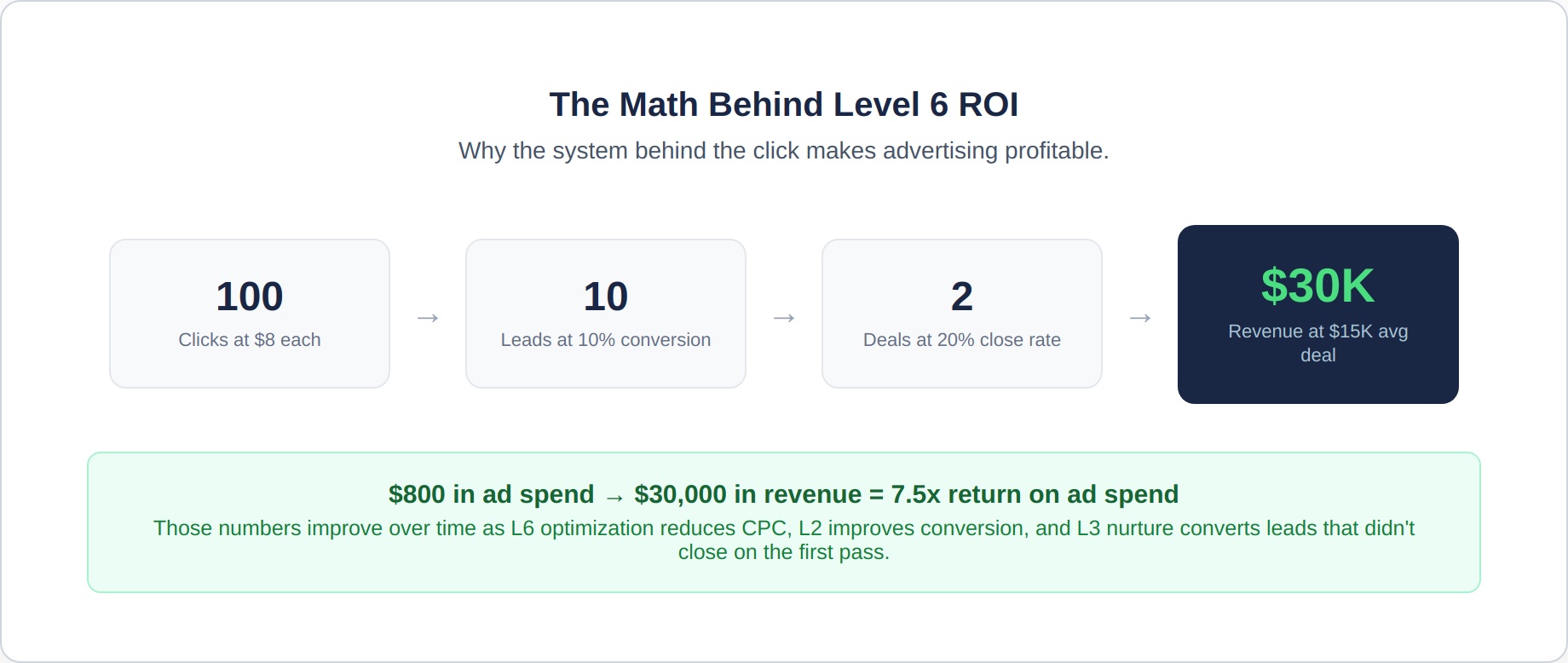
If your Level 2 landing pages convert at 10% and your ad campaign produces clicks at $8, every 100 clicks generates 10 leads at a cost of $80 per lead. If your sales team closes 20% of qualified leads and your average deal is $15,000, every 50 leads (costing $4,000 in ad spend) produces 10 qualified leads, 2 closed deals, and $30,000 in revenue.
That’s a 7.5x return on ad spend before accounting for the lifetime value of the client relationship.
Those numbers improve over time as Level 6 optimization reduces cost per click, Level 2 optimization improves conversion rates, Level 3 nurture converts leads that didn’t close on the first pass, and audience data makes targeting more efficient with each passing month.
The reason Level 6 produces these returns, even as most companies report poor ad performance, is the system behind the click. The ad is just the introduction. Levels 0-5 do the rest.
Without the system, the same ad spend yields bounce-back clicks, cold leads, and a cost-per-acquisition that makes advertising look unprofitable. With the system, the same ad spend produces leads that convert, nurture, and close.
What This Level Solves
Level 6 solves the problem of speed and scale. Organic channels compound, but they compound slowly. Social media builds recognition over months. Content ranks over quarters. Newsletters grow subscribers over time. Paid advertising reaches the same buyers in days instead of months.
Level 6 doesn’t replace organic growth. It accelerates it. It fills the pipeline while organic channels are still building. It amplifies the content that’s already working. It retargets buyers who engaged but haven’t converted. And it provides the predictable, controllable lead flow that allows you to scale revenue on a timeline rather than waiting for organic momentum to reach critical mass.
What This Level Does NOT Include
- Website changes (Level 0)
- Social media content creation or daily management (Level 1 — though Level 1 content informs ad creative and clips are used in video ads)
- Landing page creation (Level 2 — though Level 6 coordinates closely with Level 2 for campaign landing pages)
- Newsletter writing or lead magnet creation (Level 3 — though Level 3 offers are promoted through paid campaigns)
- Blog article writing (Level 4 — though Level 4 articles are promoted through content amplification campaigns)
- Video production (Level 5 — though Level 5 videos are used in video ad campaigns)
- AI outreach (Level 7)
- Ad spend (managed separately from management fee and billed directly by the ad platforms)
Level 6 manages the paid amplification. The levels around it create the content, conversion infrastructure, and nurture system that make the amplification profitable.
What You Need to Provide
- Onboarding conversation (60-90 minutes): We review your business goals, target audience, competitive landscape, existing ad account history (if any), and align on budget, platforms, and campaign strategy
- Ad platform access: Admin or manager access to your Google Ads, LinkedIn Campaign Manager, and/or Meta Business Manager accounts. If accounts don’t exist, we create them under your ownership during onboarding.
- CRM access: Integration access to connect ad platforms with your CRM for conversion tracking and offline conversion data
- Budget approval: You approve the recommended ad spend and any budget changes before they’re implemented
- Monthly report review (30-45 minutes): Review performance data, discuss lead quality feedback from sales, and align on optimization priorities
- Sales feedback (ongoing): The quality of leads from ads must be communicated so we can optimize for pipeline and revenue, not just form fills. This is the single most important input you provide.
- Quarterly strategy review (45-60 minutes): Deep review of ROI, channel performance, competitive landscape, scaling assessment, and next quarter planning
Total monthly time commitment: approximately 2-3 hours
Who Manages This
Rod Agatep personally directs the paid advertising strategy, budget allocation, and performance optimization for every Level 6 engagement. With 27 years of experience in B2B marketing, including extensive paid advertising management across Google, LinkedIn, and Meta, Rod understands the difference between campaigns that drive clicks and those that drive clients.
Every campaign is built under Rod’s direct supervision, with targeting, creative, and optimization decisions aligned to the positioning and conversion data established across all active levels. This is not a campaign managed by a junior media buyer running playbook templates. It is strategic advertising managed by someone who understands the full system the ads plug into and who uses ad performance data to improve every level of the ecosystem.
Level 6 Readiness Assessment
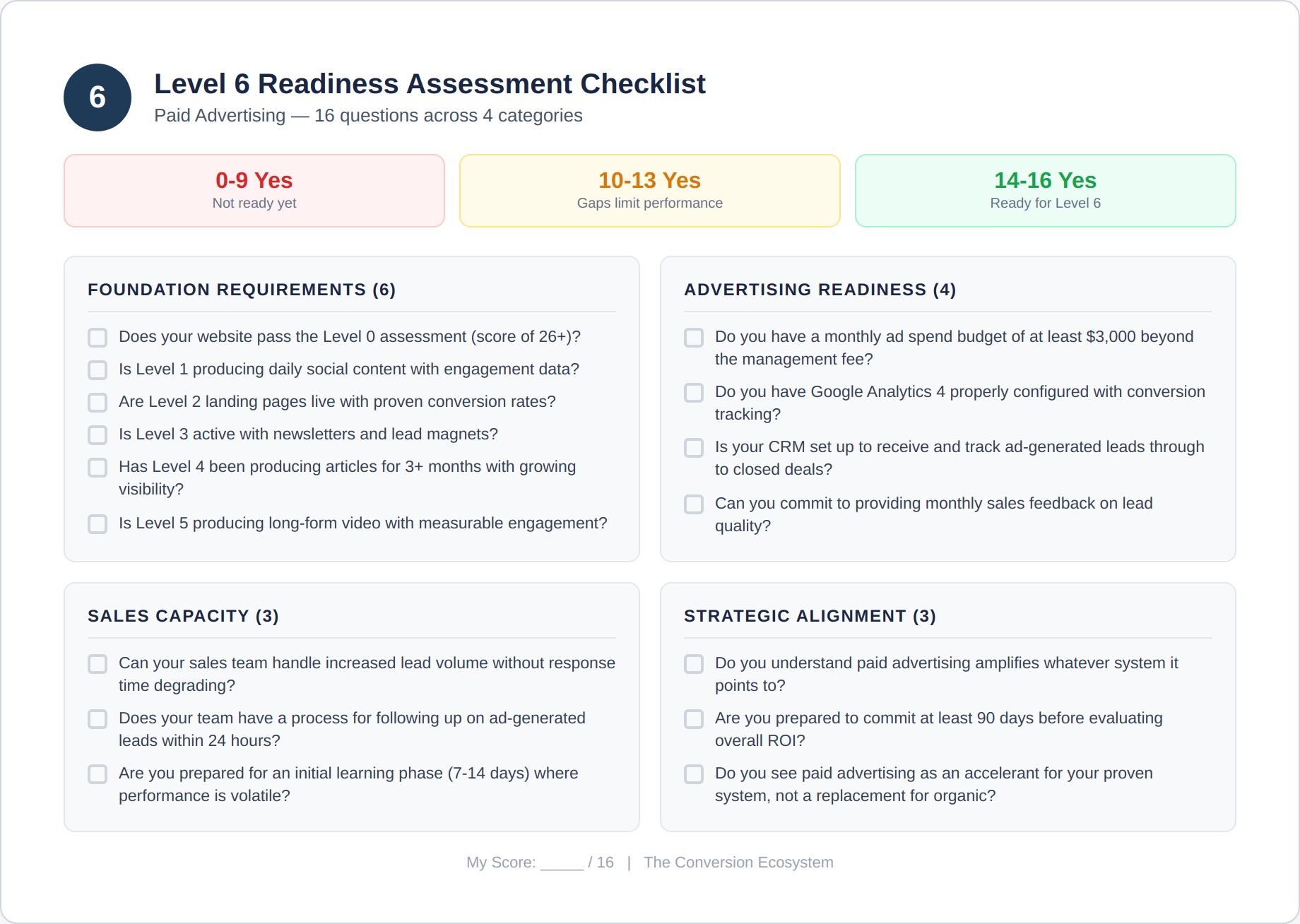
Scoring
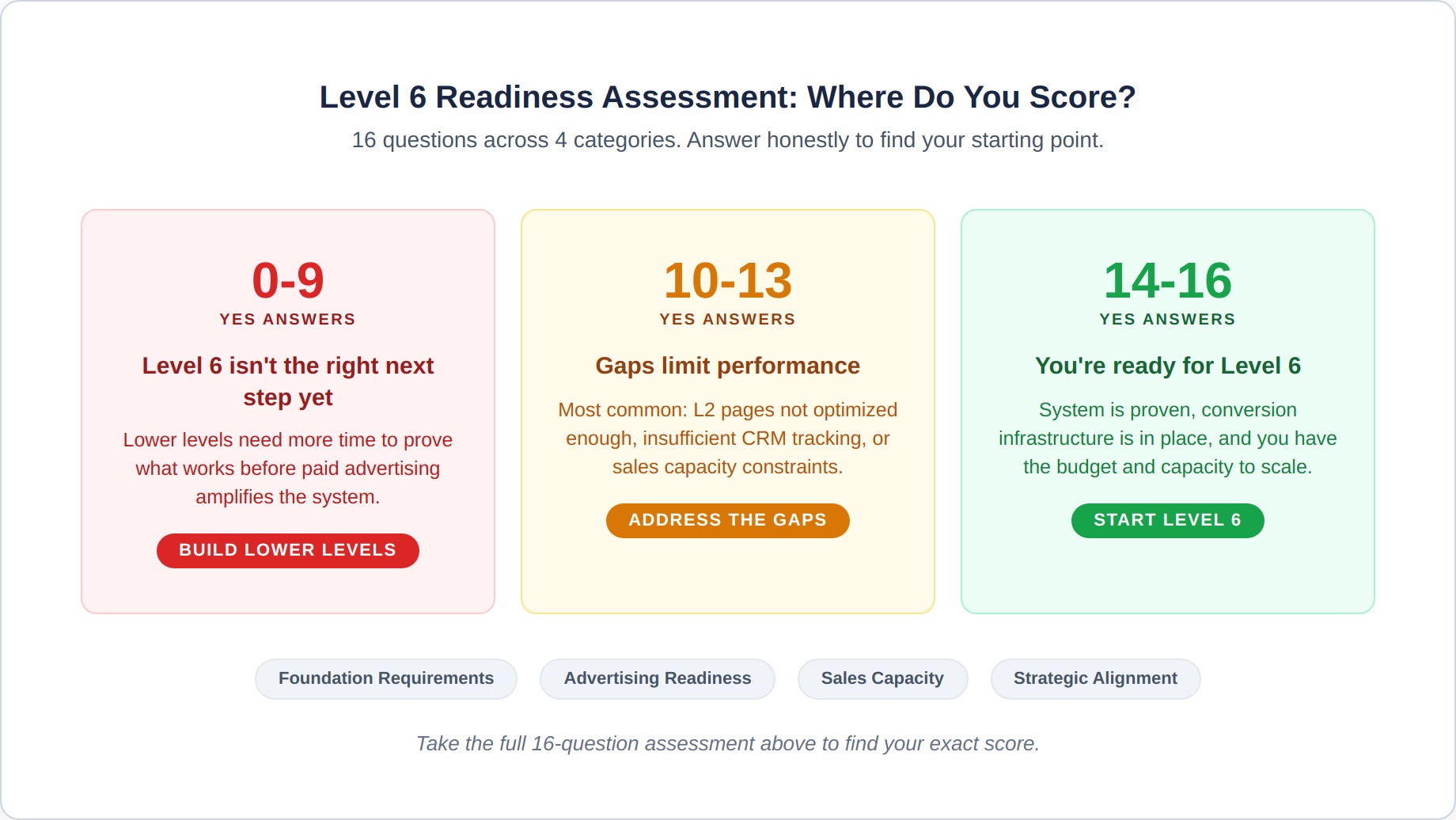
14-16 YES answers: You’re ready for Level 6. Your system is proven, your conversion infrastructure is in place, and you have the budget and capacity to scale through paid advertising.
10-13 YES answers: Gaps exist that will limit Level 6 performance. The most common gaps are Level 2 landing pages that haven’t been optimized with enough organic traffic, insufficient CRM tracking to measure true ROI, or sales capacity constraints that limit lead handling. Address those before scaling with paid traffic.
9 or fewer YES answers: Level 6 isn’t the right next step yet. The lower levels need more time to prove what works before paid advertising amplifies the system. Advertising without a proven system is the most expensive way to discover what doesn’t work.
Pricing Summary
| Option | Investment |
|---|---|
| Level 6 monthly management fee | $2,500 – $6,000/month |
| Ad spend (separate, paid directly to platforms) | Typically $3,000 – $20,000+/month |
| Level 6 annual commitment | 20% off monthly management fee |
| Level 6 stacked with other levels | See Conversion Ecosystem pricing table |
What’s included in the management fee: Platform strategy and setup, campaign architecture, ad creative development and fatigue management, targeting and audience building, bid management and budget optimization, seasonality planning, landing page coordination with Level 2, conversion tracking and attribution setup (including server-side tracking), privacy compliance monitoring, A/B testing, segmented retargeting strategy, competitive intelligence, brand safety controls, ad-to-organic feedback loop, weekly optimization, monthly performance reporting with full dashboard access, and quarterly strategy reviews.
What’s not included: Ad spend (paid directly to platforms), landing page creation (Level 2), content creation (Levels 1, 3, 4, 5), website changes (Level 0), or AI outreach (Level 7).
The Conversion Ecosystem Rule
Every level below your active level must be in place. Level 6 requires all five lower levels to operate effectively because paid advertising amplifies whatever system it points to. Without a converting website (Level 0), daily visibility building trust (Level 1), landing pages capturing leads (Level 2), email nurture maintaining engagement (Level 3), content attracting organic traffic (Level 4), and video building deep trust (Level 5), paid advertising sends expensive traffic into a system that isn’t built to convert it.
The companies that profit from advertising have the system in place first. The companies that lose money on advertising almost always have a system problem, not an advertising problem.
Next Step
If you’re not sure whether Level 6 is the right next investment, whether your lower levels are strong enough to support paid traffic profitably, or whether your budget and sales capacity align with paid advertising, the fastest way to find out is a conversation.
We’ll review your current conversion data, assess your landing page performance, evaluate your market’s paid advertising landscape, and tell you honestly whether Level 6 will produce profitable results now or whether other levels need more maturity first.
No pitch. No pressure. Just clarity on where you stand and what to do next.
Frequently Asked Questions
How is this different from hiring a PPC agency?
Most PPC agencies manage ads in isolation. They optimize for platform metrics like cost per click and click-through rate without understanding or influencing what happens after the click. Level 6 is integrated with your entire marketing ecosystem. Every campaign is built on proven data from Levels 1-5, every ad points to optimized Level 2 landing pages, every lead enters Level 2 automation and Level 3 nurture, ROI is measured through to closed revenue, and ad performance data feeds back to improve organic strategy across every level. A PPC agency manages a channel. Level 6 manages a conversion system.
Why is ad spend separate from the management fee?
Ad spend goes directly to the platforms (Google, LinkedIn, Meta). You own the accounts and control the budget. Keeping management fees separate from ad spend ensures transparency: you know exactly what you’re paying us for strategy and optimization versus what you’re paying the platforms for traffic. Some agencies bundle fees into a percentage of spend, which incentivizes them to increase your budget, whether it’s productive or not. Our management fee is fixed based on scope, not spend.
What’s the minimum ad spend needed?
We don’t set a minimum, but meaningful results on most platforms require at least $3,000 in monthly ad spend. Below that threshold, the data accumulates too slowly for effective optimization, and the learning phase takes longer to exit. For companies targeting competitive B2B keywords on Google, $5,000-$10,000/month in search spend is often needed to capture sufficient volume. We recommend a starting budget during onboarding based on your market and goals.
What if I’ve run ads before and they didn’t work?
That’s common, and the reason is almost always what happened after the click, not the ads themselves. If previous campaigns sent traffic to your homepage, used generic landing pages, had no automated follow-up, or measured success by clicks instead of revenue, the campaigns were set up to fail regardless of targeting or creative quality. Level 6 addresses every one of these failure points through the integrated ecosystem.
How quickly can I scale if ads are working?
Budgets can typically be increased 20-30% per month without significantly degrading performance. We recommend scaling gradually with weekly monitoring rather than large jumps that overwhelm the algorithm or exceed sales capacity. The most common scaling constraint is not the ad platform but your sales team’s ability to handle additional lead volume without degrading response time.
Can I pause campaigns during slow periods?
Yes. Campaigns can be paused and restarted without losing the optimization data and audience signals that have been built. However, pausing retargeting campaigns specifically is not recommended, as the warm audiences you’ve built will cool during the gap, and audience data expires after 90-180 days, depending on the platform. If the budget needs to be reduced, we recommend scaling back new acquisition campaigns while maintaining retargeting at a minimum.
Will iOS privacy changes and cookie deprecation affect my campaigns?
They already have, and Level 6 is built to manage these changes. We use server-side tracking, Conversions API integrations, and first-party data strategies to maintain measurement accuracy and targeting effectiveness. The advertising landscape will continue evolving, and Level 6 monitoring includes staying current with these changes and adapting strategies as needed.
What if ad-generated leads are lower quality than organic leads?
This is expected and normal. Ad leads haven’t consumed as much content before converting and may be earlier in the buying process. However, the ecosystem bridges this gap: Level 2 nurture sequences and Level 3 newsletters move ad leads through the same trust-building journey that organic leads travelled voluntarily. By the time ad leads reach sales after 4-8 weeks of ecosystem nurture, the quality gap has narrowed significantly. Additionally, the volume advantage of ad leads typically results in more total closed deals, even at lower per-lead conversion rates.
Who owns the ad accounts?
You do. All ad accounts are created under your business ownership. You have full admin access and can see everything in real time: spend, performance, audience data, and ad creative. If the engagement ends, the accounts and all their data remain yours. No account ownership transfer is needed because the accounts were yours from the start.
What are the cancellation terms?
Month-to-month engagements can be cancelled with 30 days’ notice. Annual commitments receive the 20% discount in exchange for a 12-month term. Early termination of annual commitments is subject to a fee equal to the discount received on months already completed. You retain full ownership of all ad accounts, campaign data, audience data, and ad creative.
Do I own the ad creative?
Yes. Every ad, every image, every video edit, and every piece of copy created for your campaigns belongs to you. If the engagement ends, you can continue running the campaigns independently or with another provider using the creative we developed. There are no licensing restrictions or creative holdback clauses.