

Key Takeaways
- AI Content Engine transforms every interaction into content ideas and assets, resolving the ongoing challenge of deciding what to write about.
- Content repurposing at scale means a single Level 5 video becomes an article draft, 5 social posts, 3 newsletter segments, 10 quote graphics, and a lead magnet outline without starting from scratch on any of them.
- Hook testing and message optimization use AI to rapidly test which headlines, angles, and framing produce the highest engagement, then apply winning patterns across every content channel in the ecosystem.
- Topic gap analysis continuously identifies what your buyers are searching for that neither you nor your competitors have covered, creating a content roadmap that fills gaps before competitors find them.
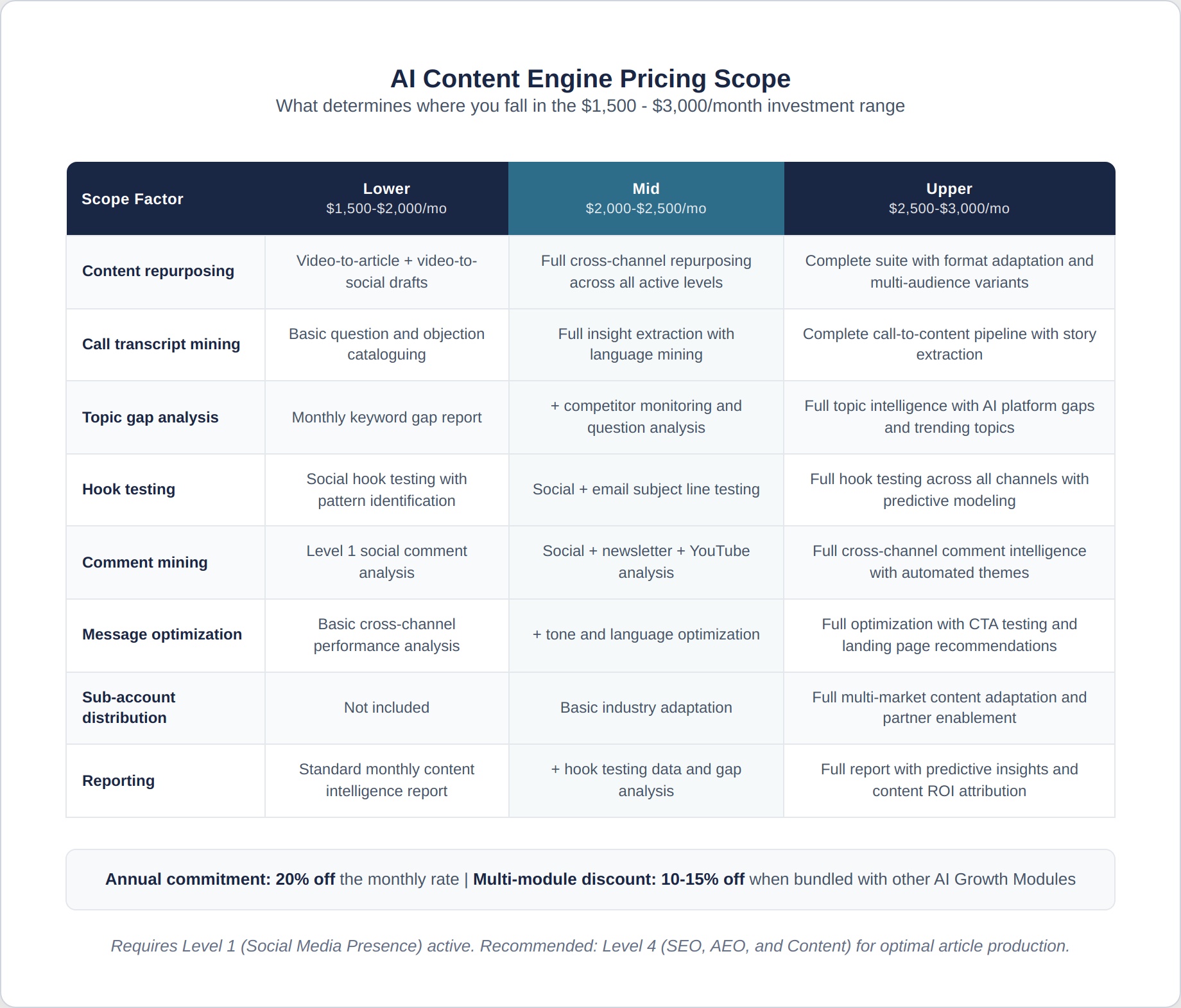
- The investment ranges from $1,500 to $3,000/month, depending on content volume, repurposing depth, testing intensity, and the number of ecosystem levels the engine feeds
One Sentence Summary: AI Content Engine turns every interaction across your ecosystem into content fuel, then optimizes every message based on performance data so your content gets smarter, faster, and more effective every month.
Investment Range: $1,500 – $3,000/month
Annual Commitment: 20% off the monthly rate
Multi-module discount: 10–15% off if bundled with other AI Growth Modules
Module Requirement: To activate the AI Content Engine, you need to have Level 1 (Social Media Presence) currently active. For optimal article production, it is recommended to also have Level 4 (SEO, AEO, and Content) active. These modules ensure the necessary content sources and distribution channels are available for content generation and repurposing.
Timeline to first results: Content repurposing begins producing assets within the first week. Topic gap analysis delivers its first content roadmap within 30 days. Hook testing and message optimization produce actionable data in 30-60 days. The system reaches full intelligence at 90 days as patterns accumulate across channels.
What This Module Is
Every company that runs the Conversion Ecosystem produces an enormous amount of raw material that never gets fully used.
Sales calls contain insights that could become articles. Level 5 videos contain frameworks that could become social posts. Level 3 newsletter replies contain the exact language buyers use to describe their problems. Level 1 comment sections contain the questions buyers are asking right now. Level 4 articles contain data points that could be turned into infographics. Customer conversations contain proof points that could become case studies.
Most of that material gets used once and discarded. A sales call happens, and the insights stay in the rep’s head. A video gets published, and the frameworks inside it never become written content. A newsletter reply reveals a buyer concern, and nobody turns it into an article topic.
AI Content Engine captures unused material, converts it to content assets, and continuously optimizes messaging based on performance data across all channels.
Content production accelerates as you aren’t starting from scratch. Quality improves because each piece is data-informed. AI continuously refines strategy by detecting effective topics and messaging early.
Why Content Production Is the Bottleneck for Most Companies
The Conversion Ecosystem produces content across multiple levels: daily social posts at Level 1, weekly newsletters at Level 3, monthly articles at Level 4, and monthly videos at Level 5. That’s a significant volume of content production.
For most companies, the bottleneck isn’t strategy. They know what topics matter. The bottleneck is production. Turning ideas into finished content takes time: researching, writing, editing, formatting, optimizing, and publishing. Each piece feels like it starts from scratch, even when the same ideas, frameworks, and insights have already been expressed in a different format elsewhere in the ecosystem.
AI Content Engine eliminates the “starting from zero” problem by connecting every content channel so material flows between them automatically. A framework explained in a Level 5 video becomes a Level 4 article draft. That article’s best-performing sections become Level 1 social posts. The social post that generates the most engagement becomes a Level 3 newsletter topic. The newsletter that produces the most replies reveals the next Level 5 video topic.
The content ecosystem becomes circular. Every piece feeds every other piece. Production time drops because the raw material already exists. Quality increases because each piece is informed by performance data from related pieces across other channels.
What You Get
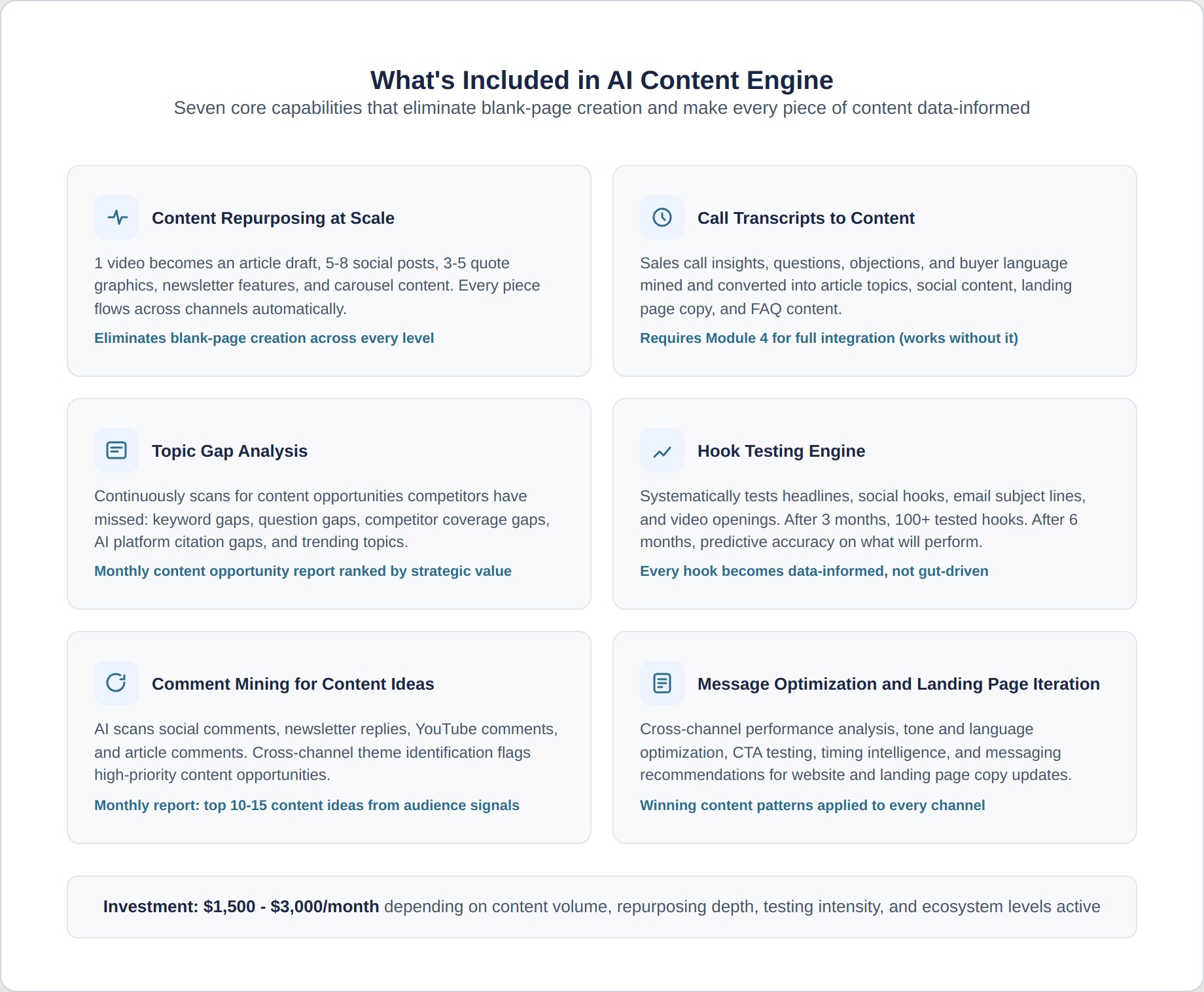
Content Repurposing at Scale
The core capability: turning one piece of content into many without starting from scratch on any of them.
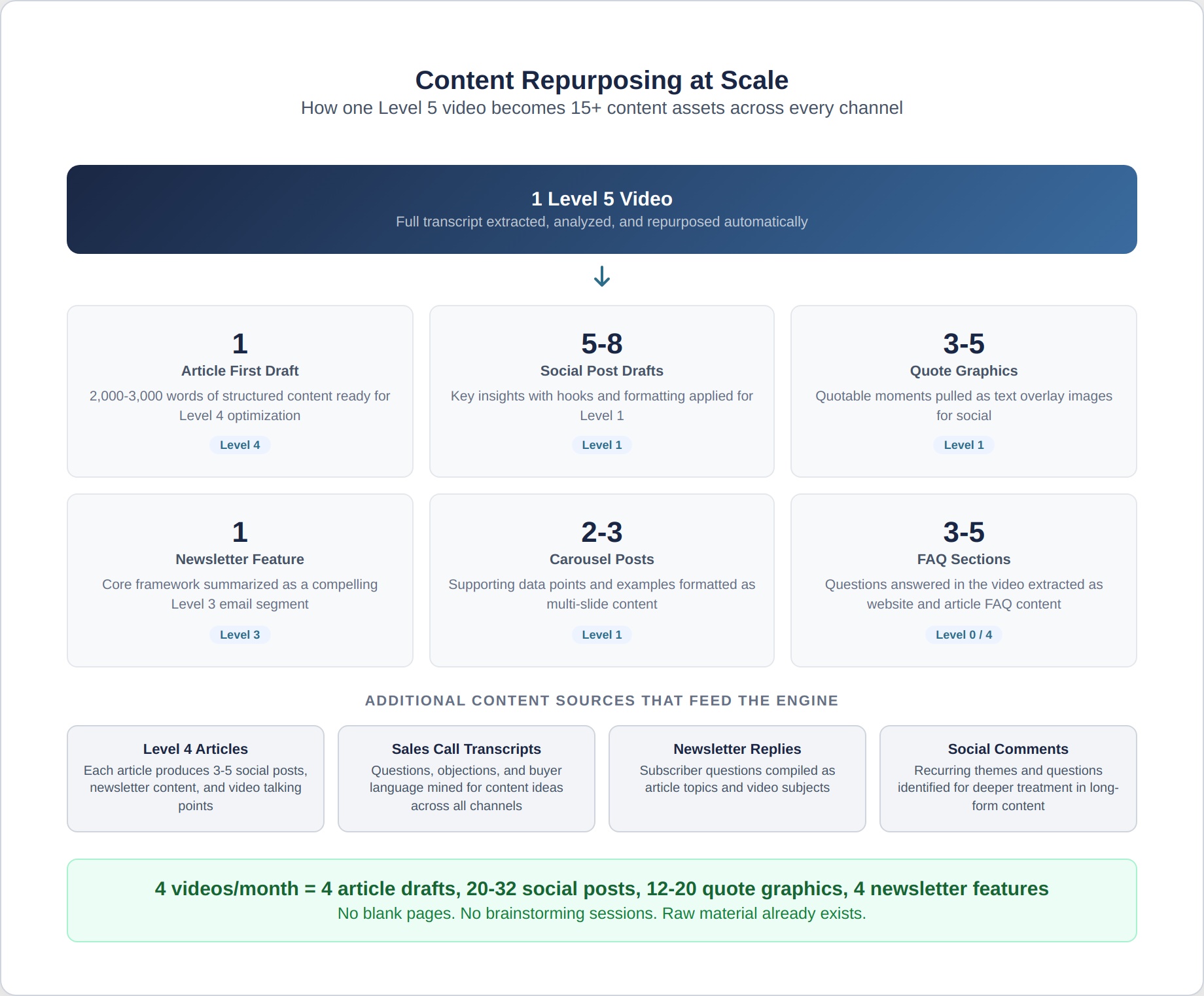
How repurposing flows through the ecosystem:
From Level 5 Videos:
- Full transcript extracted and formatted as a Level 4 article first draft (2,000-3,000 words of raw material that needs editing and optimization, not creation from scratch)
- 5-8 key insights extracted as standalone Level 1 social post drafts with hooks and formatting already applied
- 3-5 quotable moments pulled as text overlay graphics for Level 1 image posts
- Core framework or model from the video, summarized as a Level 3 newsletter feature
- Supporting data points and examples formatted as carousel post content
- FAQ questions answered in the video extracted as website FAQ content or Level 4 article sections
From Level 4 Articles:
- Key insights reformatted as Level 1 social posts (each article produces 3-5 posts)
- Article summary formatted as Level 3 newsletter content with a compelling reason to read the full piece.
- Data points and statistics extracted as shareable graphics
- Article sections expanded into talking points for future Level 5 video scripts.
- FAQ sections from articles repurposed as chatbot knowledge base content for Module 3
From Sales Calls (via Module 4 transcripts):
- Client questions and objections catalogued as Level 4 article topic ideas.
- Frameworks and explanations the rep used successfully formatted as Level 1 social content
- Specific client language and phrases captured for use in Level 2 landing page copy, Module 1 outreach messaging, and Level 6 ad copy
- Common objections turned into FAQ content for the Level 0 website and the Module 3 chatbot.
From Level 3 Newsletter Replies:
- Subscriber questions compiled as Level 4 article topics and Level 5 video subjects
- Subscriber language is analyzed for patterns that improve messaging across all channels
- High-engagement reply topics flagged as content the audience wants more of
From Level 1 Social Comments:
- Comment questions compiled as content ideas across all formats.
- Recurring themes identified as topics that deserve deeper treatment in articles and videos
- Audience language patterns captured for messaging optimization
What this means in practice: A company running Levels 1, 3, 4, and 5 with the AI Content Engine active might produce 4 videos per month at Level 5. Those 4 videos, through AI repurposing, produce 4 article first drafts, 20-32 social post drafts, 12-20 quote graphics, 4 newsletter features, and raw material for the next month’s content calendar. The Level 4 writer isn’t staring at a blank page. The Level 1 content manager isn’t brainstorming topics. The Level 3 newsletter writer isn’t wondering what to cover. The raw material is already there.
Call Transcripts to Content
If Module 4 (AI Sales Acceleration) is active, every sales call becomes a content source:
- Insight extraction: AI identifies the moments in each call where the rep explains something particularly well, shares a framework, or addresses an objection with a response that resonates. Those moments are flagged as content candidates.
- Question cataloguing: Every question a prospect asks during a call is logged, categorized, and ranked by frequency across all calls. The most-asked questions become content priorities because they represent what your market genuinely wants to know.
- Language mining: The specific words and phrases that prospects use to describe their problems, goals, and concerns are captured. This language is gold for messaging because it’s how your market actually talks, not how your marketing team thinks they talk.
- Story extraction: When reps share examples, case studies, or client stories during calls, AI identifies and captures those narratives for potential use in articles, social posts, and videos (with appropriate anonymization).
Without Module 4 active, the AI Content Engine can still work with call transcripts if your team records calls and provides access. The integration is smoother and richer with Module 4 because transcripts are already structured and analyzed, but it’s not a hard requirement.
Topic Gap Analysis
AI continuously scans for content opportunities your competitors have missed:
- Keyword gap analysis: Identifying search queries your buyers use that neither you nor your competitors have addressed with comprehensive content. These are open opportunities where the first quality article or video can capture the position.
- Question gap analysis: Monitoring question platforms (Google’s People Also Ask, Quora, Reddit, industry forums) for questions related to your services that nobody has answered well. Each unanswered question is a content opportunity.
- Competitor content monitoring: Tracking what competitors publish, which of their content performs well, and where their coverage is thin. When a competitor publishes a popular article on a topic, AI identifies angles they missed that your content can cover more comprehensively.
- AI platform gap analysis: Monitoring what AI answer engines cite for queries related to your services and identifying where the cited content is weak, outdated, or incomplete. Your content can become the preferred citation by being more thorough and up to date.
- Trending topic detection: Identifying emerging topics in your industry that are gaining search interest but don’t yet have comprehensive content. Early coverage of trending topics captures position before competition intensifies.
Deliverable: A monthly content opportunity report ranking the highest-value topics by search volume, competition level, buyer intent, and strategic fit. This report directly informs Level 4 article production, Level 5 video topic selection, Level 1 social content themes, and Level 3 newsletter subjects.
Hook Testing Engine
The first line of any content determines whether it gets consumed or ignored. AI Content Engine systematically tests which hooks capture attention:
- Headline variation testing: For each Level 4 article, AI generates 10-15 headline variations using different psychological triggers (curiosity, specificity, controversy, utility, fear, aspiration). The strongest performers are identified through a combination of Level 1 social testing and Level 3 email subject line testing before the article is titled.
- Social hook testing: For Level 1 posts, AI generates multiple opening line variations for the same core content. Different hooks are tested across different posts over time, building a database of which hook patterns your specific audience responds to.
- Email subject line optimization: For Level 3 newsletters, AI generates and tests subject line variations, building a library of what framing, length, and tone produce the highest open rates for your specific subscriber base.
- Video hook testing: For Level 5 videos, AI suggests multiple opening approaches and tracks which styles produce the highest 30-second retention rates. Short-form clips from Level 1 serve as a testing ground for hooks before they’re used in long-form production.
How hook testing compounds: After 3 months, you have a dataset of 100+ tested hooks showing exactly which patterns your audience responds to. After 6 months, the dataset is rich enough that AI can predict with high accuracy which hook approaches will perform best for any given topic before the content is produced. Your content starts winning the attention game consistently because every hook is data-informed rather than gut-driven.
Comment Mining for Content Ideas
Your audience tells you what content to create through their comments, replies, and engagement. Most companies ignore this signal. AI Content Engine captures it:
- Level 1 social comment analysis: AI scans all comments on your social posts, categorizes them by topic, identifies questions that appear repeatedly, and flags comments that reveal unmet information needs.
- Level 3 newsletter reply analysis: Subscriber replies are analyzed for patterns, frequently asked questions, and topics that generate the most conversational engagement.
- Level 5 YouTube comment analysis: Video comments are scanned for questions, requests for specific topics, and feedback that indicates what viewers want more of.
- Level 4 article comment analysis: If your articles allow comments, AI monitors and categorizes them for content intelligence.
- Cross-channel theme identification: When the same topic or question appears across multiple channels (e.g., social comments, newsletter replies, and YouTube comments all mention the same concern), it’s flagged as a high-priority content opportunity because the demand signal is confirmed across multiple sources.
Deliverable: A monthly comment intelligence report listing the top 10-15 content ideas extracted from audience engagement across all channels, ranked by frequency and strategic value.
Message Optimization Based on Data
AI Content Engine doesn’t just produce content. It makes every piece of content across every channel more effective by analyzing what works and applying the patterns:
- Cross-channel performance analysis: When a topic performs exceptionally well on Level 1 social media, AI identifies why (the angle, the hook, the framing) and applies those patterns to how the same topic is covered in Level 4 articles, Level 3 newsletters, and Level 5 videos.
- Underperformance diagnosis: When content underperforms, AI identifies potential causes by comparing it against high-performing content: was the hook weak, the angle wrong, the topic mistimed, or the format mismatched to the audience?
- Tone and language optimization: By analyzing which specific words, phrases, and sentence structures correlate with higher engagement across all channels, AI identifies the linguistic patterns your specific audience responds to and flags content that doesn’t match those patterns before publication.
- CTA optimization: Tracking which calls-to-action produce the highest click rates across all content types and standardizing the most effective approaches.
- Timing intelligence: Identifying when your audience is most receptive to different content types and recommending optimal publication timing for each.
Continuous Sales Page and Landing Page Iteration
Your Level 0 service pages and Level 2 landing pages contain messaging that can always be improved. AI Content Engine provides the data to improve it:
- Messaging performance signals from content: When a specific framing of your value proposition consistently outperforms others across social, email, and article content, that winning framing should be reflected on your service pages and landing pages.
- Language migration: When AI identifies that your audience responds to specific terminology (they say “lead flow” instead of “lead generation,” or “pipeline predictability” instead of “consistent leads”), those language preferences are documented and recommended for website and landing page copy updates.
- Headline and CTA recommendations: Based on testing data across all content channels, AI recommends specific headline and CTA changes for service pages and landing pages, with predicted performance impacts.
These recommendations are delivered as part of the monthly reporting. Implementation happens through Level 0 (website) or Level 2 (landing pages), depending on where the changes apply.
Sub-Account Distribution Systems
For companies that serve multiple markets, industries, or geographic regions, AI Content Engine can adapt core content for distribution across different channels or brands:
- Industry-specific content adaptation: Core articles or posts modified with industry-specific examples, terminology, and proof points for different vertical markets
- Regional content adaptation: Core content adjusted for geographic relevance, local references, and regional market conditions
- Partner content enablement: Core content reformatted and co-branded for distribution through partner networks or channel partners
This capability is most relevant for companies at the upper end of the price range with broad market coverage and multiple audience segments.
What the Content Workflow Actually Looks Like
Here’s how AI Content Engine changes your content production process:
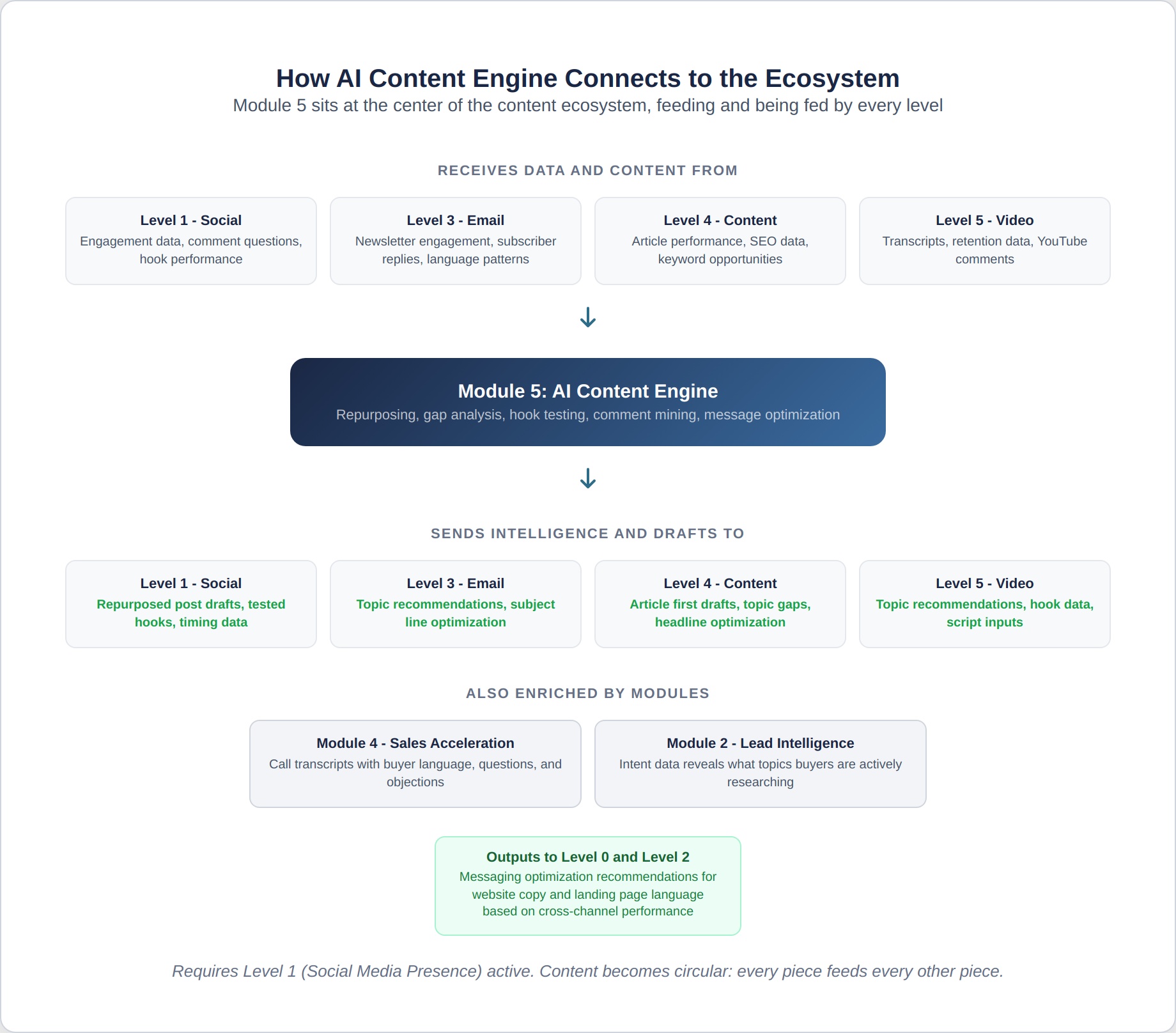
Without AI Content Engine
Monday: Level 1 content manager brainstorms topics for the week’s social posts. Starts from scratch. Spends 2 hours coming up with 7 ideas and writing them.
Tuesday: Level 4 writer stares at a blank document, trying to figure out the angle for this month’s article. Spends 30 minutes reviewing competitor content for inspiration.
Wednesday: Level 3 newsletter writer needs to decide what this week’s newsletter is about. Opens a shared spreadsheet of topic ideas. Most are stale. Pick one and start writing from scratch.
Thursday: Level 5 video scripts need to be written for next week’s filming session. The scriptwriter picks topics based on intuition and past experience. No data on what the audience actually wants.
Friday: Marketing meeting. Team discusses what to create next month. Opinions differ. No clear data on what’s working. Decisions are made by committee gut feeling.
With AI Content Engine
Monday morning: The content dashboard shows the weekly content roadmap already populated:
- 7 Level 1 social posts drafted from last week’s top-performing content across other channels, each with tested hooks
- Level 3 newsletter draft built around the topic that generated the most newsletter replies last month
- 3 Level 4 article first drafts auto-generated from Level 5 video transcripts
- Level 5 video topic recommendations ranked by audience demand signals from comments, search gaps, and engagement data
Monday, 9:00 AM: Level 1 content manager reviews the 7 drafted posts, edits for voice, and approves 5. Writes 2 from scratch for timely topics. Total time: 45 minutes instead of 2 hours.
Tuesday: Level 4 writer opens the article draft generated from last month’s Level 5 video transcript. The structure, key points, and examples are already there. They optimize for SEO, add depth, and refine the voice. A 2,400-word article that normally takes 6-8 hours takes 3-4 hours because 60% of the work has already been done.
Wednesday: Level 3 newsletter writer opens the draft built around last month’s highest-engagement topic. The angle is data-informed. They refine, add personal perspective, and approve. Total time: 30 minutes instead of 90.
Thursday: Level 5 scriptwriter opens the topic recommendations ranked by audience demand. Three topics show strong signals from comment mining, search gap analysis, and social engagement data. Scripts are built around proven demand rather than assumptions.
Friday: Marketing meeting reviews the AI Content Engine dashboard showing which topics performed best across all channels, which hooks captured the most attention, which message angles produced the highest engagement, and which content gaps represent the biggest opportunities. Decisions for next month are data-driven, not opinion-driven.
The difference: Less time producing. Higher quality output. Every piece of content is informed by data from every other piece. No blank pages. No guessing.
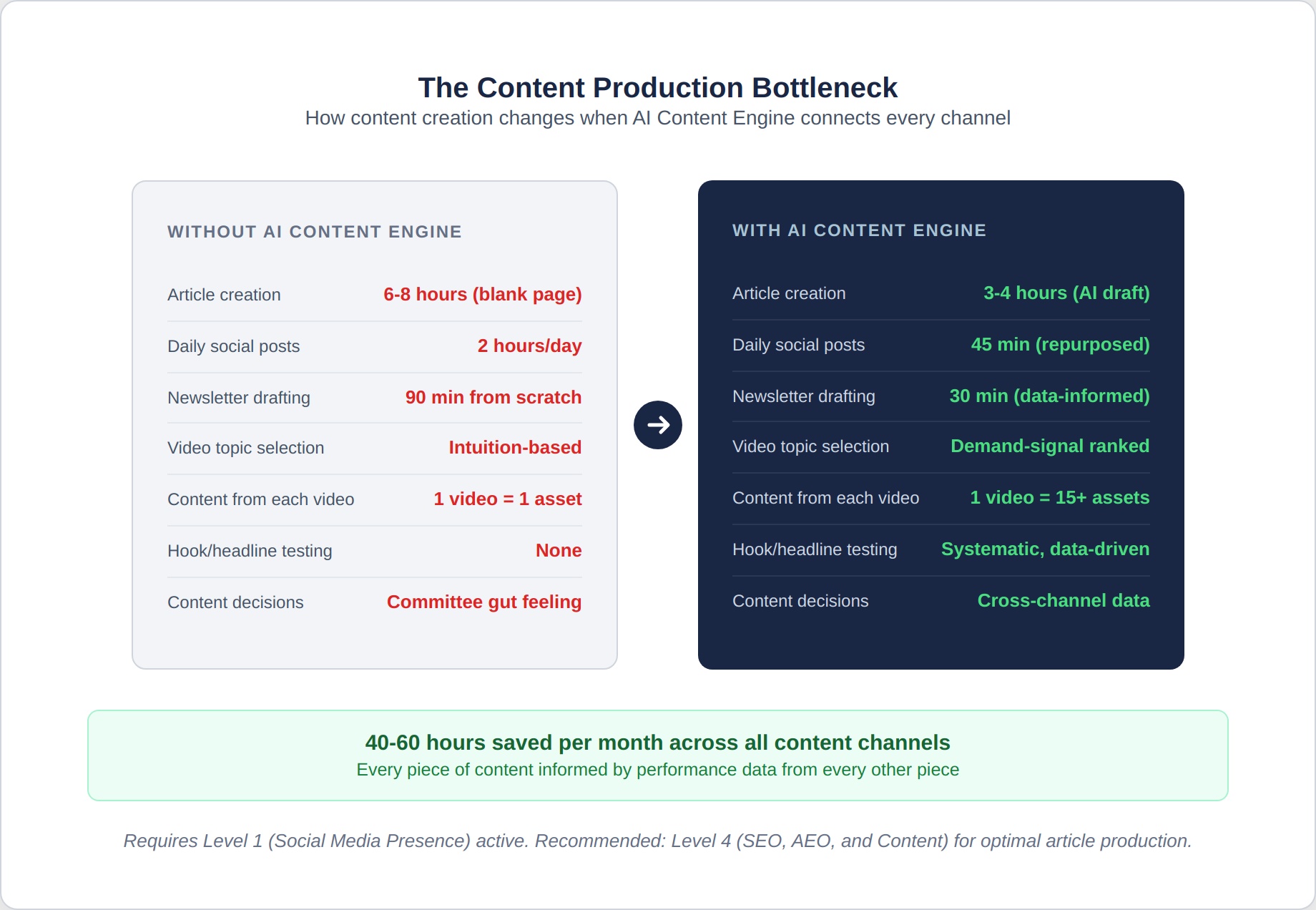
How AI Content Engine Connects to the Ecosystem
This module sits at the center of the content ecosystem, feeding and being fed by every level:
From Level 1 (Social): Engagement data shows which topics and hooks resonate. Comment analysis reveals content ideas. High-performing posts become seeds for deeper content.
To Level 1 (Social): Repurposed content from Levels 4 and 5 provides daily post drafts. Hook testing data tells the content manager which openings will perform best.
From Level 3 (Email): Newsletter engagement data shows which topics subscribers care about. Reply analysis reveals audience language and unmet needs.
To Level 3 (Email): Newsletter topic recommendations based on cross-channel performance. Subject line optimization from accumulated testing data.
From Level 4 (Content): Article performance data shows which topics attract the most qualified traffic. SEO data reveals keyword opportunities.
To Level 4 (Content): Article first drafts from video transcripts. Topic gap analysis, identifying the highest-value articles to produce next. Headline optimization from hook testing.
From Level 5 (Video): Video transcripts provide raw material. Retention data shows which topics hold attention.
To Level 5 (Video): Video topic recommendations based on audience demand signals. Hook testing data for video openings. Scripts informed by what performs in written and social formats.
From Module 4 (Sales Acceleration): Call transcripts provide real buyer language, questions, and objections that can be repurposed across every channel.
From Module 2 (Lead Intelligence): Intent data reveals what topics your buyers are actively researching, informing content priorities.
To Level 0 (Website) and Level 2 (Landing Pages): Messaging optimization recommendations based on which language, framing, and CTAs perform best across all content channels.
What Determines Where You Fall in the Price Range
How Long Before You See Results
Week 1: Content repurposing begins immediately. The first batch of social post drafts from existing videos and articles is delivered within days. Your content team experiences the “not starting from scratch” effect immediately.
Week 2-4: Topic gap analysis produces its first content opportunity report. Comment mining begins accumulating data from active channels. Hook testing framework is configured, and the first tests are running.
Month 1: The first full repurposing cycle is complete. Content production time across all levels is measurably reduced. First hook testing results identify initial patterns. Topic gap analysis delivers the first prioritized content roadmap.
Month 2: Cross-channel performance analysis begins producing optimization insights. The hook-testing database has sufficient data to make initial predictions. Comment mining patterns reveal the top audience questions and content demands. Message optimization recommendations are delivered for the first time.
Month 3: The system reaches full intelligence. Cross-channel data is flowing in both directions. Content production is significantly faster across all levels because raw material, topics, and hooks are all data-informed. The content team has shifted from “what should we create” to “which of these proven ideas should we create first.”
Months 4-6: Compounding intelligence. Every month’s content produces data that improves next month’s content. Hook prediction accuracy increases. Topic recommendations get more precise. The gap between your content performance and competitors widens because every piece you publish is data-informed, while theirs is still intuition-driven.
Month 6+: AI Content Engine is a structural advantage. Your content production is faster, your topics are better targeted, your hooks are more effective, and your messaging is more resonant than competitors who produce content without systematic intelligence. The content engine feeds itself: better content drives more engagement, which generates more data, which in turn drives better content.
Why This Investment Makes Sense
Consider the cost of content production without the AI Content Engine.
If your Level 4 writer spends 6-8 hours producing a 2,500-word article from scratch, and AI Content Engine provides a first draft from video transcripts that reduces that time to 3-4 hours, you’ve saved 3-4 hours per article. At 4 articles per month, that’s 12-16 hours saved monthly on article production alone.
If your Level 1 content manager spends 2 hours daily creating social posts from scratch, and AI Content Engine provides drafted posts from content repurposing that reduces that time to 45 minutes, you’ve saved 1.25 hours per day or approximately 25 hours per month.
Combined time savings across all content channels typically range from 40 to 60 hours per month for a company running Levels 1, 3, 4, and 5. At the value of that production time, the module pays for itself in efficiency alone.
But the bigger value isn’t time savings. It’s quality improvement. Content that’s informed by performance data from across the entire ecosystem performs better than content created on intuition. Better-performing content drives more traffic, engagement, leads, and pipeline. The compounding effect of data-driven content production is worth more over 12 months than the direct time savings, though both are significant.
What This Module Solves
AI Content Engine solves two problems simultaneously. First, it solves the production bottleneck by eliminating blank-page creation and replacing it with data-informed drafting, repurposing, and optimization. Second, it closes the intelligence gap by connecting performance data across all channels, so every piece of content benefits from what every other piece has taught you about your audience. The result: faster production, higher quality, and a content strategy that gets measurably smarter every month.
What This Module Does NOT Include
- Outbound outreach (Module 1: NeuroReach AI)
- Anonymous visitor identification or intent tracking (Module 2: AI Lead Intelligence)
- Website chatbots or interactive tools (Module 3: AI Conversion Tools)
- Sales call preparation or CRM automation (Module 4: AI Sales Acceleration)
- Email nurture optimization (Module 6: AI Nurture and Retention)
- Final content production and publishing at any level (ecosystem levels handle the final production — this module produces the raw material, intelligence, and optimization that make level production faster and better)
AI Content Engine produces the intelligence and raw material. Ecosystem levels produce the final content.
What You Need to Provide
- Onboarding conversation (60 minutes): We map your active ecosystem levels, content workflow, production bottlenecks, and strategic priorities
- Content access: Access to all active content channels (social accounts, email platform, article CMS, video platform, CRM with call transcripts if Module 4 is active) so AI can analyze performance and mine content
- Weekly content review (15-20 minutes): Review repurposed content drafts and topic recommendations, provide feedback on quality and relevance
- Monthly report review (20-30 minutes): Review content intelligence report, hook testing data, and optimization recommendations
- Content team coordination: Your content producers at each level need to adopt the AI-informed workflow, using drafted material and topic recommendations rather than starting from scratch
Total monthly time commitment: approximately 2-3 hours
Who Manages This
Rod Agatep personally oversees the content intelligence strategy, repurposing architecture, and optimization framework for every AI Content Engine engagement. With 27 years of experience in B2B content production and a deep understanding of how content compounds across channels, Rod ensures the intelligence produced is actionable rather than just analytical.
Every repurposing flow, every topic recommendation, and every optimization insight is produced under Rod’s direct supervision to align with the positioning, voice, and strategic direction established across all active ecosystem levels.
AI Content Engine Readiness Assessment
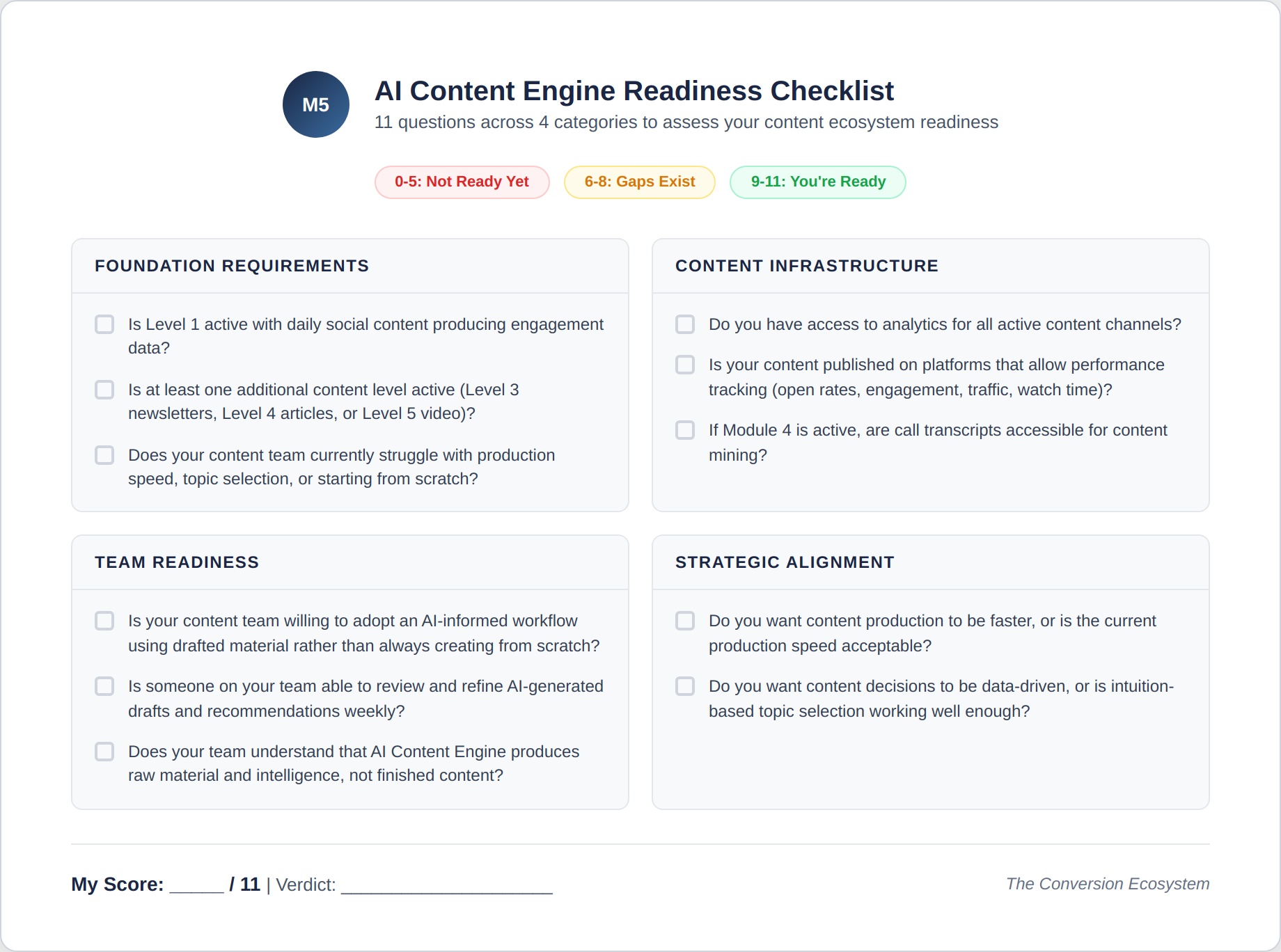
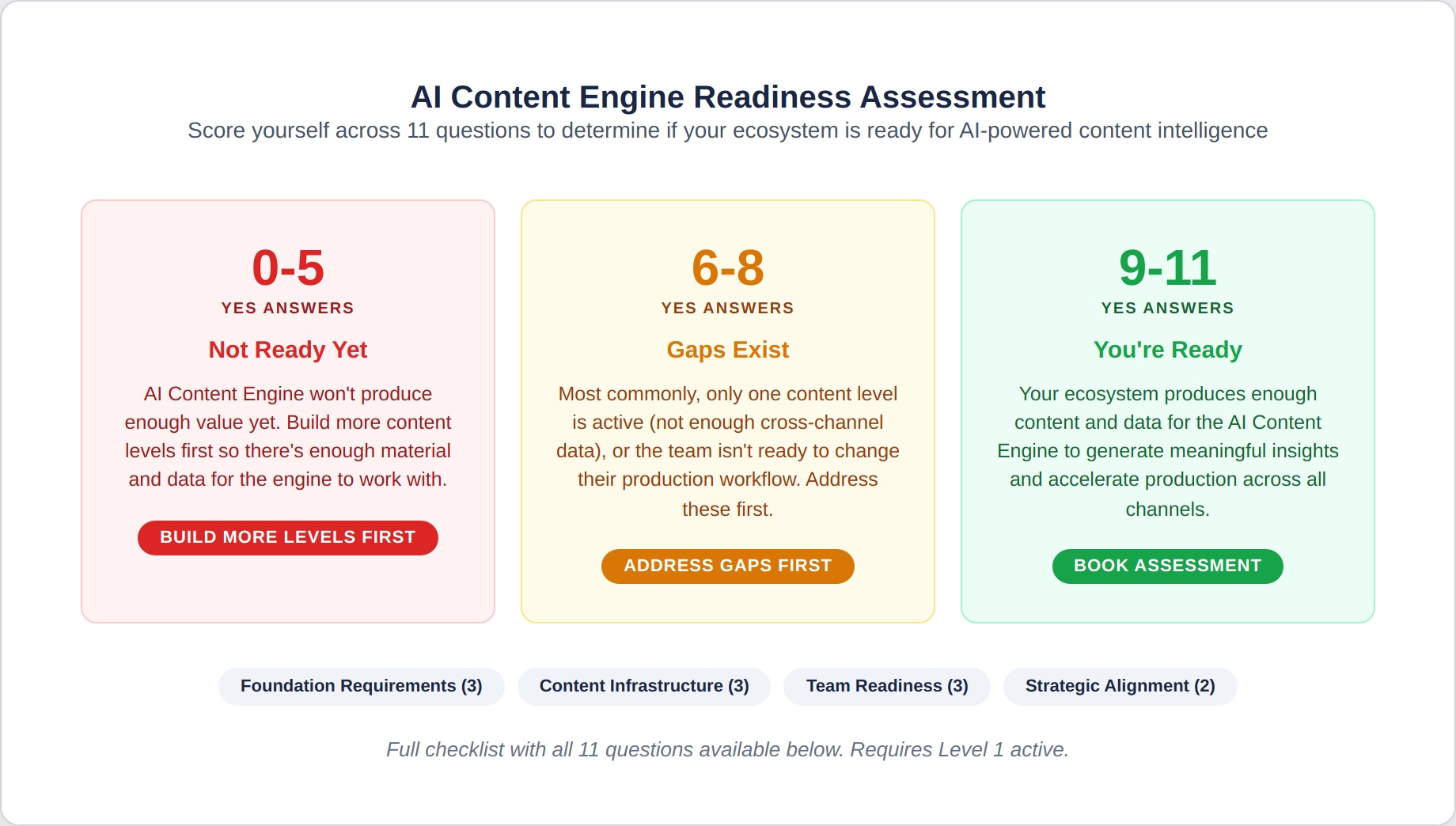
Scoring
9-11 YES answers: You’re ready. Your ecosystem produces enough content and data for the AI Content Engine to generate meaningful insights and accelerate production.
6-8 YES answers: Gaps exist. Most commonly, only one content level is active (not enough cross-channel data), or the team isn’t ready to change their production workflow. Address these first.
5 or fewer YES answers: AI Content Engine won’t produce enough value yet. Build more content levels first so there’s enough material and data for the engine to work with.
Pricing Summary
| Option | Investment |
|---|---|
| AI Content Engine monthly | $1,500 – $3,000/month |
| Annual commitment | 20% off monthly rate |
| Combined with other AI Growth Modules | 10-15% multi-module discount |
What’s included: Cross-channel content repurposing, call transcript mining (with Module 4), topic gap analysis with competitor and AI platform monitoring, hook testing engine across all active channels, comment mining and audience intelligence, message optimization and language analysis, CTA and timing optimization, landing page and service page messaging recommendations, sub-account distribution (upper range), monthly content intelligence reporting, and quarterly strategy reviews.
What’s not included: Final content production or publishing (ecosystem levels), outbound outreach (Module 1), visitor identification (Module 2), website chatbots (Module 3), sales call automation (Module 4), email nurture optimization (Module 6), or paid advertising (Level 6).
Next Step
If you’re not sure whether AI Content Engine is the right module, whether your content production is the actual bottleneck, or whether your ecosystem produces enough material and data for the engine to work with, the fastest way to find out is a conversation.
We’ll review your active content channels, assess your production workflow, evaluate the data flowing through your ecosystem, and tell you honestly whether AI Content Engine will produce meaningful acceleration and intelligence for your situation.
No pitch. No pressure. Just clarity on where you stand and what to do next.
Frequently Asked Questions
Does this replace our content team?
No. AI Content Engine produces raw material, intelligence, and optimization data. Your content team (or the production managed through ecosystem levels) still produces the final content. The module makes them faster and better informed, not redundant. Think of it as giving your content team a research assistant, a first-draft writer, and a data analyst rolled into one.
How good are the AI-generated drafts?
Drafts require human editing. They are 60-70% of the way to finished content: the structure, key points, examples, and core arguments are there. Voice refinement, nuance, and final optimization are done by the human content producer. The value is in eliminating the blank-page problem and the research time, not in producing publish-ready content without human involvement.
What if we only have Level 1 active?
The module produces value at Level 1 alone through comment mining, hook testing, and social performance optimization. However, the full power of content repurposing requires multiple content channels. If Level 1 is your only active content level, consider whether the investment is justified, or wait until Level 3 or Level 4 is active and the repurposing engine has more channels to work with.
How does this work with Level 4 (Content) production?
Level 4 produces finished articles with full SEO/AEO optimization. AI Content Engine provides Level 4 with article first drafts from video transcripts, prioritized topic recommendations from gap analysis, optimized headlines from hook testing, and performance intelligence from cross-channel analysis. Level 4 takes these inputs and produces the final optimized article. The two work as a pipeline, with the engine feeding the production.
Does the hook testing require additional ad spend?
No. Hook testing uses organic channels (Level 1 social posts and Level 3 email subject lines) as testing platforms. Different hooks are deployed across different posts and email sends, and performance data reveals the winners. No paid promotion is required, though hook testing insights can also be applied to Level 6 ad copy.
Can this module work without Module 4 (Sales Acceleration)?
Yes. Module 4 provides call transcripts that AI Content Engine mines for content, but this isn’t required. Without Module 4, the engine works with content from Levels 1, 3, 4, and 5, plus comment and engagement data. In Module 4, the engine adds sales call intelligence to the content supply, significantly enriching the output.
What are the cancellation terms?
Month-to-month with 30 days’ notice. Annual at 20% off with a 12-month term. The early termination fee equals the discount on the completed months. You retain all content intelligence reports, topic gap analyses, hook-testing data, repurposed content drafts, optimization recommendations, and comment-mining databases.
Do I own the intelligence and drafts?
Yes. Every draft, every report, every analysis, every hook testing dataset, and every optimization recommendation belongs to you. If the engagement ends, all intellectual property and data remain yours. There are no data retention clauses or intelligence holdback terms.