
Key Takeaways
- Long-form content and search optimization build a library of articles that generate organic traffic 24/7 without ongoing ad spend, creating the only marketing channel where a single piece of work can produce leads for years.
- AEO (Answer Engine Optimization) structures your content for AI platforms so your business appears when buyers ask AI for recommendations—not just when they search Google.
- Every article includes custom images and diagrams, full SEO and AEO optimization with dual scoring, question-based headings for featured snippets and AI extraction, and FAQ sections that capture long-tail searches.
- Every article powers the ecosystem: newsletter content (Level 3), social media topics (Level 1), landing page messaging (Level 2), and video topics (Level 5).
- The investment ranges from $2,500 to $5,000/month, depending on article volume, keyword competitiveness, and the required content depth.
SEO, AEO, and content marketing build a searchable library of expertise that generates organic traffic and AI visibility around the clock, attracting buyers actively searching for the solutions you provide.
The investment for this service is $2,500 to $5,000 per month. The exact rate depends on the number of articles needed each month, the level of keyword competitiveness, and the depth and complexity of the content required for your business goals.
Annual Commitment: 20% off the monthly rate
A stacking discount applies when you add additional levels of service. As more levels are included, the price per level decreases (see the Conversion Ecosystem pricing table for specific amounts).
Individual articles can rank within 4-8 weeks for lower-competition keywords. Meaningful organic traffic growth shows in 3-6 months. The compound effect begins in 6-12 months as the content library reaches critical mass.
What This Level Is
Level 4 is where your marketing works while you sleep.
Every other level requires ongoing activity. Level 1 demands daily posting. Level 2 needs landing pages matched to active campaigns. Level 3 calls for weekly newsletters. All of them produce results only as long as the work continues.
Level 4 is different. A single article written today can generate traffic, leads, and sales conversations for years. It sits on your website, indexed by search engines, surfaced by AI platforms, and discovered by buyers who are actively researching the exact problem you solve. It works at 2 AM on a Sunday. It works during holidays. It works whether you’re on vacation, in a meeting, or sleeping.
Level 0 built your website. Level 1 created daily visibility. Level 2 built conversion infrastructure. Level 3 built and owned an audience. Now, Level 4 creates the content library that attracts new visitors who have never heard of you but are searching for exactly what you offer, and it does it through the two most important discovery channels in modern marketing: search engines and AI answer platforms.
Every marketing channel has a cost-per-impression model. Paid ads cost money for every click. Social media requires daily effort for daily visibility. Email requires weekly production for weekly contact.
Content is the exception to this model.
An article has a fixed production cost. Once published, it drives unlimited impressions, traffic, and leads at no extra cost per visitor—whether it’s the 100th or 10,000th visitor.
Now multiply that by a library of 30, 50, or 100 articles, each targeting a different keyword, each attracting a different segment of buyers, each working simultaneously. The traffic compounds because each new article adds to the total while previous articles continue to perform.
After 12 months of Level 4, your content library generates traffic equivalent to thousands of dollars in monthly ad spend. After 24 months, the equivalent value often exceeds $10,000- $20,000 per month in paid traffic. The investment was made once per article. The returns continue indefinitely.
No other marketing channel works this way.
Why AEO Matters Now, Not Later
SEO has been important for two decades. AEO (Answer Engine Optimization) has become critical over the last two years and is becoming increasingly important every month.
Here’s what’s changing: buyers are increasingly asking AI platforms for recommendations instead of searching Google. When a B2B buyer asks ChatGPT, “What should I look for in a marketing agency?” or asks Perplexity, “What’s the best approach to lead generation for B2B service companies?” the AI pulls from published content to construct its answer.
If your content exists, is well-structured, and fully answers these questions, the AI cites you. Your company name appears in the answer. The buyer clicks through to your site with the AI’s endorsement.
If your content is missing or unstructured for AI, you are cited by competitors and buyers never hear about you.
AEO optimization means:
- Structure content so AI can extract clear answers from your articles. It’s not just about ranking your content in a list of search results.
- Using question-based headings that match the way buyers phrase queries to AI platforms
- Including summary blocks at the top of articles that give AI a concise answer to surface in results
- Building topical authority through clusters of related content so AI platforms recognize you as a comprehensive source on your subject matter
- Implementing schema markup that helps both search engines and AI platforms understand what your content covers and how it should be categorized.
- Target featured snippets and position zero in Google. Structure answers, lists, tables, and definitions in formats Google extracts for the answer box above all other search results. The AEO quick answer block does double duty: it captures the featured snippet and gives AI a structured answer.
Companies that optimize for AEO now will dominate AI-generated answers for the next 3-5 years. Companies that wait will find those positions already occupied by competitors who moved first.
Level 4 builds for both SEO and AEO simultaneously because the buyers of 2026 use both channels, and the content strategy that serves one serves the other when it’s built correctly.
Why AI-Generated Content Won’t Replace This
Every Level 4 buyer asks: “Can’t I just use ChatGPT to write free articles?”
You can—but the articles will be mediocre, generic, and penalized.
Here’s why Level 4 content is fundamentally different from what AI generates:
Google targets AI-generated content lacking unique value. Its algorithm rewards genuine expertise, original perspective, and real-world experience that AI can’t fake.
AI-generated content lacks your unique expertise. ChatGPT can write about “how to improve lead generation,” but only in generic terms. It cannot write about specific patterns you’ve observed over 27 years, the framework you created through trial and error, or the unique insight gained from a project that went sideways. Your original perspective helps content rank, get cited by AI platforms, and convert readers into leads.
AI platforms increasingly cite original sources over AI-generated summaries. When Perplexity or ChatGPT answers a query, it looks for original data, unique frameworks, and clear authority. AI-generated content offers nothing the AI doesn’t already know. Content based on genuine experience offers the AI something new to share.
Optimization, structure, and topic clustering are tasks that generic AI cannot match. Knowing which keyword to target, how to structure for featured snippets, where to place internal links, how to build the AEO quick answer block, and how the article fits into a cluster strategy requires strategy beyond text generation.
Level 4 uses AI for research and drafting when appropriate, but every article is grounded in your expertise, structured with proven SEO/AEO frameworks, and optimized by experts—delivering what AI alone cannot produce.
What You Get
Content Strategy Built on Data
Level 4 content strategy never guesses. It starts with data from every prior level.
Data sources that inform your content strategy:
- Level 3 newsletter engagement data showing which topics produced the highest click rates and reply rates, revealing what your existing audience genuinely cares about
- Level 1 social media data showing which content themes generated the most engagement and website traffic
- Level 2 landing page data showing which offers attracted the most conversions and which buyer concerns appeared most frequently. Sales team intelligence reveals the questions, objections, and concerns that appear most often in actual buyer conversations. ations
- Keyword research using SEMrush, Ahrefs, or similar tools to identify the specific search queries your buyers use and the competitive landscape for each
- AI platform analysis examining what AI tools currently recommend for queries related to your services and identifying gaps where your content can become the cited source
- Competitor content audit assessing what your competitors have published, what’s ranking, and where the opportunities exist for better, more comprehensive content.
This means every article has a strategic purpose. It targets a specific keyword. It addresses a proven buyer concern. It fills a gap in the competitive landscape. It’s built to rank in search and to be cited by AI platforms.
Monthly Article Production
Every month, Level 4 produces long-form, SEO and AEO-optimized articles published on your website.
Each article includes:
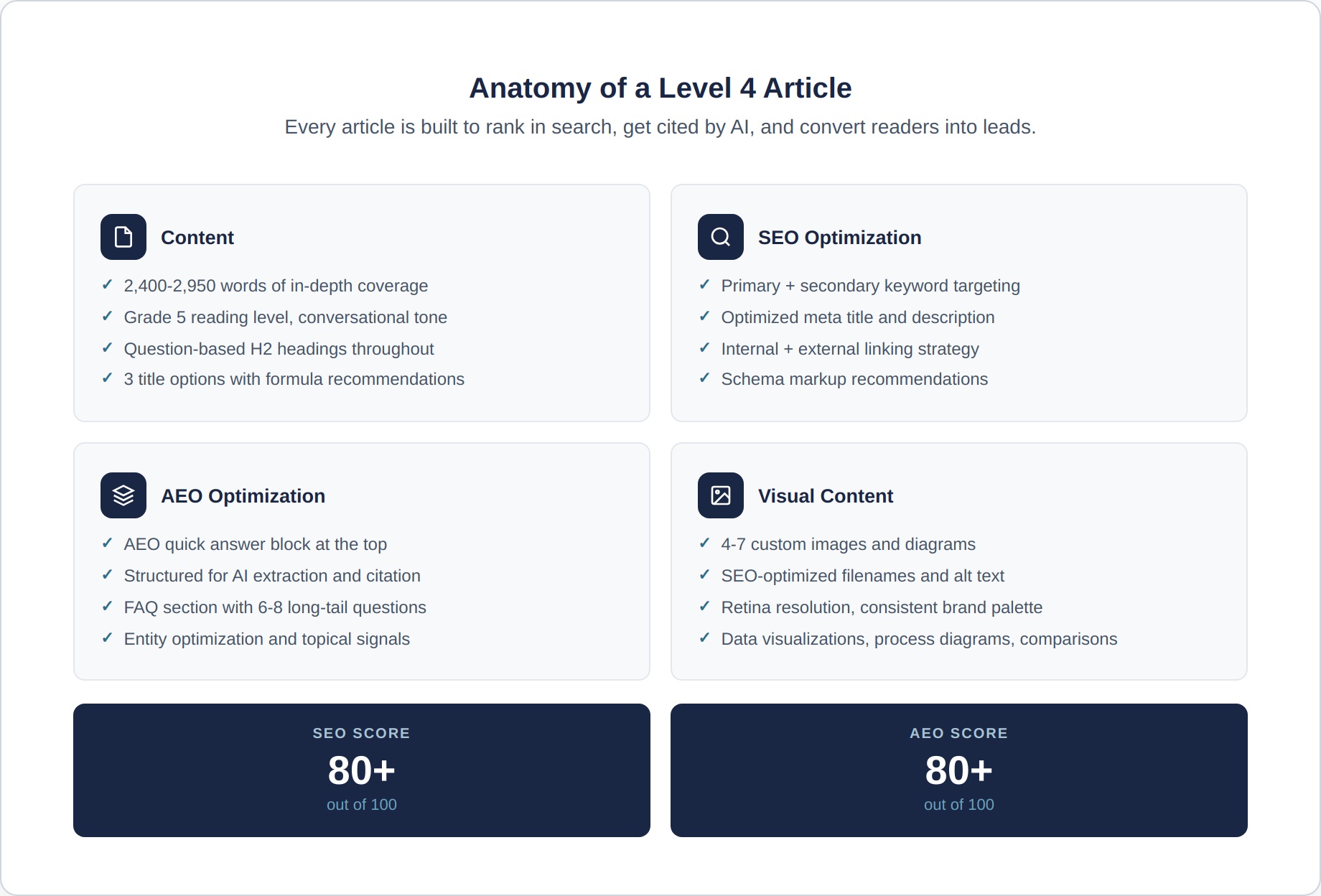
- 2,400-2,950 words of in-depth content that comprehensively covers the topic, because search engines and AI platforms both favour thorough, authoritative content over thin pages
- Primary and secondary keyword targeting with natural keyword integration throughout the title, headers, body, and meta elements
- Question-based H2 headings structured around the actual questions buyers ask, optimized for both search featured snippets and AI answer extraction.
- AEO quick answer block near the top of each article, providing a concise summary that AI platforms can extract and cite directly, also designed to capture Google’s featured snippet position zero
- Conversational, accessible tone written at a grade 5 reading level, so complex topics are clear to every reader regardless of their technical background.
- 4-7 custom images and diagrams per article (see visual content section). Internal linking to relevant service pages, other articles, and Level 2 landing pages, so every article strengthens the overall site structure and guides readers toward conversion.
- External linking to authoritative sources that support key claims and signal credibility to search engines
- Optimized meta title and description written for click-through from search results
- FAQ section with 6-8 additional questions and answers that capture long-tail search queries and provide more content for AI extraction
- Schema markup recommendations (Article, FAQ, HowTo) for each piece to maximize search visibility
- Full SEO and AEO audit with dual scoring (details below)
- Three title options using proven headline formulas with a recommendation for the strongest performer
What an Actual Article Looks Like
To make the quality tangible, here’s the structure of a real Level 4 article:
Title: “How Much Does a Lead Generation System Actually Cost in 2026?”
AEO Quick Answer Block: A 4-5 bullet summary at the top answering the core question directly, structured so AI platforms can extract it as a complete answer.
12-14 Question-Based Sections: Each H2 heading is a question buyers actually search for:
- What does a lead generation system include?
- Why is the price range so wide?
- What do the three investment tiers look like?
- Where does the money actually go?
- What’s the math that makes this investment make sense?
- Why do cheap systems cost more in the long run?
- When does higher investment make sense?
- What red flags indicate a system is failing?
6 Custom Images: Pricing tier comparison, cost breakdown bar chart, campaign vs system performance chart, 90-day timeline, ROI calculation visual, and a decision framework diagram. Each has an SEO-optimized filename and descriptive alt text.
Internal Links: 3 links to relevant service pages, 2 links to related articles, 1 CTA to a Level 2 landing page offering a free assessment.
FAQ Section: 6 additional questions targeting long-tail searches like “Is $5,000 enough for lead generation?” and “How long before a lead generation system produces results?”
SEO Score: 88/100. AEO Score: 91/100.
That’s what every Level 4 article looks like. Comprehensive, structured, optimized, visual, and built to rank.
Monthly article volume:
| Range | Articles Per Month | Best For |
|---|---|---|
| Lower ($2,500-$3,200/mo) | 2-3 articles | Companies entering content marketing, building initial library |
| Mid ($3,200-$4,200/mo) | 3-5 articles | Companies building momentum, targeting competitive keywords |
| Upper ($4,200-$5,000/mo) | 5-8 articles | Companies pursuing aggressive organic growth across broad keyword landscape |
How Content Volume Connects to Timeline
More articles per month compress the time to meaningful results because you build topical authority faster and generate data sooner:
- At 2-3 articles/month: Expect meaningful organic traffic growth at 8-12 months. The library builds slowly, but every article compounds. Best for companies with moderate keyword competition and a willingness to grow gradually.
- At 4-5 articles/month: Expect meaningful organic traffic growth at 5-8 months. Topic clusters fill out faster. Authority signals build more quickly. Best for companies targeting moderately competitive keywords that want to accelerate the timeline.
- At 6-8 articles/month: Expect meaningful organic traffic growth at 3-6 months. The library reaches critical mass faster. Search engines recognize topical authority sooner. Best for companies in competitive markets who want to establish content dominance quickly.
All paths reach the same compounding destination. Volume determines how fast you get there.
Custom Images and Visual Content
Every Level 4 article includes custom visual content that reinforces key points, improves engagement, and provides additional SEO value.
Each article includes 4-7 custom images:
- Data visualizations: Charts, comparison tables, and metric breakdowns that make complex information immediately scannable
- Process diagrams: Flow charts, timelines, and step-by-step visuals that illustrate systems and sequences
- Comparison graphics: Side-by-side visuals, tier cards, and decision frameworks that help readers evaluate options
- Concept illustrations: Visual representations of frameworks, models, and strategic concepts from the article
Every image follows a consistent visual identity:
- Clean, uncluttered design with generous whitespace
- Consistent colour palette (navy, steel blue, slate, and warm accent) across all articles
- Georgia serif titles and Arial sans-serif body. All text is large enough to read on mobile. mobile
- Professional quality that matches or exceeds what readers expect from premium publications
Every image is SEO-optimized:
- Descriptive, keyword-rich filenames (e.g., “lead-generation-system-monthly-cost-2026.png”, not “image-1.png”)
- Alt text that describes the image content and includes relevant keywords naturally
- Compressed file sizes for fast page loading without quality loss
- Retina resolution (2x) for crisp display on all devices
Images are a genuine differentiator. Most B2B articles use stock photos or no images at all. Level 4 articles include original, data-rich visuals that make the content more engaging, more shareable, and more likely to appear in Google Image search results.
Content Types We Produce
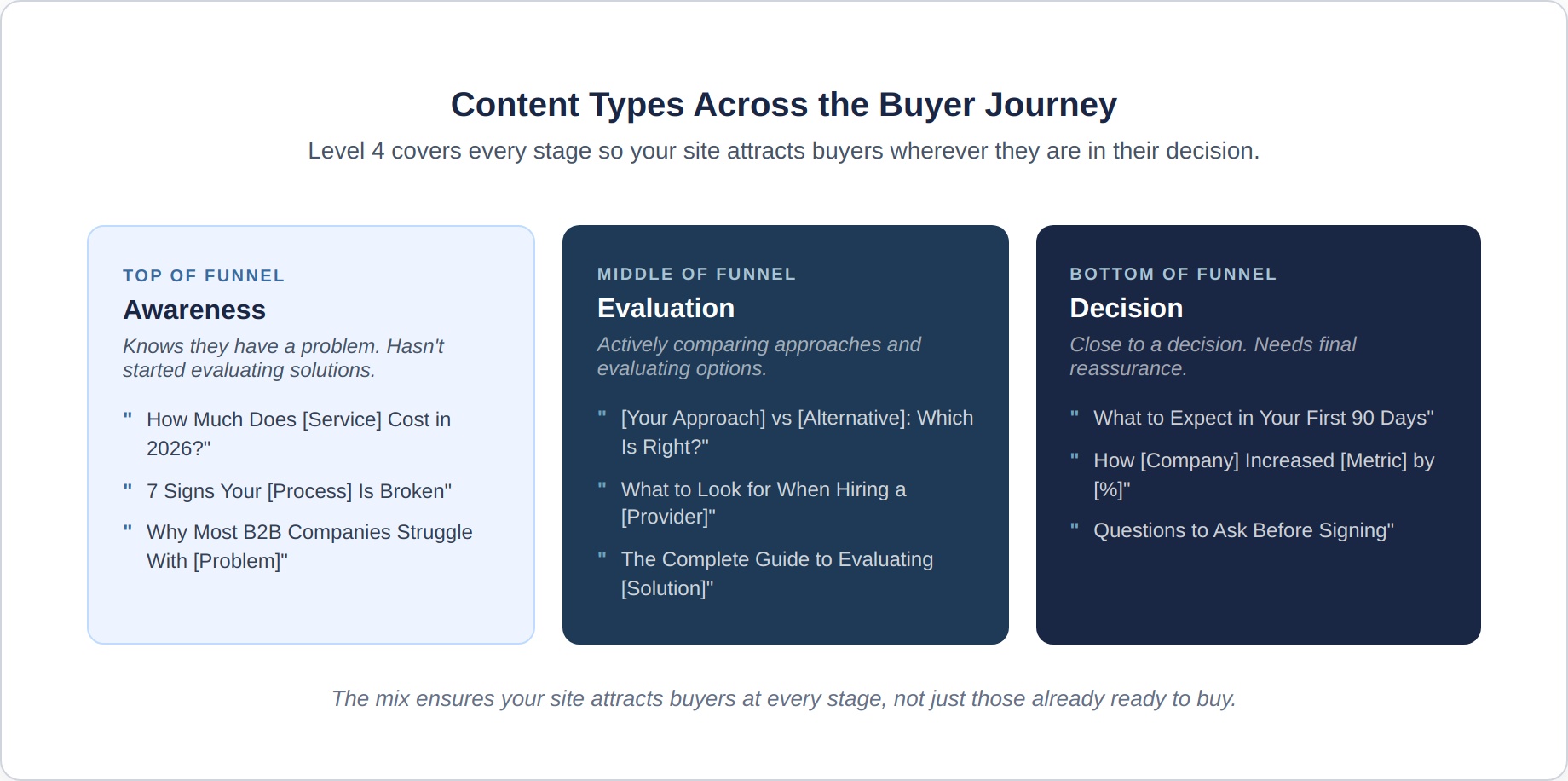
Not every article serves the same purpose. Level 4 includes a strategic mix of content types that covers the full buyer journey:
**Top-of-Funnel Content (Awareness)**Articles targeting buyers who know they have a problem but haven’t started evaluating solutions yet. These articles educate, build awareness, and position your company as the knowledgeable guide.
- “How Much Does [Service] Cost in 2026?”
- “7 Signs Your [Process] Is Broken.”
- “Why Most B2B Companies Struggle With [Problem]”
**Middle-of-Funnel Content (Evaluation)**Articles targeting buyers who are actively comparing approaches and evaluating options. These articles address the Big 5 questions from Level 0: cost, problems, comparisons, best-of lists, and reviews.
- “[Your Approach] vs [Alternative]: Which Is Right for Your Business?”
- “What to Look for When Hiring a [Service Provider]”
- “The Complete Guide to Evaluating [Solution Type]”
**Bottom-of-Funnel Content (Decision)**Articles targeting buyers who are close to a decision and need final reassurance. These articles address specific objections, provide proof, and make the next step clear.
- “What to Expect in Your First 90 Days With a [Service Provider]”
- “How [Type of Company] Increased [Metric] by [Percentage]”
- “Questions to Ask Before Signing With a [Service Provider]”
The mix of content types ensures your site attracts buyers at every stage of their journey, not just the ones who are already ready to buy.
How Articles Handle Competitor Mentions
Comparison content and best-of content are among the highest-converting article types because they reach buyers who are actively evaluating options. Level 4 handles competitor mentions strategically:
- Direct competitor naming is used when it serves the buyer. Buyers are searching “[your company] vs [competitor]” whether you write about it or not. Owning that comparison on your site means they compare through your framing rather than a third party’s.
- Honest, objective positioning that acknowledges competitor strengths while clearly articulating where your approach differs and why. Buyers trust companies that can discuss alternatives fairly rather than pretending competitors don’t exist.
- Differentiation through depth rather than criticism. Rather than attacking competitors, the content demonstrates superior expertise through the thoroughness and quality of its analysis.
- “When we’re not the right fit” transparency that increases trust by showing you’re willing to direct buyers elsewhere when appropriate, which paradoxically makes buyers more confident in choosing you when it is the right fit.
Topic Cluster Strategy and Keyword Cannibalization Prevention
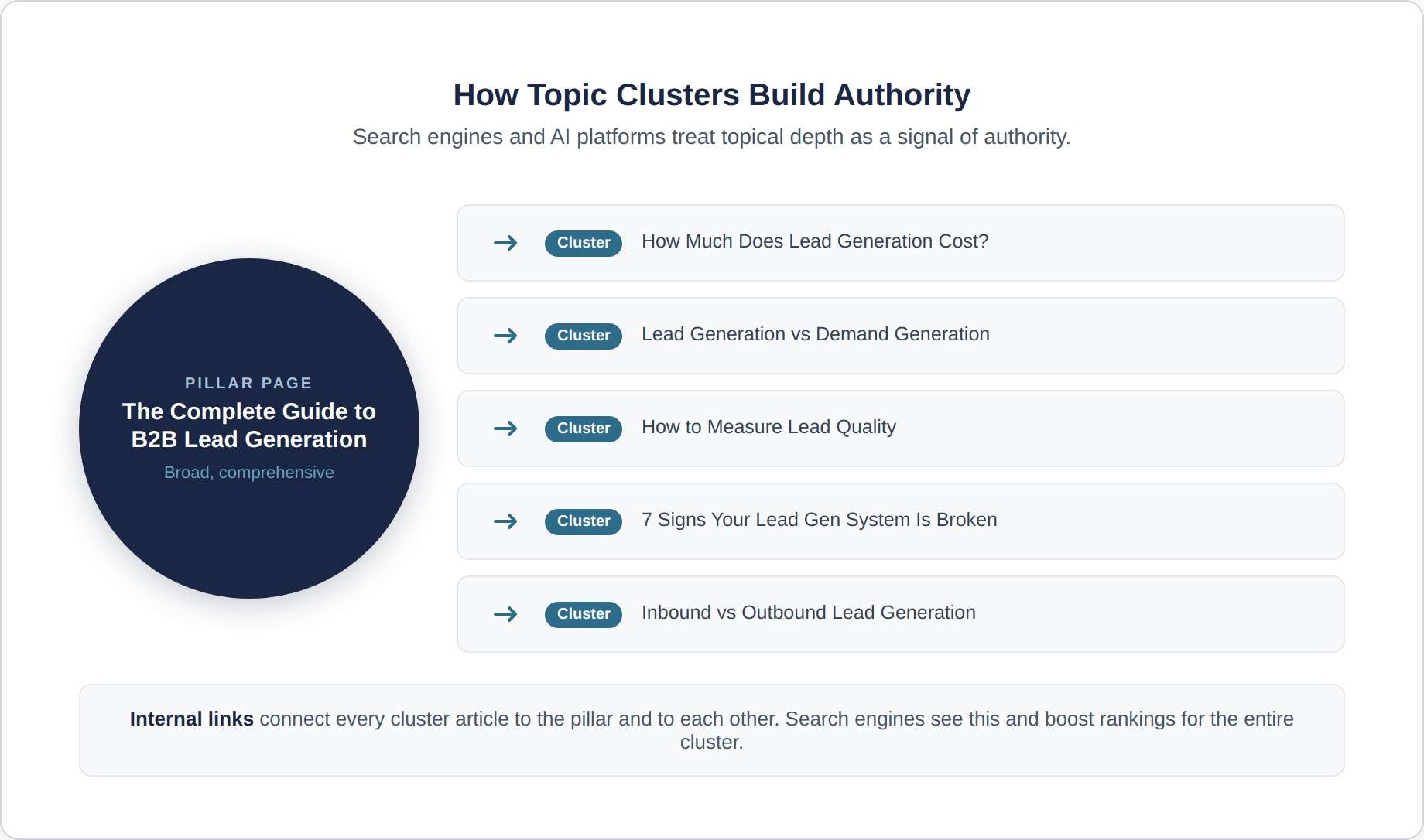
Individual articles are valuable. Organized clusters of related articles are dramatically more valuable because search engines and AI platforms treat topical depth as a signal of authority.
How topic clusters work:
- A pillar page covers a broad topic comprehensively (e.g., “The Complete Guide to B2B Lead Generation”)
- Cluster articles cover specific subtopics in depth (e.g., “How Much Does Lead Generation Cost?”, “Lead Generation vs Demand Generation”, “How to Measure Lead Quality”)
- Internal links connect every cluster article to the pillar page and to other articles within the cluster.
- Search engines see this interconnected structure and recognize your site as an authoritative source on the entire topic, boosting rankings for every article in the cluster.
- AI platforms draw on the cluster to generate comprehensive answers, increasing the likelihood of citations.
How to prevent keyword cannibalization:
Keyword cannibalization occurs when multiple articles compete for the same search query, splitting your authority and hurting the performance of both. Level 4 prevents this through:
- Keyword mapping, where every article is assigned a unique primary keyword before writing begins, ensuring no two articles target the same query
- Search intent differentiation so that articles covering related topics are positioned around different buyer intents (informational vs commercial vs navigational)
- Internal linking hierarchy that signals to search engines which article is the primary resource for each topic, and which articles are supporting content
- Quarterly cannibalization audit reviewing Search Console data to identify any articles that are competing with each other and consolidating or differentiating them.
Level 4 builds these clusters strategically over time. Each month’s articles are selected not just for individual value but for how they strengthen existing clusters and fill gaps in your topical coverage.
SEO and AEO Audit for Every Article
Every article produced at Level 4 includes a comprehensive optimization audit:
SEO scoring (out of 100) covering:
- Title tag and meta description optimization
- Header structure and keyword placement
- Content depth and comprehensiveness
- Internal and external linking
- Image optimization with descriptive filenames and alt text
- URL structure and technical elements
- Mobile readability and page speed impact
AEO scoring (out of 100) covers quickly answering block presence and quality. uality
- Question-based heading structure
- Content extractability for AI platforms
- Entity optimization and topical signals
- FAQ section depth and relevance
- Schema markup recommendations
- Conversational clarity and directness
Each article targets a minimum score of 80 on both SEO and AEO scales. Articles scoring below the threshold are revised before publication.
Measuring AEO Performance
AEO is newer than SEO, and measurement requires different tools and approaches:
- AI citation monitoring using tools that track when and where AI platforms cite your content in their responses. We periodically query relevant AI platforms with the questions your articles target and document when your content appears in answers.
- Referral traffic from AI platforms tracked in Google Analytics, identifying visitors who arrive from ChatGPT, Perplexity, or other AI sources
- Featured snippet capture tracked through SEMrush or Ahrefs, showing which articles occupy position zero in Google results.
- Knowledge panel appearances are monitored for branded and topic-based queries.
- Monthly AEO visibility report documenting which articles are being cited, which AI platforms are referencing your content, and which queries trigger your content in AI answers
AEO measurement is evolving as the technology matures. We use the best available tools and methods while building processes that adapt as new measurement capabilities emerge.
Content Distribution Beyond the Ecosystem
Level 4 articles live on your website as their primary home, but strategic distribution extends their reach and builds the backlinks that strengthen domain authority:
- LinkedIn article republishing, where appropriate, with canonical tags pointing to the original to avoid duplicate content issues while reaching LinkedIn’s built-in audience
- Industry publication outreach, identifying relevant publications, directories, or industry sites where your content or expertise could be featured or syndicated
- Content partnership opportunities where your articles are referenced or excerpted by complementary businesses or industry resources
- Natural backlink attraction through content quality. Comprehensive, data-rich, visually supported articles naturally earn links from other sites that reference your research, frameworks, and insights. This organic link building is the most sustainable and Google-rewarded approach to building domain authority.
Aggressive or manipulative link-building tactics are not part of Level 4. Google penalizes artificial link schemes. Quality content that genuinely serves the reader naturally attracts links. That approach is slower but permanent.
Content Refresh and Maintenance
Published content requires periodic maintenance to maintain and improve rankings:
- Quarterly performance review of all published articles, identifying which are gaining traffic, which are declining, and which have ranking opportunities within striking distance
- Content refresh cycle: updating statistics, adding new sections, improving headers, and strengthening internal links on articles with ranking potential but that need improvement.
- Competitor monitoring tracking when competitors publish content targeting the same keywords, and adjusting your content to maintain or improve position
- Seasonal updates, refreshing date-sensitive content (pricing articles, annual guides, trend pieces) to maintain accuracy and freshness signals
An article published in month 1 and refreshed in month 6 often performs better in month 12 than it did in month 3 because the refresh signals to search engines that the content is maintained, up to date, and authoritative.
What Happens During Pauses in Production
If you need to reduce or pause article production temporarily:
- Existing content continues performing. Published articles don’t disappear or lose rankings because new articles have stopped being added. The library you’ve built keeps working.
- Maintenance continues. Content refresh, technical monitoring, and performance tracking remain active to protect the rankings you’ve already earned.
- Momentum does slow. Consistent publishing signals to search engines that your site is active and authoritative. Extended pauses (3+ months) can slow ranking progress for newer articles. When production resumes, it typically takes 4-6 weeks to rebuild momentum.
- Minimum recommended cadence: If budget requires a reduction, 1-2 articles per month maintains the publishing signal and keeps the library growing, even if more slowly. Going to zero for extended periods is not recommended if organic growth is a priority.
How Content Feeds the Entire Ecosystem
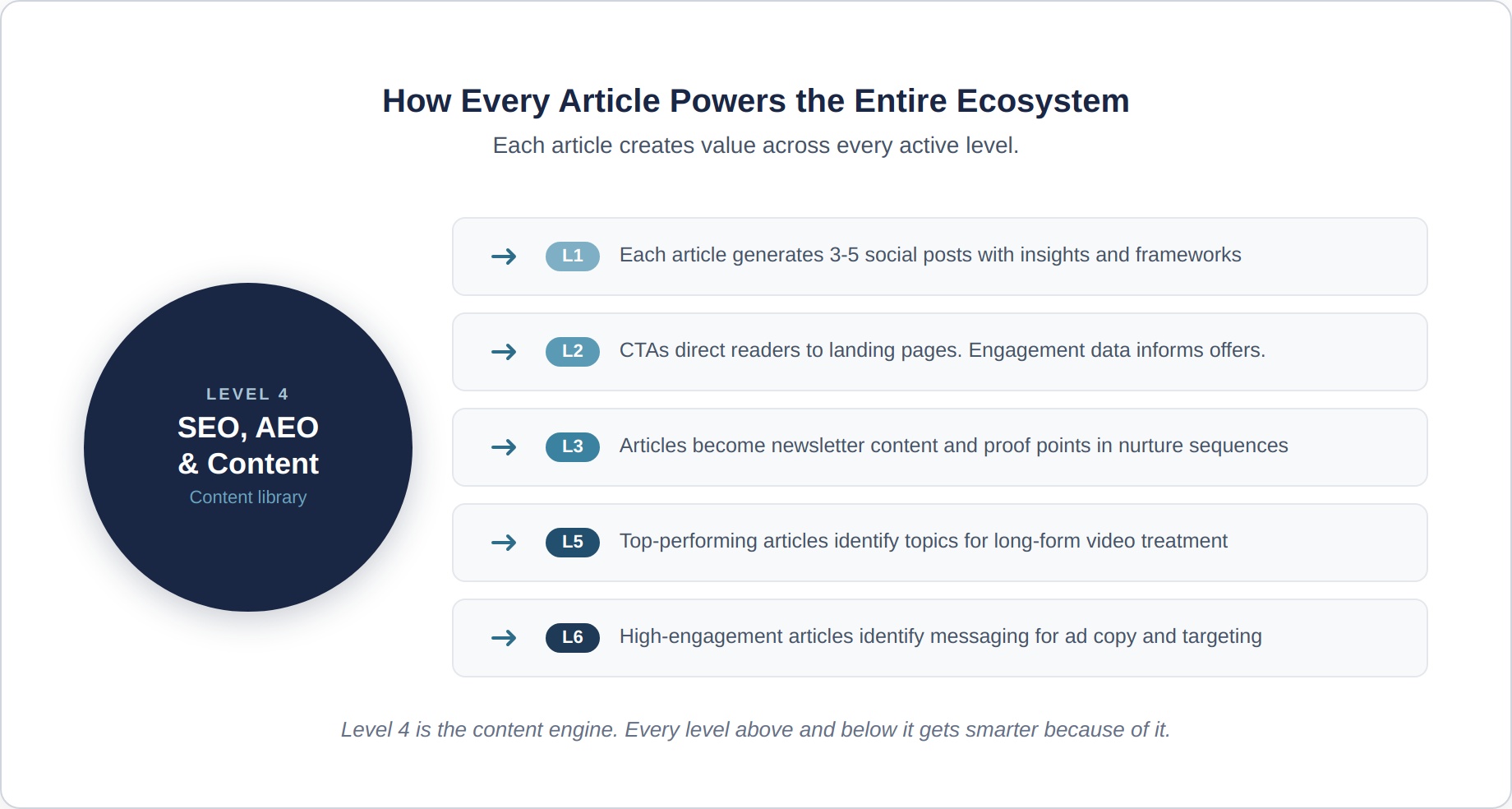
Every article produced at Level 4 creates value across every other active level:
Feeds Level 1 (Social Media):
- Each article generates 3-5 social media posts: key insights, controversial points, statistics, and frameworks extracted from the article and reformatted for social media.
- Social posts link back to the full article, driving traffic that improves search rankings through engagement signals.
Feeds Level 2 (Landing Pages):
- Articles include CTAs directing readers to relevant Level 2 landing pages.
- Article engagement data reveals which buyer concerns are most common, informing landing page messaging and offer development.
Feeds Level 3 (Email Marketing):
- Each article becomes newsletter content, either summarized or featured with a link to the full piece.
- Article topics that generate high social engagement become newsletter themes.
- Articles serve as proof points in nurture sequences.
Feeds Level 5 (Video):
- Top-performing articles identify which topics deserve long-form video treatment.
- Article research and structure become the foundation for video scripts.
- Video content embedded in articles improves engagement metrics and time-on-page.
Feeds Level 6 (Paid Ads):
- Articles with high organic engagement identify messaging angles that resonate, informing ad copy and targeting.
- High-traffic articles can be promoted through paid distribution for accelerated reach.
What a Buyer’s Discovery Journey Looks Like
Here is how Level 4 content works in practice to attract a buyer who has never heard of you.
A marketing director at a B2B services company is struggling with inconsistent lead flow. She opens Google and searches “how much does a lead generation system cost.”
Your Level 4 article ranks on page 1 for that query. She clicks through and finds a comprehensive, honest guide with custom diagrams showing pricing tiers, cost breakdowns, and ROI calculations. The article answers her question thoroughly without a hard pitch. She spends 6 minutes reading and scrolls through every section.
At the bottom of the article, a CTA offers a free assessment. She clicks through to a Level 2 landing page. She completes the form. She enters the Level 2 automation sequence. She receives the Level 3 newsletter starting the following week.
Over the next 6 weeks, she reads three newsletters, downloads a lead magnet, and watches two Level 1 LinkedIn videos from your profile. She replies to a newsletter with a question. Your sales team follows up.
By the time she gets on a call, she’s consumed 8-10 pieces of your content. She understands your approach. She’s seen proof. She trusts your expertise. The conversation starts at mile 7, not mile 0.
Two weeks later, she asks her AI assistant, “What’s the best approach to B2B lead generation for service companies?” Perplexity cites your article in the answer because it was the most comprehensive, well-structured source available. A colleague of hers sees your name in the AI response and clicks through. The cycle begins again with a completely new buyer you never would have reached without Level 4.
That entire sequence started with one article. The article existed because Level 4 built it. The conversion happened because Level 2 captured her. The nurture happened because Level 3 maintained the relationship. The trust was reinforced because Level 1 kept appearing in her feed. The AI citation happened because the article was optimized for AEO.
Every level worked together. Level 4 was the front door.
What Determines Where You Fall in the Price Range
Level 4 – SEO, AEO & Content Marketing
Search-driven authority content that captures demand, builds trust before the call, and turns organic traffic into qualified pipeline.
| Scope Factor | Lower ($2,000–$2,800/mo) | Mid ($2,800–$3,600/mo) | Upper ($3,600–$4,500/mo) |
|---|---|---|---|
| Articles Per Month | 4 articles | 6 articles | 8–10 articles |
| Content Focus | SEO traffic generation | SEO + conversion-focused content | Full funnel authority content (awareness to decision) |
| Keyword Strategy | Basic keyword targeting | Structured keyword clusters | Full topical authority and content silo strategy |
| Buyer Intent Coverage | Mixed intent topics | Strong focus on problem-aware and solution-aware | Full coverage including BOFU (pricing, comparisons, best options) |
| AEO Optimization | Not included | Basic AI answer optimization | Full AEO strategy for AI search and featured answers |
| Content Types | Blog articles | Articles + comparisons + buyer guides | Articles + guides + case-style + authority assets |
| Internal Linking | Basic linking | Structured internal linking | Full ecosystem linking across pages and funnels |
| Level 0 Integration | Supports blog only | Supports service pages and trust assets | Fully integrated with conversion architecture |
| Level 2 Alignment | Indirect support | Articles feed landing pages | Content built specifically to drive landing page conversions |
| Optimization & Updates | Publish only | Periodic refreshes | Continuous optimization based on rankings and performance |
| Performance Tracking | Traffic and rankings | Traffic + engagement | Leads, pipeline, and revenue attribution |
How Long Before You See Results
Content marketing has a longer ramp than other levels because search engines take time to discover, index, evaluate, and rank new content. Setting realistic expectations is essential.
Month 1-2: Articles are published, indexed, and begin appearing in search results, typically on pages 2-5 for target keywords. AI platforms begin encountering your content. The traffic impact is minimal, but the foundation is being laid. Custom images start appearing in Google Image search results.
Month 3-4: Early articles begin climbing in rankings as search engines assess engagement and authority signals. Some articles targeting lower-competition keywords reach page 1. AI platforms start citing your content for specific queries. Organic traffic is measurably growing. Topic cluster authority begins forming.
Months 5-6: The content library reaches sufficient critical mass that topic-cluster authority begins strengthening individual article rankings. Articles that were on page 2 move to page 1. Traffic growth accelerates as multiple articles contribute simultaneously. Newsletter and social content benefit from the growing library of reference material. Featured snippets are beginning to appear for some queries.
Months 7-12: Compounding is fully active. Each new article benefits from the domain authority that previous articles built. Older articles continue climbing as the site’s overall authority grows. AI citations increase as the breadth of your content library expands. Organic traffic may rival or exceed paid traffic in volume. The content library is becoming a significant business asset.
Month 12+: The content library generates traffic equivalent to thousands of dollars in monthly ad spend at no ongoing cost per visitor. AI platforms regularly cite your content. The cost-per-lead from organic content is a fraction of the cost from paid channels. Each new article performs faster because it benefits from the authority established by all previous publications.
The critical lesson: Companies that publish for 3 months and quit because “SEO takes too long” lose 100% of their investment. Companies that publish for 12 months and continue to build an asset that produces returns for years. The compounding curve is real, but it requires patience through months 1-4 before it becomes visible.
Why This Investment Makes Sense
Consider the alternative to organic content: paying for every visitor through ads.
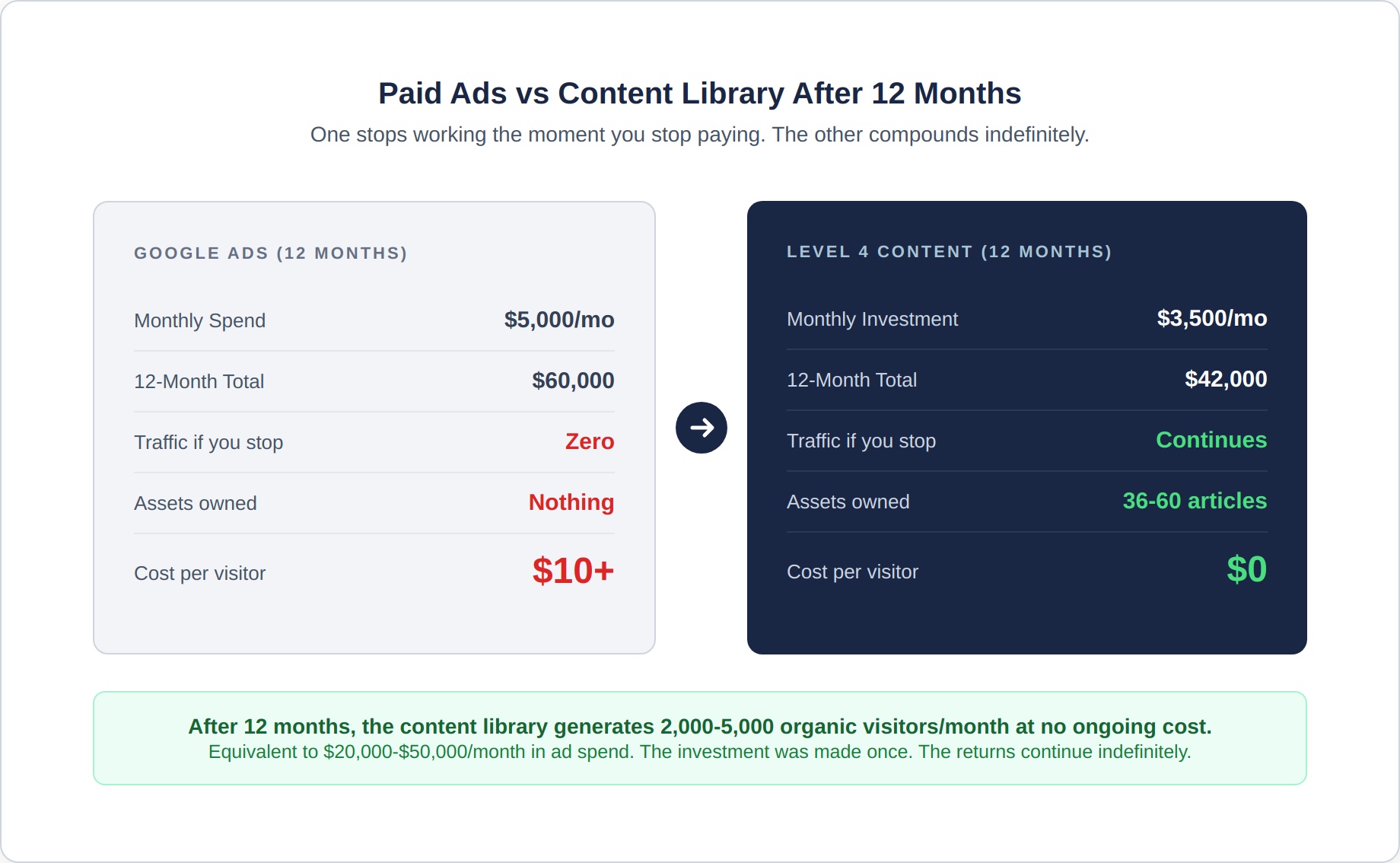
If you’re spending $5,000/month on Google Ads, generating 500 clicks at $10 per click, that traffic stops the moment you stop paying. After 12 months, you’ve spent $60,000 and own nothing.
If you invest $3,500/month in Level 4 content for 12 months, you’ve spent $42,000 and own a library of 36-60 articles with 150-400 custom images that continue generating traffic indefinitely. After 12 months, that library may be generating 2,000-5,000 organic visitors per month, the equivalent of $20,000-$50,000 in monthly ad spend, at no ongoing cost per visitor.
By month 18, the content library has likely paid for itself multiple times over. By month 24, it’s generating traffic at a fraction of the cost of any paid channel. And every published article continues to work while new articles are being created.
The companies that commit to content for 12+ months build an organic traffic asset that their competitors can’t replicate quickly. The companies that rely entirely on paid traffic are always one budget cut away from zero visibility.
What This Level Solves
Level 4 solves the problem of depending entirely on paid and outbound channels to generate awareness. Without organic content, your business is invisible to every buyer who discovers solutions through search or AI platforms. With Level 4, your expertise becomes discoverable by buyers who are actively looking for what you offer, creating a steady stream of inbound interest that costs less per lead than any other channel over time and that AI platforms cite when buyers ask for recommendations.
What This Level Does NOT Include
- Website structural changes (Level 0 — though Level 4 articles are published on your Level 0 website)
- Social media content creation or management (Level 1 — though Level 4 articles generate social content topics)
- Landing page creation (Level 2 — though articles include CTAs to Level 2 pages)
- Newsletter writing (Level 3 — though articles feed newsletter content)
- Video production (Level 5 — though articles identify video topics and video can be embedded in articles)
- Paid advertising (Level 6)
- AI outreach (Level 7)
Level 4 builds the content library. The levels around it distribute, amplify, and convert the traffic it generates.
What This Level Solves
Level 4 solves the problem of depending entirely on paid and outbound channels to generate awareness. Without organic content, your business is invisible to every buyer who discovers solutions through search or AI platforms. With Level 4, your expertise becomes discoverable by buyers who are actively looking for what you offer, creating a steady stream of inbound interest that costs less per lead than any other channel over time and that AI platforms cite when buyers ask for recommendations.
What You Need to Provide
- Onboarding conversation (60-90 minutes): We align on your content strategy, target keywords, competitive landscape, and the topics where your expertise is strongest
- Subject matter input (30-45 minutes per month): A monthly call where you share insights, perspectives, and expertise on the upcoming month’s article topics. You provide the thinking. We do the research, writing, image creation, and optimization.
- Article review (15-20 minutes per article): Review each article before publication to ensure accuracy and alignment with your expertise
- Sales team intelligence (as needed): Sharing the questions and objections that come up most frequently in sales conversations, so content addresses real buyer concerns
- Quarterly strategy review (45-60 minutes): Reviewing content performance, ranking progress, AEO citations, and strategy adjustments for the next quarter
Total monthly time commitment: approximately 3-4 hours
Who Manages This
Rod Agatep personally directs the content strategy, topic selection, and quality standard for every Level 4 engagement. With 27 years of experience in B2B marketing and a deep understanding of how search engines and AI platforms evaluate content, Rod ensures every article is built to rank, built to be cited by AI, and built to convert the traffic it attracts.
Every article is produced under Rod’s direct supervision using a proven content framework refined across 150+ published articles. The writing, the structure, the SEO optimization, the AEO formatting, the custom images, and the internal linking strategy all reflect what actually produces rankings and AI citations in competitive B2B markets.
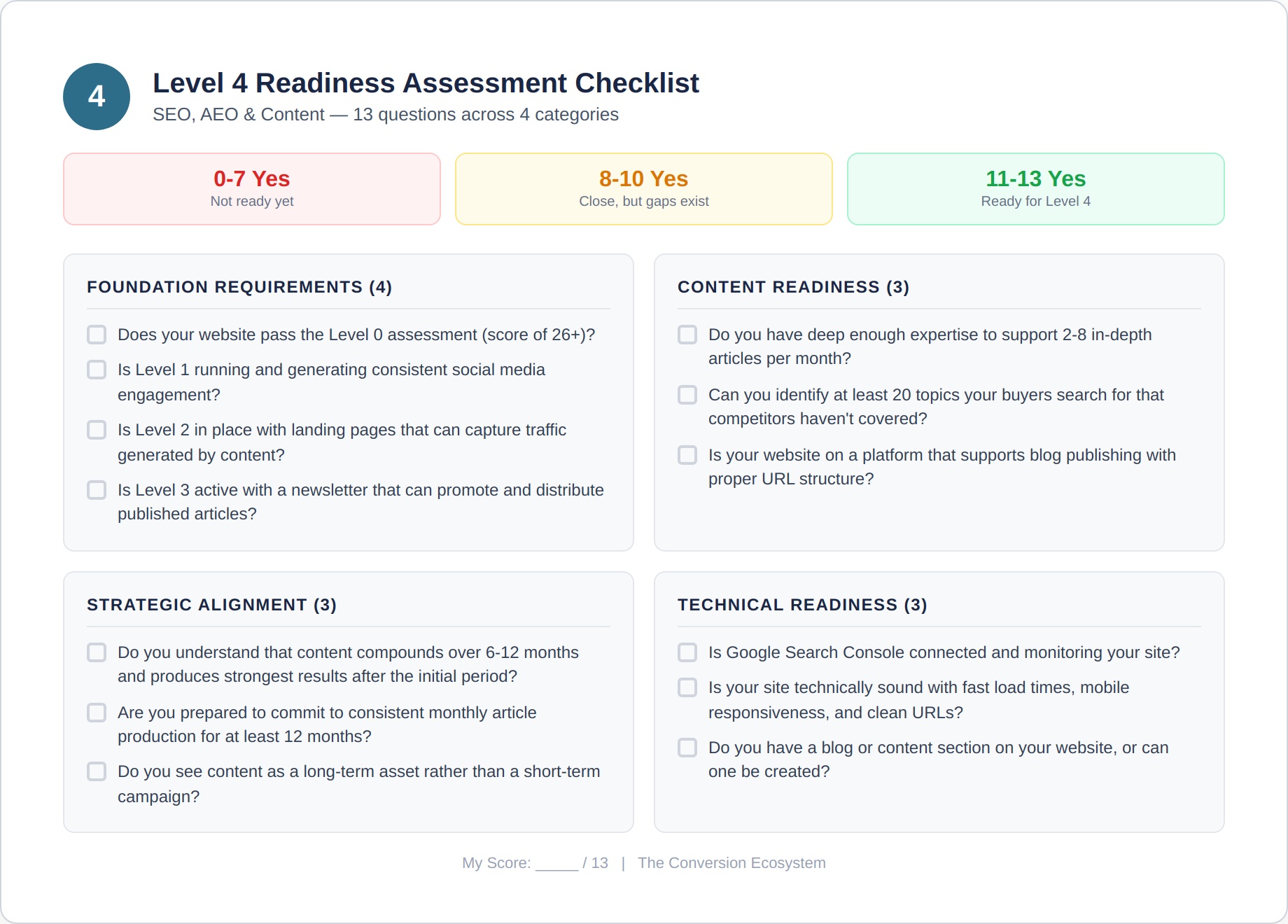
Level 4 Readiness Assessment
Scoring
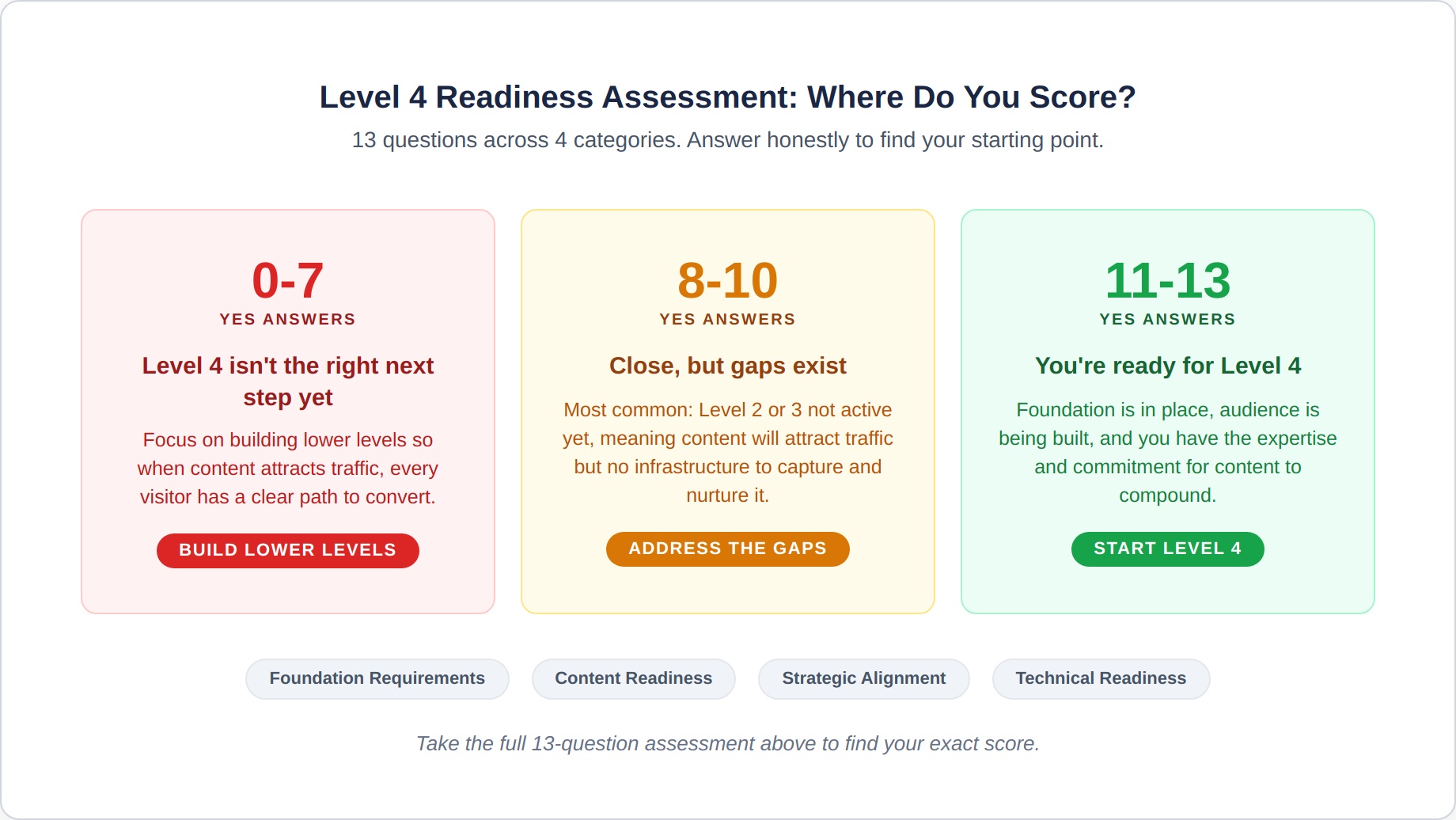
11-13 YES answers: You’re ready for Level 4. Your foundation is in place, your audience is being built, and you have the expertise and commitment needed for content marketing to compound.
8-10 YES answers: Close, but gaps exist. The most common gaps are Level 2 or Level 3 not being active yet, meaning content will attract traffic, but there’s no conversion infrastructure or newsletter to capture and nurture it. Address those first.
7 or fewer YES answers: Level 4 isn’t the right next step yet. Focus on building the lower levels so that when content starts attracting traffic, every visitor has a clear path to convert and an ongoing relationship to join.
When to Move to Level 5
You’re ready for Level 5 (Long-Form Video) when:
- Level 4 has been producing content for at least 3-6 months, and organic traffic is growing.
- Your content library has identified the topics that produce the strongest engagement across search, newsletter, and social.
- You want to build a video library that covers your highest-performing topics in a format that builds deeper trust than written content alone.
- You’re ready to invest in a YouTube or video platform presence that compounds alongside your written content library.
- Your Level 1 short-form videos have proven that you’re comfortable on camera, and your audience responds to video content.
Level 4 builds the written content library. Level 5 builds the video content library. Together, they create a comprehensive knowledge base that covers every buyer’s question in both the format they prefer to read and the format they prefer to watch. Written content ranks in search and gets cited by AI. Video content builds trust through face-to-face connection and ranks on YouTube, the second-largest search engine in the world.
Pricing Summary
| Option | Investment |
|---|---|
| Level 4 monthly | $2,500 – $5,000/month |
| Level 4 annual commitment | 20% off monthly rate |
| Level 4 stacked with other levels | See Conversion Ecosystem pricing table |
What’s included: Content strategy development, keyword and AI platform research, monthly article production (2-8 articles), 4-7 custom images per article, full SEO and AEO optimization with dual scoring, topic cluster strategy, keyword cannibalization prevention, internal linking, FAQ sections, schema markup recommendations, content refresh and maintenance, AEO citation monitoring, content distribution strategy, monthly performance reporting, and quarterly strategy reviews.
What’s not included: Social media distribution (Level 1), landing page creation (Level 2), newsletter writing (Level 3), video production (Level 5), paid content promotion (Level 6), or AI outreach (Level 7).
The Conversion Ecosystem Rule
Every level below your active level must be in place. Level 4 requires Levels 0 (website to publish on), 1 (social media to distribute content), 2 (landing pages to capture traffic), and 3 (newsletter to nurture readers). Content that attracts traffic to a website without conversion infrastructure, social distribution, or email nurture generates pageviews that never convert. The full system must be active for content to produce a pipeline, not just traffic.
Next Step
If you’re not sure whether Level 4 is the right next investment, whether your foundation is strong enough to support content marketing, or whether your market has enough search demand to justify it, the fastest way to find out is through a conversation.
We’ll review your current organic visibility, assess your competitive landscape, evaluate your keyword opportunities and AI citation potential, and tell you honestly whether Level 4 will produce results in your market or whether other levels should come first.
No pitch. No pressure. Just clarity on where you stand and what to do next.
Frequently Asked Questions
How is this different from just writing blog posts?
Most blog posts are thin, unoptimized, and published without a strategy. Level 4 articles are 2,000-2,550 words of comprehensive, keyword-targeted, AEO-optimized content with custom images, built within a topic cluster strategy and designed to rank in search, get cited by AI platforms, capture featured snippets, and convert readers into leads. A blog post fills a content calendar. A Level 4 article builds a long-term traffic asset.
Do I need to write the articles myself?
No. You provide subject matter expertise through monthly conversations and article reviews. We handle the research, keyword analysis, writing, image creation, optimization, and publishing. Your role is to ensure the content accurately represents your expertise and perspective. The writing is done for you.
Can’t I just use ChatGPT to write articles for free?
You can, and the articles will be generic, unoptimized, and increasingly penalized by search engines. Google’s Helpful Content updates specifically target AI-generated content that doesn’t add unique value. Level 4 articles include genuine expertise from your experience, original frameworks, custom images, strategic keyword targeting, AEO optimization, topic cluster positioning, and an internal linking strategy that AI-generated content cannot replicate. AI is a tool we use in the process. It’s not a replacement for the strategic and experiential work that makes content rank and convert.
How long before articles start ranking?
Individual articles typically begin appearing in search results within 2-4 weeks of publication. Reaching page 1 for moderately competitive keywords usually takes 2-6 months, depending on your domain authority and the competitive landscape. Lower-competition keywords can rank within 4-8 weeks. Higher-competition keywords may take 6-12 months to rank, but once they do, they produce significantly more traffic.
What if my competitors already have more content than I do?
Content quantity matters less than content quality and strategy. A well-optimized, comprehensive article with custom images that genuinely answers the buyer’s question will outrank a thin, outdated competitor article regardless of how long it’s been published. Level 4 identifies the specific gaps where your content can be more thorough, up to date, and more useful than what exists, and targets those opportunities first.
Can I use content I’ve already published?
Yes. Existing content is audited during onboarding. Articles with ranking potential are identified and optimized. Outdated or underperforming articles are refreshed or rewritten. Existing content becomes part of the strategy rather than being discarded.
How do articles work with AI platforms like ChatGPT?
AI platforms construct answers by pulling from published content across the web. When your article is well-structured with clear answers, question-based headings, AEO quick answer blocks, and comprehensive coverage, AI platforms extract your content and cite it in their responses. This means your company name appears in AI-generated answers alongside the advice, creating a new discovery channel that most B2B companies haven’t yet optimized.
What happens if Google changes its algorithm?
Algorithm changes are constant and expected. Level 4 content is built on principles that have remained stable through every major algorithm update: comprehensive content that genuinely answers the user’s question, clean technical structure, original expertise, and authoritative topical coverage. Tactics-based SEO breaks during algorithm updates. Principles-based SEO gets rewarded by them.
Are backlinks part of Level 4?
Level 4 focuses on creating content quality that naturally attracts backlinks rather than pursuing artificial link-building schemes. Comprehensive, data-rich articles with original images and frameworks earn links from other sites that reference your content as a source. This organic approach is slower than paid link building but permanent and Google-rewarded. Industry publication outreach is included at the upper end of the price range for companies that want to accelerate external visibility.
What are the cancellation terms?
Month-to-month engagements can be cancelled with 30 days’ notice. Annual commitments receive the 20% discount in exchange for a 12-month term. Early termination of annual commitments is subject to a fee equal to the discount received on months already completed. You retain full ownership of all published content and images. Articles remain on your website and continue generating traffic indefinitely.
Do I own the content?
Yes. Every article, every image, every diagram, and every optimization element belongs to you. Articles remain published on your website regardless of whether the engagement continues. There are no licensing restrictions or content removal clauses. The content library you build is yours permanently.