

Key Takeaways
- Long-form video builds the deepest trust of any content format because buyers spend 10-30 minutes watching you think, explain, and demonstrate expertise in a way that no written content can replicate.
- YouTube is the second-largest search engine in the world and the only video platform where content compounds over time, like written content, generating views and leads for years after publication.
- Each long-form video creates 8-10+ assets: the full video, 3-5 short clips, podcast audio, transcripts for SEO, and quote graphics.
- Level 5 includes full production support: topic strategy, scripting, filming direction, professional editing, thumbnail design, YouTube SEO optimization, playlist strategy, and cross-platform distribution.
- The investment ranges from $3,000 to $6,000/month, depending on video volume, production complexity, and platform strategy.
One Sentence Summary: Long-form video builds a searchable library of trust-building content on YouTube and your website, where buyers can spend 10-30 minutes absorbing your expertise, creating the deepest pre-sales trust of any marketing channel.
Investment Range: $3,000 – $6,000/month (depending on video volume, production complexity, and platform strategy)
Annual Commitment: 20% off the monthly rate
Stacking Discount: Pricing decreases as levels are added (see Conversion Ecosystem pricing table)
Timeline to first results: Individual videos begin generating views within the first week. YouTube channel authority builds measurably at 3-6 months. Compounding traffic and subscriber growth accelerate at 6-12 months.
What This Level Is
Level 5 builds the deepest trust.
Written content builds credibility. Short-form video builds recognition. But long-form video builds the kind of trust where a buyer feels like they know you personally before you’ve ever met.
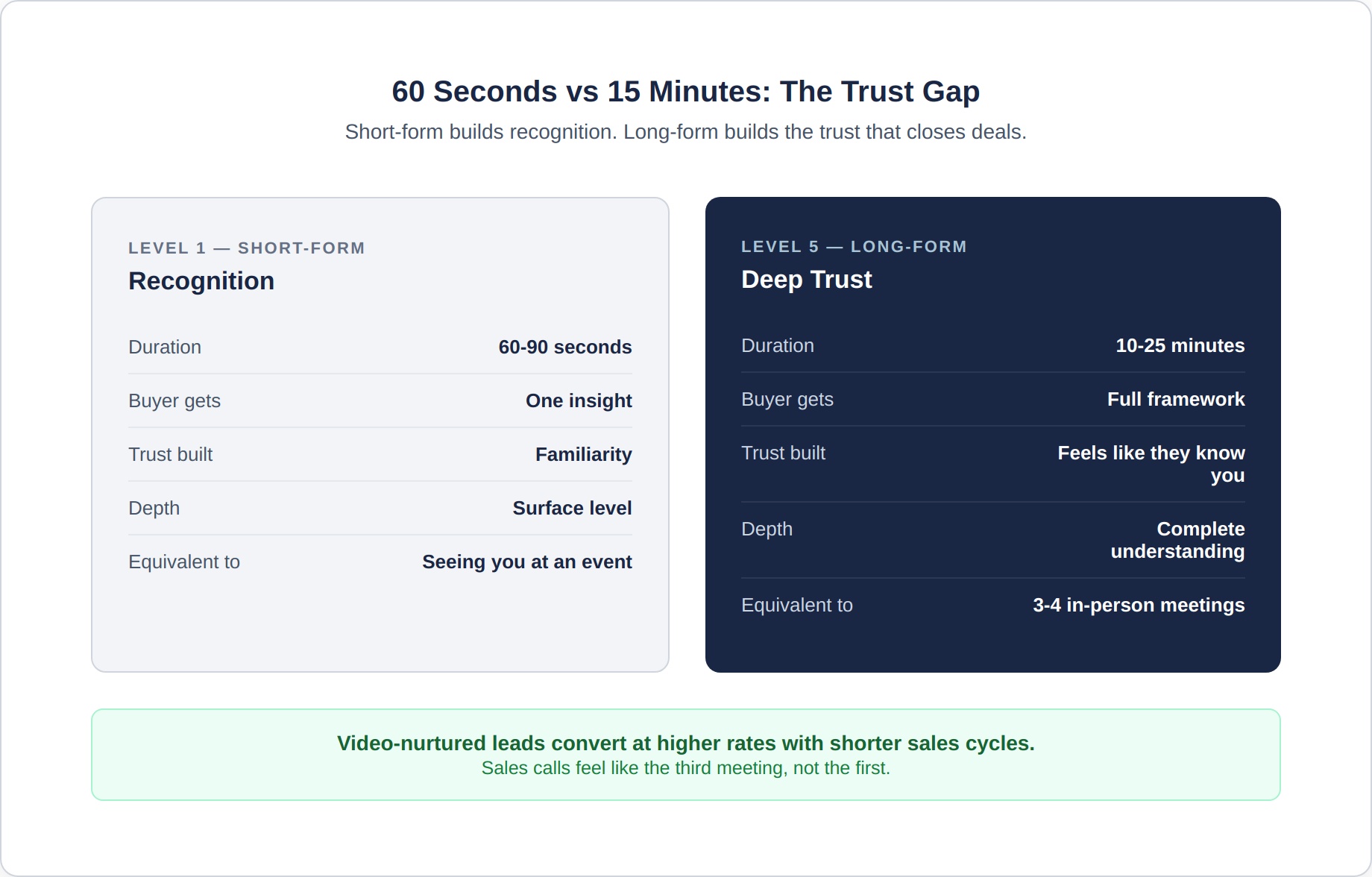
When a buyer watches you explain a complex topic for 15 minutes, they’re not just absorbing information. They’re assessing your thinking. They’re evaluating how you communicate. They’re deciding whether you’re someone they’d want to work with. They’re building the kind of familiarity that typically requires 3-4 in-person meetings to develop.
Long-form video leads to shorter sales cycles and higher close rates. Buyers already know you from your videos. Calls skip introductions and go straight to working together.
Level 0 built your website. Level 1 created daily visibility. Level 2 built conversion infrastructure. Level 3 built and owned an audience. Level 4 built a searchable content library. Now Level 5 adds the format that builds the deepest trust and creates a video library that compounds on YouTube, the second-largest search engine in the world.
Level 1 includes 3 short-form videos per week. Those videos are 60-90 seconds long and are designed to capture attention, build recognition, and keep your name in the feed. They work. They’re essential. But they’re appetizers.
Long-form video is the full course.
Here’s what happens when a buyer watches a 15-minute video versus a 60-second clip:
In 60 seconds, buyers get one insight and a sense of who you are. In 15 minutes, they grasp your entire framework, see your reasoning, and understand your perspective. They trust you because they watched you show competence for 15 minutes.
No other format builds this depth of trust. Articles build authority but lack a personal connection. Short videos build familiarity but lack depth. Podcasts build intimacy but lack visual impact. Long-form video combines all three: depth, personal connection, and visual proof.
Why YouTube Specifically
YouTube is not just a video platform. It is the second largest search engine in the world and the only video platform where content compounds over time.
YouTube videos rank in Google search results. When a buyer searches “how to build a lead generation system” on Google, YouTube videos appear alongside written articles. Your Level 4 article and your Level 5 video can both rank on page 1 for the same query, doubling your visibility.
YouTube videos compound like articles. A video published today continues to generate views for years. Unlike social media, where a post disappears from the feed within 48 hours, YouTube’s algorithm continues recommending videos that demonstrate strong engagement. A well-optimized video published in month 1 often generates more views in month 12 than it did in month 1 because YouTube has more data about who watches it and when to recommend it.
YouTube builds subscriber audiences you partially own. While YouTube is a platform, you don’t fully control the way you control your email list; YouTube subscribers receive notifications when you publish new content, and your videos appear in their subscription feeds. This creates a recurring audience that grows with each video.
YouTube videos can be embedded across your website, articles, newsletters, and landing pages. The video lives on YouTube, but serves your entire ecosystem.
YouTube descriptions link to your site from a Google-owned domain. This creates consistent, high-authority backlinks that boost your site’s authority and article rankings.
AI platforms increasingly cite video content. As AI answer engines evolve, they’re increasingly referencing and summarizing video content alongside written content. Having both a comprehensive article and a comprehensive video on the same topic maximizes your chances of being cited, regardless of how the AI constructs its answer.
What You Get
Video Strategy Built on Proven Data
Level 5 chooses topics based on data from previous levels—never guessing what video to produce.
- Level 1 social media data showing which short-form videos generated the most engagement, watch time, and profile visits, indicating topics that deserve deeper treatment.
- Level 3 newsletter data showing which topics produced the highest click rates and reply rates, confirming what the audience actively wants to learn about
- Level 4 article data showing which written content generates the most traffic, time on page, and conversions, identifying topics proven to attract and hold buyer attention
- Sales conversation intelligence reveals the questions, objections, and concerns that take the longest to address on calls, which are the exact topics that benefit most from video explanation.
- YouTube keyword research identifying search queries with video intent that your audience is actively searching for on YouTube
- Competitor video audit assessing what competitors have published, what’s performing, and where gaps exist for better, more comprehensive video content.
Every video has a strategic purpose. It addresses a proven topic. It fills a gap in the competitive landscape. It targets a YouTube search query. And it serves a specific role in the buyer’s journey from awareness to decision.
Monthly Video Production
Each month includes:
| Range | Videos Per Month | Best For |
|---|---|---|
| Lower ($3,000-$3,800/mo) | 2 long-form videos | Companies building initial YouTube presence |
| Mid ($3,800-$4,800/mo) | 3-4 long-form videos | Companies building momentum with weekly or bi-weekly publishing |
| Upper ($4,800-$6,000/mo) | 4-6 long-form videos | Companies pursuing aggressive YouTube growth with weekly publishing |
Each video includes:
- 10-25 minutes of finished content covering the topic comprehensively enough that a viewer walks away with a complete understanding
- Full scripting and structure so every minute of the video is planned for maximum impact and engagement.
- We professionally edit each video with cuts, graphics, b-roll, text overlays, and branding.
- We design custom thumbnails because they drive clicks—auto-generated ones hurt results.
- YouTube SEO optimization, including title, description, tags, chapters, cards, and end screens
- Captions and subtitles for accessibility and engagement
- We publish a full transcript on your site alongside the video, adding SEO value with additional text.
- We extract clips for social content and audio for podcast distribution from each video.
Video Types We Produce
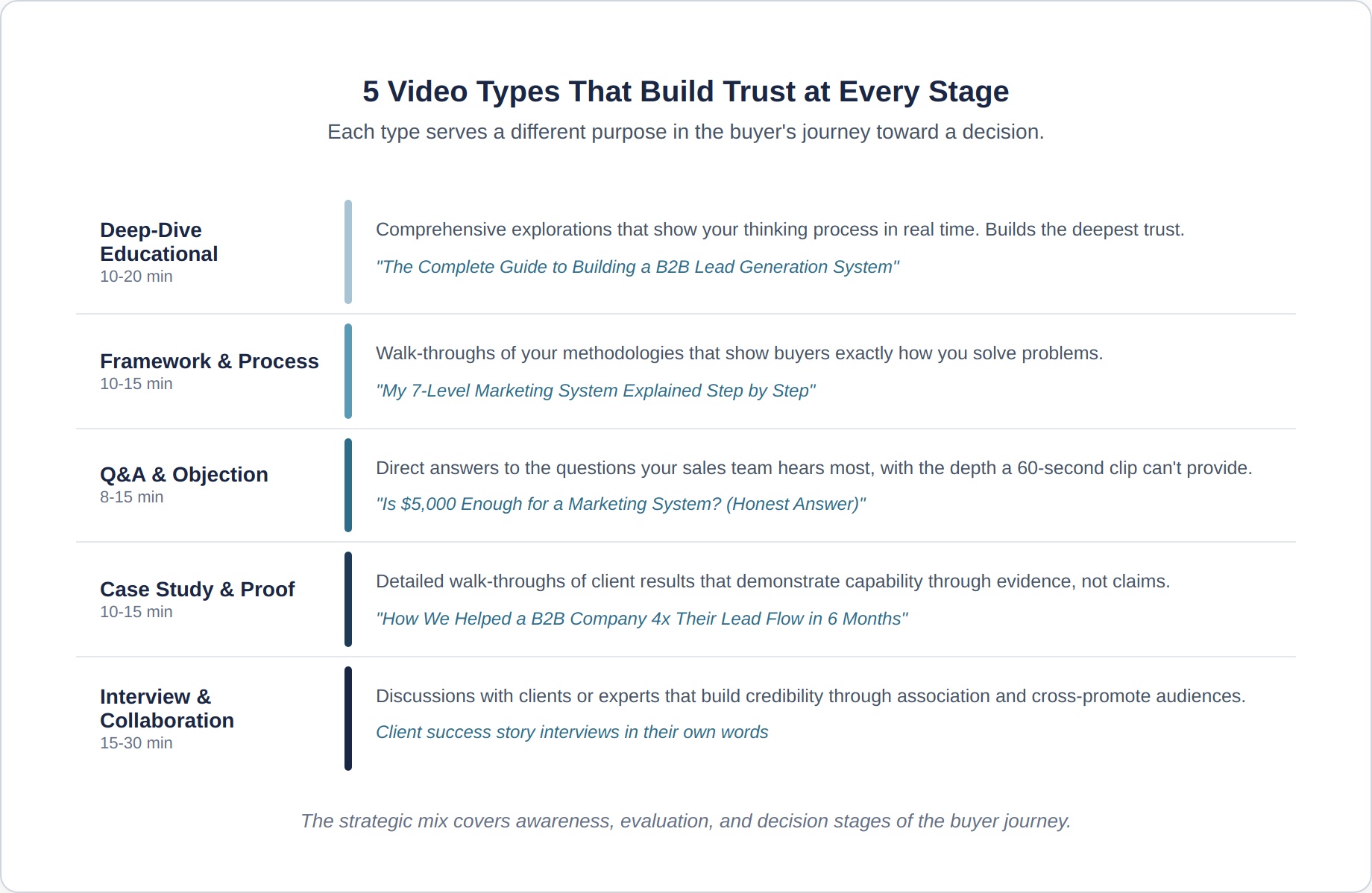
Different videos serve different stages of the buyer journey. Level 5 includes a strategic mix:
**Deep-Dive Educational Videos (10-20 minutes)**Comprehensive explorations of specific topics that demonstrate your expertise and methodology. These are the videos that build the deepest trust because they show your thinking process in real time.
- “The Complete Guide to Building a B2B Lead Generation System”
- “How to Evaluate Whether Your Marketing Is Helping or Hurting Sales”
- “What to Look for When Hiring a Marketing Partner (And What to Avoid)”
**Framework and Process Videos (10-15 minutes)**Walk-throughs of your specific frameworks, methodologies, and processes that show buyers exactly how you think about and solve problems.
- “My 7-Level Marketing System Explained Step by Step.”
- “The Exact Process We Use to Build Landing Pages That Convert at 10%+”
- “How We Audit a B2B Website in 30 Minutes”
**Q&A and Objection Videos (8-15 minutes)**Direct answers to the questions and concerns your sales team hears most frequently, filmed with the depth and nuance that a 60-second social clip can’t provide.
- “Is $5,000 Enough for a Marketing System? (Honest Answer)”
- “Why Most B2B Companies Fail at Content Marketing (And How to Avoid It)”
- “What Happens in the First 90 Days of Working With Us”
**Case Study and Proof Videos (10-15 minutes)**Detailed walk-throughs of client results, project breakdowns, and real examples that demonstrate your capability through evidence rather than claims.
- “How We Helped a B2B Services Company 4x Their Lead Flow in 6 Months.”
- “The Website Rebuild That Turned a 1% Conversion Rate Into 8%.”
- “What a Full Conversion Ecosystem Looks Like After 12 Months”
**Interview and Collaboration Videos (15-30 minutes)**Discussions with clients, industry experts, or partners that provide diverse perspectives and build credibility through association.
- Client success story interviews, where they describe the experience in their own words
- Industry expert perspectives on trends affecting your market
- Behind-the-scenes conversations about methodology and approach
Strategic value of guest and collaboration videos:
- Guest videos introduce your channel to the guest’s audience, accelerating subscriber growth through cross-promotion
- Client interview videos serve as compelling video case studies, surpassing written testimonials because buyers can see the client’s genuine enthusiasm and hear their story firsthand.
- Industry expert interviews build credibility through association and demonstrate that respected voices in your market endorse spending time with you on camera.
- We identify and invite guests, brief them on the format, and handle all production to ensure a seamless experience for both parties.
Scripting and Pre-Production
Every video begins with strategic scripting that ensures your time on camera produces the strongest possible result.
For each video, we provide:
- Complete script or detailed outline, depending on your comfort level and the video type. Some formats work best with full scripts. Others work best with structured talking points that allow natural delivery.
- Hook writing because the first 30 seconds determine whether someone watches or clicks away. Long-form video hooks are different from short-form hooks. They need to establish the topic, promise a clear payoff, and give the viewer a reason to invest the next 10-20 minutes.
- Chapter structure that breaks the video into clear sections, improving watch time because viewers can see the roadmap of what’s coming and stay engaged, knowing each section progresses toward the payoff
- Engagement markers at strategic points (roughly every 3-4 minutes) that re-hook the viewer’s attention, preview what’s coming next, or introduce a new angle that prevents drop-off.
- CTA scripting that naturally directs viewers toward the next step (website, landing page, another video, subscription) without feeling forced or salesy
- B-roll and visual notes indicating where screen recordings, diagrams, examples, or other visual elements should be inserted during editing to maintain visual engagement throughout
Filming Support
You do the filming. We make it as easy and efficient as possible.
- Batch filming guidance so you record 2-4 videos in a single session rather than filming every week. Most clients batch-film monthly during a 2- to 3-hour session.
- Set up recommendations for lighting, camera positioning, audio, and background that produce professional results without requiring a studio. A quiet room, decent lighting, and a modern smartphone or webcam produce content that looks better than 90% of what’s on YouTube.
- Delivery coaching, including pacing, energy, eye contact with the camera, and techniques for sounding natural when reading from a script or teleprompter
- Remote filming direction available for clients who want real-time guidance during filming sessions through video call
Equipment requirements: A smartphone with a good camera or a webcam, a decent microphone (we recommend specific models during onboarding), and reasonable lighting. Professional studio equipment is not required. Authenticity and content quality matter more than production value in B2B video.
Professional Post-Production
Raw footage becomes polished, platform-optimized content:
- Comprehensive editing, including cuts, pacing adjustments, removal of pauses and filler, and restructuring when needed to improve flow
- Motion graphics and text overlays that reinforce key points, display data, and maintain visual interest throughout longer videos.
- B-roll integration, including screen recordings, diagrams, article screenshots, and relevant imagery that breaks up talking-head footage
- Branded intro and outro that reinforce your visual identity and direct viewers to the next step
- Chapter markers inserted at section breaks for easy navigation
- Captions and subtitles are burned in or as closed captions for accessibility and for viewers watching without sound.
- Audio optimization, including noise reduction, level balancing, and compression, so the video sounds professional regardless of the recording environment
- Thumbnail design for each video using proven click-through design principles: clear text overlay, expressive facial expression, high contrast, and a visual that communicates the video’s topic at a glance
- Multiple aspect ratio exports when videos are repurposed for different platforms
YouTube SEO Optimization
Every video is optimized so YouTube’s algorithm can find, categorize, and recommend it to the right viewers:
- Keyword-targeted titles that balance search optimization with click-through appeal
- Comprehensive descriptions (300-500 words) that include target keywords, chapter timestamps, links to relevant resources, and a clear CTA
- Tags and hashtags targeting primary and secondary keywords
- Chapter timestamps that allow viewers to navigate directly to sections they care about and that appear in YouTube and Google search results
- Cards and end screens that direct viewers to related videos, playlists, and external links (your website, landing pages, newsletter sign-up)
- Community tab strategy using YouTube’s community features to promote new videos, poll the audience on future topics, share behind-the-scenes updates, and drive discussion. Community tab engagement builds subscriber loyalty and gives viewers a sense of ownership over the channel’s direction by voting on which topics to cover next.
- YouTube Shorts strategy publishing native short-form content directly to YouTube’s Shorts feed, which operates on a separate algorithm from long-form content and reaches viewers who may never discover your full videos through search or recommendations. Shorts serve as a gateway: viewers who discover you through a Short and subscribe then receive notifications for your full-length videos.
Playlist Strategy for Binge-Watching
Playlists are one of YouTube’s most underused features and one of the most powerful for building deep trust:
- Playlists create auto-play sessions where YouTube plays your next video immediately after the current one ends. A buyer who clicks on one video and gets auto-played into a second, then a third, has now spent 30-45 minutes with you in a single sitting. That is the equivalent of a long first meeting.
- Playlists organized by buyer journey guide viewers through a trust-building sequence: awareness videos first, evaluation videos second, decision videos third. A buyer who watches the playlist in order arrives at the end having been taken through the same progression as your sales process.
- Topic-based playlists group related videos so a buyer interested in one aspect of your expertise can watch everything you’ve produced on that topic in sequence.
- Playlist watch time contributes to channel authority, which helps all your videos rank better, not just the ones in the playlist. More total watch time signals to YouTube that your channel produces content worth recommending.
We design playlist architecture during onboarding and update it as the library grows. Every new video is added to the appropriate playlists, keeping the binge-watching infrastructure up to date.
Content Repurposing: 8-10+ Assets From Every Video
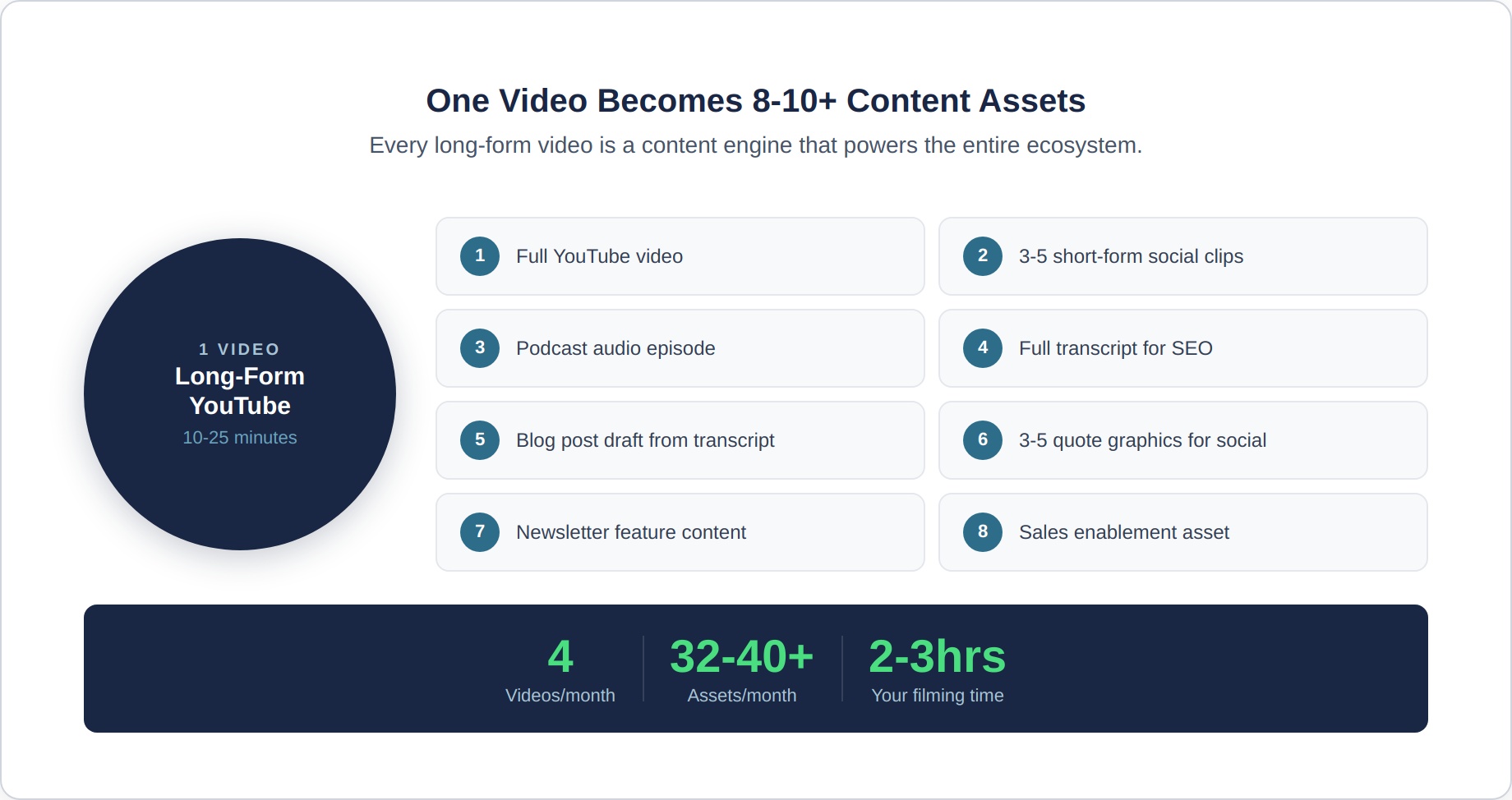
Every long-form video is not one piece of content. It is a content engine that produces 8-10+ assets across the ecosystem:
1. The full YouTube video (the primary asset)
2. 3-5 short-form clips extracted and independently edited for Level 1 social platforms (LinkedIn, Instagram Reels, TikTok, YouTube Shorts), each with its own hook, pacing, captions, and CTA optimized for the short-form platform. Clips drive traffic back to the full video, creating a funnel where short-form captures attention, and long-form builds trust.
3. Audio podcast episode extracted from the video and distributed on Spotify, Apple Podcasts, and other audio platforms. This reaches buyers who consume content during commutes, workouts, or time away from screens. The audio is cleaned, levels are balanced, and a podcast-specific intro/outro is added. Podcast distribution is included at the mid and upper price ranges or available as an add-on at the lower range.
4. Full transcript published on your website alongside the embedded video, creating 2,000-4,000 words of additional indexable text content that strengthens the page’s SEO and provides an alternative format for readers who prefer text.
5. Blog post draft where the transcript serves as the foundation for a Level 4 written article on the same topic. The video research, structure, and insights are already done. The article requires adaptation to a written format rather than creation from scratch, significantly reducing Level 4 production time for topics that have video counterparts.
6. 3-5 quote graphics featuring key insights from the video, designed for Level 1 social posts with branded visual treatment.
7. Newsletter feature where the video or a key insight from it becomes the centrepiece of a Level 3 newsletter with a compelling reason to watch.
8. Sales enablement asset where specific videos are tagged for the sales team to send during follow-up sequences. When a prospect raises a specific objection, the rep can share a video that addresses that exact concern in depth.
This means a month of 4 long-form videos produces 32-40+ individual content assets across the ecosystem. The production investment per asset drops dramatically when you account for the full repurposing chain.
How to Handle Videos That Underperform
Not every video will be a hit. Some topics that performed well in written format don’t translate to video. Some videos have strong content but weak thumbnails. The 80/20 principle from Level 1 applies to long-form video as well.
How we handle underperformance:
- Every video is analyzed within 14 days of publication for view count, click-through rate, audience retention, and engagement relative to channel averages.
- Underperforming videos are diagnosed to identify the cause: was it the topic (low search demand), the thumbnail (low click-through), the hook (high early drop-off), or the content structure (declining retention curve)?
- Fixable elements get fixed. Thumbnails can be replaced. Titles can be rewritten. Descriptions can be reoptimized. YouTube allows these changes after publication and often rewards them with renewed distribution.
- Content lessons feed future production. If a particular video format consistently produces lower retention, we shift production away from it. If certain hooks hold attention longer, we adopt that pattern across future scripts.
- The 80/20 audit, conducted quarterly, identifies the top 20% of videos that account for 80% of views, watch time, and subscriber growth. Future production doubles down on the formats, topics, and structures that those top performers share.
Understanding Audience Retention Curves
The monthly report includes audience retention data for every video. Here’s why this matters and what it tells us:
- Audience retention curves show exactly where viewers stop watching. A video where 80% of viewers watch to the 5-minute mark but only 30% reach minute 10 tells us the second half needs restructuring.
- Hook effectiveness shows in the first 30 seconds. A sharp drop in the first 30 seconds means the hook isn’t working. A gradual decline is normal. A cliff is actionable.
- Retention spikes reveal high-interest moments. When the curve shows viewers re-watching a specific section, that topic deserves its own dedicated video.
- Retention dips reveal low-interest sections. When viewers consistently skip a section, future videos either restructure or remove that type of content.
- This data directly improves every future video because we learn which structures, pacing styles, and content types hold attention. By month 6, your videos are built on 6 months of retention data, not intuition.
Comment Management and Handling Criticism
Putting yourself on camera for 15-20 minutes creates deeper exposure than short-form clips. We address this proactively:
- YouTube comments are monitored daily as part of the Level 5 engagement. Genuine questions are flagged for response. Spam and irrelevant comments are removed.
- You respond to substantive comments because viewers who take the time to comment are highly engaged and often become your strongest advocates. A thoughtful reply from you strengthens the relationship and signals to YouTube that the video generates meaningful discussion.
- Disagreement is welcomed, not feared. Comments that challenge your perspective create engagement that YouTube’s algorithm rewards. A respectful back-and-forth in the comments often builds more credibility than the video itself because viewers see you handling pushback with confidence.
- Trolls and bad-faith comments are managed without escalation. Some comments deserve responses. Others deserve to be ignored or removed. We know the difference.
- Controversial or strong-opinion content performs best. Videos where you take a clear position generate more engagement than safe, generic content. The risk of disagreement is far outweighed by the reward of being remembered. The strongest B2B YouTube channels are built on perspectives that not everyone agrees with, but everyone respects.
Video Accessibility
Beyond captions and subtitles, Level 5 includes accessibility considerations:
- Closed captions on every video for hearing-impaired viewers and for anyone watching in a quiet environment
- Full transcripts are published on your website alongside embedded videos, providing an alternative format for viewers who prefer reading or who use screen readers.
- Clear visual presentation with text overlays large enough to read on mobile and diagrams designed for clarity rather than complexity
- Descriptive verbal context is scripted into the videos so that audio-only listeners (podcast format) can follow along without the visual elements.
What the Viewer Actually Experiences
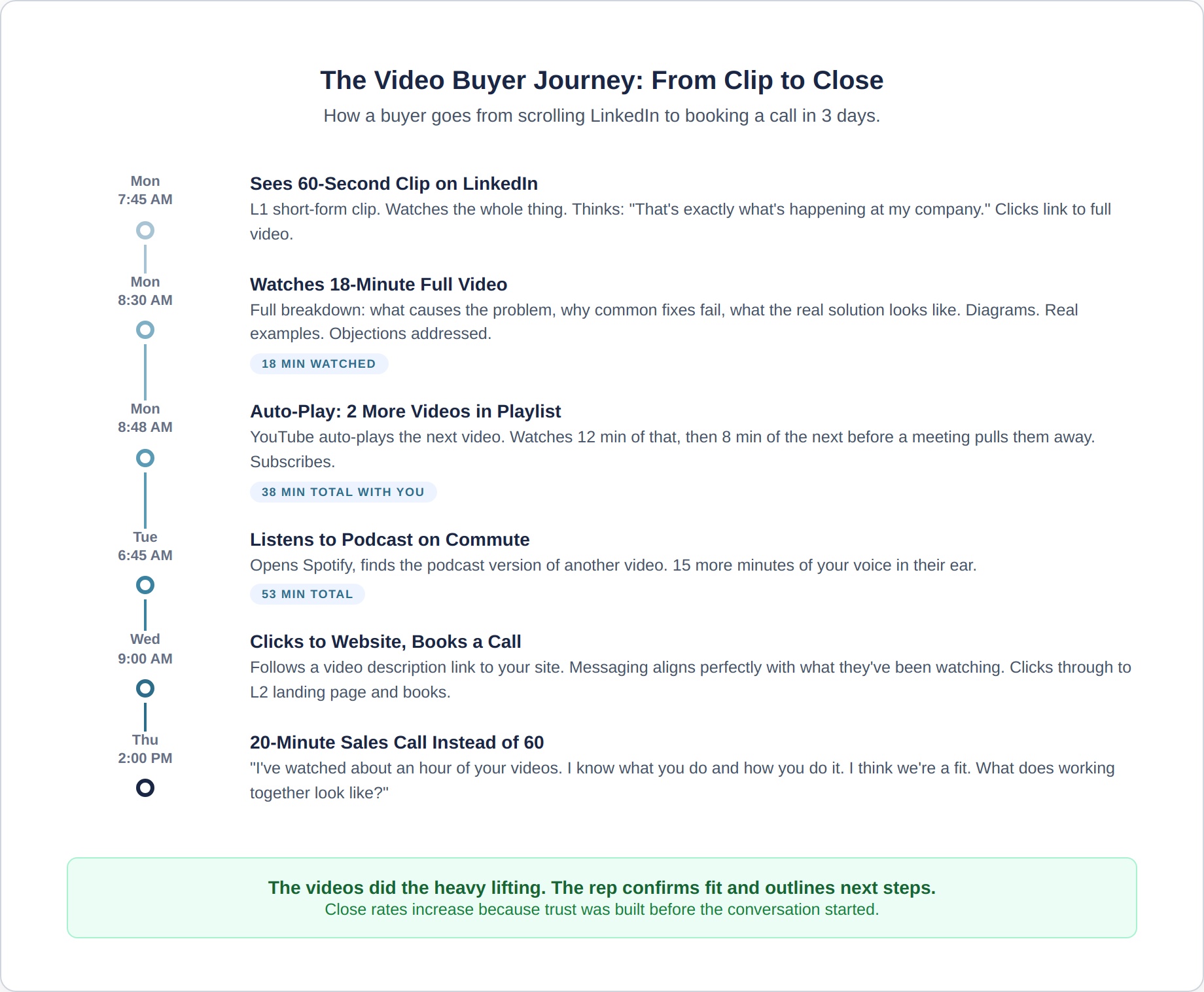
Here’s what a buyer’s video journey looks like when Level 5 is working.
Monday, 7:45 AM: The buyer scrolls LinkedIn and sees a 60-second Level 1 clip of you explaining why most B2B companies waste money on marketing that doesn’t convert. They watch the whole thing. They think: “That’s exactly what’s happening at my company.” In the comments, there’s a link: “Full 18-minute breakdown on YouTube.”
Monday, 8:30 AM: At their desk with coffee, they click through and watch the full video. For 18 minutes, you walk through the problem in depth: what causes it, why common fixes don’t work, what the real solution looks like, and what the first 90 days of fixing it involve. You show diagrams. You reference real examples. You address the objections they’re carrying.
Monday, 8:48 AM: The video ends. YouTube auto-plays the next video in the playlist: “How We Audit a B2B Website in 30 Minutes.” They watch 12 minutes of that one. Then the next video starts: “The Exact Process We Use to Build Landing Pages That Convert.” They watch 8 minutes before a meeting, which pulls them away.
Monday, 9:30 AM: They’ve now spent 38 minutes with you across three videos. They feel like they’ve had a full consultation. They subscribe to the channel so they don’t lose it.
Tuesday, 6:45 AM: On their commute, they open Spotify and listen to the podcast version of a video they haven’t watched yet. Another 15 minutes of your voice in their ear.
Wednesday, 9:00 AM: They click the link in a video description to your website. They browse your Level 0 site. The messaging aligns perfectly with what they’ve been watching. They click through to a Level 2 landing page and book a call.
Thursday, 2:00 PM: Your sales rep gets on the call. The buyer says, “I’ve watched about an hour of your videos. I basically know what you do and how you do it. I think we’re a fit. What does working together look like?”
That call takes 20 minutes instead of 60. The buyer doesn’t ask basic questions. They don’t need convincing. The videos did all the heavy lifting. The rep’s job is simply to confirm the fit and outline the next steps.
That is what Level 5 produces. Sales calls that feel like the third meeting, not the first. Buyers who arrive educated, confident, and ready to make a decision. Close rates increase because trust was built before the conversation started.
How Level 5 Connects to the Ecosystem
Long-form video amplifies and is amplified by every other level:
- From Level 1: Short-form social videos identify which topics resonate, informing long-form topic selection. Long-form videos produce 3-5 clips that feed back into Level 1’s daily posting cadence. YouTube Shorts, published natively, drive subscribers who discover long-form content.
- From Level 2: Landing pages with embedded video convert at higher rates. Video CTAs drive viewers to Level 2 conversion points. Video testimonials and case studies become landing page trust elements. Sales teams share specific videos during follow-up sequences.
- From Level 3: Newsletter engagement data reveals which topics deserve video treatment. Videos featured in newsletters deepen subscriber engagement and drive YouTube views.
- From Level 4: Top-performing articles become video scripts. Articles with embedded video show improved engagement metrics and search rankings. Video transcripts become blog post drafts. Video and written content targeting the same keyword can both rank on page 1 of Google.
- Feeds Level 6: Video content with proven engagement provides tested creative for paid promotion. High-performing videos can be amplified through paid distribution for accelerated reach.
- Feeds Level 7: Video content referenced in AI outreach sequences increases response rates because the prospect can see and hear you before deciding whether to engage.
How Videos Build Domain Authority and SEO
Long-form video strengthens your website’s search performance in ways beyond the videos themselves:
- YouTube description backlinks create consistent, high-authority links from a Google-owned domain to your website, strengthening your domain authority over time.
- Embedded videos improve page engagement metrics, including time on page, reduced bounce rate, and scroll depth, all of which are positive signals for search rankings.
- Video transcripts published alongside embedded videos add 2,000-4,000 words of indexable text content per video, strengthening the page’s keyword coverage.
- Other sites embed or reference your YouTube videos when citing your expertise, creating additional backlinks you didn’t actively pursue
- Videos that rank in Google search results drive traffic to both YouTube and your website simultaneously, creating dual traffic streams from a single piece of content.
What Determines Where You Fall in the Price Range
Level 5 – Long-Form Video & Authority Content
Authority-building video content that builds trust faster, shortens sales cycles, and turns attention into conversion-ready buyers.
| Scope Factor | Lower ($2,000–$2,500/mo) | Mid ($2,500–$3,400/mo) | Upper ($4,000–$6,000/mo) |
|---|---|---|---|
| Long-Form Videos Per Month | 2 videos | 3–4 videos | 5–8 videos |
| Video Length | 5–10 minutes | 8–15 minutes | 10–25+ minutes |
| Script Strategy | Basic educational scripts | Structured authority and conversion scripts | Full funnel scripts (awareness → trust → conversion) |
| Content Types | Educational videos | Educational + case-style + breakdown videos | Educational + case studies + VSL-style + authority content |
| On-Camera Guidance | Not included | Basic delivery guidance | Full performance coaching and positioning |
| Editing & Production | Basic editing | Enhanced editing with branding | Full production with advanced visuals and structure |
| Distribution Support | YouTube upload only | YouTube + basic repurposing | Full distribution strategy across platforms |
| Level 4 Integration | Standalone videos | Videos aligned with article topics | Full integration with SEO and content ecosystem |
| Conversion Strategy | Light CTA | Structured CTAs with lead magnets | Full conversion integration with landing pages and offers |
| Performance Tracking | Views and watch time | Engagement and retention metrics | Full tracking tied to leads, pipeline, and revenue |
How Long Before You See Results
Month 1: First videos are published. YouTube begins indexing and categorizing the content. Initial views primarily come from cross-promotion via Level 1 social clips, Level 3 newsletter features, and website embedding. YouTube’s algorithm is learning about your channel. Podcast distribution begins building a secondary audience.
Months 2-3: YouTube begins recommending your videos to viewers watching similar content. Views on individual videos grow as the algorithm identifies your audience. Early videos may start ranking for YouTube search queries. Website traffic from YouTube becomes measurable. Playlist binge-watching sessions are beginning to appear in analytics. Underperforming videos are diagnosed and optimized.
Months 4-6: Channel authority builds. New videos perform faster because the channel has established credibility. Subscriber count grows consistently. YouTube recommends older videos alongside new ones, creating a compounding effect. Some videos begin ranking in Google search results alongside your Level 4 articles. The 80/20 audit identifies top-performing formats and topics.
Months 7-12: The video library is a significant asset. Multiple videos rank on YouTube and Google search. Subscribers receive notifications for new content. Older videos continue to generate views and grow through recommendations. The sales team regularly reports that prospects reference videos before calls. Podcast audience grows alongside YouTube. Guest collaboration videos expand reach.
Month 12+: The YouTube channel is a predictable source of inbound leads. The video library works continuously, building trust with new viewers while deepening relationships with existing subscribers. Each new video benefits from the channel authority built up by previous videos. The compound effect is fully active. Playlist architecture guides new viewers through trust-building sequences that end in conversion.
Why This Investment Makes Sense
Consider the trust differential between a buyer who has watched 30 minutes of your video content and a buyer who has only seen your website.
The buyer who watched your videos feels like they know you. They’ve seen your face, heard your voice, observed your thinking process, and assessed your expertise through extended exposure. When they get on a sales call, they’re already leaning toward yes.
The buyer who only visited your website has a lower trust baseline. They’ve read text and seen images, but they haven’t experienced you as a person. The sales call has to build the familiarity and trust that the video would have already established.
The result: video-nurtured leads convert at higher rates with shorter sales cycles. One additional closed deal per quarter, driven by improved trust and shorter cycles, easily justifies the Level 5 investment. For most B2B companies with deal sizes above $10,000, the math works within the first 90 days.
Additionally, YouTube content compounds in the same way as Level 4 articles compound. A video produced in month 1 continues generating views, subscribers, and website traffic indefinitely. The per-view cost decreases every month as the library grows. After 12 months, you own a video asset that generates inbound interest at a fraction of the cost of any paid channel. The podcast distribution doubles the reach at minimal incremental cost.
What This Level Solves
Level 5 solves the problem of trust depth. Written content builds credibility. Short-form video builds recognition. But the deepest trust, the kind that makes buyers feel like they already know you, requires extended face-to-face exposure that only long-form video provides. Level 5 creates that exposure at scale, building trust with hundreds or thousands of buyers simultaneously through content that works 24/7 on the second largest search engine in the world, across podcast platforms during commutes, and embedded throughout your website and marketing ecosystem.
What This Level Does NOT Include
- Website changes (Level 0 — though videos are embedded on your Level 0 website)
- Short-form social media content creation beyond clips extracted from long-form videos (Level 1)
- Landing page creation (Level 2 — though videos are embedded on Level 2 pages)
- Newsletter writing (Level 3 — though videos are featured in newsletters)
- Blog article writing (Level 4 — though video transcripts serve as article drafts and videos are embedded in articles)
- Paid advertising or video promotion (Level 6)
- AI outreach (Level 7)
- Video filming equipment (you use your own setup)
Level 5 builds the video library. The levels around it distribute, embed, and amplify the trust it creates.
What You Need to Provide
- Onboarding conversation (60-90 minutes): We align on your video strategy, topics, format preferences, filming setup, and playlist architecture
- Monthly filming session (2-3 hours): You batch-film 2-6 videos in one session using prepared scripts. We provide filming direction and coaching.
- Script review (15-20 minutes per video): Review each script before filming day so you’re comfortable with the material
- Subject-matter expertise: The insights, frameworks, and perspectives in the videos are drawn from your experience. We structure and script them. You deliver them on camera.
- Guest coordination (as needed): For collaboration videos, we identify and invite guests. You participate in the conversation. We handle production.
- Monthly report review (20-30 minutes): Review performance data, retention curves, and 80/20 analysis, and align on next month’s topics
- Quarterly strategy review (45-60 minutes): Deep review of video performance, audience analysis, playlist effectiveness, podcast metrics, and planning for the next quarter
Total monthly time commitment: approximately 4-6 hours, with the majority of that time spent on the filming session, which typically happens in one sitting per month.
Who Manages This
Rod Agatep personally directs the video strategy, topic selection, scripting approach, playlist architecture, and quality standard for every Level 5 engagement. With 27 years of experience in B2B marketing and a deep understanding of how video content builds trust and drives business results, Rod ensures every video serves a strategic purpose within the Conversion Ecosystem.
Video production is managed under Rod’s direct supervision, with every script, edit, thumbnail, and optimization decision aligned to the positioning and strategy established across all active levels. This is not a generic video production service. It is a strategic trust-building system designed to produce measurable business outcomes.
Level 5 Readiness Assessment
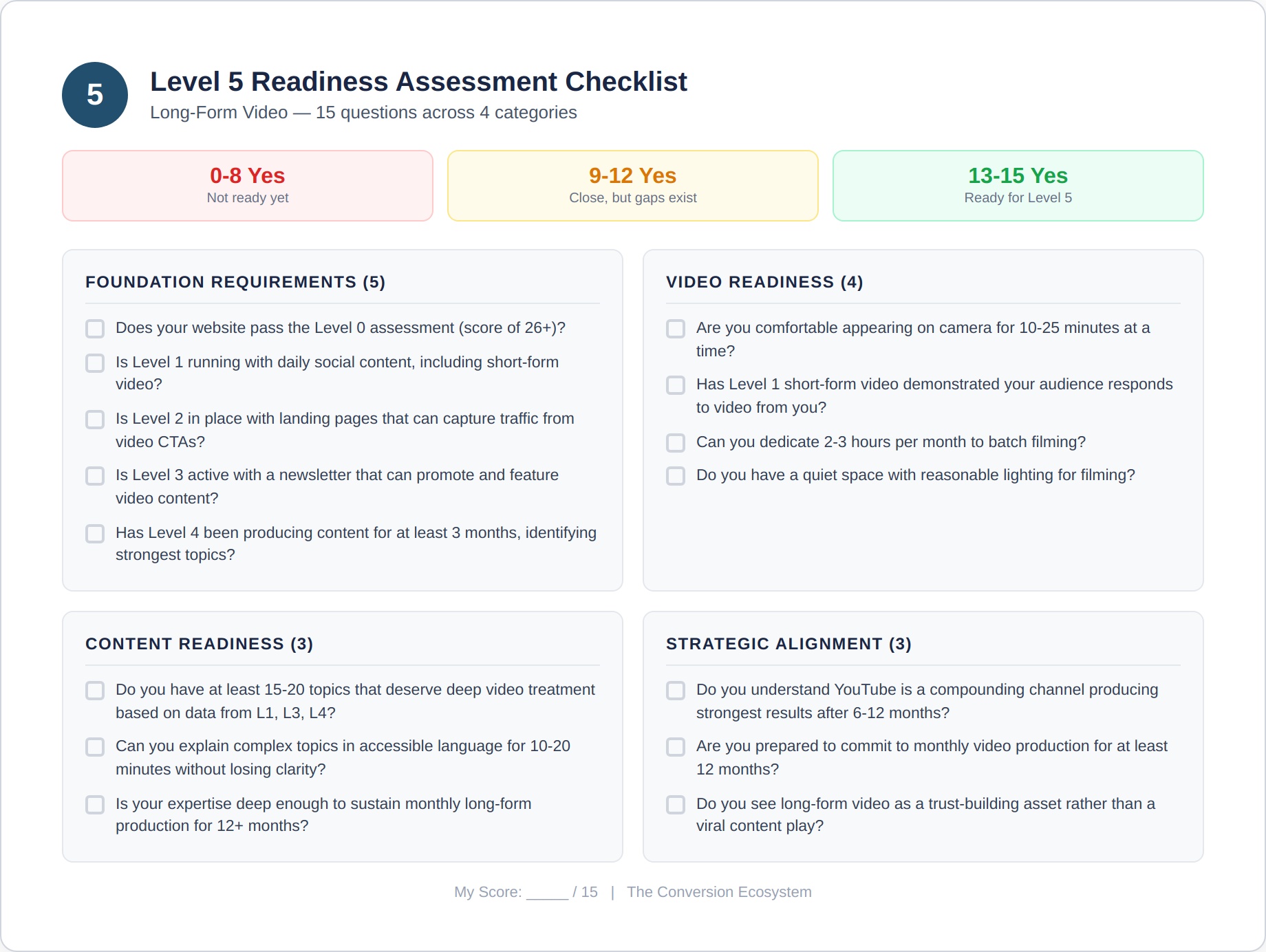
Scoring
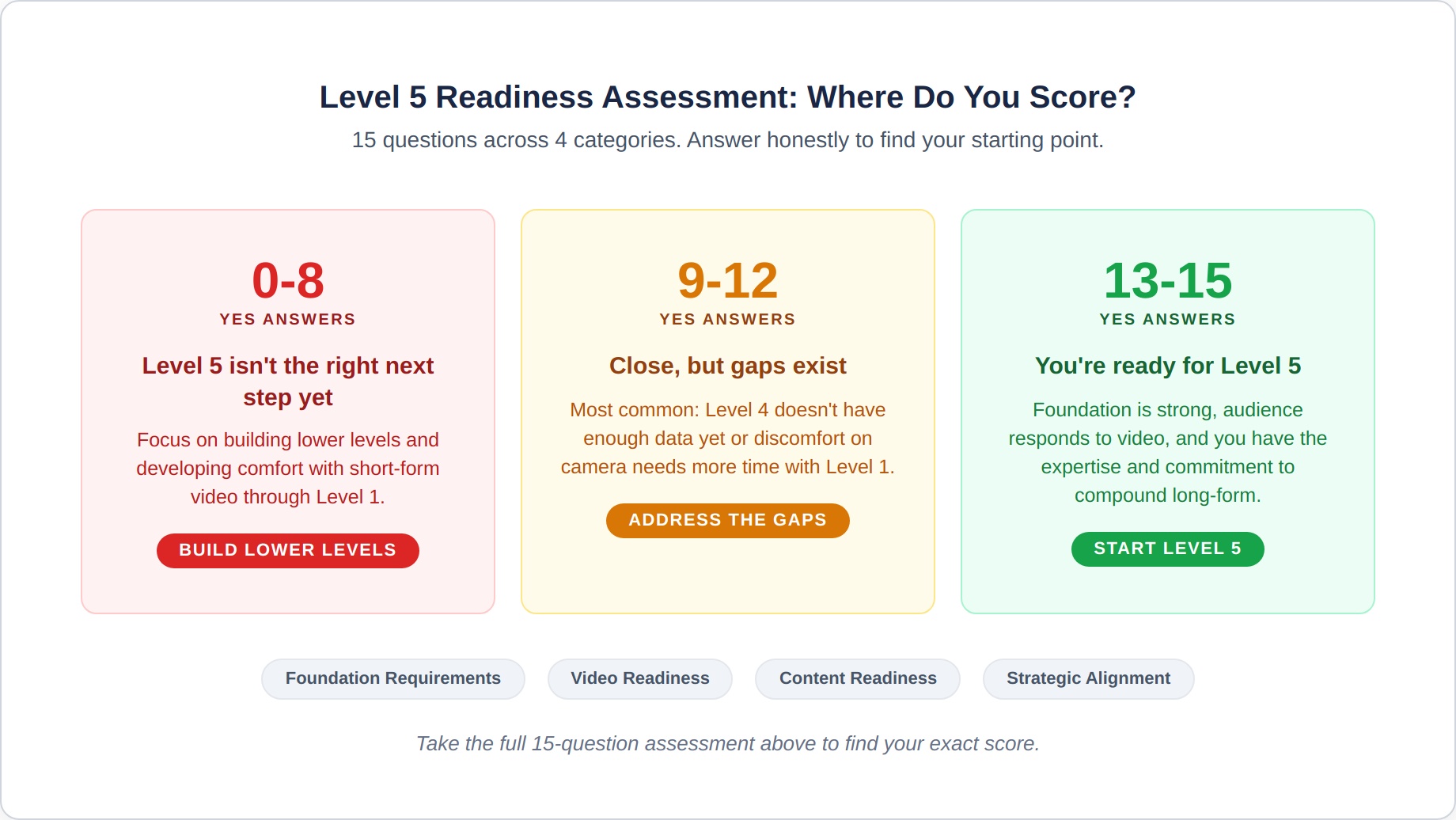
13-15 YES answers: You’re ready for Level 5. Your foundation is strong, your audience responds to video, and you have the expertise and commitment to compound your long-form video.
9-12 YES answers: Close, but gaps exist. The most common gaps are Level 4 not having enough data yet to inform video topic selection, or discomfort on camera that may need more time with Level 1 short-form video to develop. Address those first.
8 or fewer YES answers: Level 5 isn’t the right next step yet. Focus on building the lower levels and developing comfort with short-form video through Level 1 before investing in long-form production.
When to Move to Level 6
You’re ready for Level 6 (Paid Advertising) when:
- Levels 1-5 are active and producing consistent organic engagement, traffic, and leads.
- Your content library (written and video) has identified the messaging angles, topics, and offers that resonate most with your audience through organic testing.
- You have Level 2 landing pages with proven conversion rates that can absorb paid traffic profitably.
- You want to accelerate results beyond what organic channels alone can deliver.
- Your sales team can handle additional lead volume without quality degradation.
Level 5 builds trust through organic video. Level 6 amplifies the best-performing content across all levels through paid distribution. Together, they create a system where organic content proves what works and paid advertising scales it.
Pricing Summary
| Option | Investment |
|---|---|
| Level 5 monthly | $3,000 – $6,000/month |
| Level 5 annual commitment | 20% off monthly rate |
| Level 5 stacked with other levels | See Conversion Ecosystem pricing table |
What’s included: Video strategy, topic selection, full scripting, filming direction and coaching, professional editing with motion graphics, thumbnail design and optimization, YouTube SEO optimization, playlist architecture, YouTube Shorts and Community Tab strategy, comment monitoring, captions and transcripts, short-form clip extraction (3-5 per video), podcast audio extraction and distribution (mid and upper ranges), cross-platform embedding coordination, audience retention analysis, 80/20 performance auditing, guest collaboration coordination, monthly performance reporting, and quarterly strategy reviews.
What’s not included: Video filming equipment (you use your own setup), paid video promotion (Level 6), social media management beyond extracted clips (Level 1), landing page creation (Level 2), newsletter writing (Level 3), article writing (Level 4), or AI outreach (Level 7).
The Conversion Ecosystem Rule
Every level below your active level must be in place. Level 5 requires Level 0 (website to embed videos), Level 1 (social media to distribute clips and build initial video comfort), Level 2 (landing pages to capture video-driven traffic), Level 3 (newsletter to promote videos and deepen subscriber engagement), and Level 4 (content library that identifies proven topics and provides complementary written coverage). Long-form video without the lower levels creates content with no distribution system, no conversion infrastructure, and no data to inform topic selection.
Next Step
If you’re not sure whether Level 5 is the right next investment, whether your audience responds to video, or whether your lower levels are strong enough to support long-form production, the fastest way to find out is a conversation.
We’ll review your current video presence, assess your Level 1 short-form performance, evaluate your topic opportunities, and tell you honestly whether Level 5 will produce results now or whether other levels need more time to mature first.
No pitch. No pressure. Just clarity on where you stand and what to do next.
Frequently Asked Questions
How is this different from hiring a video production company?
Most video production companies focus on making things look cinematic. Level 5 focuses on making videos that build trust and produce business results. Every video is strategically planned around proven topics, optimized for YouTube search, structured for viewer retention, integrated into playlists designed for binge-watching, repurposed across 8-10+ content assets, and connected to your entire marketing ecosystem. A production company gives you a nice video. Level 5 gives you a trust-building system that compounds.
I’m not naturally good on camera. Is that a problem?
No. Most business leaders aren’t natural on-camera performers, and that’s fine. Authenticity outperforms polish in B2B video. Buyers want to see a real person thinking through real problems, not a polished presenter reading a teleprompter flawlessly. Scripts remove the anxiety of figuring out what to say. Editing removes the imperfections that make people self-conscious. Filming coaching improves your delivery with each session. Most clients feel comfortable by their second or third filming session.
Do I need professional studio equipment?
No. A modern smartphone or a decent webcam, a good USB microphone ($50-$150), and reasonable lighting (a window or a basic ring light) produce content that looks and sounds professional. We recommend specific equipment during onboarding based on your budget and setup. Many successful B2B YouTube channels were built with nothing more than an iPhone and a quiet room.
How long are the filming sessions?
Most clients batch-film all monthly videos in a single 2-3 hour session. This includes setup, filming, and brief breaks between videos. With prepared scripts and a consistent setup, most people can comfortably record 3-4 videos in a single session. Some clients prefer two shorter sessions per month. We accommodate whatever schedule works best.
Can I repurpose existing presentations or webinars as long-form videos?
Yes, with adaptation. Existing presentations and webinar recordings can be re-edited and optimized for YouTube with updated intros, improved pacing, chapter markers, and YouTube SEO. However, purpose-built videos typically outperform repurposed content because they’re structured specifically for the YouTube viewing experience rather than adapted from a different format.
How do long-form videos and Level 4 articles work together?
They cover the same topics in complementary formats. A Level 4 article targets buyers who prefer reading. A Level 5 video targets buyers who prefer watching. Both can rank on Google page 1 for the same query, doubling your visibility. Embedded videos improve article engagement metrics. Articles linked in video descriptions provide deeper resources for engaged viewers. Video transcripts become article drafts, reducing Level 4 production time. Together, they create comprehensive topic coverage that search engines, AI platforms, and buyers all reward.
Is podcast distribution included?
Audio extraction and basic podcast distribution on Spotify, Apple Podcasts, and other major platforms is included at the mid and upper price ranges. At the lower range, it’s available as an add-on. The audio is cleaned, levels are balanced, and a podcast-specific intro/outro is added. This extends your reach to buyers who consume content during commutes, workouts, or time away from screens at minimal incremental cost.
Will YouTube change its algorithm, hurting my videos?
YouTube’s algorithm changes, but the fundamentals it rewards have been consistent: viewer retention, engagement, and content that satisfies the viewer’s intent. Videos that genuinely help viewers perform well through algorithm changes because the algorithm is designed to surface content viewers find valuable. Clickbait and manipulation get penalized. Genuine expertise gets rewarded. Level 5 content is built on the principles that survive algorithm changes.
What happens to the YouTube channel if the engagement ends?
The YouTube channel is yours. It’s created under your account, managed through your login, and remains fully under your control. If the engagement ends, the channel continues functioning. All videos remain published. Subscribers continue receiving content if you publish independently. No channel ownership transfer is needed, since it was yours from the start. We provide a transition document covering ongoing maintenance, optimization practices, and recommendations for continuing independently.
What are the cancellation terms?
Month-to-month engagements can be cancelled with 30 days’ notice. Annual commitments receive the 20% discount in exchange for a 12-month term. Early termination of annual commitments is subject to a fee equal to the discount received on months already completed. You retain full ownership of all video content, scripts, thumbnails, podcast episodes, transcripts, and channel assets.
Do I own the videos?
Yes. Every video, every script, every thumbnail, every clip, every podcast episode, every transcript, and all edited content belongs to you. Videos remain on your YouTube channel, embedded across your website, and distributed on podcast platforms regardless of whether the engagement continues. There are no licensing restrictions, content removal clauses, or channel ownership disputes. The video library you build is yours permanently.