

Key Takeaways
-
- AI Conversion Tools turn your website and landing pages from passive form collectors into active sales assistants that qualify visitors, answer questions, book appointments, and personalize the experience in real time.
- AI chatbots handle the conversations your sales team can’t: the 11 PM visitor, the Saturday browser, the prospect who has three questions before they’ll fill out a form, and the buyer who wants to book a call right now without waiting for email.
- Interactive tools like ROI calculators, assessments, and quizzes create value exchanges that feel helpful rather than transactional, producing higher-quality leads as buyers self-qualify through the process.
- AI landing page personalization shows different content to different visitors based on their industry, company size, behaviour, or referral source, so every buyer sees a page that feels built specifically for them.
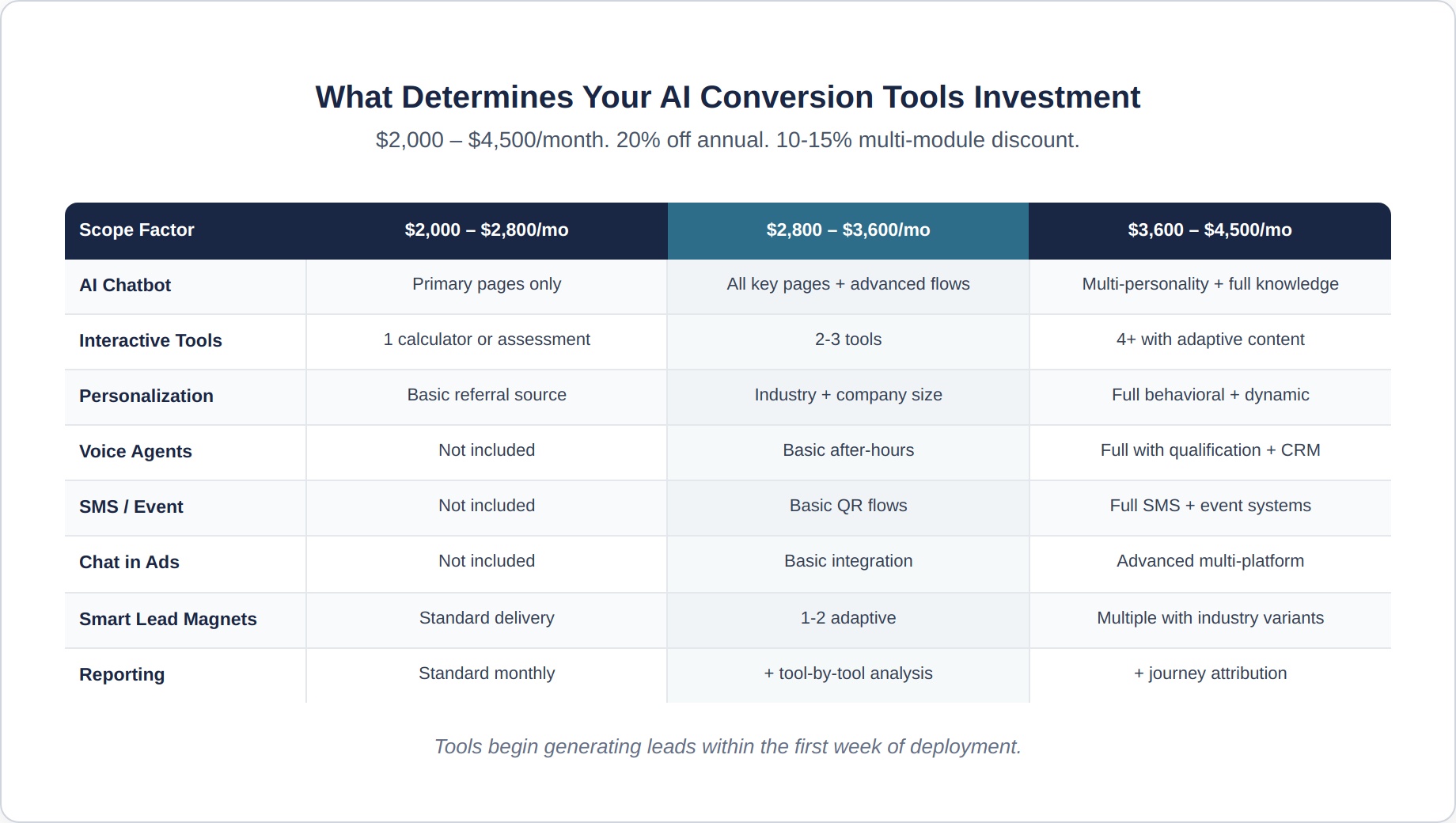
- The investment ranges from $2,000 to $4,500/month, depending on the number of tools deployed, the complexity of personalization, and the depth of integration with your ecosystem.
One Sentence Summary: AI Conversion Tools turn every digital touchpoint into an active qualification and conversion system that engages visitors in real time, personalizes the experience based on behaviour, and captures leads that passive forms would miss.
Investment Range: $2,000 – $4,500/month
Annual Commitment: 20% off the monthly rate
Multi-Module Discount: 10-15% off when combined with other active AI Growth Modules
Requires: Level 0 (Website Foundation) active. Recommended: Level 2 (Landing Pages and Automation) for full landing page integration.
Timeline to first results: AI chatbots and booking tools produce conversations within the first week of deployment. Interactive tools begin generating leads immediately upon launch. Landing page personalization reaches meaningful data-driven performance at 30-60 days.
What This Module Is
Your Level 0 website and Level 2 landing pages already convert visitors into leads. They work, but only passively. A visitor arrives, reads content, sees a form, then fills it out or leaves. The page doesn’t respond, adapt, or engage. It just waits.
AI Conversion Tools change that dynamic entirely.
Instead of a static page waiting for the visitor to decide, AI Conversion Tools create an active experience. The website engages visitors in conversation, answers specific questions, qualifies in real time, personalizes content based on who they are and what interests them, and captures leads through valuable, interactive exchanges.
The difference: a static page converts 5-10% of visitors. An AI-enhanced page that actively engages, qualifies, and personalizes can significantly increase conversion rates by catching visitors who are interested but not quite ready to fill out a form and giving them a reason to engage on their terms.
Why Forms Alone Aren’t Enough
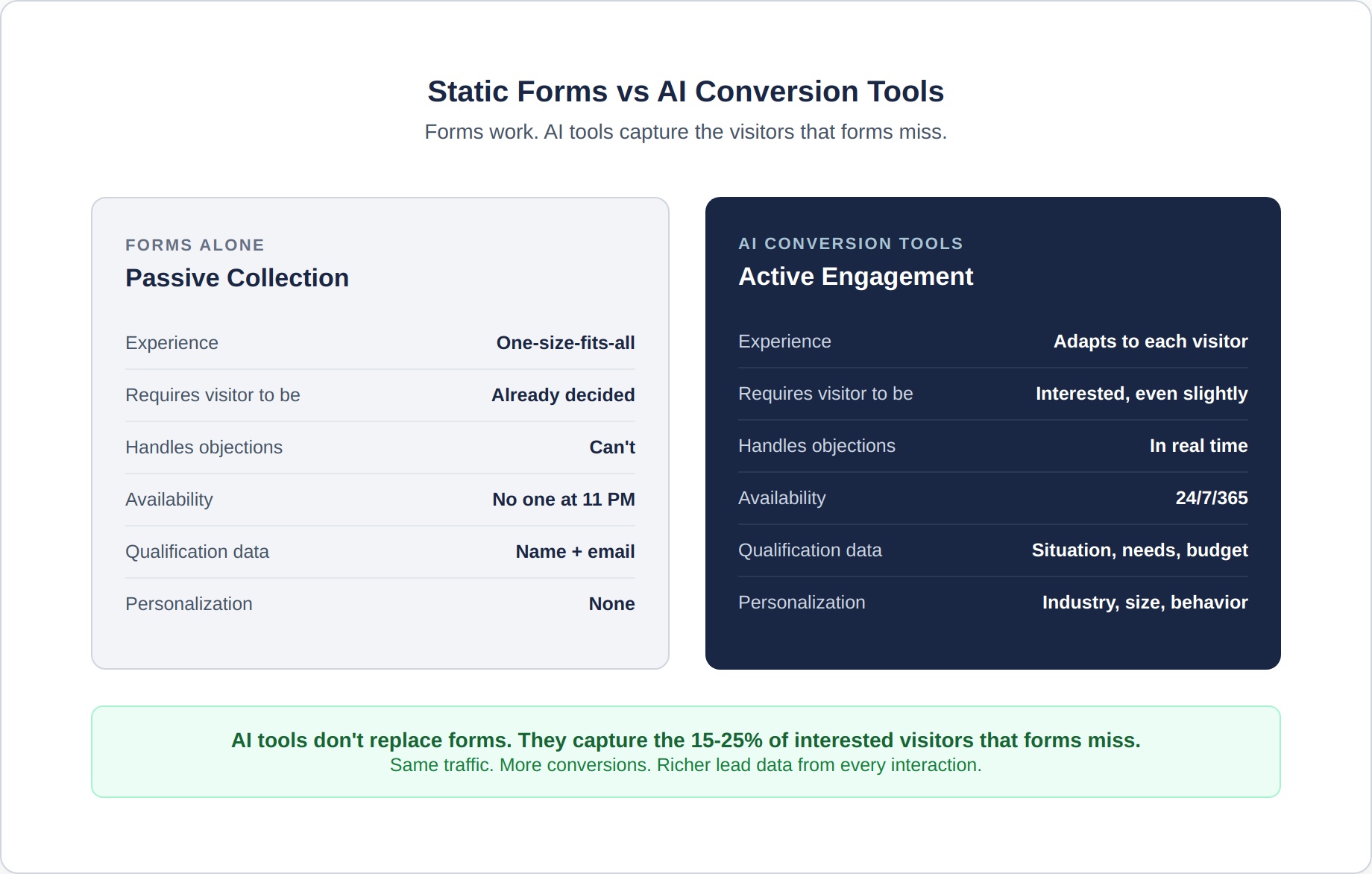
Forms work. They’re the backbone of Level 2. But they have structural limitations:
Forms are one-size-fits-all. Every visitor sees the same form, whether they’re a CEO evaluating a $100,000 engagement or a marketing coordinator conducting preliminary research. The form can’t distinguish between them and can’t adjust what it asks or offers based on who’s filling it out.
Forms require the visitor to be ready. A form only captures visitors who have already decided to take action. Every visitor who is interested but has questions, wants to understand more before committing their contact information, or isn’t sure which offer is right for their situation, leaves without converting. The form didn’t fail. It just wasn’t designed for those visitors.
Forms can’t handle objections. If a visitor hesitates, there’s no way to address it in real time. The visitor must push past doubt to fill out the form or just leave. A 30-second conversation could resolve the hesitation.
Forms don’t work at 11 PM on a Tuesday. When a prospect is researching your services late at night, there’s nobody available to answer questions. They browse, they consider, and by morning, they’ve moved on. The moment of peak interest passed, with no one there to capture it.
AI Conversion Tools solve these problems by adding intelligence, responsiveness, and real-time engagement at every conversion point.
What You Get
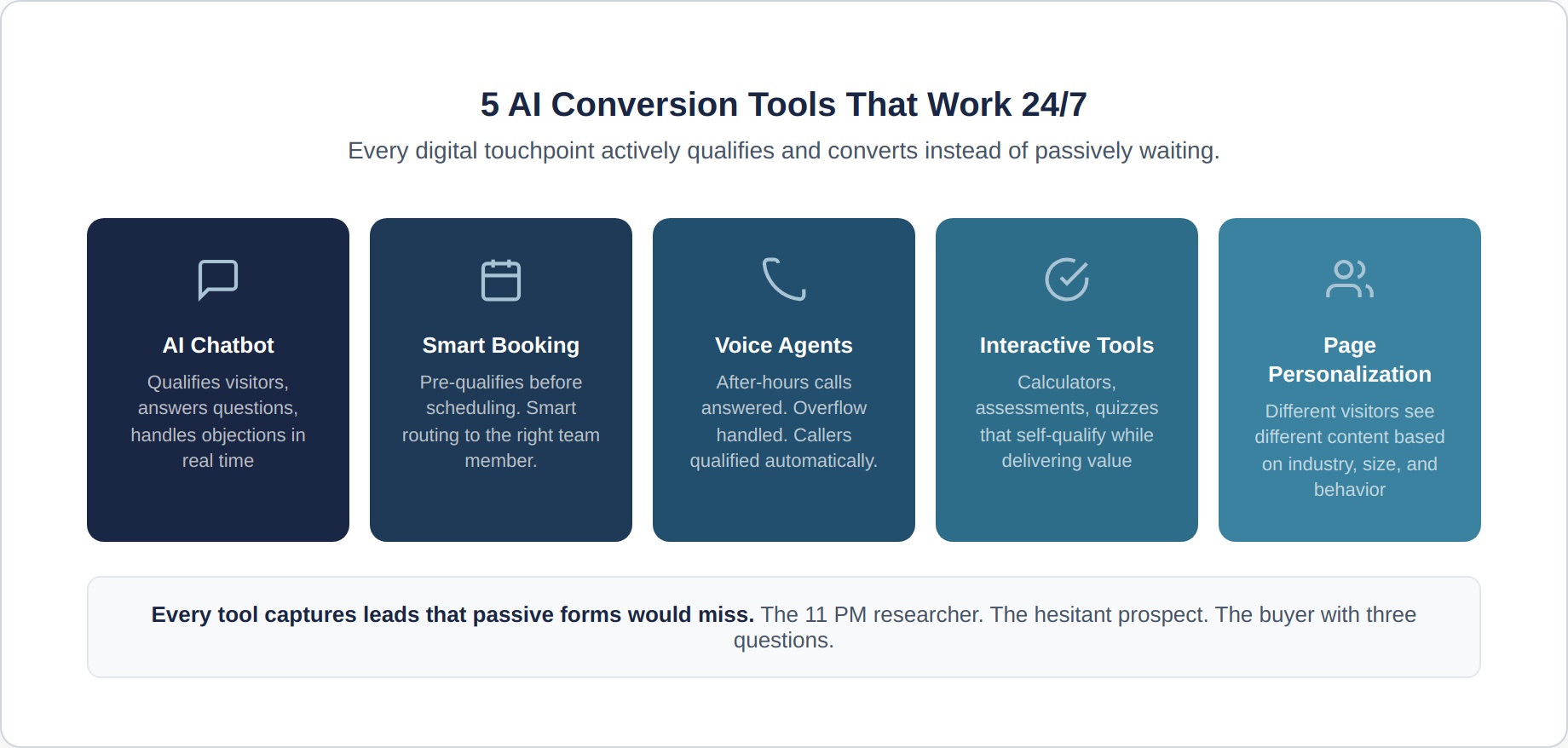
AI Chatbot for Qualification and Engagement
The centrepiece of this module is an AI-powered chatbot that doesn’t feel like a chatbot. It feels like talking to someone who understands your business.
What the chatbot does:
- The chatbot answers visitor questions in real time using your Level 0 website content, Level 4 articles, and specific FAQs. When a visitor asks about costs or industries served, it provides helpful, accurate answers from your content, not from generic scripts.
- Qualifies visitors through conversation by asking relevant questions that determine whether the visitor matches your ICP, their specific situation, and the appropriate level of service. This isn’t a scripted questionnaire. It’s a natural conversation that adapts based on the visitor’s responses.
- Qualified visitors move to the next step: booking a call, downloading a resource, viewing a case study, or connecting with a team member, based on their needs.
- The chatbot captures contact information naturally during the conversation—no abrupt forms. When visitors are engaged in a helpful exchange, sharing an email for a recommendation or booking link feels natural, not transactional.
- If a visitor hesitates, the chatbot handles objections in the moment. When someone says, “I’m not sure we’re ready” or “We’ve been burned before,” the chatbot responds with helpful information, relevant case studies, or reassurance from your content.
- Operates 24/7/365, so the 11 PM researcher, the weekend browser, and the international prospect in a different time zone all receive immediate, intelligent engagement.
What the chatbot does not do:
- It does not pretend to be a human. Visitors know they’re interacting with an AI assistant. Transparency builds trust.
- It does not push for the sale. It helps the visitor find what they need and takes the next step when they are ready, not before.
- It does not replace your sales team. It qualifies and routes. When a visitor is ready for a human conversation, the chatbot seamlessly connects them with a human.
- It does not make up answers. When it doesn’t know something, it says so and offers to connect the visitor with someone who does.
What the visitor experiences:
A small, non-intrusive chat prompt appears after the visitor spends 15-30 seconds on the page. It doesn’t show up immediately, which can feel aggressive. The prompt is specific and relevant: “Looking at pricing? I can help with levels,” or “Have questions about your industry? I can help.”
If the visitor engages, the conversation flows naturally. The chatbot asks a few questions, provides relevant information, and guides the visitor to the best next step. The exchange takes 60-90 seconds and results in a qualified lead, a booking, or a resource recommendation to keep the visitor engaged.
If the visitor doesn’t engage, the prompt disappears and never interferes with their browsing experience.
AI Appointment Booking
Removing friction between “I’m interested” and “I’m on the calendar” directly increases conversion:
- Intelligent scheduling presents available time slots based on the visitor’s time zone, preferred format (phone, video, or in-person), and conversation type needed.
- Pre-qualification before booking, so your calendar only fills with meetings that are worth having. The chatbot or booking flow gathers enough context that your team knows what the meeting is about before it begins.
- Confirmation and preparation sequences send prospects a confirmation with clear expectations about the call and what to prepare. This reduces no-shows and improves conversation quality.
- Calendar integration with Google Calendar, Outlook, Calendly, or your existing scheduling system
- Smart routing sends different types of meetings to different team members based on the prospect’s needs, company size, or service interest.
AI Voice Agents for Inbound Capture
For phone inquiries, AI voice agents answer calls your team misses:
- After-hours call handling: an AI voice agent answers phone calls outside business hours, qualifies callers through conversational questions, captures their information, and books a callback at a time that works for both parties.
- During busy times, overflow calls are routed to AI handling, so no call goes to voicemail.
- During initial qualification, the agent gathers the caller’s name, company, situation, and interest level, then routes the call to the right team member with full context.
- Call summary and CRM logging automatically create a record of the conversation with key details, so your team has full context before returning the call.
What voice agents sound like: Modern AI voice technology is conversational, natural, and clearly helpful. The caller knows they’re speaking with an AI assistant, but the experience is professional and efficient rather than robotic. The agent represents your company with the same positioning and tone established across your ecosystem.
Interactive Tools: Calculators, Assessments, and Quizzes
Interactive tools create value exchanges where the visitor receives something genuinely useful in return for engaging with your system:
ROI Calculators
- Custom-built calculators specific to your service, where prospects input their current numbers and see the projected impact of working with you
- “Enter your monthly ad spend and current conversion rate. We’ll show you what your pipeline would look like with conversion-optimized landing pages.”
- The calculator does genuine math and provides genuine insight. The prospect receives useful information. You receive their contact information and a detailed picture of their situation.
Assessment and Diagnostic Tools
- Interactive assessments where prospects answer 10-15 questions about their current situation and receive a personalized score with specific recommendations
- Similar to the readiness assessments in your ecosystem level pages, but dynamic, interactive, and generating personalized results based on the visitor’s specific answers
- Results are delivered via email, capturing contact information while providing real value.
- Assessment responses feed your CRM, so your sales team knows exactly where the prospect scored weak and strong before the first conversation.
AI-Powered Quizzes
- Shorter, more engaging formats where prospects answer 5-8 questions and receive a personalized recommendation for which service, level, or approach fits their situation
- “Which Conversion Ecosystem Level Should You Start With?” — the prospect answers questions about their current marketing, and the quiz recommends their starting level with an explanation of why
- Quiz results feel personalized because they are. The AI adapts the recommendation based on the specific combination of answers.
Smart Lead Magnets That Adapt to the User
- Standard lead magnets deliver the same PDF to everyone. Smart lead magnets adjust the content based on the visitor’s industry, company size, or responses to qualifying questions.
- A prospect in professional services receives a guide with examples from professional services. A prospect in SaaS receives the same guide with SaaS examples.
- The adaptation happens automatically. The prospect feels like the resource was created specifically for them.
Micro-Diagnostics for Fast Personalization
- Ultra-short (3-5 question) interactive widgets that produce an instant result without requiring email capture
- Designed to create micro-engagement that builds enough interest for the visitor to want the full assessment or detailed results, which does require email capture
- The micro-diagnostic is the hook. The full diagnostic is the conversion point.
AI Landing Page Personalization
Different visitors should see different pages. AI landing page personalization makes that happen:
- Industry-specific personalization showing different headlines, case studies, and social proof based on the visitor’s identified industry. A healthcare company sees healthcare testimonials. A technology company sees technology case studies. Same page structure. Different content.
- Company-size personalization, adjusting messaging and pricing presentation based on whether the visitor is from a 20-person company or a 500-person company. Small companies see messaging about efficiency and growth. Enterprise companies see messaging about scale and integration.
- Referral source personalization shows different content based on how the visitor arrived. A visitor from a Level 6 Google Ad sees messaging that continues the exact conversation the ad started. A visitor from a Level 1 LinkedIn post sees messaging that builds on the social content they engaged with.
- Behavioural personalization adjusts content based on what the visitor has already done on your site. A returning visitor who previously viewed the pricing page sees a different CTA than a first-time visitor who just arrived from a blog post.
- Geographic personalization adjusts testimonials, case studies, or messaging based on the visitor’s location when regional relevance matters.
How personalization works technically: AI landing page personalization uses visitor data (IP for company and location, referral source, cookies for return visits, UTM parameters for campaign attribution) to select the most relevant content variant. The page loads the personalized version in milliseconds. The visitor never knows they’re seeing a customized experience. They just think: “This page speaks directly to my situation.”
SMS-Based Lead Capture
For events, conferences, or any offline interaction where immediate digital engagement matters:
- Text-to-engage systems where prospects text a keyword to a number and receive an immediate response with a link to a relevant landing page, lead magnet, or booking page
- QR code flows connecting physical marketing materials (business cards, brochures, trade show displays) directly to personalized digital experiences.
- Instant follow-up that captures the contact the moment they engage, rather than waiting for them to remember to visit your website later
Event Lead Capture and Instant Follow-Up
For conferences, trade shows, and in-person events:
- Scan-to-engage systems where prospects scan a QR code or NFC tag and immediately enter a personalized digital experience
- Real-time follow-up that sends a personalized email within minutes of the interaction, while your conversation is still fresh in their mind
- CRM logging with full context about where the interaction happened and what was discussed, so your team can follow up with relevant information rather than a generic “nice to meet you” email
AI Chat Inside Ads
Engagement that begins before the prospect even reaches your website:
- Conversational ad formats on platforms that support them, where the prospect can interact with an AI chat directly within the ad experience
- Pre-qualification before the click, so visitors who do reach your landing page are already partially qualified and engaged.
- Higher-quality traffic because the conversation filters out casual browsers before they consume a click, reducing wasted ad spend in Level 6 campaigns
What the Visitor Actually Experiences
Here’s what a buyer’s journey looks like when AI Conversion Tools are active across your ecosystem:
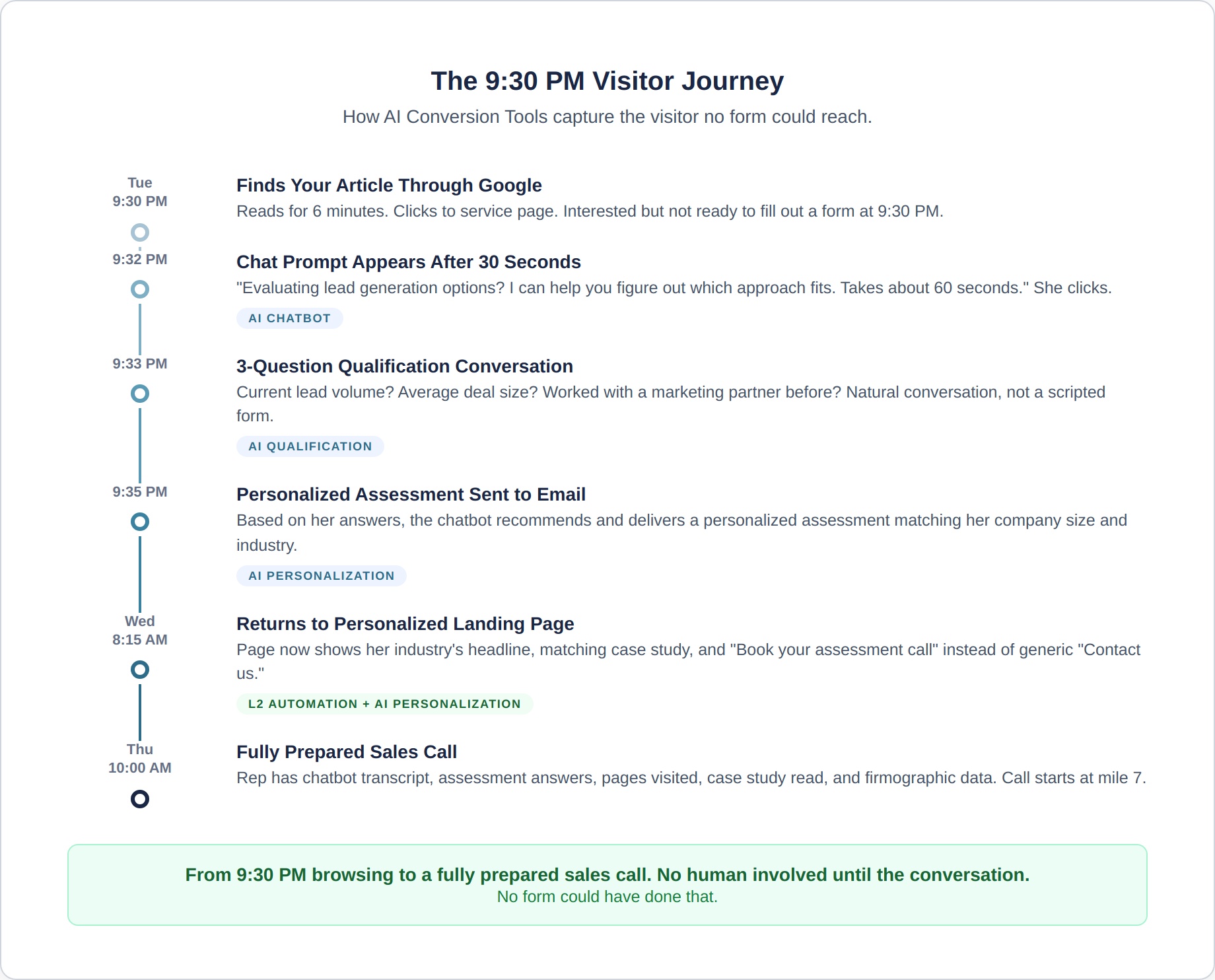
Tuesday, 9:30 PM: A marketing director is researching lead generation systems from her couch. She finds your Level 4 article through Google and reads it for 6 minutes. She clicks through to your service page. She’s interested but not ready to fill out a contact form at 9:30 PM.
Tuesday, 9:32 PM: A chat prompt appears: “Evaluating lead generation options? I can help you figure out which approach fits your situation. Takes about 60 seconds.” She clicks it.
Tuesday, 9:33 PM: The chatbot asks three questions: How many leads does your team generate per month currently? What’s your average deal size? Have you worked with a marketing partner before? She answers each one.
Tuesday, 9:34 PM: Based on her answers, the chatbot recommends a specific resource: “Based on what you’ve shared, our Lead Generation System Assessment would give you a clear picture of where your gaps are. I can send it to your email along with a personalized summary of what we’d recommend for a company of your size. Want me to send it over?”
Tuesday, 9:35 PM: She provides her email. The assessment arrives within 60 seconds. It’s personalized to her company size and industry. She reads it for 3 minutes before bed.
Wednesday, 8:15 AM: She opens the assessment again at her desk. The follow-up email (Level 2 automation triggered by the chatbot conversion) includes additional context. She clicks through to a case study relevant to her industry.
Wednesday, 8:30 AM: She returns to the service page. The page now shows personalized content: the headline references her industry, the case study matches her company size, and the CTA says “Book your assessment call” instead of the generic “Contact us” she saw last night. She books a call for Thursday.
Thursday, 10:00 AM: Your sales rep has the chatbot conversation transcript, her assessment answers, the pages she visited, the case study she read, and her company’s firmographic data. The call starts with: “I saw you took our assessment. Your score was strong in positioning but showed some gaps in conversion infrastructure. Let me walk you through what that usually looks like and what we’d recommend.”
That entire experience, from 9:30 PM browsing to a fully prepared sales call, was managed by AI Conversion Tools with no human involvement until the actual conversation. The chatbot captured her at the moment of interest. The personalized assessment gave her value. The landing page personalization made her feel recognized. The Level 2 automation maintained engagement. The sales handoff provided full context.
No form could have done that.
What Good AI Conversion Looks Like vs What Bad Looks Like
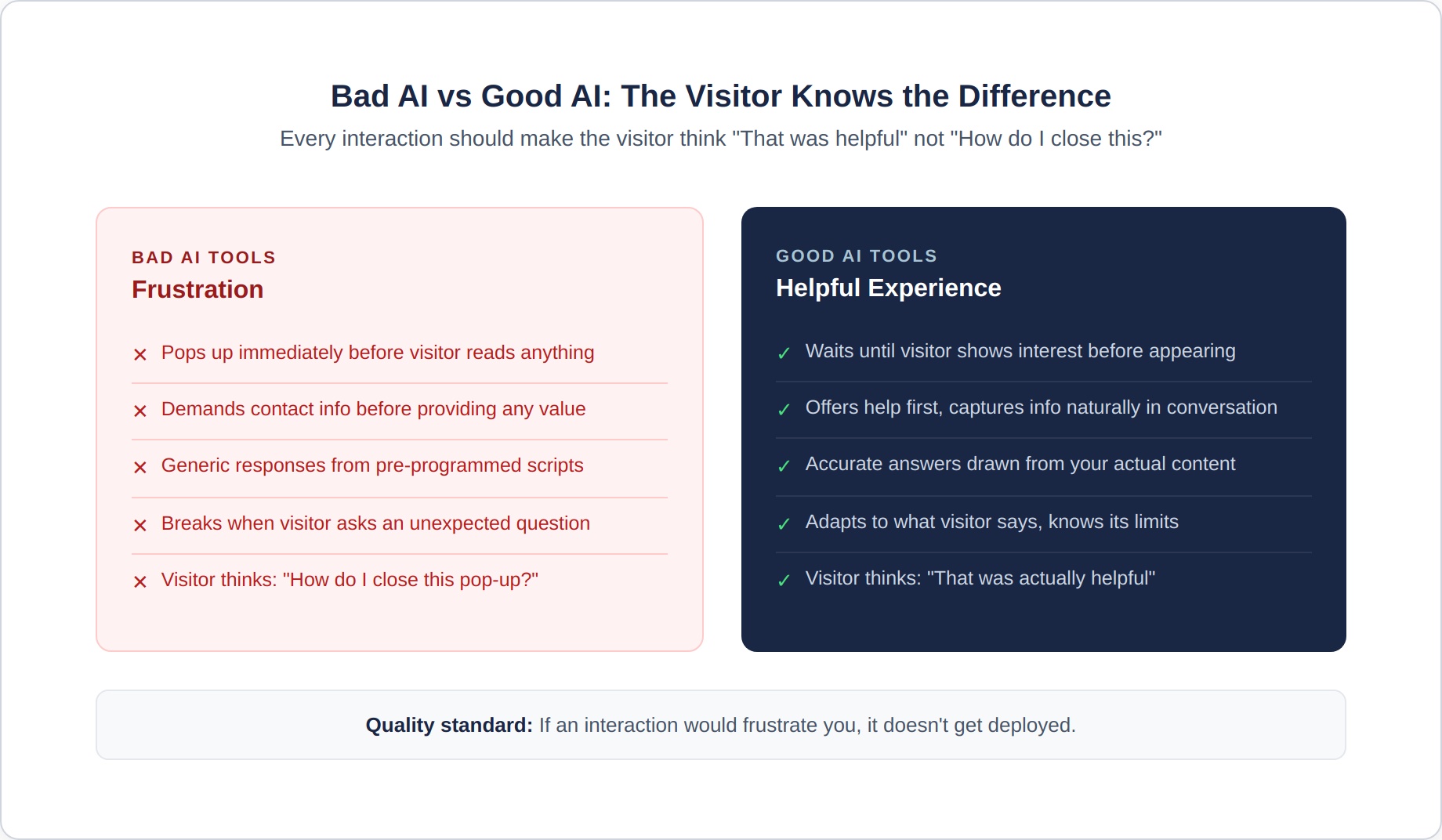
Buyers have had bad experiences with chatbots, and they’re skeptical. Here’s the difference:
Bad AI conversion tools pop up immediately and aggressively before the visitor has had time to read anything. They ask for contact information before providing any value. They give generic, unhelpful responses that make the visitor feel like they’re talking to a script. They can’t handle questions that aren’t in their pre-programmed flow. They create frustration rather than engagement.
Good AI conversion tools wait until the visitor has shown interest by spending time on the page or reaching a certain scroll depth before appearing. They offer to help rather than demanding information. They answer questions with genuine accuracy drawn from your actual content. They adapt to what the visitor actually says rather than forcing a rigid flow. They feel like talking to a knowledgeable assistant who genuinely wants to help.
The quality standard: Every AI conversion interaction should make the visitor think, “That was actually helpful,” rather than “How do I close this pop-up?” If an interaction would frustrate you, it doesn’t get deployed.
How AI Conversion Tools Connect to the Ecosystem
This module enhances specific ecosystem levels:
Enhances Level 0 (Website): Your website becomes an active conversion system rather than a passive collection of pages. Every visitor encounters intelligent engagement matched to their situation.
Enhances Level 2 (Landing Pages): Landing pages with AI personalization and chatbot engagement convert at higher rates than static pages. The chatbot catches visitors who would have bounced from the form.
Enhances Level 6 (Paid Ads): AI chat inside ads qualifies visitors before the click, improving traffic quality. Personalized landing pages matched to ad audiences improve conversion rates from paid traffic.
Feeds Module 2 (AI Lead Intelligence): Chatbot conversations and interactive tool responses provide rich qualification data that feeds into lead scoring and intent tracking.
Feeds Module 1 (NeuroReach AI): Assessment and quiz results reveal specific prospect challenges and needs, informing outreach personalization.
Feeds Level 3 (Email Marketing): Interactive tool responses create rich segmentation data. A prospect who scored 4/10 on a readiness assessment is placed in a different email nurture track than one who scored 8/10.
Feeds Level 4 (Content): Chatbot question patterns reveal what visitors are asking most frequently, identifying content gaps that Level 4 articles should address.
What Determines Where You Fall in the Price Range
How Long Before You See Results
Week 1: AI chatbot goes live on your primary pages. First conversations happen within days. You immediately begin seeing engagement from visitors who previously would have browsed and left.
Week 2-4: Interactive tools launch. First assessment completions and calculator uses generate leads with rich qualification data. Landing page personalization begins accumulating behavioural data.
Month 1: Initial performance data shows chatbot engagement rates, conversion-to-conversion rates, and interactive tool completion rates. First optimization adjustments based on which questions visitors ask most frequently and where conversations drop off.
Month 2: Landing page personalization reaches meaningful data. Variant performance shows which personalization elements produce the highest conversion lifts. Chatbot knowledge base is refined based on the questions it couldn’t answer well in month 1. Interactive tools are optimized based on completion and conversion data.
Month 3: The system stabilizes. Chatbot conversations feel natural and comprehensive. Interactive tools produce consistent, qualified leads. Personalization rules are refined and are producing measurable conversion improvements. The full conversion toolset is operating as an integrated system.
Month 4-6: Continuous improvement. Chatbot learns from accumulated conversations. Personalization rules become more sophisticated as behavioural data deepens. New interactive tools are developed based on what the data shows visitors want. Conversion rates across all touchpoints improve month over month.
Month 6+: AI Conversion Tools are a structural advantage. Your website actively qualifies and converts visitors at rates that static websites cannot match. The 11 PM visitor is captured. The hesitant prospect gets their questions answered. The returning visitor sees personalized content that accelerates their decision. Every digital touchpoint works harder than a passive form ever could.
Why This Investment Makes Sense
Consider what happens to the visitors your current site doesn’t convert.
If your Level 2 landing pages convert at 8% and you’re generating 1,000 landing page visitors per month, 80 people convert and 920 leave. Some of those 920 weren’t qualified. But research shows that 15-25% of B2B website visitors who don’t convert are still genuinely interested. They had questions that the page didn’t answer. They weren’t ready for the specific offer but would have engaged with something lower-commitment. They wanted to interact before committing their contact information.
AI Conversion Tools capture a significant share of visitors who are interested but not converting. If the chatbot and interactive tools capture even 3-5% of the visitors that form misses, that’s 28-46 additional leads per month from the same traffic.
At your average deal size, those additional leads represent a pipeline that was always there but slipping through the cracks because the only conversion mechanism was a passive form that required the visitor to make the first move.
The module doesn’t require more traffic. It captures more value from the traffic you already have.
What This Module Solves
AI Conversion Tools solve the problem of passive conversion. Forms wait for the visitor to act. AI Conversion Tools engage the visitor at the moment of interest, answer their questions, qualify their situation, personalize their experience, and capture their information through exchanges that feel valuable rather than transactional. The result: higher conversion rates from the same traffic, richer lead data from every conversion, and 24/7 engagement that never takes a day off.
What This Module Does NOT Include
- Outbound outreach to prospects (Module 1: NeuroReach AI)
- Anonymous visitor identification and intent tracking (Module 2: AI Lead Intelligence)
- Sales call preparation or CRM automation beyond lead creation (Module 4: AI Sales Acceleration)
- Content production or repurposing (Module 5: AI Content Engine)
- Email nurture optimization (Module 6: AI Nurture and Retention)
- Landing page design and creation (Level 2 — though this module enhances Level 2 pages with AI capabilities)
- Website content or structural changes (Level 0)
AI Conversion Tools add intelligence to existing conversion points. The levels and other modules build and optimize those conversion points.
What You Need to Provide
- Onboarding conversation (60 minutes): We align on your conversion goals, visitor profiles, qualification criteria, and which tools match your buyer journey
- Knowledge base input (60-90 minutes): We build the chatbot’s knowledge base from your Level 0 website content, Level 4 articles, FAQs, and sales team intelligence. You provide the expertise. We configure the AI.
- Interactive tool input (30-45 minutes per tool): For each calculator, assessment, or quiz, we need your specific metrics, scoring criteria, and recommendation logic. You know what good answers look like. We build the tool.
- Website access: To deploy chatbots, interactive tools, and personalization scripts
- CRM access: To connect all conversion tools to your lead management system
- Monthly review (20-30 minutes): Review tool performance, chatbot conversation quality, and personalization results
- Feedback on lead quality (ongoing): Are the leads from chatbot conversations and interactive tools meeting sales expectations?
Total monthly time commitment: approximately 2-3 hours, with the largest investment during onboarding and initial tool setup.
Who Manages This
Rod Agatep personally oversees the conversion strategy, chatbot design, interactive tool development, and personalization architecture for every AI Conversion Tools engagement. With 27 years of experience in B2B conversion optimization, Rod ensures every tool is built to produce qualified leads rather than just generate engagement metrics.
Every chatbot conversation flow, every assessment question, every personalization rule, and every interactive tool is designed under Rod’s direct supervision to align with the positioning, buyer psychology, and conversion principles established across your ecosystem. This is not a chatbot plugin installed with default settings. It is a strategic conversion system designed for your specific buyers.
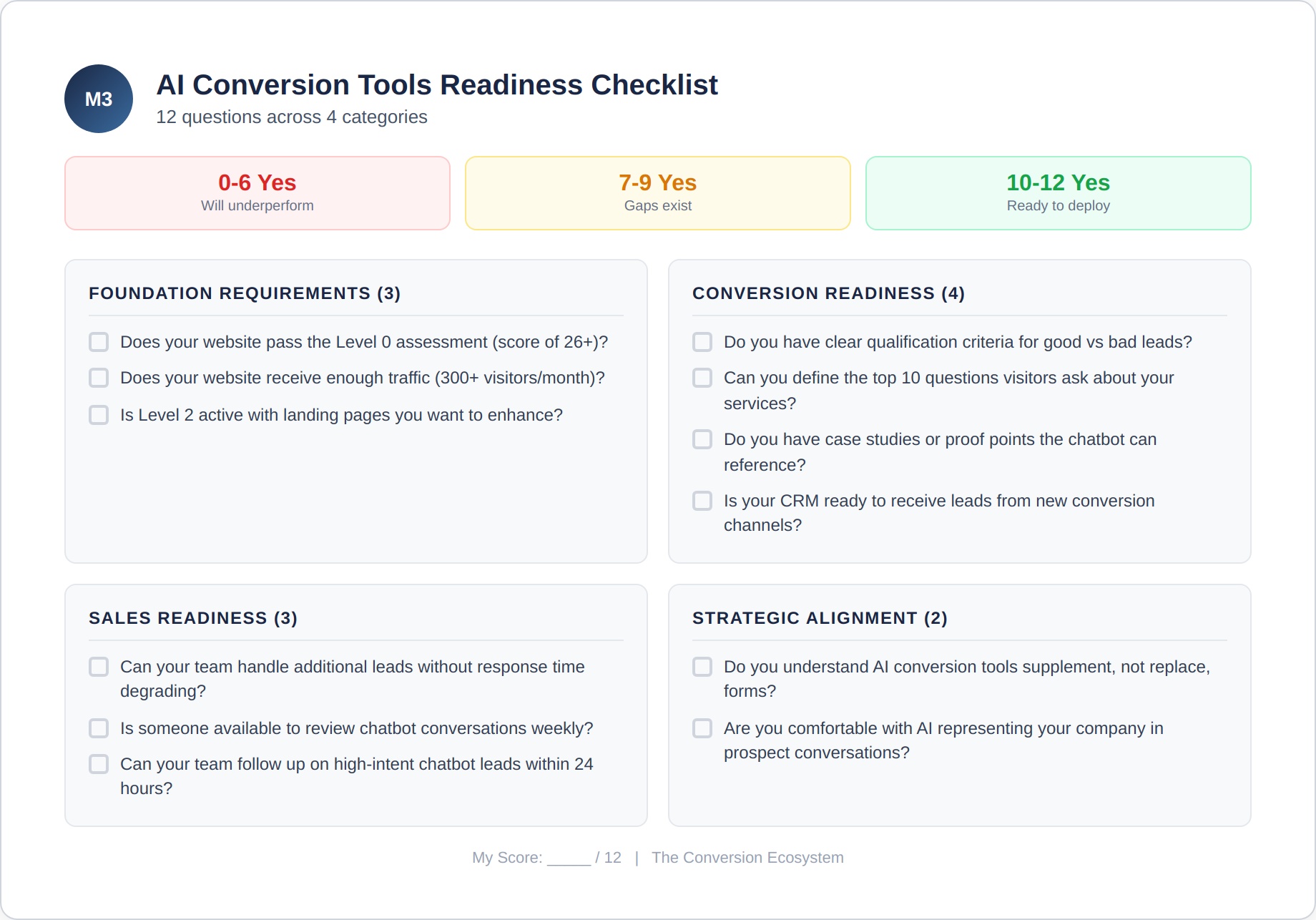
AI Conversion Tools Readiness Assessment
Scoring
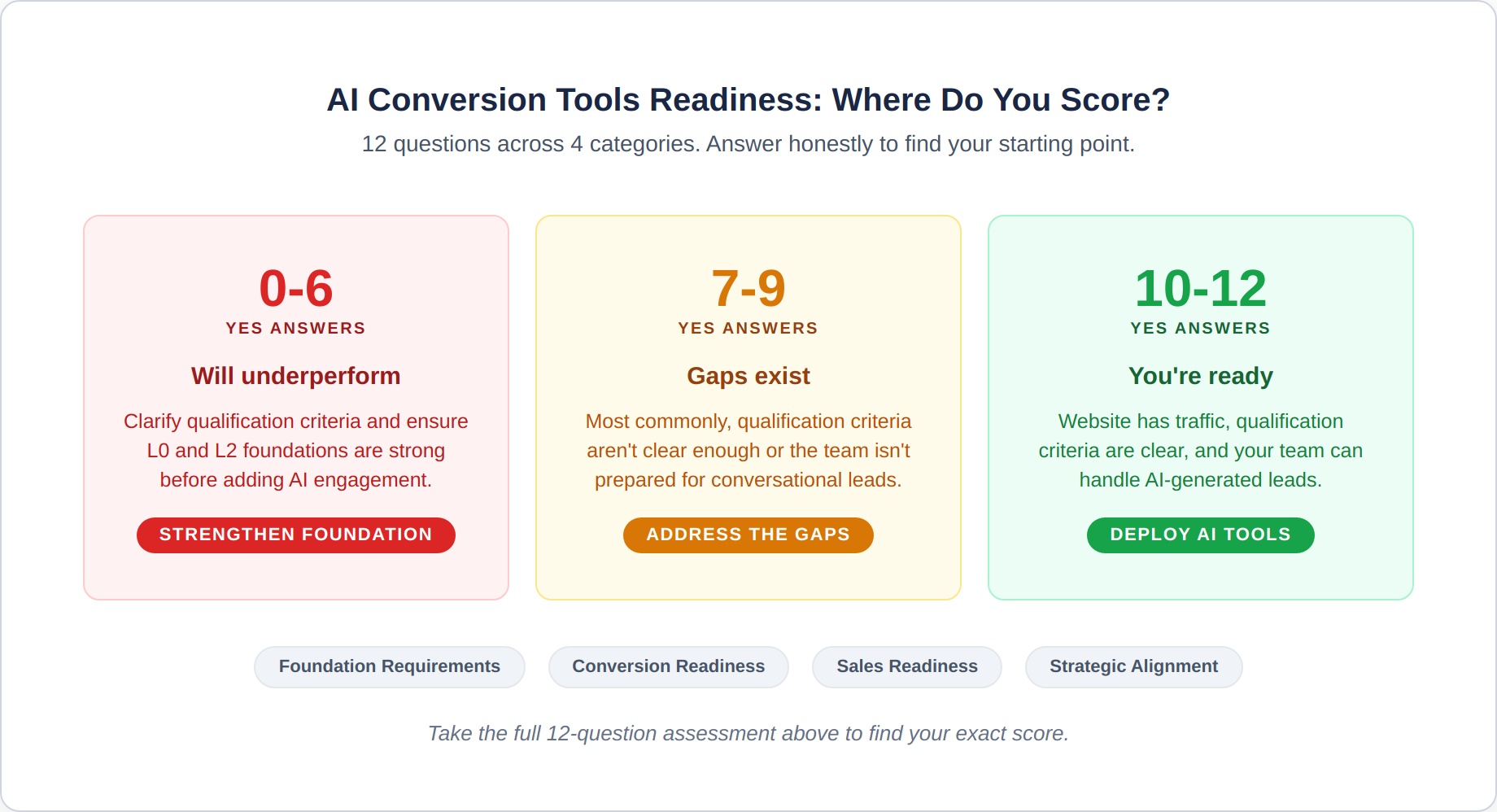
10-12 YES answers: You’re ready. Your website has enough traffic, your qualification criteria are clear, and your team can handle the additional leads AI conversion tools will produce.
7-9 YES answers: Gaps exist. Most commonly, the qualification criteria aren’t clear enough to program into the chatbot, or the team isn’t prepared for the volume and format of leads from conversational tools.
6 or fewer YES answers: AI Conversion Tools will underperform. Focus on clarifying your qualification criteria and ensuring your Level 0 and Level 2 foundations are strong before adding AI engagement.
Pricing Summary
| Option | Investment |
|---|---|
| AI Conversion Tools monthly | $2,000 – $4,500/month |
| Annual commitment | 20% off monthly rate |
| Combined with other AI Growth Modules | 10-15% multi-module discount |
What’s included: AI chatbot design, configuration, and ongoing optimization; interactive tool development (calculators, assessments, quizzes); smart lead magnet creation; AI landing page personalization; AI voice agent setup and management (mid and upper ranges); SMS and event capture systems (mid and upper ranges); AI chat in ads integration (upper range); CRM integration across all tools; conversation quality monitoring; monthly performance reporting; and quarterly strategy reviews.
What’s not included: Website design or structural changes (Level 0), landing page creation (Level 2), outbound outreach (Module 1), visitor identification (Module 2), sales call preparation (Module 4), content production (Module 5 and ecosystem levels), or email nurture optimization (Module 6).
Next Step
If you’re not sure whether AI Conversion Tools are the right module, whether your website traffic justifies the investment, or whether your conversion goals align with what these tools produce, the fastest way to find out is a conversation.
We’ll review your current conversion rates, assess your visitor behaviour patterns, evaluate which tools would have the greatest impact on your specific buyer journey, and tell you honestly whether AI conversion enhancement makes sense now or whether other ecosystem work should come first.
No pitch. No pressure. Just clarity on where you stand and what to do next.
Frequently Asked Questions
Won’t a chatbot annoy visitors?
Bad chatbots annoy visitors. They pop up immediately, demand attention, and provide useless responses. The chatbots we deploy wait until the visitor has shown interest, offer help rather than demand information, provide genuinely useful answers, and disappear when ignored. The experience is designed to feel like a helpful concierge, not an aggressive salesperson.
How does the chatbot know enough about my business to answer questions accurately?
We build the chatbot’s knowledge base from your Level 0 website content, Level 4 articles, service descriptions, pricing information, FAQs, and common sales questions. The chatbot draws from your actual content rather than generating generic responses. When it encounters a question it can’t answer confidently, it acknowledges the limitation and offers to connect the visitor with a human.
Can the chatbot handle complex technical questions?
The chatbot handles the most frequently asked questions with clear answers. For complex or nuanced questions that require human judgment, the chatbot captures the question and the visitor’s context, then routes them to your team for personal follow-up. The chatbot doesn’t guess at complex answers. It knows its limits.
How is this different from the chatbots I’ve seen on other websites?
Most chatbots are scripted decision trees that break the moment a visitor asks an unexpected question. AI Conversion Tools use conversational AI that understands natural language, adapts to what visitors actually say, and draws on a comprehensive knowledge base rather than a rigid script. The difference is immediately apparent in the quality of the conversation.
Do interactive tools actually generate good leads?
Interactive tools consistently produce higher-quality leads than standard forms because prospects self-qualify throughout the process. A prospect who completes a 15-question assessment has told you their company size, their current challenges, their budget range, and their priorities before you ever speak to them. That’s richer qualification data than any form can capture.
Will landing page personalization slow down my site?
No. Personalization rules execute in milliseconds. The visitor never experiences a delay. The page loads personalized content as quickly as it would with default content. Performance optimization is built into every personalization implementation.
What are the cancellation terms?
Month-to-month with 30 days’ notice. Annual at 20% off with a 12-month term. The early termination fee equals the discount on the completed months. You retain all chatbot configurations, interactive tool designs, personalization rules, and lead data. Tools can continue operating or be deactivated at your discretion.
Do I own the tools and data?
Yes. Every chatbot configuration, every interactive tool, every personalization rule, every conversation transcript, and every lead generated belongs to you. If the engagement ends, the tools remain deployed and functional on your website. There are no tool-removal clauses or data-expiration terms.