

Key Takeaways
- AI Growth Advantage is the unfair advantage layer that creates compounding strategic benefits competitors can’t see, replicate, or reverse-engineer because it’s built on your unique data, your specific market, and your accumulated ecosystem intelligence.
- Offer testing at scale eliminates guessing about what your market wants by rapidly testing positioning, pricing, packaging, and messaging variations against real audience behaviour rather than internal opinions.
- ICP refinement loops continuously sharpen your targeting. They analyze who actually buys versus who you thought would buy. Then, they adjust every level of the ecosystem to focus on buyers who produce the highest lifetime value.
- Relationship intelligence maps your entire professional network to identify warm introduction paths, referral timing, and partnership opportunities that would take years to discover manually.
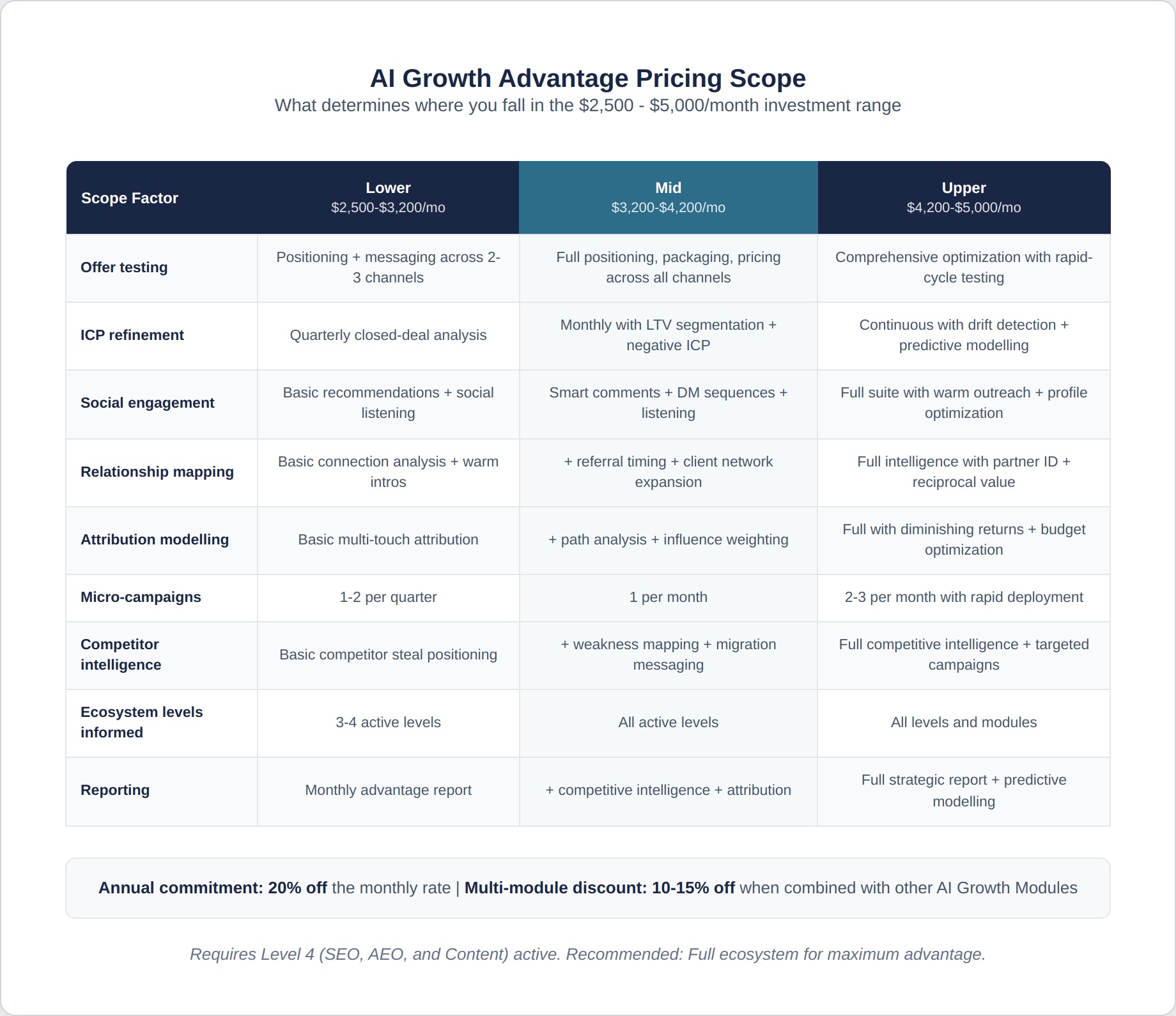
- The investment ranges from $2,500 to $5,000/month, depending on the number of active advantage plays, data depth, breadth of ecosystem integration, and market complexity.
One Sentence Summary: AI Growth Advantage builds compounding strategic advantages that separate companies that dominate their market from those that compete in it, continuously testing, refining, and optimizing every element of your positioning, targeting, and market approach based on real data.
Investment Range: $2,500 – $5,000/month
Annual Commitment: 20% off the monthly rate
Multi-Module Discount: 10-15% off when combined with other active AI Growth Modules
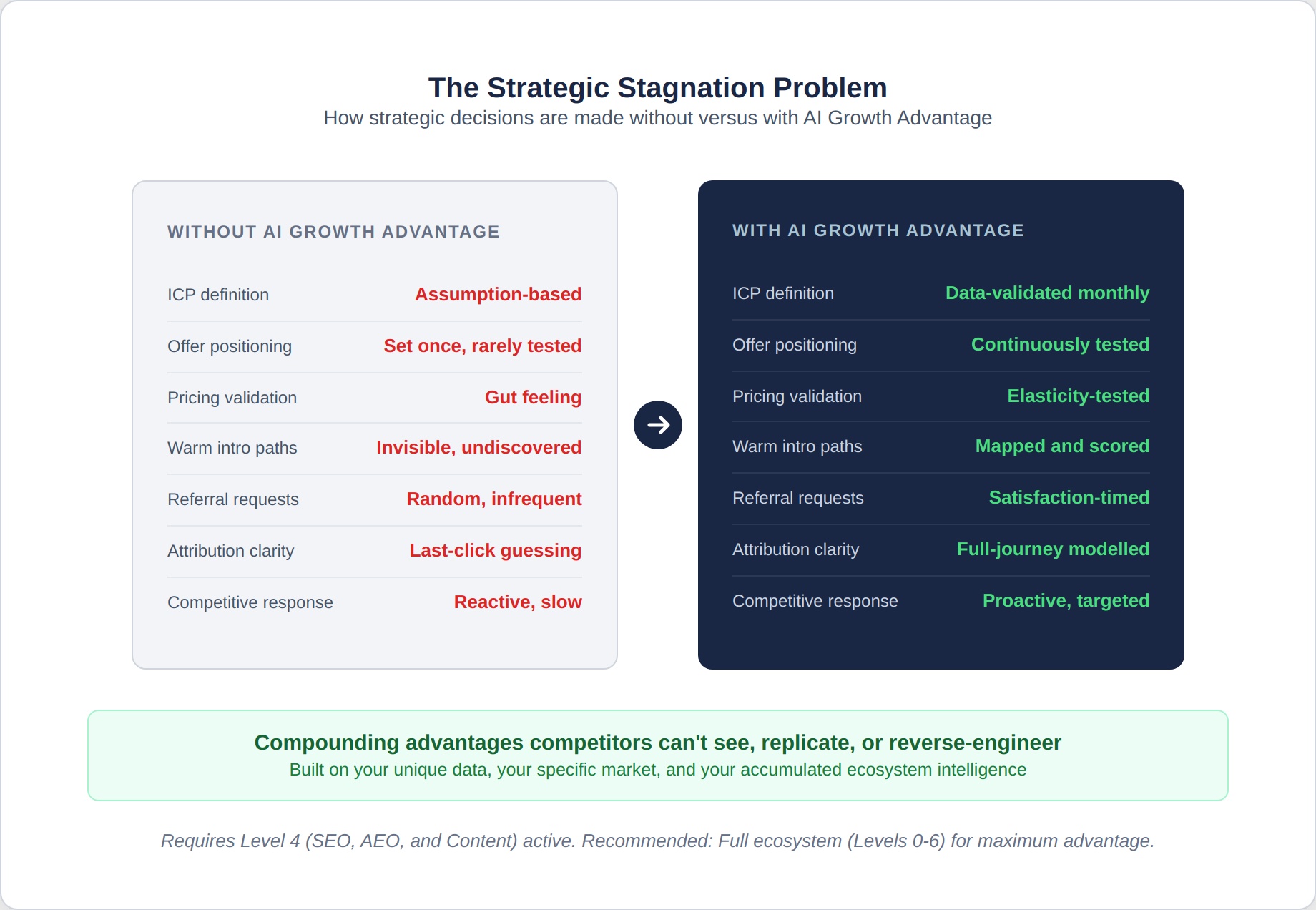
Requires: Level 4 (SEO, AEO, and Content) active. Recommended: Full ecosystem (Levels 0-6) for maximum advantage.
Timeline: Initial testing produces actionable data in 30-60 days. ICP refinement and relationship insights start in 60-90 days. Full compounding advantages are visible in 6-12 months as intelligence accumulates.
What This Module Is
Every other module in the AI Growth suite optimizes a specific function: outreach, intelligence, conversion, sales, content, or nurture. Module 7 is different. It doesn’t optimize a function. It optimizes your strategy.
AI Growth Advantage operates across your entire ecosystem. It continuously tests what your market actually responds to. It refines who you should target, based on who actually buys. It identifies relationship paths that create opportunities that no cold outreach could. It builds market intelligence that compounds into advantages your competitors can’t match, because they don’t have access to your data.
This is the module that most agencies can’t offer because it requires a functioning ecosystem to work with. Without daily social engagement data, without article performance data, without email response data, without landing page conversion data, without sales call transcripts, without video retention data, without ad performance data, there’s nothing for AI Growth Advantage to analyze. The ecosystem produces the data. This module turns that data into a strategic advantage.
The companies running Module 7 don’t just execute marketing better; they drive better results. They make better decisions about what to market, who to market to, how to position it, what to charge, and where to find the next opportunity. Those decisions determine whether you compete in a market or dominate it.
Why This Is the Module Competitors Can’t Replicate
Most marketing competitive advantages are temporary. Competitors can copy your ad creative, publish similar content, target the same keywords, or build landing pages that are similar. These advantages are visible and replicable.
AI Growth Advantage creates invisible, unreplicable advantages. They’re built on three things competitors can’t access:
Your data. The accumulated behavioural data from your specific ecosystem, your specific audience, and your specific market interactions. A competitor can’t access your newsletter reply patterns, your social engagement data, your landing page conversion data, your sales call transcripts, or your client retention signals. That data is yours exclusively.
Your time. AI Growth Advantage compounds. Insights from month one inform tests in month two. Results from month two refine strategy in month three. By month twelve, you have 12 months of continuous optimization. A competitor starting today would need 12 months to match. They can never close the gap, because you keep compounding while they’re just starting.
Your relationships. Relationship intelligence maps connections, referral patterns, and partnership opportunities within your specific network. A competitor can’t replicate your relationships, your client history, or the warm-introduction paths within your unique professional network.
These three advantages compound independently and multiply together. A competitor who starts building the same ecosystem today is 12 months behind on data, 12 months behind on optimization, and has none of your relationship intelligence. By the time they catch up to where you are now, you have moved 12 months further ahead.
That’s what “unfair advantage” means.
What You Get
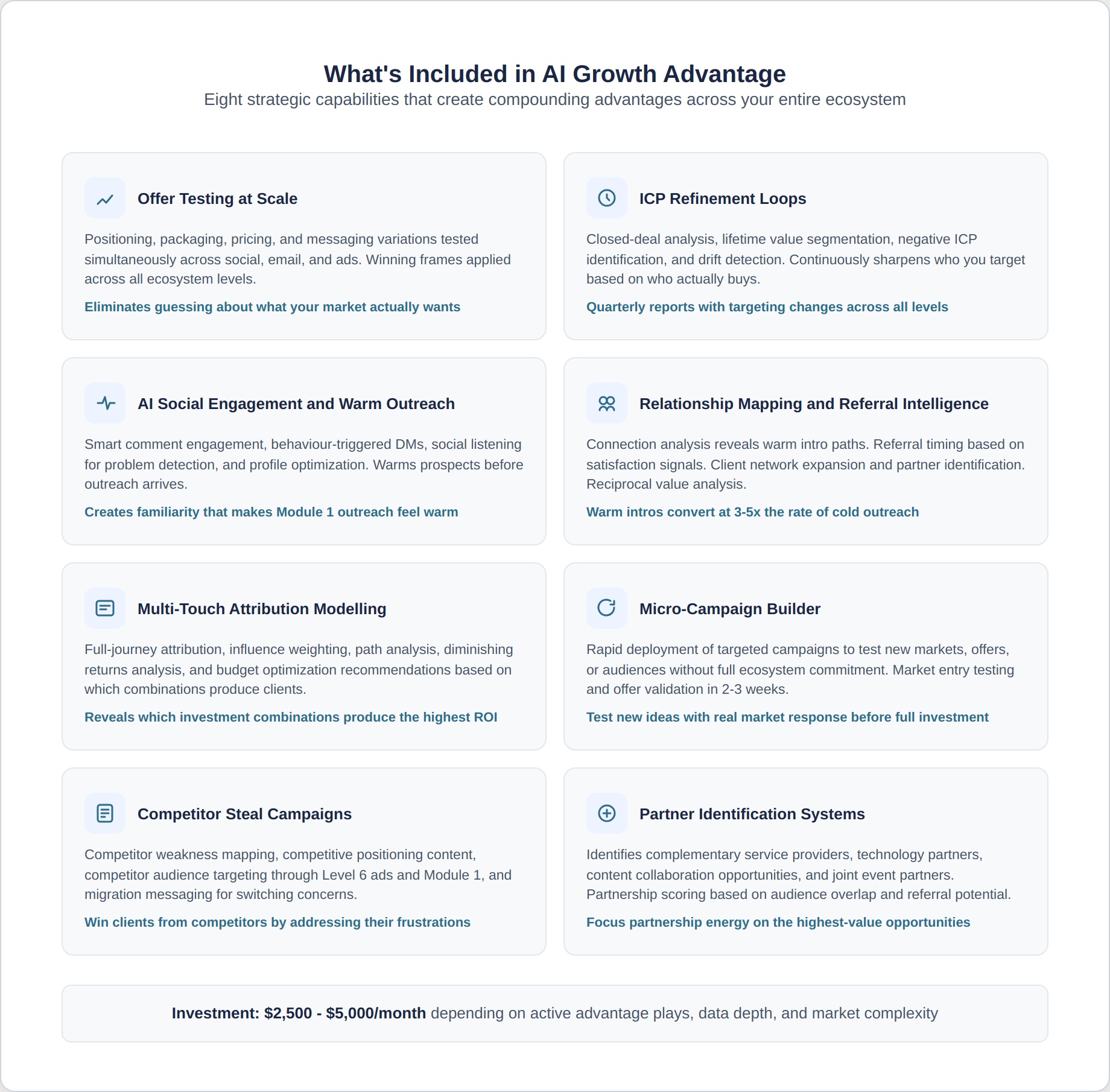
Offer Testing at Scale
Most companies launch a service and leave it unchanged for months or years. They adjust only when revenue drops. AI Growth Advantage continuously tests what your market actually wants:
Positioning variation testing:
- AI creates multiple positioning frames for the same service and tests them simultaneously across Level 1 social content, Level 3 email subject lines, and Level 6 ad copy.
- Each frame emphasizes a different value angle: efficiency, risk reduction, revenue growth, competitive advantage, and time savings.
- Performance data reveals which positioning frame your specific market responds to most strongly.
- The winning frame is applied across all ecosystem levels: website copy, landing pages, outreach messaging, ad creative, newsletter angles.
Packaging variation testing AI tests different ways of packaging your services: bundled vs. unbundled, tiered vs. flat, project vs. retainer.ner.
- Testing happens through Level 2 landing page variants, Level 6 ad offers, and Level 1 content that frames services differently.
- Response patterns reveal which packaging structure your buyers prefer and which produces the highest conversion rates and deal values.
Pricing elasticity testiAI tests pricing sensitivity by varying presentations across channels and audiences.ences.
- This is not about changing your actual prices randomly. It’s about understanding which price points, payment structures, and value framings produce the optimal combination of conversion rate and deal value.
- Testing might reveal that presenting pricing as “investment per lead generated” converts better than “monthly retainer,” even though the actual cost is the same.
- Or, a specific audience segment may be willing to pay 20% more when the offer includes a specific deliverable that costs you very little to add.
Messaging angle testing at spePaid advertising provides the fastest testing because you control traffic volume.olume.
- AI generates 10-20 messaging variations per test cycle and runs them across sufficient volume to produce statistically meaningful results within 2-4 weeks.
- Winning messages are applied across all channels. Losing messages are eliminated. Each cycle is informed by previous tests, making testing more precise over time. time.
Deliverable: A monthly offer optimization report that shows what was tested, what won, what the data suggests for the next round, and specific recommendations for changes across the ecosystem.
ICP Refinement Loops
Your Ideal Customer Profile was defined during onboarding. But the ICP you defined based on assumptions rarely produces the highest lifetime value. AI Growth Advantage continuously refines who you should target based on who actually buys and who produces the best outcomes.
Closed-deal analysis:
- AI analyzes every closed deal for patterns. It looks at industry, company size, revenue, technology stack, buying trigger, deal cycle length, engagement pattern before close, and the ecosystem touchpoints engaged.
- Patterns emerge that challenge assumptions. You may discover that your best clients aren’t the ones you expected. The industry you thought was your sweet spot produces deals, but the adjacent industry produces larger deals with shorter cycles.
Not all clients are equal. AI segments your base by lifetime value, retention, expansion, and satisfaction.gnals.
- Segments with the highest lifetime value are prioritized for Level 1 content, Module 1 outreach, Level 6 advertising, and Level 4 content strategy. Segments with the lowest lifetime value are deprioritized, freeing marketing spend for the audiences that matter most.
Negative ICP identification:
- Equally important as knowing who to target: knowing who to avoid. avAI flags prospect profiles that consume sales time but don’t close, that churn quickly, or that require disproportionate effort.
- These profiles are added to exclusion lists across Module 1 outreach and Level 6 advertising. This reduces wasted spend on prospects who look like fits but aren’t.
ICP drift detection. Markets change. The ICP from 12 months ago may no longer be optimal. AI monitors if the engagement or conversion profiles shift. time.
- When drift is detected, the system alerts you with data showing how the converting audience has changed and recommendations for adjusting targeting across all levels.
Deliverable: Quarterly ICP refinement report with updated targeting recommendations, negative ICP exclusions, lifetime value analysis, and specific changes recommended across Module 1, Level 1, Level 4, and Level 6 targeting.
AI Social Engagement at Scale
Level 1 provides daily social content and 30 minutes of manual engagement. AI Growth Advantage adds intelligent engagement that builds relationships strategically:
Smart comment engagement:
- AI monitors target account activity on social platforms and engages with their content through thoughtful, relevant comments that demonstrate expertise and build familiarity.
- Comments are drafted by AI and reviewed before posting to ensure quality and authenticity.
- Engagement targets are prioritized based on Module 2 lead intelligence, Module 1 outreach sequences, and ICP data.
- Strategic engagement creates recognition that warms outreach: when a Module 1 message arrives from someone who’s been commenting insightfully on the prospect’s content for 3 weeks, it feels familiar rather than cold.
Smart DM sequences triggered by behaviour. When a target prospect engages with your Level 1 content (likes, comments, shares), the AI triggers a DM sequence that naturally builds on the interaction.lly.
- “I noticed you liked the post about lead generation costs. We actually published a deeper breakdown that covers the math behind the numbers. Want me to send it over?”
- The DM doesn’t feel automated because it references a real interaction the prospect just took. It feels responsive and relevant.
Social listening for problem detection:
- AI monitors social platforms for conversations where your target audience discusses problems your services solve
- When a prospect posts about a challenge you address, the system alerts your team with context and a suggested engagement approach.
- Responding to a prospect’s public problem statement with a genuinely helpful insight is one of the most effective trust-building actions on social media.
Profile optimization for conversion:
- AI continuously analyzes which LinkedIn profile elements (headline, summary, featured section, activity) correlate with higher connection acceptance rates and engagement rates.
- Optimization recommendations are delivered monthly with specific suggested changes based on what the data shows is working.
Warm Outreach Triggered by Engagement
Beyond smart DMs, AI Growth Advantage enables outreach that’s triggered by specific engagement events:
- When a target prospect comments on your Level 1 post, AI evaluates whether the comment indicates genuine interest and, if so, triggers a warm outreach sequence through Module 1 that references the interaction. When a prospect who previously received Module 1 outreach and didn’t respond suddenly engages with your Level 1 content, a re-engagement sequence naturally acknowledges the gap.
- When multiple people at the same company engage with your content simultaneously, the system recognizes this as an organizational buying signal and alerts both Module 1 (for outreach) and the sales team.
Relationship Mapping Across Your Network
Your existing professional network contains opportunities that are invisible without systematic analysis:
Connection analysis:
- AI maps your LinkedIn connections, CRM contacts, client relationships, and professional network to identify who knows who
- The map reveals warm introduction paths to target accounts: “You’re connected to the VP of Sales at Target Company through your client at Existing Company. They worked together at the previous company for 3 years.”
Warm intro suggestions:
- When Module 1 identifies a high-priority target account, AI checks your relationship map for warm introduction paths before recommending cold outreach.
- A warm introduction converts at 3-5x the rate of cold outreach. AI ensures you never send a cold message when a warm path exists.
Client network expansion:
- AI analyzes your existing clients’ professional networks to identify prospects who match your ICP and are connected to people who already trust you.
- Referral requests are timed and scripted based on client satisfaction signals from Module 6 data: happy clients who just achieved strong results are the most likely to provide introductions.
Referral Timing and Prompts
Referrals are the highest-converting lead source in B2B, but most companies leave them to chance. AI Growth Advantage systematizes referral generation:
- Satisfaction-based timing: AI identifies the optimal moment to request a referral based on client satisfaction signals: strong recent results, positive sentiment in communications, high engagement with deliverables, or a milestone achievement
- Prepared referral requests: When the timing is right, your account manager receives a notification with a scripted referral request tailored to the specific client relationship and recent results
- Referral tracking: Every referral is tracked from request through introduction through conversion, building data on which clients, at which timing, and which request approaches produce the most referrals
- Reciprocal value identification: AI identifies opportunities where you can provide value to the referral source (introducing them to someone in your network, sharing relevant content, highlighting their work) so the referral relationship is reciprocal rather than extractive
Partner Identification Systems
AI identifies companies and individuals who serve the same market but don’t compete with you:
- Complementary service providers who could refer clients to you and receive referrals in return
- Technology partners whose tools integrate with or benefit from your services
- Content collaboration opportunities where co-created content reaches both audiences
- Joint event or webinar partners where shared expertise creates more value than either could deliver alone
- Partnership scoring based on audience overlap, reputation quality, and referral potential, so you focus partnership energy on the highest-value opportunities.
Multi-Touch Attribution Modelling
Understanding which combination of touchpoints produces clients, not just which single touchpoint gets credit:
- Full-journey attribution: Mapping every touchpoint a client interacted with from first exposure through closed deal, across all ecosystem levels and modules
- Influence weighting: Understanding which touchpoints have the strongest influence on conversion versus which are incidental
- Path analysis: Identifying the most common and most effective paths to conversion. Does the typical client journey go Social → Article → Newsletter → Video → Call? Or is it Ad → Landing Page → Email → Video → Call? The dominant paths inform investment decisions.
- Diminishing returns analysis: Identifying which channels and touchpoints add the most incremental value and which add minimal value relative to their cost
- Budget optimization recommendations: Based on attribution data, specific recommendations for reallocating budget across ecosystem levels to maximize ROI
Micro-Campaign Builder
Rapid deployment of small, targeted campaigns that test new markets, offers, or audiences without committing full ecosystem resources:
- Quick-launch campaigns combining a Level 2 landing page, a Level 1 social push, and a Level 6 ad set to test a new idea within 2-3 weeks
- Market entry testing for new industries, geographies, or company segments using small-budget campaigns to validate demand before investing in full ecosystem coverage
- Seasonal or event-tied campaigns that capitalize on timely opportunities with rapid deployment and teardown
- Offer validation testing new service ideas or packaging approaches with real market response before committing to full production.
Competitor Steal Campaigns
Strategic campaigns designed to win clients from specific competitors:
- Competitor weakness mapping: AI identifies the specific areas where competitor services fall short based on review data, social commentary, and prospect feedback during sales calls
- Competitive positioning content: Level 4 articles and Level 1 social content that address the specific limitations prospects experience with competitors, without naming them aggressively, but positioning your approach as the solution to their frustrations
- Competitor audience targeting: Level 6 ads and Module 1 outreach specifically targeting companies that show competitor engagement signals.
- Migration messaging: Messaging that addresses the specific concerns companies have when switching providers: transition risk, data migration, learning curves, and contract overlap.
How All the Advantage Plays Work Together
The individual capabilities are powerful. Together, they create a system that compounds:
ICP refinement tells you who to target. Offer testing tells you what to offer them. Relationship mapping tells you how to reach them warmly. Social engagement warms them before outreach arrives. Attribution modelling tells you which combination of touchpoints converts them. Micro-campaigns test new approaches rapidly. Competitor steal takes them from the competition.
Each capability feeds the others. ICP data informs offer testing targets. Offer testing results to inform social engagement messaging. Social engagement data enriches relationship mapping. Attribution modelling reveals which of these capabilities produces the highest ROI. The system learns from its own experience and improves continuously.
A competitor can copy any single element. They can’t copy the system because they don’t have your data, your relationships, or your 12 months of compounded learning.
What This Looks Like in Real Life
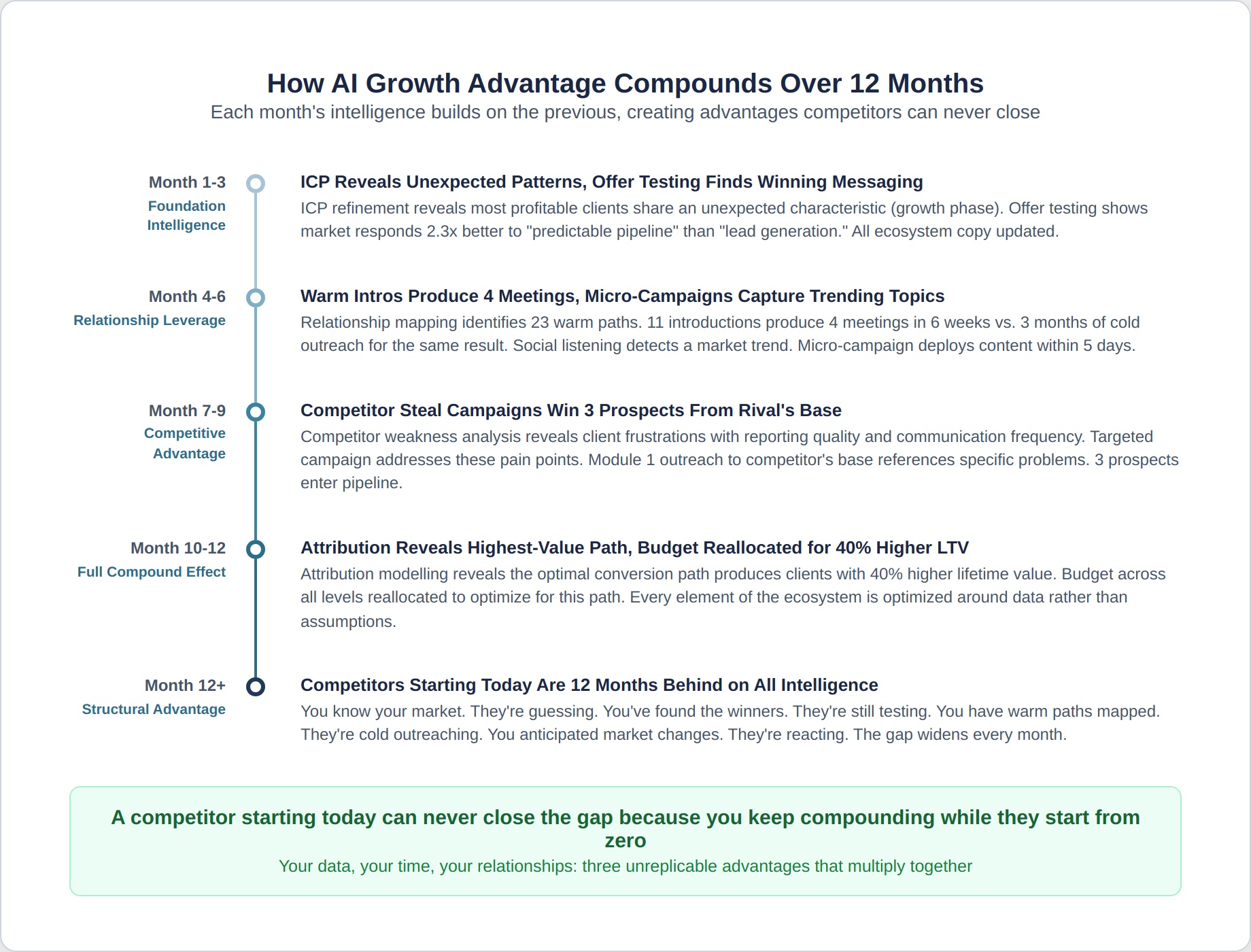
Here’s a 12-month scenario showing how AI Growth Advantage compounds:
Month 1-3: Foundation Intelligence ICP refinement reveals that your most profitable clients share a characteristic you didn’t expect: they’re all in a growth phase (recently funded, expanding team, entering new markets). This insight reshapes Module 1 outreach targeting to prioritize companies showing growth signals. Offer testing reveals that your market responds 2.3x better to “predictable pipeline” messaging than “lead generation” messaging. Every level’s copy is updated.
Month 4-6: Relationship Leverage Relationship mapping identifies 23 warm introduction paths to companies on your target account list. Your sales team requests 15 introductions and receives 11. Those warm introductions produce 4 meetings in 6 weeks, compared to 3 months of Module 1 cold outreach to produce the same number from the same account list. Social listening identifies a trending concern in your market (a regulatory change affecting your target industry). You publish Level 4 content and Level 5 video about it before competitors react. AI Growth Advantage’s micro-campaign builder pushes the content through Level 6 ads to the affected audience within 5 days of the announcement.
Month 7-9: Competitive Advantage Competitor steal analysis reveals that a major competitor’s clients are frustrated with the quality of their reporting and the frequency of their communications. You develop a specific campaign addressing these pain points without naming the competitor. Module 1 outreach to the competitor’s client base references the specific problems those clients experience. 3 prospects from the competitor’s base enter your pipeline.
Month 10-12: Full Compound Effect Attribution modelling reveals that the highest-value conversion path is: Module 1 outreach → Level 5 video watch → Level 3 newsletter subscribe → Level 4 article read → Level 2 consultation booking. This path produces clients with 40% higher lifetime value than the average. Budget across all levels is reallocated to optimize for this path. ICP refinement has now processed 12 months of closed-deal data. The targeting is precise. Offer testing has identified the exact positioning, pricing, and packaging that produce the highest conversion rates. Every element of the ecosystem is optimized around data rather than assumptions.
The competitor who starts building today is 12 months behind on all of this intelligence. They’re still guessing about targeting, while you know. They’re still testing messaging while you’ve found the winners. They’re still cold, outreaching while you have warm paths mapped. They’re reacting to market changes while you anticipated them.
That gap widens every month because you keep compounding.
How AI Growth Advantage Connects to the Ecosystem
This module sits above all others because it optimizes the strategy that every level and module executes:
Informs Level 1 (Social): Which topics to post about, which hooks to use, which engagement targets to prioritize.
Informs Level 2 (Landing Pages): Which offers to promote, which messaging frames to use, which audience segments get which page variants.
Informs Level 3 (Email): Which newsletter topics produce the highest engagement, which segments deserve different content, and which referral timing is optimal.
Informs Level 4 (Content): Which topics to write about based on gap analysis and ICP refinement, which headlines will perform best based on testing data.
Informs Level 5 (Video): Which topics deserve video treatment based on audience demand, which formats hold attention based on cross-channel data.
Informs Level 6 (Paid Ads): Budget allocation based on attribution modelling, audience targeting based on ICP refinement, and creative direction based on offer testing.
Informs Module 1 (NeuroReach AI): Who to target based on ICP data, warm paths from relationship mapping, and messaging angles from offer testing.
Informs Module 2 (Lead Intelligence): Which signals to weight heaviest based on conversion data, which company profiles to prioritize.
Informs Module 3 (Conversion Tools): Which assessment questions and calculator inputs produce the most qualified leads based on ICP data?
Informs Module 4 (Sales Acceleration): Which talking points work best based on call analysis and offer testing, which objection responses produce the best outcomes.
Informs Module 5 (Content Engine): Which content angles to prioritize based on market response data.
Informs Module 6 (Nurture and Retention): Which nurture angles re-engage most effectively, which upsell timing is optimal, which client segments warrant the most attention.
Everything flows from Module 7 intelligence. It’s the strategic brain of the entire operation.
What Determines Where You Fall in the Price Range
How Long Before You See Results
Month 1: Initial testing frameworks are deployed. First offer tests run across social, email, and paid channels. ICP refinement begins by analyzing closed-deal data. Relationship mapping produces its first warm introduction paths. Social listening activates.
Month 2: First offer testing results arrive. You know which positioning frame produces the highest engagement. ICP analysis reveals initial patterns in who actually buys versus who you assumed would buy. First warm introductions are facilitated. Social engagement intelligence identifies high-value interaction opportunities.
Month 3: ICP refinement produces its first full recommendation. Targeting adjustments are applied across relevant levels and modules. Attribution modelling has enough data for initial path analysis. Micro-campaign capability is tested with a first rapid-deployment campaign. Competitor steal analysis delivers its first insights.
Months 4-6: Compounding begins. Each month’s testing is more precise because it builds on previous months’ data. ICP refinement narrows targeting progressively. Relationship mapping uncovers deeper warm paths. Offer positioning is refined through multiple testing cycles. The gap between your strategic precision and competitors’ guesswork becomes measurable.
Months 7-12: Full compound effect. ICP is data-defined rather than assumption-defined. Offer positioning is optimized through 6+ rounds of testing. Relationship intelligence has produced multiple warm introductions that converted. Attribution modelling confidently shows which investment combinations produce the highest ROI. Every strategic decision across the ecosystem is informed by accumulated intelligence.
Month 12+: AI Growth Advantage is a structural competitive advantage. You know your market better than competitors because you have 12+ months of continuous testing and refinement data they can’t access. Your targeting is precise. Your messaging is optimized. Your relationships are mapped. Your budget allocation is data-driven. Every month, the advantage compounds further because you keep learning while competitors keep guessing.
Why This Investment Makes Sense
AI Growth Advantage is the hardest module to calculate an immediate ROI for because its value is strategic rather than tactical. It doesn’t produce leads directly. It makes every lead-producing channel more effective by ensuring they target the right people with the right message through the right positioning.
Here’s how to think about the value:
If ICP refinement shifts 10% of your marketing budget from low-converting segments to high-converting segments, the same total spend produces measurably more pipeline. On a $10,000/month marketing budget, a 10% efficiency improvement is $1,000/month in effectively recovered budget.
If offer testing identifies positioning that converts at 1.5x the rate of your current messaging, every channel produces 50% more leads from the same traffic and spend.
If relationship mapping produces 3-5 warm introductions per quarter that each convert at 3-5x the rate of cold outreach, those introductions alone may produce more revenue than the module costs.
If attribution modelling reveals that 20% of your ad spend is allocated to a channel that produces minimal pipeline contribution, reallocating that spend to the highest-performing channel yields an immediate, measurable improvement.
If competitors steal campaigns, convert even 2-3 clients from competitor frustration per year, those deals represent significant revenue at no additional customer acquisition cost beyond the module investment.
The value of Module 7 is cumulative and cross-functional. It doesn’t add a single capability. It improves the effectiveness of everything else.
What This Module Solves
AI Growth Advantage solves the problem of strategic stagnation. Most companies set their targeting, positioning, pricing, and messaging once and then execute against those decisions for months or years without systematic validation. Markets change. Competitors evolve. Buyer preferences shift. The companies that continuously test, refine, and optimize their strategic decisions compound their advantages over those that don’t. Module 7 provides the intelligence infrastructure that enables continuous strategic optimization at a pace manual analysis can’t match.
What This Module Does NOT Include
- Outbound outreach execution (Module 1: NeuroReach AI — though Module 7 informs targeting and messaging)
- Anonymous visitor identification (Module 2: AI Lead Intelligence — though Module 7 uses intent data)
- Website chatbots or interactive tools (Module 3: AI Conversion Tools)
- Sales call preparation or CRM automation (Module 4: AI Sales Acceleration — though Module 7 informs talking points)
- Content production or repurposing (Module 5: AI Content Engine — though Module 7 informs topics and angles)
- Lead nurture or retention automation (Module 6: AI Nurture and Retention)
- Execution of any ecosystem level (Levels 0-6 — Module 7 informs strategy across all levels, but doesn’t execute the work)
AI Growth Advantage provides the strategic intelligence. Other modules and levels execute against it.
What You Need to Provide
- Onboarding conversation (90 minutes): Deep strategic alignment covering your market, competitors, current positioning, pricing, client history, professional network, and growth goals
- CRM and analytics access: Full access to historical data for ICP analysis, attribution modelling, and relationship mapping
- LinkedIn access: For relationship mapping and social engagement intelligence
- Client history: Detailed information about past and current clients, including how they found you, why they bought, what they paid, how long they stayed, and which ones were most profitable
- Competitive intelligence input: Which competitors do you encounter most? What do you hear from prospects about alternatives? Where do you win and lose?
- Monthly strategy review (45-60 minutes): Review testing results, ICP data, relationship opportunities, and strategic recommendations. This is the most important monthly meeting in the entire ecosystem because it shapes the decisions that every other level and module executes.
- Quarterly deep strategy session (60-90 minutes): Comprehensive review of accumulated intelligence, 12-month trend analysis, and strategic planning for the next quarter
Total monthly time commitment: approximately 3-5 hours, with the monthly strategy review being the most critical investment of time.
Who Manages This
Rod Agatep personally leads every aspect of AI Growth Advantage. This is not a module that can be delegated to a junior team member because it requires the strategic depth to interpret complex data patterns, the market experience to know which signals matter and which are noise, and the judgment to translate intelligence into actionable strategy across seven ecosystem levels and six other modules simultaneously.
With 27 years of experience in B2B marketing strategy, Rod has seen enough market cycles, competitive dynamics, and business model evolutions to interpret the patterns AI surfaces and translate them into decisions that produce outcomes. The AI provides the data. Rod provides the wisdom to use it well.
AI Growth Advantage Readiness Assessment
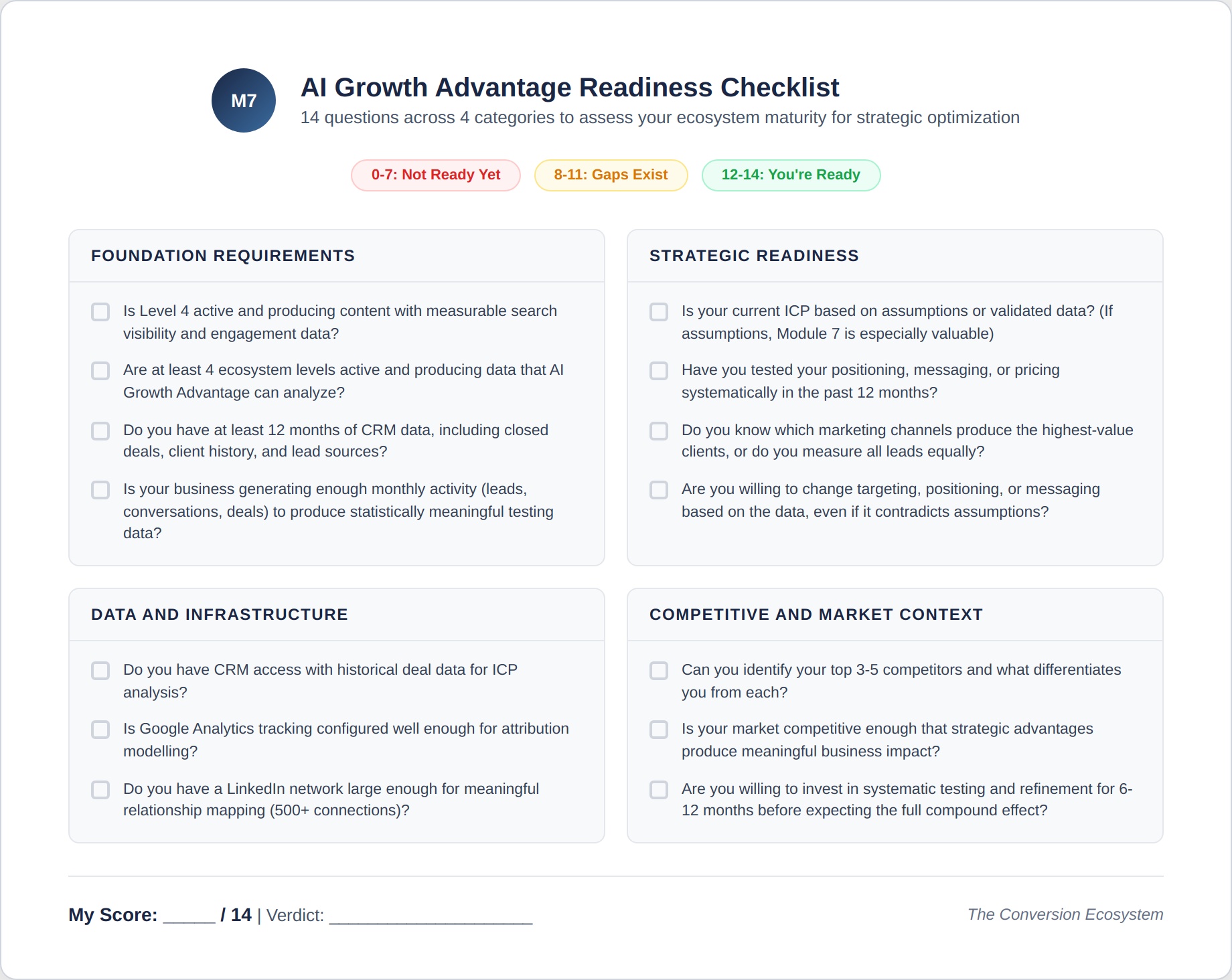
Scoring
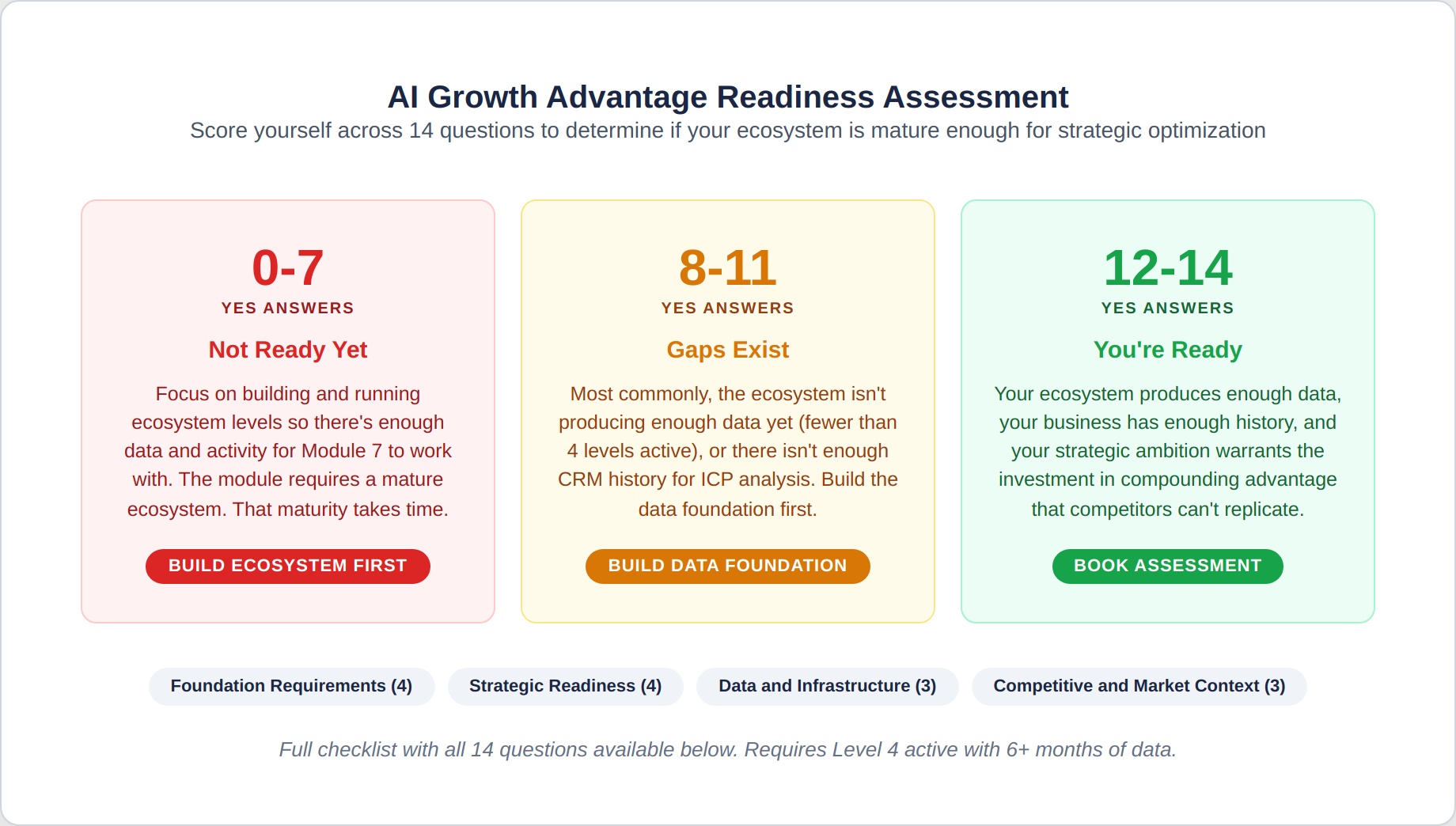
12-14 YES answers: You’re ready. Your ecosystem produces enough data, your business has enough history, and your strategic ambition warrants the investment in compounding advantage.
8-11 YES answers: Gaps exist. Most commonly, the ecosystem isn’t producing enough data yet (fewer than 4 levels active), or there isn’t enough CRM history for ICP analysis. Build the data foundation first.
7 or fewer YES answers: AI Growth Advantage won’t produce enough value yet. Focus on building and running the ecosystem levels so there’s enough data and activity for Module 7 to work with. The module requires a mature ecosystem. That maturity takes time.
Pricing Summary
| Option | Investment |
|---|---|
| AI Growth Advantage monthly | $2,500 – $5,000/month |
| Annual commitment | 20% off monthly rate |
| Combined with other AI Growth Modules | 10-15% multi-module discount |
What’s included: Offer testing (positioning, packaging, pricing), ICP refinement loops with lifetime value analysis and negative ICP identification, AI social engagement intelligence (comment engagement, smart DMs, social listening, profile optimization), warm outreach triggers, relationship mapping with warm introduction paths, referral timing and prompt system, partner identification, multi-touch attribution modeling with path analysis, micro-campaign building and deployment, competitor steal campaign development, monthly strategy reporting, and quarterly deep strategy sessions.
What’s not included: Execution of any ecosystem level (Levels 0-6), outbound outreach execution (Module 1), visitor identification (Module 2), conversion tools (Module 3), sales automation (Module 4), content production (Module 5), or nurture automation (Module 6). Module 7 provides the strategic intelligence. Other modules and levels execute against it.
Next Step
If you’re not sure whether AI Growth Advantage is the right module, whether your ecosystem produces enough data to support it, or whether your business is at the stage where strategic optimization compounds meaningfully, the fastest way to find out is a conversation.
We’ll review your ecosystem maturity, assess your data depth, evaluate your competitive landscape, and tell you honestly whether Module 7 will produce the kind of compounding advantage your situation warrants, or whether building the lower levels and modules should come first.
No pitch. No pressure. Just clarity on where you stand and what to do next.
Frequently Asked Questions
Is this module worth it if I already know my market well?
Yes, often more so. Companies that know their market well tend to have strong assumptions. AI Growth Advantage tests those assumptions against actual data and frequently reveals blind spots: audience segments that convert better than expected, messaging angles that outperform the “proven” approach, and relationship paths that were invisible. The companies that benefit most from Module 7 are often the ones that thought they knew everything and discovered through data that they had significant optimization opportunities.
How is this different from a marketing strategy consultant?
A strategy consultant provides recommendations based on their experience and a point-in-time assessment. AI Growth Advantage provides continuous, data-driven intelligence that updates every month based on real market feedback from your specific ecosystem. A consultant tells you what they think will work. Module 7 tells you what the data shows is working. Both have value. Module 7’s value compounds because it never stops learning.
Can I start Module 7 before the others?
Module 7 requires ecosystem data to analyze. Without multiple active levels producing engagement, conversion, and sales data, there’s not enough signal for the intelligence to be meaningful. We recommend a minimum Level 4+ active with 6+ months of data before activating Module 7. The more levels active and the more data accumulated, the more powerful the module becomes.
How do you protect competitive intelligence?
All data, analysis, and intelligence produced by Module 7 is confidential and belongs exclusively to you. We do not share client data, strategic insights, or competitive intelligence between clients. Each engagement operates in complete isolation. Your competitive advantages remain yours.
What if the data contradicts our beliefs about our market?
That’s the point. Module 7 often reveals that assumptions about ideal clients, best messaging, and optimal pricing are partially or significantly wrong. The value is in discovering this through systematic testing rather than through years of gradually declining results. When the data contradict beliefs, we present the evidence clearly and recommend adjustments. You decide whether to act on the data. In our experience, clients who follow the data consistently outperform those who override it with assumptions.
How does attribution modelling work with long B2B sales cycles?
B2B sales cycles can span months. Attribution modelling accounts for this by tracking the full journey from the first touchpoint through to the closed deal, regardless of how long it takes. The model becomes more accurate over time as more complete journeys are captured. Early attribution insights (months 1-3) are directional. Mature attribution insights (months 6+) are reliable enough for confident budget allocation decisions.
What are the cancellation terms?
Month-to-month with 30 days’ notice. Annual at 20% off with a 12-month term. The early termination fee equals the discount on the completed months. You retain all ICP analysis, testing data, relationship maps, attribution models, competitive intelligence, and strategic recommendations. All intellectual property produced during the engagement belongs to you.
Do I own the intelligence?
Yes. Every analysis, every model, every map, every testing dataset, every strategic recommendation, and every piece of competitive intelligence belongs to you. If the engagement ends, all intellectual property remains yours. There are no data retention clauses, intelligence holdback terms, or model removal provisions.