
How AI Implementation Consulting Pricing Works
AI implementation consulting is a structured advisory engagement that guides your business through every decision between wanting AI and having AI that produces measurable results. The investment depends on the number of AI applications being evaluated, the complexity of your existing infrastructure, the depth of vendor evaluation required, and whether the engagement includes ongoing advisory support through deployment and optimization. Every business comes to this engagement with a different starting point and different goals, which is why every engagement is scoped individually.
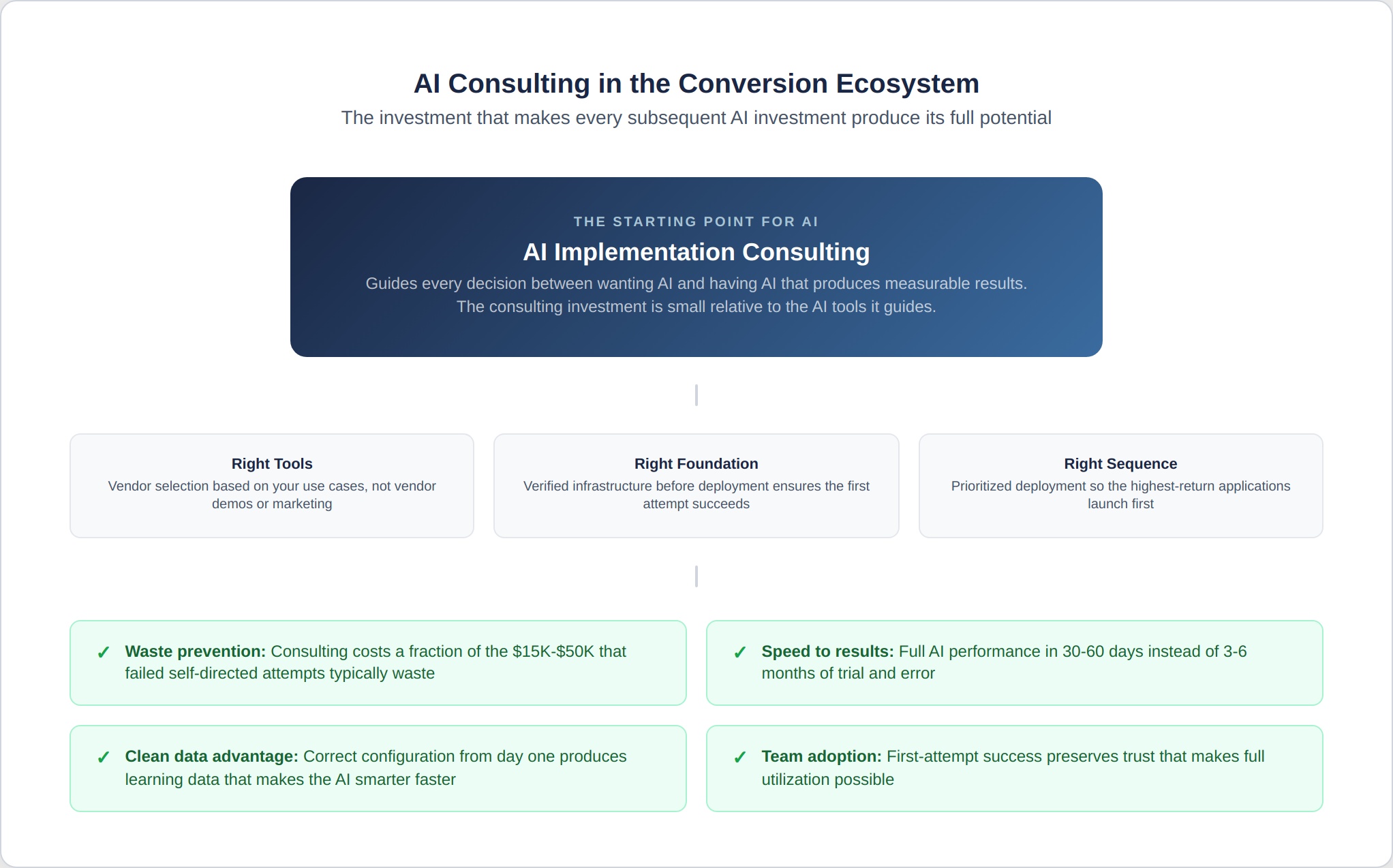
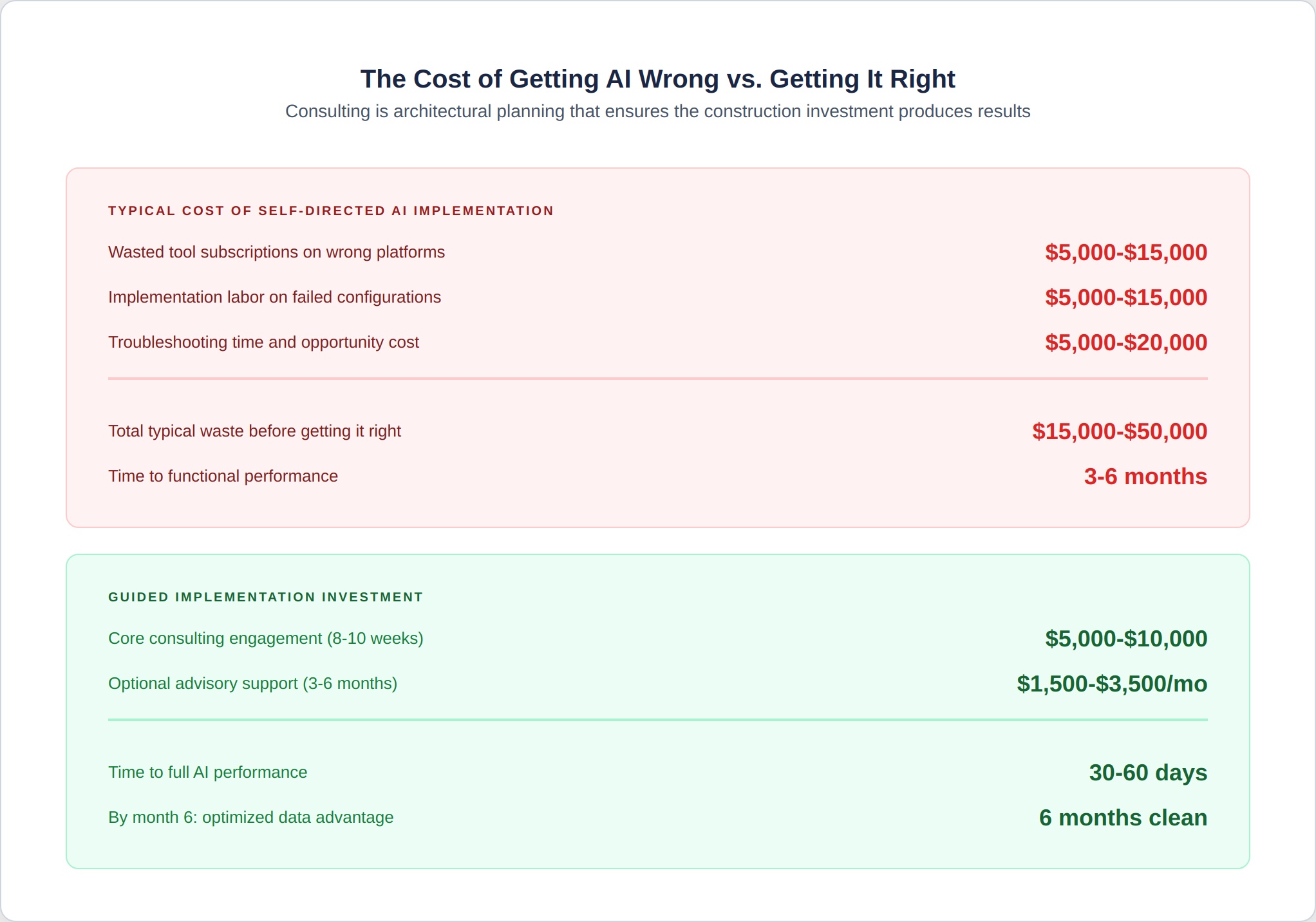
The consulting investment is separate from and significantly smaller than the AI tools and implementation it guides. Think of it as the architectural planning phase that ensures the construction investment produces the intended results. Businesses that skip this phase and go directly to purchasing AI tools typically spend $15,000 to $50,000 in wasted subscriptions, failed implementations, and troubleshooting before getting it right. The consulting investment prevents that waste by ensuring the first deployment is the right one.
What’s Included in Each Phase of the Consulting Engagement
AI Readiness Assessment and Foundation Evaluation
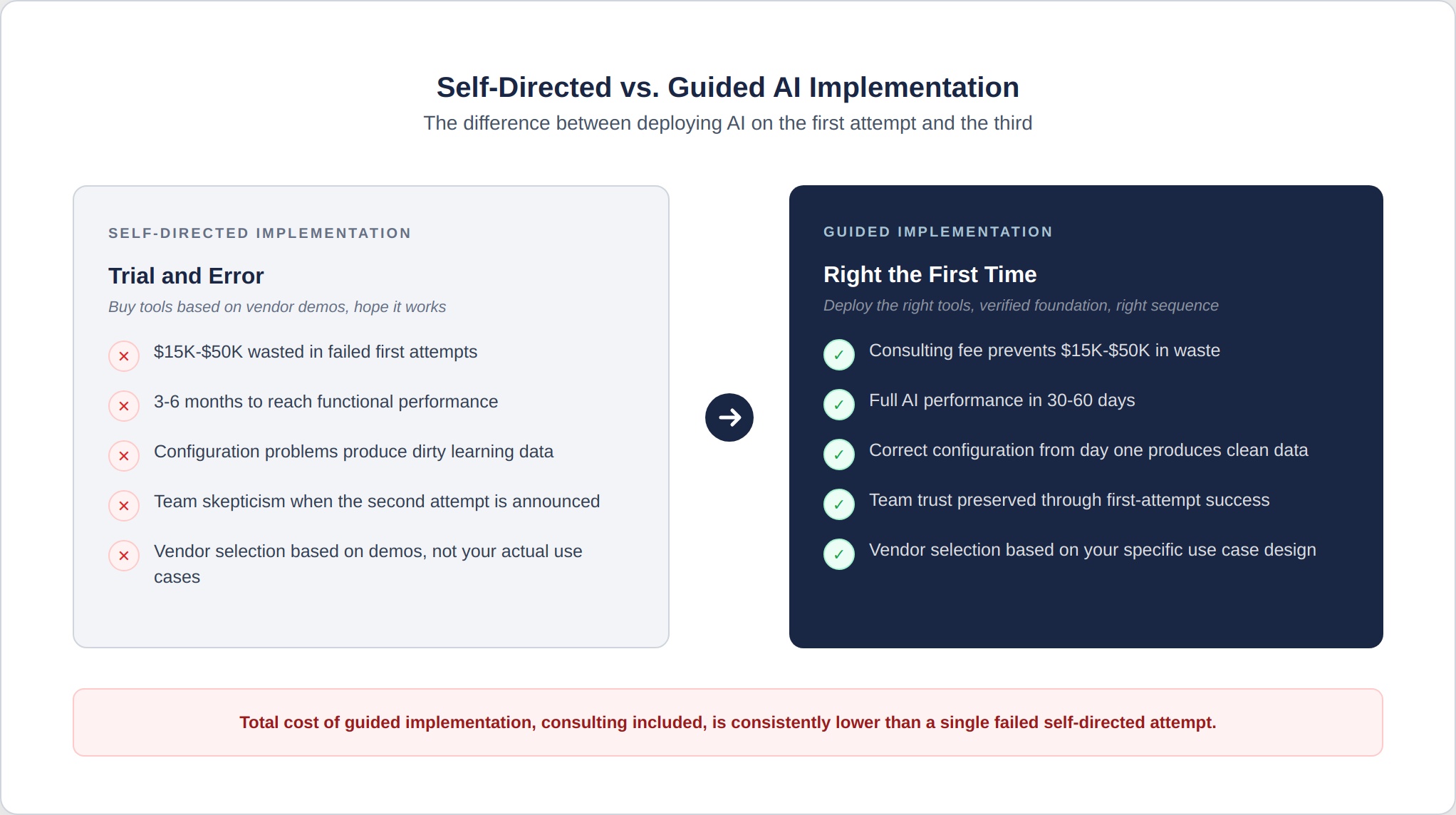
Complete evaluation of your infrastructure’s ability to support AI deployment. CRM data quality audit covering completeness, tagging consistency, duplicate rate, and historical depth for model training. Technology stack integration assessment identifying API capabilities, native connections, and data silo risks. Process maturity review identifying where AI deployment requires workflow changes, new handoff procedures, or updated response protocols. The deliverable is a readiness scorecard for each AI application relevant to your business, showing what you can deploy immediately and what requires foundation work first, with specific steps to close each gap.
AI Application Prioritization and Use Case Design
Specific analysis of which AI applications produce the fastest measurable return in your situation, based on your operations, revenue model, pipeline bottlenecks, and competitive landscape. Not a generic recommendation. A specific prioritization based on your data. Each recommended application includes detailed use case design: what it needs to do in your business, the qualification criteria it applies, the routing logic it follows, the CRM fields it populates, the handoff processes it uses, and the integration specifications it requires. The deliverable is a prioritized deployment sequence with detailed use case specifications for each application.
Vendor Evaluation and Technology Selection
Objective assessment of AI platforms against your specific use case design, integration requirements, data structure, and budget. Not a generic comparison chart. A specific evaluation based on how well each vendor serves your deployment plan. Includes integration compatibility testing against your existing stack, contract term analysis identifying common gotchas, and a negotiation brief for better pricing and terms. The deliverable is a vendor recommendation with specific rationale, configuration specifications, and contract guidance.
Implementation Roadmap and Deployment Specifications
Detailed build guide your team or technology partner follows to deploy correctly the first time. Covers every configuration decision: conversation scripts, qualification criteria, scoring thresholds, CRM field mappings, calendar integration rules, trigger definitions, escalation paths, and monitoring dashboards. Phased deployment with measurable benchmarks at each stage and diagnostic protocols for troubleshooting. The deliverable is a complete implementation roadmap with specifications detailed enough that your team can execute without guessing.
Team Training and Adoption Planning
Role-specific training plan for every team member affected by AI deployment. For voice agents: how reps handle AI-to-human transfers and use context briefings. For chat agents: how to monitor conversation quality and update knowledge bases. For prospecting engines: how to translate signal-enriched profiles into personalized outreach. Includes change management strategy addressing adoption resistance, graduated rollout plan, and metrics showing each person how AI makes their work more effective. The deliverable is a training and adoption plan designed to achieve full team utilization rather than underutilization that wastes the technology investment.
Ongoing Advisory and Optimization Support
Structured post-deployment support reviewing system performance data, identifying optimization opportunities, diagnosing underperformance, and guiding expansion decisions based on live data. The advisory period is where the most valuable insights emerge because the AI is processing real data from your specific market. Covers model recalibration, expansion timing, cross-application intelligence connections, and strategic adjustments informed by what the live system reveals. The deliverable is ongoing strategic guidance that ensures your AI investment reaches its full performance potential rather than plateauing at its initial configuration.
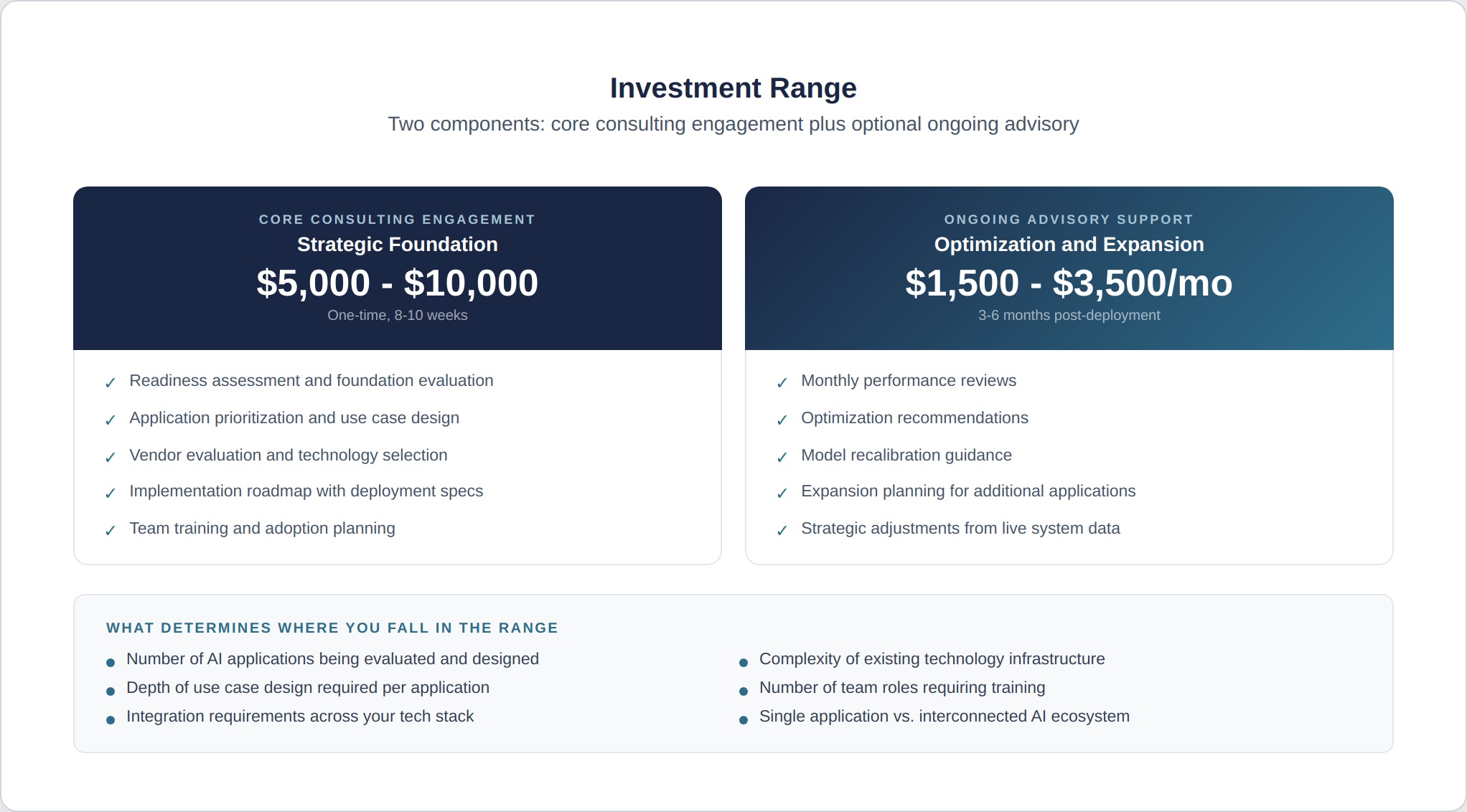
The AI Implementation Consulting engagement has two investment components:
Core Consulting Engagement (8-10 weeks)
Typical investment range: $5,000 to $10,000 for the complete consulting engagement covering readiness assessment, application prioritization and use case design, vendor evaluation, implementation roadmapwith deployment specifications, and team training and adoption planning. The range depends on the number of AI applications being evaluated, the complexity of your infrastructure, and the depth of use case design required. A business evaluating a single AI application with a straightforward technology stack falls toward the lower end. A business evaluating three to five applications with complex integrations and multiple user roles falls toward the higher end.
Ongoing Advisory Support (3-6 months post-deployment)
Typical investment range: $1,500 to $3,500 per month for ongoing advisory including monthly performance reviews, optimization recommendations, recalibration guidance, and expansion planning. The advisory duration depends on the number of applications deployed and the complexity of the optimization required. Most businesses engage advisory for three to six months after initial deployment, with the option to extend if additional applications are being phased in. The advisory is optional but strongly recommended because the optimization period is where AI systems transition from functional to high-performing.
Total typical engagement investment: $5,000 to $10,000 for core consulting plus $4,500 to $21,000 for three to six months of advisory support, for a total range of approximately $9,500 to $31,000 depending on scope and duration. This compares to the $15,000 to $50,000 that self-directed implementations typically waste in failed first attempts, making the consulting investment a net savings even before accounting for the faster time to results and the higher performance ceiling that guided deployment produces.
What Determines Where You Fall in the Range
Number of AI applications being evaluated and designed. A single voice agent deployment is a different scope than a full AI ecosystem covering voice, chat, prospecting, and automations. Complexity of your existing technology infrastructure and the integration requirements each application presents. Depth of use case design required, which scales with the complexity of your business processes and the number of scenarios each AI application needs to handle. Number of team roles requiring training and the adoption complexity involved. Whether the ongoing advisory covers a single application or multiple interconnected applications.
The discovery conversation before the engagement begins gives you a specific scope and investment for your situation. You’ll know exactly what’s included, what the timeline looks like, and what the deliverables are before any commitment.
Why the Consulting Investment Produces Better Economics Than Self-Directed Implementation
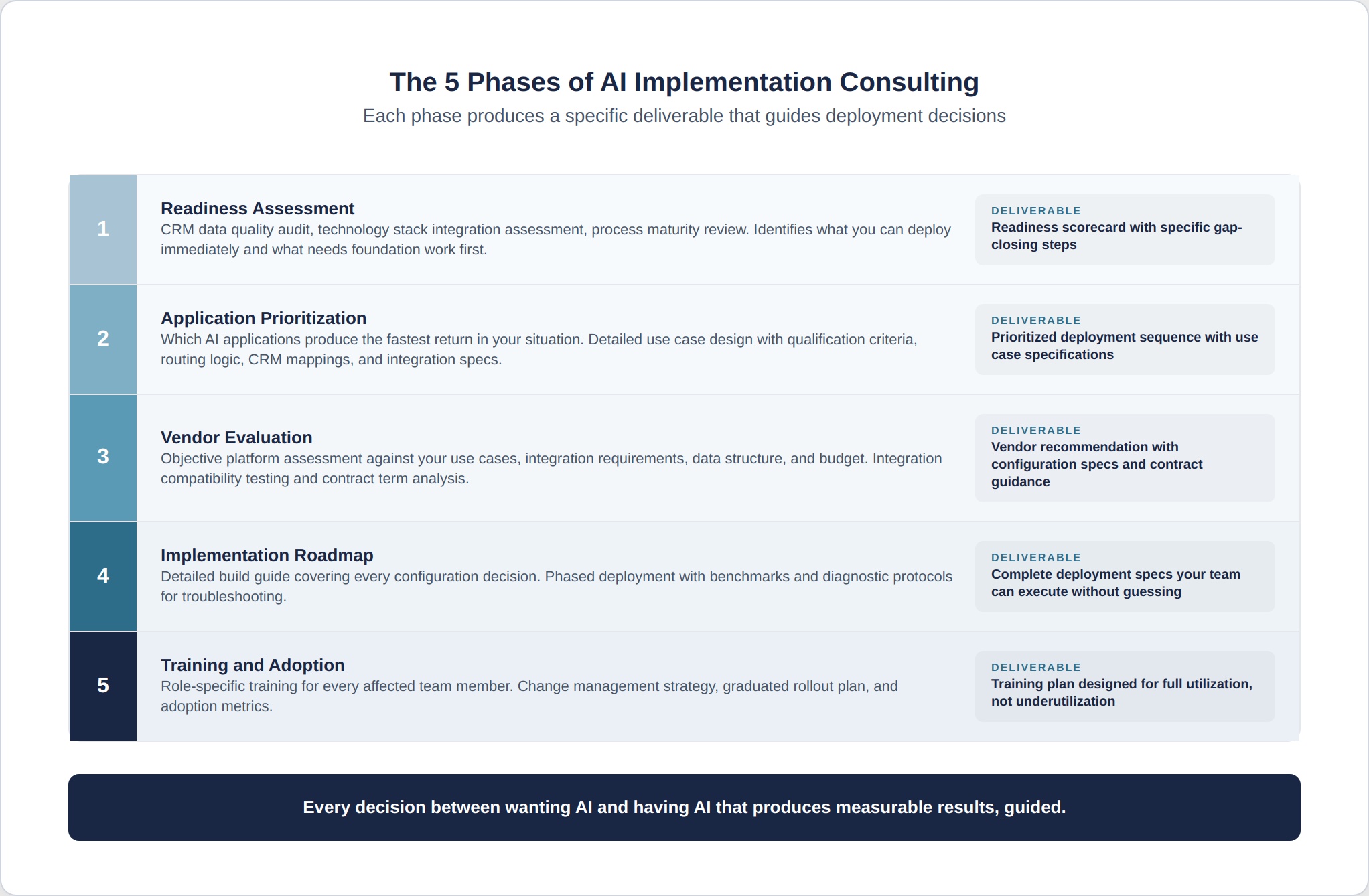
The math is straightforward. A failed self-directed AI implementation typically costs $15,000 to $50,000 in wasted tool subscriptions, implementation labor, troubleshooting time, and opportunity cost before the business regroups and tries again. A guided implementation costs the consulting fee plus the targeted tool investment, reaches full performance in weeks instead of months, and avoids the waste entirely. The total cost of successful guided implementation, consulting included, is consistently lower than the cost of a failed self-directed attempt.
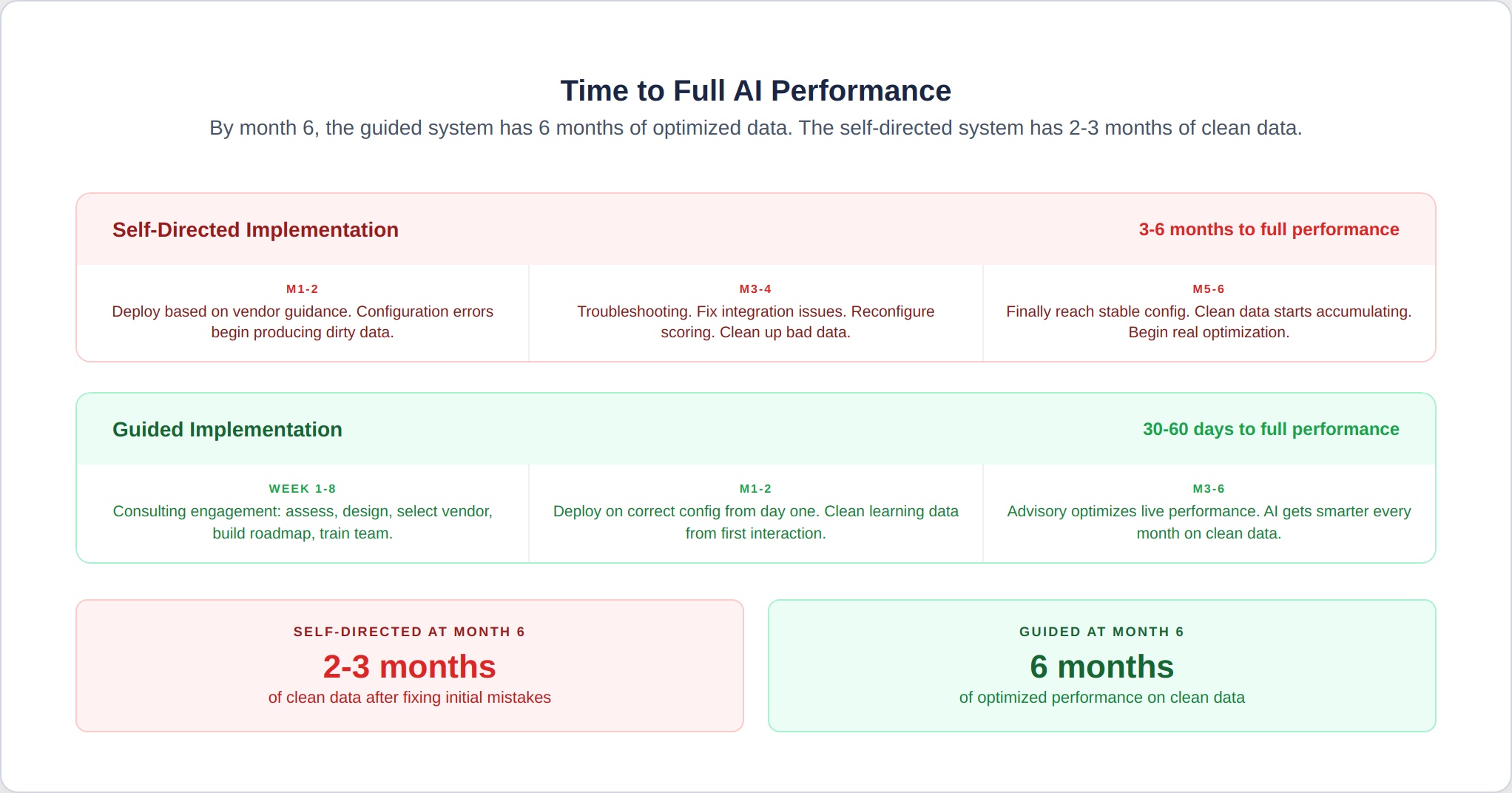
Beyond cost avoidance, the consulting produces better performance outcomes. Guided implementations reach full AI performance in 30 to 60 days. Self-directed implementations typically take three to six months to reach the same level because every avoided mistake is time not spent troubleshooting, and every correct configuration from day one produces clean learning data that makes the AI smarter faster. By month six, the guided system has six months of optimized performance. The self-directed system has two to three months of clean data after spending three to four months fixing initial configuration problems.
The consulting also prevents the organizational credibility damage that failed implementations create. When the team hears ‘we’re implementing AI’ for the second time after the first attempt failed, skepticism makes adoption harder even when the second attempt is properly planned. Getting it right the first time preserves organizational momentum and builds the trust that produces full team adoption rather than workaround behaviors that undermine the technology investment.
How the Consulting Connects to Done-for-You AI Deployment
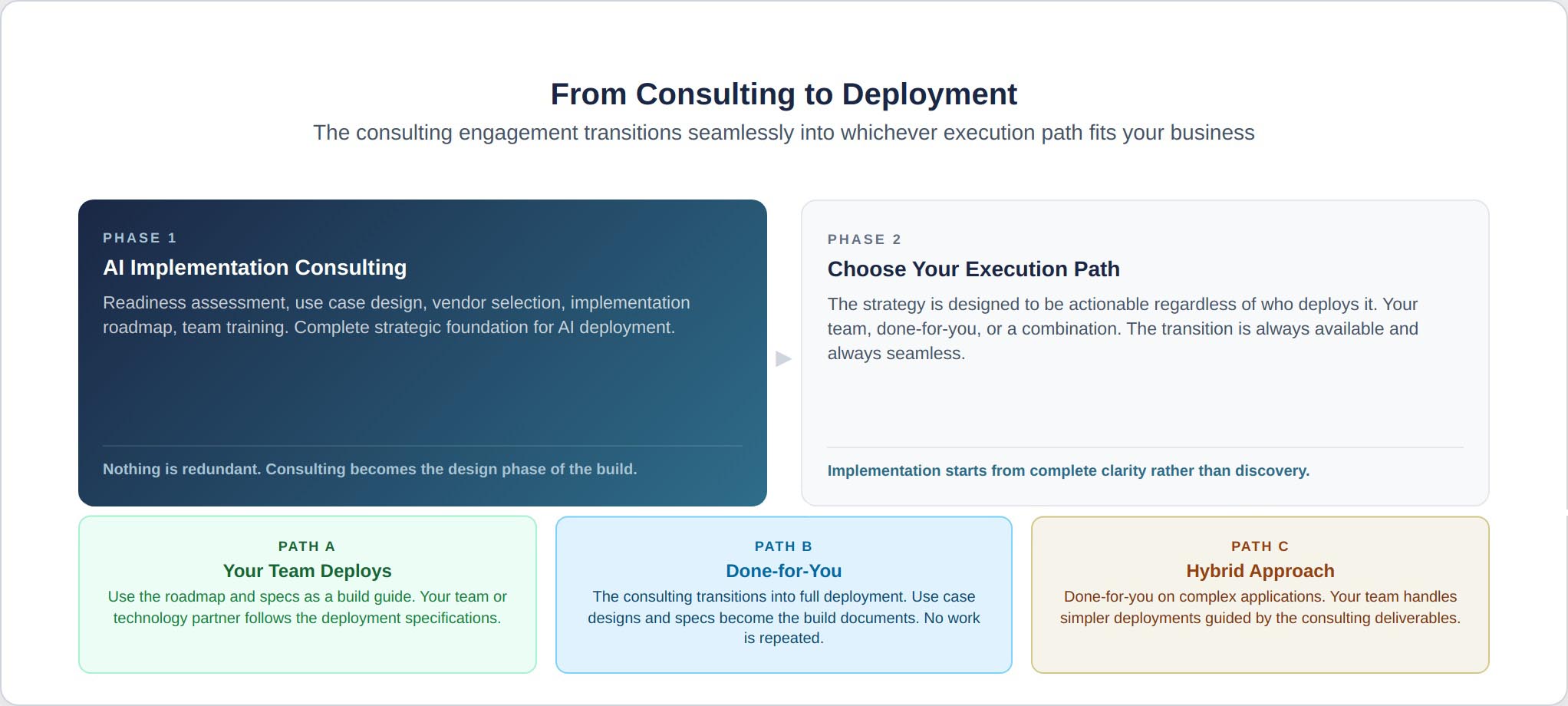
For businesses that decide they want the AI built and deployed rather than just guided through the process, the consulting engagement transitions seamlessly into done-for-you implementation. The readiness assessment, use case designs, vendor selections, and deployment specifications become the build documents for the implementation. Nothing is redundant. The consulting investment effectively becomes the strategic design phase of the full deployment, which means the implementation starts from a position of complete clarity rather than beginning with discovery work that would otherwise add weeks and cost to the project.
Many businesses start with consulting intending to have their team execute the recommendations, then decide during the engagement that done-for-you deployment makes more sense after seeing the full scope and complexity of what proper implementation involves. That transition is always available and always seamless.
The Bottom Line
AI implementation consulting is the investment that makes every subsequent AI investment produce its full potential return. Without it, you’re deploying tools based on vendor demos and hoping the foundation supports them. With it, you’re deploying the right tools, on a verified foundation, in the right sequence, with the right configurations, supported by a team trained to leverage them. The consulting investment is small relative to the AI tool investments it guides and even smaller relative to the waste it prevents. If you want your AI deployment to produce results on the first attempt rather than the third, this is where it starts.
If you’re ready to deploy AI with strategic confidence, book an AI Implementation Consulting engagement.