
How Digital Marketing Strategy Consulting Pricing Works
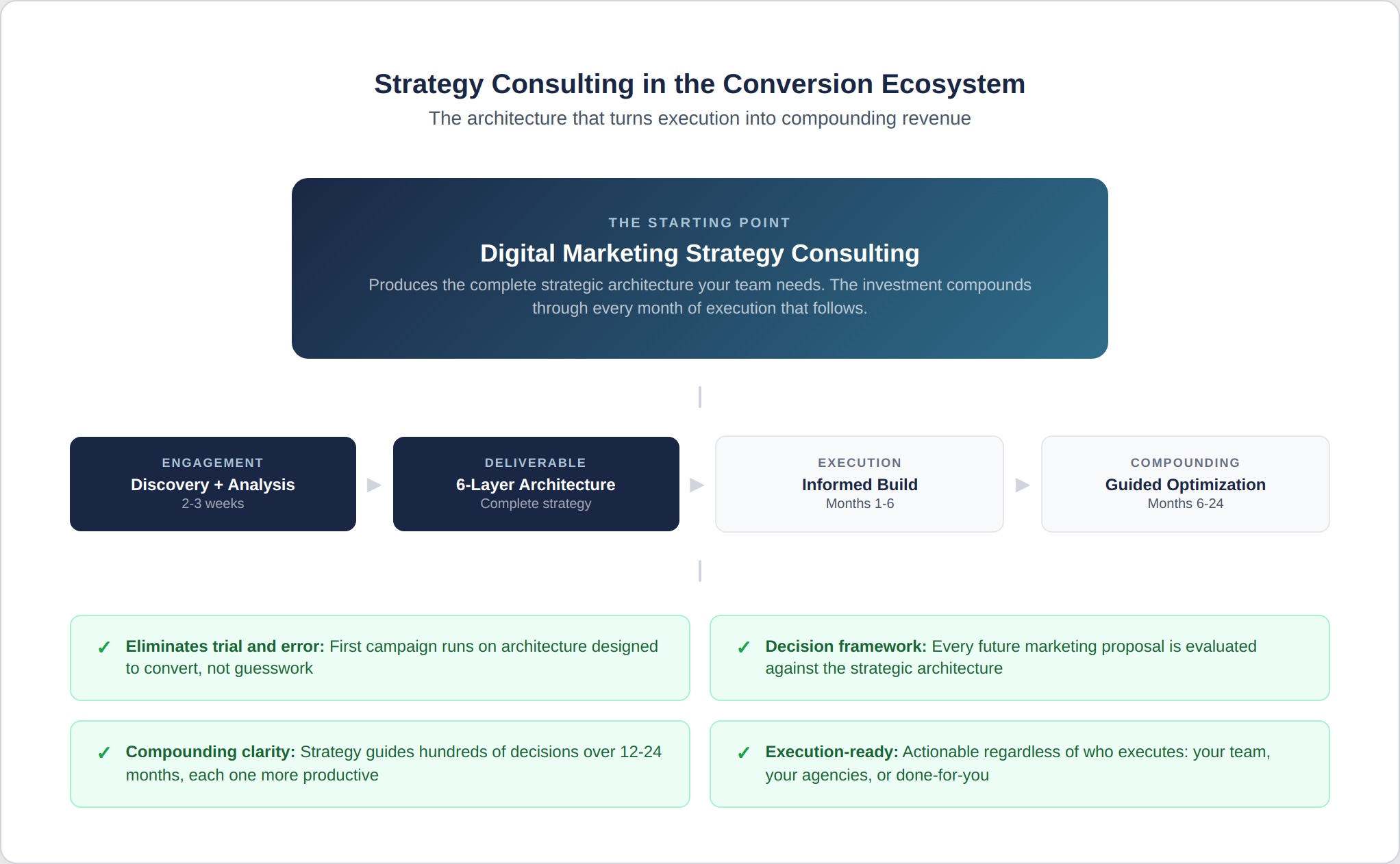
Digital marketing strategy consulting is a structured advisory engagement that produces the complete strategic architecture your team needs to execute marketing that compounds into revenue growth. The investment depends on the number of channels currently in operation, the complexity of your buyer journey and competitive landscape, the depth of data analysis required, and the scope of strategic design across the six layers of the engagement. Every business operates in different market conditions with different infrastructure, which is why every engagement is scoped individually based on your specific situation.
This is not a monthly retainer. It’s a defined engagement that produces a comprehensive strategic deliverable your team executes against for 12 to 24 months. The investment is front-loaded in strategic analysis and design, and the return compounds through every month of execution that follows because every marketing decision is guided by architecture rather than improvisation.
What’s Included in the Strategy Engagement
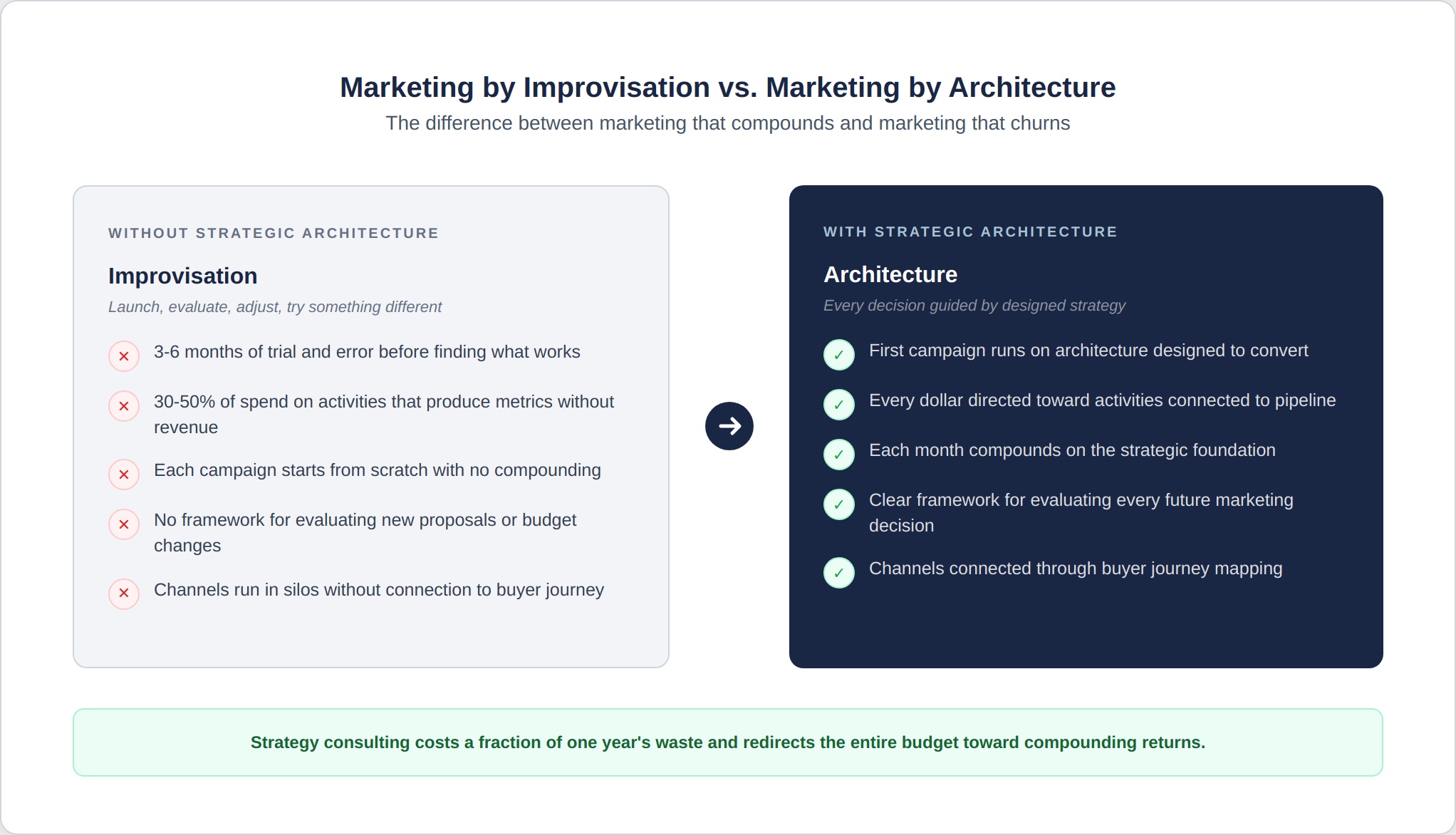
Buyer Journey Mapping and Conversion Path Architecture
Analysis of how your specific buyers actually move from first awareness to purchase decision based on real customer behavior, not theoretical funnel models. Mapping of every touchpoint your marketing needs to create at each stage. Identification of gaps between what your buyers need at each decision point and what your current marketing provides. The deliverable is a complete conversion path map showing every touchpoint, the content or experience required at each, and where current gaps are costing you pipeline.
Channel Strategy and Budget Architecture
Determination of which channels deserve investment based on where your buyers spend attention and what each channel can produce at each buyer journey stage. Budget allocation recommendations tied to pipeline contribution rather than activity metrics. Expected outputs for each channel defined in pipeline terms: cost per qualified lead, pipeline influence, and revenue contribution. The deliverable is a channel strategy with specific budget allocations, performance benchmarks, and a measurement framework that evaluates channels on revenue impact rather than vanity metrics. Includes identification of channels to stop investing in because the data shows they don’t contribute to the conversion path.
Content Strategy and Authority Architecture
Definition of exactly what topics to cover, what format each piece should take, how content maps to buyer journey stages, and how each piece connects to lead capture mechanisms. Topics selected based on the intersection of search demand, buyer journey relevance, competitive opportunity, and conversion potential. Authority architecture defining pillar content, supporting content, proof content, and differentiation content with production sequencing. The deliverable is a prioritized topic map, content calendar, lead capture strategy for each piece, and authority positioning plan.
Paid Advertising Strategy and Campaign Architecture
Campaign architecture from audience definition through conversion tracking. Platform selection based on where your buyers are active and cost-per-qualified-lead economics. Audience architecture including prospecting, retargeting, and lookalike segments. Mapping between ad messaging, landing page experience, and post-conversion follow-up for each buyer journey stage. The deliverable is a complete advertising strategy with platform recommendations, audience specifications, campaign structures, landing page specifications, and end-to-end conversion tracking requirements.
Email and Nurture Strategy Design
Complete follow-up architecture for every lead path: welcome sequences, stage-specific nurture sequences, re-engagement sequences, post-conversion sequences, and referral activation sequences. Content framework defining what each email accomplishes, what proof or value it delivers, and what behavioral triggers advance contacts between stages. The deliverable is a nurture architecture with sequence maps, content frameworks, trigger definitions, segmentation criteria, and performance benchmarks for each sequence.
Measurement Framework and Attribution Architecture
Analytics architecture connecting marketing activity to revenue outcomes. KPI definitions for each channel tied to pipeline contribution. Attribution model designed for your specific multi-touch buyer journey. Dashboard specifications for leadership visibility. Data collection plan ensuring every touchpoint is tracked and attributed. The deliverable is a complete measurement framework that enables budget and optimization decisions based on revenue reality rather than channel-level activity metrics. This single layer typically produces 20 to 40 percent improvement in marketing ROI by redirecting investment toward what actually produces customers.
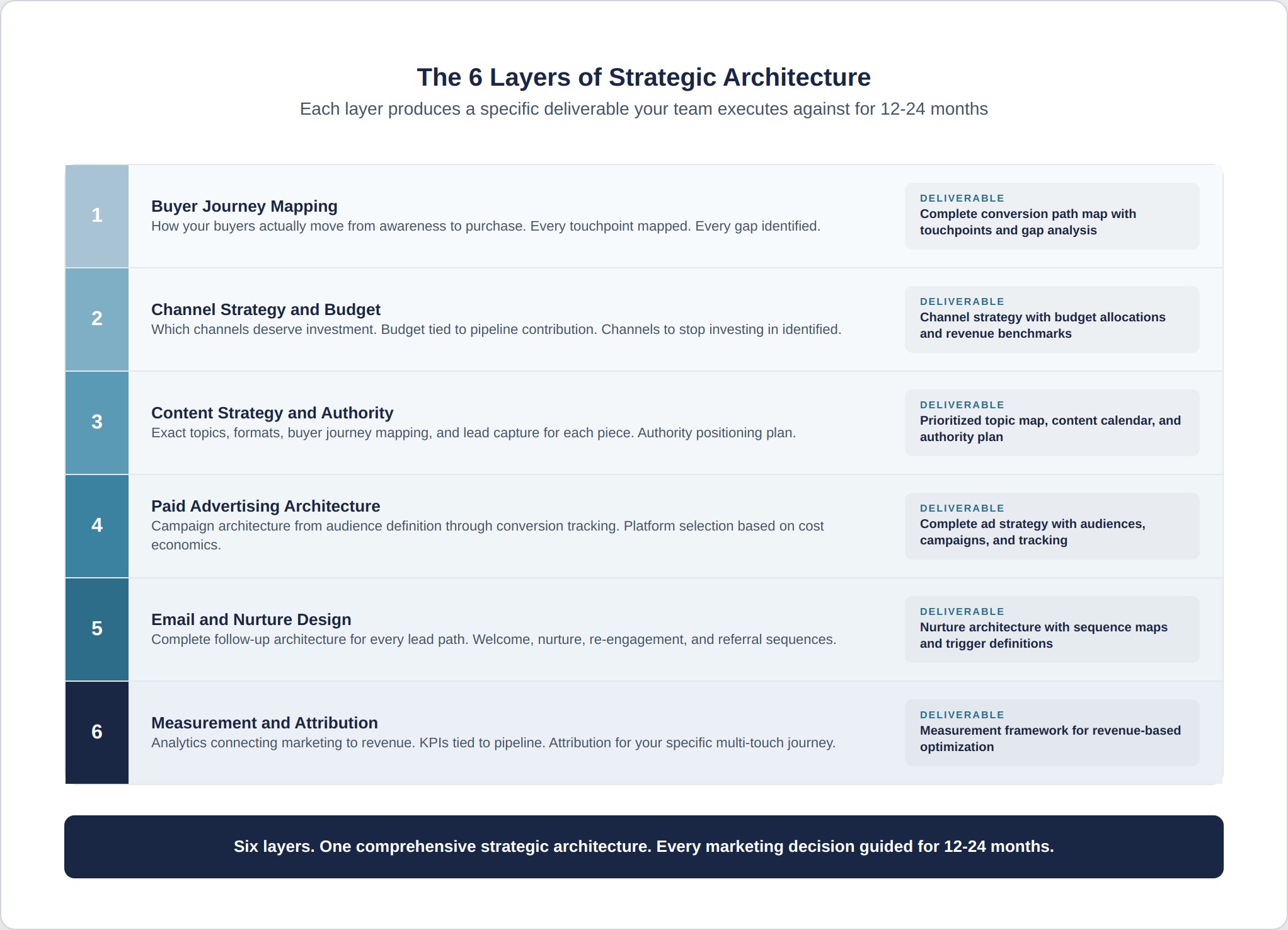
Typical investment range: $5,000 to $10,000 for the complete Digital Marketing Strategy Consultingengagement. This includes the discovery session, full six-layer analysis and strategy design, the complete strategic architecture document, the presentation session, and a 30-day follow-up support window.
What determines where you fall in the range: the number of marketing channels requiring analysis and strategic design, the complexity of your buyer journey and the number of customer segments, the competitiveness and breadth of your market, the number of platforms in your technology stack requiring integration planning, and the depth of data analysis needed across analytics, CRM, ad platforms, and email systems. Businesses with a focused market and three to four active channels fall toward the lower end. Businesses with complex multi-segment markets and six to eight active channels fall toward the higher end.
Your total direct time investment is approximately five to seven hours across the engagement: a 60 to 90 minute discovery session, one to two check-ins during the analysis phase, and a two to three hour deliverable presentation. The strategy design and analytical work happens over two to three weeks without requiring daily team involvement.
Why Strategy Consulting Produces Better Economics Than Strategy-by-Execution
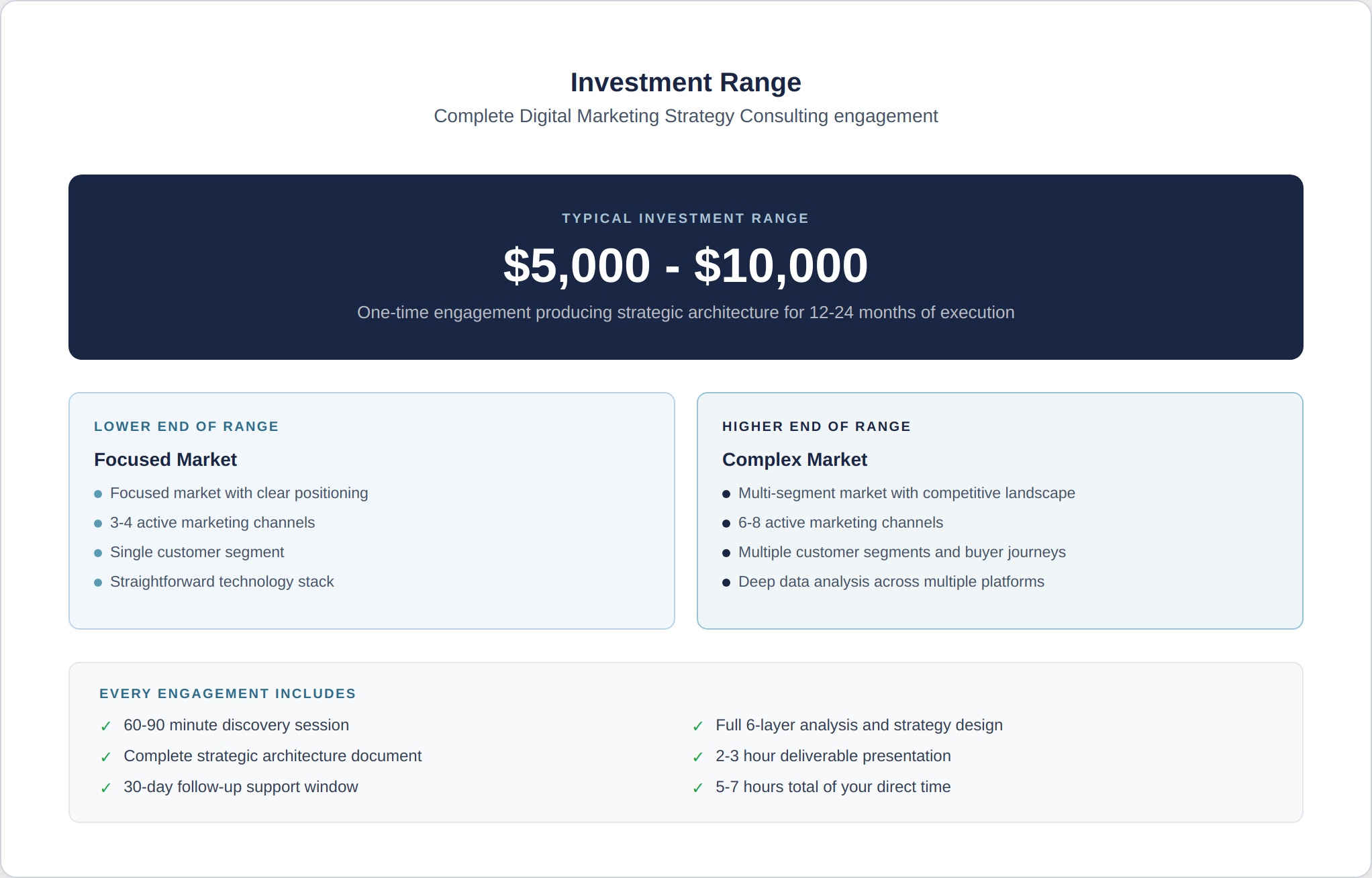
Businesses without a cohesive strategy typically waste 30 to 50 percent of their marketing spend on activities that produce metrics without producing proportional revenue. On a $10,000 monthly budget, that’s $36,000 to $60,000 per year spent on work that isn’t connected to pipeline in a measurable way. The strategy consulting engagement costs a fraction of one year’s waste and redirects the entire budget toward activities designed to produce compounding returns.
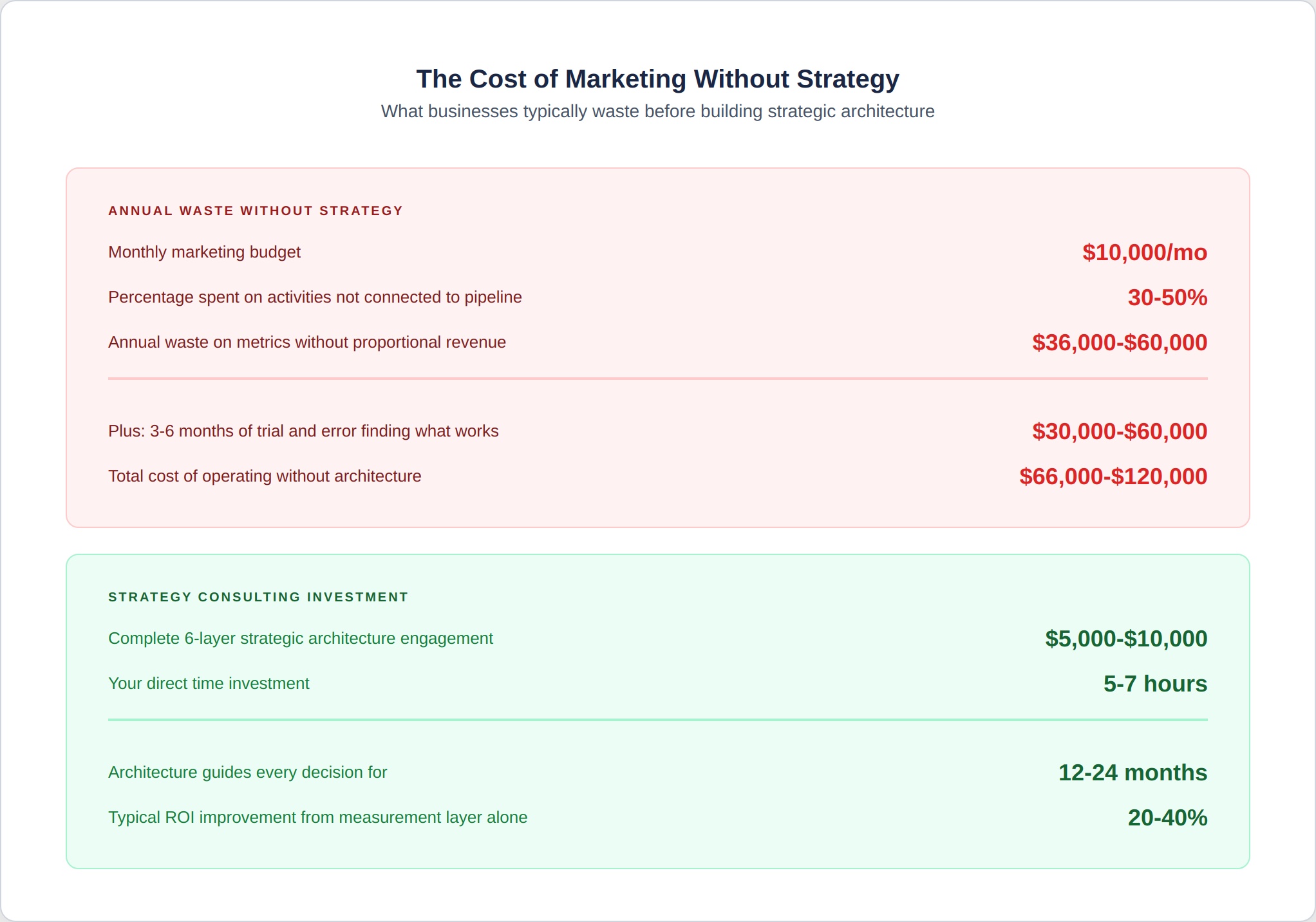
Businesses without a cohesive strategy typically waste 30 to 50 percent of their marketing spend on activities that produce metrics without producing proportional revenue. On a $10,000 monthly budget, that’s $36,000 to $60,000 per year spent on work that isn’t connected to pipeline in a measurable way. The strategy consulting engagement costs a fraction of one year’s waste and redirects the entire budget toward activities designed to produce compounding returns.
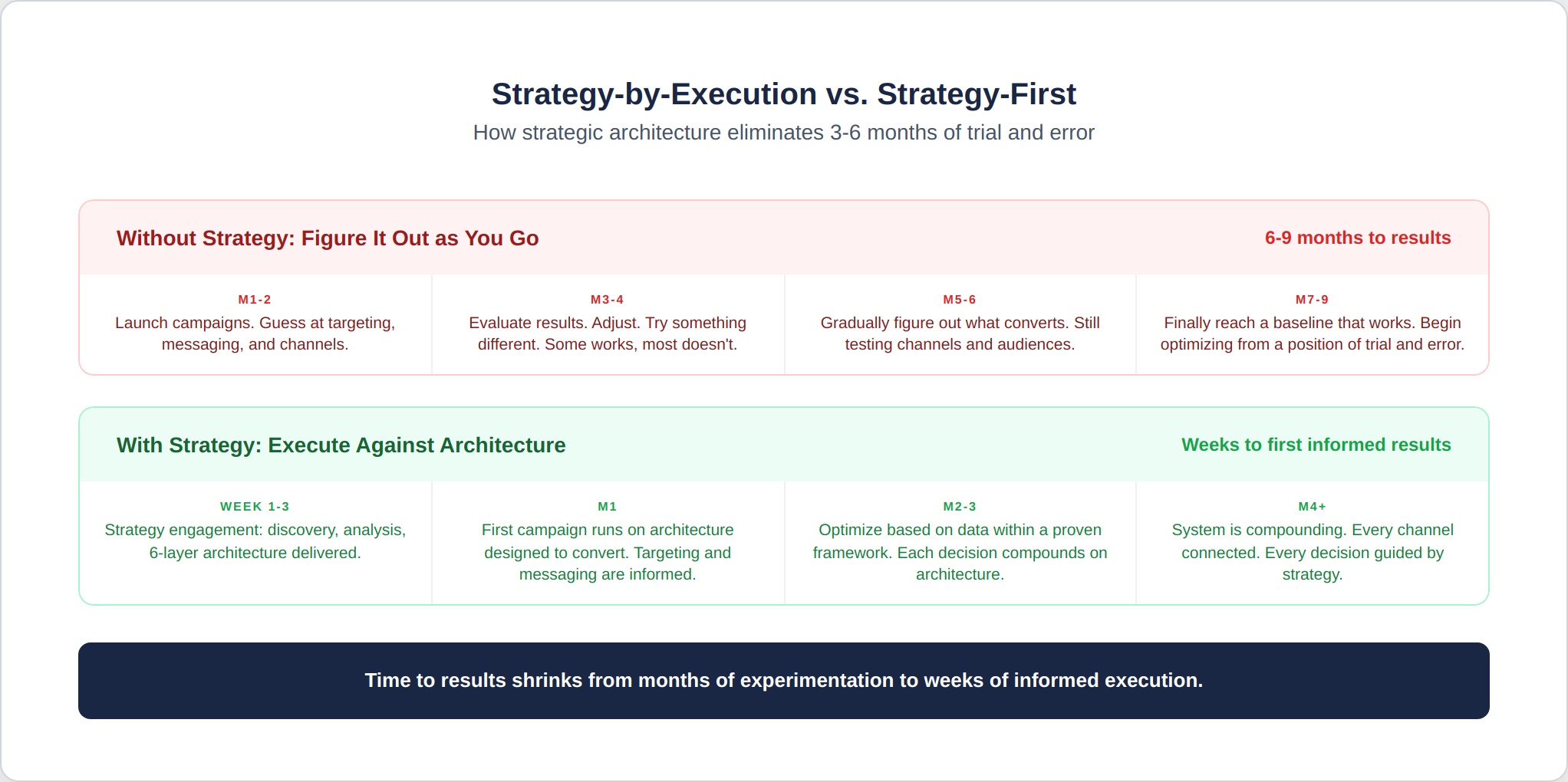
The strategy also eliminates the three to six months of trial and error that businesses go through when building marketing execution without architecture. Instead of launching a channel, evaluating results, adjusting, trying something different, and gradually figuring out what works, your team launches with a strategy that reflects data analysis, competitive intelligence, and buyer journey mapping. The first campaign runs on architecture designed to convert. The first content piece targets a topic designed to produce pipeline. The first email sequence follows a nurture path designed around actual buyer behavior. Time to results shrinks from months of experimentation to weeks of informed execution.
The strategic architecture also provides a framework for evaluating every future marketing decision. When an agency proposes a new campaign, you evaluate it against the architecture. When a team member suggests a new channel, you check whether it serves a specific stage of the buyer journey. When a budget increase is available, the architecture tells you exactly where additional investment produces the highest incremental return. That decision-making clarity compounds over the 12 to 24 months the strategy remains relevant, making every marketing dollar more productive across hundreds of decisions.
What Happens After the Strategy Is Delivered
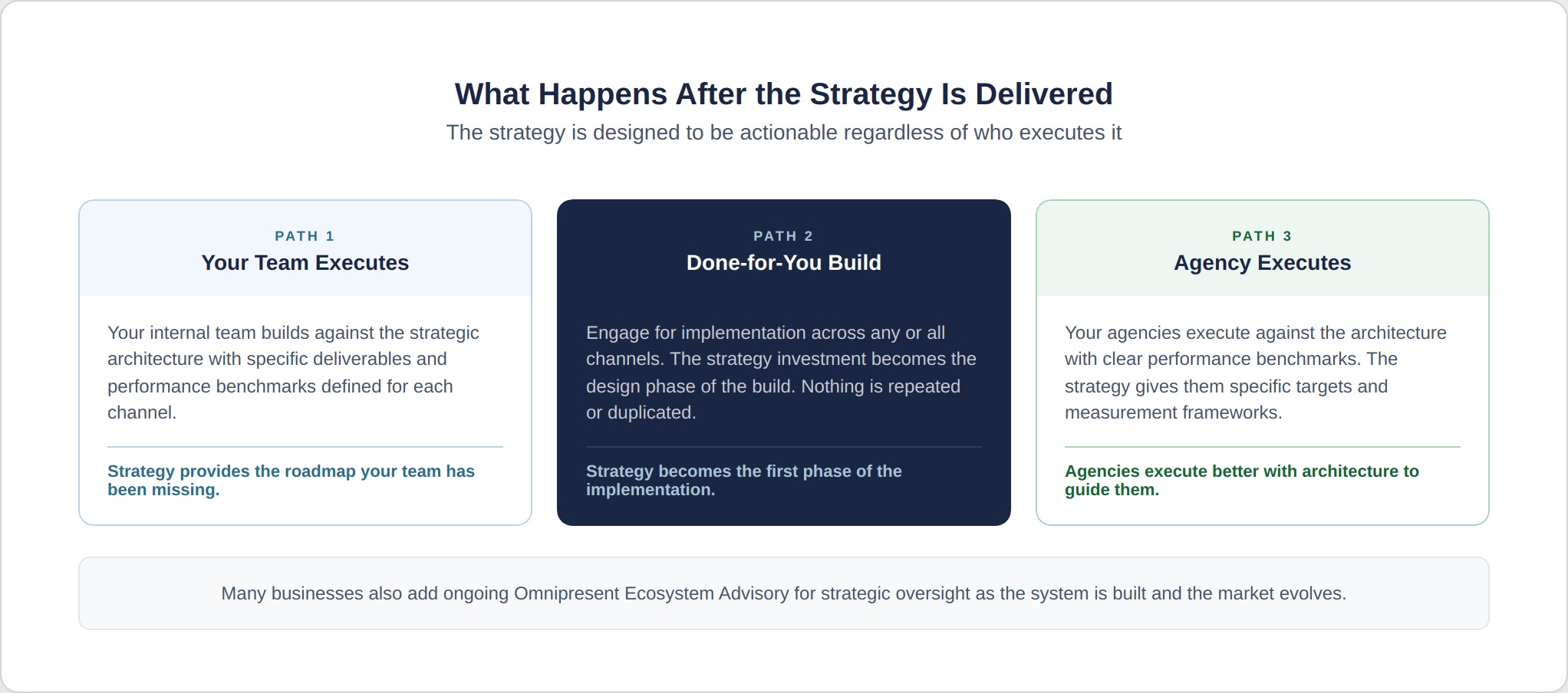
The strategy is designed to be actionable regardless of who executes it. Your internal team can build against it. Your agencies can execute against it with specific deliverables and performance benchmarks defined. Or you can engage me for done-for-you implementation across any or all channels. For businesses that move from strategy to implementation with me, the strategy investment becomes the design phase of the build, meaning nothing is repeated.
Many businesses also transition into an Omnipresent Ecosystem Advisory engagement for ongoing strategic oversight as the system gets built and the market evolves. The strategy defines the initial architecture. The advisory ensures the architecture adapts to changing conditions and continues compounding rather than gradually drifting out of alignment with market reality.
The Bottom Line
Your team can execute. What they need is the architecture that tells them what to execute, in what order, connected in what way, measured against what outcomes. Digital marketing strategy consulting provides that architecture. The investment is a fraction of the annual marketing spend it redirects, and the return compounds across every marketing decision made in the 12 to 24 months that follow. If your marketing effort is strong but your revenue results don’t reflect it, the problem is almost certainly strategic. This engagement solves it.
If you’re ready to give your team the strategic architecture that turns execution into compounding revenue, book a Digital Marketing Strategy Consulting engagement.