
How AI Automation Pricing Works and Why Every Business Gets a Different Number
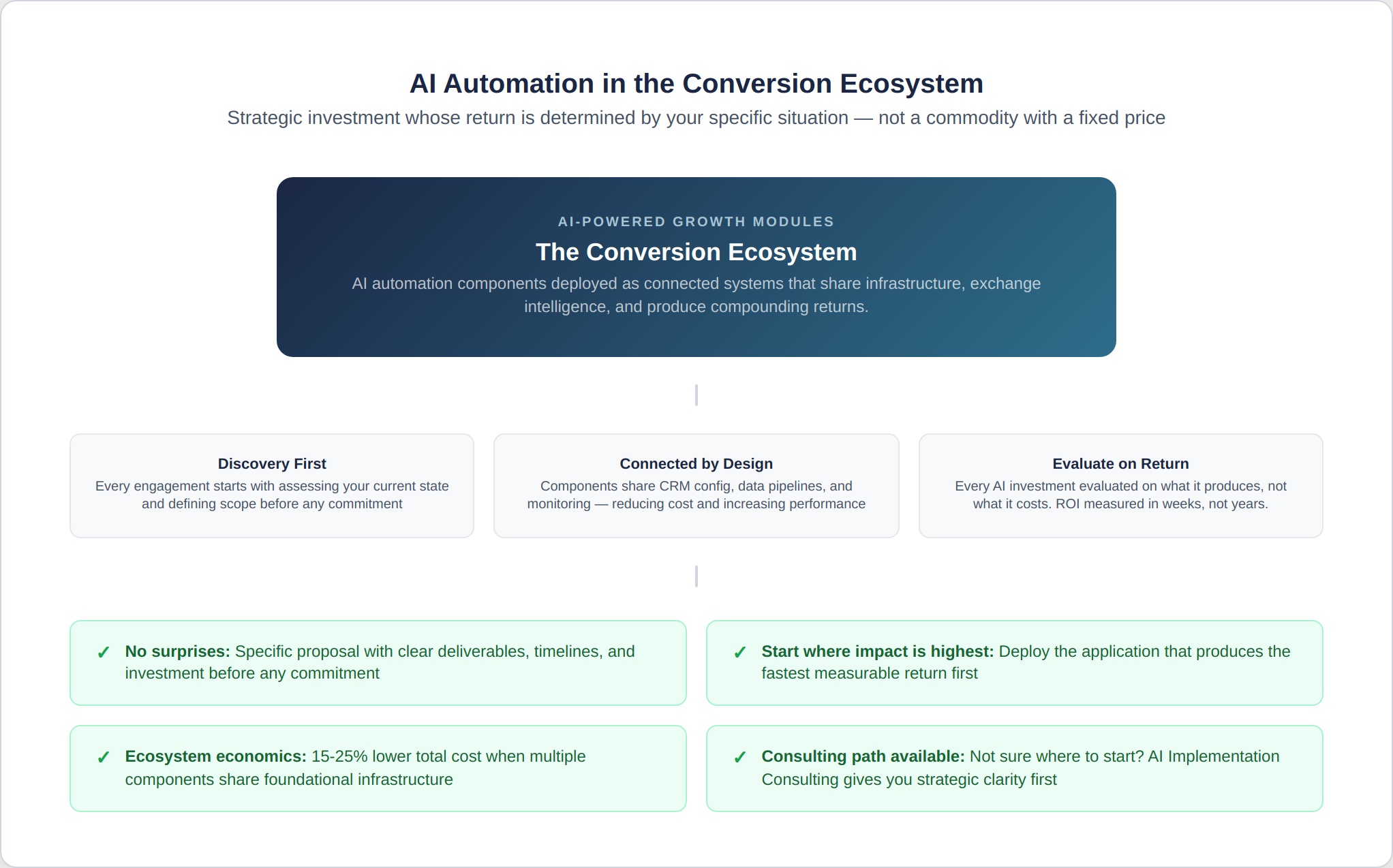
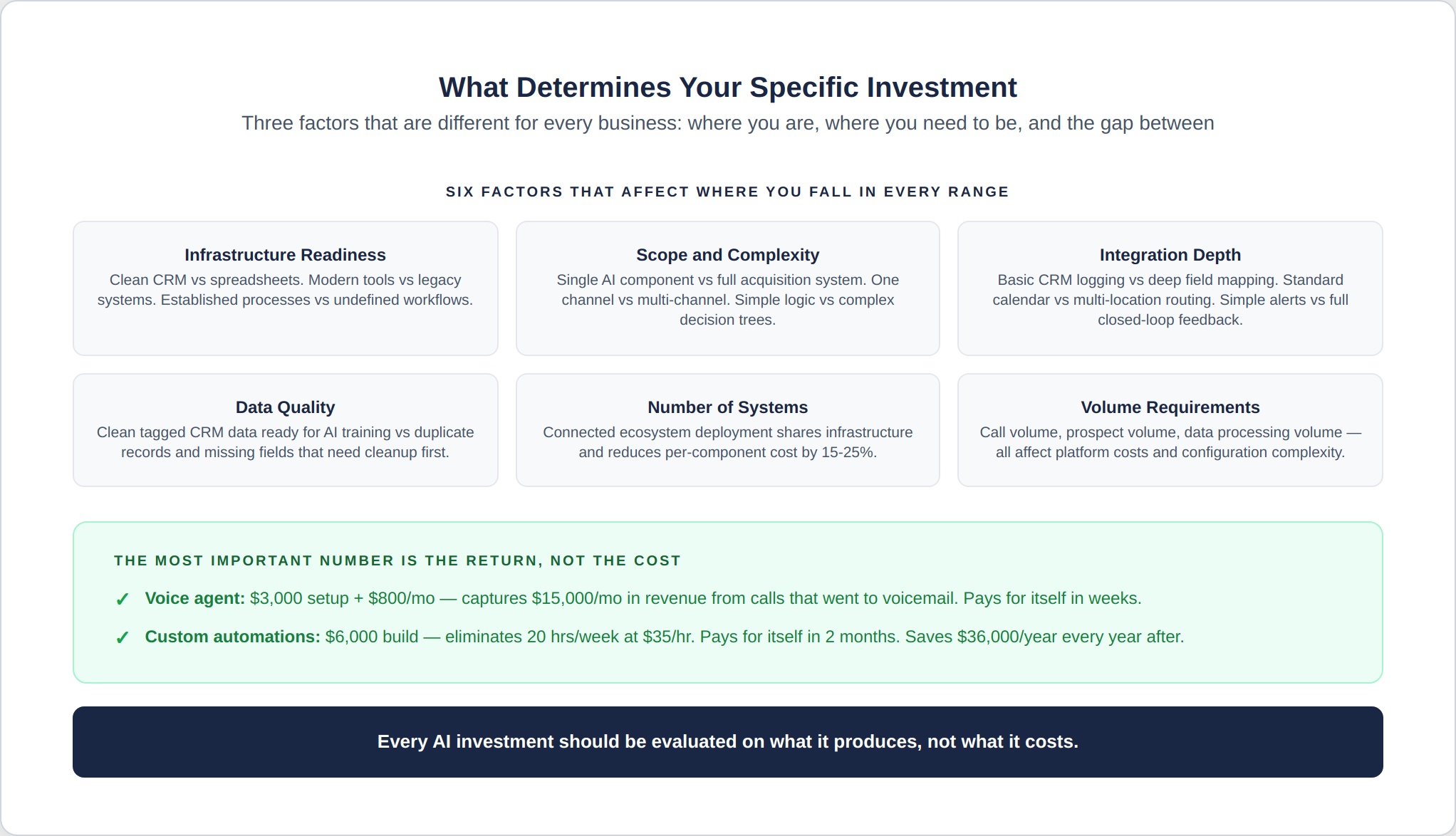
If you’re looking for a flat-rate price list for AI automation services, you won’t find one here, and you should be skeptical of anyone who offers one. AI automation pricing depends entirely on three factors that are different for every business: where you are now, where you need to be, and the gap between those two points. A business with a clean CRM, established processes, and modern tools has a different starting point than one running on spreadsheets with no CRM integration. A business that needs a single AI voice agent to handle inbound calls has a different scope than one building a full client acquisition system across five channels. The investment is determined by your specific situation, not by a menu.
What I can give you are realistic ranges for each type of AI automation service based on typical engagements. These ranges reflect the spectrum from straightforward deployments where the foundation is solid and the scope is focused, to complex builds where significant integration work, data preparation, and multi-system connections are required. Your actual investment will fall somewhere within these ranges based on the complexity of your requirements, the readiness of your existing infrastructure, and how many AI systems you’re deploying as part of a connected ecosystem versus as standalone tools.
Every engagement starts with a discovery conversation where we assess your current state, define the desired outcome, and scope the work required to bridge the gap. You receive a specific proposal with clear deliverables, timelines, and investment before any commitment. No surprises. No vague estimates that balloon during implementation. The ranges below give you a realistic framework for planning and budgeting before that conversation happens.
AI Voice Agents
AI voice agents answer your phone calls, qualify callers, book appointments, route inquiries, and capture data to your CRM, all without a human in the loop for routine calls. Pricing depends on the complexity of your call handling requirements, the number of call scenarios the agent needs to manage, the depth of CRM integration, and whether you need inbound-only or both inbound and outbound capabilities.
A straightforward inbound voice agent for a single-location service business with standard qualification questions, calendar booking, and basic CRM logging falls on the lower end of the range. A multi-scenario voice agent handling different call types, complex routing logic, deep CRM integration with custom field mapping, outbound speed-to-lead follow-up, and multi-location scheduling falls on the higher end. The voice agent’s intelligence and conversational depth scale with configuration complexity.
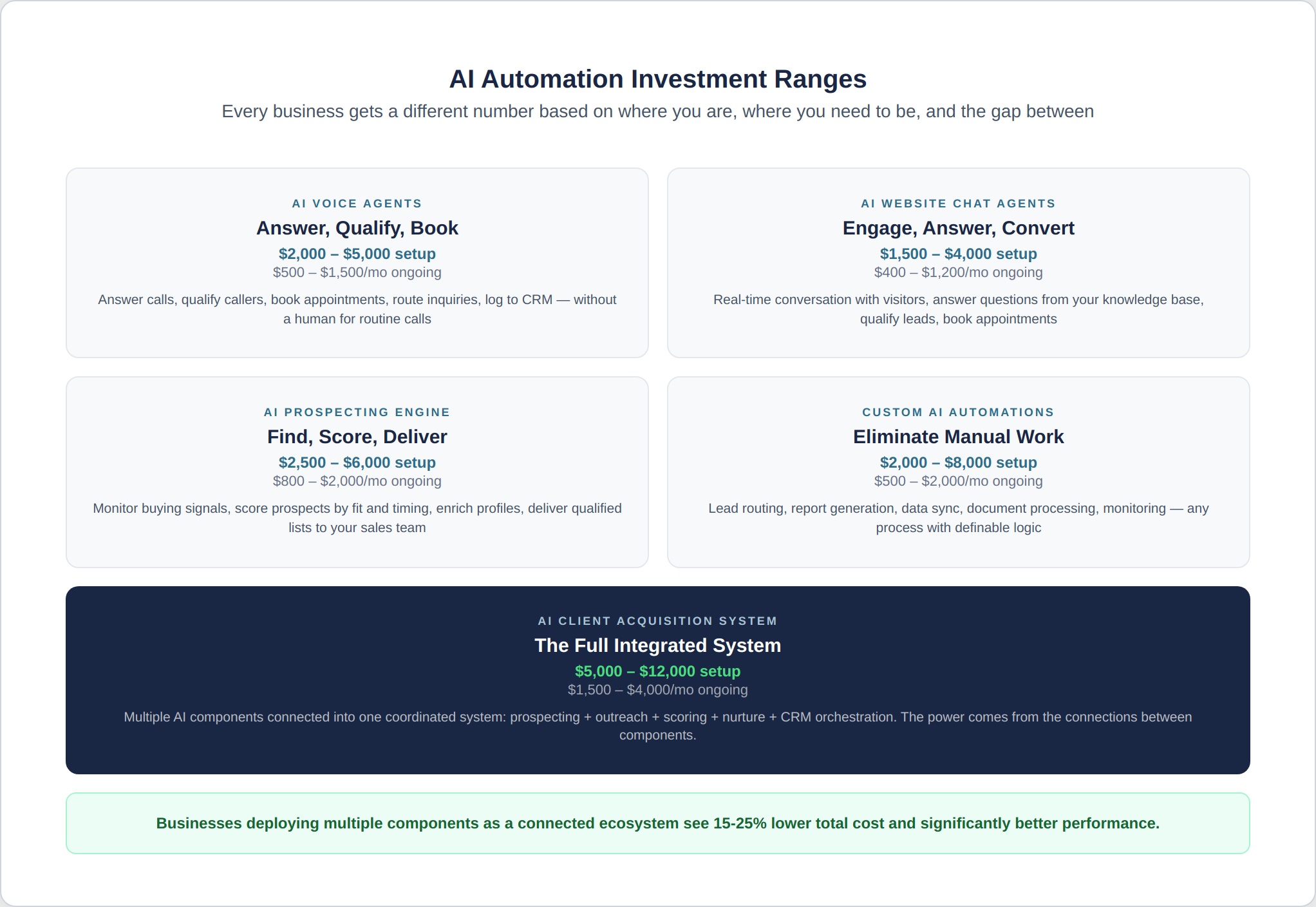
Typical investment range: $2,000 to $5,000 for initial setup and configuration, plus $500 to $1,500 per month for ongoing platform costs, monitoring, and optimization. Businesses deploying voice agents as part of a larger AI ecosystem typically see better economics per component because the integration architecture and CRM configuration serve multiple systems.
What affects where you fall in the range: call volume and complexity of qualification logic, number of distinct call scenarios, depth of CRM and calendar integration, inbound versus inbound plus outbound capabilities, single versus multi-location routing, and whether your existing phone system supports the required telephony integration or needs to be upgraded.
AI website chat agents engage visitors in real-time conversation, answer questions using your business knowledge, qualify leads through natural dialogue, and book appointments or route inquiries, turning passive website traffic into active pipeline. Pricing depends on the depth of business knowledge the agent needs to be trained on, the complexity of the qualification and routing logic, and the integrations required with your CRM, calendar, and other systems.
A focused chat agent for a business with a clear service offering, straightforward qualification criteria, and standard CRM integration falls toward the lower end. A sophisticated chat agent serving a business with multiple service lines, complex qualification paths that vary by service type, deep knowledge requirements covering dozens of common questions with nuanced answers, multi-step booking logic, and integration with multiple downstream systems falls toward the higher end. The chat agent’s effectiveness is directly proportional to the depth and quality of its training.
Typical investment range: $1,500 to $4,000 for initial setup, knowledge base development, and configuration, plus $400 to $1,200 per month for platform costs, ongoing knowledge base updates, and optimization. The initial build investment is heavily influenced by how much business knowledge the agent needs to absorb and how many distinct conversation paths need to be designed.
What affects where you fall in the range: number of services or products the agent needs to understand, complexity of qualification and routing logic, volume and specificity of questions the knowledge base must cover, depth of CRM integration and field mapping requirements, whether the agent needs to handle appointment booking with complex scheduling rules, and the number of distinct visitor personas the agent needs to recognize and respond to differently.
AI Prospecting Engine
AI prospecting engines identify your ideal customers by monitoring buying signals across data sources, scoring prospects based on fit and timing, enriching profiles with actionable intelligence, and delivering qualified prospect lists that your sales team can act on immediately. Pricing depends on the sophistication of your ideal customer profile, the number of signal sources monitored, the depth of enrichment required, and how tightly the engine integrates with your CRM and outreach systems.
A foundational prospecting engine built on a defined ICP with standard signal monitoring, basic enrichment, and CRM integration falls toward the lower end. An advanced engine with multi-layered ICP modeling, real-time monitoring across numerous signal sources including job changes, funding events, technology adoption, and content engagement, deep enrichment from multiple data providers, and closed-loop CRM integration that feeds deal outcomes back into the model for continuous learning falls toward the higher end. The engine’s accuracy and value improve dramatically with the depth of configuration and the quality of feedback data it receives.
Typical investment range: $2,500 to $6,000 for initial setup, ICP modeling, signal configuration, and integration, plus $800 to $2,000 per month for data source subscriptions, platform costs, and ongoing model optimization. The monthly costs are driven primarily by the data sources required and the volume of prospects processed.
What affects where you fall in the range: complexity of your ideal customer profile and the number of attributes that define it, number and type of buying signals monitored, depth of enrichment sources required, quality and completeness of your existing CRM data for model training, whether the engine needs to connect to outreach systems for automated follow-up, and the sales volume that determines how many prospects the engine processes monthly.
AI Client Acquisition System
The AI client acquisition system is the most comprehensive AI service offering because it integrates multiple AI components into a single coordinated system that identifies, engages, qualifies, nurtures, and converts prospects with minimal manual intervention. This is not a single tool. It’s an interconnected system that combines prospecting intelligence, automated outreach, lead scoring, CRM orchestration, and conversion optimization into one pipeline that operates continuously. Pricing reflects the scope and complexity of connecting multiple AI components into a unified acquisition engine.
A focused acquisition system built around a single channel with AI prospecting feeding automated outreach with CRM integration and basic scoring falls toward the lower end. A comprehensive multi-channel acquisition system with AI prospecting across multiple signal sources, personalized outreach across email, LinkedIn, and phone, AI-powered lead scoring that adapts based on engagement patterns, multi-stage nurture with behavioral triggers, and full closed-loop CRM integration where deal outcomes refine every upstream component falls toward the higher end. The system’s power comes from the connections between components, not the components themselves.
Typical investment range: $5,000 to $12,000 for initial system design, component configuration, integration architecture, and deployment, plus $1,500 to $4,000 per month for platform costs, data sources, ongoing optimization, and model refinement. This is typically the highest-investment AI service because it encompasses the broadest scope and produces the most direct revenue impact.
What affects where you fall in the range: number of channels the system operates across, complexity of the prospect identification and scoring model, depth of personalization in automated outreach, number of nurture stages and behavioral triggers, completeness and quality of your existing CRM data, number of integrations required between AI components and your existing tools, and whether the system is being deployed alongside other AI components that share infrastructure and reduce per-component costs.
Custom AI Automations
Custom AI automations eliminate the manual, repetitive operational tasks that consume your team’s time without generating revenue. These are workflows built specifically for your business processes: automated lead routing, report generation, document processing, invoice creation, data synchronization between platforms, monitoring and alerts, client communication sequences, and any other process that follows definable logic but currently requires human labor. Pricing depends on the number of processes being automated, the complexity of the decision logic involved, the number of platforms that need to be connected, and the volume of data being processed.
A small batch of three to five focused automations connecting two or three platforms with straightforward decision logic falls toward the lower end. A comprehensive automation architecture spanning ten to fifteen processes across five or more platforms with complex conditional logic, exception handling, AI-powered document processing, intelligent routing with multi-factor decision trees, and continuous monitoring with automated alerts falls toward the higher end. The value scales directly with the number of manual hours eliminated and the error reduction achieved.
Typical investment range: $2,000 to $8,000 for initial process audit, workflow design, and automation build, plus $500 to $2,000 per month for platform costs, monitoring, maintenance, and ongoing expansion. Most businesses start with the highest-impact automations and expand the suite over time as new opportunities are identified, which means the initial investment captures the biggest wins and the monthly investment grows as the automation footprint expands.
What affects where you fall in the range: number of processes being automated in the initial build, complexity of the decision logic and exception handling required, number of platforms that need to be connected through APIs, volume of data being processed and the transformation required, whether document processing or content generation is included, and the monitoring and alerting requirements for your operation.
Building Multiple AI Systems as a Connected Ecosystem
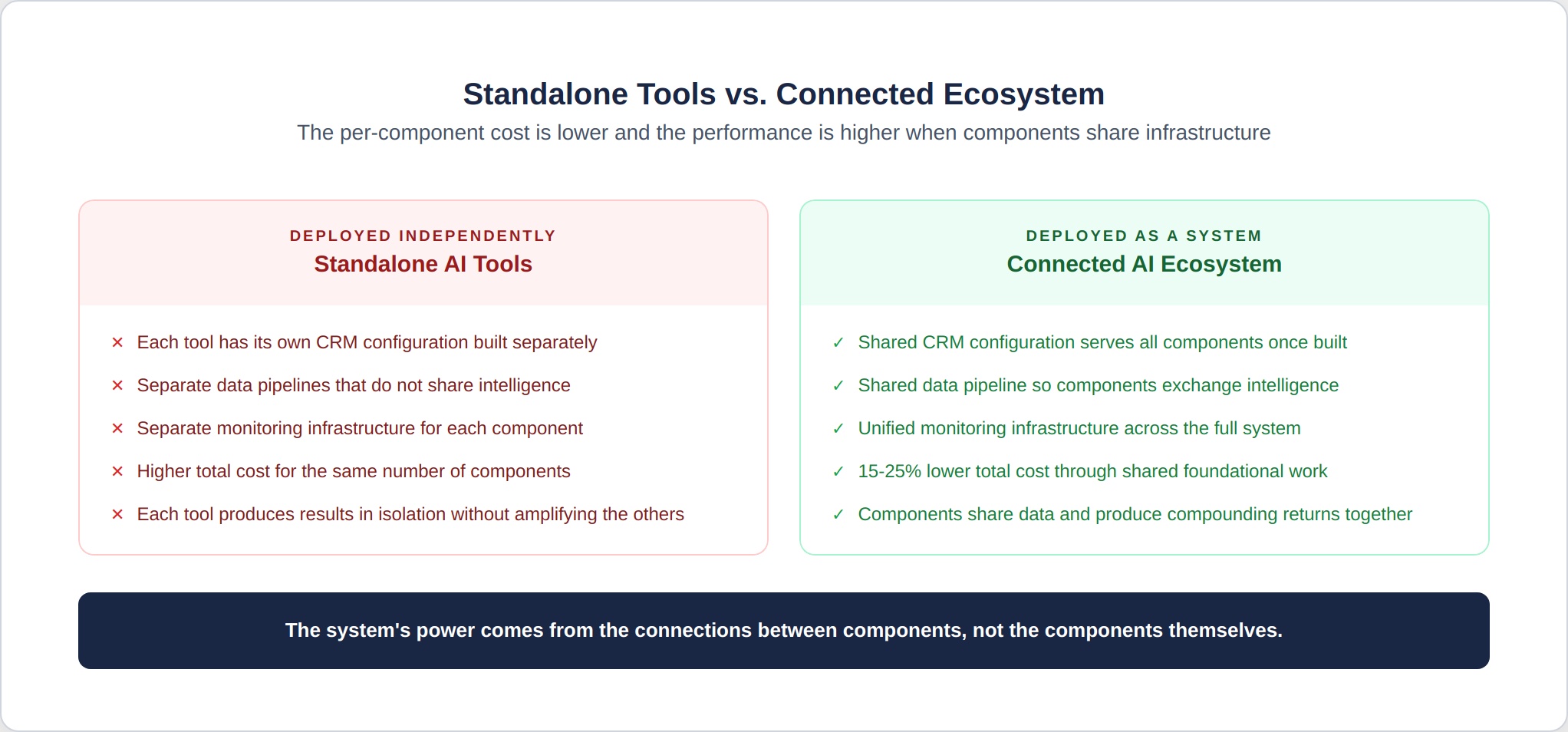
Businesses that deploy multiple AI components as part of a connected ecosystem rather than as standalone tools typically see better economics per component because the foundational work, CRM integration, data architecture, and platform infrastructure, serves all components once it’s built. A voice agent, chat agent, and prospecting engine deployed as an integrated system share the same CRM configuration, the same data pipeline, and the same monitoring infrastructure. The per-component cost is lower than deploying each one independently, and the performance is higher because the components share data and intelligence.
For businesses building a full AI automation suite as part of an omnipresent conversion ecosystem, we scope the entire system as a unified engagement rather than pricing each component separately. The total investment reflects the system-level architecture, the shared infrastructure, and the cross-component integrations that produce compounding returns. This approach typically produces a 15 to 25 percent reduction in total cost compared to deploying the same components independently, along with significantly better performance because the components are designed to work together from the start.
Not Ready for Full Deployment? Start With AI Implementation Consulting
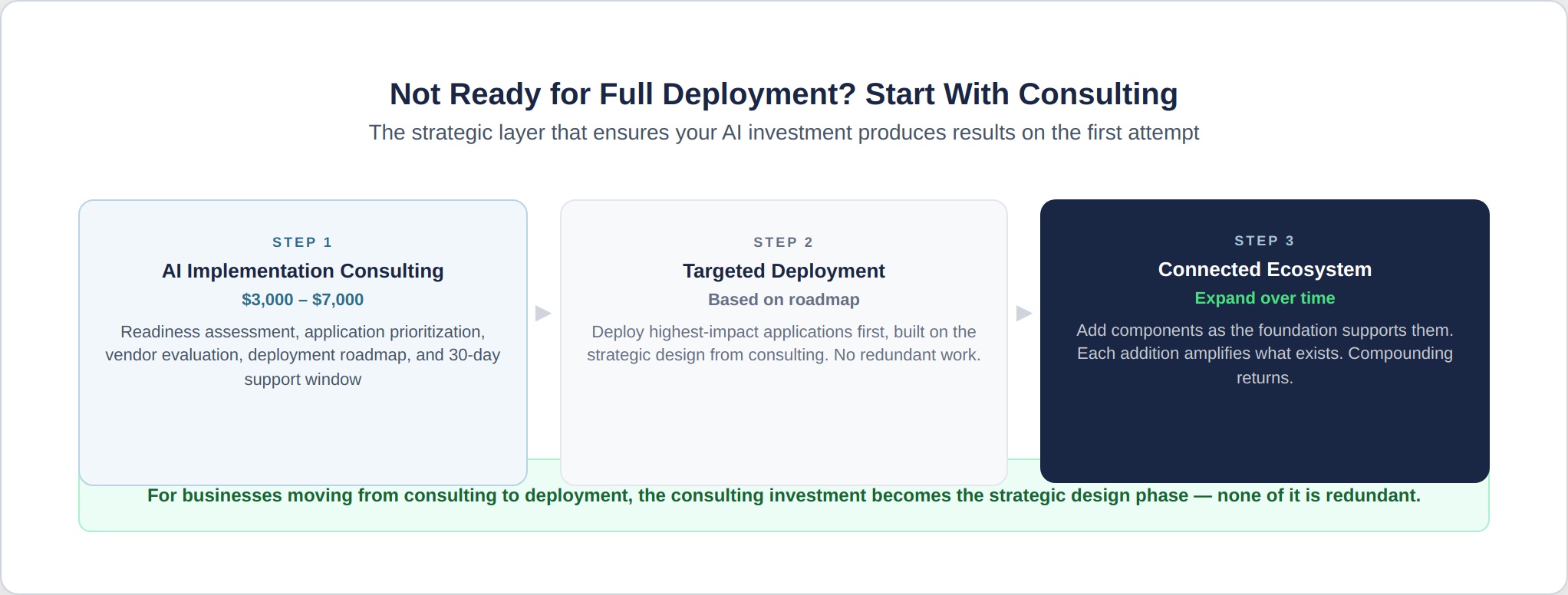
If you know AI can help your business but aren’t sure which applications to deploy first, whether your infrastructure is ready, or how to evaluate the vendor options, AI Implementation Consulting gives you the strategic clarity to make informed decisions before committing to a full build. The consulting engagement assesses your readiness, prioritizes applications by impact, evaluates vendors objectively, and delivers a deployment roadmap your team can follow. It’s the strategic layer that ensures your AI investment produces results on the first attempt rather than the third.
Typical consulting investment range: $3,000 to $7,000 for the complete advisory engagement including readiness assessment, application prioritization, vendor evaluation, deployment specifications, and a 30-day support window. For businesses that move from consulting into full deployment, the consulting investment effectively becomes the strategic design phase of the implementation, meaning none of it is redundant.
The Bottom Line on AI Automation Pricing
AI automation is not a commodity with a fixed price tag. It’s a strategic investment whose cost and return are determined by your specific situation: your current infrastructure, your operational complexity, your growth goals, and the gap between where you are and where AI can take you. The ranges above give you a realistic framework for budgeting and planning. The specific number for your business comes from a discovery conversation where we assess your current state, define the scope, and provide a detailed proposal with clear deliverables and timelines.
The most important number isn’t the cost. It’s the return. An AI voice agent that costs $3,000 to deploy and $800 per month to operate but captures $15,000 in monthly revenue from calls that used to go to voicemail produces a return that makes the investment irrelevant within weeks. A custom automation suite that costs $6,000 to build but eliminates 20 hours per week of manual labor at $35 per hour pays for itself in two months and produces $36,000 per year in recovered capacity every year after that. Every AI investment should be evaluated on what it produces, not what it costs.
If you’re ready to explore what AI automation would look like for your specific business, book a discovery call. We’ll assess your current situation, identify the highest-impact opportunities, and provide a proposal that gives you exact numbers based on your actual requirements, not a generic price list.