
How Custom Development Pricing Works and Why Every Project Gets a Different Number
Custom development is exactly that: custom. There is no template, no preset configuration, and no standard package because the entire point is building something that doesn’t exist off the shelf, something designed specifically for how your business operates, how your customers interact with you, and what your technology stack needs to do that no existing tool handles. Pricing depends on the complexity of what’s being built, the number of features and integrations required, the design and user experience standards, and how the custom build connects to your broader marketing and operational ecosystem.
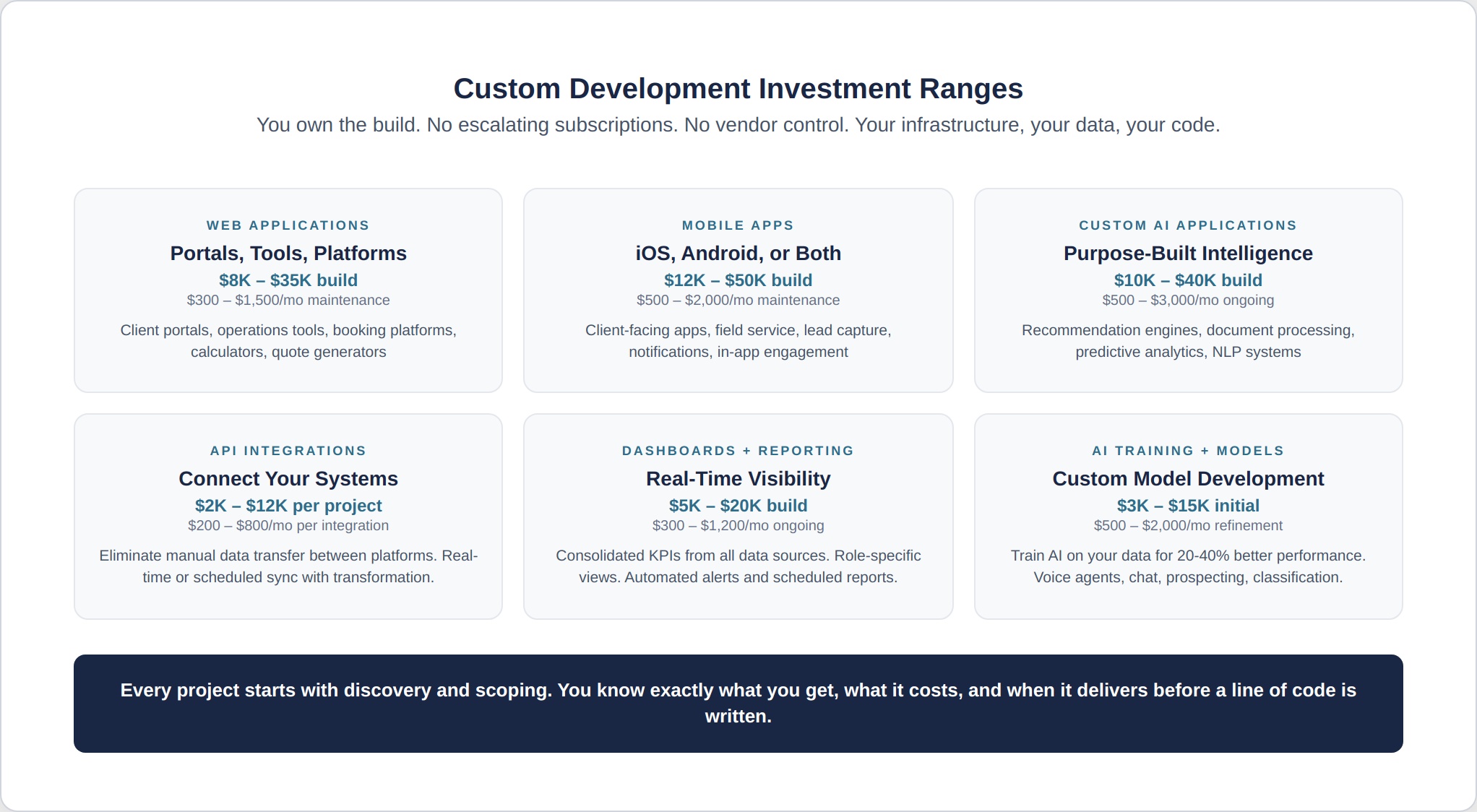
The ranges below give you a realistic framework for planning and budgeting. But custom development pricing is inherently project-specific because the gap between a simple tool and a complex platform is enormous. A focused utility application that solves one specific workflow problem has a fundamentally different scope than an enterprise-grade platform handling thousands of users across multiple workflows. Every project starts with a discovery and scoping conversation that produces a detailed specification, timeline, and investment before any commitment. You know exactly what you’re getting, what it costs, and when it delivers before a line of code gets written.
One thing that applies across every category: the investment is in the architecture and the build, not in a recurring subscription that someone else controls. When the project is complete, you own it. The application runs on your infrastructure. The data lives in your systems. The codebase belongs to you. That ownership model means the asset you invest in today produces value for years without escalating platform fees, feature limitations, or the risk of a vendor discontinuing the product you depend on.
Custom Web Application Design
Custom web applications are browser-based tools built for specific business needs that off-the-shelf software doesn’t serve. This includes client portals where customers access their account data, project status, and documents in one place. Internal operations tools that automate workflows specific to how your team works. Booking and scheduling platforms designed around your service delivery model rather than forcing your process into a generic tool’s limitations. Calculator and assessment tools that generate leads by providing prospects with personalized analysis. Quote generators that price complex services based on your specific pricing logic. Any business process that currently runs on spreadsheets, manual emails, or clunky software that doesn’t fit can be replaced with a web application designed exactly for that process.
Pricing depends on the number and complexity of features, the user interface and experience design requirements, the data architecture, the integrations with your existing systems, and the user management and security needs. A focused single-purpose application with a clean interface, basic data storage, and one or two integrations falls toward the lower end. A comprehensive multi-feature platform with complex data relationships, multiple user roles and permissions, advanced UI/UX design, real-time data processing, and deep integrations across your technology stack falls toward the higher end.
Typical investment range: $8,000 to $35,000 for design, development, and deployment depending on scope and complexity. Ongoing maintenance, hosting, and feature updates typically run $300 to $1,500 per month depending on the application’s complexity and the pace of enhancement. Most custom web applications reach a stable state within 60 to 90 days of launch where maintenance costs are minimal and the primary ongoing investment is in feature enhancements driven by user feedback and business growth.
What affects where you fall in the range: number of features and user workflows, complexity of the data model and business logic, user interface design sophistication, number of user roles and permission levels, integrations required with CRM, payment systems, email platforms, or other tools, real-time data requirements versus batch processing, and whether the application needs to handle high concurrent user volumes.
Custom mobile applications put your business tools, services, or customer experience directly on your users’ phones. This includes client-facing apps that give customers access to their accounts, schedules, documents, and communication with your team from anywhere. Field service apps that give your team mobile access to job details, scheduling, inventory, and reporting. Lead capture apps that work at events, trade shows, or in-person meetings. Notification and engagement apps that keep your business top-of-mind through push notifications, in-app messaging, and personalized content delivery. Any process that benefits from mobile accessibility and real-time interaction can be served by a custom mobile application.
Pricing depends on the platforms targeted (iOS, Android, or both), the feature set and complexity, the user interface and experience design, backend infrastructure requirements, and integrations with your existing systems. A focused single-platform app with core features and standard design falls toward the lower end. A cross-platform app with advanced features, custom UI animations, offline functionality, push notification systems, complex backend logic, and deep integrations across your technology stack falls toward the higher end.
Typical investment range: $12,000 to $50,000 for design, development, and deployment across one or both platforms. Cross-platform development frameworks can reduce the investment for dual-platform deployment by 30 to 40 percent compared to building native apps separately for each platform. Ongoing maintenance including app store compliance updates, OS compatibility updates, bug fixes, and feature enhancements typically runs $500 to $2,000 per month. App store submission and approval are included in the initial build.
What affects where you fall in the range: single platform versus cross-platform deployment, number of features and user workflows, complexity of the user interface and custom design elements, offline functionality requirements, push notification and real-time messaging needs, backend infrastructure complexity, integrations with CRM, payment systems, calendars, or other tools, and whether the app needs to handle media capture, GPS location, or other device-specific capabilities.
Custom AI Applications
Custom AI applications go beyond deploying pre-built AI tools. They are purpose-built intelligent systems designed around your specific business processes, your specific data, and your specific outcomes. This includes AI-powered recommendation engines that suggest products, services, or next steps based on customer behavior patterns unique to your business. Intelligent document processing systems that read, classify, extract, and route business documents based on your specific document types and workflow requirements. Predictive analytics tools that forecast demand, identify churn risk, or score opportunities based on your historical data. Natural language processing applications that analyze customer communications, support tickets, or reviews to extract actionable intelligence. Any business process that involves pattern recognition, prediction, classification, or decision-making based on data can be enhanced or automated with a custom AI application.
Pricing depends on the complexity of the AI model required, the data preparation and training work involved, the application’s user interface and integration requirements, and the ongoing learning and optimization needs. A focused AI application using established model architectures with clean, available training data and a straightforward interface falls toward the lower end. A complex AI application requiring custom model development, extensive data preparation and labeling, sophisticated user interface, real-time processing, multiple integration points, and continuous learning from production data falls toward the higher end.
Typical investment range: $10,000 to $40,000 for design, data preparation, model development, application build, and deployment. Ongoing costs for model hosting, data processing, monitoring, and optimization typically run $500 to $3,000 per month depending on processing volume and the complexity of ongoing model refinement. Custom AI applications produce their highest value when they’re connected to your broader ecosystem, feeding intelligence to your CRM, marketing automation, and operational systems rather than operating in isolation.
What affects where you fall in the range: complexity and novelty of the AI model required, volume and quality of available training data, data preparation and labeling requirements, real-time versus batch processing needs, user interface sophistication, number of integrations with existing systems, ongoing learning and retraining requirements, and whether the application needs to handle edge cases that require human-in-the-loop review workflows.
Custom API Integrations
Custom API integrations connect systems that don’t natively talk to each other, eliminating the manual data transfer, duplicate entry, and information silos that consume your team’s time and introduce errors. If your CRM doesn’t sync with your invoicing system, your project management tool doesn’t update your client portal, your marketing platform doesn’t feed data to your analytics dashboard, or any two tools in your stack require a human to copy information between them, a custom API integration solves that problem permanently. The integration moves data automatically, in real time or on a defined schedule, with transformation and enrichment applied at every step.
Pricing depends on the number of systems being connected, the complexity of the data transformations required, the volume of data being processed, the error handling and monitoring requirements, and whether the APIs involved are well-documented and reliable or require custom workarounds. A focused two-system integration with straightforward data mapping and standard API documentation falls toward the lower end. A complex multi-system integration hub connecting five or more platforms with conditional logic, data transformation, error handling, retry mechanisms, and real-time monitoring falls toward the higher end.
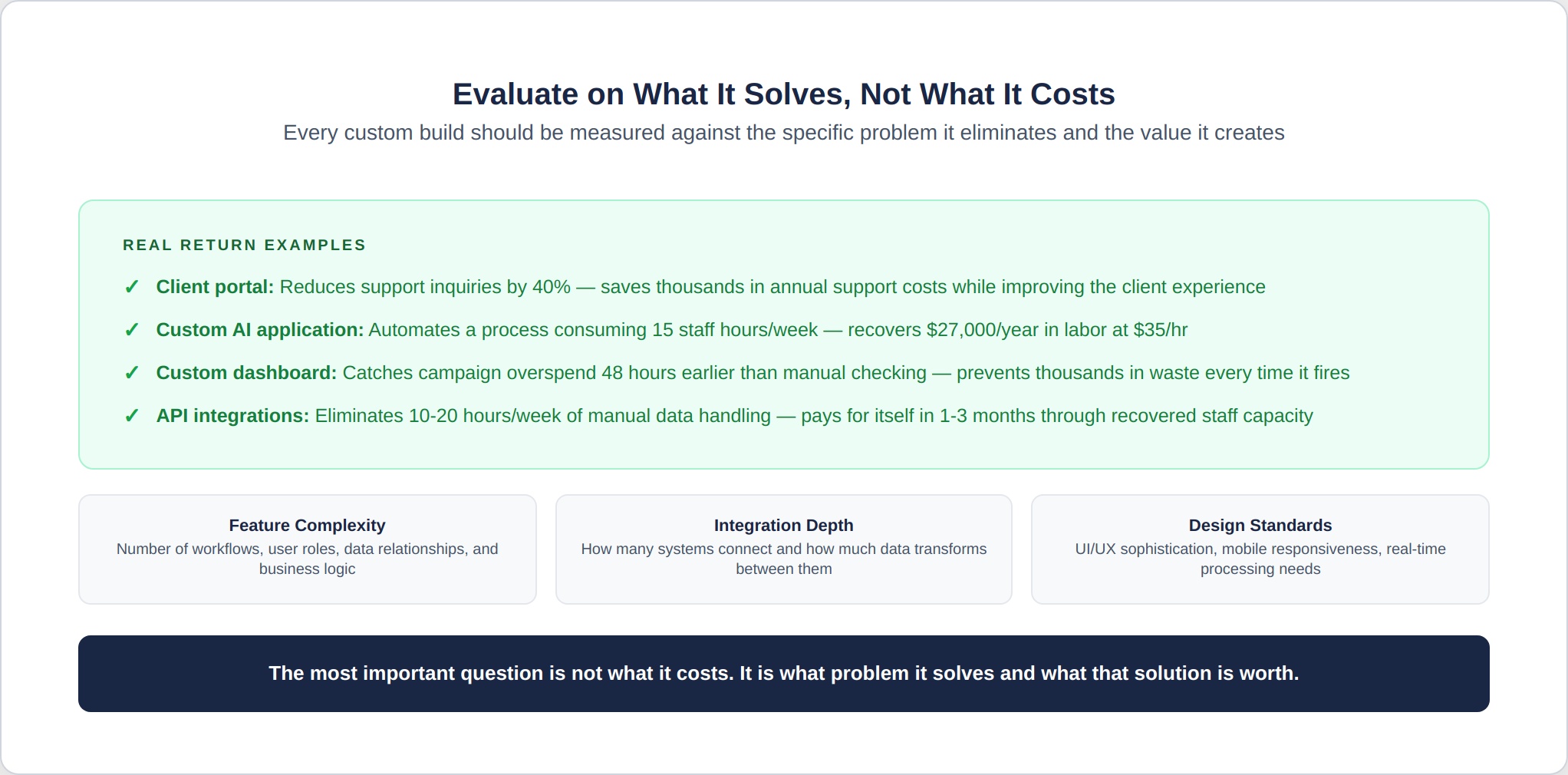
Typical investment range: $2,000 to $12,000 per integration project depending on scope and complexity. Ongoing monitoring and maintenance typically runs $200 to $800 per month per integration to handle API changes, data format updates, error resolution, and performance optimization. Most businesses have three to eight integration opportunities that collectively eliminate 10 to 20 hours per week of manual data handling, which makes the integration investment pay for itself within the first one to three months through recovered staff capacity.
What affects where you fall in the range: number of systems being connected, quality and reliability of the APIs involved, complexity of data mapping and transformation logic, volume of data being processed and frequency of sync, error handling sophistication and monitoring requirements, whether real-time or scheduled sync is needed, and the number of conditional rules and exceptions the integration must handle.
Custom Dashboard and Reporting Systems
Custom dashboards and reporting systems give you real-time visibility into the metrics that actually matter for your business, consolidated from multiple data sources into one view designed around your specific KPIs and decision-making needs. This replaces the fragmented reporting that most businesses rely on: logging into five different platforms, exporting data to spreadsheets, building charts manually, and assembling reports that are outdated by the time they’re finished. A custom dashboard pulls live data from your CRM, marketing platforms, analytics tools, financial systems, and operational tools into a single interface that shows your business health at a glance and lets you drill into the details when needed.
Pricing depends on the number of data sources being consolidated, the complexity of the metrics and calculations, the visualization design, the user access and permission requirements, and whether the dashboard needs automated alerting and scheduled report delivery. A focused executive dashboard pulling from three to four data sources with core KPIs and clean visualization falls toward the lower end. A comprehensive business intelligence platform with ten or more data sources, complex calculated metrics, multiple role-specific dashboard views, drill-down capabilities, automated alerts, and scheduled PDF report generation falls toward the higher end.
Typical investment range: $5,000 to $20,000 for design, data connection architecture, build, and deployment. Ongoing costs for data hosting, API connections, and maintenance typically run $300 to $1,200 per month depending on the number of data sources and the processing volume. The ROI from custom dashboards comes from two sources: the staff time recovered from manual report assembly, which is often 5 to 15 hours per week, and the better decisions made when leadership has real-time visibility into accurate, consolidated data rather than making strategic calls based on stale, fragmented, or incomplete information.
What affects where you fall in the range: number of data sources and API connections required, complexity of metrics and calculated KPIs, number of dashboard views for different user roles, visualization design sophistication, drill-down and filtering capabilities, automated alerting and threshold monitoring requirements, scheduled report generation and delivery, and user access and permission management complexity.
Custom AI Training and Model Development
Custom AI training and model development takes the AI tools you’ve already deployed or plan to deploy and trains them on your specific business data, your specific customer patterns, and your specific operational context to produce dramatically better results than generic out-of-the-box configurations. This includes training AI voice agents on your actual call recordings to develop conversation patterns that reflect your business tone, terminology, and customer expectations. Training AI chat agents on your complete business knowledge base including edge cases, exceptions, and nuanced scenarios that generic training misses. Developing custom scoring models for your prospecting engine based on your historical deal data rather than industry averages. Building custom classification models that categorize your specific document types, customer intents, or support ticket patterns based on your actual data rather than general-purpose models.
Pricing depends on the volume and quality of training data available, the complexity of the model being trained, the amount of data preparation and labeling required, the number of training iterations needed to achieve target accuracy, and the testing and validation work to ensure the model performs reliably in production. A focused training engagement using clean, well-organized data to fine-tune an existing model for your specific use case falls toward the lower end. A comprehensive model development project requiring data collection, cleaning, labeling, custom architecture design, extensive training, and rigorous validation testing falls toward the higher end.
Typical investment range: $3,000 to $15,000 for the initial training and development engagement depending on scope. Ongoing model refinement and retraining typically runs $500 to $2,000 per month as new data accumulates and the model continues learning from production interactions. The investment produces measurable improvement in AI accuracy, which translates directly into better lead qualification, more accurate routing, higher conversion rates from AI interactions, and fewer exceptions requiring human intervention. Businesses that invest in custom model training typically see 20 to 40 percent improvement in AI performance metrics compared to generic configurations.
What affects where you fall in the range: volume and quality of available training data, amount of data preparation and labeling work required, complexity of the model architecture, number of training iterations and validation cycles, number of distinct use cases or scenarios the model needs to handle, production testing requirements, and whether the engagement covers a single AI application or multiple applications that share training infrastructure.
Building Custom Development as Part of a Connected Ecosystem
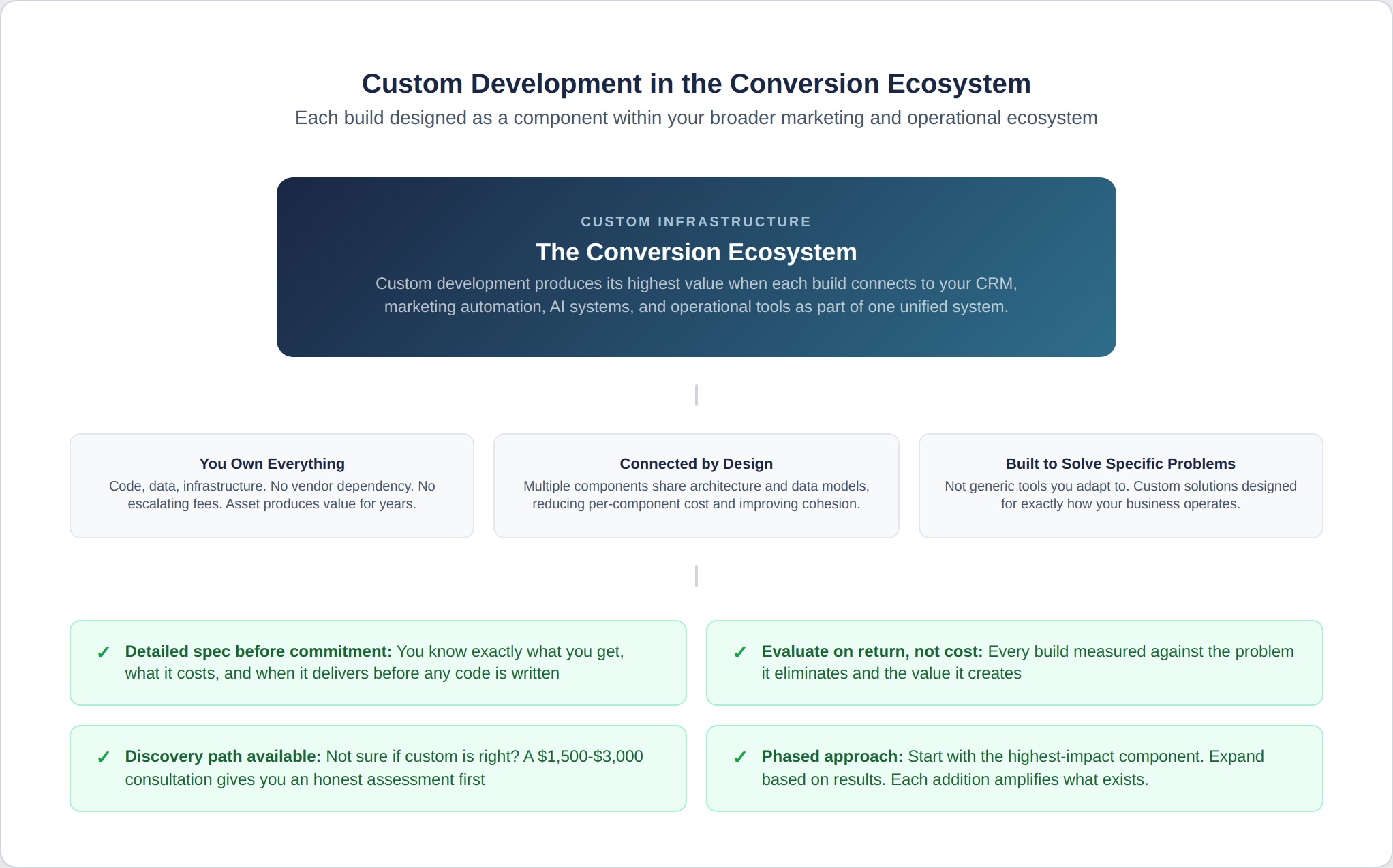
Custom development produces its highest value when each build is designed as a component within your broader marketing and operational ecosystem rather than as a standalone tool. A client portal is more valuable when it connects to your CRM and triggers automated follow-up based on client activity. A mobile app is more valuable when it feeds engagement data to your AI systems and marketing automation. A custom dashboardis more valuable when it consolidates data from your AI applications, marketing channels, and operational tools into one view. API integrations are most valuable when they’re designed as part of a unified data architecture rather than built one at a time without a plan.
For businesses building multiple custom components, we scope the full project as a unified engagement. The shared architecture, data models, and integration infrastructure serve all components, which reduces the per-component cost and produces a more cohesive, maintainable system. The discovery and scoping phase identifies which components produce the most value, which dependencies exist between them, and what build sequence produces results at each stage rather than requiring everything to be complete before anything works.
Not Sure What You Need? Start With a Discovery Consultation
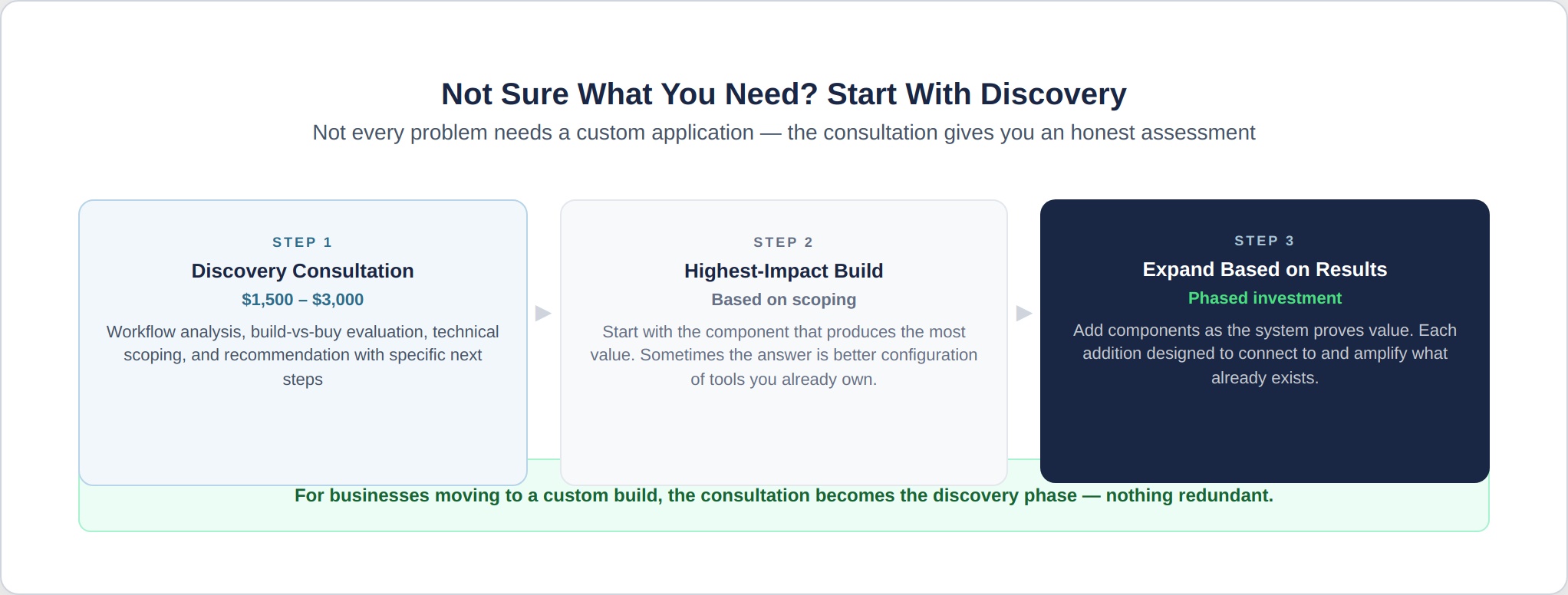
If you’re not certain whether your business needs a custom build or whether an existing tool could serve the purpose, a discovery consultation gives you the clarity before any development investment. We evaluate your current workflow, identify where generic tools are costing you in workarounds, manual effort, or missed capability, and determine whether a custom solution produces enough return to justify the build versus adapting what already exists.
Not every problem needs a custom application. Sometimes the right answer is a better configuration of tools you already own, an integration that connects what’s already there, or a phased approach that starts with the highest-impact component and expands based on results. The consultation gives you an honest assessment of what makes sense for your situation rather than a pitch for the most expensive option.
Typical consultation investment: $1,500 to $3,000 for a complete assessment covering workflow analysis, build-versus-buy evaluation, technical scoping, and a recommendation with specific next steps. For businesses that move forward with a custom build, the consultation investment becomes the discovery and scoping phase of the project, meaning nothing is redundant.
The Bottom Line on Custom Development Pricing
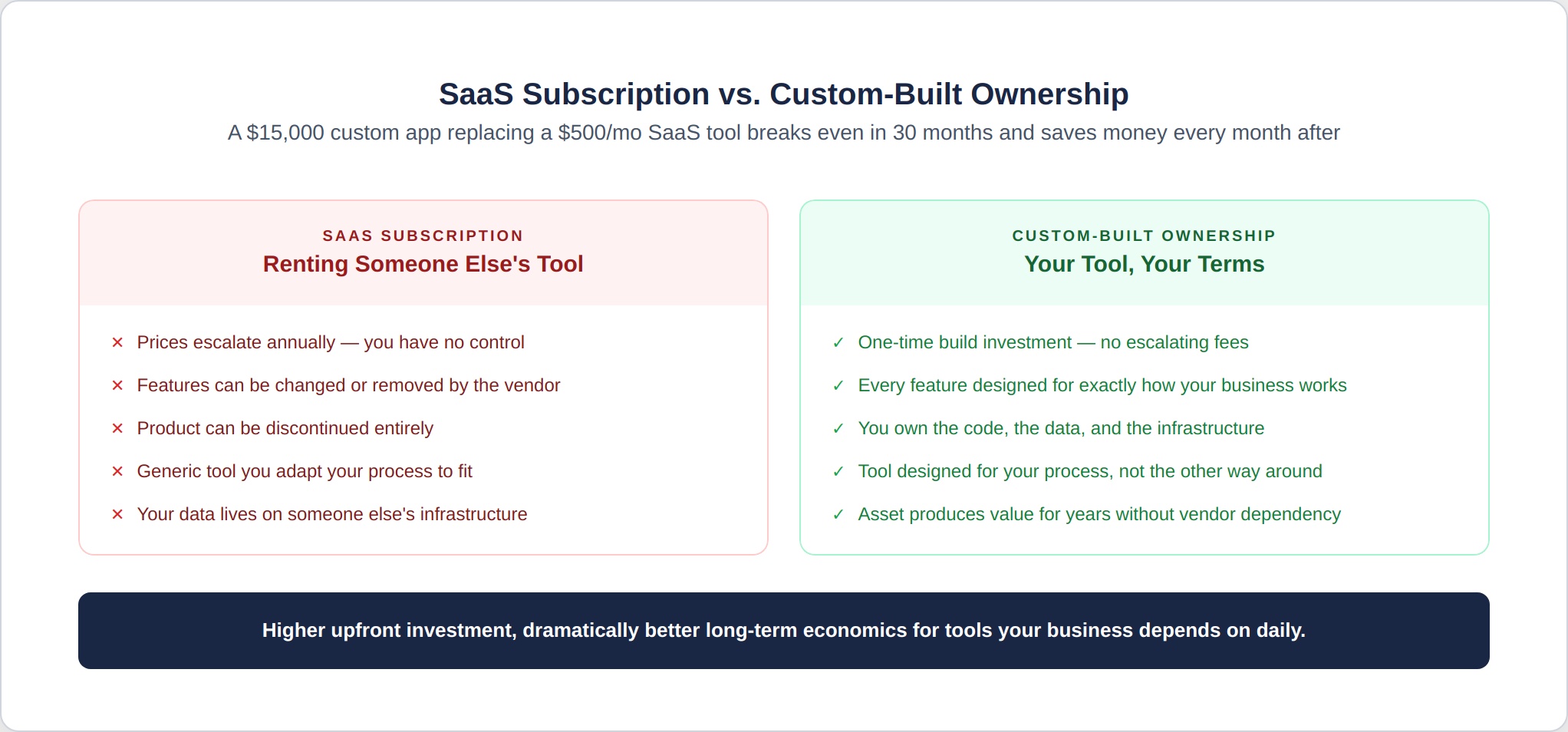
Custom development is a capital investment in infrastructure that your business owns outright. Unlike SaaS subscriptions that escalate in price and can be changed or discontinued by the vendor at any time, custom-built tools operate on your terms, with your data, under your control. The investment is higher upfront than a monthly subscription, but the long-term economics are dramatically better for tools that your business depends on daily. A $15,000 custom application that replaces a $500 per month SaaS tool breaks even in 30 months and saves money every month after that, while giving you a tool designed exactly for your needs rather than a generic tool you’ve adapted your process to fit.
The most important question isn’t what it costs. It’s what problem it solves and what that solution is worth. A custom client portal that reduces support inquiries by 40 percent saves thousands in annual support costs. A custom AI application that automates a process currently consuming 15 staff hours per week recovers $27,000 per year in labor at $35 per hour. A custom dashboard that catches a campaign overspend problem 48 hours earlier than manual checking prevents thousands in waste every time it fires. Every custom build should be evaluated on the specific problem it eliminates and the specific value it creates.
If you have a business process that’s being served poorly by generic tools, a workflow that currently runs on spreadsheets and manual effort, or an idea for a tool that would give your business a meaningful advantage, book a discovery call. We’ll scope the project, define the specifications, and provide a detailed proposal with exact investment, timeline, and deliverables.