
How Digital Assets Pricing Works and Why Every Business Gets a Different Number
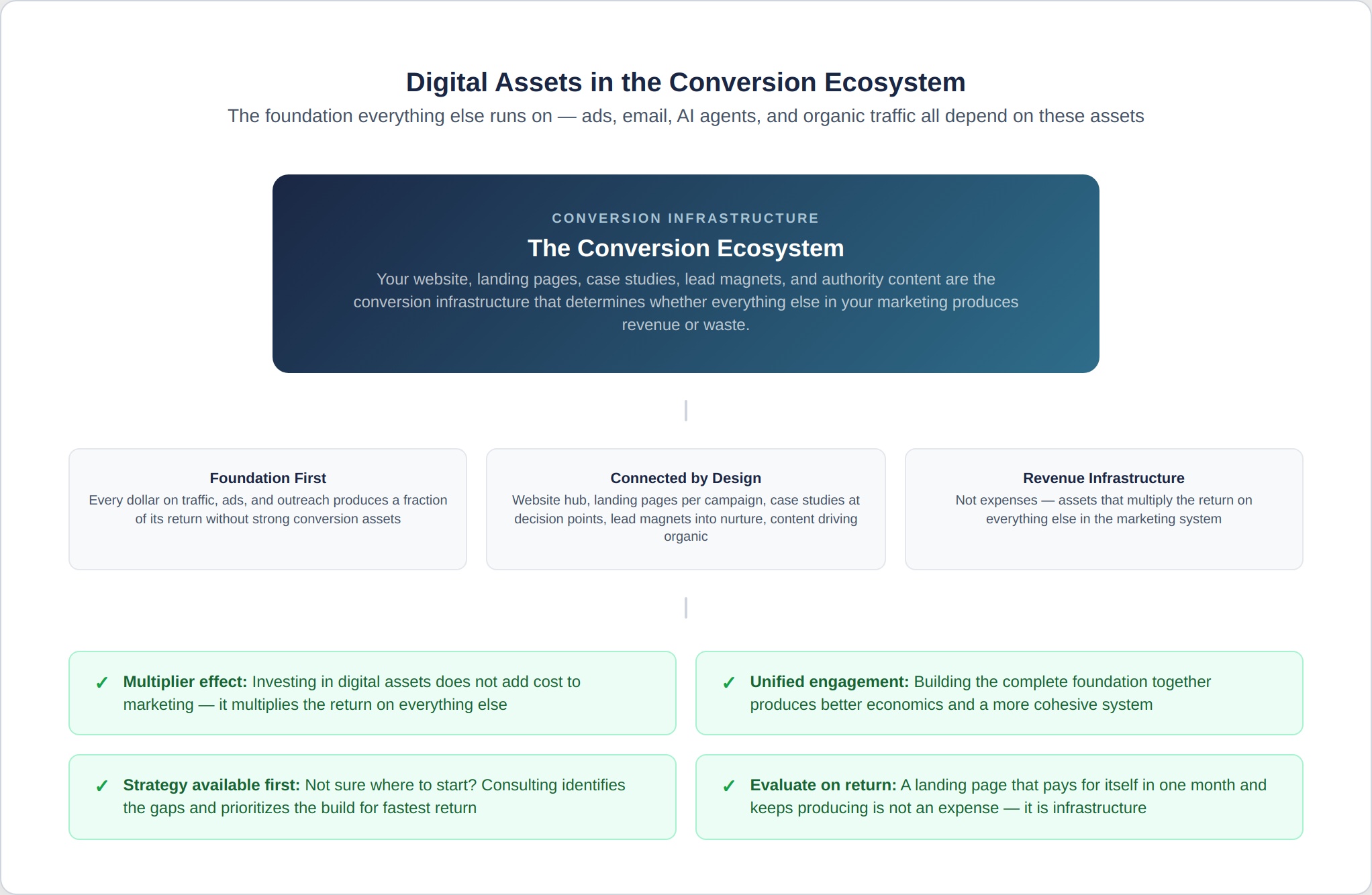
Digital assets are the foundational components your entire marketing system runs on. Your website, your landing pages, your case studies, your lead magnets, your authority content. These aren’t cosmetic investments. They’re the conversion infrastructure that determines whether the traffic, leads, and prospects your marketing generates actually turn into revenue. Pricing for digital assets depends on where you are now, what needs to be built or rebuilt, and the level of strategic depth and integration required to make each asset serve its role within a connected marketing ecosystem.
A business with a functioning website that needs targeted improvements has a different investment profile than one that needs a complete omnichannel website built from scratch. A business with existing content that needs to be upgraded for SEO and conversion has a different scope than one starting with no authority content at all. The ranges below reflect the spectrum from focused, targeted builds to comprehensive foundational projects. Your specific investment depends on your current state, your goals, and the gap between them.
Every engagement begins with a discovery conversation that assesses what you have, what you need, and what the build requires. You receive a specific proposal with deliverables, timelines, and investment before any commitment.
Omnichannel Website Design
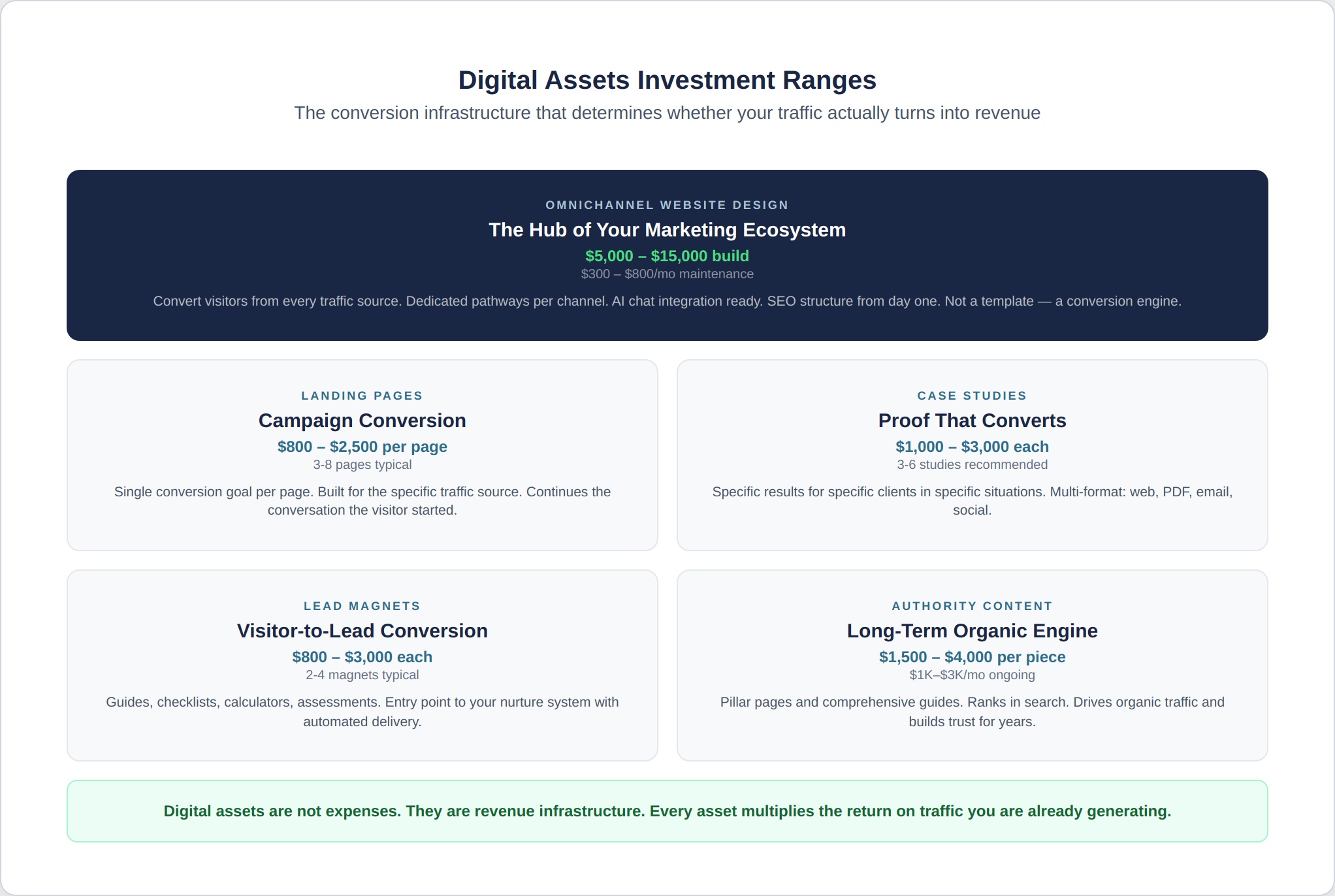
Your website is the hub of your marketing ecosystem. Every channel you invest in, ads, content, email, social, AI agents, ultimately drives traffic to your website. An omnichannel website is designed to convert visitors from every traffic source, with dedicated pathways for each channel, strategic conversion points throughout the visitor journey, AI chat agent integration readiness, and a structure built for SEO performance from day one. This is not a template website with your logo on it. It’s a conversion engine designed around how your specific buyers research and make decisions.
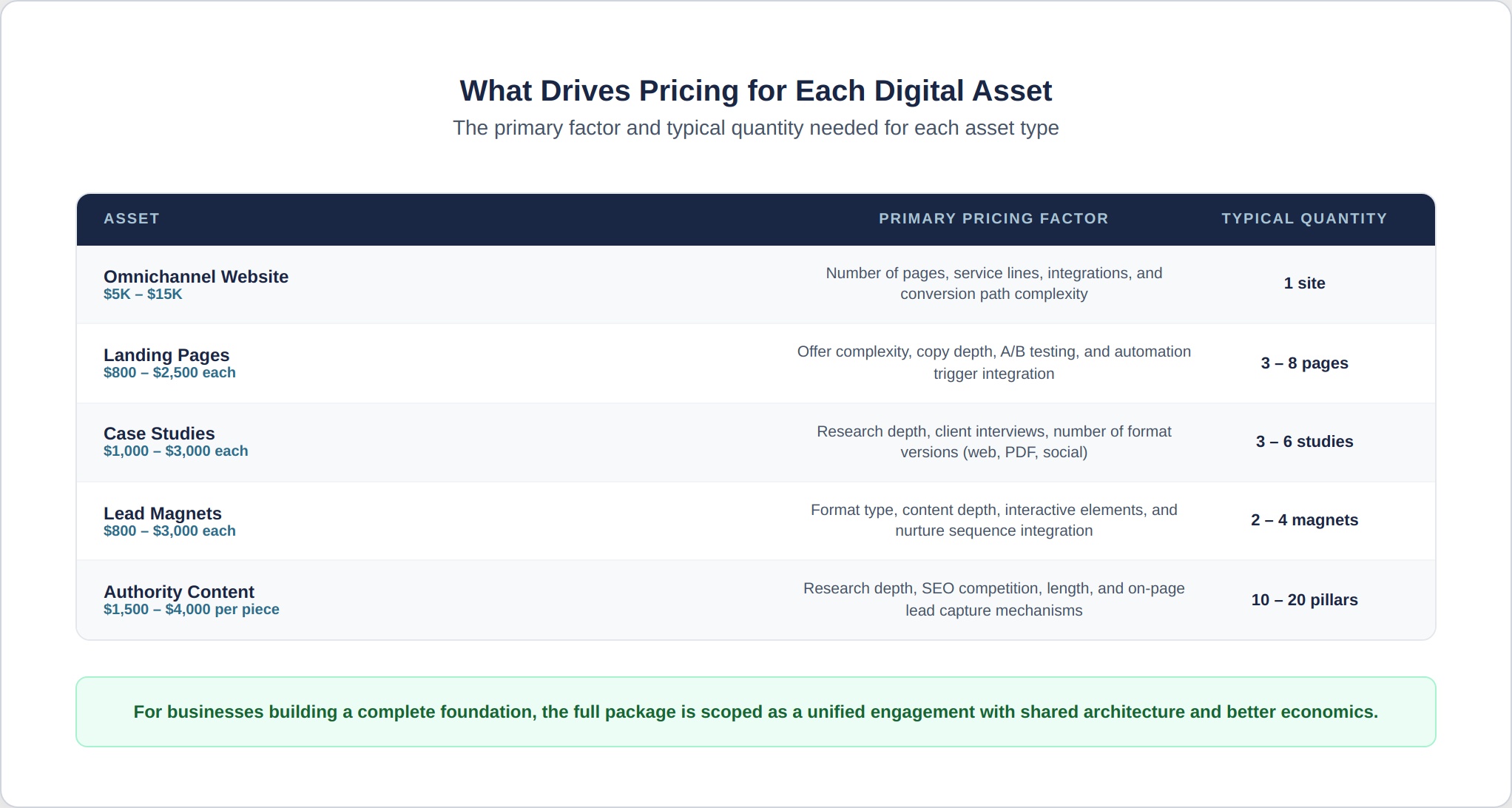
Pricing depends on the size and complexity of the site, the number of service or product pages required, the depth of conversion path architecture, the integrations needed with your CRM, booking system, and marketing platforms, and whether the site needs to support AI chat agent deployment and advanced analytics tracking.
Typical investment range: $5,000 to $15,000 for design, development, and deployment. Sites on the lower end typically serve single-service businesses with straightforward conversion paths. Sites on the higher end serve multi-service businesses with complex buyer journeys, multiple audience segments, deep integrations, and advanced functionality like dynamic content personalization or AI agent integration. Ongoing maintenance and optimization typically runs $300 to $800 per month depending on the frequency of updates and the level of performance monitoring required.
What affects where you fall in the range: number of pages and service lines, complexity of the buyer journeyand conversion path architecture, CRM and marketing platform integrations, AI chat agent integration requirements, SEO structure complexity, custom functionality needs, and whether existing content can be migrated or needs to be created from scratch.
Landing pages are dedicated conversion pages designed for specific campaigns, audiences, or offers. Unlike general website pages, each landing page is built with a single conversion goal and optimized for the specific traffic source driving visitors to it. A landing page for Google Ads traffic about a specific service looks and functions differently than one for a lead magnet download from an email campaign. Each one is designed to continue the conversation the visitor started when they clicked, and to convert that attention into a specific next step.
Pricing depends on the number of landing pages needed, the complexity of the offer and conversion mechanism, the depth of copywriting and design work, and the integrations required with your ad platforms, CRM, and automation systems.
Typical investment range: $800 to $2,500 per landing page for strategy, copy, design, development, and integration. Simple lead capture pages with a form and basic copy fall toward the lower end. Complex landing pages with multi-section storytelling, proof elements, dynamic content based on traffic source, A/B testing setup, and deep automation triggers fall toward the higher end. Most businesses need three to eight landing pages to cover their primary campaigns and offers, with additional pages added as new campaigns launch.
What affects where you fall in the range: complexity of the offer and the buyer psychology involved, length and depth of the page copy, design sophistication, A/B testing requirements, number and complexity of form fields and conversion mechanisms, CRM and automation integration depth, and whether the page needs to support multiple traffic sources with dynamic content.
Case Study Development
Case studies are the most powerful proof asset in your marketing arsenal because they show specific results achieved for specific clients in specific situations. Prospects reading a case study are evaluating whether you can deliver the outcome they want by seeing evidence that you’ve done it for someone in a situation like theirs. Pricing depends on the depth of the case study, the research and interview work required, the format of the final deliverable, and how many touchpoints the case study needs to be formatted for.
A focused case study based on provided data and metrics with a standard written format falls toward the lower end. A comprehensive case study requiring client interviews, data analysis, narrative development, professional design, and formatting for multiple uses including website page, PDF download, email content, and social media snippets falls toward the higher end.
Typical investment range: $1,000 to $3,000 per case study. Most businesses benefit from three to six case studies covering their primary service areas and client types, which creates a proof library that supports multiple stages of the buyer journey. Ongoing case study production on a quarterly or monthly basis typically falls at the lower end of the per-unit range because the process and templates are established.
What affects where you fall in the range: depth of research and data analysis required, whether client interviews are needed, number of format versions produced (web, PDF, email, social), design complexity, length and narrative depth of the written content, and whether the case study includes video or multimedia components.
Lead Magnet Creation
Lead magnets are high-value resources offered in exchange for a prospect’s contact information. They serve as the entry point to your email nurture system, converting anonymous website visitors into identified, contactable leads. Effective lead magnets provide genuine value that demonstrates your expertise while naturally leading the prospect toward your services. Pricing depends on the type and depth of the resource, the research required, the design work, and the delivery mechanism integration.
Common lead magnet formats include guides, checklists, templates, assessment tools, calculators, and mini-courses. A focused checklist or template with professional design and automated delivery integration falls toward the lower end. A comprehensive guide with original research, custom illustrations, professional multi-page design, and integration with a multi-step nurture sequence falls toward the higher end.
Typical investment range: $800 to $3,000 per lead magnet, depending on format and depth. Most businesses need two to four lead magnets targeting different stages of the buyer journey or different audience segments. The lead magnet itself is only part of the investment. The landing page, email delivery sequence, and nurture path that follow the download are what convert the lead into a customer, and those components are scoped alongside the lead magnet to ensure the entire conversion path works as a system.
What affects where you fall in the range: type and format of the resource, depth of original content and research, design complexity and length, whether interactive elements like calculators or assessment tools are included, delivery mechanism integration, and the nurture sequence that follows the download.
Authority Content
Authority content is the long-form, strategic content that establishes your business as the definitive expert in your space. This includes pillar pages, comprehensive guides, thought leadership articles, and in-depth educational content designed to rank in search engines, attract high-intent organic traffic, and build the trust that converts readers into prospects. This is not blog-post-level content. It’s substantive, deeply researched content that serves as a permanent asset producing organic traffic and leads for years after publication.
Pricing depends on the depth and length of each piece, the research required, the SEO strategy underlying the topic selection, and the lead capture mechanisms integrated into the content. Authority content is typically produced as part of a strategic content plan rather than as one-off pieces, because the topics need to be selected based on buyer journey mapping, keyword opportunity analysis, and competitive positioning.
Typical investment range: $1,500 to $4,000 per pillar piece for research, writing, SEO optimization, and on-page lead capture integration. Most businesses need 10 to 20 pillar pieces to establish comprehensive authority across their core topic areas, with the production sequenced over three to six months based on strategic priority. Ongoing content production for supporting articles and content updates typically runs $1,000 to $3,000 per month depending on volume and depth.
What affects where you fall in the range: length and depth of each piece, amount of original research and data analysis required, complexity of the SEO strategy and competitive landscape, number of internal links and supporting content elements needed, lead capture mechanism design, and whether the content requires subject matter expert interviews or primary research.
Building Digital Assets as a Connected Foundation
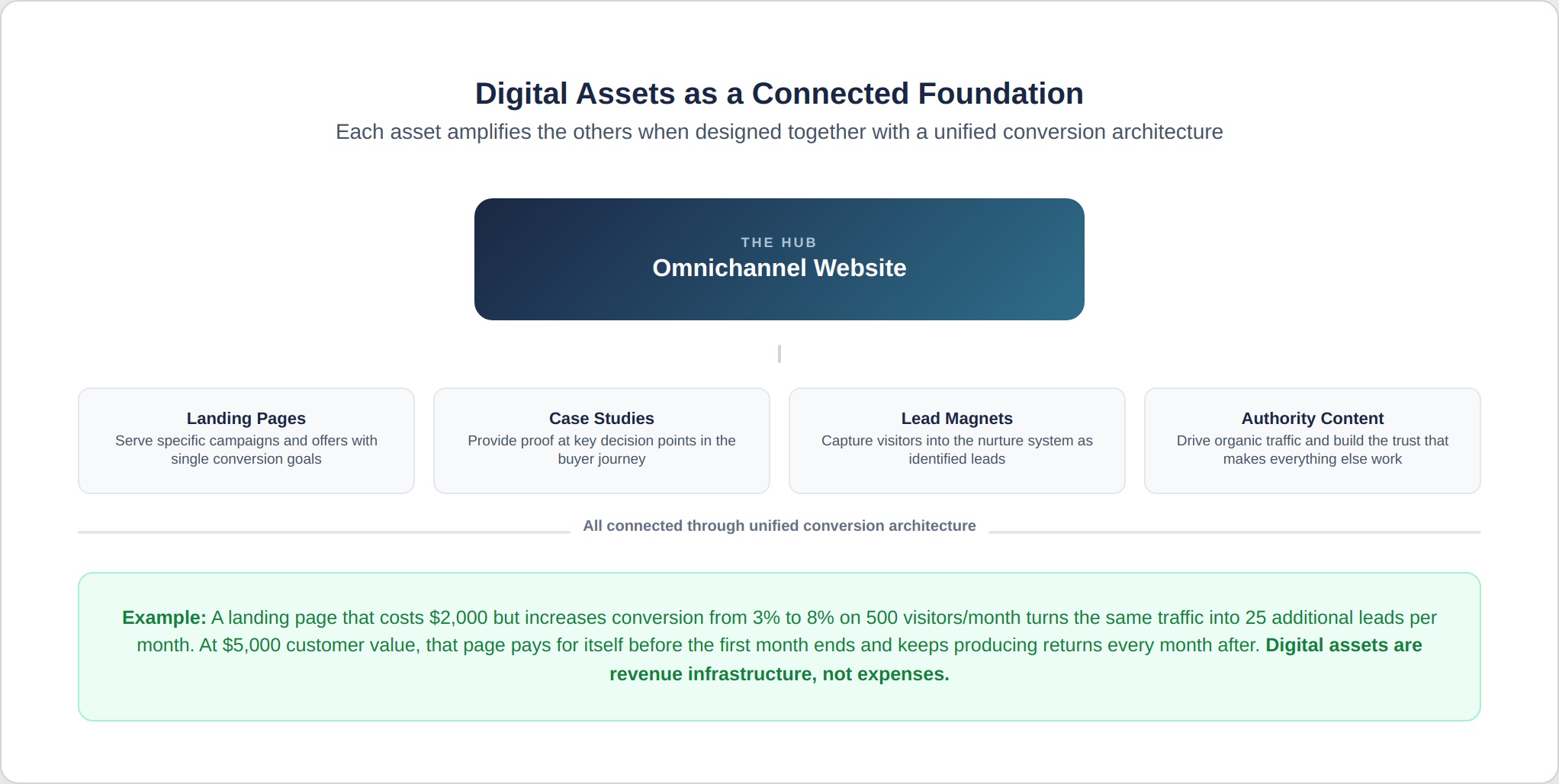
Digital assets produce their highest return when they’re designed as a connected system rather than built as independent pieces. Your website is the hub. Your landing pages serve specific campaigns and offers. Your case studies provide proof at key decision points. Your lead magnets capture visitors into your nurture system. Your authority content drives organic traffic and builds the trust that makes every other asset more effective. When these assets are designed together with a unified conversion architecture, each one amplifies the others. When they’re built independently without that architecture, each one works at a fraction of its potential.
For businesses building a complete digital asset foundation, we scope the entire package as a unified engagement. The total investment reflects the shared conversion architecture, the interconnected design system, and the strategic integration between assets. This typically produces better economics than building each asset independently because the strategy, design framework, and integration work is done once and applied across all components.
Not Ready for a Full Build? Start With Digital Marketing Strategy Consulting
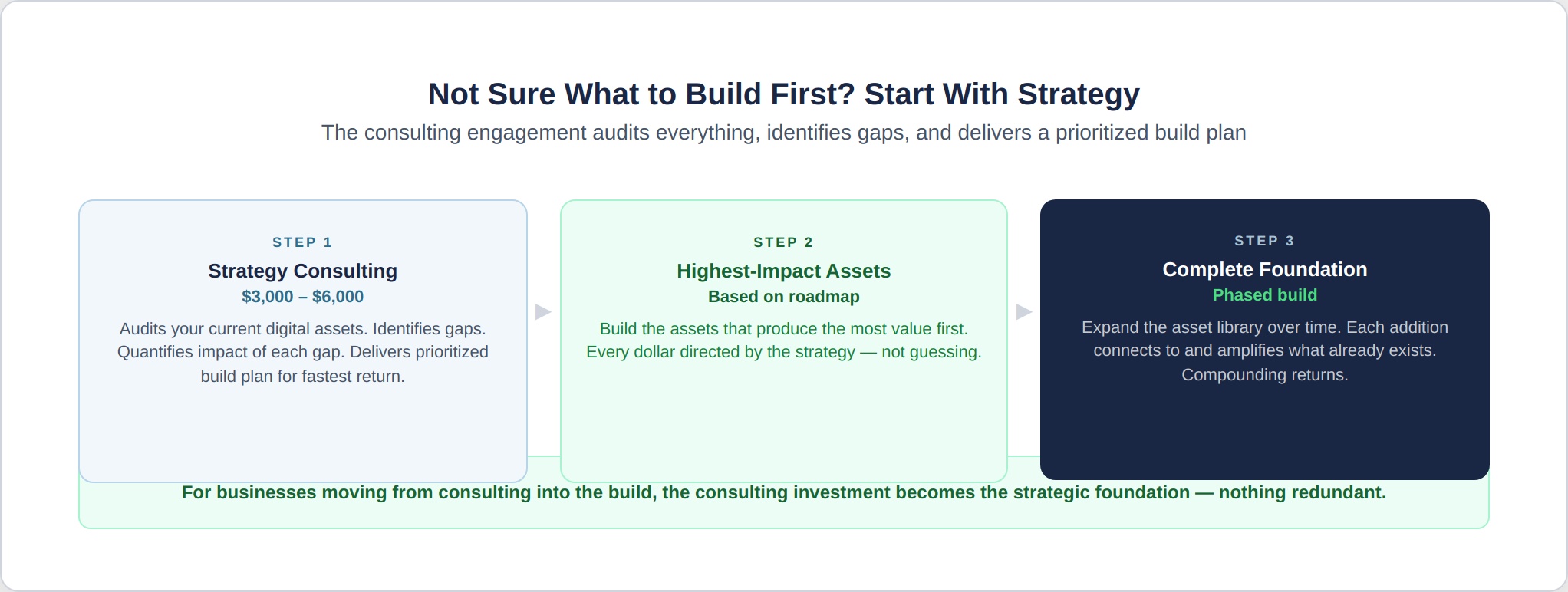
If you’re unsure which digital assets need to be built, rebuilt, or optimized first, Digital Marketing Strategy Consulting gives you the complete assessment and prioritized roadmap before any building begins. The consulting engagement audits your current digital assets, identifies the gaps, quantifies the impact of each gap, and delivers a prioritized build plan that tells you exactly what to invest in and in what order to produce the fastest measurable return.
Typical consulting investment range: $3,000 to $6,000 for the complete assessment and strategic roadmap. For businesses that move from consulting into the build phase, the consulting investment becomes the strategic foundation of the project, meaning nothing is redundant.
The Bottom Line on Digital Assets Pricing
Your digital assets are the foundation everything else runs on. Ads, email, AI agents, organic traffic, all of them ultimately depend on your website, landing pages, and content to convert attention into revenue. Underinvesting in the foundation means every dollar you spend on traffic, leads, and outreach produces a fraction of the return it should because the conversion infrastructure can’t do its job. The right investment in digital assets doesn’t add cost to your marketing. It multiplies the return on everything else.
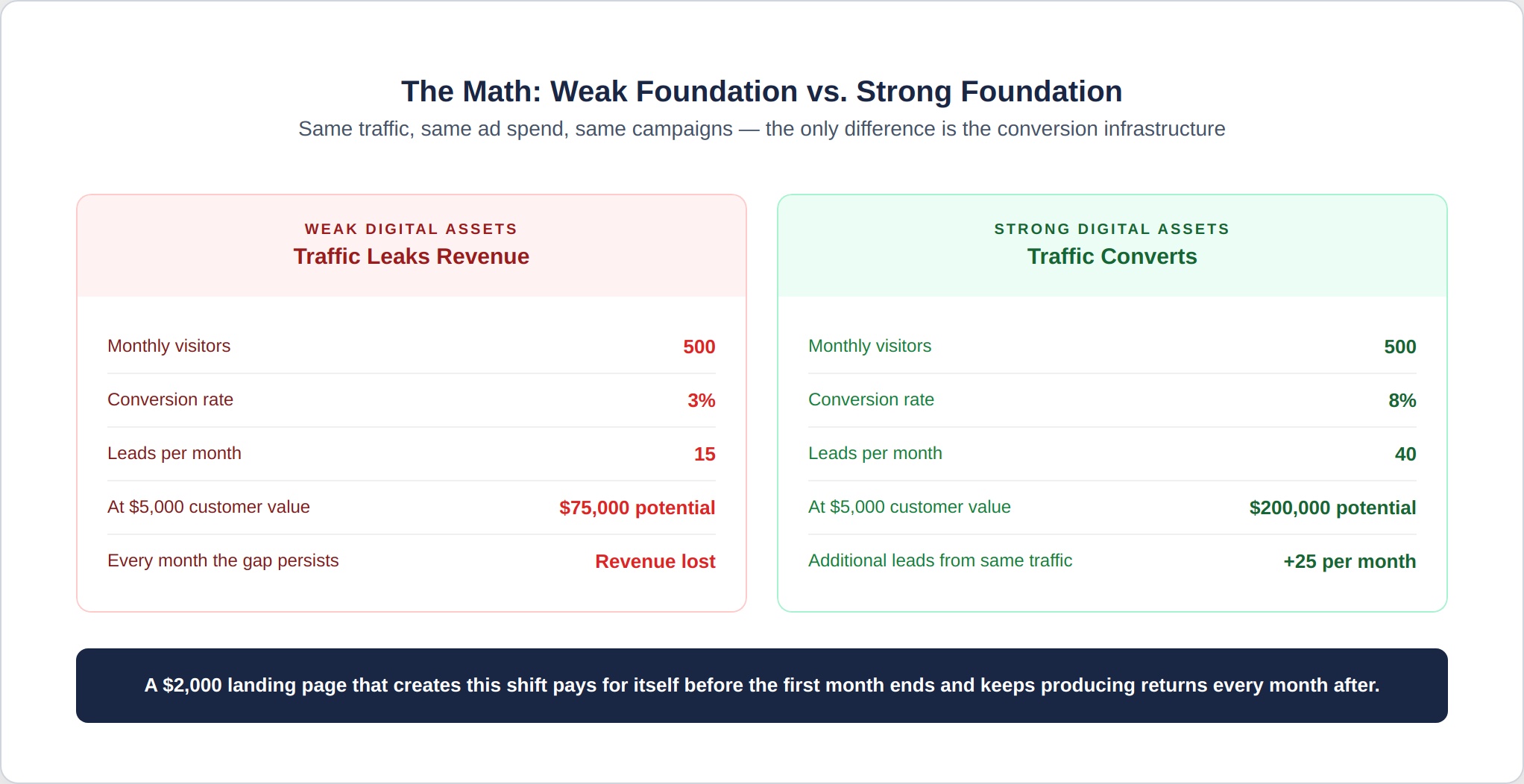
Every investment should be evaluated on what it produces, not just what it costs. A landing page that costs $2,000 to build but increases conversion rate from 3 percent to 8 percent on a campaign generating 500 visitors per month turns the same traffic into 25 additional leads per month. At a $5,000 customer value, that page pays for itself before the first month ends and keeps producing returns every month after. Digital assets are not expenses. They’re revenue infrastructure.
If you’re ready to explore what a complete digital asset foundation would look like for your business, book a discovery call. We’ll assess where you are, identify the highest-impact opportunities, and provide a specific proposal based on your actual requirements.