

Newsletter Marketing: How a Weekly Email Becomes the Most Valuable Audience Asset Your Business Owns
Social media algorithms change overnight and your reach disappears. Google rolls out a core update and your organic traffic drops 30%. Ad costs keep climbing and the ROI keeps shrinking. But your newsletter list? That’s yours. Nobody can throttle it. Nobody can take it away. Nobody gets to decide whether your message reaches the people who signed up to hear from you. A newsletter is the only marketing channel where you own the relationship completely. No middleman. No algorithm. No platform that can change the rules and erase your audience while you sleep.
And yet most businesses treat their newsletter like an afterthought. They send a monthly company update that nobody asked for. A recap of blog posts that subscribers already saw. A holiday greeting in December and maybe a product announcement when they have something to sell. That’s not newsletter marketing. That’s checking a box. A real newsletter strategy builds an audience that looks forward to hearing from you, trusts your perspective, and buys from you because you’ve earned their attention week after week through content that’s actually worth reading.
I’ve spent 27 years building marketing systems across every channel that’s existed during that time. Platforms have come and gone. Algorithms have shifted hundreds of times. Ad costs have done nothing but increase. Through all of it, the one constant has been email. And the most powerful application of email isn’t nurture sequences or promotional campaigns. It’s the newsletter. A consistently delivered, genuinely valuable newsletter builds the kind of audience relationship that no other channel can replicate because it’s built on earned attention, not rented distribution.
Here’s the complete breakdown of how newsletter marketing works as a business growth strategy, what separates newsletters that build loyal audiences from ones that get ignored, and how to create a newsletter that becomes the most valuable marketing asset your business owns, so read on.
Why Your Current Newsletter Isn’t Building the Audience or Revenue It Should
Here’s the pattern I see repeatedly. A business starts a newsletter with good intentions. The first few issues get solid open rates because the list is fresh and curious. But without a clear content strategy, the quality drifts. Some weeks it’s a collection of links to recent blog posts. Other weeks it’s a company announcement that only the internal team cares about. Sometimes it’s a thinly disguised sales pitch dressed up as ‘news.’ Open rates slide from 35% to 22% to 16%. Click rates become negligible. The person writing it starts dreading the weekly deadline because they have nothing compelling to say. Eventually the newsletter goes from weekly to biweekly to ‘whenever we get around to it.’ The list stagnates. The channel dies quietly.
The root cause is always the same. The newsletter was designed around what the business wanted to say instead of what the subscriber wanted to receive. There’s a fundamental difference between a company newsletter and a newsletter marketing strategy. A company newsletter reports on business activity. A strategic newsletter delivers value that the subscriber can’t easily get anywhere else. One is self-serving. The other is audience-serving. And the difference shows up immediately in open rates, engagement, subscriber growth, and revenue.
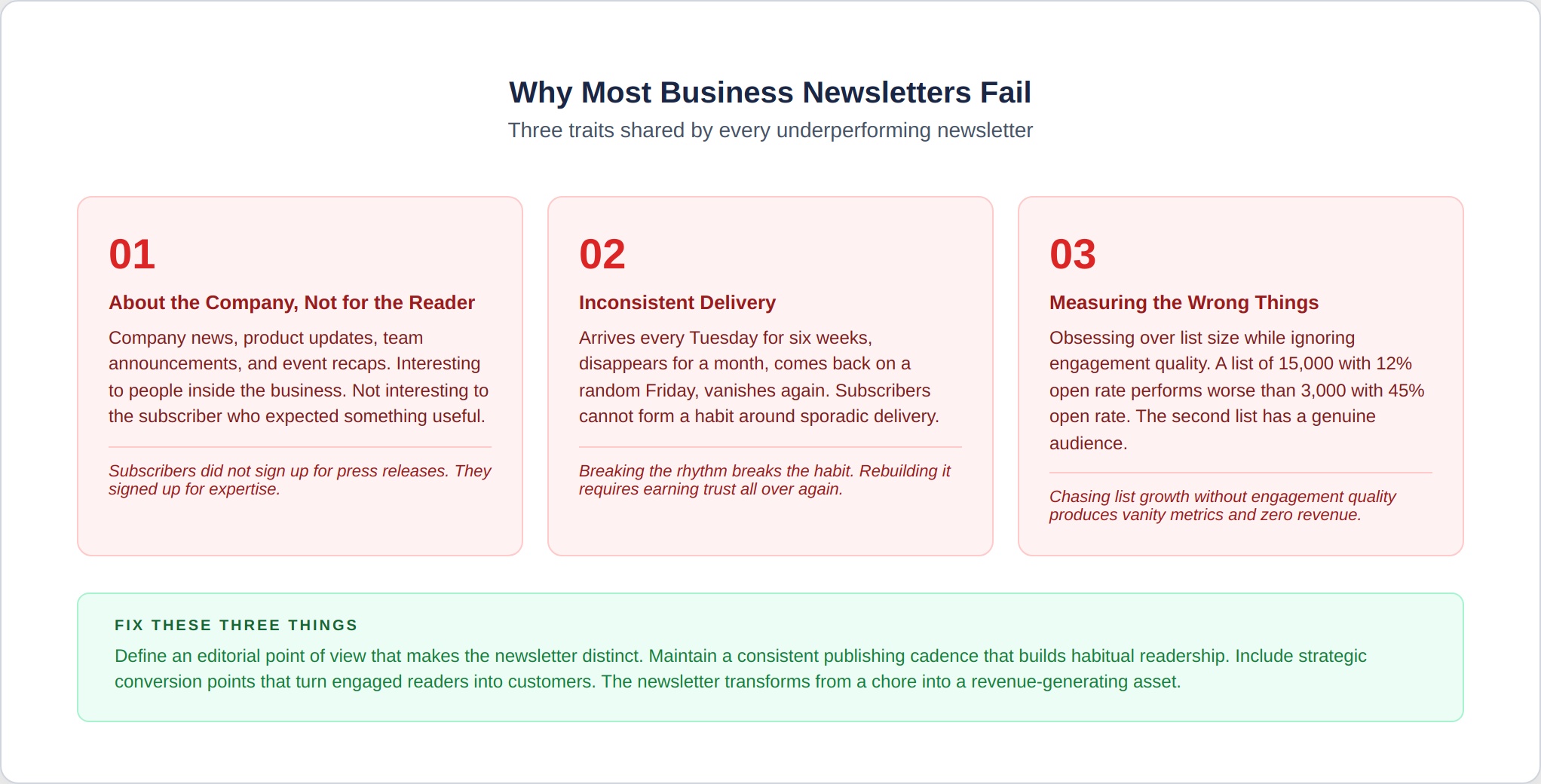
In my experience, the businesses with underperforming newsletters share three traits. They don’t have a defined editorial point of view that makes the newsletter distinct from everything else in the subscriber’s inbox. They don’t maintain a consistent publishing cadence that builds habitual readership. And they don’t include strategic conversion points that turn engaged readers into customers. Fix those three things and the newsletter transforms from a marketing chore into a revenue-generating asset.
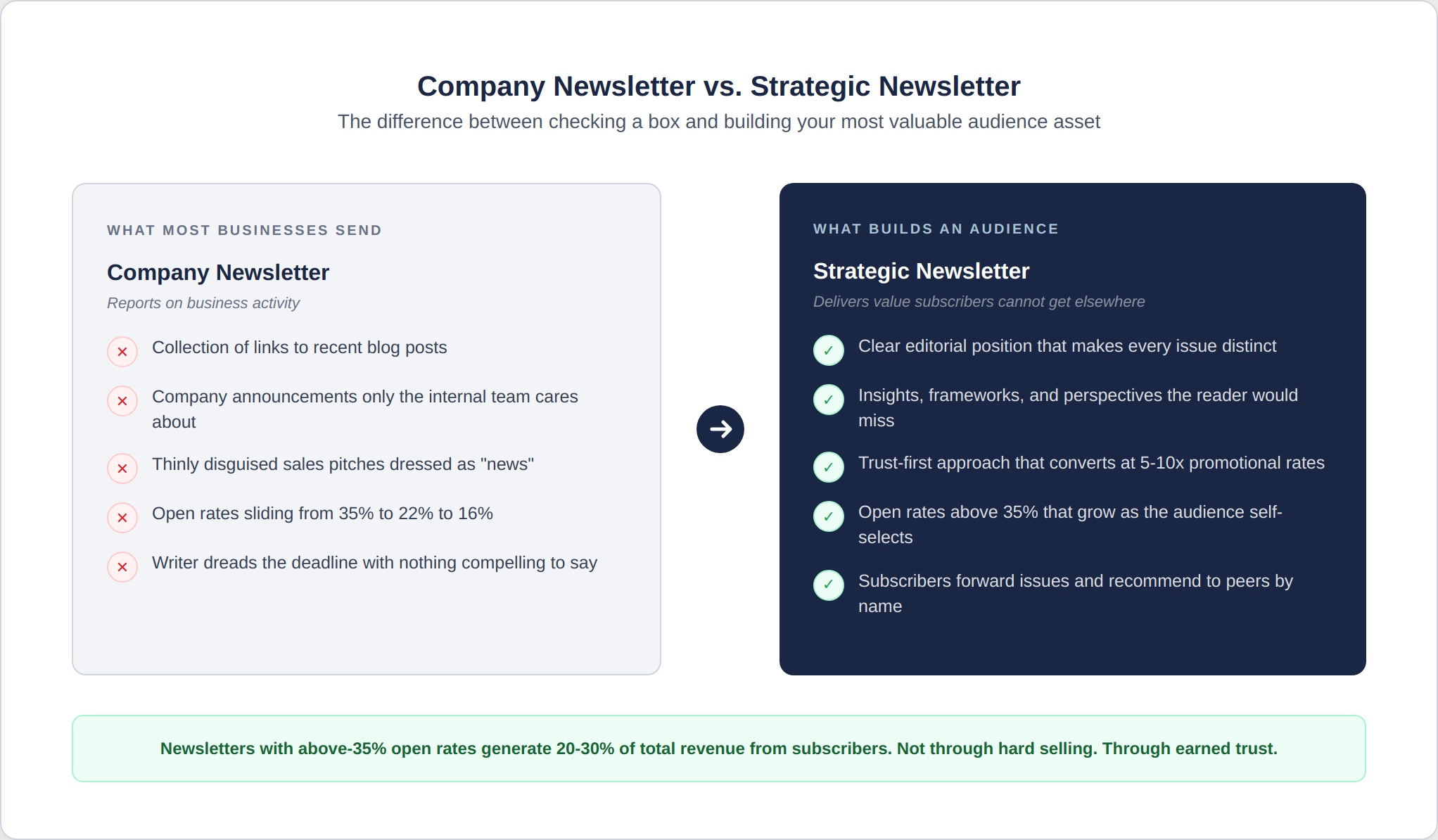
Picture this instead. Every Tuesday morning at 7 AM, your newsletter lands in 4,000 inboxes. Forty-two percent open it within the first three hours. They open it because last week’s issue gave them a genuinely useful insight they applied to their business that same day. The week before that, you shared a perspective on an industry trend that nobody else was talking about and it changed how they thought about their strategy. Your newsletter isn’t competing with the other 47 emails in their inbox. It’s the one they look for.
That engaged audience becomes your most reliable business asset. When you mention a new service offering in the newsletter, you get inquiries that same day from subscribers who trust your expertise because they’ve experienced it every week for months. When you share a case study, readers forward it to colleagues who then subscribe themselves. When you publish a detailed breakdown of a topic, subscribers share it on LinkedIn and tag their networks. Your newsletter doesn’t just retain readers. It grows your audience organically because the content is good enough to spread on its own.
Based on real results, businesses with a strategic newsletter that maintains above-35% open rates generate 20% to 30% of their total revenue from newsletter subscribers. Not through hard selling. Through consistent trust building that makes the subscriber think of them first when they’re ready to buy. The newsletter creates a warm audience that’s perpetually primed for conversion because every issue deposits another unit of trust into the relationship. No other marketing channel builds that kind of compounding loyalty.
How to Build a Newsletter Marketing Strategy That Grows Your Audience and Revenue
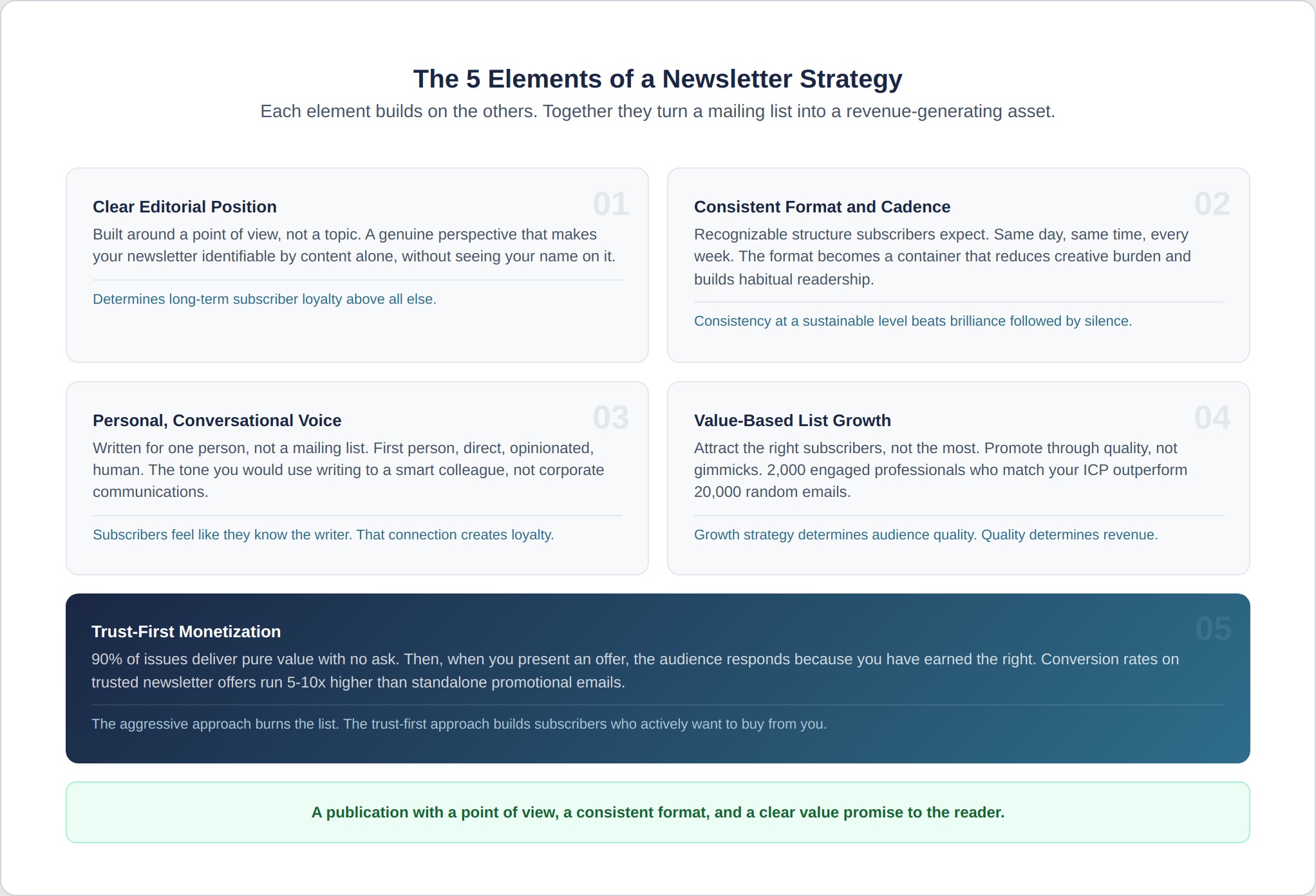
A newsletter that builds a loyal audience and generates business isn’t a content dump. It’s a publication with a point of view, a consistent format, and a clear value promise to the reader. Here’s how each element needs to work.
Define a Clear Editorial Position That Makes Your Newsletter Worth Reading
The most successful newsletters are built around a point of view, not a topic. There are a thousand newsletters about digital marketing. But a newsletter that says ‘We believe most businesses overcomplicate their marketing and we show you how to build simple systems that actually work’ has a position. It’s specific. It’s opinionated. It attracts people who resonate with that philosophy and gives the writer a lens through which every issue gets filtered. That clarity of perspective is what turns a generic update into a publication people look forward to.
Your editorial position should emerge from the intersection of what you believe, what your audience needs, and what nobody else in your space is saying consistently. Maybe you believe most marketing advice is too complicated for small businesses. Maybe you think data-driven decisions are overrated compared to customer conversations. Maybe you’ve observed that the businesses growing fastest are the ones doing three things well instead of twenty things poorly. Whatever the perspective, it needs to be genuine, defensible, and distinct enough that a reader could identify your newsletter from the content alone without seeing your name on it.
After working with businesses on their newsletter strategies, the editorial position is the single element that determines long-term subscriber loyalty. Newsletters without a clear point of view become indistinguishable from every other business email in the inbox. Newsletters with a strong perspective develop readers who feel aligned with the writer’s thinking and stay subscribed for years because the viewpoint itself is valuable to them, independent of any specific topic covered in a given issue.
Create a Consistent Format That Subscribers Can Rely On
The best newsletters have a recognizable structure that subscribers grow to expect and appreciate. It might be three sections: one industry insight, one tactical tip they can implement immediately, and one resource recommendation. Or it might be a single deep-dive essay on one topic each week. Or a curated roundup of the five most important developments in your space with your analysis of each one. The specific format matters less than the consistency. When subscribers know what they’re getting, they’re more likely to open because they’ve already decided the format works for them.
Consistency in format also makes the newsletter easier to produce, which is critical for sustainability. When the writer knows they need to deliver one insight, one tip, and one recommendation every week, the creative burden shrinks dramatically compared to starting from a blank page with no structure. The format becomes a container that just needs to be filled. That reduces the friction that causes most newsletters to die from inconsistency.
The publishing schedule needs to be predictable too. Same day, same approximate time, every week. The subscribers who look forward to your newsletter expect it when it arrives. If it comes on random days at random intervals, it loses the habitual quality that makes it part of their routine. Tuesday morning newsletters that arrive every Tuesday morning become part of the subscriber’s week. Newsletters that show up whenever the writer finds time become part of nobody’s routine.
Write for One Person, Not a Mailing List
The newsletters with the highest engagement are written in a personal, conversational voice directed at a single reader. Not ‘Dear valued subscribers.’ Not ‘We’re excited to share.’ But rather the tone you’d use if you were writing an email to one smart colleague who asked for your take on something. First person. Direct. Opinionated. Human. The moment a newsletter starts reading like corporate communications, the reader’s brain categorizes it as marketing and the engagement drops.
This voice requires the writer to actually have something to say. Not recapped. Not curated. Original thinking based on real experience. ‘I talked to a business owner this week who was spending $8,000 a month on ads and couldn’t tell me his cost per lead. Here’s what I told him and why it changed his entire approach.’ That kind of content comes from a real person with real opinions who’s willing to put them in writing. It can’t be outsourced to a content mill or generated by a template.
The personal voice also builds a relationship that extends beyond the content itself. Subscribers start to feel like they know the writer. They reply to the newsletter with questions or comments. They reference specific issues in conversations. They recommend the newsletter to peers by name. That personal connection is the mechanism that turns a mailing list into an audience and an audience into a revenue-generating community. No amount of polished corporate messaging produces that effect.
Grow the List Through Value, Not Gimmicks
Newsletter growth that produces business results comes from attracting the right subscribers, not the most subscribers. A list of 2,000 engaged professionals who match your ideal customer profile is worth more than 20,000 random emails collected through a giveaway. Growth strategies should focus on value-based attraction. Promote the newsletter on your website with a clear description of what the subscriber gets and why it’s worth their email address. Share standout issues on social media so people can see the quality before subscribing. Mention the newsletter in podcast appearances, guest posts, and speaking engagements.
The sign-up offer matters. ‘Subscribe to our newsletter‘ converts at a fraction of the rate of ‘Get one actionable marketing strategy delivered to your inbox every Tuesday.’ The more specific and value-oriented the promise, the higher the opt-in rate and the more qualified the subscriber. People don’t want another newsletter. They want a specific outcome that the newsletter delivers. Frame the offer around the outcome, not the format.
Time and again, the newsletters with the most profitable subscriber bases are the ones that grew slowly through quality rather than quickly through gimmicks. Viral sweepstakes and lead magnet bundles produce subscribers who never open a single issue. Organic growth from content quality produces subscribers who open every issue and eventually become customers. The growth strategy determines the quality of the audience, and the quality of the audience determines the revenue the newsletter generates.
Monetize Through Trust, Not Promotion
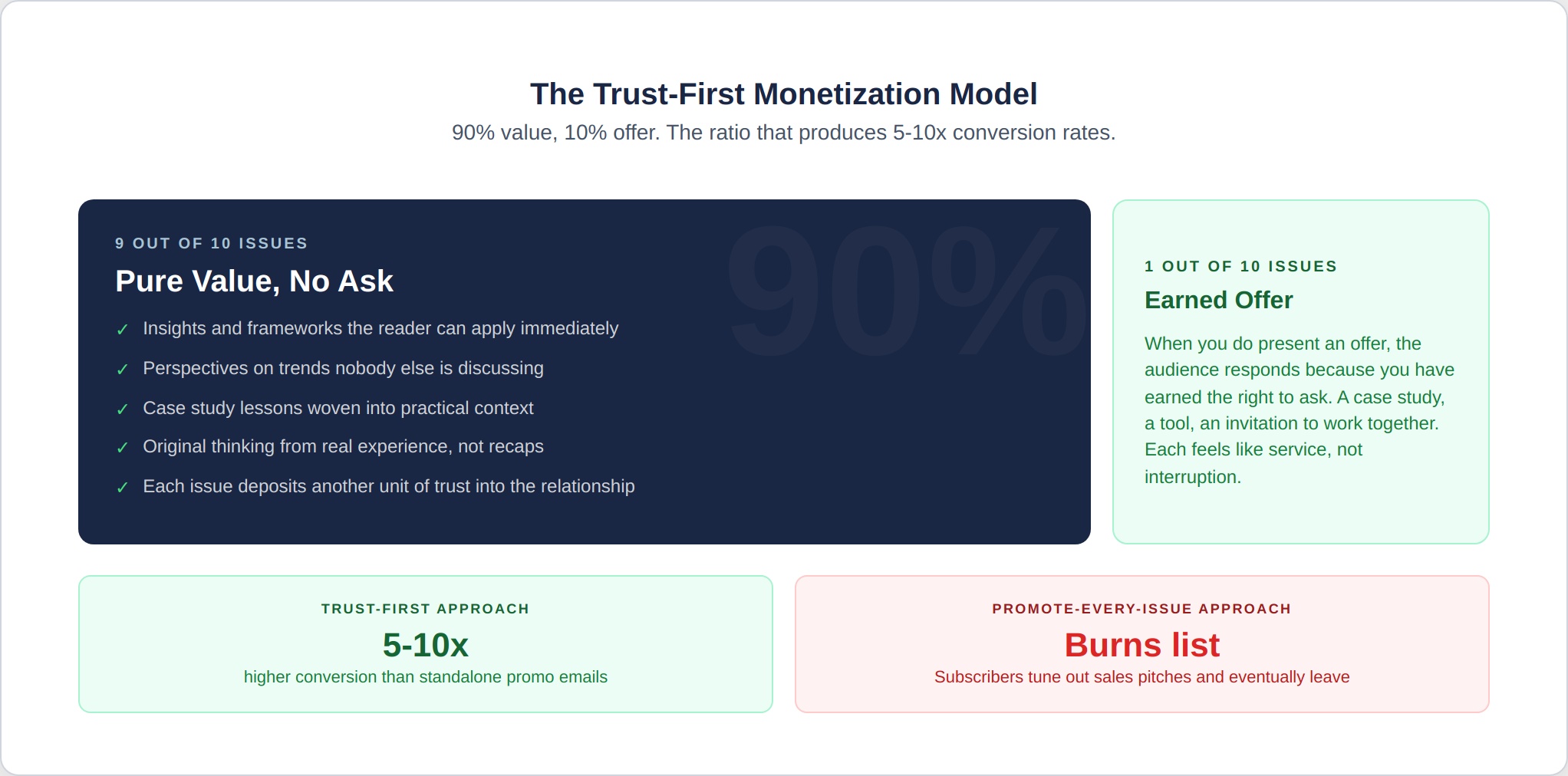
The newsletter generates revenue not by selling in every issue but by building enough trust that the occasional offer converts at an exceptionally high rate. The monetization model is subtle. Ninety percent of issues deliver pure value with no ask. They build trust, demonstrate expertise, and deepen the relationship. Then, when you do present an offer, whether it’s a new service, a consultation, or a limited engagement, the audience responds because you’ve earned the right to ask. The conversion rates on offers embedded in trusted newsletters are 5x to 10x higher than the same offer sent as a standalone promotional email.
The conversion opportunities come in different forms. A case study naturally mentioned in the context of a lesson. A tool or resource you’ve built that solves a problem the newsletter discussed. A direct invitation to work together framed as the logical next step for subscribers who’ve been implementing your advice. Each of these feels like a service to the reader, not an interruption, because it emerges naturally from the value you’ve been providing.
Based on real results, newsletters that follow the trust-first monetization approach generate more revenue per subscriber than newsletters that promote in every issue. The aggressive approach burns the list. Subscribers tune out the sales pitches and eventually leave. The trust-first approach builds a list of subscribers who actively want to buy from you because every interaction has been positive. That’s not just better marketing. That’s a fundamentally different business model built on earned loyalty instead of manufactured urgency.
How Long Before Newsletter Marketing Builds an Audience That Produces Revenue
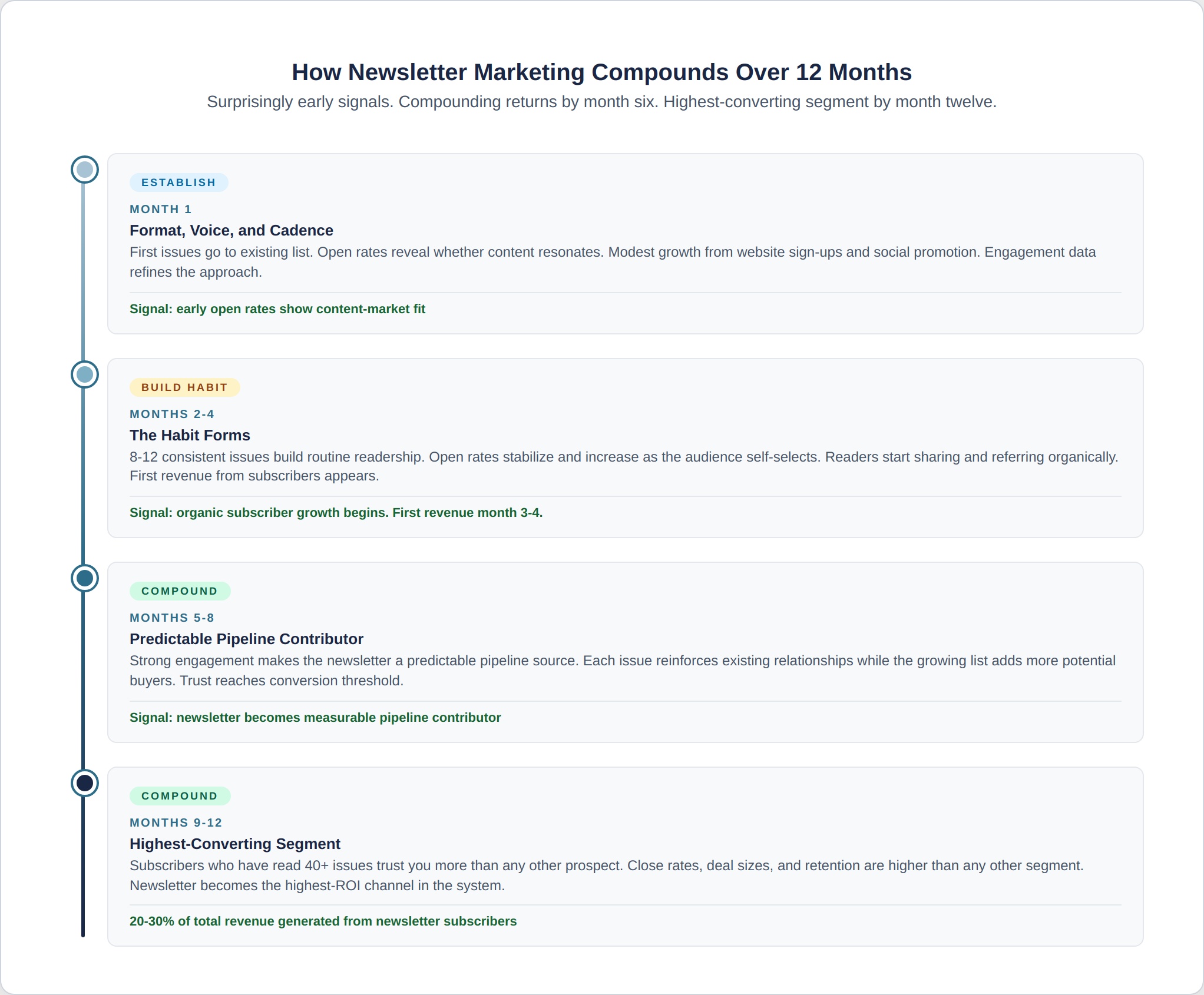
Newsletter marketing is a long game with surprisingly early signals. The first month establishes the format, voice, and publishing cadence. Early issues go to your existing email list and the open rates tell you immediately whether the content resonates. Subscriber growth during month one is modest, primarily from website sign-ups and social promotion. But the engagement data from these early issues is invaluable for refining the approach.
Months two through four is where the habit forms. Subscribers who’ve received eight to twelve consistent, valuable issues start to recognize your newsletter as part of their routine. Open rates stabilize and, for well-executed newsletters, actually increase during this period as the audience self-selects for people who genuinely value the content. Subscriber growth accelerates as readers start sharing and referring others organically. The first revenue from newsletter subscribers typically appears in month three or four as the trust reaches the threshold where offers convert.
Months five through twelve is the compounding phase. Each new issue reinforces the relationship with existing subscribers while the growing list adds more potential buyers. By month six, a newsletter with strong engagement becomes a predictable pipeline contributor. By month twelve, the newsletter audience is typically the highest-converting segment in the entire marketing ecosystem. The subscribers who’ve read 50 issues trust you more than any other prospect in your pipeline, and that trust shows up in close rates, deal sizes, and customer retention.
Why the First Ten Issues of Your Newsletter Define Its Long-Term Success
The first ten issues establish every expectation your subscribers will hold going forward. The quality bar. The voice. The format. The consistency. The relevance. Subscribers who receive ten strong issues become loyal readers who give you a long leash for the occasional off week. Subscribers who receive ten mediocre issues unsubscribe or, worse, stop opening entirely and drag down your deliverability metrics for everyone else on the list.
This means the launch period requires more investment than steady-state publishing. The first ten issues should represent your best thinking, your most useful insights, and your clearest writing. Front-load the value. Make subscribers feel like the newsletter is the best email they receive all week. That early investment in quality creates the reader habit and the word-of-mouth growth that sustains the newsletter long-term.
I’ve seen businesses launch newsletters with strong first issues that generated excitement and referrals, then let the quality drop by issue fifteen because the initial effort wasn’t sustainable. The result was a spike in subscribers followed by a slow bleed of disengagement. Better to start at a quality level you can maintain indefinitely than to overcommit early and burn out. Consistency at a sustainable quality level beats brilliance followed by mediocrity every time.
Why Most Business Newsletters Fail to Build an Audience Worth Having
The first and most fatal failure is making the newsletter about the company instead of for the reader. Company news, product updates, team announcements, and event recaps are interesting to the people inside the business. They are not interesting to the subscriber who gave their email address because they expected to receive something useful. Every issue that prioritizes company information over subscriber value erodes the trust that makes the newsletter worth reading. Subscribers didn’t sign up for your press releases. They signed up for your expertise.
The second failure is inconsistency. A newsletter that arrives every Tuesday for six weeks, then disappears for a month, then comes back on a random Friday, and then vanishes again for three weeks isn’t a newsletter. It’s a sporadic email that subscribers can’t form a habit around. The power of newsletter marketing comes from rhythmic, predictable delivery that becomes part of the subscriber’s routine. Breaking that rhythm breaks the habit, and rebuilding it requires earning trust all over again.
The third failure is measuring the wrong things. Businesses obsess over list size and ignore engagement quality. A list of 15,000 with a 12% open rate is performing worse than a list of 3,000 with a 45% open rate. The second list has a genuine audience. The first has a database of people who mostly don’t remember subscribing. Chasing list growth without maintaining engagement quality produces vanity metrics that look good in a report and produce nothing in revenue. The businesses that succeed with newsletter marketingmeasure opens, clicks, replies, and revenue generated, in that order.
What 27 Years of Direct Communication Marketing Brings to Newsletter Strategy
I’ve been writing to audiences since before the word ‘newsletter‘ applied to email. The principles that make a newsletter work haven’t changed in three decades: say something worth reading, say it consistently, and respect the reader’s time and attention enough to make every issue earn its place in their inbox. What has changed is the competitive landscape. The average professional receives 121 emails per day. Standing out requires not just good content but a distinctive voice, a clear point of view, and a commitment to value that most businesses aren’t willing to sustain.
When I build a newsletter marketing strategy, we start by defining the editorial position that will make your newsletter distinct. Not different for the sake of different. Distinct because your perspective on your industry is genuinely unique and valuable. Then we design the format, the voice, and the publishing workflow in a way that’s sustainable for the long term, not just exciting for the first month. Every issue gets built with a structure that balances value delivery with strategic conversion opportunities so the newsletter grows the audience and generates revenue simultaneously.
The result is a newsletter that subscribers treat as a publication worth their attention, not another marketing email to delete. It builds the kind of audience relationship that makes every other marketing channel more effective. Subscribers who trust your newsletter engage more deeply with your website, respond more positively to your offers, and convert to customers at rates that make the newsletter the highest-ROI channel in your entire marketing system.
Newsletter Marketing as the Audience-Building Engine of an Omnipresent Marketing System
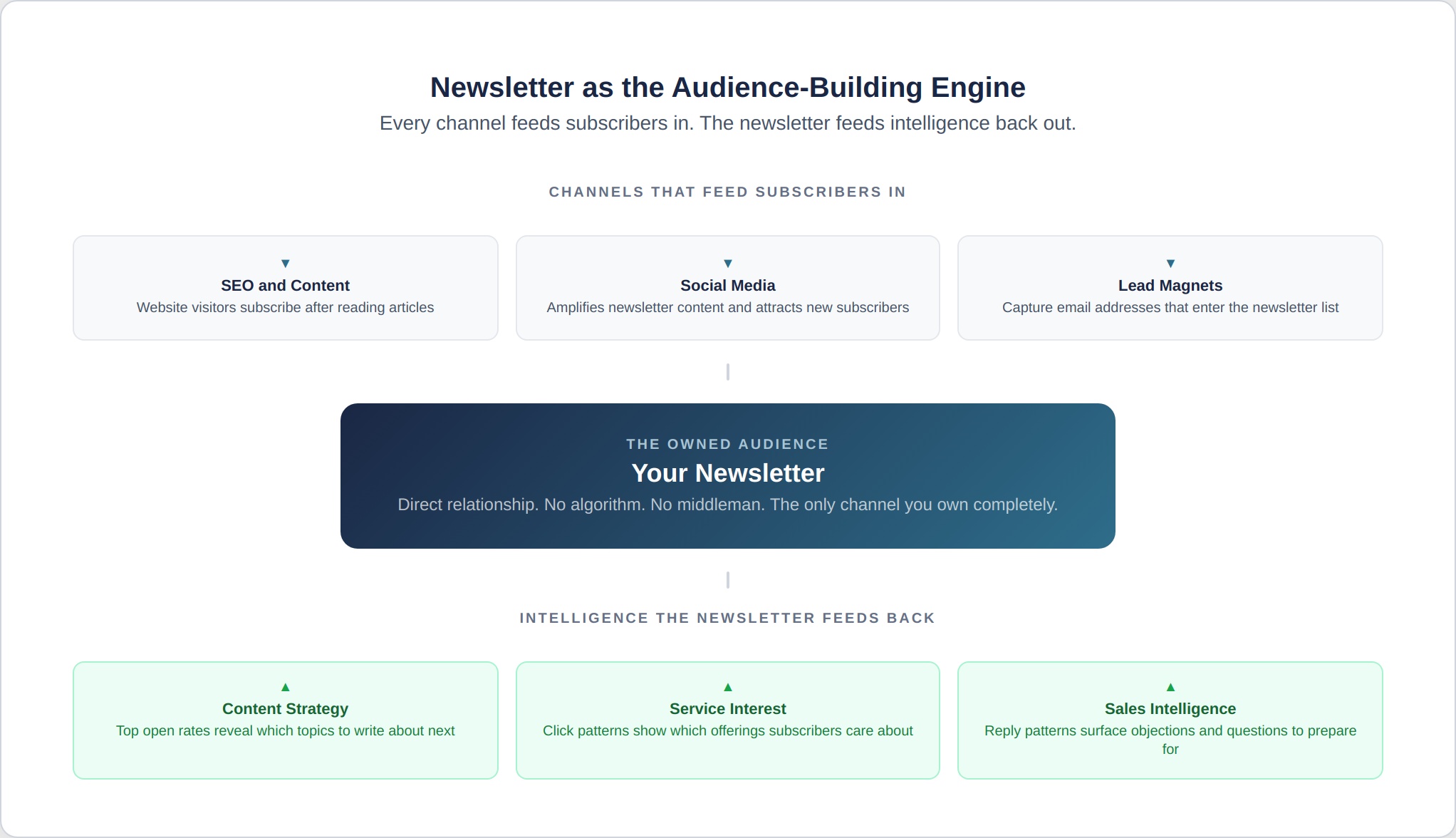
Your newsletter is the audience-building engine that creates a direct, owned relationship with every person your marketing touches. SEO and content marketing drive website visitors who subscribe. Social media amplifies newsletter content and attracts new subscribers from audiences who discover your posts. Lead magnets capture email addresses that enter the newsletter list. Video content builds trust that makes viewers want to subscribe for more. Every acquisition channel feeds the newsletter, and the newsletter converts that attention into an owned audience you control completely.
The newsletter feeds intelligence back into the system too. Which topics get the highest open rates tells your content team what to write about. Which links get clicked reveals what services subscribers are most interested in, informing your ad targeting and landing page strategy. Reply patterns surface objections and questions that your sales team should be prepared to handle. The newsletter becomes a constant feedback loop between your business and your market.
That’s what an omnipresent marketing system looks like when newsletter marketing is the audience-building engine at the center. You attract through search and social. You capture through lead magnets and opt-ins. You build the relationship through your newsletter. You convert through trust-based offers and behavioral triggers. And the audience you build is yours, not dependent on any platform, any algorithm, or any third party. The businesses that build this owned audience create a competitive moat that can’t be disrupted by the next platform change because the relationship lives in the inbox, not on borrowed ground.
The Bottom Line
Every marketing channel you use today could change its rules tomorrow. Your organic reach could get throttled. Your ad costs could double. Your rankings could drop overnight. But your newsletter list is yours. The subscribers who look forward to hearing from you every week represent the most valuable marketing asset your business can build because no external force can take that relationship away. Newsletter marketing isn’t about sending emails. It’s about building an audience that trusts you, values your perspective, and buys from you because you’ve earned their loyalty one issue at a time. In a world where every other channel is rented, the newsletter is the only one you own.
What to Do If Your Newsletter Is a Chore Nobody Reads
Be honest with yourself about the current state. Pull up your last ten newsletter issues and read them from the subscriber’s perspective. Is there anything in those emails that a subscriber couldn’t find by visiting your blog, checking your social media, or Googling the topic? Did any issue make you think ‘this is genuinely useful and I’m glad I opened it’? Are you proud enough of the content to forward it to a peer and say ‘you should subscribe to this’? If the honest answer is no, you’ve identified the problem.
Now look at the metrics. What’s your open rate trend over the last six months? Is it stable, growing, or declining? What percentage of subscribers have opened at least one of your last five issues? How many replies or direct responses do you receive from subscribers? If the trends are flat or declining and engagement is minimal, the newsletter is losing the audience instead of building it.
Better approach: redefine the newsletter from the ground up. Start with the editorial position that will make it distinct. Design a format that’s valuable and sustainable. Write the first issue as if you’re writing to one specific person you want to impress. Publish on the same day at the same time every week without exception. Deliver value in nine out of ten issues and only present an offer when you’ve genuinely earned the right. Measure engagement quality, not list size. And commit to 26 issues before you evaluate whether it’s working, because the compounding effect takes six months to fully materialize.
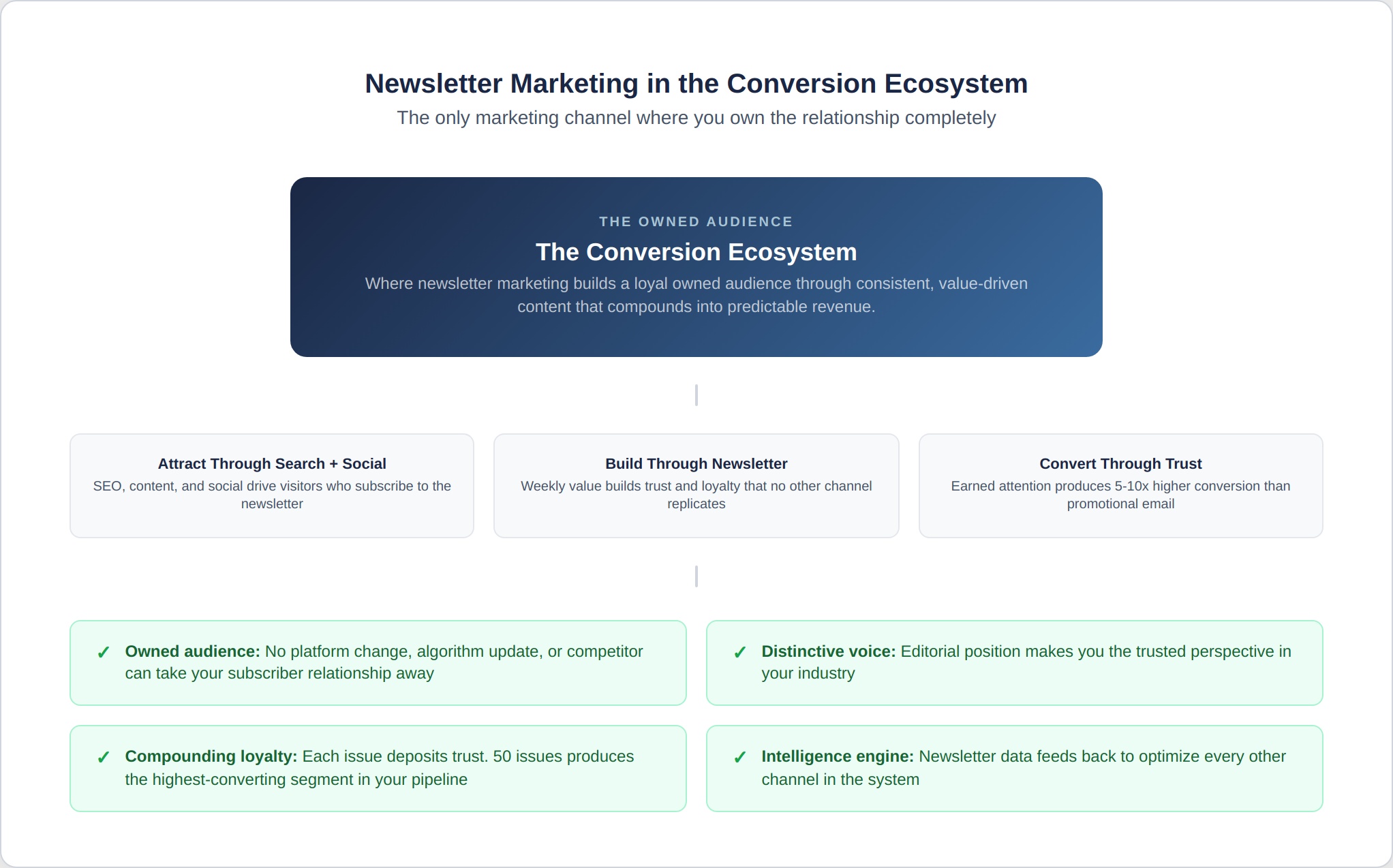
What you need is a complete digital marketing strategy designed to turn traffic into customers predictably and repeatedly. Where your newsletter marketing strategy builds a loyal owned audience through consistent, value-driven content that subscribers genuinely look forward to receiving. Where a distinctive editorial voice positions you as the trusted perspective in your industry. Where strategic conversion opportunities turn engaged readers into customers without burning the trust you’ve built. Where every other marketing channel feeds subscribers into the newsletter and the newsletter feeds intelligence back to optimize every channel. And where the audience you build becomes a permanent business asset that no platform change, algorithm update, or competitor can take from you.
If you want help building a newsletter that subscribers actually read, developing the editorial strategy and voice that makes your email stand out in crowded inboxes, or connecting your newsletter to a marketing ecosystem that compounds audience loyalty into predictable revenue, reach out. This is where your marketing stops depending on rented platforms and starts building something you own.