Do Landing Page Builders Really Convert?

Your marketing manager built a campaign landing page using a high-converting template.
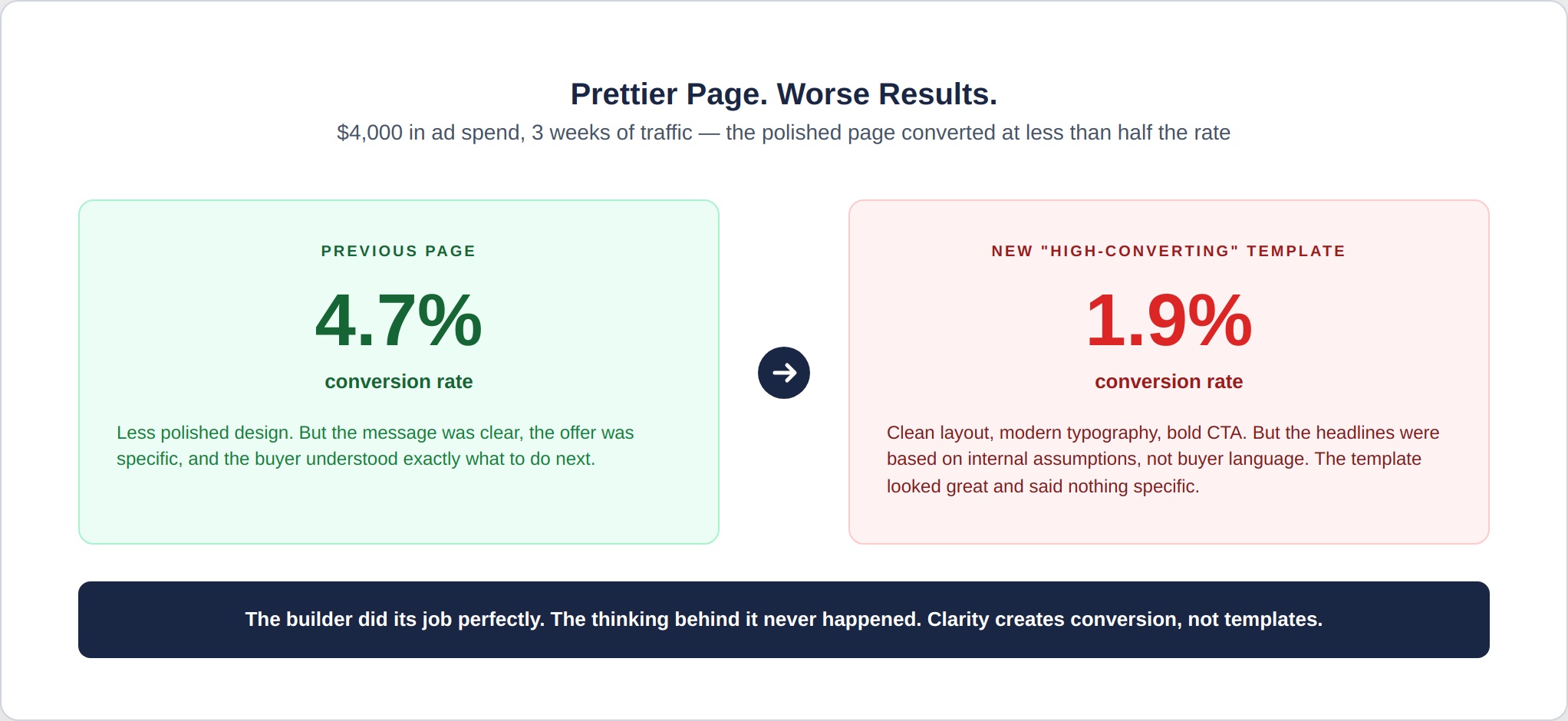
It looked sharp: clean layout, modern typography, bold call to action. After launching paid traffic, you checked the results after 3 weeks, and $4,000 spent, the conversion rate was only 1.9%, compared to the previous page’s 4.7%. Despite looking better, the new version performed worse.
This story highlights an important point: landing page builders do not drive conversions. What drives conversions is clear and persuasive messaging paired with a strategy aimed at producing results.
A visually polished page or an advanced builder is never the decisive factor that turns visitors into leads. Prioritizing appearance or tools over the clarity of your offer and message is a costly misconception B2B companies often make.
Many companies debate which builder offers the best templates and editor.
The key idea: it’s almost never the landing page builder alone that determines conversion outcomes.
Real success is driven by the clear knowing of why, to whom, and how. Focusing solely on appearance or tools, rather than on the clarity of the offer and message, is a mistake that can undermine results for B2B companies. The true difference-maker is when you focus on message and strategy.
Looking at things more closely, you can see:
- What are landing page builders actually good at?
- Where do they quietly underperform?
- And, most importantly, how should you decide if your builder is helping or hurting your conversion rate?
As you read, challenge yourself to compare your own process to these pitfalls and consider applying the insights to your next campaign.
The Landing Page Builders Were Actually Built to Do
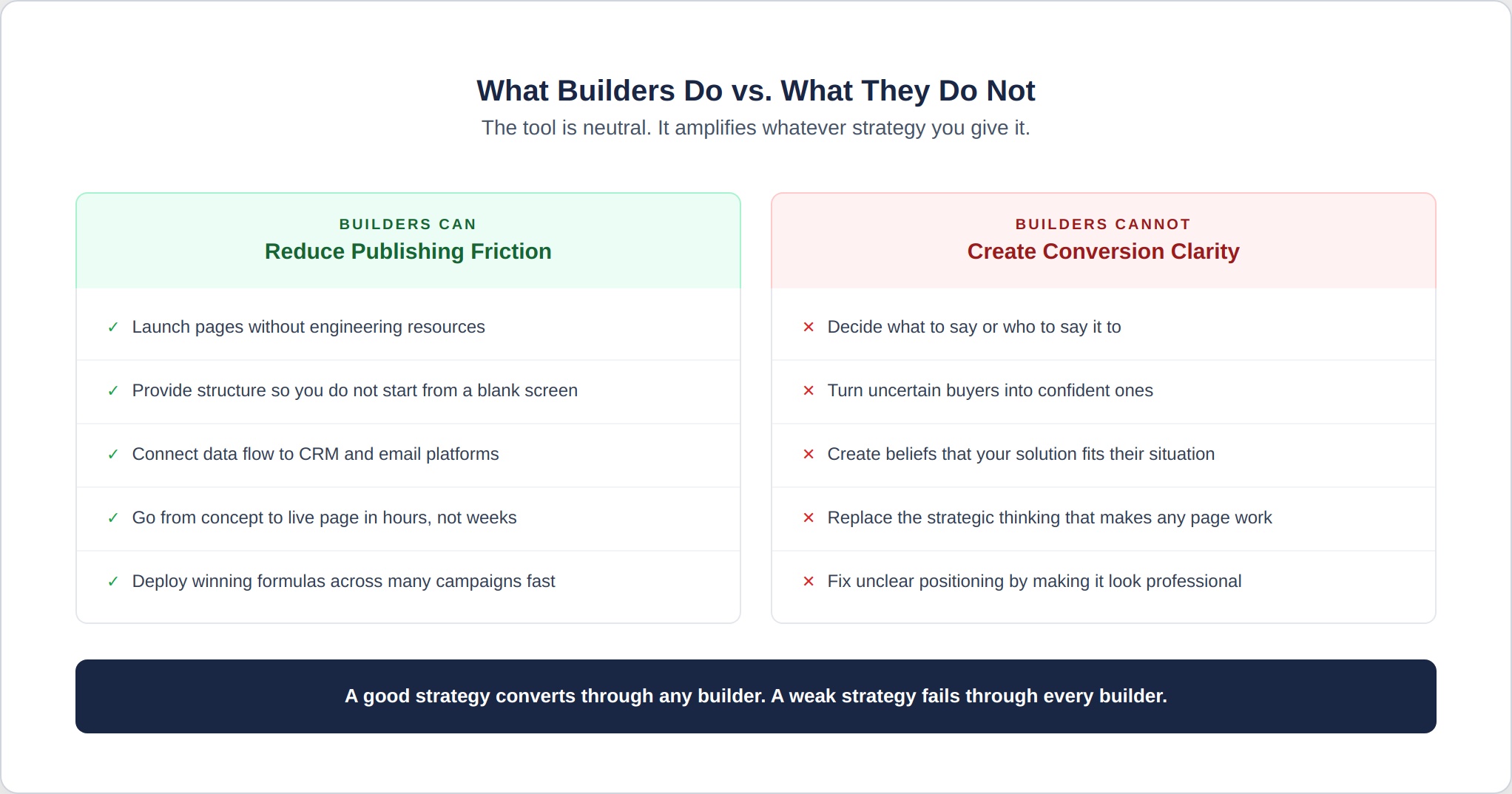
The goal of landing page builders is to give more people the ability to publish landing pages by giving them a friction-free way to do so. They enable launching pages without engineering resources. Templates provide structure, so you don’t start from a blank screen. Integrations simplify data flow to your CRM and email platform. Speed increases because you can go from concept to live page in hours rather than weeks.
Strong builders launch pages quickly, reduce dependency on developers, standardize layouts across campaigns, and enable rapid testing of variations. These are real advantages.
Builders help distribute your message quickly, but don’t decide what to say or to whom. Like a printing press, the tool delivers distribution, not content or message clarity.
When companies focus on execution speed at the expense of strategic quality, they end up with beautiful pages that say nothing useful.
When Builders Genuinely Deliver Value
Builders are useful in specific scenarios, and being honest about those scenarios matters.
They add real value when messaging has already been validated through conversations with actual buyers. When offers are clearly defined, and the page’s job is straightforward. When pages need to be tested frequently because the team is running multiple campaigns simultaneously. When the marketing team needs autonomy to move fast without waiting for a developer every time a headline changes.
This is where they can create actual value:
Once you have tested your message and you know it resonates with your audience, you can:
- Launch 10 variations targeting different segments.
- Update pages weekly based on campaign performance.
- Let your team iterate without a development bottleneck.
In those situations, builders are powerful tools that remove technical friction and enable speed. The value disappears when builders are used to skip the validation step entirely.
The Template Trap That Creates Beautiful Failures
Here is where most teams fail without realizing it.
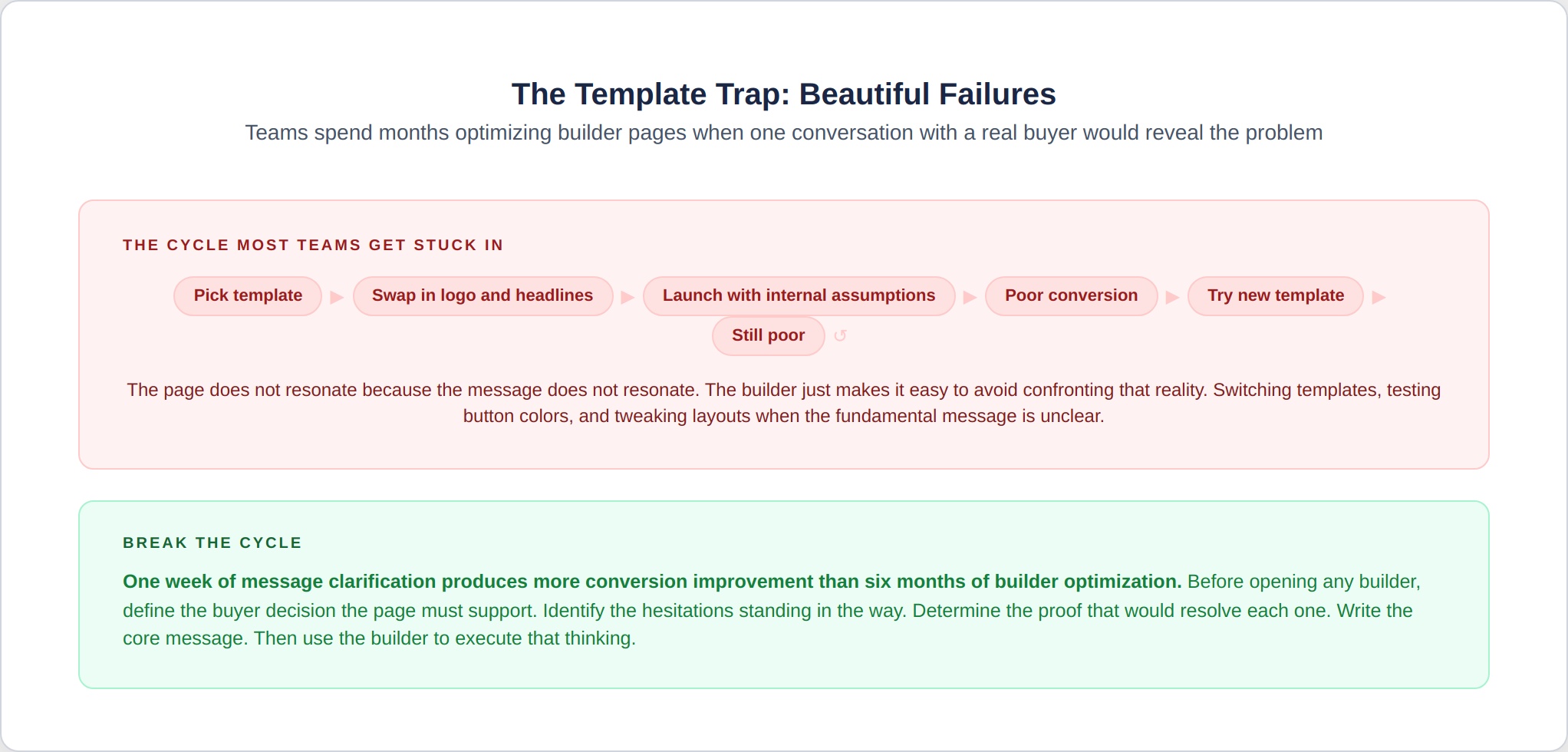
A company signs up with a builder, chooses a professional-looking template, swaps in their logo, writes headlines based on assumptions, plugs in stock testimonials, and launches. Their conversion rates either stay flat or decrease. So instead of fixing the underlying problem, they try a new template with new headlines, different buttons, and adjusted sections. The result? Conversions that are underwhelming.
Companies don’t realize that the real issue is not the builder or template. It is the thinking behind the page. Clear positioning and persuasive messaging have never been built into templates, and these are the two ingredients that convert visitors. When that clarity is missing, using builders only multiplies ineffective attempts, resulting in visually appealing but unconvincing pages.
Businesses can spend months optimizing a template when one conversation with a customer would have revealed the underlying issue. The page doesn’t resonate because its message doesn’t.
What Builders Can Convert Versus What They Cannot
Landing page builders can convert clicks into leads. They cannot convert uncertainty into confidence.
If buyers don’t understand why your offer matters to them specifically, why it matters right now rather than next quarter, why your company is the right one to deliver it, and what happens after they fill out the form, no builder fixes that gap.
Think about what this means for how you evaluate your builder’s performance. The tool is neutral. It executes whatever strategy you give it. A good strategy produces good results through any competent builder. A weak strategy yields weak results, even with the most sophisticated builder on the market.
Conversion problems almost always stem from a lack of clarity in the message and the offer, not from issues with the layout or builder itself.
Understanding this distinction is the most important insight for companies evaluating landing page tools: the tool is not the root cause of performance gaps, the messaging is.
Why Your Growth Stage Changes Whether Landing Builders Help or Not
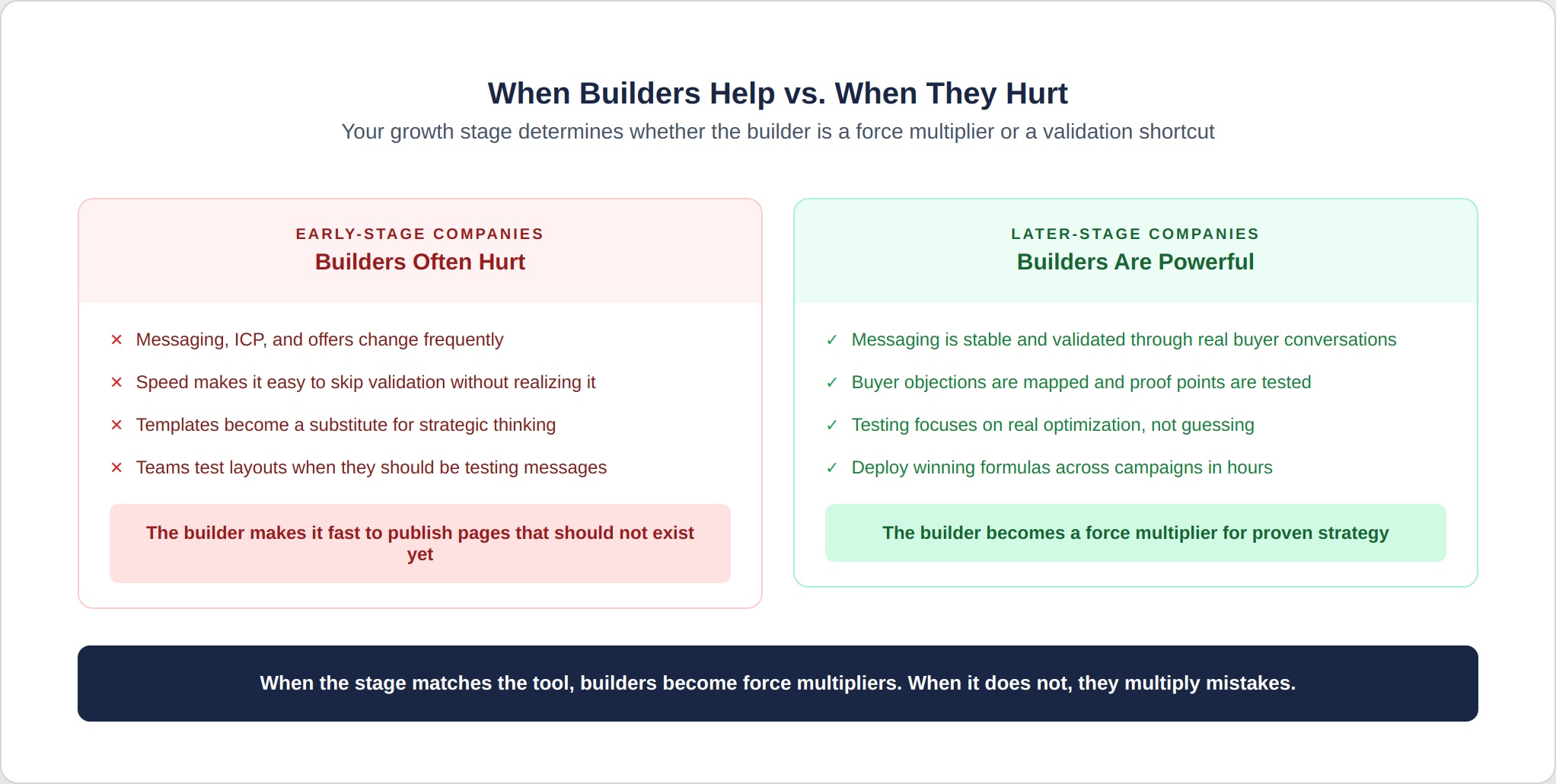
Companies that are starting out or in the first few years of their business struggle because their messaging, Ideal Customer Profile (ICP), and offers constantly change. Builders make launching pages fast, so it’s easy to skip validation without realizing it.
Companies in the later stages of their business, past the 5-10-year mark, benefit from templates and builders because of these things:
- Messaging is stable.
- Buyer objections are mapped.
- Testing focuses on genuine optimization.
The web page builder lets them publish iterations quickly, enabling them to refine pages faster.
When the growth stage aligns with the tool, builders become a force multiplier rather than something that slows down a company.
When a company get’s to this stage, they can start doing all of this faster:
- Publish winning assets
- Test specific variables
- Scale what works
And all of these things directly impact revenue.
The Belief Gap that No Tool Can Bridge
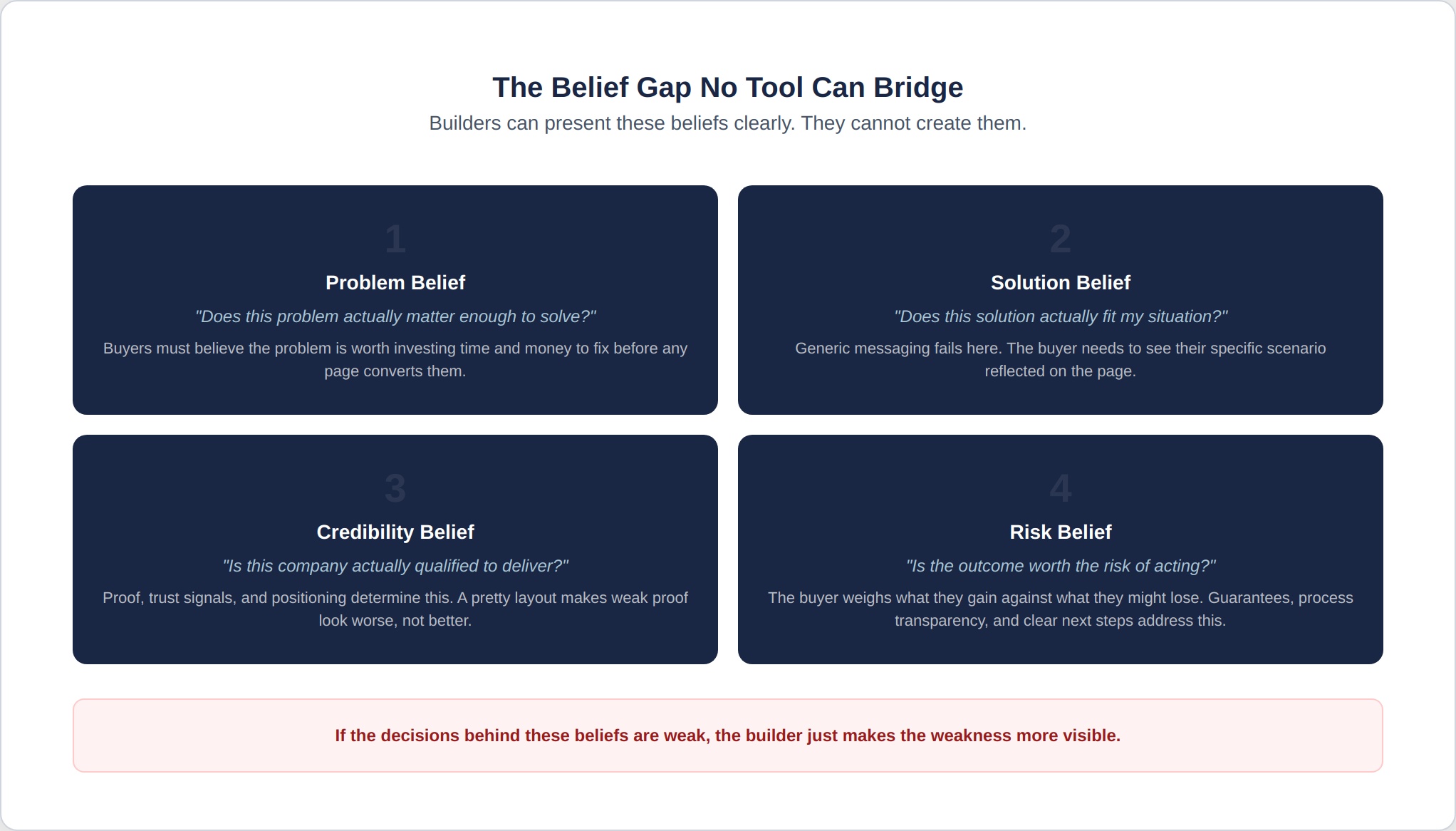
No landing page works unless you can convince the customer that their problem is something that affects their bottom line, that your solution can solve their problem, that your company is credible, and that the final outcome is worth the risk of moving forward with you.
With the right content on your landing page, you can present it clearly using the clean layout the website builder provides.
They cannot create those beliefs. Belief comes from strategically deciding what proof to show, what claims to make, how to position yourself relative to alternatives, and which trust signals matter most to your specific buyer.
The builder displays those decisions attractively. If the decisions are weak, the display just makes the weakness more visible.
When Busy Looks Like Progress, but Nothing Improves
Builders can create the illusion of productivity. Sure, you can get pages launched and variants tested, but unless the team focuses on increasing conversions, nothing will improve.
You need to monitor these warning signs:
- Conversions that stay stable regardless of the template used.
- Small conversion lifts from testing that never turn into any improvement.
- Endless experimentation without clear insight into what the experiments are teaching you.
When you run into these warning signs, it means the team is optimizing for symptoms rather than causes.
These are things like testing button colours when the headline fails to resonate, tweaking layouts when the offer isn’t clear, and moving fast in the wrong direction, never pausing to reconsider.
Why “Best Practices” Kill Differentiation
Many templates have some best practices laid out in the design. Things like:
- CTAs above the fold.
- Social proof blocks in the middle.
- Minimal navigation.
- Benefit-driven headlines.
These patterns appear in every template library.
But these best practices assume common problems. When you are trying to sell, your buyer’s needs are specific, and these best practices dilute relevance. This is why your concerns, offer, and position may not fit generic templates.
Because templates aim for broad appeal, builders often encourage conformity. However, real conversion in competitive B2B markets depends on differentiation, which comes only from a strategy that addresses your buyers’ specific needs and your company’s positioning. Builders can display strong, unique strategies—but they cannot create them for you.
Why Custom Code Is Not the Answer Either
Some teams abandon builders for fully custom builds, assuming that greater control over design and functionality will improve conversion rates.
Custom pages fail at the same rate regardless of the underlying strategy. A fifty-thousand-dollar custom-coded landing page with vague messaging converts worse than a template with sharp messaging. Custom code amplifies effort and investment. It does not amplify effectiveness.
The variable that determines conversion is the same regardless of how the page is built. Does the page make the buyer’s decision easier? Custom code gives you complete control over layout and functionality. If you are using that control to execute a strategy that doesn’t address the buyer’s real hesitations, the result is an expensive failure rather than an affordable one.
The Question That Eliminates the Tool Debate
The debate should not be about using a landing page builder versus creating a custom landing page from scratch.
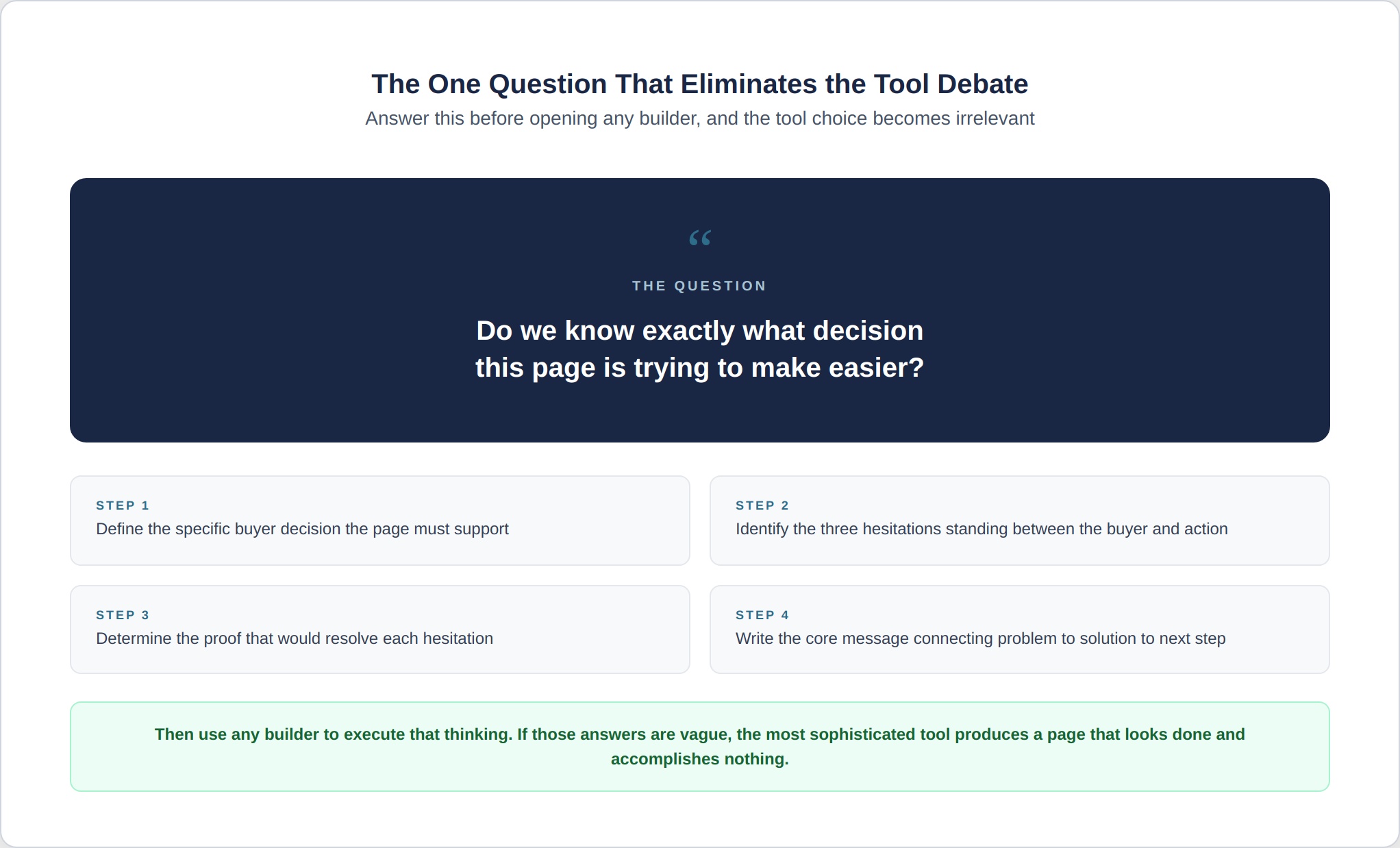
The real question should be: Do we know exactly what decision this page is trying to make easier?
To do this, review your current landing pages, focusing on whether your messaging helps move the customer one step forward in the decision-making process.
Don’t just debate tools; act by revisiting strategy and engaging with real customer feedback to uncover what truly drives conversions in your context.
If your team can lay out information about:
- the specific decision
- the specific buyer
- the specific hesitations standing in the way
- the specific proof that would resolve those hesitations
Then it doesn’t matter if you use a builder or not, because that page would be built to convert.
On the other hand, if those answers are vague, even the most sophisticated tool in the world will produce a page that looks completed but accomplishes nothing.
That question forces strategic thinking before the builder is opened. It eliminates the urge to start dragging elements around before the message is clear. It saves months of optimization theatre.
Why 2026 Makes Cognitive Friction the Real Battle
ear after year, buyers are becoming more skeptical. Instead of reading the page fully, they skim the page faster. They are starting to distrust any hype or exaggerations from companies. And they notice and avoid anything that feels like a trap faster than ever before.
Landing page builders help address the technical friction when designing a page. Things like slow load times, broken forms, mobile issues, and development bottlenecks. Every major builder handles these competently.
There is also the cognitive friction that users encounter in 2026.
- Can buyers understand your offer instantly?
- Do they see relevance to their situation within seconds?
- Does trust build quickly enough that they don’t leave?
- Does the page feel like it was made for them rather than for everyone?
There isn’t a landing page builder that solves cognitive friction. The companies that win are the ones solving cognitive friction through strategy, not through better templates.
How Companies That Win Use Landing Page Builders
High-growth companies have a specific process for creating their marketing assets.
First, they validate their message with real buyer conversations and small-scale tests. Then they lock in what works. From there, they use the builder to quickly deploy it and then test to optimize the page.
You will never see high-growth companies skip the validation stage. It doesn’t matter if they have a landing page builder or not.
They never treat templates as strategy. They never confuse ease of publishing with quality of thinking. The builder is a tool for execution after strategy is set, not a replacement for the strategic work that makes any page worth publishing.
Why the Tool Always Gets Blamed First
Many landing page builder failures stem from strategy, offer, or messaging failures.
But these failures are invisible because the design is the most visible component.
For companies, it is easier to blame the tool than to admit their positioning is unclear or customer-focused. To a business, switching landing pages or designs feels productive. But the real work of fixing your fundamental message takes work.
So what happens? Teams switch between platforms and get the same results. They switch again, and nothing changes because the builder was never the problem. The problem was an unclear value proposition, misaligned targeting, weak proof, or an offer that didn’t match what the buyer actually needed.
After watching this pattern repeat across companies, the conclusion is always the same. One week of message clarification produces more conversion improvement than six months of builder optimization.
The Bottom Line
Landing page builders can absolutely convert. But only when used for what they are designed to do.
Builders reduce publishing friction. Clarity creates conversion. The tool is neutral. It amplifies whatever strategy you give it. A good strategy converts through any builder. Weak strategy fails through every builder.
The companies that grow don’t ask whether builders are “good enough.” They ask whether the page makes the buyer’s decision easier, then use whatever tool best supports that goal.
What to Do Before You Blame Your Landing Page Builder for Low Conversions
Before migrating to a new platform, rebuilding pages from scratch, or concluding that landing page builders don’t work for your business, pause and step back from the tool entirely.
Ask yourself these questions. Do buyers immediately understand what problem this page solves and why it matters to them specifically? Are we making a clear decision easier, or are we presenting information and hoping the buyer figures out why they should act? Does the page reduce hesitation through specific proof and clear next steps, or does it ask visitors to think too hard about what happens next?
Landing page builders are not conversion engines on their own. Conversion slows when pages are built before clarity exists, regardless of how sophisticated the builder is.
Most teams approach this backwards. They see low conversion and blame the tool. They research alternatives. They compare feature sets. They migrate to a new platform and are surprised when results don’t improve. The platform was never the problem. The unclear thinking moved to the new platform along with the logo and the brand colours.
Before switching a design or moving to a different landing page platform, define what buyer decision the page must solve for the user.
Start by identifying the top three hesitations standing in the way of that buyer taking action. Provide the proof that would help the user overcome that objection. From there, write the core message that connects the problem to the solution for the next step. Then use the builder to execute your thinking and test variations within that strategic frame.
Before moving forward with a new design, you need to audit your current pages against actual buyer feedback.
- Where are buyers still confused?
- What questions do they ask that remain unanswered?
- What proof would have made them feel safer?
Fix the strategic gaps first, then use your builder to deploy the improved message at speed.
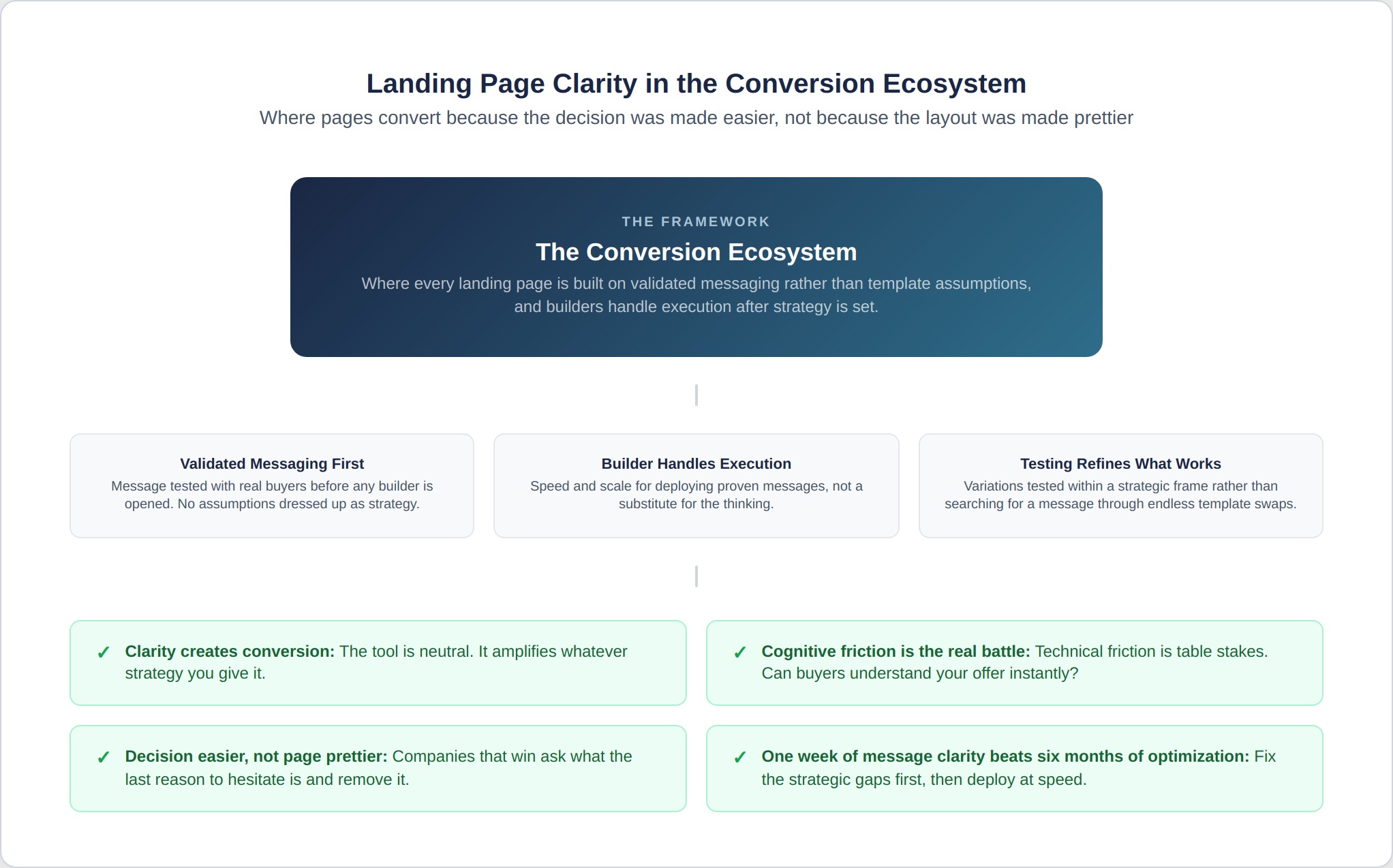
This is why landing page clarity is central to what we call a conversion ecosystem. A complete digital marketing strategy designed to turn traffic into customers predictably and repeatedly. Where every landing page is built on validated messaging rather than template assumptions. Where builders handle execution speed, while human judgment handles the strategic thinking that makes execution worthwhile. Where pages convert because the decision was made easier, not because the layout was made prettier. Where testing refines a message that already works rather than searching for a message through endless template swaps.
If you want help figuring out why your landing pages aren’t converting, getting your message to land, or building a system where landing pages consistently convert, reach out.
We can help you turn pages into decision accelerators instead of tweak traps that consume budget and produce beautiful pages nobody acts on.

