
Why Businesses Fail to Get Clients with Digital Marketing

Why Businesses Fail to Get Clients
Businesses that invest heavily in marketing across available channels but still struggle to attract clients can be linked directly to the marketing message, which does not clearly connect with what their market expects or understands about the solution they offer.
Establishing a connection with the buyer is the key to converting marketing into lead generation and lead generation into consistent client acquisition.
Despite consistent efforts, bookings stall in the pipeline, responses drop without explanation, and momentum fades quickly, ultimately showing a gap between the marketing and client acquisition goals.
When marketing fails to produce results, frustration spreads through operations daily. You question whether marketing fits your model or whether competitors already possess a critical missing element.
The main problem is not low traffic or tough competition but a lack of clarity. Buyers are unclear about what you offer, how it solves their problem, or why it’s right for them. This confusion stops them from making a decision.
The core issue is that buyers don’t understand your offer or how it meets their needs. Businesses fail if they don’t resolve this uncertainty.
The Reality Business Owners Avoid
A business may possess what is objectively a solid offer and still experience conversion difficulties consistently in sales. This isn’t due to a weak offer, tough competition, or platform changes. It’s because buyers cannot yet confidently decide on the promised outcome.
Every buyer, consciously or not, weighs risk and wants certainty that the solution will work for their needs.
When an individual arrives at your website, consumes your content materials, or views your video presentation, they are subconsciously processing the question:
“Do I comprehend this sufficiently to feel secure regarding proceeding with the purchase decision?”
If the answer is not a definitive yes, they hesitate, and the chance for a sale quietly disappears without warning.
Sales are not lost through outright rejection but through indefinite postponement.
Understanding Why Hesitation Causes More Risk than Rejection
Rejection provides you with implementable feedback to improve the offer. Hesitation merely provides silence and uncertainty in communication.
Businesses lose potential buyers who indicate they are not at this moment in time, never return to the conversation, or whose uncertainty remains unresolved.
Hesitation looks like:
- Bookmarking pages for later reference
- Partially watching videos
- Repeatedly requesting information already available on the site
- Going silent after initial interest
From a business perspective, looking at the daily metrics, this suggests lower-than-expected conversion rates across each of the funnel stages. From the buyer’s perspective, it simply feels like uncertainty about the right choice.
This uncertainty is costly for a business as it affects its overall revenue.
Why More Marketing Makes Things Worse
After reviewing the Key Performance Indicators (KPIs), if you notice the results begin to deteriorate, the typical response is to immediately increase volume.
More posts are published across channels, ad spending rises on campaigns, more tech tools are added to the stack, and more offer versions are tested in the market.
The logic seems sound: if results lag behind targets, then increase the marketing volume.
But adding more volume without fixing the messaging doesn’t reduce confusion in buyers’ minds, it just makes it worse.
This happens because clarity has been the missing ingredient from the start. Not that volume is the wrong approach entirely, not because buyers need less information, and not because platforms are already oversaturated with content.
It doesn’t matter what you do, nothing will increase sales if clarity is entirely absent.
More traffic sparks more unanswered prospect questions. Extra ads boost skepticism rather than trust. Added calls to action freeze buyers instead of moving them.
Marketing fails not because of a weak reach to the audience. It fails when buyers don’t gain enough confidence in your offer.
Confidence comes from clear value communicated, not from repeating unclear messages.
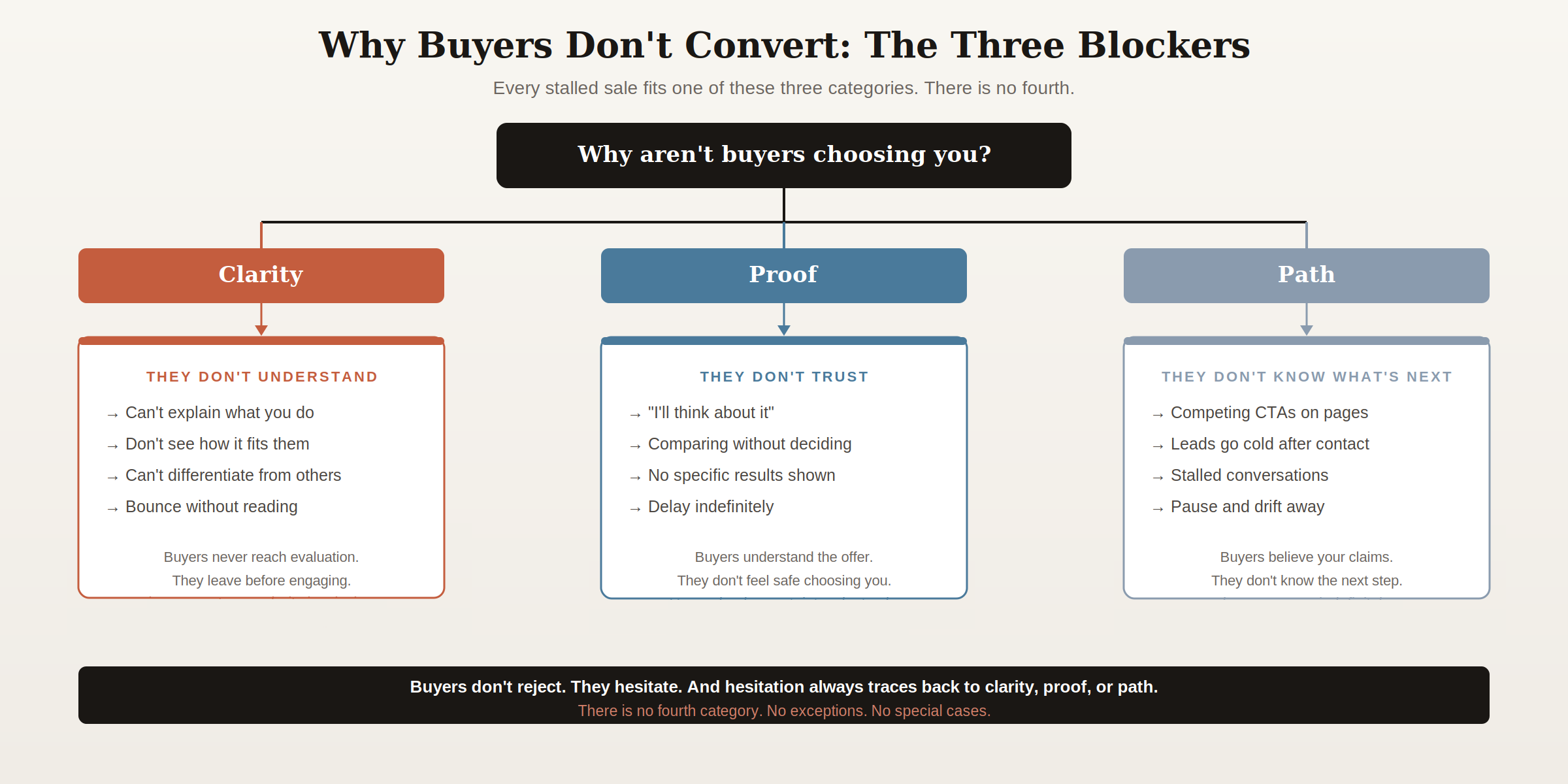
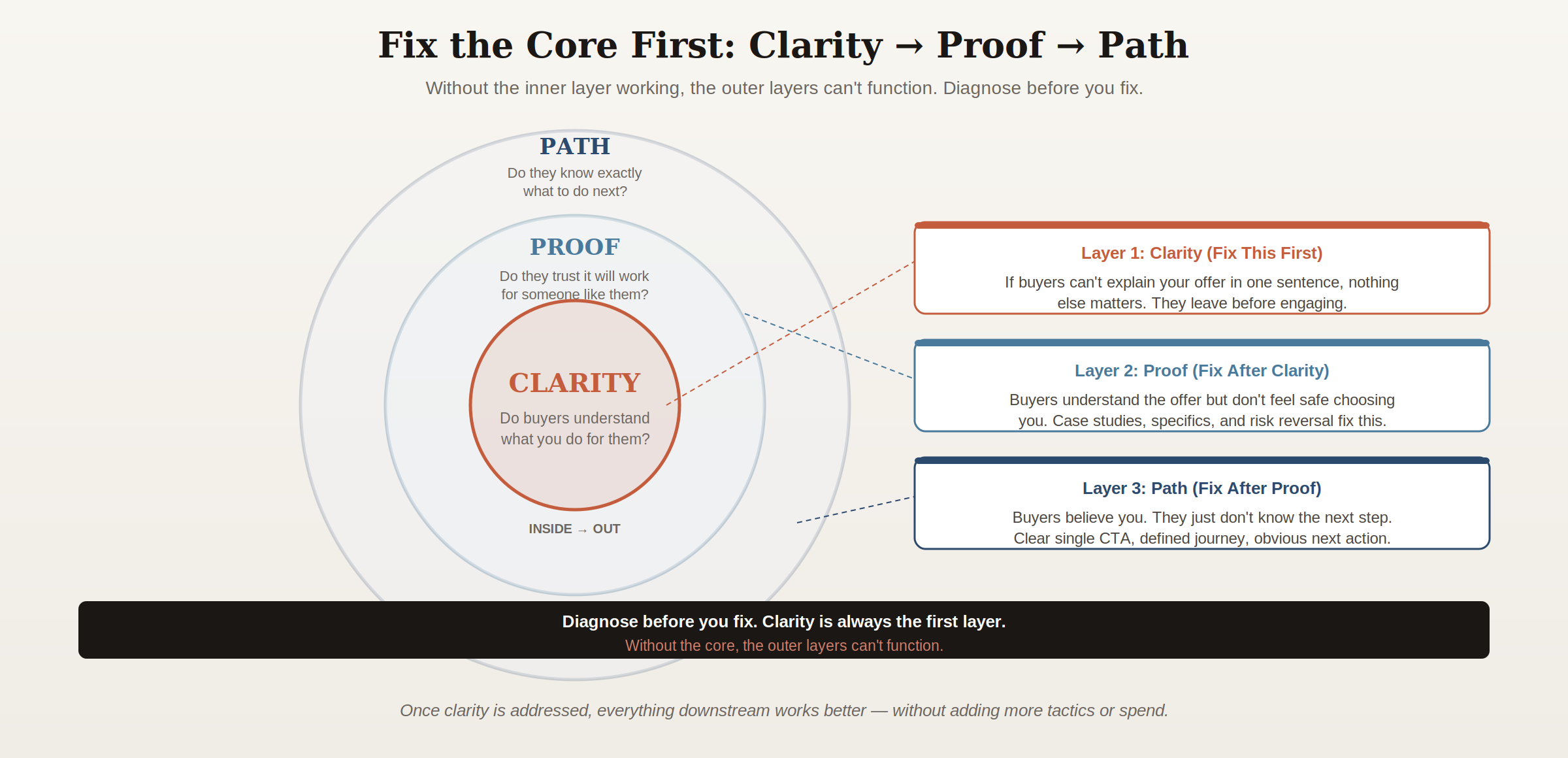
The main reasons buyers hesitate are a lack of clarity, insufficient proof, and an unclear path. Every buying decision stalls for one or more of these reasons.
After reviewing stalled funnels, delayed decisions, and cold leads a clear pattern will emerge. All buyer hesitation fits into three categories across industries.
- Clarity is always the biggest obstacle. If buyers do not quickly and fully understand your offer, they will not engage further.
- Proof is the second blocker.
- Path is the third blocker.
There are no others. There is no fourth category hiding somewhere, no exceptions to this trend identified, and no special cases requiring a different framework.
Everything else stems from these main causes. But understand that they are symptoms, not root problems.
Clarity: When Buyers Do Not Understand
In this category, prospective buyers do not immediately understand what you specifically do for them or how you will fix their current situation.
They may understand your offer in general, but they cannot quickly answer the critical questions that arise in their minds.
- Is this solution specifically designed for someone like me in my current situation?
- Does this solve the particular problem that I am experiencing right now in business?
- Is this meaningfully differentiated from the alternatives available in the market?
When messaging-based positioning lacks clarity, buyers are forced to think deeply about the fit with their current needs.
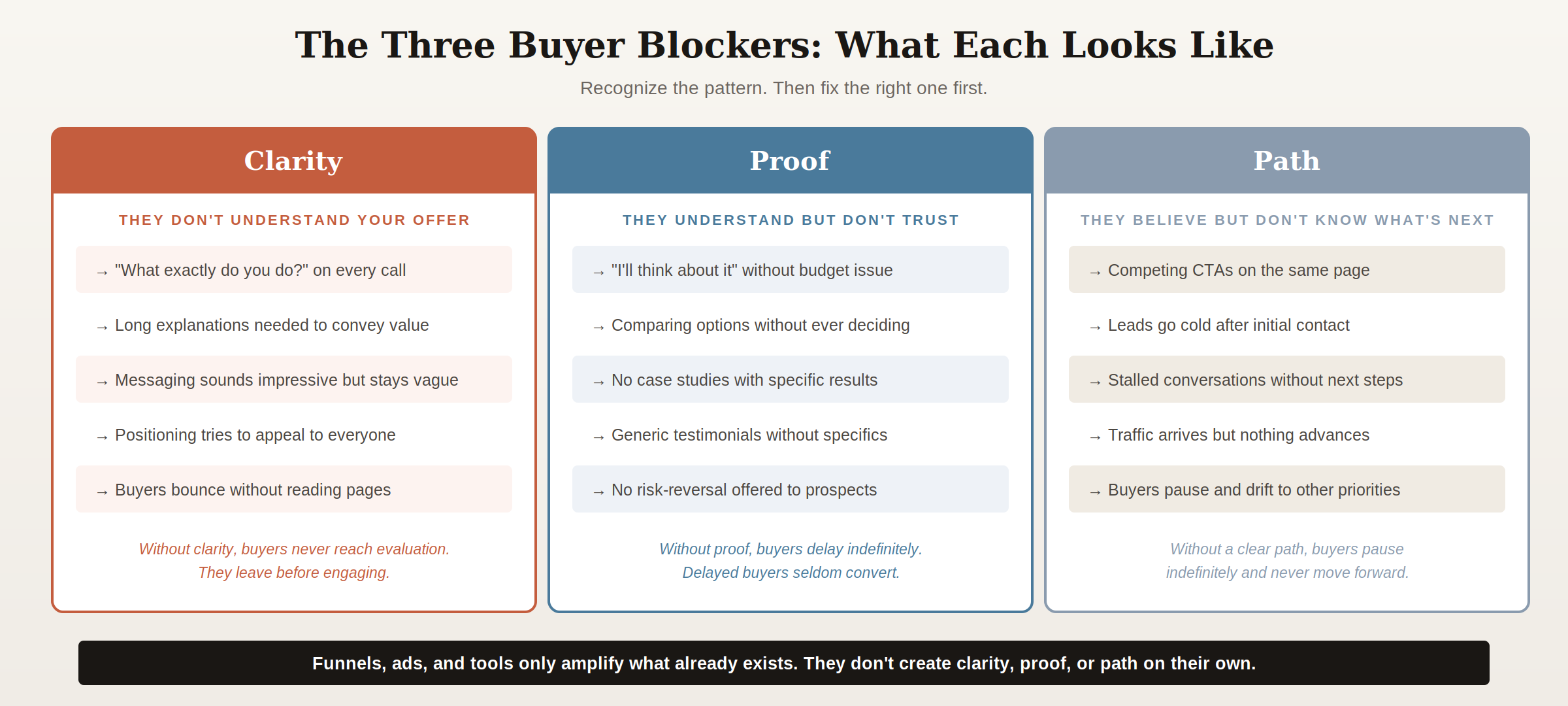
- Broken clarity that shows up in daily conversations.
- The question of exactly what you do for clients comes up repeatedly in discussions.
- Lengthy explanations are needed during sales calls with interested prospects.
- Messaging that sounds impressive, but it remains vague to the audience.
- Positioning that tries to appeal to everyone.
Just remember, if buyers can’t explain your offer in one sentence, clarity is missing entirely.
And without clarity firmly established in positioning, buyers never reach the evaluation stage of the process. They bounce from your site without reading. They scroll onward to competitors’ offerings. They quietly leave your digital space, leaving no trace of even being there.
Proof: When Buyers Do Not Trust
Buyers understand what you do, but they do not yet trust you.
It’s not general credibility or branding that is holding them back. Buyers want safety and the certainty that the promised outcome will materialize.
Buyers are asking themselves this question constantly:
“Will this work for someone like me, specifically in my circumstances?”
Proof answers the emotional risk perceptions held by prospects, not logical questions or rational objections to the price point.
When signs of weak proof appear, buyers say they will think about it in response. As the objections raised are not tied to the available budget. They may not be consciously aware of it, but buyers are continually comparing options without making a decision.
In the absence of clear proof, buyers delay their decision, and the timeline can double or even triple the time required to purchase, or even worse, they never decide, and you lose a sale.
Remember that delayed buyers seldom convert into customers, and unresolved uncertainty leads to lost sales.
If their internal uncertainty is never resolved, they remain distrustful of you as a seller and don’t trust that what you do will solve their current situation.
Path Problem: Buyers Do Not Know What To Do Next
Buyers will start believing your claims as long as they are made clearly, but they will not continue if they do not know what to do next.
Imagine that traffic arrives at the site daily through search results; pages receive views from visitors who regularly browse; leads respond initially with interest in the solution, but nothing advances toward the close of the sale.
Vague direction shows up in conversations as:
- Competing CTAs on pages simultaneously
- Leads going cold after initial contact
- Stalled sales talks without clear next steps.
Is the next step unclear?
If what to do next in the process isn’t clear to them, buyers pause indefinitely and don’t move forward in the journey.
To solve this, commit to these fundamentals in your daily approach and shift from unpredictable outcomes to consistent sales.
The businesses that thrive in the market are those that take decisive action to empower clients to understand the offerings, trust the solutions, and proceed without the hesitations that are holding them back from making a decision.
You must decide now to remove messaging confusion, clearly prove your value, and guide every prospect to their next best step in the process. This is how you turn effort applied consistently into results achieved measurably, consistently, and predictably over time invested.
If this isnever fixed, paused buyers will always feel stuck in their current state. Then they just drift away gradually to other priorities competing for their attention. And eventually, they disappear without any given explanation.
Why Every Stalled Sale Fits One Category
During the buying process, users do not stall for random or arbitrary reasons. They stall when something is missing, because trust has not yet been established, or because the next step in the decision process is entirely unclear to them.
Everything else represents a symptom of these fundamental reasons.
Funnels, ads, content, traffic, and tools only amplify what already exists in your marketing ecosystem. They do not create clarity on their own. They do not build proof automatically. They do not establish direction independently.
They amplify only what you give them to work with.
When you market your services and these symptoms exist, you amplify the issue. Therefore, you must fix not only the symptoms but also the underlying problems.
Why Guessing Wrong Wastes Months of Time
Time and financial resources quietly disappear into the void when you’re not producing results. This problem exists because most businesses guess which problem they have, rather than knowing which one exists.
The majority of businesses guess which problem they actually have.
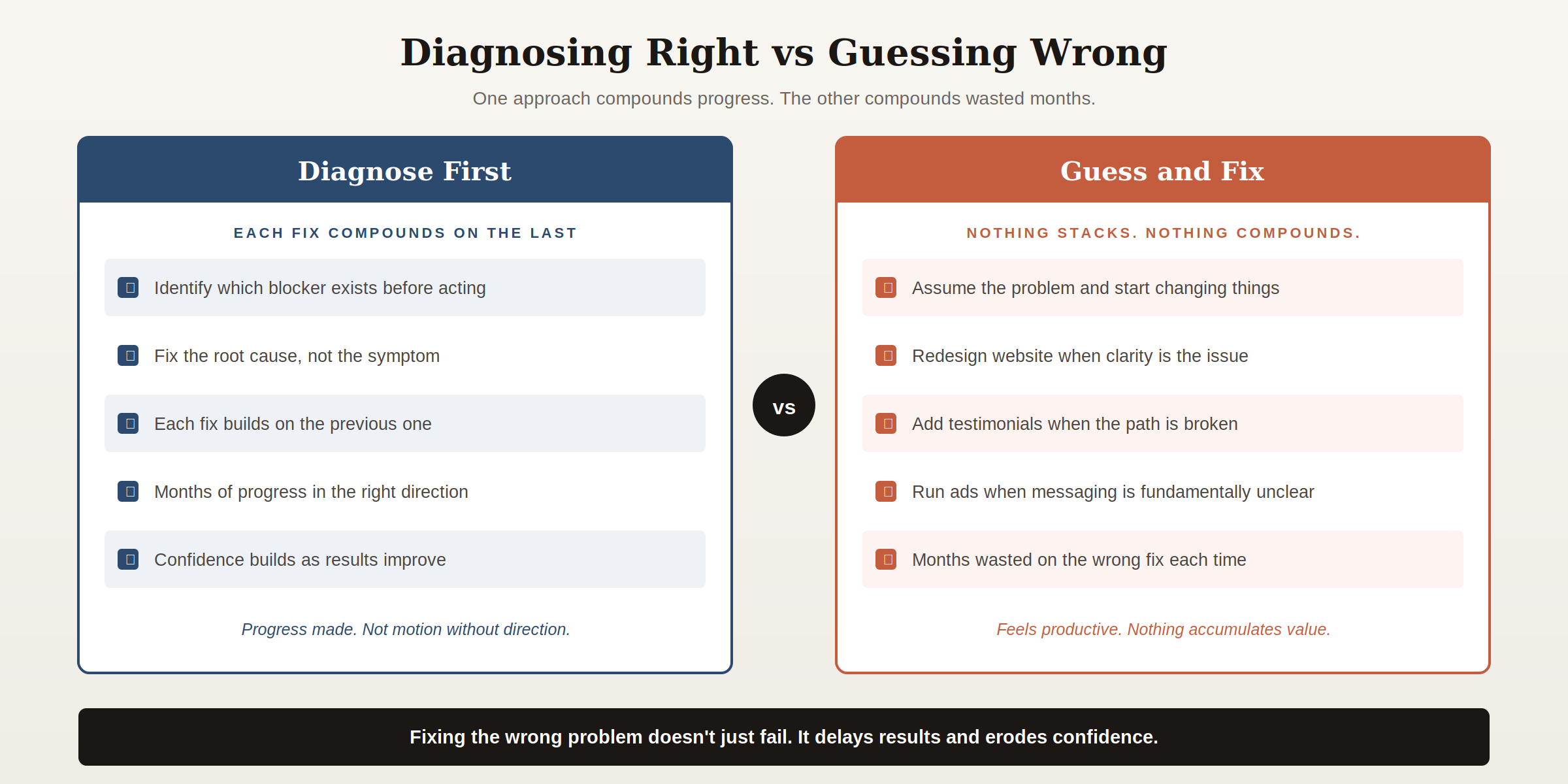
- Companies waste time redesigning their entire website when there is something else that is the real issue that is blocking sales.
- They add testimonials generically to pages when the messaging is fundamentally unclear.
- They run active advertising campaigns when the route is entirely unclear to prospects.
Diagnosing the real issue is difficult without an organized framework, and most businesses don’t have the right evaluation process in place to identify what’s actually blocking conversions.
Each change feels productive in the moment of implementation, but none of them compound over time; none build on each other systematically in sequence, and none fix the real problem blocking growth.
This right here is why marketing feels exhausting and draining for teams working daily. You are constantly doing something active in campaigns. Yet nothing stacks together properly. Nothing accumulates value over time.
Fixing the wrong problem does not just fail to help you, it significantly delays results, erodes confidence, and wastes months you cannot recover.
In essence, the particulars are a full-time issue when businesses attempt to diagnose conversion problems without a systematic evaluation method. They address symptoms rather than causes, and this extends the problem timeline by months or years.
Misdiagnosis leads to the wrong solution being applied to the problem, which means resources are spent on fixes that don’t address the actual blocker preventing conversions.
You think you need more traffic and higher ad spend, even though weak proof is the issue. You feel that the website looks outdated, and that type of thinking calls for a complete redesign.
Clarity is the real problem, and it can lead to confusion that eventually blocks sales.
Each misdiagnosis wastes months of progress toward goals.
Three months here wasted on the wrong thing.
Six months there gone on the wrong fix.
This time compounds over multiple weeks, months or even years, all because you were guessing and fixed the wrong problem.
How This Plays Out in Business
Imagine a B2B consulting firm that believes traffic is the issue holding back its growth.
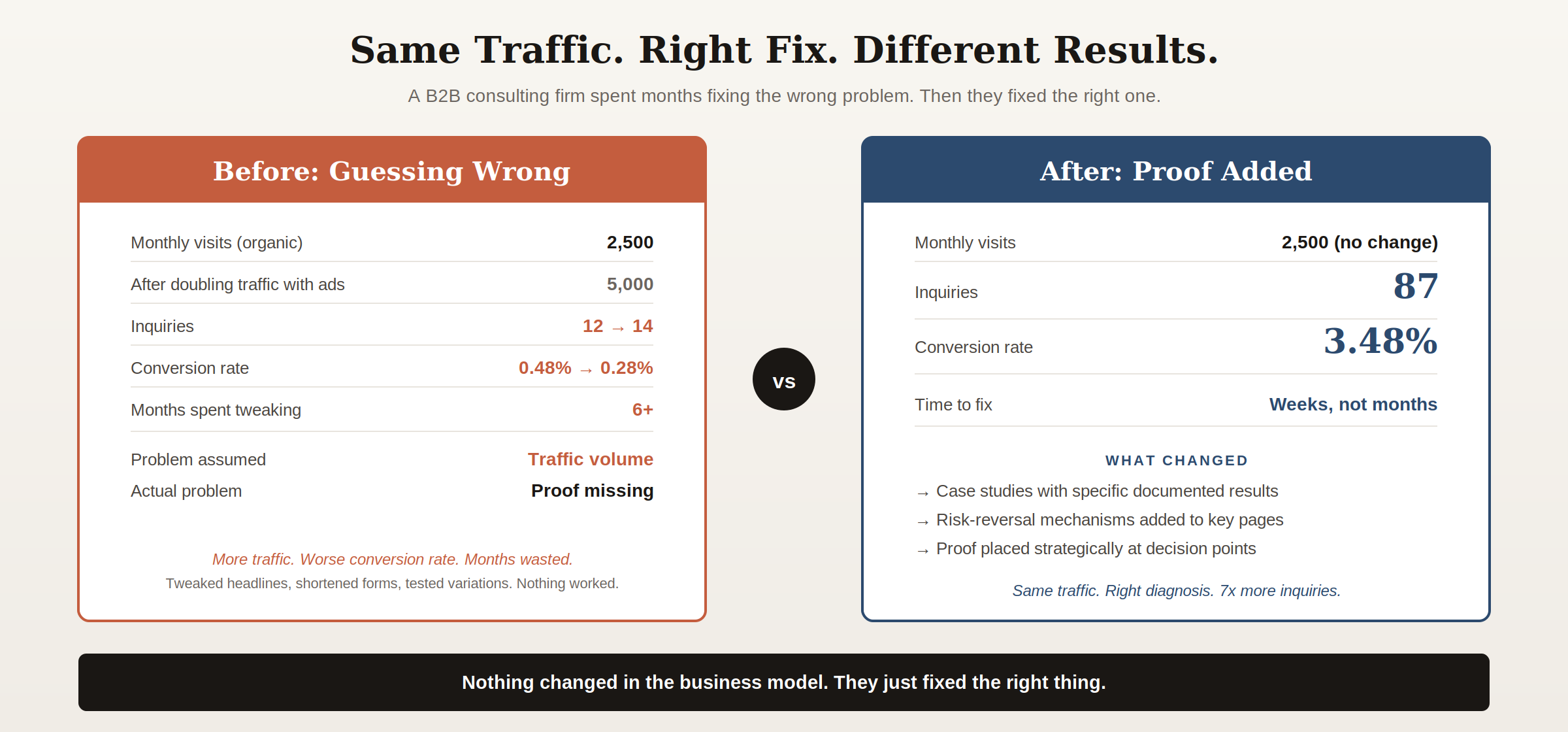
They receive approximately 2,500 website visits per month, with visitors returning regularly. But not enough inquiry forms are being submitted for the sales team to work with. Only 12 inquiries are received monthly from visitors. Representing a 0.48% conversion rate performance overall, as measured by the team.
So they invest heavily in paid advertising channels to increase site traffic. Traffic increases to 5,000 visits monthly from campaigns run actively by the team. Conversions are barely moving, with 14 inquiries total received from prospects. Now, 0.28% conversion rate is even worse than before the campaigns started.
They tweak landing pages extensively with variations tested repeatedly by team members.
They shorten forms from 7 to 3 fields to make completion easier for visitors.
They change headlines continuously every week without stopping their efforts.
They test variations endlessly without results improving.
Still, nothing improves meaningfully in outcomes as measured by their analytics.
The real issue was not traffic volume at all, coming to the site – it was proof, specifically lacking on pages throughout the website entirely.
Buyers understood the offer conceptually, as it was clearly presented to them on the pages. Clarity was adequately established throughout the messaging. But did not feel safe choosing this particular firm over established competitors in the market they were familiar with. The website featured generic testimonials without any specifics visible to prospects. No case studies with documented achievements, clearly documented for buyer review. No risk-reversal mechanisms are offered to prospects evaluating their options.
Once proof was strategically added to the right places on the site pages, conversions increased to 87 monthly inquiries for the sales team. From the same 2,500 monthly visits, original without any change. Now, the final results show a 3.48% conversion rate. Without adding more traffic sources at all to the campaigns running.
Nothing fundamentally changed in the business model; they just fixed the right thing after months wasted guessing wrong. They addressed the issues on the website pages, not the traffic volume.
Who This Is For
This applies if you already have a real offer that delivers proven value to clients. If you are receiving some attention but not enough action from prospects. If you are tired of guessing what to fix next in the sequence of efforts. If you want marketing to feel predictable, not chaotic and random in results.
This is not for people looking for fast hacks or shortcuts to success. Not for businesses with no clear offer yet properly developed for the market. Not for anyone who wants tactics without grasping the fundamental problem blocking.
If you want only surface-level tips, this will not help you achieve your desired results. If you want to fix what is actually blocking buyers from converting, continue reading.
The Cost of Doing Nothing About Clarity
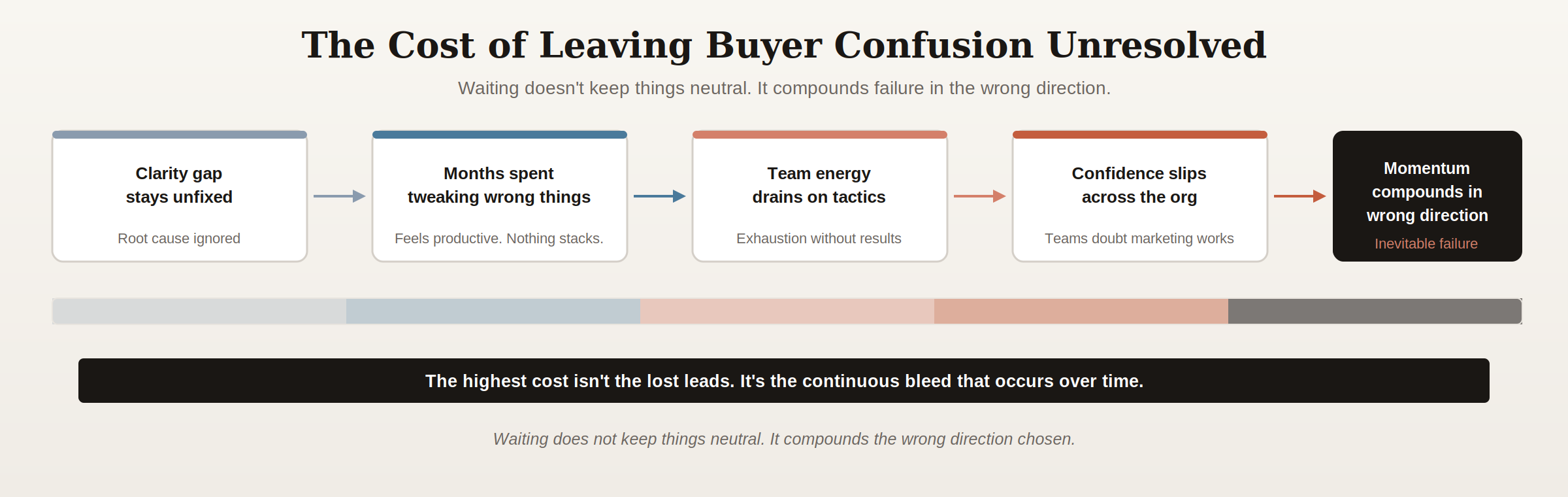
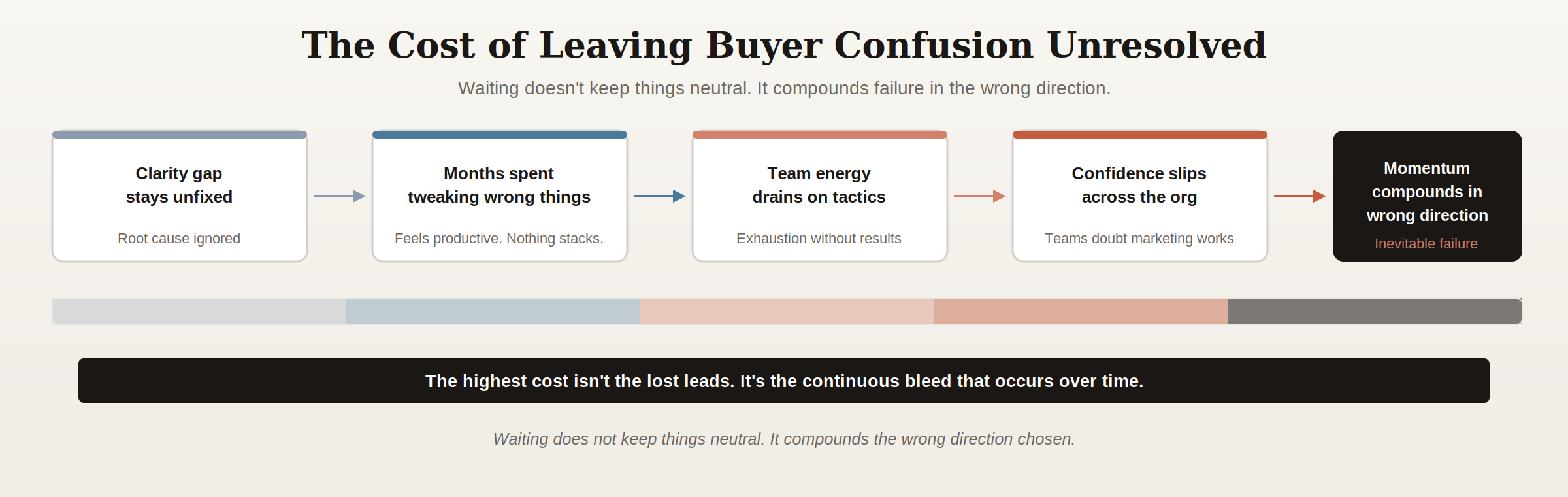
The highest cost is not only the lost leads in the pipeline, but also the continuous bleed that occurs over time.
- Months spent repeatedly tweaking the wrong elements in campaigns without results.
- Energy is draining from teams chasing tactical solutions that don’t work properly for growth.
- Confidence slipping when nothing works despite consistent efforts.
- Teams are becoming confused about what matters most for business growth.
Waiting does not keep things neutral or static in business; it compounds the wrong direction chosen and eventually brings the momentum towards an inevitable failure in your marketing and sales.
Diagnose Before You Fix Anything
Before changing tactics or implementing new strategies across the board, you need to know which of the three is blocking buyers right now, and specifically at each stage of their journey.
You shouldn’t speculate on the future or use hypothetical situations. You need to assess what’s happening right now.
That is the difference between progress made and mere motion without direction towards goals.
The Buyer-Clarity Diagnostic survey we have identifies the specific blocks you have.
It does not tell you to blindly add more marketing activities, hand you a generic report full of fluff without value, or guess at problems you might have.
It methodically assesses clarity, proof, and path across aspects, identifies the primary blocker preventing conversions, and shows you the next best step to fix it specifically in sequence.
There are no assumptions about the situation, no guesswork in the process, and no generic advice given to everyone. It pinpoints your issues based on your responses.
Why This Changes Everything Downstream in Operations
Once buyer clarity is properly addressed in the messaging you create for prospects, everything else works better automatically downstream in your funnel.
This improvement occurs because clarity has finally been established in your messaging for buyers.
This happens without adding more tactics to the mix you already use, without spending more on the ad campaigns you run, and without waiting for the perfect timing to suddenly align.
Content converts at higher rates because buyers understand it immediately once it is presented clearly. Advertising analytics increase positively because trust friction drops significantly when the solution is offered to the prospects.
Sales calls are shorter because less explanation is needed upfront with engaged prospects. Follow-ups feel natural rather than forced or pushy for recipients who are regularly contacted by team members.
Buyers do not feel sold to aggressively by deliberately used tactics. They feel guided through a clear, logically laid-out process, with understanding built naturally over time, rather than being pressured into a decision or manipulated by tactics.
That is the difference between pressure applied to buyers forcefully and momentum built naturally through clarity and honesty.
The Next Step
If you have been putting in steady effort and not seeing it turn into clients, do not add another tactic to the mix.
First, find out what is actually blocking buyers from choosing you over the alternatives available.
Run the Buyer-Clarity Diagnostic tool now.
Before you change your marketing approach fundamentally again, make certain you are fixing the right thing first in sequence.
Because the particular causes are full-time issues and guessing wrong costs sales that you can never recover.
