
How Much Does a B2B Marketing Strategy Cost in 2026

If you are asking this question, you’re already ahead of most B2B companies operating today.
Most businesses do not ask what a real marketing strategy costs upfront. Instead, they ask why leads are inconsistent, why sales cycles feel longer than before, or why growth stalls even though they are doing marketing activities. Cost questions usually come later in the process, after money has already been spent in the wrong places without results.
In 2026, the cost of a B2B marketing strategy is not a single, easily quoted number. It reflects the complexity faced, the risks present, and the ambition level set.
To understand this, let’s break down the concept and its cost so the process is clear.
What a B2B Marketing Strategy Actually Is
Before discussing price ranges, we need to define what people think they are buying when they hire a marketing firm.
A real B2B marketing strategy isn’t a content calendar. It’s not landing pages. It’s not your CRM setup. It’s not ads running. It’s not a pitch deck. Those are just tactics sitting in isolation, and tactics without structure give you random results.
Those are the tools available. Strategy is the system that decides how those tools work together.
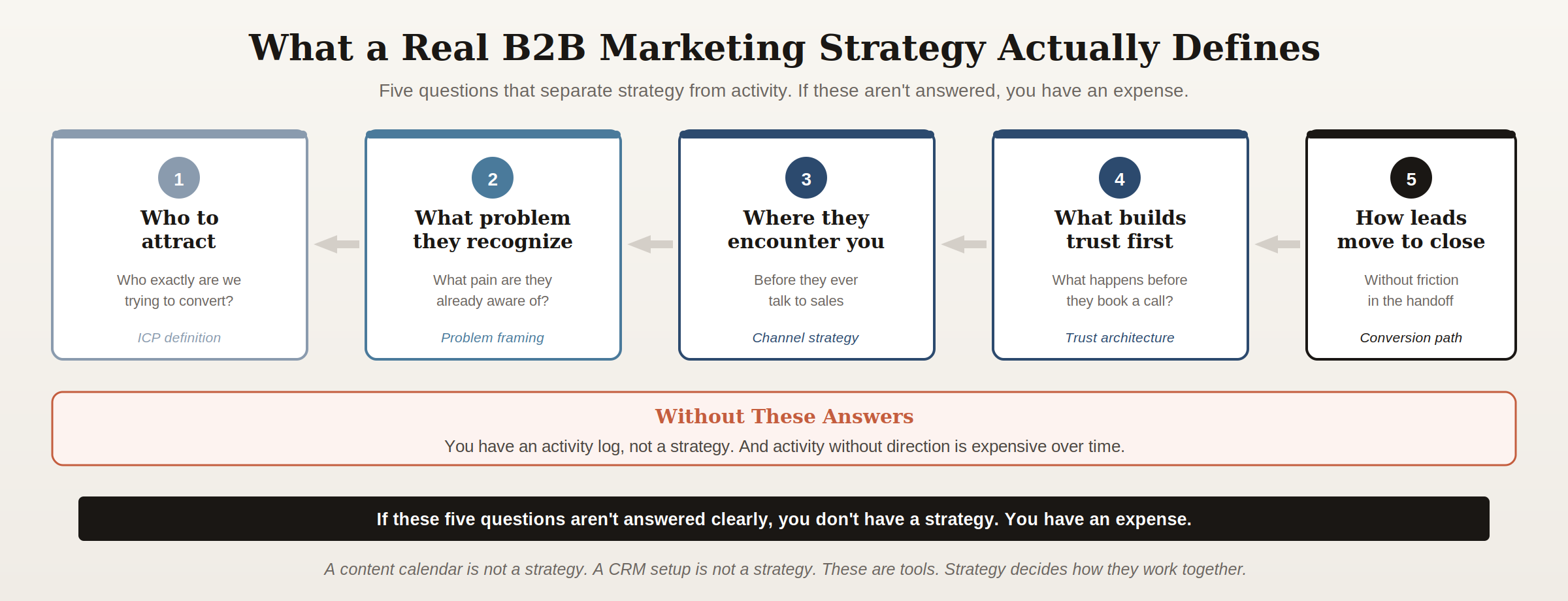
A true strategy answers questions like these:
- Who exactly are we trying to attract and convert into clients?
- What problem are they already aware of experiencing?
- Where do they encounter us before they ever talk to the sales team?
- What has to happen before they trust us enough to book a call?
- How do leads move from first touch to closed deal without friction happening?
If those questions are not answered clearly, you do not have a working strategy, you have an activity log.
And activity without direction is expensive over time.
The 2026 Reality: Strategy Is No Longer Optional for Growth
In earlier years of operation, companies could get away with tactics alone.
Publish a few blogs, launch some ads, send out cold emails and then hope something sticks with the audience.
That does not work anymore in 2026.
Buyers are overloaded with information, skeptical of claims, and better informed than before. They do not respond to isolated tactics. They respond to systems that feel intentional and connected together.
And this one shift has completely changed pricing models.
In 2026, you are not paying for ideas alone. You are paying for clarity established, channel orchestration, and decision-making confidence.
How Much for B2B Marketing Strategy in 2026
Here is what most B2B companies actually pay for strategy today.
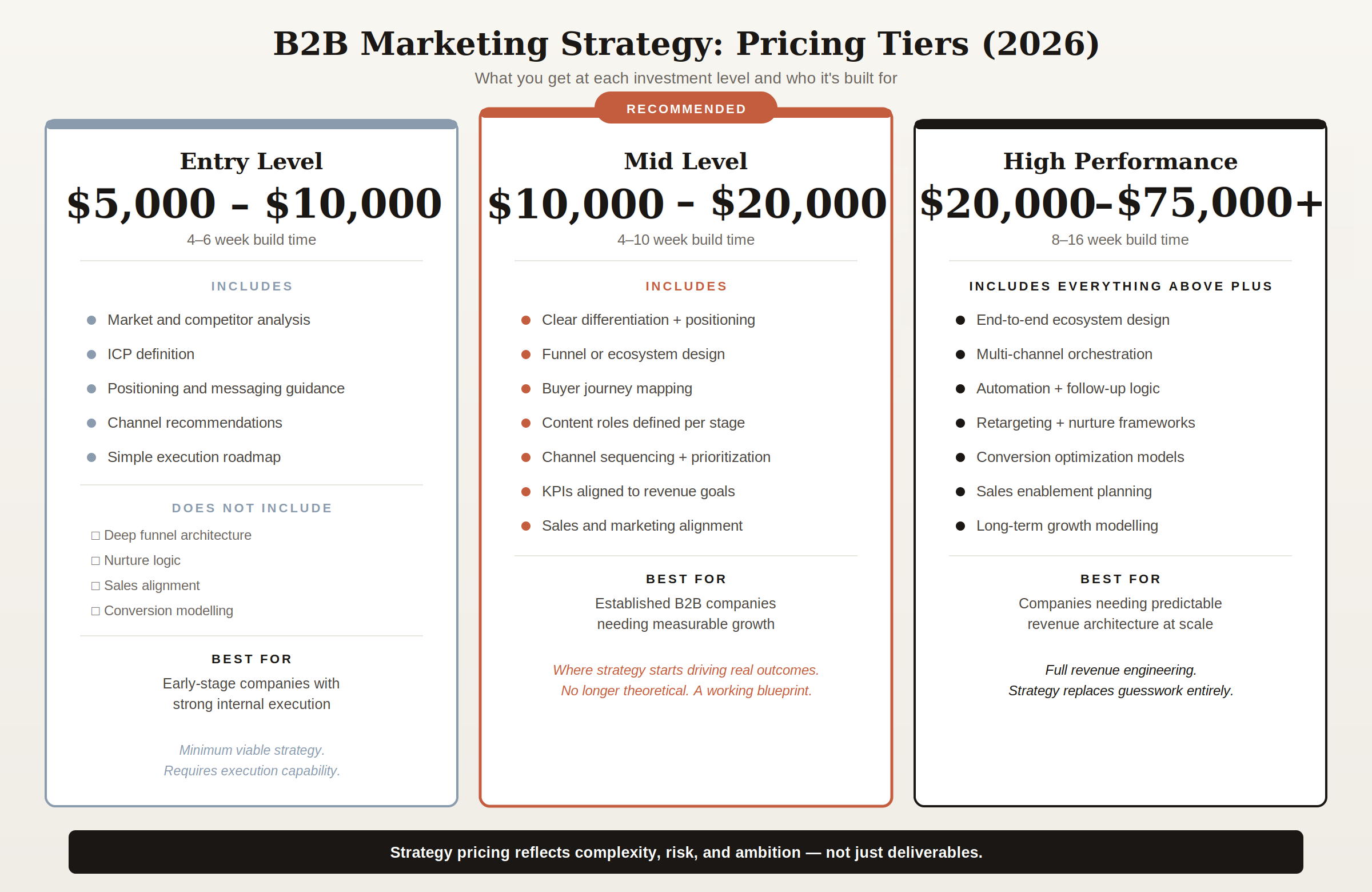
Entry-Level Strategy: $5,000 to $10,000
This is the minimum viable investment for a working strategy.
It usually includes:
- High-level market and competitor analysis
- An established Ideal Customer Profile (ICP) definition
- Positioning and messaging guidance
- Channel recommendations
- A simple execution roadmap
Costs for each component should be detailed separately.
What this investment does not cover:
- Building deep-funnel architecture
- Conducting detailed conversion modelling
- Establishing nurture logic
- Creating comprehensive sales alignment
This type of marketing works for early-stage companies or teams with strong internal execution capability, but if execution is weak, this level often turns into a document that never gets used.
Mid-Level Strategy: $10,000 to $20,000
This is where strategy starts to drive measurable, real outcomes.
At this level of investment, expect to establish clear differentiation and positioning.
The breakdown of the investment should cover funnel or ecosystem design, buyer journey mapping, defining content roles for awareness, trust, and conversion, channel sequencing and prioritization, aligning KPIs to revenue goals, and building sales and marketing alignment.
This is the range most established B2B companies actually need for growth.
It is no longer theoretical. It is a working blueprint implemented.
High-Level Strategy and System Design Costs $20,000 to $75,000 or More
This is a fully designed revenue architecture.
It often includes:
- An end-to-end ecosystem designed specifically for operations
- Multi-channel orchestration planned across platforms
- Automation and follow-up logic for prospects.
- Retargeting and nurture frameworks for leads.
- Conversion optimization models for funnel stages.
- Sales enablement asset planning for team use.
- Long-term growth scenarios are modelled
This is common for companies that need predictable results, not for running experiments.
At this level of investment, strategy replaces guesswork entirely.
What Strategy Costs Look Like by Business Type
At this point, most buyers mentally decide if the numbers make sense for the budget.
There are a few real-world examples.
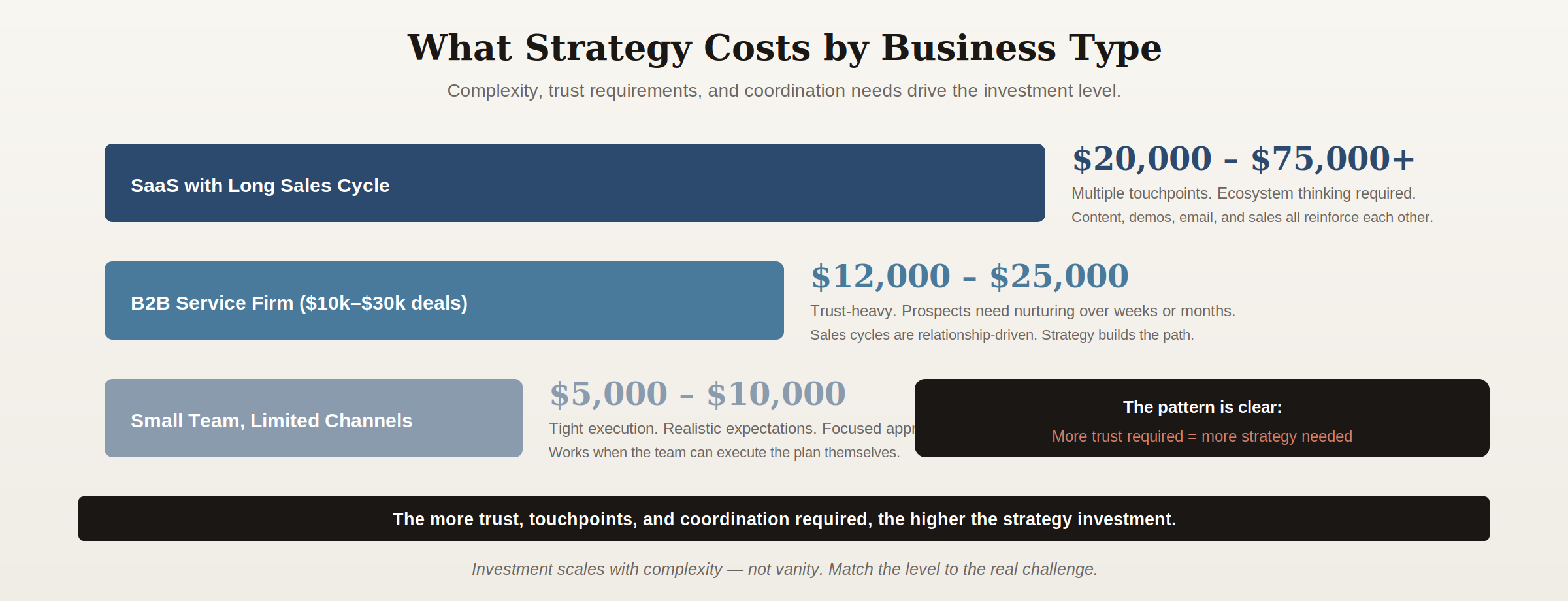
A B2B service firm selling engagements of $10k to $30k typically needs a mid-level strategy investment. Sales cycles are trust-heavy; prospects and leads need nurturing over time, and conversions happen over weeks or months. Strategy costs often fall in the $12k-$25k range.
A SaaS company with a long sales cycle needs ecosystem thinking applied. Content created, demos given, email sent, and sales conducted all have to reinforce each other systematically. Strategy costs often start at $20k and increase with complexity.
A small team with limited channels may succeed with an entry-level strategy if execution is tight and expectations are realistic.
The more trust, touchpoints, and coordination required to increase sales, the higher the strategy investment will be to achieve the goals they want.
Why Prices Vary So Much Between Providers
If you have seen wildly different quotes from providers you contacted, here is why the pricing varies.
First, the depth of the diagnosis conducted during the process matters significantly. Some strategies are based on surface-level assumptions made quickly without research. Others are built on thorough, comprehensive audits completed over weeks, interviews with stakeholders, carefully analyzed behavioural data from systems, and detailed funnel analysis across stages.
Depth costs more upfront. Shallow thinking costs more in the long run.
Second, the distinction between custom and template thinking also affects pricing. Many strategies are recycled frameworks with minor tweaks added solely for appearance. True custom work takes longer, costs more upfront, and better fits your specific business.
The revenue and sales complexity in the model also drive costs. Higher deal values and longer sales cycles require stronger systems built for trust building. More trust-building means more strategy is needed for conversion to happen.
Strategy vs Tactics: Where Money Is Actually Lost
Allocation is where most businesses get it wrong.
They compare strategy costs to tactics such as ads run, content created, or the cost of tools, but strategy is what prevents waste.
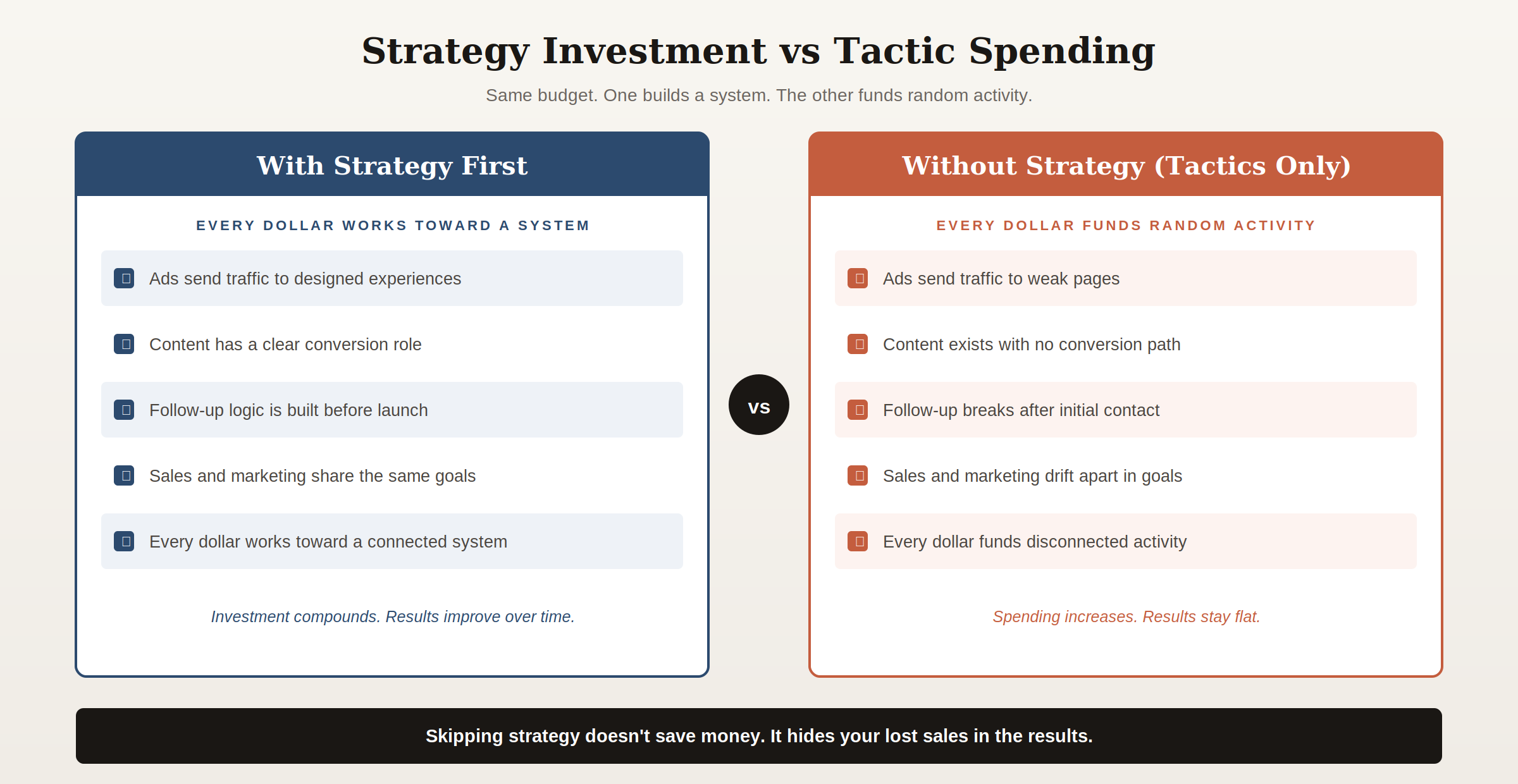
Without a working strategy:
- Ads send traffic to weak experiences.
- Content has no conversion role.
- Follow-up breaks down after initial contact.
- Sales and marketing drift apart in goals.
Skipping the strategy does not save money within your budget, it just hides your lost sales in the results.
How Long Does Strategy Take
A real strategy takes time to build properly.
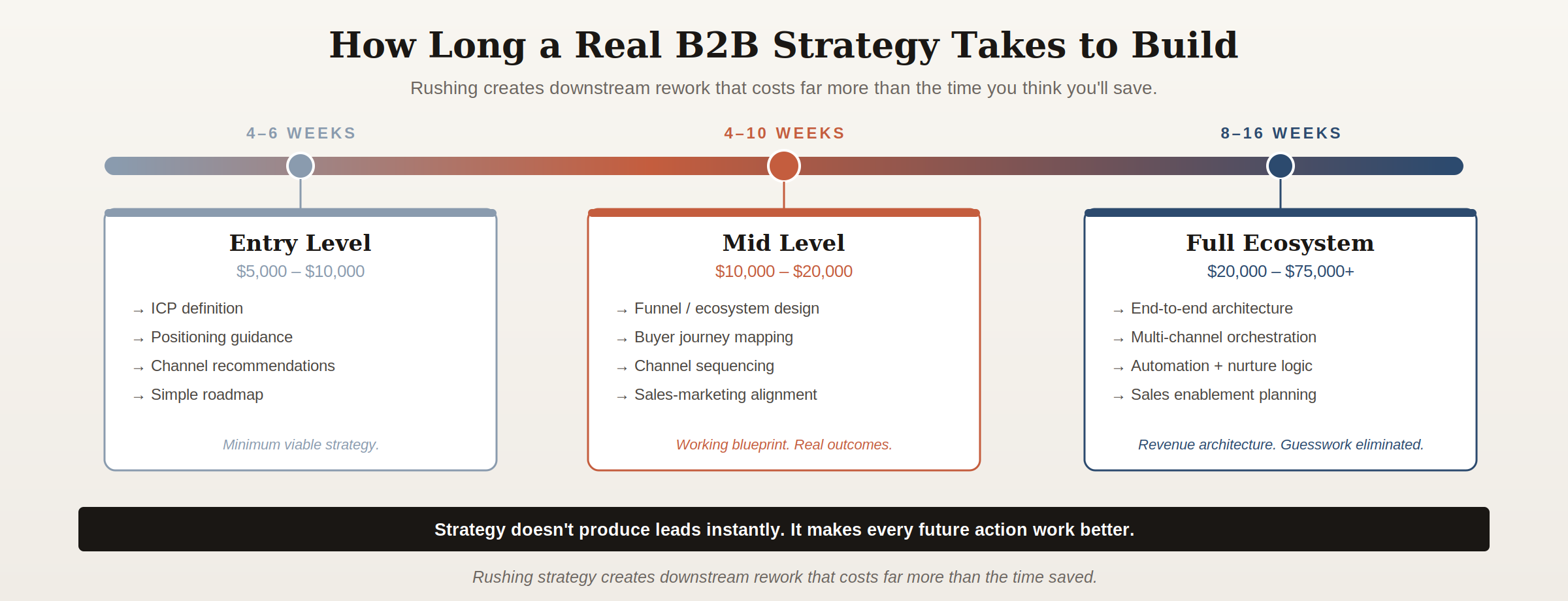
Typical timelines seen: Entry-level strategy takes 4 to 6 weeks. Mid-level strategy takes 4 to 10 weeks. A full ecosystem strategy takes 8 to 16 weeks.
Strategy does not instantly produce leads. It makes every future action work better.
But you need to be aware that rushing a strategy usually creates downstream rework that costs far more than the time that you think you will initially save.
What a Bad Strategy Looks Like in Practice
Recognizing a bad strategy is important.
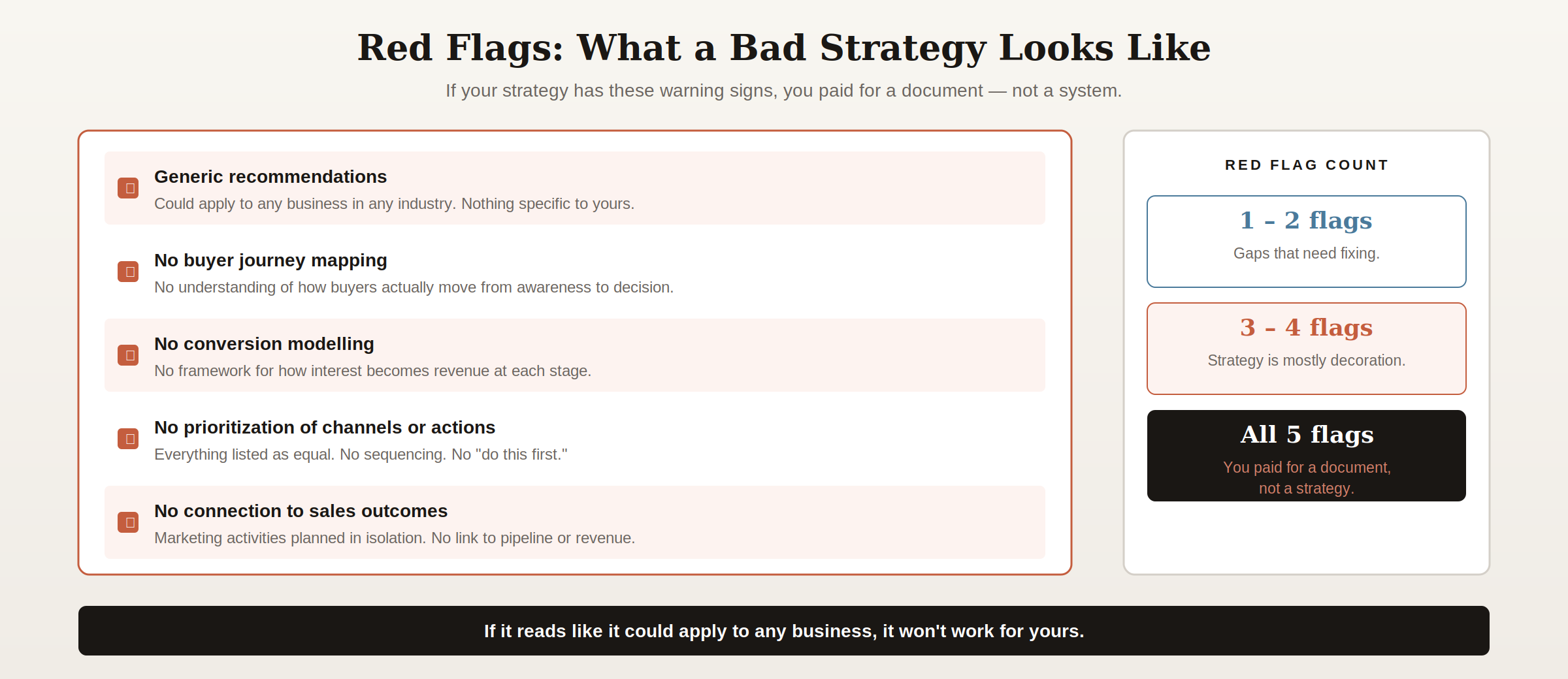
Warning signs include:
- Generic recommendations
- No buyer journey mapping.
- No conversion modelling.
- No prioritization.
- No connection to sales outcomes.
The key is that if it reads as if it could apply to any business operating, it will not work for yours specifically.
How to Budget Properly for Strategy Investment
This simple rule holds up in 2026.
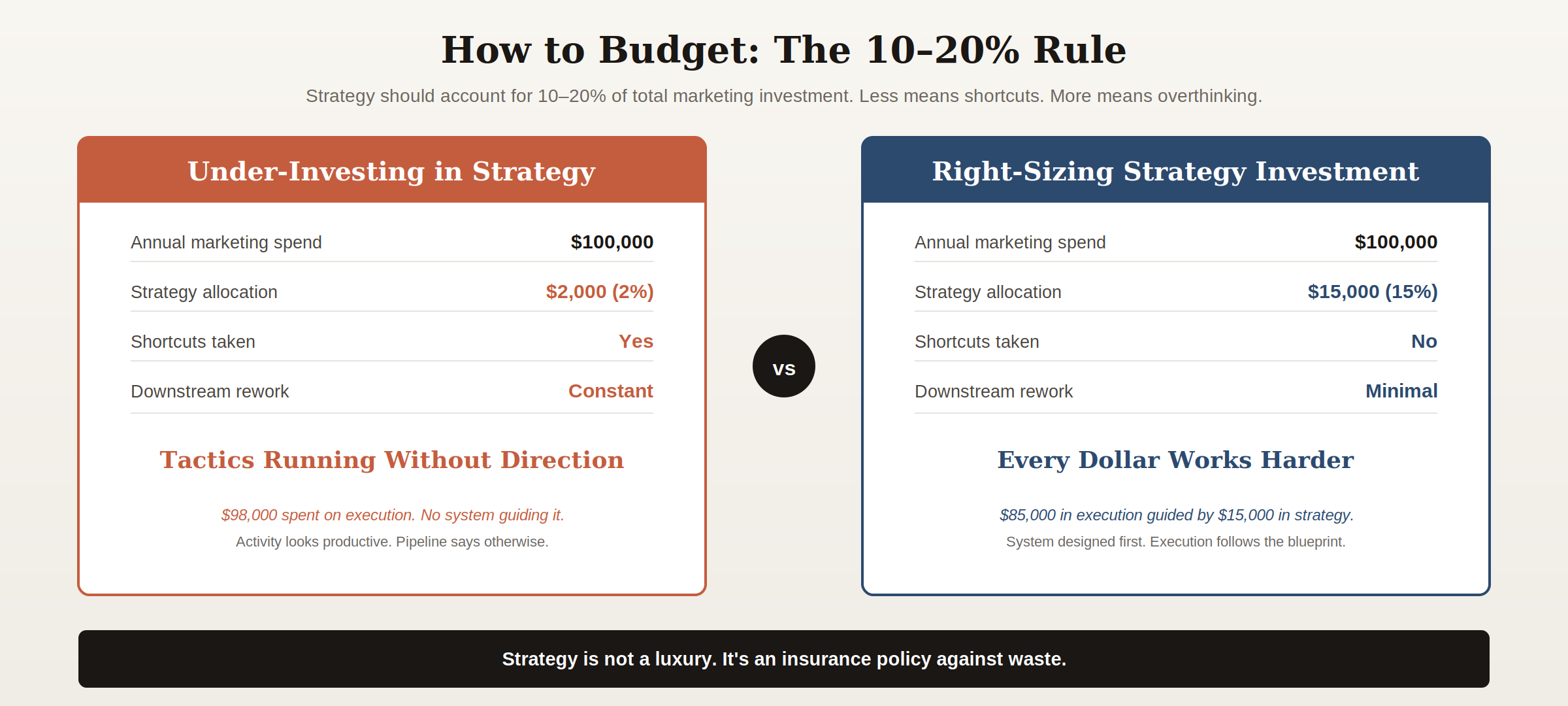
If marketing is expected to drive growth, strategy should account for a controlled percentage of your total marketing investment.
For most B2B companies, allocating 10 to 20 percent of annual marketing spend to strategy and system design is a healthy allocation. Less than that usually means shortcuts will be taken. And more often than not, it means overthinking without execution.
Strategy is not a luxury item, it is an insurance policy against creating waste.
A Quick Decision Check for Clarity
Ask yourself these questions:
- Are we clear on who we are targeting specifically?
- Do we know where leads drop off in the process?
- Is content tied to conversion outcomes?
- Are sales aligned with marketing goals?
- Are we building systems or buying tactics individually?
If the answers are unclear, a strategy is a must-have for growth.
Questions to Ask Before Investing
Ask yourself these questions about operations:
- Are we clear on who we are targeting specifically?
- Do we know where the leads drop off?
- Is content tied to conversion outcomes?
- Are sales aligned with marketing goals?
- Are we building systems together or buying tactics individually without connection?
If those answers are not clear, having a strategy is a must to move forward.
Without clarity on these points, spending on tactics creates waste. With clarity, every dollar spent works harder.
What to Do Before Budgeting for Strategy
Before you compare proposals received from agencies, negotiate pricing discussed in meetings, or decide what you are willing to spend allocated from the budget, pause and challenge the assumption that cost is the real problem blocking progress.
Ask yourself these questions:
- Are we clear on who this strategy is actually intended to serve in the market?
- Do we know where buyers hesitate or drop off along the funnel journey?
- Can we explain our value without relying on sales calls to do all the heavy lifting for prospects?
If marketing spend keeps increasing over time but outcomes remain unpredictable, the issue is usually not that the strategy is too expensive. It is that decisions are being made without sufficient clarity.
Many companies respond by cutting budgets quickly or jumping straight into tactics without thinking. Others do the opposite, overinvesting without understanding the specific strategy that is needed to fix marketing.
Both approaches create waste by spending resources.
Strategy pricing only makes sense when you clearly understand the problem to be solved and how marketing, sales, and follow-up need to work together systematically. Without that clarity, even a well-priced strategy becomes daily guesswork.
Before you commit to a provider’s quoted number, get a second set of eyes to review the approach.
If you want help pressure-testing your investment thinking, understanding which level of strategy actually fits your business in practice, or avoiding unnecessary spending on the wrong things, reach out. I can help you think it through clearly and point you in the right direction for growth.

