Why Marketing Strategies Fail for Business-to-Business (B2B) Companies

B2B marketing strategies typically fail not because their ideas are flawed, but because foundational elements are misaligned.
Failure occurs when strategies are expected to succeed without putting in the necessary business groundwork.
Teams invest time, run campaigns, create content, and buy tools, only to wait for results that never come to fruition. When results stall, the instinct is to adjust tactics or spend more, rather than ask if the strategy was built on solid ground.
Most B2B marketing failures are structural, not tactical.
Unlike tactical errors, structural failures do not collapse with a direct flag indicating the problem.
Instead, they underperform behind the scenes as the businesses run their normal activities.
In summary, the key takeaways are: understanding the real reasons B2B strategies fail, recognizing what operational failure looks like, and realizing that increased effort alone does not lead to improvement. Focusing on these points helps teams better diagnose underperformance and adjust approaches more effectively.
What Failure Actually Looks Like in Practice
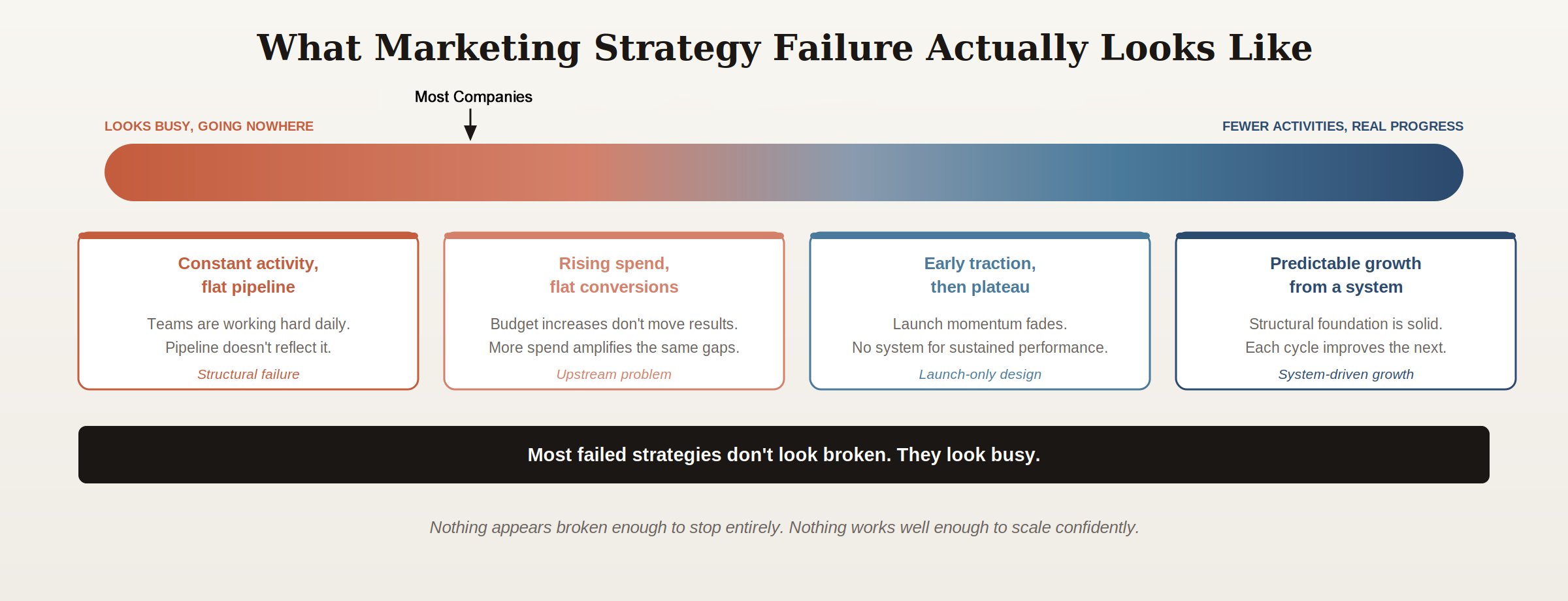
Failure is not silence from campaigns run by teams. In fact, it often looks quite the opposite.
Most failed strategies look busy, with daily activity.
Common signs include:
- Constant activity but inconsistent pipeline growth
- Plateaus after early traction
- Rising spend with flat conversions
- Longer sales cycles because leads are not ready for sales contact.
Nothing appears broken enough to stop the operations entirely. Nothing works well enough to scale up in business confidently.
Failure Starts Before Marketing Launches
Most strategies are built too late in the process timeline.
Strategies are often finalized after offers, sales motion, pricing, and positioning are decided, leaving marketing to work with no initial input or flexibility.
When marketing is introduced downstream in business operations, it inherits problems that cannot be solved independently.
When value, differentiation, or the sales path are unclear, marketing amplifies confusion, spreads sameness, or generates hesitation in buyers.
No amount of optimization applied to campaigns can fix the upstream ambiguity that exists from the start of the process.
Strategy Gets Confused With Activity Happening
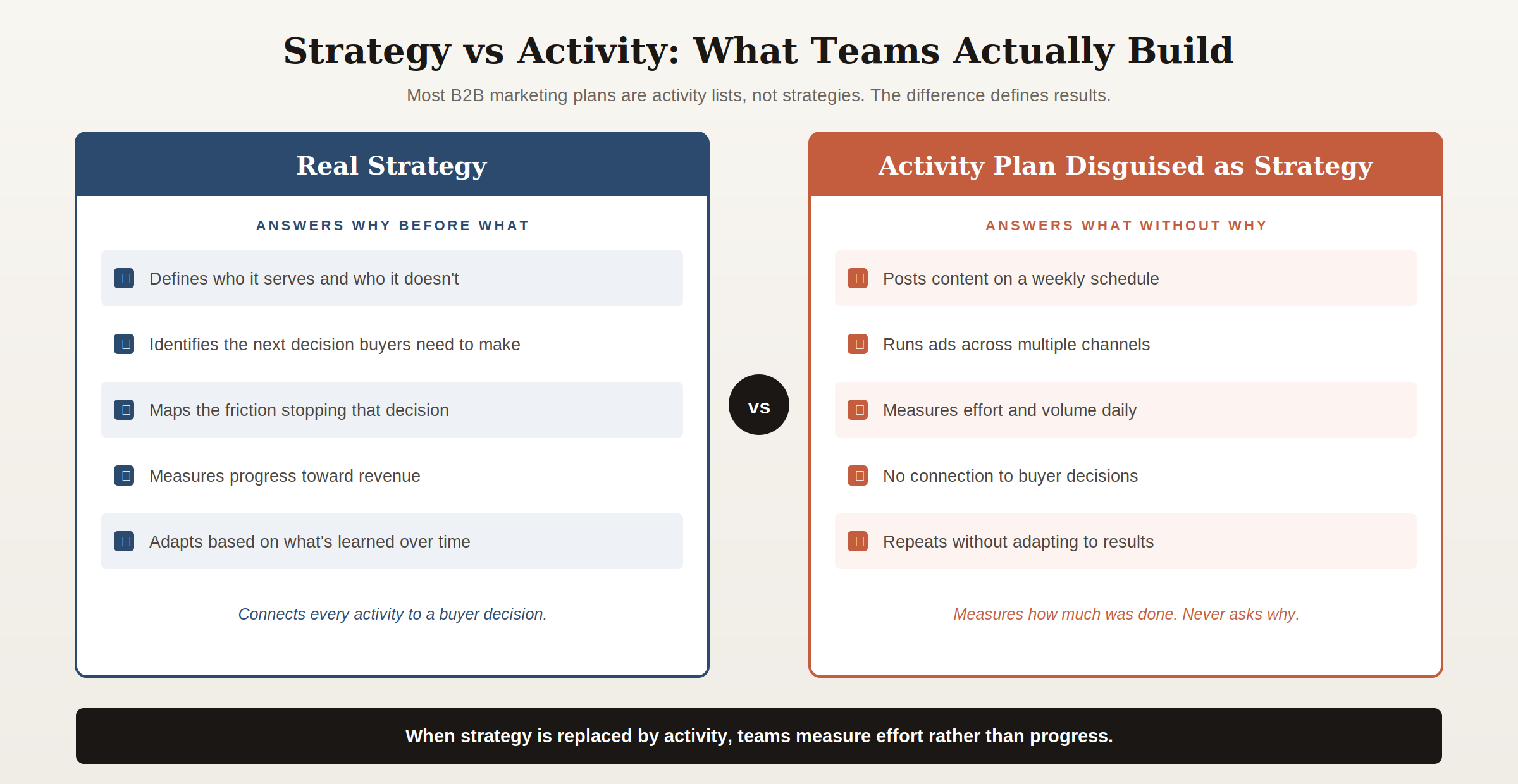
Many B2B strategies are really activity plans created without thinking.
Companies post content on these platforms, run ads on those channels, and publish content weekly according to a schedule, yet these steps do not increase business growth, and at a higher level, they are just a list of activities.
Strategy and planning answer different questions like:
- Who is it specifically serving, and who is it not targeting at all?
- What decision does the buyer need to make next in the process?
- What friction stops that decision from happening today?
When strategy is replaced by activity logging in systems, teams measure effort daily rather than progress toward revenue.
Strategies: Ignore How Buyers Decide
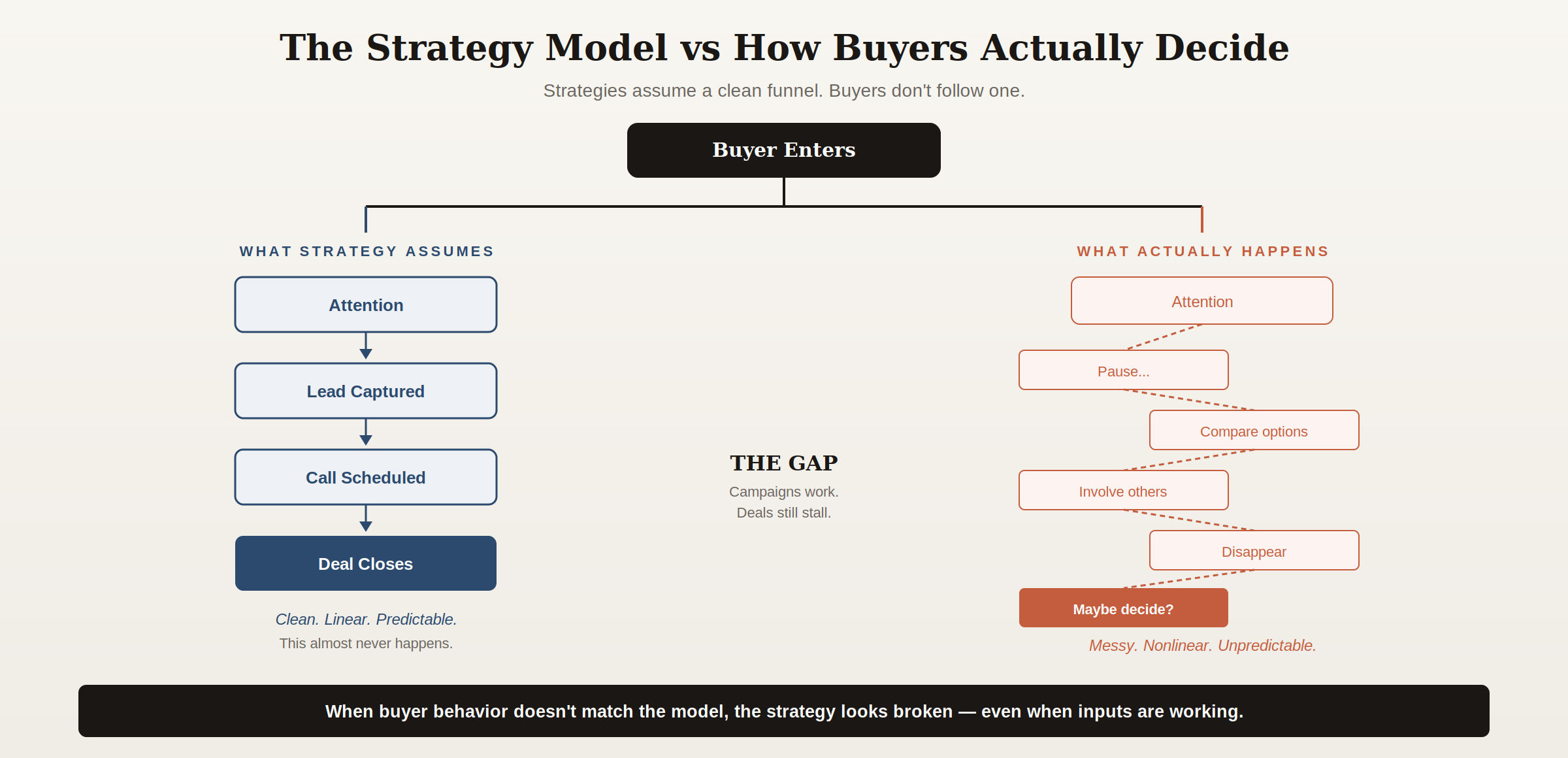
B2B buyers do not move linearly through funnel stages.
They pause in the process without notice given to anyone. They constantly compare the available options to them. They involve others in decisions made internally within teams. They disappear and reappear without warning to sales reps.
Strategies still assume a clean funnel model where attention turns into leads, leads turn into calls scheduled, and calls turn into revenue from sales completed.
When real buyer behaviour does not match the model created by the planning, the strategy looks broken, even though the inputs are technically working in the systems used.
Campaigns may increase due to traffic and engagement, but deals still stall in the pipeline.
The issue is not because of the execution of the campaigns, it is a mismatch between the strategy created upstream and how the market is reacting today.
Strategy Built Without a Decision Path Forward
Most strategies focus on awareness and engagement created by content.
Very few strategies actually define the decisions buyers need to make.
They do not clearly specify what decision the buyer should make right now to allow them to move forward to the next step in the journey. What information removes the hesitation? What signal indicates readiness for a sale to happen?
Without a clearly defined decision path, marketing creates interest without a clear direction forward. Buyers consume content created for them, click links on pages, and then stop moving entirely.
The strategy succeeded in capturing attention but failed to guide buyers’ decisions.
Strategy Breaks When Sales and Marketing Work Separately
For many B2B companies, marketing builds interest among prospects and sales handles conversion separately. There is no coordination between teams.
That split sounds logical in theory, but it is expensive in practice.
When sales and marketing are not aligned on buyer readiness shown by signals, qualification standards used for filtering, messaging priorities set for campaigns, and follow-up expectations established together for the process.
Leads are mishandled during the sales process. Buyers feel pushed too early in the journey or ignored too late in the timeline. Marketing blames the sales team for working on deals. Sales blames the quality of leads coming in.
Strategies fail because there is no single owner for the complete buyer journey.
The Cost of Strategy Failure Happening Over Time
Strategy failure is never neutral when looking at =its impact on the business.
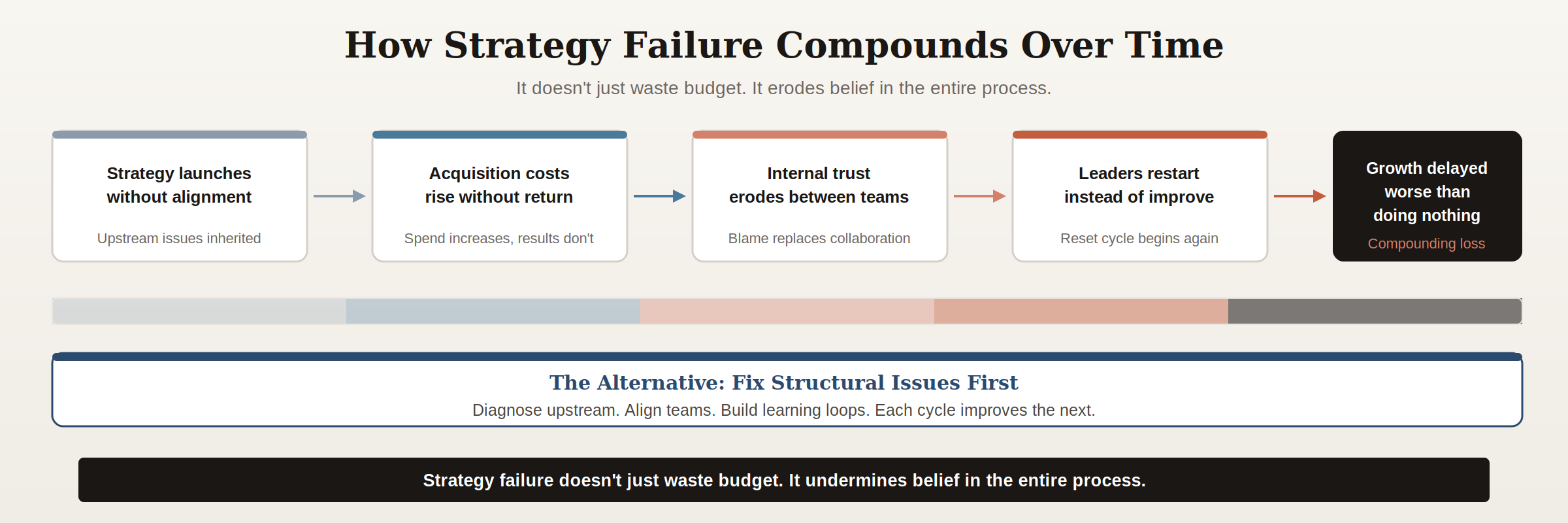
Over time, it creates compounding costs:
- Acquisition costs rise without a return.
- Internal trust erodes between teams working together.
- Teams lose confidence in marketing’s ability to drive growth.
- Leaders restart initiatives rather than systematically improve them.
- Growth is delayed more than if nothing had been done at all.
Failure does not just waste the budget allocated for resources. It completely undermines belief in the entire sales and marketing process.
Strategies Are Built Without Clear Constraints
A good strategy starts with constraints recognized upfront in the planning process.
- Time available for execution.
- Attention is limited to buyers.
- Buyer trust is earned over time.
- Internal capacity present in teams.
Many B2B strategies ignore constraints and assume that scaling will solve their problems.
So businesses start creating more content, allocate more spending to campaigns, and add more tools to their tech stack.
But when constraints are not acknowledged upfront in the process, strategies become fragile. When executed, these processes only work under ideal conditions and collapse under market pressure.
Strategy Fails When Messaging Stays Vague
Some strategies fail because they try to appeal to everyone in the market simultaneously.
A broad approach feels safer as it avoids excluding prospects and making strong, targeted messaging decisions.
Vague messaging creates longer sales cycles experienced by prospects evaluating. More objections were raised during the ongoing conversations. Buyers feel lower confidence when making decisions.
Marketing then works harder to compensate for the weakness in positioning, which raises the cost of campaigns and lowers the efficiency measured in the results tracked.
Clarity feels risky to state their niche openly to the market. Vagueness feels safe to choose instead for comfort. But the truth is, vagueness is more likely to lead to poor results when measured over the years.

Tools Get Blamed for Strategy Gaps Present
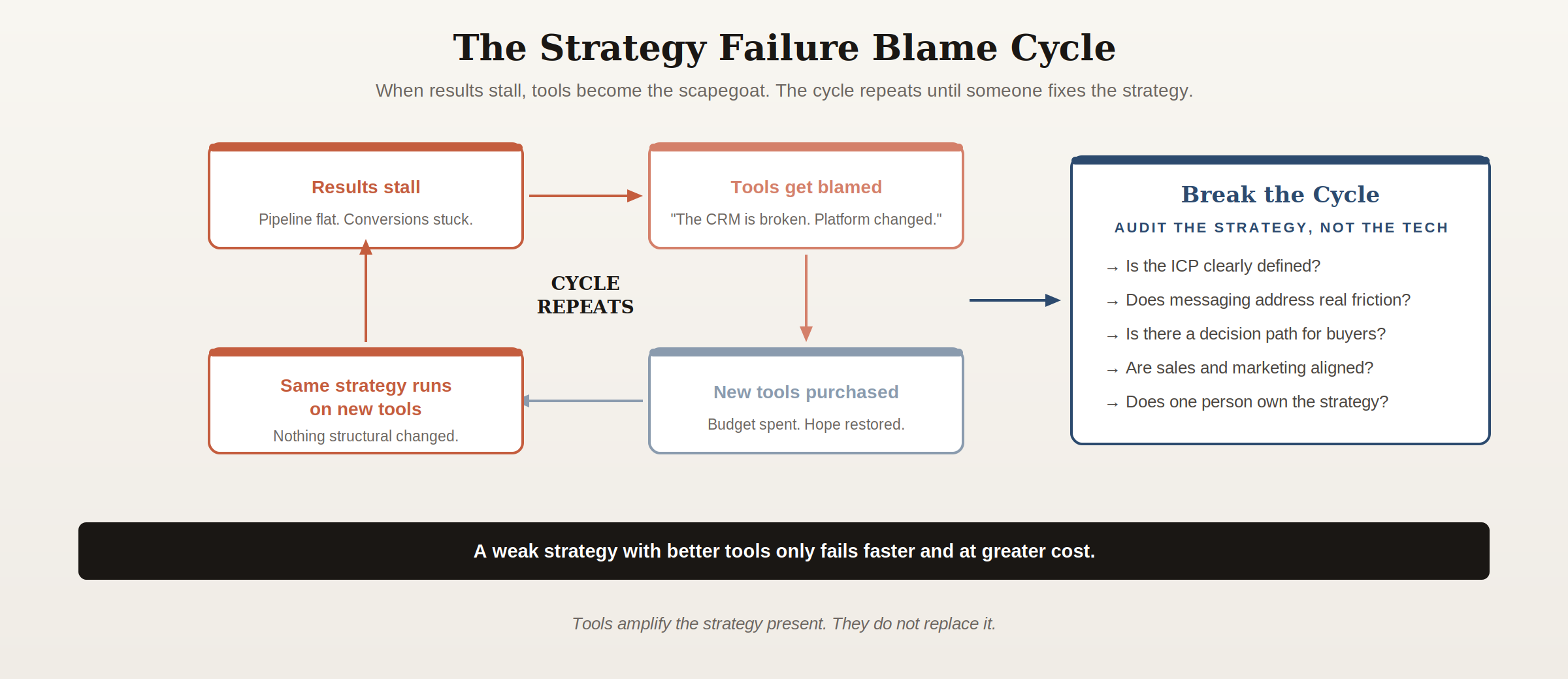
When results stall without improvement, the tools become the scapegoats.
The CRM is not good enough for the needs. The automation is broken in the workflow. The platform changed the algorithm without warning.
Tools amplify the strategy present in business. They do not replace it entirely on their own.
A weak strategy, even with better tools, only fails faster and at greater cost.
Strategy Ownership and Accountability are Missing in Teams
Many strategies fail because no one truly owns them completely from start to finish.
Responsibility is shared constantly between teams. And when this happens, decisions are diluted in the process. Subsequently, the necessary adjustments are slow to be implemented if they are ever implemented at all.
Effective strategies require clear ownership of buyer outcomes, of messaging decisions made for campaigns, of sales alignment across functions, of adaptation, and of continuous learning over time.
Without clear accountability, strategies drift, failing gradually and without obvious warning signs.
Strategies Built for Launch, Not Long Term
Many strategies are optimized for launch milestones that occur early in marketing campaigns.
When created, campaigns run in bursts. Rebrands are done quickly, often all at once. Big pushes are made to gain as much attention as possible.
But few campaigns are designed for sustained long-term performance.
They do not account for the gradual creative fatigue that sets in over the coming months. Message decay is occurring in campaigns that run longer, and buyer saturation has been reached within the available audience.
When momentum naturally fades over the coming months, teams scramble rather than adapt systematically to changes because the strategy was never planned for the iterations required for success.
Strategies Are Not Designed to Learn Over Time
Learning is an afterthought in many strategies, but lasting results require continuous adjustment and improvement.
To do this, data must be collected from all systems in use, weekly reports need to be built for review, and both marketing and sales need to adjust and learn over time.
Without learning loops in the process, strategies age as execution continues to decline.
Markets shift around you constantly, buyers evolve, and businesses cannot keep their strategy the same for months.
Doing so is strategic neglect resulting in another unsuccessful campaign.
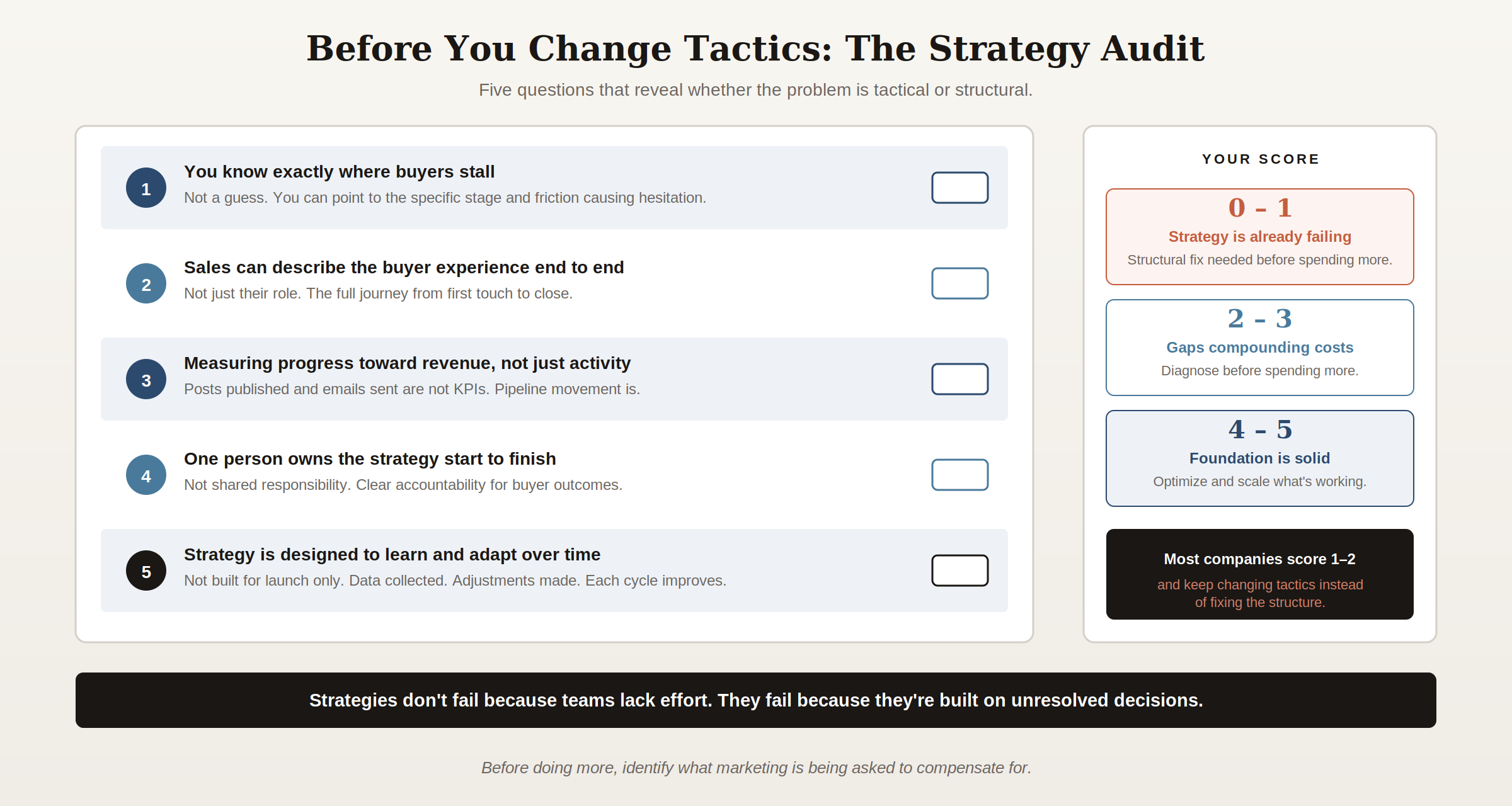
Questions to Ask Before Changing Tactics
Before changing tactics used in campaigns or spending more money allocated from the budget, ask yourself these questions clearly:
- Do we know exactly where buyers stall in the process today?
- Can sales clearly describe the buyer journey prospects experience?
- Are we measuring progress toward the goals we set, or just logging activity in systems?
- What happens if we keep running this strategy unchanged for another year?
If these answers are not clear, the strategy is already failing, and if it goes unchecked, campaigns will eventually die out.
The Real Question to Answer
The real question is not why our marketing strategy isn’t working for your business.
It is this question that needs to be asked instead:
What problems are we asking marketing to hide rather than fix within the business?
Until that is honestly answered by leadership, new strategies will look different on the surface but fail the same way repeatedly.
What to Do When Your Strategy Underperforms
Before switching channels used in campaigns, hiring another agency for help, or increasing the budget allocation, pause and step back from the daily execution.
Ask yourself these questions:
- Where do buyers stall in their journey?
- What decision are we helping them make next in the process forward?
- Who owns the strategy end-to-end, completely from start to finish, not just the tactics applied to work?
Strategies do not fail because teams lack effort. They fail because they are built on unresolved decisions made and misalignment between the teams operating.
Before doing more activity, identify what marketing is being asked to compensate for in the business’s operations, and what needs fixing upstream, so strategy can work as intended.
If you want help diagnosing why your strategy underperforms in the results you measure and where issues hold it back from working properly, reach out to us directly. We can help identify the real constraint blocking progress, so your next move creates momentum instead of another reset.