
Is Your Business Is Ready for an AI-Powered Lead Generation System?

AI-powered lead generation has progressed past initial trial phases and is no longer experimental.
Most B2B companies that ask about it have seen demos and case studies and know that it is inevitable, but the real question companies are asking is not whether AI technically works. It’s something deeper.
It is whether their business is actually ready to use and implement it into their company.
What companies must understand is that AI does not fix the broken fundamentals. It magnifies them.
This article is not about available tools, tactics, or the hype around AI. This article is about finding out if your company is ready to use AI.
It’s about deciding whether you can leverage AI for your company or treat it as a liability.
Why Readiness Matters More than Capability
AI lead-generation systems can produce impressive results.
They can automatically identify prospects, personalize outreach, run continuously without interruption, and operate faster than human teams.
What they cannot do is compensate for unclear positioning, weak offers, or disjointed sales processes.
Companies that succeed with AI do not start by asking what the system can do, they start by asking if their business is ready to support AI.
The Core Misconcpeption about AI Lead Generation
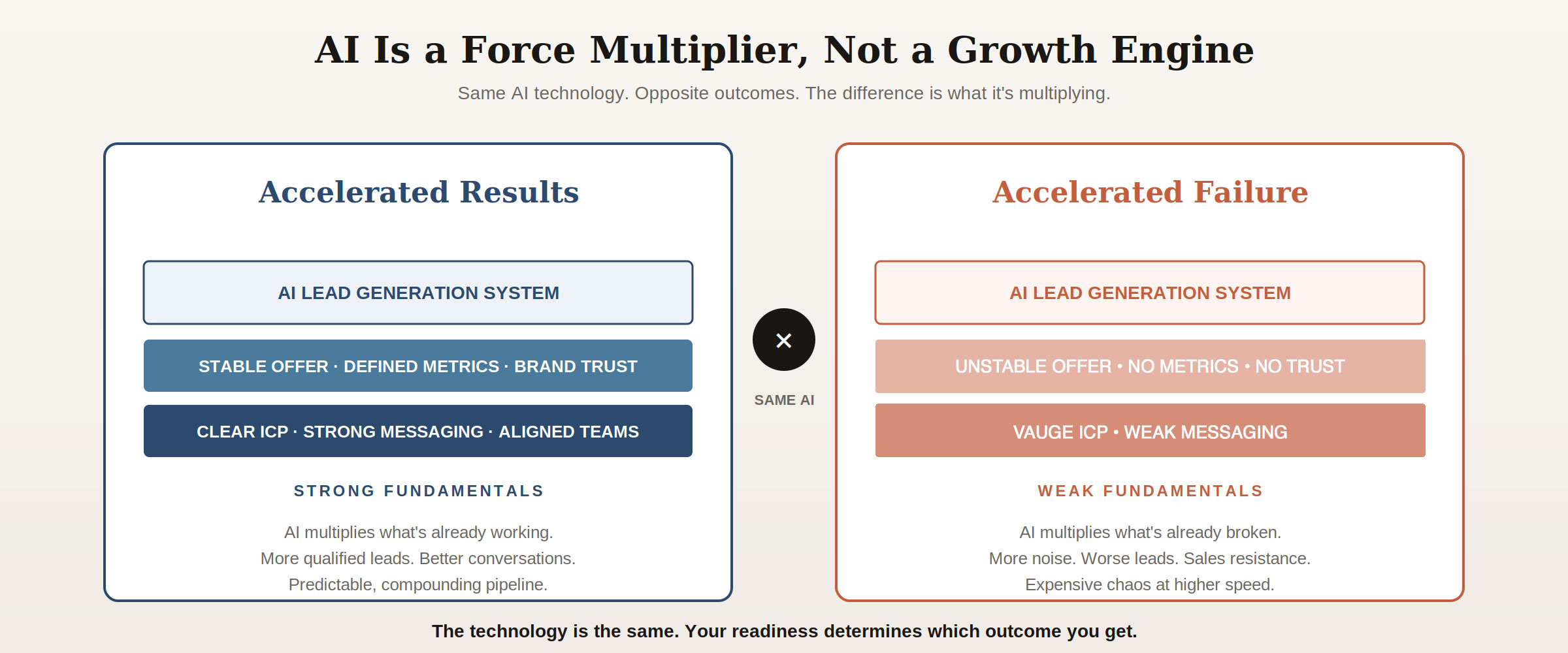
Most teams think AI is a growth engine running, but in reality, it is a force multiplier working.
If your fundamentals are solid, AI accelerates your results. If they are weak, AI accelerates failure.
That distinction is why two companies can use similar AI tools and see opposite outcomes.
A company’s readiness determines the direction it should take with AI.
The First Readiness Test: Do You Know Exactly Who You are Targeting
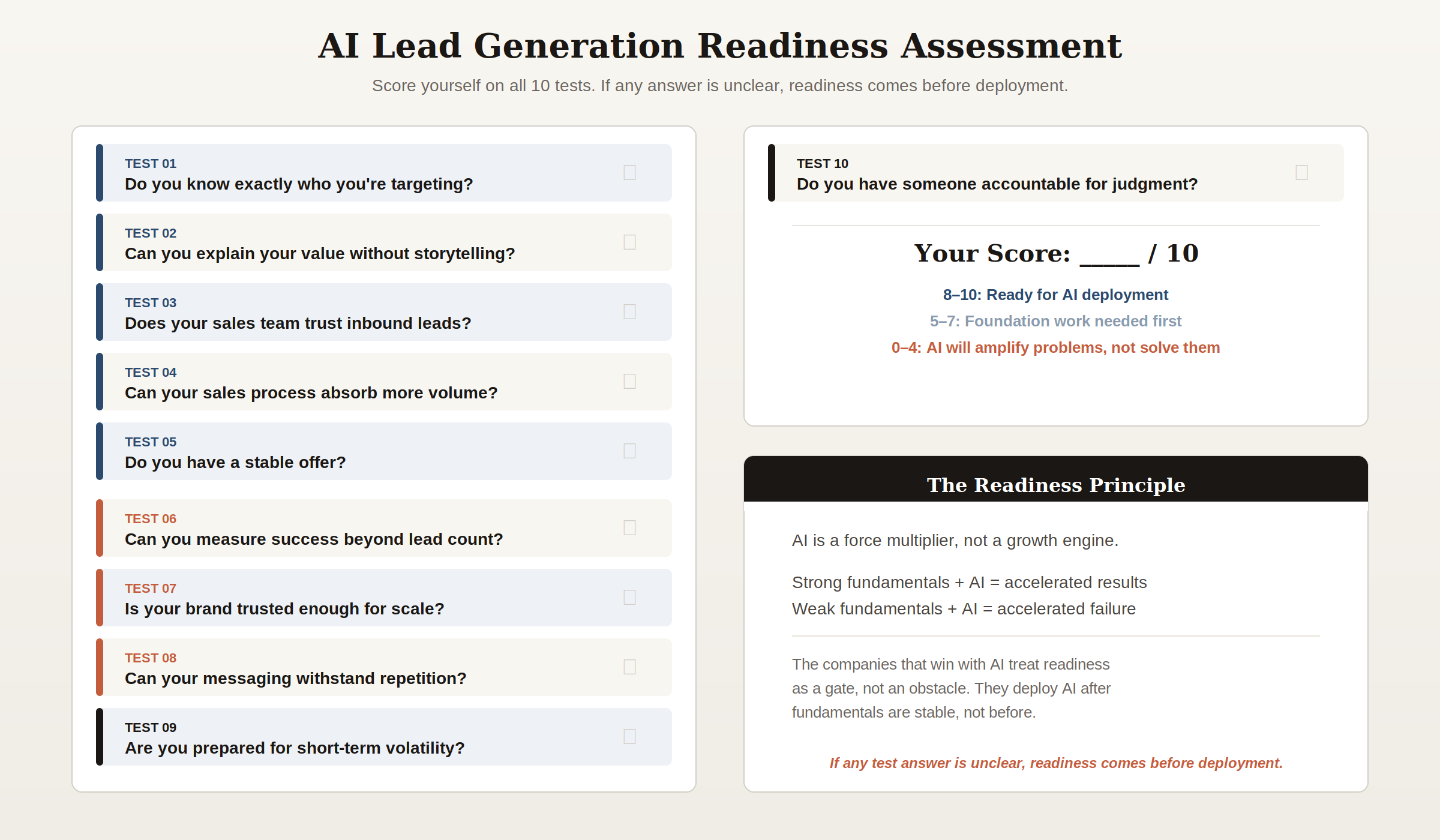
Though AI is powerful, it does not automatically figure out your market for you.
AI can only execute against the inputs you give it. If your Ideal Customer Profile (ICP) is vague, AI will generate overly broad results because of it.
You are ready for AI lead generation only if your ideal buyer is clearly defined. You can articulate who is not a fit for the solution. You understand buying triggers, not just demographics shown.
If your team still debates who the system should target in the market, that will surface when AI tries to target that audience.
The Second Test: Can You Explain Your Value Without Storytelling
AI outreach and AI-driven lead generation rely on clarity, not persuasion.
This means you must state a clear problem definition, articulate clear outcomes, and explain the mechanism clearly.
If your value proposition requires live explanation or extra nuance, or storytelling to land properly, AI will struggle with your messaging.
This does not mean your offer is weak, it means it relies heavily on context.
Context-heavy offers require clear human intervention before automation is used.
The Third Test: Does Your Sales Team Trust Inbound Leads
AI-generated leads often look different from manually sourced ones. They arrive faster, there are usually more of them, and they are not as pre-qualified as other leads.
If sales already distrust leads generated by marketing, AI will only intensify friction between the teams. In essence, sales know what a good lead looks like. Marketing and sales must agree on follow-up expectations, and a defined handoff process must be established to ensure only vetted leads are sent.
Without alignment, AI creates internal resistance before it can generate revenue.
The Fourth Test: Can Your Sales Process Absorb More Volume Without Breaking
AI can generate leads faster than most sales teams can handle, which sounds like a good problem. But because of this speed, it can become unmanageable.
If your sales process already struggles with response time, follow-up consistency, or pipeline hygiene, then AI can’t fix that.
All AI will do is expose. A business that is ready for AI has some slack in its sales system or has a plan to create it.
The Fifth Test: Do You Have a Stable Offer
AI lead generation systems assume stability, and frequent changes to pricing, positioning, packaging, or target market will require constant retraining and adjustment.
That does not mean you cannot evolve your AI lead-generation system over time. It simply means you need a stable core. If your offer is still in flux, AI will increase uncertainty rather than momentum.
The Sixth Test: Can You Measure Success Beyond Lead Count
AI systems make generating volume easier, but at the same time, these systems make understanding what is working harder to find.
If success is measured by the number of leads generated, replies received, or activity tracked, you are not ready for AI.
Business readiness requires a clear understanding of marketing benchmarks, AI’s effects, contribution to the sales pipeline, and sales feedback loops to increase success.
Without outcome-based measurement, AI optimization can drift without direction.
The Seventh Test: Is Your Brand Trusted Enough
AI outreach increases exposure. That includes more inboxes reached, more impressions, and more scrutiny.
If your brand lacks proof, credibility, or clear positioning, then you are not ready.
AI accelerates skepticism, and without the authority required to build trust, your AI lead generation will not provide the results that you are hoping for.
Companies ready for AI know how they are seen in the marketplace, and because of this, they have enough digital assets to reinforce what they have worked hard to create.
The Eighth Test: Can Your Messaging Withstand Repetition
AI systems repeatedly repeat messages during operations, and that repetition can reveal flaws within your messaging.
Weak claims are questioned more quickly, vague language is ignored faster, and overpromises are flagged faster by the market.
If your messaging hasn’t been pressure-tested, AI will do it publicly.
Readiness means that when your message is repeated, it can survive any scrutiny.
The Ninth Test: Are You Prepared for Short-Term Volatility
AI lead generation systems rarely stabilize immediately after launch.
The early stages involve calibration, the creation of feedback loops, and adjustments.
Companies that expect instant, smooth performance often pull the plug too early in the process.
Readiness includes the patience and tolerance needed to handle temporary inconsistencies.
The Tenth Test: Do You Have Someone Accountable for Judgment
AI systems still require decisions to be made.
Someone must be assigned to approve changes. Someone must be assigned to interpret the feedback signals to optimize the system. Someone must be assigned to decide when to intervene in the lead generation process and to let the team know when changes are needed.
If AI is managed with a hands-off approach, its performance gradually declines over time. Businesses that are ready for AI clearly assign ownership so that the system can constantly evolve.
Why Readiness Is a Strategic Advantage
Most companies adopt AI reactively due to competition.
They see competitors using it and rush to match how they are using it in the market.
The truth is, the companies that win with AI treat readiness as a gatekeeper, not an obstacle.
They install AI only after fundamentals are stable and clarity is established.
What Happens When You Adopt AI Too Early
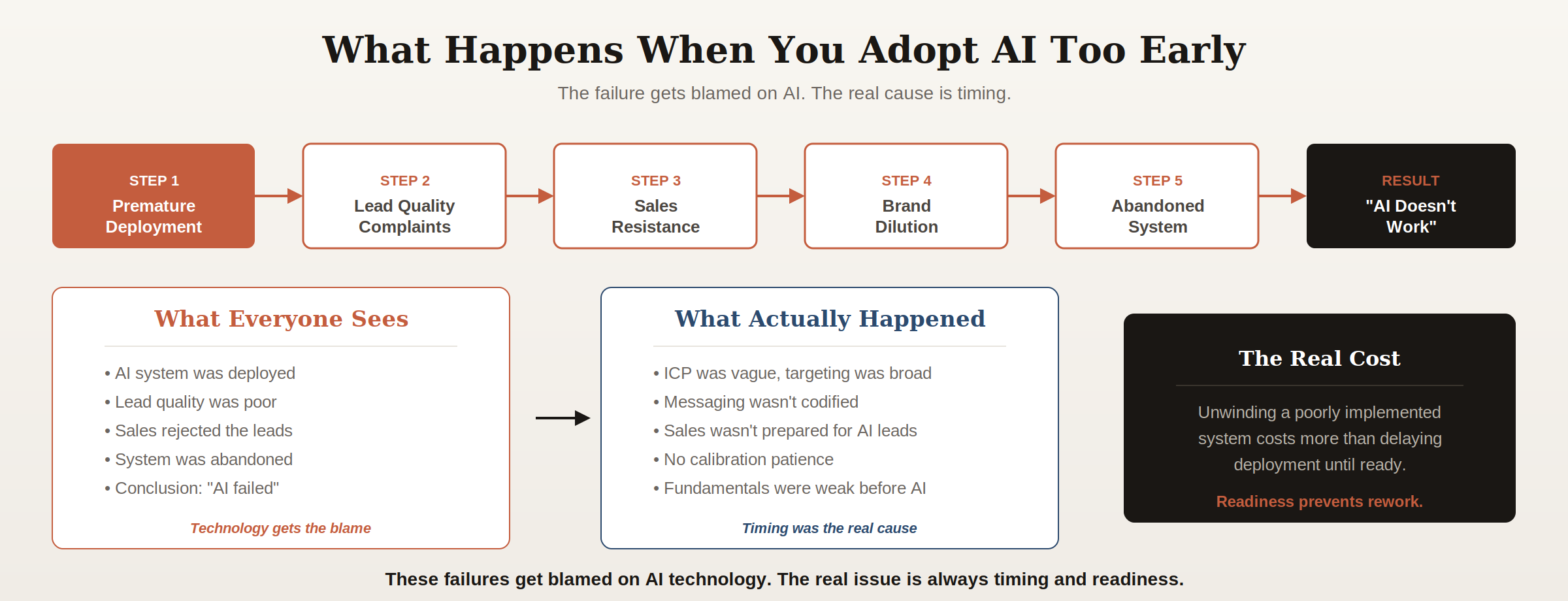
Premature AI adoption usually leads to complaints about the quality of leads from the sales team. This, in turn, leads to sales resistance, brand dilution and an abandoned system.
These failures often get blamed on AI technology, but the real issue is poor timing.
Why We Will Figure It Out Later Is Risky
AI systems build momentum quickly, and once they are live and running, they shape market perception of your business, sales behaviour, and internal expectations.
Unwinding a poorly implemented system costs more than delaying deployment initially, but planning and readiness prevent the need for rework and reprogram the system.
The Companies Most Ready for AI Lead Generation
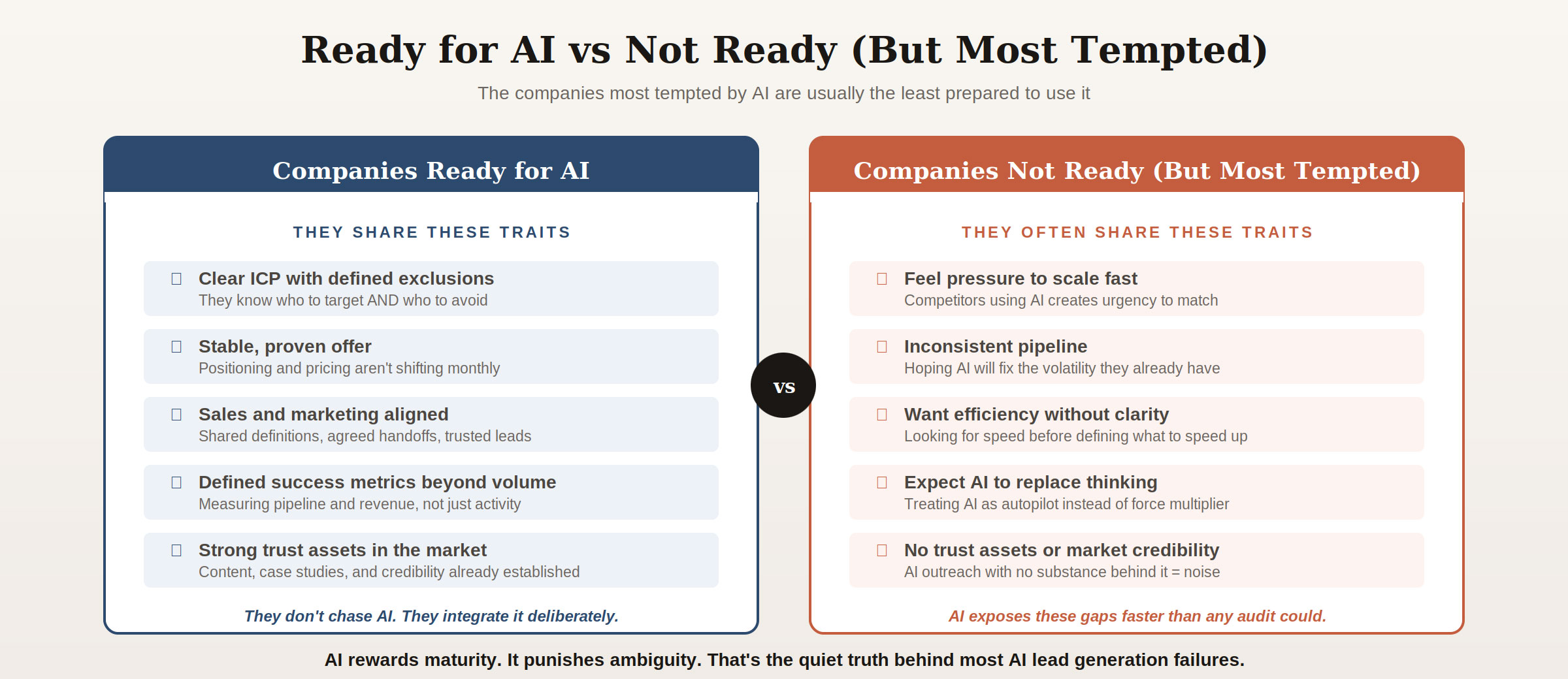
The companies that are ready for AI usually share these traits:
- Clear ICP and defined exclusions
- Stable offers
- Aligned sales and marketing teams
- Defined success metrics
- Strong trust assets
Instead of frantically chasing AI, they approach adoption deliberately. As a result, they systematically integrate AI without any issues.
The Companies Least Ready But Most Tempted
These days, AI is a huge buzzword, and unfortunately, the unprepared companies often feel pressure to scale quickly.
They have an inconsistent pipeline, want efficiency without clarity, and expect AI to replace the thinking required to make important decisions.
But what AI does is expose these gaps faster than any audit could.
AI Is Not a Shortcut to Maturity
AI rewards maturity, and it punishes the ambiguity that exists in a business.
That is the quiet truth is behind most AI-led generation failures.
A Simple Readiness Question
Ask yourself this question before you continue with AI:
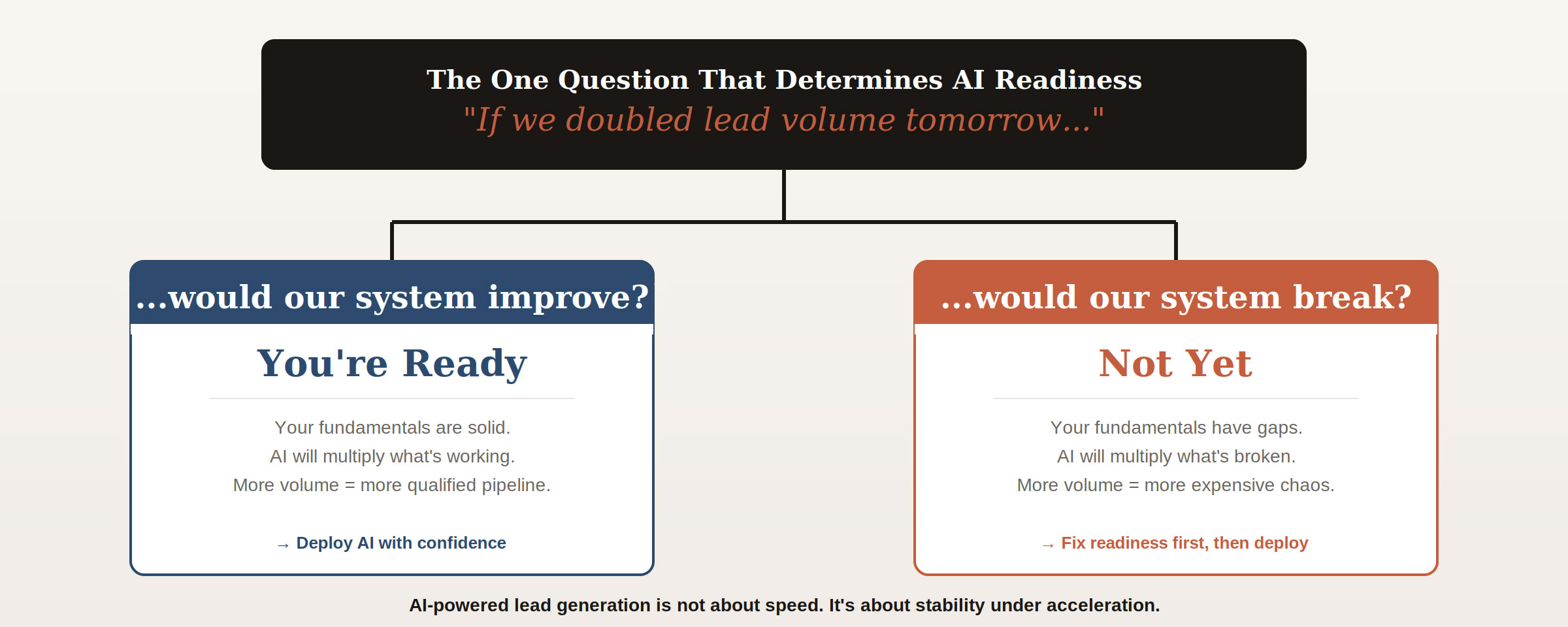
If we doubled lead volume tomorrow, would our system improve or break under the pressure of more leads?
If the answer is to break under the pressure, then taking some time to prepare your company must take priority.
Final Perspective on Readiness
AI-powered lead generation is not about achieving speed. It’s about stability under acceleration.
Businesses ready for AI do not look for miracles, they look for leverage. And they know the difference between them.
Take Action on This
If you are considering AI-powered lead generation, pause before moving forward.
Do not rush into implementation, worrying about which tool to buy or how fast to deploy it to the market.
The first question you need to consider is whether your systems can handle how AI will amplify your operations.
Here is a list of questions you need to find the answers to:
- Do you know exactly who you serve and who you exclude from targeting?
- Can prospects grasp your value without lengthy explanation?
- Do sales trust the leads marketing generates today?
- Would your sales process survive if lead volume doubled overnight?
- Are you measuring pipeline and revenue, or just tracking activity logged?
- Would your sales process survive if lead volume doubled overnight?
- Are you measuring pipeline and revenue, or just tracking activity logged in systems?
Before you deploy AI, evaluate where you stand, close the gaps, and align sales and marketing on standards and handoffs. Then move forward when AI is leveraged rather than being a problem.
If you want an honest assessment of whether your business is ready for automation and what needs to be fixed before it, reach out to us directly. We will help you determine the right sequence, so AI works for you, not against you.

