
Best Content Types for Building Authority in B2B

You met your annual content targets: 87 blog posts, weekly publishing, organic traffic up 34 percent, and more email subscribers. But despite these successes, a sales rep still found themselves explaining your company to a prospect who’d been reading those blogs for months. The prospect said, “I’ve seen your articles—they’re helpful. But I’m not sure what makes you different from everyone else.” After all your content, the buyer still couldn’t say why your company stood out.
This reveals a gap: the difference between content that gets seen and content that builds authority. Your blog garnered attention, but without authority, buyers may be aware of you but see no clear reason to trust you over competitors.
Most companies think authority comes from frequency. If you publish more, buyers will see you as the expert. That drives the content treadmill, where teams exhaust themselves producing volume but never change buyer perception.
Authority does not come from publishing more content. Authority results from content that helps buyers see their problems differently. When your insights shift a buyer’s perspective, trust is formed. In contrast, content that merely repeats widely available information generates forgettable awareness, which is just visibility, not authority.
I’ll break down the content types that build authority, how they work psychologically, and why mixing them badly weakens trust. Most teams miss the distinction between the two content types, so read on.
Why Publishing More Rarely Changes Anything
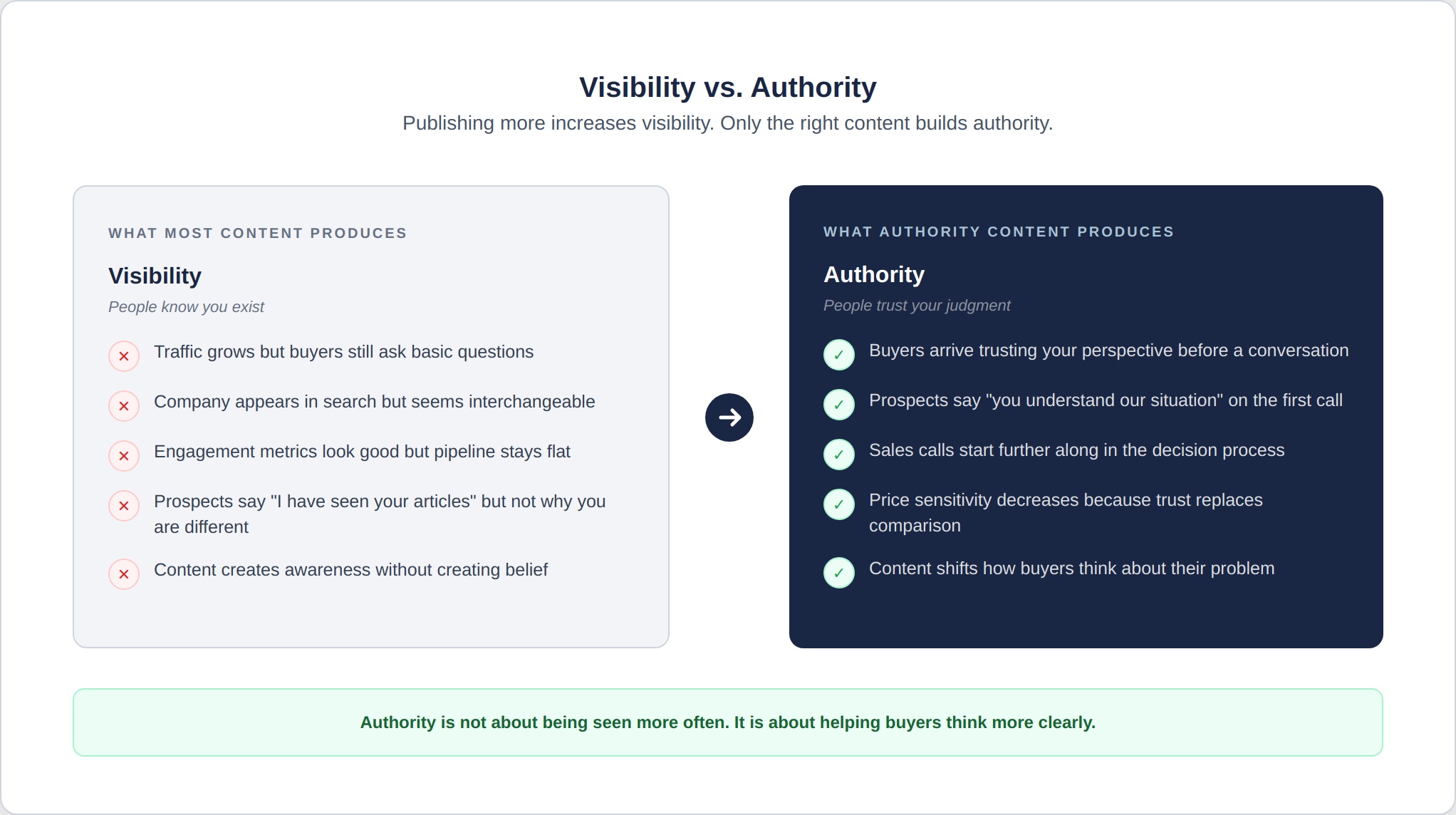
Publishing more increases visibility, not credibility or authority. These are fundamentally different outcomes, and most content strategies conflate the distinctions among visibility, credibility, and authority.
When you publish three or more times a week, it’s natural that traffic grows, engagement looks better than usual, and your company appears in search results. Yet prospects still ask the same basic questions and see you as interchangeable with similar competitors.
Sure, your content created awareness, but did it create the belief needed to turn that customer into a lead? More people know you exist, but without the right content, no one thinks you are unique or even qualified to solve their immediate problem.
This happens when companies optimize their content for reach rather than resonating with buyers and their problems.
What Authority Actually Means to Buyers
In Business-to-Business, authority means buyers trust your perspective to guide their decisions. The way you explain problems and their solutions influences how buyers assess their options. Does what you do reduce uncertainty and make it feel safe to follow your recommendations because you’ve demonstrated sound judgment?
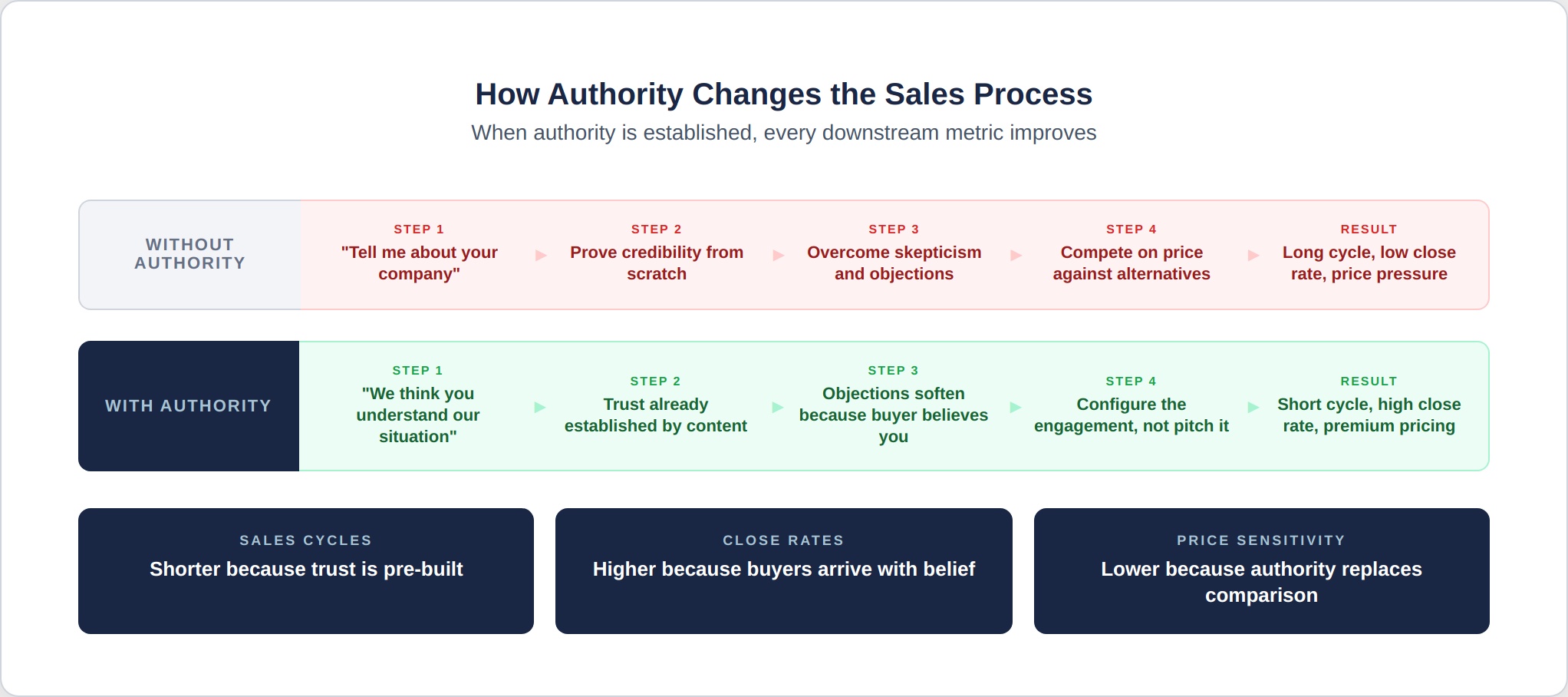
When you prove you have the authority, the sales process starts differently. Instead of “tell me about your company,” they open with “we’ve been reading your content and think you understand our situation.”
Instead of skepticism, the buyer arrives with curiosity. Instead of proving yourself, you are guiding a decision the buyer has already made that you are qualified to make.
That shift is worth more than a thousand page views from visitors who consume your content and forget about it the same day.
The Difference Between Explaining and Interpreting
Most content teams miss this crucial distinction between content that merely explains and content that truly interprets.
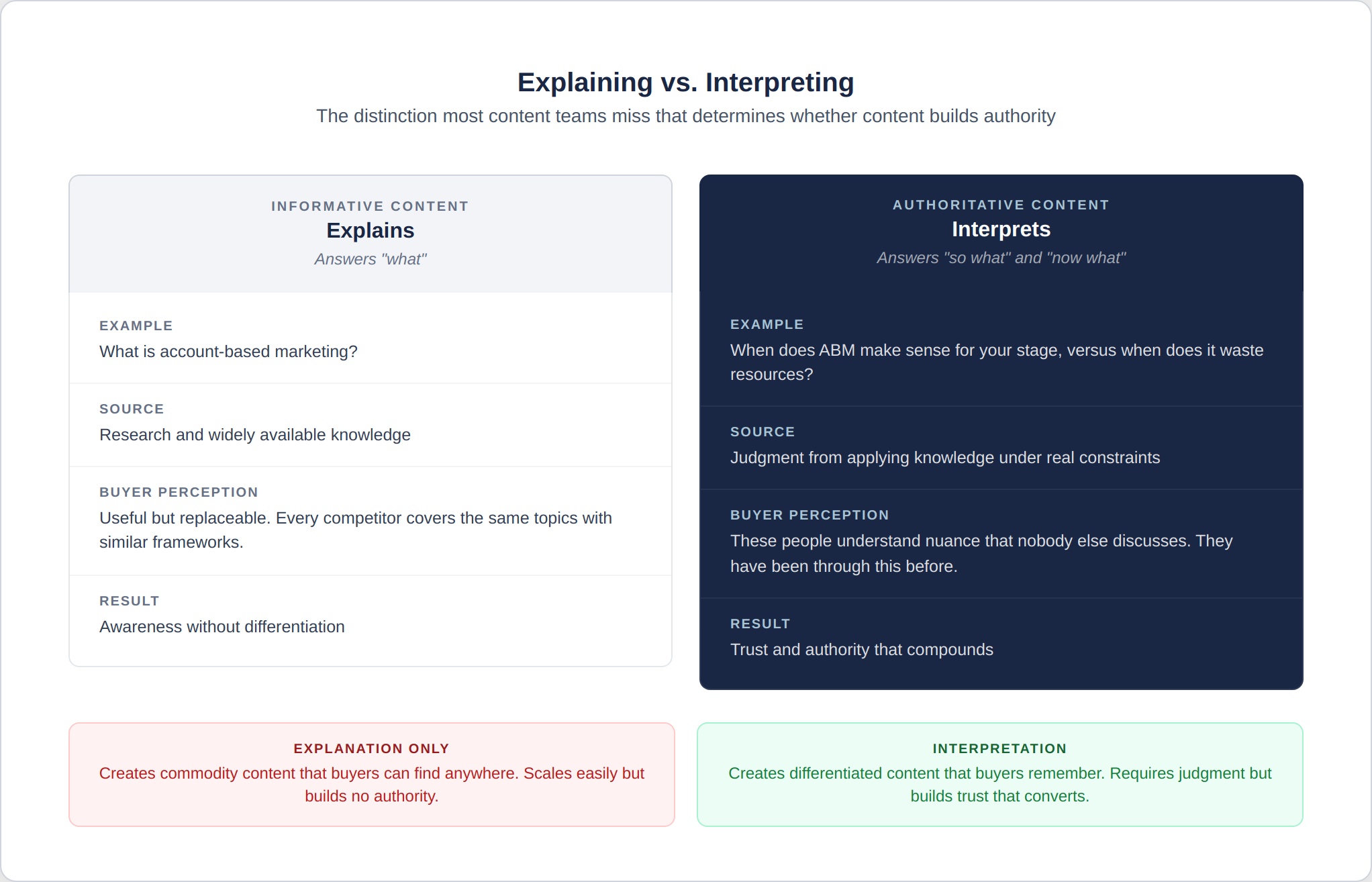
Informative content explains; it answers the ‘what.’ What is account-based marketing? What are the stages of a sales funnel? What tools exist for lead generation? This content is useful, but it is a commodity—everyone publishes it. Every competitor covers the same topics with similar frameworks.
Buyers can find this kind of explanation anywhere. When explanations provide information but do not offer interpretation or a decision-making process, they do not build authority.
However, authoritative content interprets, and it answers ‘so what’ and ‘now what.’
Interpretation guides buyers by providing context, application, and a unique perspective. For example, what does account-based marketing mean for companies at your specific stage? When does it make sense, versus when does it waste resources? What are the real tradeoffs that nobody discusses because the nuance is harder to write about than the basics? This interpretive layer is what sets authoritative content apart from merely informative content, making clear why buyers should act differently.
Interpretation requires judgment. Explanation only needs research. Companies default to explanation because it’s easier and scales better. But building authority means showing interpretive thinking. Defaulting to explanation doesn’t create true trust.
Point-of-View Content: The Foundation of Authority
Point-of-view content is the single most important content type for building authority. These pieces take a clear stance. They challenge common assumptions. They reframe how buyers think about a problem they thought they already understood.
Most companies fear point-of-view content. Wanting broad appeal, they hedge every conclusion: “It depends.” “Many valid approaches exist.” “Different strategies work for different situations.” All technically true, all useless for building authority.
Having strong point-of-view content says, “Here is what we have seen work and here is what we have seen fail.” Or, “Most companies get this wrong because they focus on the visible problem rather than the structural one underneath.” Or, “The conventional wisdom on this topic misses the real issue, and here is why.”
That type of clarity and point of view builds authority. Leaders in an industry don’t fence-sit. They take clear positions so buyers can decide whether to align with them. That decision, whether or not to agree, is what builds real authority.
Diagnostic Content: Demonstrating Understanding Without Selling
Diagnostic content helps buyers assess their own situation: self-evaluation frameworks, readiness checklists, maturity models, and guides that help them determine which path fits their circumstances.
This content shows understanding, not just opinion. It proves you see what buyers can’t yet see about their situation.
Like a doctor’s assessment, you’re not prescribing yet. You help buyers see where they are and what it means: “Based on these five factors, you’re at stage two. Here’s what usually happens now and what to prioritize.”
That insight offers immediate value. Buyers learn about themselves and realize you understand their situation in detail. Trust forms before any pitch.
Here’s the good part: diagnostic content creates a qualified lead pipeline more effectively than sales-focused content.
Case Studies That Teach Rather Than Brag
Most case studies say the same thing: revenue rose, leads increased, and the client was happy.
They’re useful but don’t build authority, since buyers can’t tell if what you accomplished would apply to their situation. They state what happened without explaining why or when the method wouldn’t work.
Authoritative case studies show initial errors, turning points, steps to result, why they mattered, and when the approach wouldn’t work. The buyer learns a mental model to apply. Even if they don’t hire you, they think differently and remember you.
Decision Guides: Helping Buyers Choose Even When It Is Not You
You need to provide prospects with decision guides to guide their buying process. This will help buyers weigh their options, understand trade-offs, assess risks, and understand timing and product fit.
Why help buyers choose competitors or possibly delay a project? Because honesty builds trust.
Creating the right content matters. Content that clarifies answers like “when to hire you versus build in-house” or “when this approach fits and when to wait” shows that you really care about the buyer’s successful outcomes.
Buyers see this: “They’re not just selling—they want to help me decide.” This builds authority beyond promotion. The Rarest and Most Credible Type
Authority also increases when you share failures:
- What didn’t work?
- What are some mistaken assumptions and lessons learned by experience?
- Publish failure content. That rarity is precisely what makes it credible.
Everyone shares success stories. The company is willing to share what went wrong, what they assumed incorrectly, and what they learned, which sets them apart as genuinely experienced rather than just skilled at marketing.
In my experience, some of the highest-performing authority content I have seen is pieces titled “What We Got Wrong About X” or “Why Our First Approach Failed and What We Changed.”
Why Educational Content Alone Falls Short
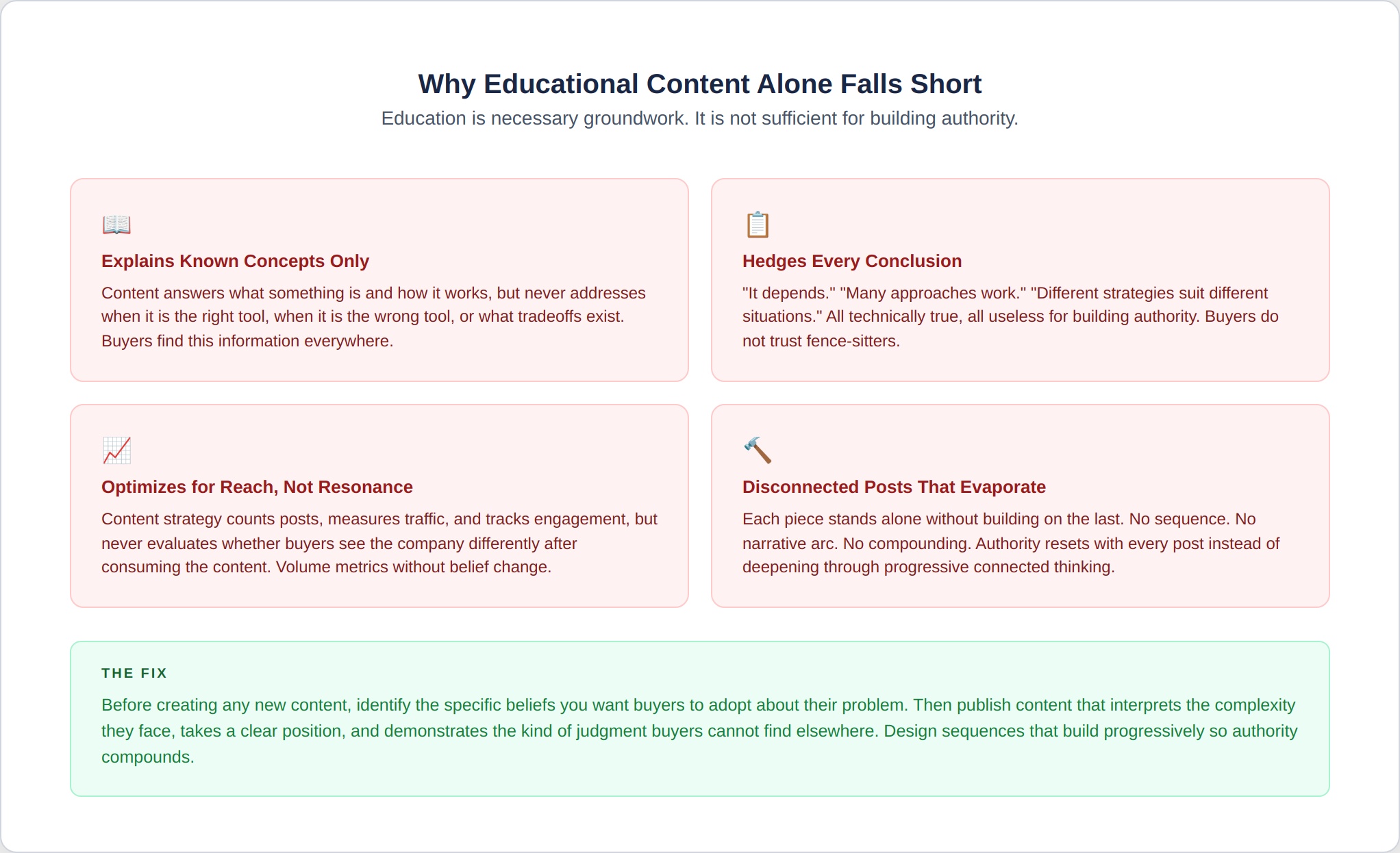
Education is the necessary groundwork. It is not sufficient for building authority.
Educational content explains known concepts. Authority content applies those concepts under pressure, with real constraints and consequences. The internet has every educational explanation a buyer needs. It lacks the judgment gained from applying knowledge in complex situations.
The companies with real authority don’t just explain the inner workings of landing pages. They take the time to explain when landing pages are the right tool or the wrong tool, why certain approaches fail in one context but succeed in another, and what they would do differently based on hard-won experience.
Why Sequence Builds Authority That Individual Posts Cannot
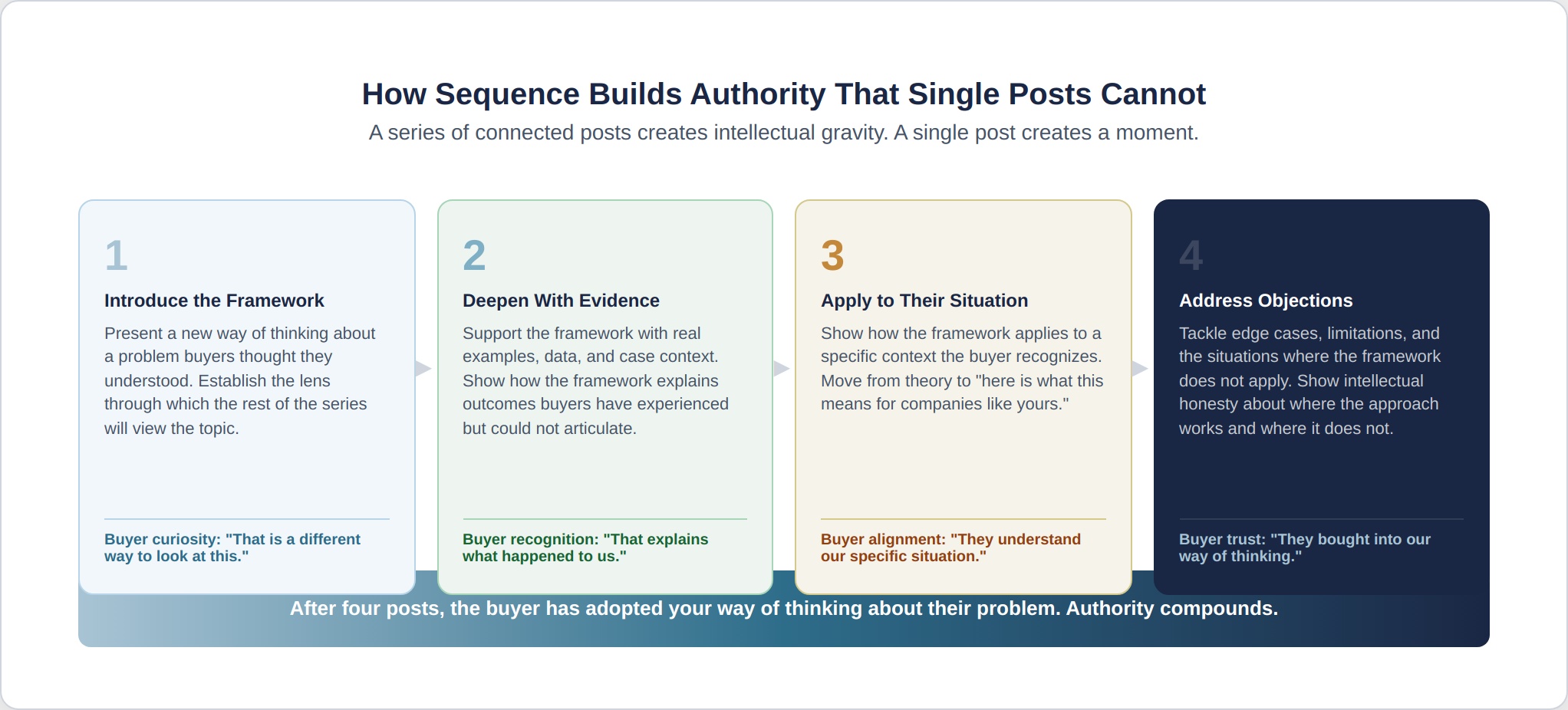
Authority compounds through narrative sequence. A single insightful post creates a moment of credibility. A series of connected posts that build on each other progressively creates intellectual gravity.
Part one introduces a framework.
Part two deepens it with evidence.
Part three applies it to a specific situation.
Part four addresses the objections and edge cases.
After all of this, a buyer will have bought into your way of thinking about their problem.
That deepening of content is how authority is built.
Format Matters Far Less Than Thinking
Blogs, videos, podcasts, and newsletters can all build authority. None of them do so by default.
The format does not create authority. The thinking inside the format does. A mediocre idea delivered through professional video is still mediocre. A powerful insight delivered through a simple blog post can change how a buyer approaches their most important decision.
Pick the format you can execute consistently and with quality. Then spend time making the ideas inside that format valuable. Do this consistently, and authority around that subject will be associated with your company.
How Authority Changes Everything Downstream
When authority is established, every other aspect of the sales process improves. Sales calls start further in the sales cycle because buyers arrive with trust already built. Objections soften because buyers believe you know and fully understand the situation they are in. And price sensitivity decreases because the buyer perceives your service as comparable to a commodity service.
Authority pre-sells confidence. Sales stops being about convincing and becomes about configuring. The buyer already believes you understand the problem. They already trust your approach. They just need to work out the details.
That creates a shift in their minds that shortens sales cycles, increases close rates, and makes the entire revenue process more efficient.
The Bottom Line
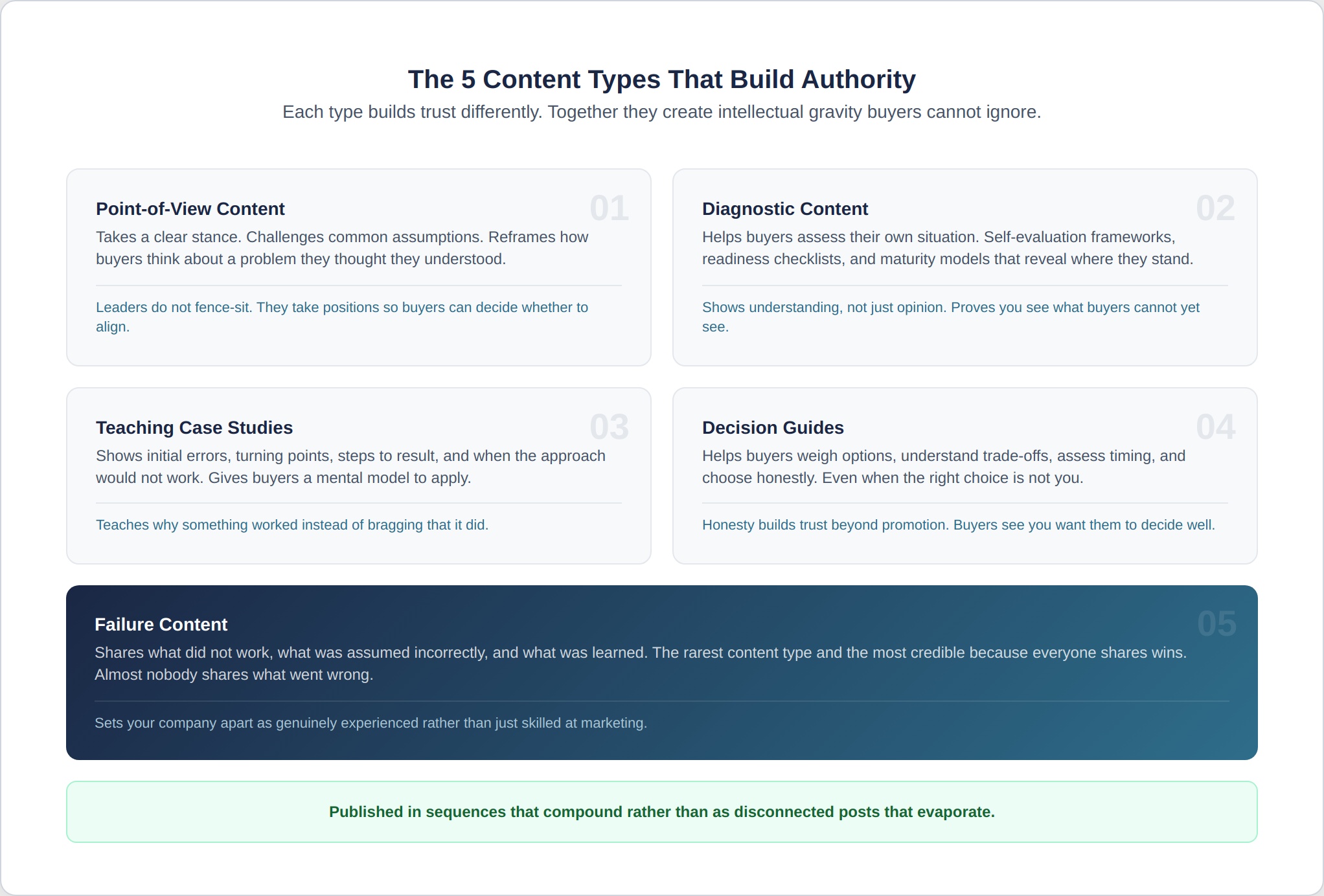
The best content types for building authority focus on learning from judgment calls. Point-of-view content that takes clear positions and explains why things work better that way. Diagnostic content that demonstrates a full understanding of how to move forward. Case studies that show why they were successful, rather than bragging about accomplishing a task. Decision guides that help buyers choose honestly. Failure content that proves real experience. All are published in sequences that compound rather than as disconnected posts that evaporate.
The companies that build genuine authority don’t ask how often to post. They ask how to help buyers think more clearly than anyone else in their market. That question, answered consistently over time, builds the kind of trust that transforms content from a publishing habit into a competitive advantage.
What to Do Before You Create More Educational Content
Before publishing, pause and step back and ask yourself these questions:
- Are we helping them see their problem differently?
- Does our content demonstrate judgment and experience?
- If a buyer consumed our content consistently for a month, would they trust our thinking more than before?
Authority is not built through volume. Growth slows when content avoids taking a position because the team is afraid of alienating part of the audience.
Most content strategies optimize for the wrong outcome. What they do is look at the wrong metrics. They count posts, measure traffic, and track engagement. They never evaluate whether buyers see the company differently after consuming the content. Traffic metrics tell you how many people found your content. They tell you nothing about whether that content changed how those people think.
Better approach: before creating any new content, identify the specific beliefs you want buyers to adopt about their problem. Then publish content that interprets the complexity they see, that takes a clear position, and that demonstrates the kind of judgment buyers cannot find elsewhere. Design sequences that build on each other progressively so authority compounds rather than resets with every post.
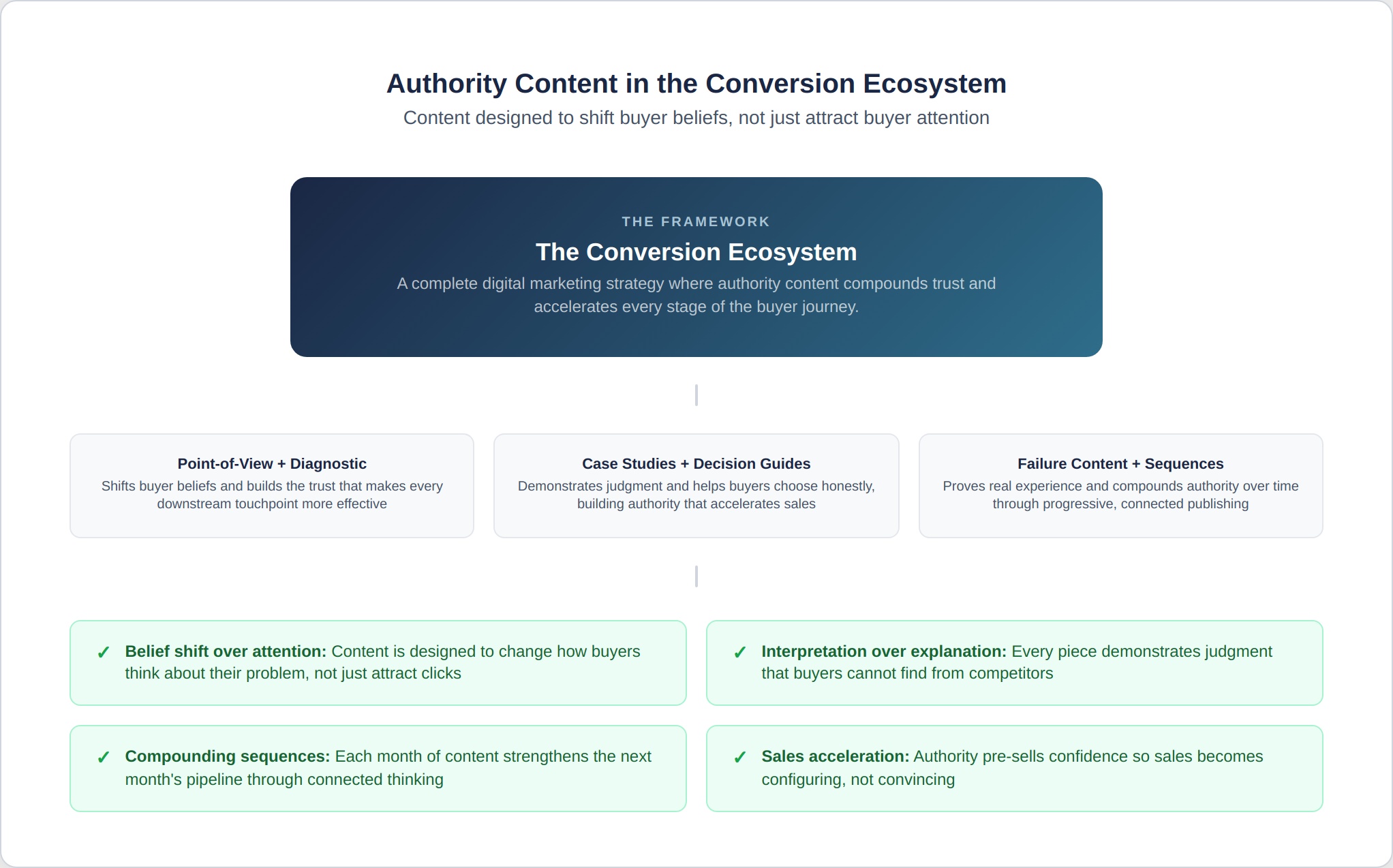
This is why authority-building content is central to what we call a conversion ecosystem. A complete digital marketing strategy designed to turn traffic into customers predictably and repeatedly. Where content is designed to shift buyer beliefs, not just attract buyer attention. Where point-of-view, diagnostic, and decision-guide content work together to build the trust that makes every other marketing and sales activity more effective. Authority compounds over time, so each month of content strengthens the next month’s pipeline.
If you want help figuring out whether your content is building authority, redesigning your content strategy, or building a conversion ecosystem that drives trust and accelerates every stage of the buyer’s journey, reach out. We can help you turn content into a credibility engine instead of a publishing habit that produces traffic without trust.

