
What Agencies Won’t Tell You About Marketing Retainers

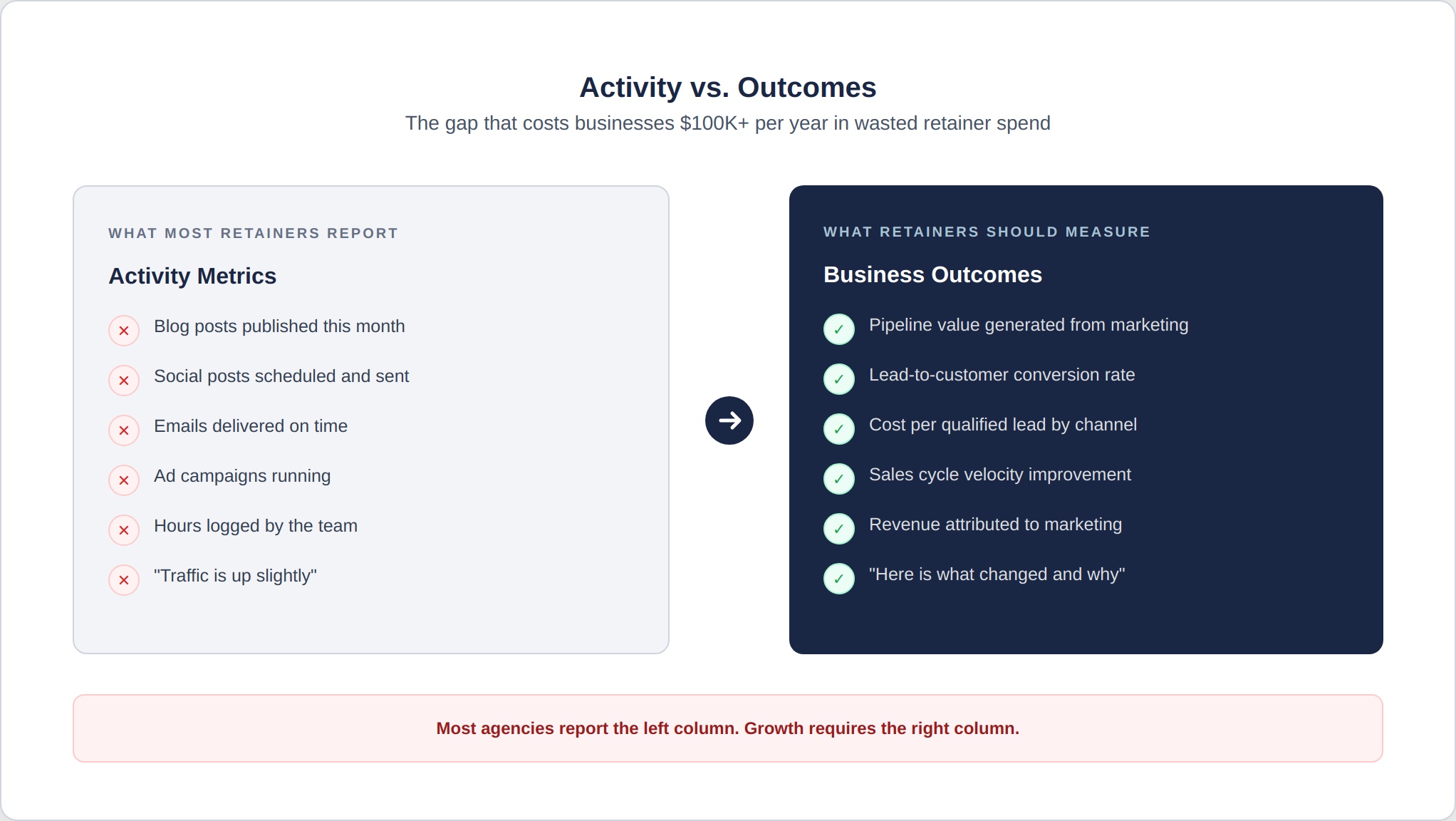
I started working with a company that had previously paid another marketing agency $9,500 per month for the last year. The firm would send reports every Friday listing which blog posts were published, which emails were sent, which social posts were scheduled, and which ongoing ad campaigns were active. From the outside, marketing activity appeared steady, the agency was responsive, and everything was professionally done.
Then, before the quarterly board meeting, the CFO asked the marketing manager to explain the return on investment. After checking the agency’s reports, the team realized that they could describe their tasks but not their impact.
All they saw was that their web traffic was up slightly, some new leads came in, but overall revenue was flat.
Over $100,000 was spent, and the only statement they could come up with was “there was more traffic, so that should give us more sales.” When they asked the agency what was going on, the agency highlighted completed deliverables and showed logged hours. When you told your board, they asked why you paid for the activity instead of the outcomes.
That gap between activity and outcomes is the real issue. The core question is not the agency’s talent or the price. It’s whether the retainer model produces true business growth, or simply spends your budget with busywork.
Most companies view it as a two-variable problem: price and vendor. You can either seek a cheaper agency, a more talented team, or negotiate harder on deliverables.
The vendor is rarely the main issue. Retainers succeed or fail based on structure, accountability for business outcomes, and clear expectations. Without these, retainers drain momentum. Designed right, they drive growth more effectively than projects ever can.
Let’s look at where marketing retainers perform well, where they struggle, and how you can decide if a retainer fits your business right now. But first, there’s a dynamic in many retainer relationships that often goes unspoken, so keep reading.
What Retainers Are Actually Designed to Do
Marketing retainers exist to maintain continuity in the services provided. It is there to provide ongoing execution, iteration, and optimization of marketing, rather than a one-time delivery that loses its effectiveness over time . The model assumes that marketing growth is a process, not a project.
Strong retainers maintain momentum, so marketing doesn’t pause with each new engagement. Retainers allow businesses to iterate based on data, not a fixed scope, enabling them to adapt to market shifts because they stay close to your business. They cut context-switching costs because a team that knows your buyers, voice, and limits is more efficient than a new team.
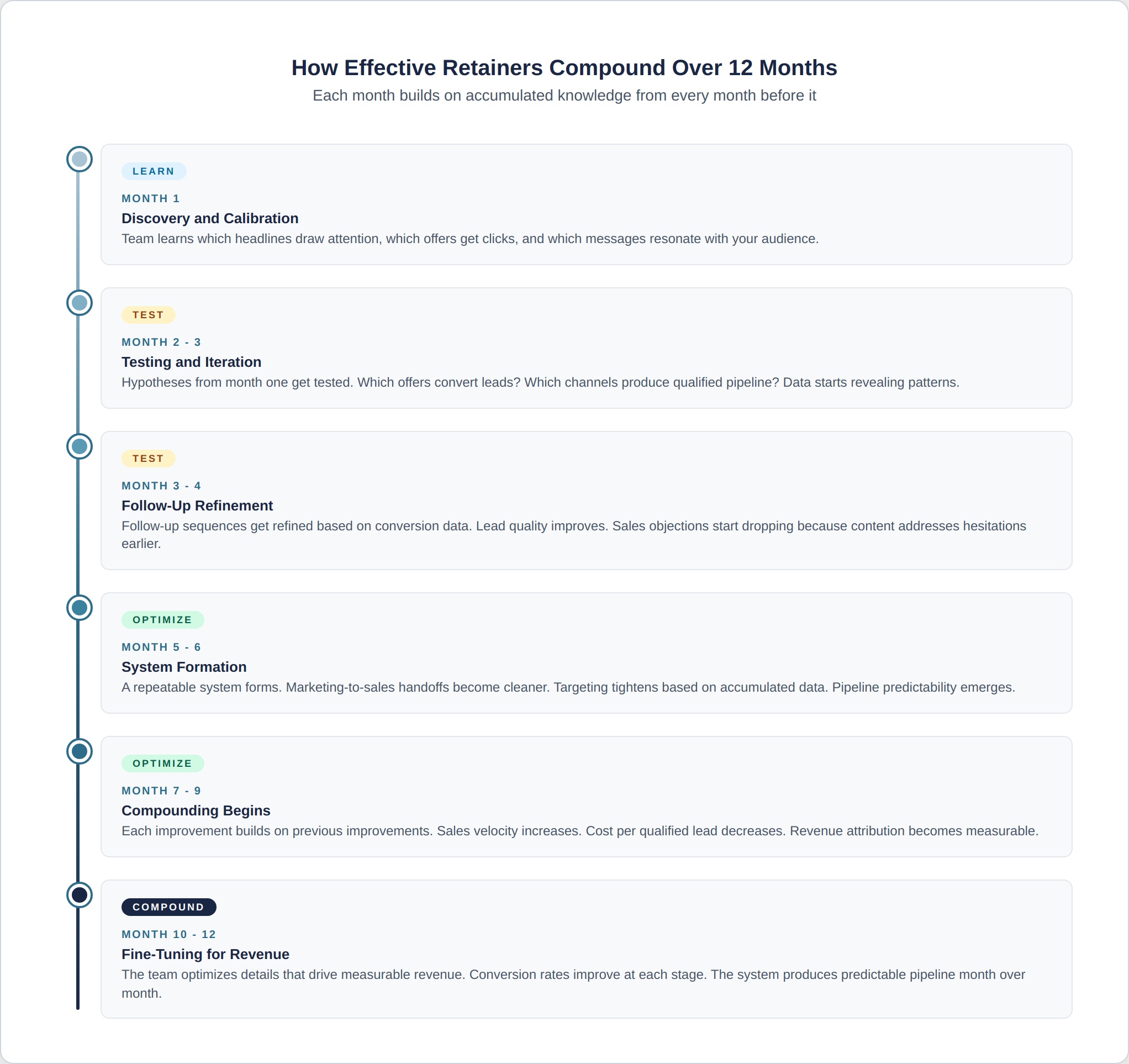
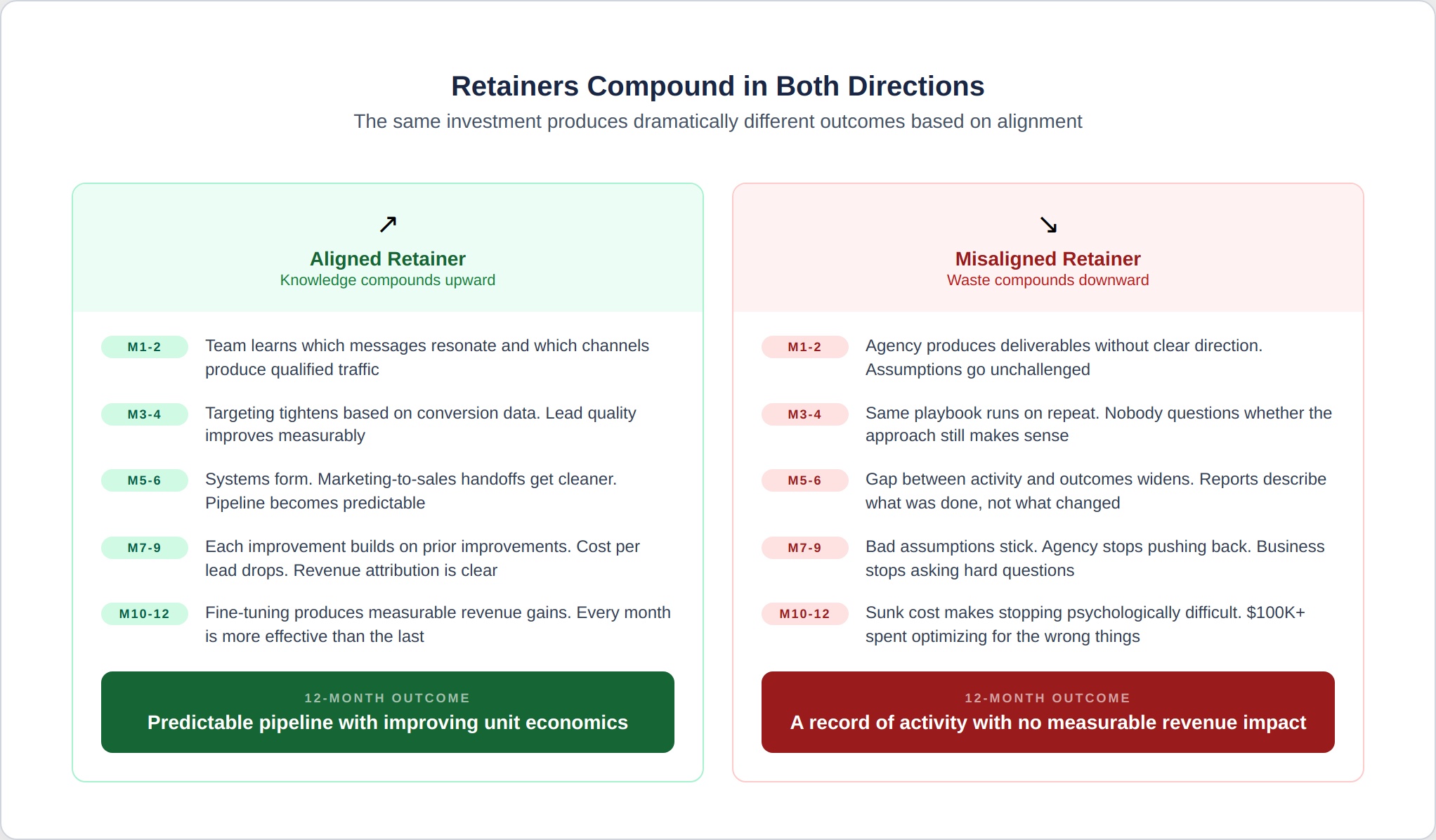
When this works, in month one, the team learns which headlines draw attention. In month two, they test which offers convert leads. In month three, they refine follow-up to drive sales. By month six, a system forms. By month twelve, they optimize details that drive measurable revenue.
Compounding knowledge is the true value of a retainer—not deliverables or hours. Each month becomes more effective than the last.
Why Most Retainers Never Reach That Potential
In my experience, most retainers get stuck in execution mode and never build the strategic knowledge required to create compounding returns.
The engagement begins clearly, with the agency reliably delivering its monthly package: blog posts, emails, social content, and ad management. Reports go out on schedule; everyone stays busy.
But without outcome-based goals, the retainer becomes just another activity. Agencies report on what’s done, not what’s changed.
If key metrics are not defined, nobody tracks whether the marketing is driving results that matter.
Over time, the business shifts from asking what is changing to asking what is included. This shift from outcomes to deliverables is where retainer value dies—by then, the budget is gone, and all that’s left is a record of activity.
The Ownership Problem Nobody Addresses
Most dissatisfaction with retainers stems from unclear responsibility.
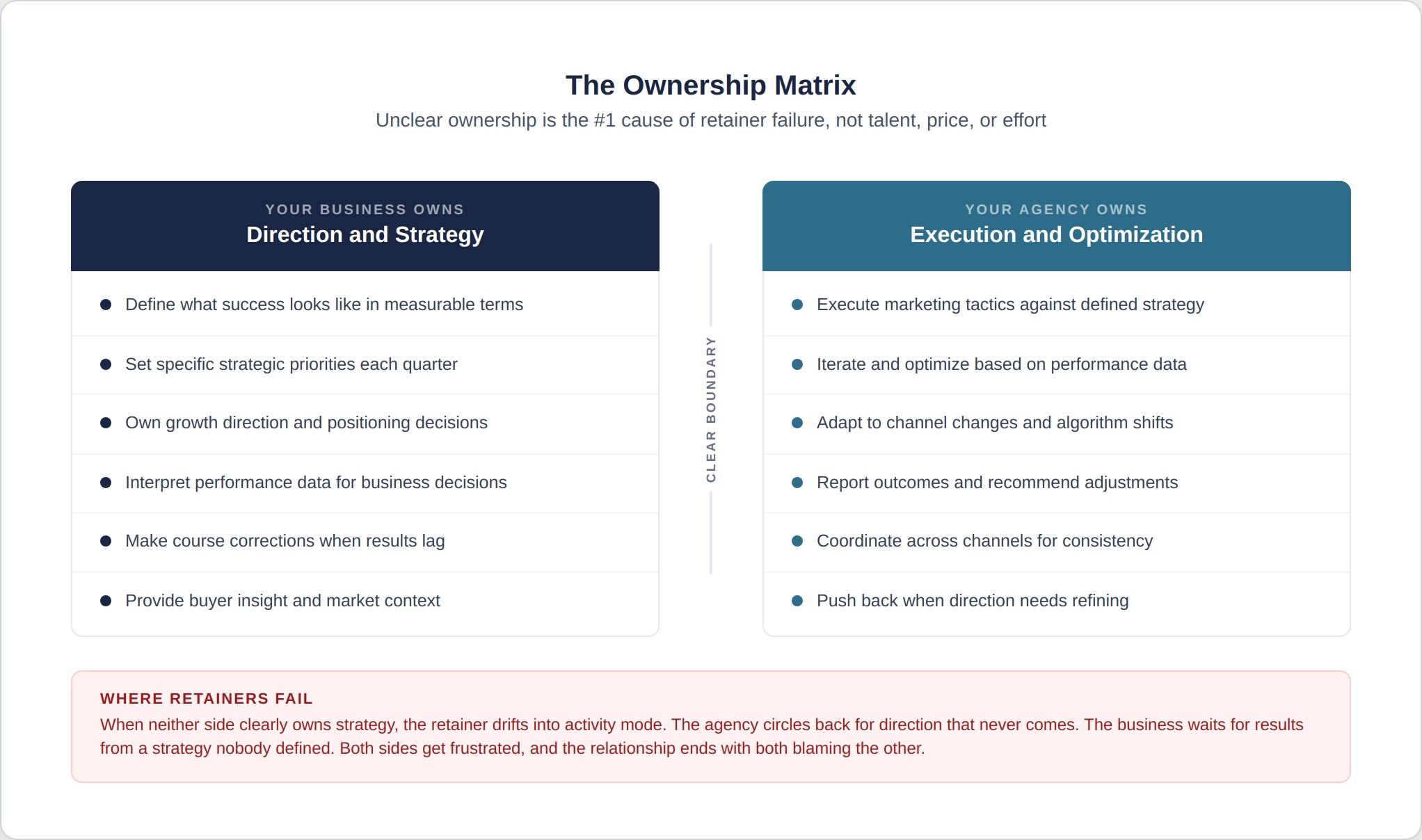
Who owns growth direction, performance interpretation, strategic priorities, and course correction when results lag?
When the retainer only owns execution, the business must explicitly own clarity around goals, priorities, and success metrics. Someone internal needs to provide direction, define what success looks like, set specific priorities, and make the key strategic decisions for the agency to execute against.
Many businesses hire agencies because they lack the internal strategic capacity to handle their marketing. They expect the marketing firm to set the strategy and get the necessary direction from the business. But in many cases, neither happens. The marketing firm circles back, both sides get frustrated, and the relationship ends with both blaming the other.
After working with teams across industries, I have found that the single most common cause of retainer failure is unclear ownership: specifically, who ultimately decides what the work should accomplish. A lack of clearly assigned roles—not talent, price, or effort—undermines retainer success.
Why Comparing Retainers to Projects Misses the Point
The problem lies in how companies evaluate retainer agreements. Many companies evaluate retainer value by comparing it to project-based work. “For the same money, we could have gotten three landing pages, a new website section, and an ad campaign.”
That misses the retainer’s purpose. Projects deliver assets, such as websites, campaigns, or content. You define the scope, the team builds it, and the engagement ends. This works for clear, discrete outputs.
Retainers improve your marketing system by boosting conversion rates, sales cycles, lead quality, and handoffs. These gains require ongoing effort and learning. Outcomes, not deliverables, are the purpose of a retainer.
When companies force retainers into a project model that measures value by counting deliverables, both sides end up frustrated. The agency focuses on producing tangible outputs to justify the invoice. The business accumulates assets without improving the system that feeds them.
Why Your Growth Stage Determines Whether a Retainer Makes Sense
Early-stage companies struggle with retainers because neither their foundational nor their strategy is stable. Because priorities change quickly and their ihe ICP is still being validated, there are constant shifts in messaging based on what the market teaches you each month.
Looking at a retainer from this stage makes optimization feel slow and expensive.
Early-stage companies need to experiment and learn from their findings. This needs to be done as quickly as possible.
Later-stage companies gain from retainers because systems exist, patterns are known, and iteration matters more than reinvention. Consistent work over six months yields insights that disconnected projects can’t match.
From my experience, the companies frustrated with retainers adopted a framework before their strategy was stable. They needed experimentation; the retainer was built to optimize. Frustration felt like a vendor problem, but it was a timing issue.
The Foundation Problem No Retainer Can Fix
Retainers don’t solve belief gaps.
Buyers must believe in your message, your credibility, and a clear journey before any tactic succeeds. These beliefs are shaped by positioning, messaging, and every touchpoint.
If those foundational elements are weak, a retainer amplifies the weakness. More content with unclear positioning. More ads with generic messaging. More follow-up on leads that were never properly qualified.
No amount of execution fixes a broken message. The retainer becomes an expensive mechanism for doing the wrong thing more consistently. That is where companies waste the most retainer budget, paying for the efficient execution of a strategy that was never sound.
When Busy Feels Like Progress but Nothing Changes
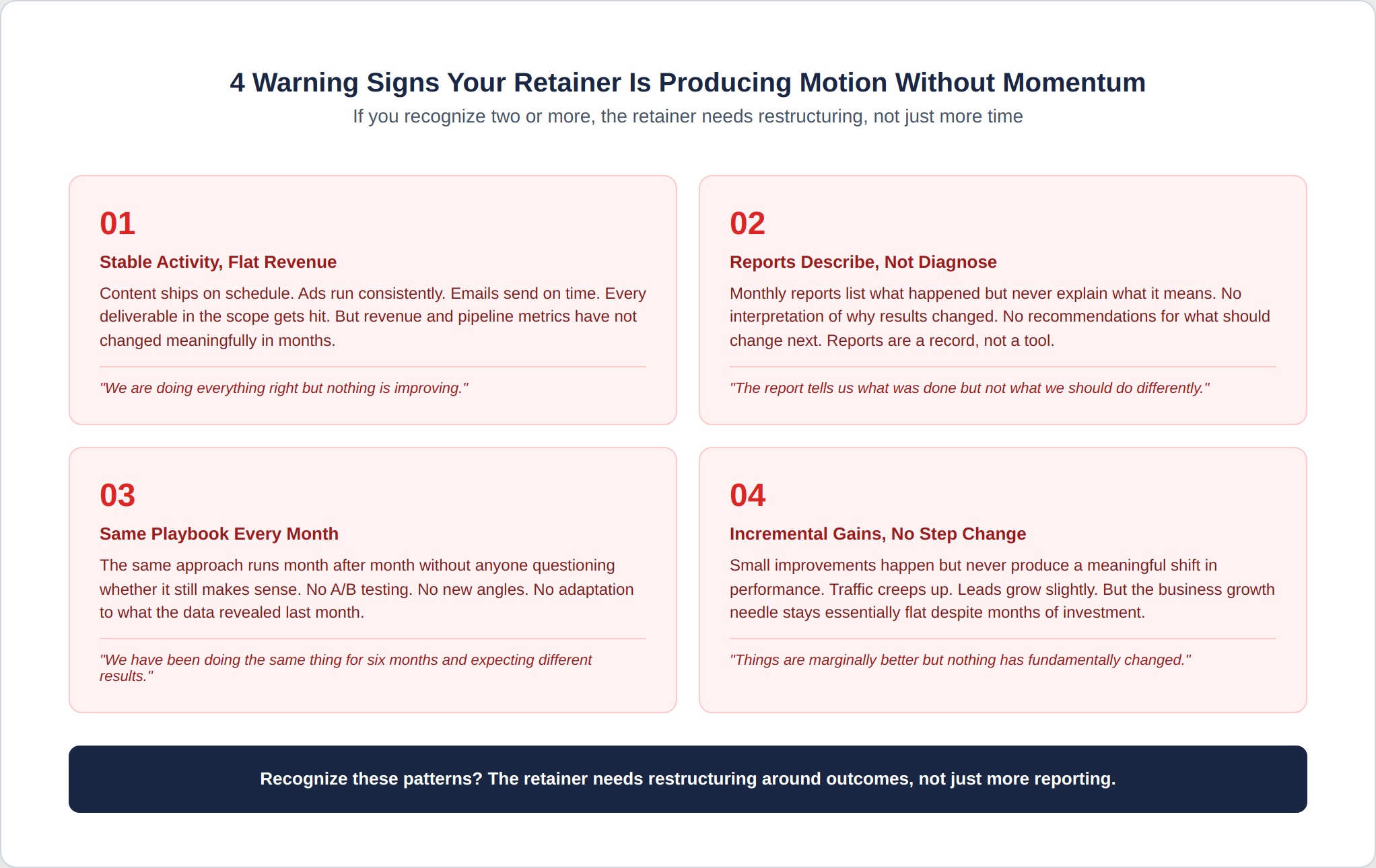
Retainers often look productive. Content ships on schedule. Ads run consistently. Emails are sent on time. The agency is hitting every deliverable in the scope.
Warning signs that the retainer is producing motion without momentum include stable activity metrics paired with flat revenue results. Incremental gains that never produce a step-change in performance. Reports that describe what happened rather than what it means and what should change. The same playbook is running month after month without anyone questioning whether it is still the right approach.
Now here comes the good part. Understanding the difference between retainers that compound and retainers that cost.
The Invisible Work That Actually Drives Value
In the first few months, retainers feel underwhelming because most improvements are invisible. But effective retainers always start off this way.
After a few months, sales conversations improve as marketing refines the messaging that shapes buyer expectations. Objections drop because the content is addressing common hesitations earlier in the journey. Lead quality increases because the team is tightening targeting based on what they learned from the previous month’s conversion data. Handoffs between marketing and sales become cleaner because the retainer team understands both sides well enough to reduce friction.
These improvements rarely show up in monthly deliverable reports. They show up in sales velocity, close rates, and pipeline quality. If nobody is measuring those downstream metrics, the retainer’s best work goes unnoticed and unvalued.
How Bad Retainers Compound in the Wrong Direction
Retainers can have a compounding effect, either good or bad.
When a retainer is designed to align, knowledge accumulates, systems improve, and each month improves compared to the last. When marketing is misaligned, waste compounds, assumptions go unchallenged, and the lessons learned the previous month go to waste.
The problem with bad retainers is that their effectiveness negatively compounds. And this degrades effectiveness slowly and is almost unnoticeable.
During this time, the gap between activity and outcomes widens. Bad assumptions stick because nobody questions whether the original approach still makes sense. The agency stops pushing back because the business stopped asking hard questions.
And during this time, the retainer becomes an expense nobody values.
The longer a misaligned retainer runs, the harder it is to unwind. By the end of month 12, you have spent over a hundred thousand dollars building a system that optimizes for the wrong things. The sunk cost makes it psychologically difficult to stop, even when the evidence is clear.
Why More Reporting Doesn’t Fix the Problem
When leaders feel uncertain about the value of a retainer, the common response is to focus on accountability. More reports. More KPIs. More meetings. More dashboards.
Accountability doesn’t fix misalignment. If priorities are unclear, tracking them more precisely just measures confusion at a higher resolution. You can’t hold someone accountable for goals that weren’t clearly defined. More reporting creates more noise. More meetings consume more time. The fundamental problem, which is that nobody agreed on what success looks like, remains untouched underneath all the additional tracking.
Fix the goals first. Define what should improve month over month. Then accountability becomes meaningful because everyone is measuring the same thing against the same standard.
The One Question That Exposes Whether Your Retainer Is Working
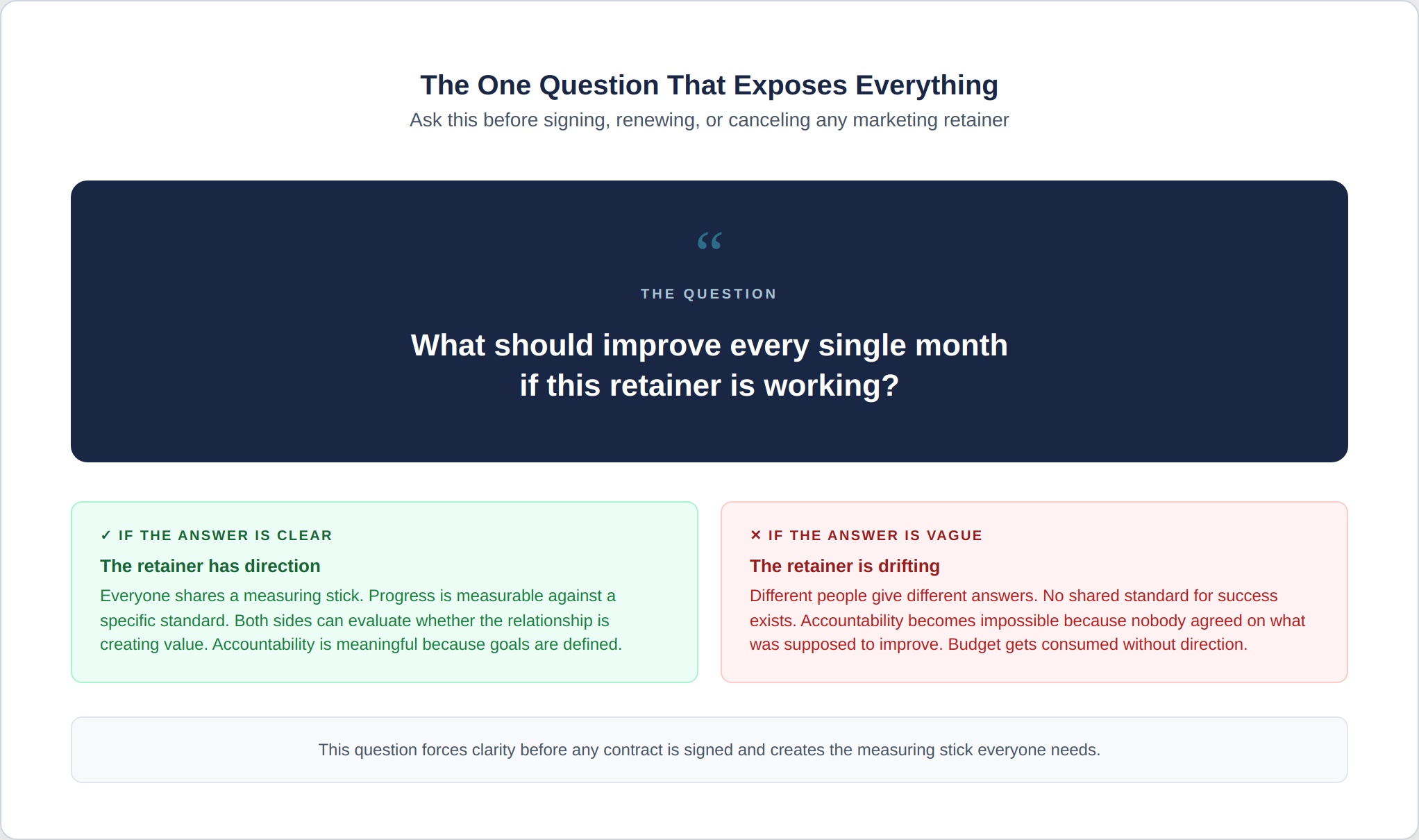
The real question is not whether retainers are worth the money. The question is this: “What should improve every single month if this retainer is working?”
If the answer is clear and specific, the retainer has direction. If the answer is vague or different depending on who you ask, the retainer is drifting.
That one question forces everyone to be clear about the expectations before any contract is signed.
It creates a measuring stick that everyone understands. It makes the retainer accountable to outcomes rather than deliverables. And it gives both sides a shared standard for evaluating whether the relationship is creating value or consuming budget.
Why 2026 Makes This Decision More Consequential
There are lots of changes that affect how companies approach retainers. Such things as:
• How fast potential clients buy.
• The constant shifts in marketing channels.
• Algorithms that continuously evolve.
• Competition increases across every platform.
• What worked last quarter might not work this quarter.
This environment increases the potential value of retainers because the need for ongoing adaptation is higher than ever. A retainer built to learn and adapt creates more value in a changing market than a series of disconnected projects that each start from scratch.
Unfortunately, most retainers are still structured around static deliverables, a fixed scope, fixed outputs, and a fixed approach.
This fails because marketing requires constant adaptation.
The retainers worth paying for in 2026 are the ones designed around learning speed, not output volume.
How Companies That Win Use Retainers Differently
Strong companies use retainers to optimize systems, interpret performance data, adjust messaging based on what the market teaches them, and coordinate across channels. They do not use retainers to replace leadership decisions, avoid strategic work, or outsource the thinking that only someone inside the business can do.
High-growth companies provide clear direction. They make strategic decisions. They own outcomes. The retainer executes brilliantly against that direction, and the combination of internal clarity plus external execution capacity produces results that neither side could achieve alone.
The retainer supports direction. It does not create it. That boundary, when maintained, is what makes the model worth the investment.
The Bottom Line
Marketing retainers are absolutely worth the money. But only when used for what they are designed to do.
Retainers create continuity. They compound learning. They build accumulated knowledge that makes every month more effective. They fail when asked to substitute for clarity, strategy, or ownership that must come from inside the business.
The companies that grow don’t ask whether retainers are cheap enough. They ask whether something meaningful improves every single month and design the entire engagement around that answer.
What to Do Before You Commit to or Cancel a Marketing Retainer
Before renewing a retainer out of habit or cutting it out of frustration, pause and step back from the emotional reaction.
Ask yourself these questions. What should be measurably improving month over month if this retainer is doing its job? Who owns direction and strategic decisions, and who owns execution? Are we paying for activities and deliverables, or for learning and system improvement?
Marketing retainers are not inherently good or bad. Growth slows when retainers are expected to replace the clarity, strategy, and leadership decisions that must come from inside the business.
Most companies make retainer decisions at the worst possible moment, when frustration is highest, and clarity is lowest. They cancelled a previous retainer that needed restructuring rather than replacing.
What is worse is that many companies renew a retainer for continuity rather than conviction.
Both responses avoid the real issue: whether the engagement is structured to produce compounding value.
Want a better approach? Before making any decision, define the three outcomes that would make the retainer unquestionably worthwhile over the next six months.
Now share those outcomes with your current or new agency and ask them to propose how they would structure the engagement to deliver those outcomes. If the agency can articulate a clear path and the business can provide clear direction, the retainer has a foundation. If either side is vague, that vagueness is the problem to solve before committing more budget.
Before investing more in your marketing, take some time to see what you need to do to start restructuring your retainer around outcomes rather than deliverables.
Make sure you define who owns strategy and who owns execution. Build a monthly review rhythm that evaluates what changed, not what was completed. Create a shared measurement framework that connects retainer work to pipeline and revenue rather than just activity.
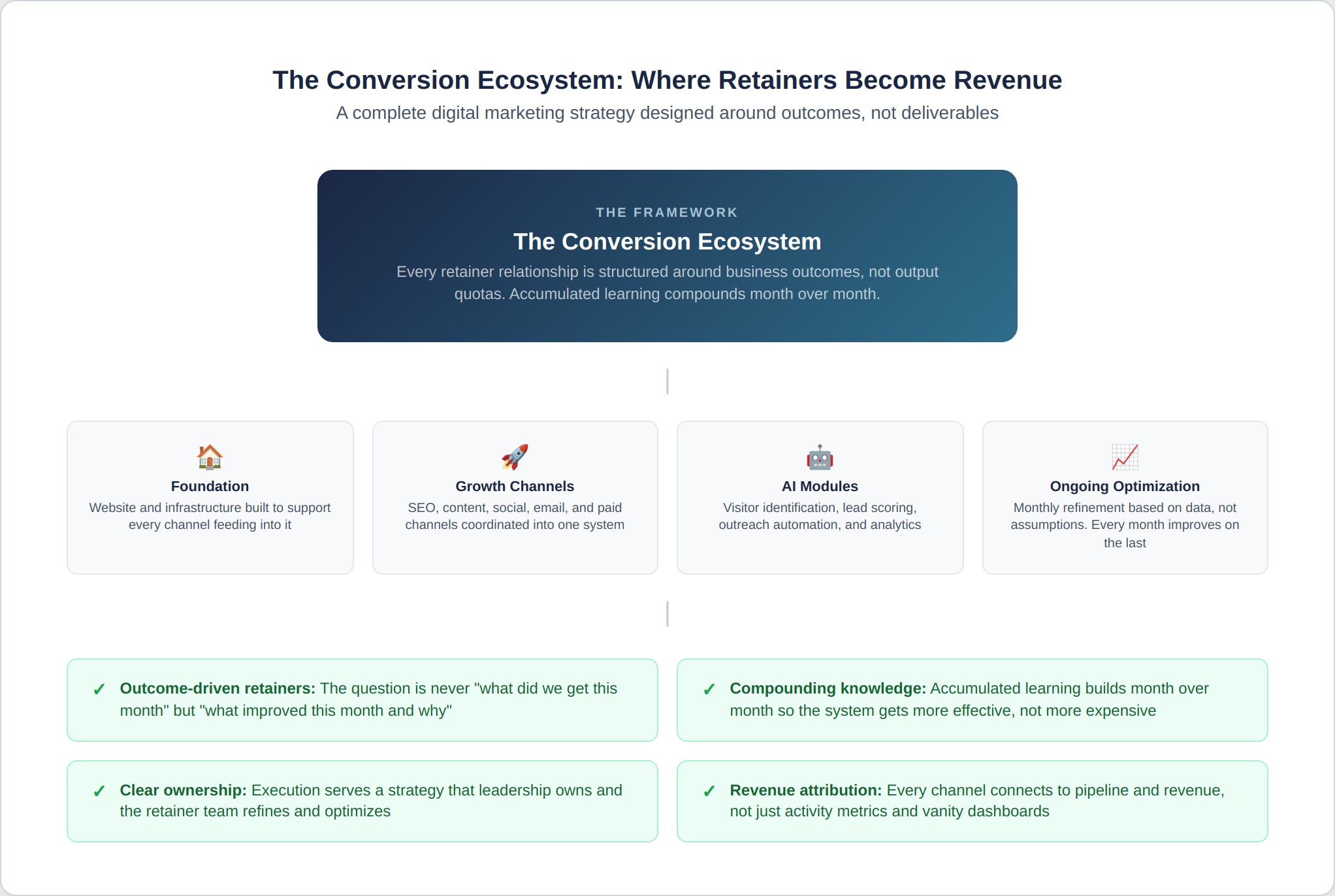
This is why the structure of ongoing marketing investment is central to what we call a conversion ecosystem. A complete digital marketing strategy designed to turn traffic into customers predictably and repeatedly.
The right strategy happens when:
• The retainer relationships are built around business outcomes rather than output quotas.
• Accumulated learning compounds month over month, so the system gets more effective with time rather than more expensive.
• Execution serves a strategy that leadership owns, and the retainer team refines.
• The question is never “what did we get this month,” but “what improved this month and why.”
If you want help evaluating whether your current retainer is helping or not, if restructuring the engagement around the outcomes that actually drive revenue, or building a conversion ecosystem where ongoing investment produces ongoing improvement instead of ongoing activity, reach out. We can help you turn retainer spend into retainer leverage so every month builds on the last instead of repeating it.

