
Landing Pages vs Websites: Which One Actually Converts?

Imagine spending $14,000 on Google Ads over the last month, driving 2,300 visitors to a landing page designed over a weekend.
And the driving force behind the landing page approval was a clean look, a bold headline, modern typography, and a form above the fold. But the conversion rate was only 1.6%—just 37 leads from $14,000 in ad spend. Your CFO pointed out, “That’s $378 per lead before sales. We’re spending more to acquire a lead than some companies spend to close a deal. What exactly is this page doing?”
This actually happened for one of my clients.
That question about the landing page isn’t after a design critique. It comes from the realization that traffic without conversion is just expensive proof that your ads work and your landing page doesn’t. The ads did their job. They got people to click. The page didn’t do its job. It was supposed to turn that attention into action.
Most companies frame the landing page cost as a design-and-development question. How much does it cost to build a page? What does the template look like? How fast can we get it live?
Those are production questions. The real question is a decision-engineering question. A landing page exists to move a specific buyer past a specific hesitation toward a specific action. What it costs depends entirely on how much thinking goes into making that happen.
Let me explain what a conversion-focused landing page actually costs in 2026, why the range is so wide, and what you are really paying for when it is done right. But there is a math problem hiding inside most companies’ ad budgets that makes this conversation far more urgent than it appears, so read on.
What “Conversion-Focused” Actually Means
Before we start talking about price, there is a distinction most companies miss entirely.
A conversion-focused landing page is not a shortened version of a website page. It is not a design template with swapped headlines. It is not a portfolio-style layout. It is not a page built to look impressive.
Those are presentation pages. They exist to showcase your brand. A conversion-focused landing page is engineered to create a decision. Its job is to move one specific buyer to take one specific action with as little friction as possible.
That means what you designed and built was based on a defined buyer and their specific problem. One primary offer or next step. Psychological sequencing that moves the reader from recognition to confidence. Objection handling is woven into the copy. Trust reinforcement is placed at moments when doubt naturally arises. Clear outcome framing so the buyer knows exactly what happens after they act.
From my experience, most companies confuse presentation pages with conversion pages. They want the page to educate, impress, and convert all at once. That is three jobs. The page fails at all three because it is trying to do too much. Conversion-focused pages do one thing. They make it easy for the right person to say yes.
Why Landing Pages Cost More Than They Used To
Previously, landing pages were dirt cheap because expectations for what they needed to do were low. A few years ago, you could assemble a page, add a form, and conversions would trickle in from sheer novelty.
Those days are gone. In 2026, buyers are more skeptical. Now, they are diligent and compare options with multiple tabs open. Trust must be built in seconds, and something as simple as a confusing sentence can distract a visitor enough for them to choose a competitor.
Effective landing pages now require more strategic thinking, more deliberate structure, and tighter alignment with the ads, emails, or content that sent the buyer there. You are no longer paying for a page. You are paying for decision design.
The shift happened because buyers have evolved. They have seen thousands of landing pages. They have been misled by exaggerated offers. They have filled out forms and regretted it. They have developed defences. Your landing page has to overcome those defences, and overcoming learned skepticism requires strategic work, not just clean design.
The Three Investment Levels
Here is what the cost to invest in a landing page is in 2026.
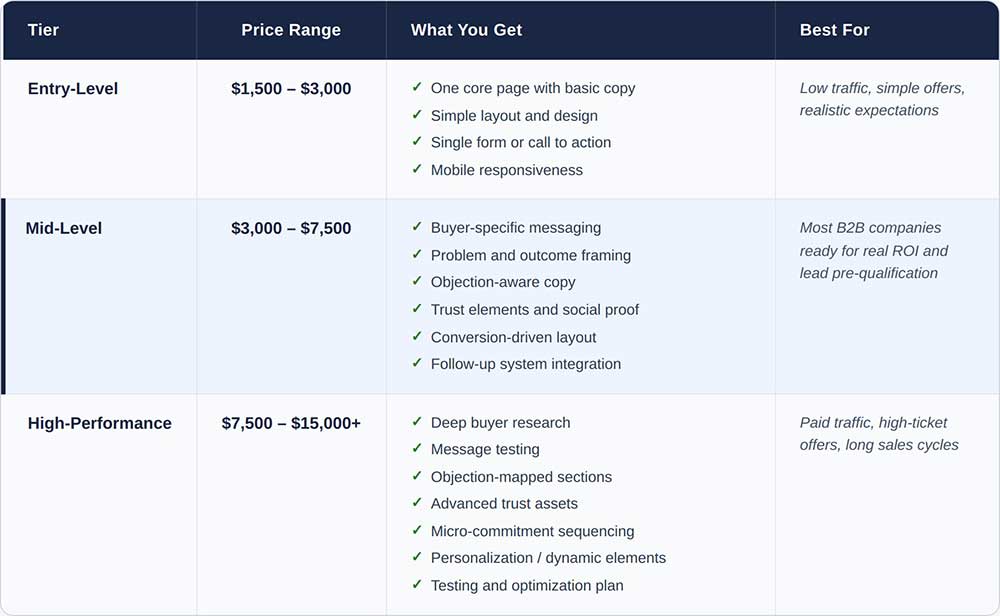
Entry-level landing pages cost between $1,500 and $3,000. This minimum viable version delivers one core page, basic copy, a simple form, and mobile responsiveness, but it usually lacks deep buyer research, objection handling, personalization, and conversion testing.
Landing pages in this range work with low-traffic pages that offer a simple product or service, and have modest expectations. But it breaks down when traffic increases, due to the assumptions it makes.
Then there are mid-level landing pages that cost between $3,000 and $7,500. At this price point, you can expect more buyer-focused messaging, clearer product or service framing, objection-awareness copy, trust elements, a strong mobile experience, and integration with follow-up systems. For most B2B teams, this investment pre-qualifies leads and generates real ROI.
Finally, there are high-performance pages that cost between $7,500 and $15,000 or more. They include deep buyer research, message testing, objective-driven sections, advanced trust assets, micro-commitment sequencing, personalization, and built-in optimization. These serve paid traffic, high-ticket offers, or long sales cycles, treating conversion as a system before and after a visitor converts.
Now here comes the good part. Understanding where the money actually goes.
Where Your Money Actually Goes
One of the biggest misconceptions about landing page cost is that you are paying for design. This is false.
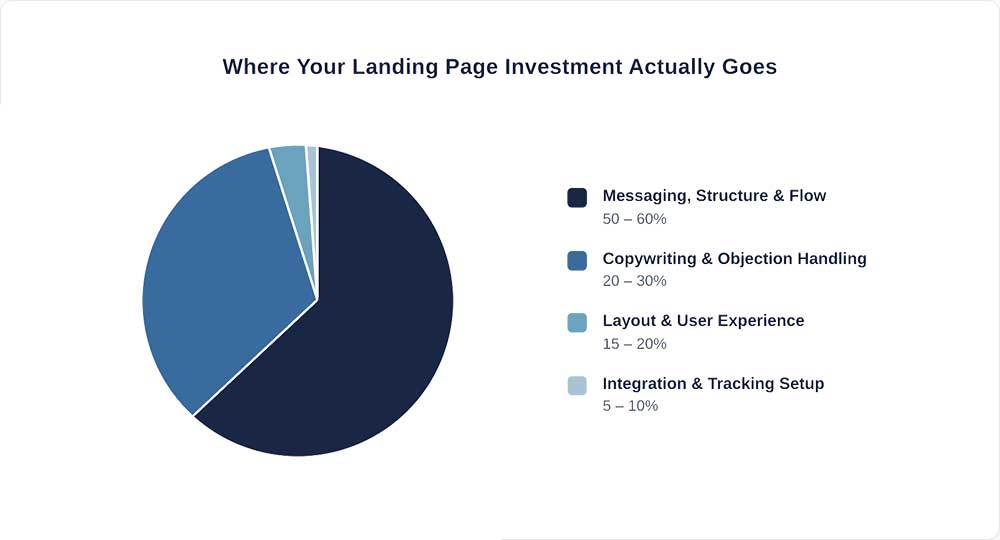
Most value is in thinking and structure—not design. Typically, 50-60% of the cost is for messaging, structure, and flow; 20-30% for copywriting and objection handling; 15-20% for layout and user experience; and 5-10% for integration and tracking.
A beautiful page with weak messaging will never convert.
A simple page with a strong strategy consistently succeeds, regardless of the industry or the size of the deal. Strategic work like buyer research, objection mapping, and sequencing may be invisible to visitors but drives visible results.
What Different Situations Actually Cost
Pricing becomes concrete when you look at specific use cases.
When running paid ads, you typically need a landing page with a mid-range budget.
These types of pages need clarity, strong trust cues, and tight alignment with the ad messaging that brought the visitor. Poor conversion here directly inflates the cost of every dollar of ad spend. Without hesitation, this is where companies waste the most money because the bleeding is continuous and often invisible.
A high-ticket service booking page often moves toward the high-performance range. Buyers committing tens of thousands of dollars need reassurance, proof, and a clear understanding of what happens after they book. Every doubt must be addressed. Every objection anticipated.
A webinar or demo registration page sits somewhere in between. The offer is lower risk, but credibility and positioning still matter because the buyer is trading their time and contact information for something they have to believe will be worthwhile.
A lead magnet entry page can be lower cost if the offer is simple. Costs rise when segmentation, personalization, or multi-step follow-up is involved.
The principle that connects all of these is straightforward. The more risk a buyer feels, the more work the page has to do. And more work means more strategic investment.
The Ad Spend Math That Changes This Entire Conversation
Here is where most companies lose money without realizing it. They spend thousands per month on ads but hesitate to invest properly in the page those ads point to.
That math does not work.
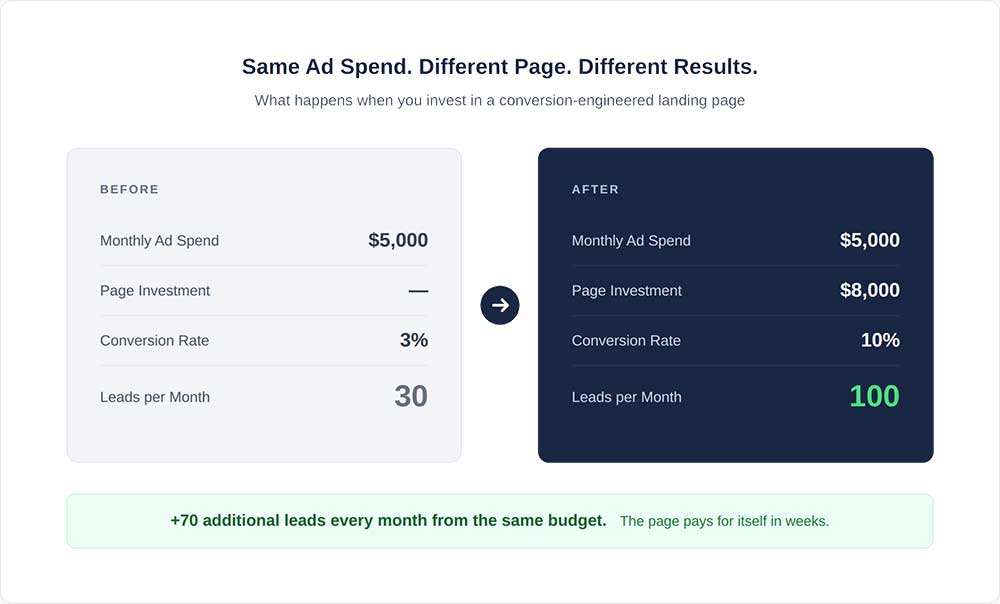
Think about it this way. You spend $5,000 a month on ads. Your page converts at three percent. You get thirty leads. Now imagine investing eight thousand dollars in a properly built page that converts at ten percent. Same ad spend. Same traffic. One hundred leads instead of thirty. That is seventy additional leads every month from the same budget. The page pays for itself in weeks.
If the page doesn’t convert, ads just accelerate loss. Every unconverted click is money spent to prove that your traffic works and your page doesn’t.
A well-designed landing page is intended to lower the cost per lead (CPL), improve lead quality, and shorten the overall sales cycle. It makes every upstream channel more efficient.
Your landing page is either multiplying your ad spend or bleeding it dry. There is rarely a middle ground.
Why Cheap Pages Cost More in the Long Run
Cheap pages usually fail because the problem isn’t framed clearly, the outcome feels vague, objections are ignored, trust is assumed rather than earned, and the next step feels risky to the buyer.
The page technically functions as needed: Traffic lands, the form loads, but buyers hesitate. When that happens, teams blame the traffic source or the lead quality. The real issue is conversion design.
When you do some simple math, a $3,000 page that converts 2% of the traffic to leads will cost more than a $10,000 page that converts at 8% of the traffic to leads when you factor in the lost revenue over the long haul. The cheaper page generates fewer leads at a higher cost per acquisition. The math is clear. Cheap doesn’t mean affordable. It means shortcuts. Shortcuts in research, in messaging, in understanding the buyer. Those shortcuts show up as poor conversion rates, and poor conversion rates are expensive regardless of what you paid for the page.
Why Launch Day Is Not Finish Day
A conversion-focused landing page is not finished when it goes live. The first version is just a hypothesis, not your best result.
There are different things you can test. This includes:
* headline variations
* offer framing
* call-to-action wording
* trust element placement
* form friction
Each test cycle produces data that strengthens the next version. Over time, the insights compound.
This matters most when traffic volume is meaningful. In lower-traffic situations, clarity and structure matter more than experimentation. But as volume scales, the difference between a page that converts at 6% and one that converts at 9% represents thousands of dollars in value every month.
Companies that treat landing pages as one-time projects leave enormous value on the table. The best pages improve continuously because the team behind them treats conversion as an ongoing discipline, not a launch event.
How Long Good Work Takes
Creating a conversion-focused landing page takes time. Entry-level landing pages take between one and three weeks. Mid-level landing pages take two to six weeks. High-performance takes four to eight weeks.
The timeline includes research, strategy, copywriting, design, development, and revision. Each phase matters. Skip the research, and the page is built on guesses. Rush copywriting, and the message falls flat. Skimp on revision, and small issues become real problems when you start to scale.
Red Flags That a Page Is Failing
Warning signs include generic headlines that could apply to any company in your space, feature-heavy copy that focuses on what you do rather than what the buyer gets, weak or misplaced trust elements, multiple competing calls to action that confuse rather than guide, and no clear next step.
Bad pages focus on features rather than outcomes. They bury the call to action. They assume trust instead of building it. They try to speak to everyone and resonate with no one. Good pages do the opposite. They focus on outcomes, make the next step obvious, earn trust systematically, and speak to a specific person with a specific problem.
When Higher Investment Makes Sense
Higher landing page costs make sense when you are running paid traffic, and every percentage point of conversion directly affects your cost per lead. When deal sizes are large enough that one additional closed deal pays for the page multiple times over.
When sales cycles are long, the page needs to build enough confidence to keep the buyer interested during weeks of evaluation. Remember, lead quality matters more than volume, and the page needs to pre-qualify a lead before they capture the information.
In these cases, a cheap page is genuinely the most expensive option available.
When Lower Cost Is the Right Call
Lower-cost pages make sense when offers are simple and low-risk, traffic is limited, and the primary goal is testing whether an idea resonates before investing in a full build.
Test cheap and scale smart. Use a lower-cost page to validate the concept. Does the offer resonate? Do people convert? Once you have proof, invest in the high-performance version.
The Question That Actually Matters
The real question is not how much a landing page costs. The real question is how much it costs you every day that your current page doesn’t convert.
In 2026, landing pages are not design projects. They are decision mechanisms. Companies that treat them that way get leverage from every dollar of traffic they drive. Companies that don’t keep paying for visitors who arrive, scan, and leave without ever getting close to a decision.
The Bottom Line
Landing page cost is not about the page. It is about the outcome.
A $1,500 page that converts poorly costs more than a $10,000 page that converts well. The investment makes sense when you measure it against what you are already spending to drive traffic to the page that is supposed to convert.
The companies that win treat landing pages as strategic assets, not production tasks. They invest in thinking that makes conversion predictable, and they build pages that improve over time rather than hoping the first version works, because it never does.
What to Do Before You Pay for a Landing Page or Redesign What You Have
Before approving a quote, picking a builder, or starting a redesign, pause and step back from the page itself.
Ask yourself these questions:
* Do we know exactly who this page is for, specific enough to describe them in one sentence?
* Are we clear on the one decision we want the buyer to make after reading?
* Do we understand the specific reasons buyers hesitate before taking that step, and are those hesitations addressed on the page?
If you are debating landing page costs, the real issue usually is not price. There is uncertainty about what the page needs to accomplish and how it fits into the larger system.
Most companies make one of two mistakes.
Mistake #1 is going for the cheaper option and hoping for the best, rushing to publish a page built on basic assumptions rather than doing research and gathering data.
Mistake #2 is overspending on design without fixing the underlying messaging or decision flow. Both approaches create frustration and wasted traffic because neither one addresses the strategic foundation that makes any page convert.
Before talking with a design company, know the following:
1. Define who the page is for?
2. Clarify the single action you want a visitor to take.
3. Document the objections that prevent buyers from acting.
4. Design the follow-up that happens after conversion.
Evaluate quotes based on which vendor addresses those strategic elements, not which one offers the cheapest build.
And before investing time or budget, audit your current page:
* Where do visitors drop off?
* Which sections get ignored?
* What questions does sales keep hearing that the page should have answered?
* Fix the strategic gaps first, then invest in production quality at the level that matches your traffic volume and deal size.
Landing page performance is critical to our Conversion Ecosystem.
If you want to succeed online, you need a comprehensive digital marketing strategy that turns traffic into customers predictably and repeatedly. Where every landing page is engineered around specific buyer decisions, not templates. Conversion design reduces the cost per lead and simultaneously improves lead quality.
Landing pages integrated with a follow-up system are just the beginning of a structured path to revenue. Where testing and refinement compound over time, so every dollar of ad spend becomes more productive.
If you want help evaluating the level of landing page investment that makes sense for your business and traffic volume, diagnosing why your current page underperforms despite decent traffic, or building a conversion system where landing pages work as strategic assets rather than one-time projects, reach out. We can help you turn your landing page from a budget line item into a revenue multiplier that makes every upstream channel more effective.

