Stop Pretending Your Marketing System Is Scalable

Have you ever thought that “Every quarter feels like we’re inventing marketing from scratch. You run a campaign. It works for a few weeks. It fades. You scramble to figure out what to do next. Meanwhile, the pipeline is unpredictable. You can’t forecast with any confidence, and my team doesn’t know whether next month will be feast or famine. When does this stop being a scramble?”
You didn’t have a good answer. Because the truth is, your marketing has been producing results, just not in a predictable way. Q1 was strong because a webinar series generated a spike in leads. Q2 was flat because the team was heads-down on a website refresh with no campaigns running. Q3 recovered when a paid ads push drove traffic. Q4 slowed again when the budget tightened, and the ads paused. Each quarter depended on whatever tactic was running at the time. Nothing carried over. Nothing compounded. Every quarter starts from zero.
That pattern is what most companies experience, which leads to the next critical question: Why is the idea of a “scalable marketing system” so universally appealing? It promises growth without fragility. Expansion without chaos. Predictable pipeline without the constant scramble to produce it.
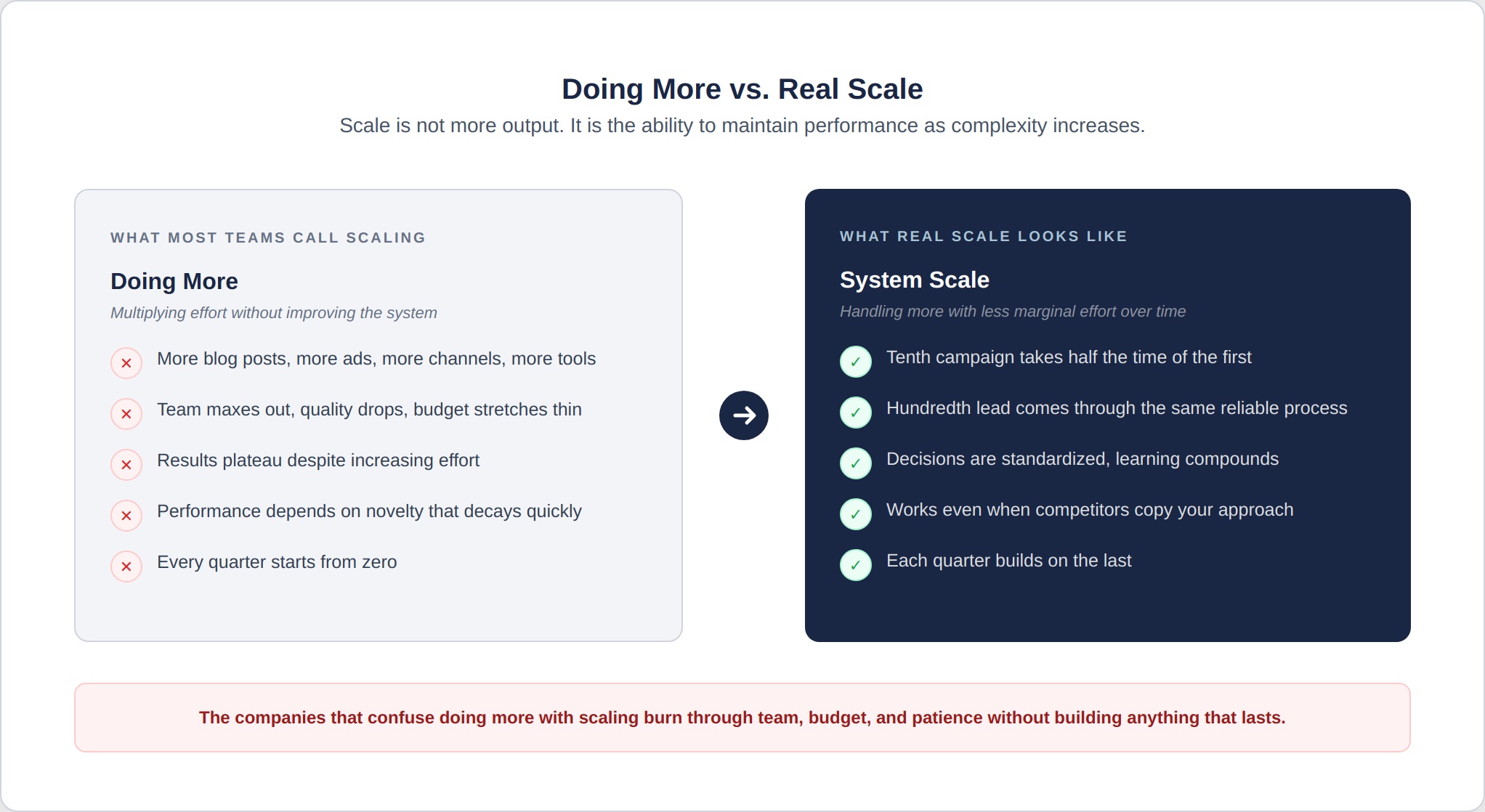
Most teams use that phrase loosely without understanding what it actually means in practice. They assume more output equals more scale. More content. More ads. More channels. More tools. Scale is not more. Scale is the ability to maintain or improve performance as complexity, volume, and pressure increase.
Let me show you what a scalable marketing system looks like in practice, how it behaves differently from the campaign-driven approach most companies use, and why most marketing setups fail the moment growth accelerates. But there is a structural weakness hiding inside most marketing operations that becomes visible only when growth demands more than the system can handle, so read on.
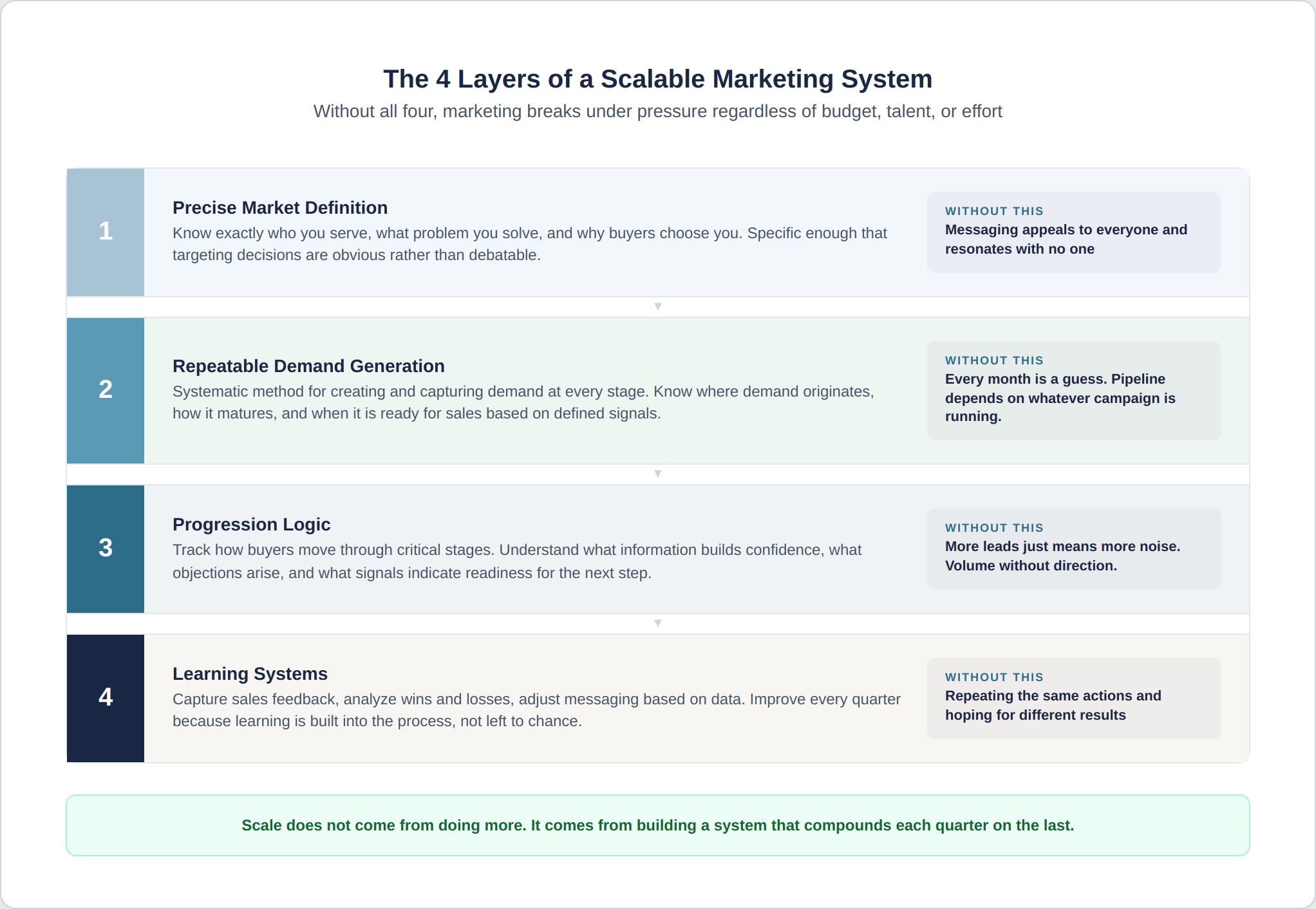
Here’s what a scalable marketing system actually requires:
* precise market definition
* repeatable demand generation
* progression logic that moves buyers forward
* learning systems that get smarter over time
Without all four, marketing breaks under pressure regardless of how much budget, talent, or effort you throw at it. Scale doesn’t come from doing more. It comes from building a system that compounds each quarter on the last rather than starting from zero.
With the need for true scalability established, let’s examine why marketing often breaks down under pressure.
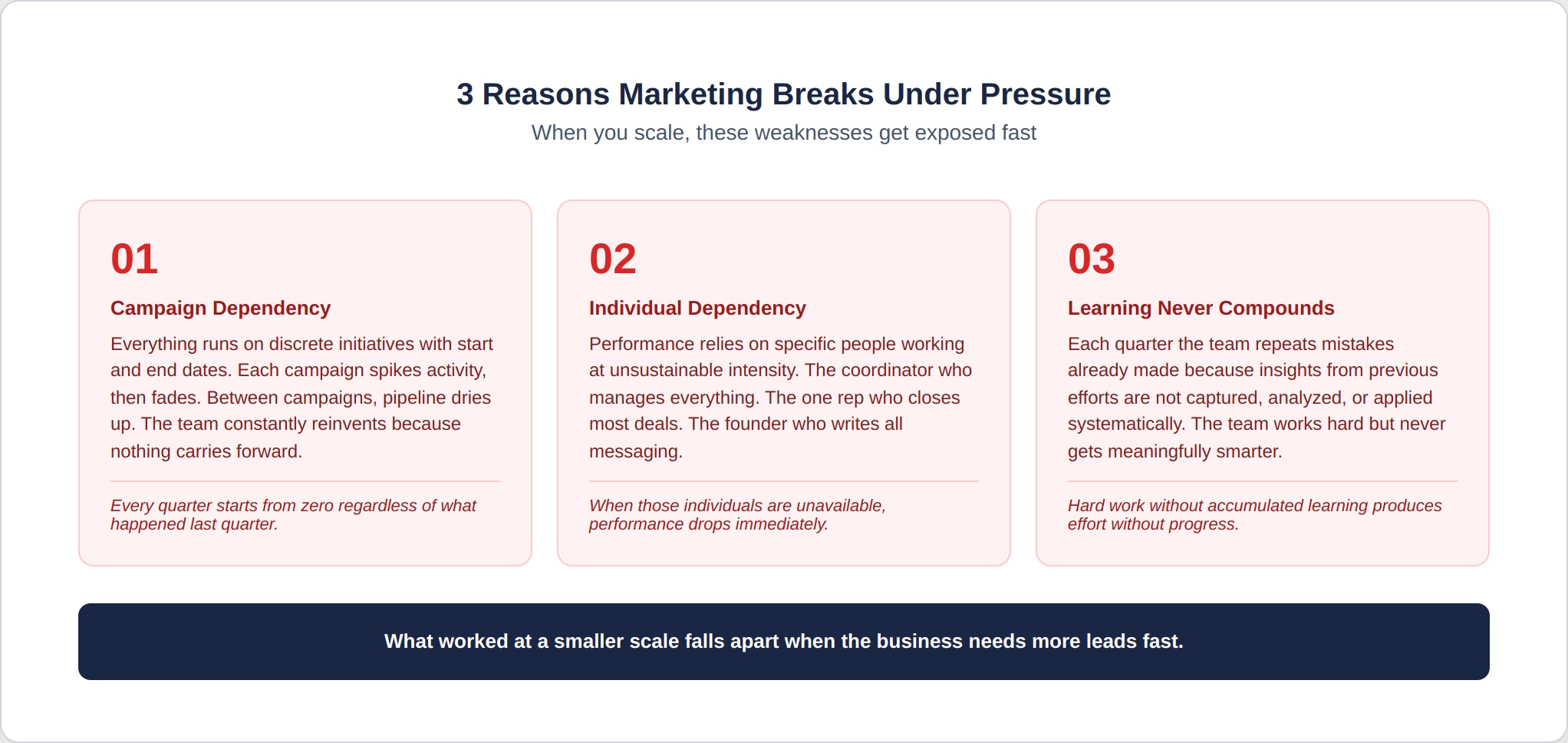
Why would a marketing campaign fail? There are three reasons:
Campaign dependency. Everything runs on discrete initiatives with start and end dates. Each campaign spikes activity, then fades. Between campaigns, the pipeline dries up. The team constantly reinvents because nothing carries forward.
Individual dependency. Performance relies on specific people working at unsustainable intensity. The marketing coordinator who manages everything. The one rep who closes most of the deals. The founder, who still writes all the messaging. When those individuals are unavailable, performance drops immediately.
Learning doesn’t compound. Each quarter, the team repeats mistakes it has already made because insights from previous efforts aren’t captured in tools like HubSpot, Google Analytics, or even a shared document. They aren’t analyzed or applied systematically. The team works hard but never gets meaningfully smarter.
When you scale, it exposes weaknesses fast.
What worked at a smaller scale falls apart when the business needs more leads fast.
More often than not, this is where growth starts feeling like chaos. Having reviewed common failure points, let’s clarify what true scale actually means in marketing.
Most teams think scaling means multiplying what works: more blog posts for more leads, running more campaigns, or adding platforms.
All of this isn’t scale; it’s just doing more.
And doing more eventually hits a wall. The team maxes out. Quality drops. Budget stretches thin. Results plateau despite increasing effort.
Real scale happens when you can handle more volume, more complexity, and more variety without increasing effort or cost.
A scalable system produces similar outcomes with less marginal effort over time:
* Your tenth campaign performs as well as your first, but takes half the time to execute because accumulated learning speeds up decision-making.
* Your hundredth lead comes through the same reliable process as your tenth.
* There is no need to reinvent the wheel every month.
* Decisions are standardized, inputs are controlled, learning compounds, and variation is deliberately reduced.
In my experience, the companies that confuse doing more with scaling are the ones that burn through their team, their budget, and their patience without ever building anything that lasts. Understanding the difference between scaling and simply doing more is important, because introducing new tactics often feels like scaling—even when it’s not.
New tactics feel like progress because they create a temporary lift. A new channel. A new content format. A new tool like Jasper or ChatGPT for content production. A new campaign angle. Each one produces a burst of results that appears to be growth.
But lift is not scale. If performance depends on novelty, it decays the moment the novelty wears off. The team has to find the next new thing. And the next one. And the next one. That cycle feels productive, but it is exhausting and fundamentally unscalable.
Scalable systems work even when nothing is new. They work when competitors copy your approach. They work when the market gets noisy. They work when buyers become more skeptical. That durability is the real test of scale.
To build scalability, you need to start at the foundation.
First, there is a precise market definition.
If you want to build a scalable system, you need to start by knowing exactly who they serve, what problem they solve for that specific audience, and why buyers choose them over competitors.
Without this clarity, everything downstream fragments:
* Messaging tries to appeal to everyone and resonates with no one.
* Channels underperform because targeting is broad.
* Sales loses confidence because the leads don’t match.
* Scale amplifies the confusion faster than any other force.
After working with teams across industries, this is where most scaling attempts fail before they begin. The company tries to scale marketing for “mid-market B2B companies” and wonders why nothing works consistently. The definition is too broad to produce consistent results at any volume.
Precise market definition means you can describe your ideal buyer in terms specific enough that targeting decisions in Google Ads, LinkedIn Ads, or any outbound platform are obvious rather than debatable. That specificity drives everything else in the system. With a defined market, the next step is to establish repeatable demand generation.
Repeatable demand generation isn’t just identifying one successful channel. It’s developing a systematic method for creating and capturing demand at every stage of the buyer’s journey, consistently across platforms and time.
Scalable systems know:
* Where demand originates
* How it matures through content consumption, retargeting, and nurture sequences in tools like ActiveCampaign or HubSpot
* When it is ready for sales based on defined signals rather than gut feeling
Random demand does not scale. Structured demand does. A repeatable demand engine means you understand the pattern well enough to predict it. You know that a specific type of content creates a specific level of awareness. You know the conversion rates at each stage. You can forecast the pipeline based on inputs rather than hoping for results.
That predictability is what makes scale possible. Without it, every month is a guess. Once demand generation is repeatable, the third layer involves progression logic that moves buyers forward.
Progression logic tracks how buyers move through critical stages—not just their general activities—by monitoring readiness, movement, and progress toward a decision.
They understand what buyers need at each stage:
* What information builds confidence
* What questions arise and when
* What objections appear and how to address them
* What signals indicate a buyer is ready for the next step
Now here comes the good part. When progression logic is designed deliberately, volume becomes an advantage rather than a burden. More leads entering a well-designed progression system means more leads advancing toward decisions. Without progression logic, more leads just means more noise.
Most companies measure engagement because it is easy. Website visits, email opens, and content downloads. Those numbers feel productive. But they don’t tell you whether anyone is actually moving toward a purchase decision. Progression logic closes that gap. Layer four completes the system: learning systems that get smarter over time.
This is where most marketing systems fail. They execute, but they don’t learn.
Scalable systems:
* Capture sales feedback about lead quality and buyer objections.
* Analyze wins and losses to understand what works.
* Adjust messaging and qualification based on data, not assumptions.
* Improve every quarter because learning is built into the process.
Time and again, the companies that hit a ceiling are the ones that stopped learning. They found something that worked, locked it in, and ran it without refinement. Performance plateaued because the market evolved, and the system didn’t.
Learning loops mean the system gets smarter. Each quarter is better than the last because accumulated knowledge makes every decision more informed. Without learning loops, you are repeating the same actions, hoping for different results. With all four layers in place, let’s confront a common pitfall: Why do linear funnels break at scale?
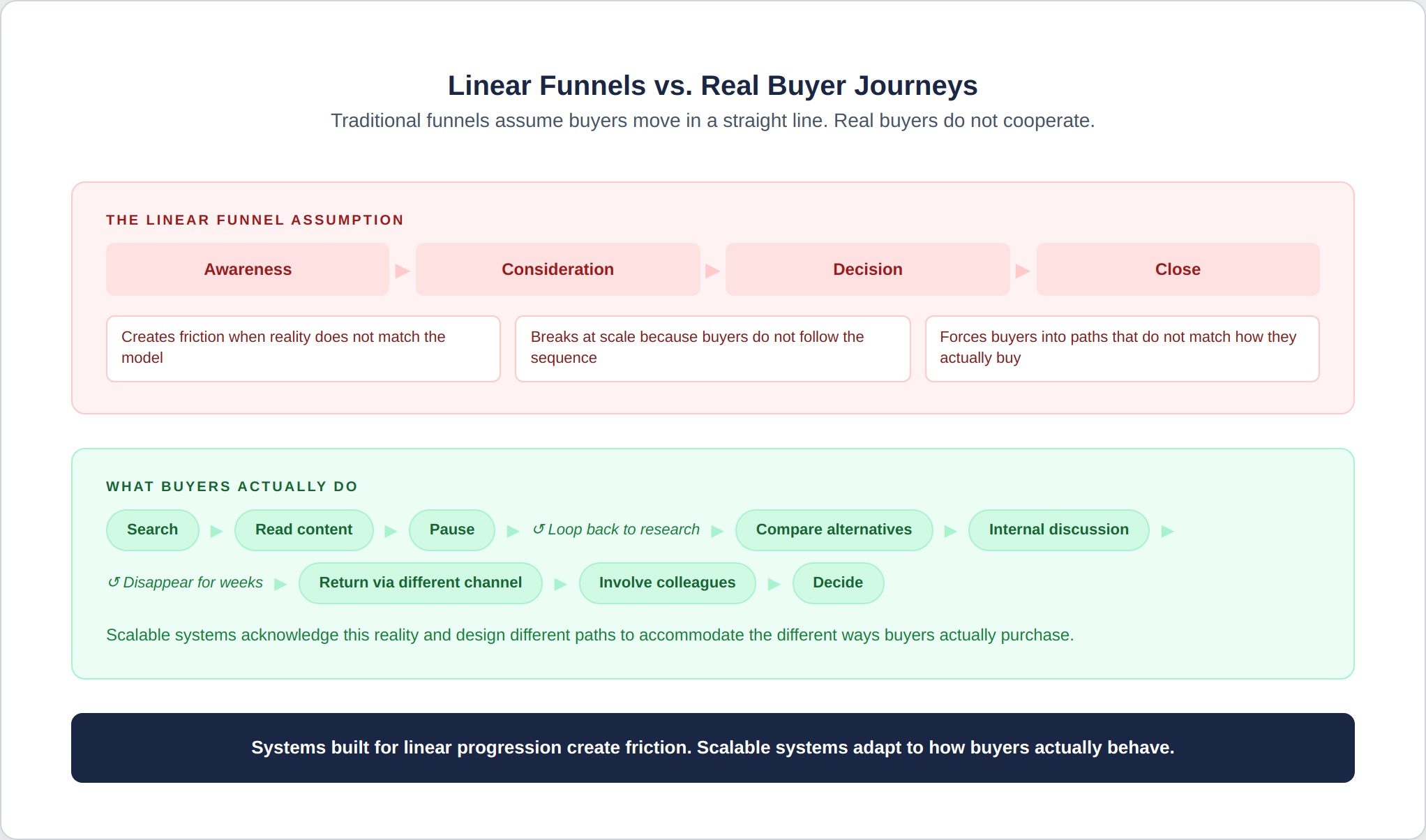
Traditional funnels assume buyers move in a straight line from awareness to consideration to decision. Real buyers don’t cooperate with that model.
They loop back to earlier research stages. They pause for internal discussions. They compare your solution to alternatives they discovered after entering your funnel. They involve colleagues who have different questions and concerns. They disappear for weeks and return through a different channel.
But it doesn’t stop here. Systems built for linear progression create friction when reality doesn’t match the model.
When building a scalable system, you must acknowledge this and design different paths to accommodate the different ways buyers actually want to purchase.
Why Does Consistency Beat Creativity When Scaling?
Consistency beats creativity at scale because consistency builds recognition, reduces cognitive load, and compounds trust.
Scalable systems reuse ideas intentionally. They don’t reinvent messaging every quarter. They evolve core messages deliberately over long periods rather than reactively every few weeks.
Buyers need repetition to remember your company, and they need consistency to trust your company.
When your approach is consistent, they know what to expect, and that predictability builds the trust that makes conversion possible.
Why Does the Marketing-Sales Trust Problem Kill Scale?
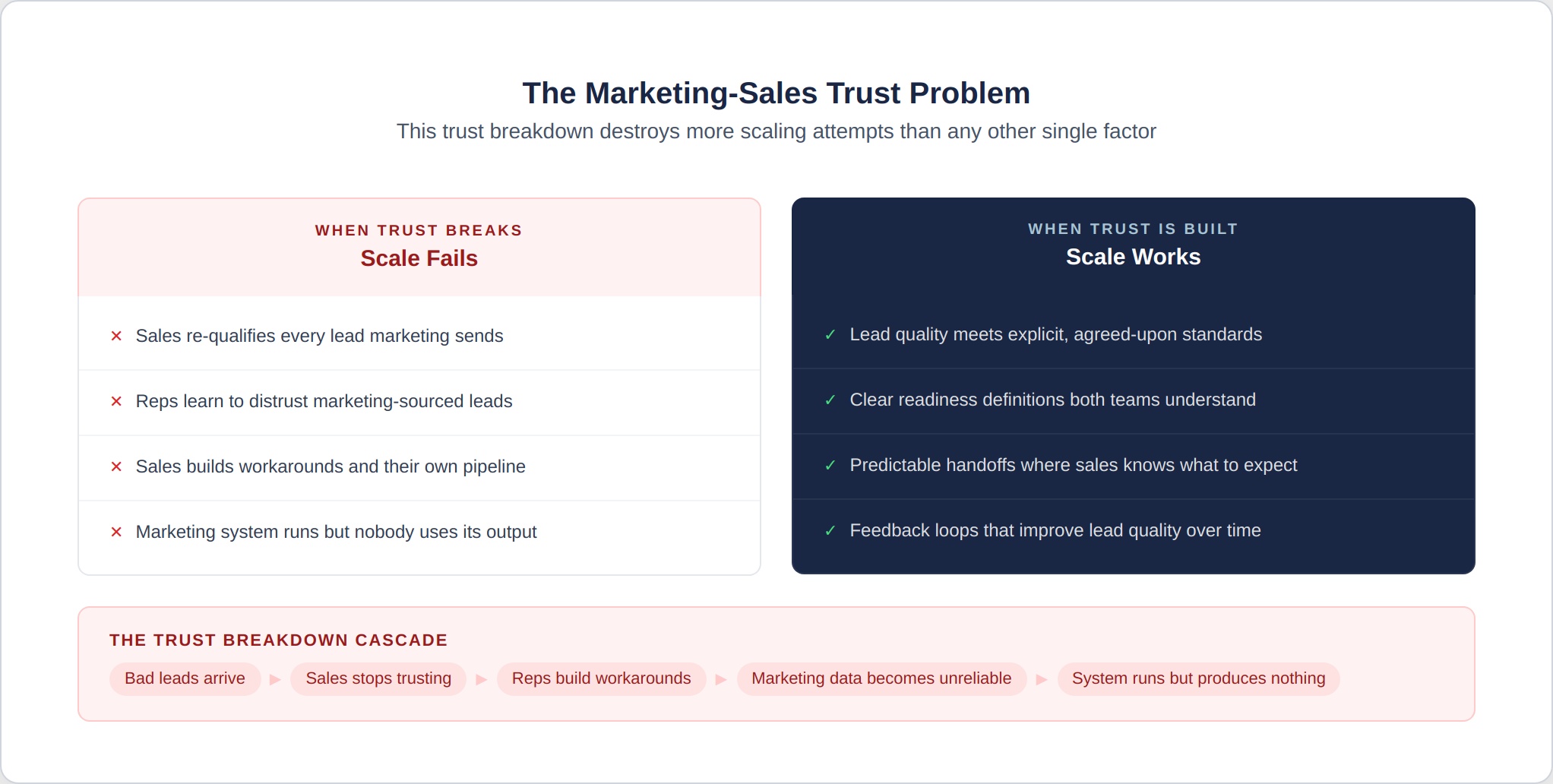
Marketing doesn’t scale if the sales team don’t trust it.
That trust comes from three specific things:
* Lead quality that meets explicit, agreed-upon standards
* Clear readiness definitions
* Predictable handoffs where sales know what to expect when they receive a lead
If sales have to spend time re-qualifying every lead marketing sends them, you can no longer scale. Reps learn to distrust marketing-sourced leads. They build workarounds. They develop their own pipelines. The marketing system runs, but nobody uses its output.
Without question, this trust breakdown between marketing and sales, often tracked through shared dashboards in HubSpot or Salesforce, destroys more scaling attempts than any other single factor.
Why Does Automation Often Increase Fragility?
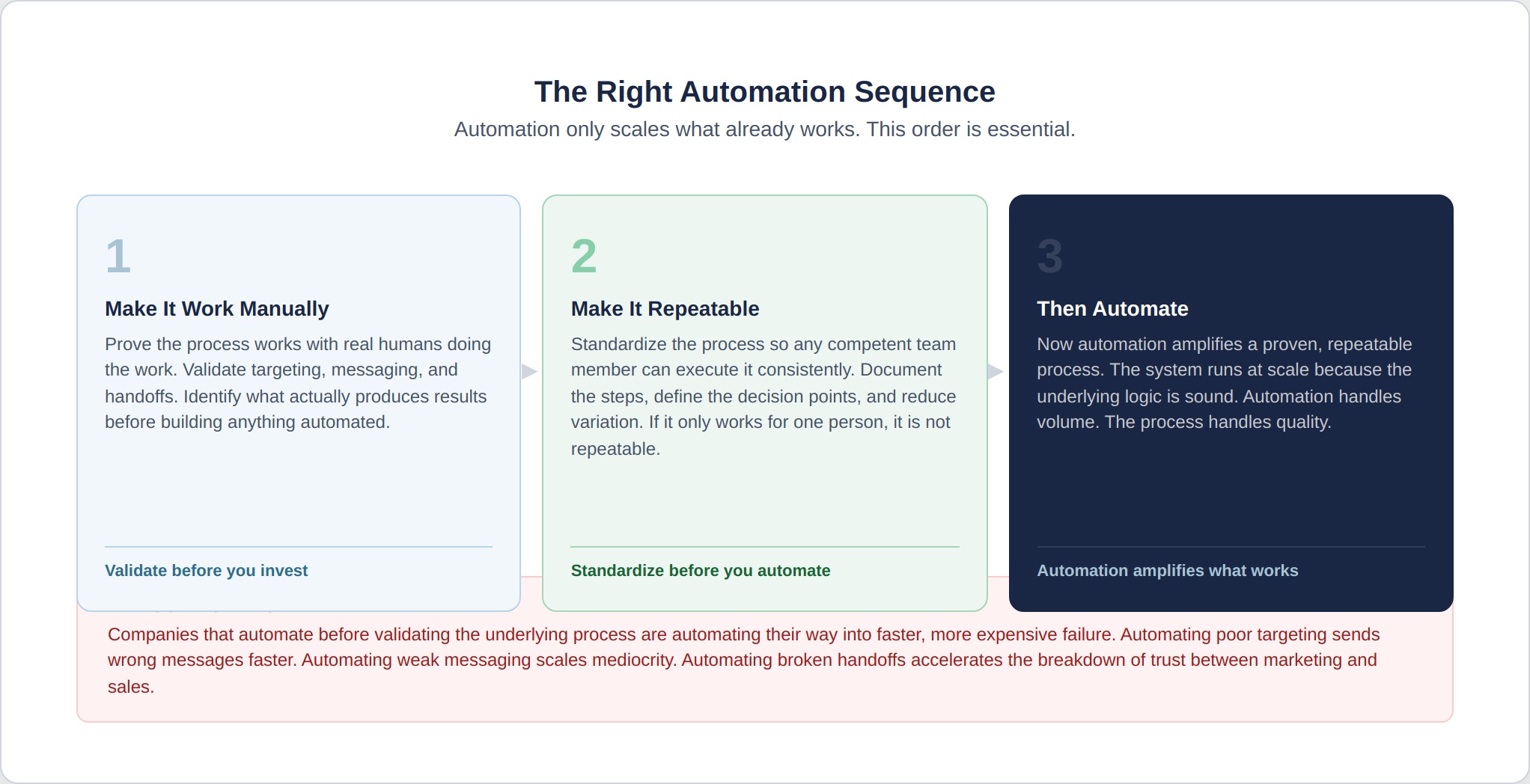
Automation often increases fragility when layered onto weak systems:
* Automating poor targeting sends the wrong messages to the wrong people faster.
* Automating weak messaging scales mediocrity
* Automating broken handoffs accelerates the breakdown of trust between marketing and sales.
Automation only scales what already works. First, make the process work manually. Then make it repeatable. Then automate. That sequence is essential. Companies that automate through tools like Zapier, Make, or built-in HubSpot workflows before validating the underlying process are automating their way into faster, more expensive failure.
Based on real results, the companies that get the most value from automation are the ones that automated last, after the process was proven, the messaging was validated, and the handoffs were reliable.
Why Does Complexity Become the Enemy of Scale?
Many systems break at scale because they are too complex. They contain elaborate workflows , multiple tools, and intricate processes.
This complexity slows decision-making, increases the possibilities of errors, and hides buyer intent. Every additional layer of complexity adds cost that scales with volume.
Scalable systems are simple, not simplistic. They do fewer things with higher quality and clearer purpose. Strip away everything that doesn’t directly contribute to outcomes. What remains is the scalable core.
The Bottom Line
A scalable marketing system is dependable. It doesn’t chase growth. It sustains it.
Clear market definition so every message lands with the right audience. Repeatable demand generation to make the pipeline predictable. Progression logic leads to advances toward decisions rather than accumulating as inactive contacts.
The goal is to continuously improve your marketing through feedback loops. Do this consistently so that trust compounds and the system can sustain long-term growth even under the pressure of algorithm and external changes.
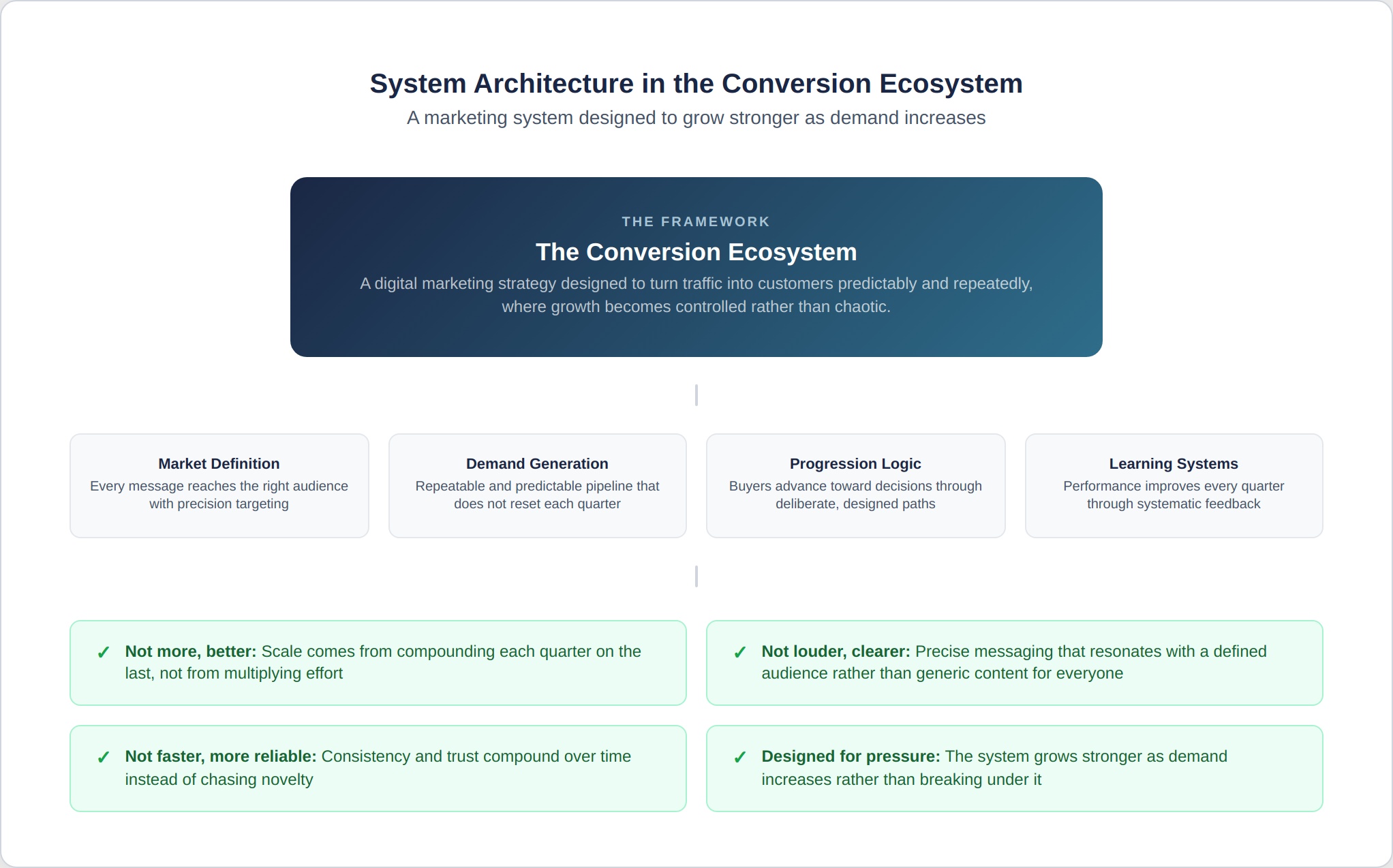
That is what scalable marketing looks like. Not more. Better. Not louder. Clearer. Not faster. More reliable. The companies that build this don’t experience growth as chaos. They experience it as the natural outcome of a system designed to handle whatever the market demands.
What to Do Before Trying to Scale Your Marketing
Before you start trying to scale your marketing, ask yourself these questions:
* Are your results dependent on specific people or campaigns?
* Can your company handle 2x or even 3x the number of leads?
* Do you have clear ownership and learning loops built into your process?
If you try to scale before you have a system worth scaling, you’ll create chaos and wonder why results don’t improve. Don’t add channels until mastering one. Don’t increase spending until you understand which dollars actually produce leads. Don’t hire more people before defining what the system needs those people to do.
Before you look to scale, focus on all marketing materials so the message serves a defined audience. Standardize your demand generation process so results are repeatable rather than dependent on the current campaign. Design paths that help the customer move closer toward buying.
Build learning loops that capture what works and why. Reduce the system’s complexity so it is simple enough that any competent team member can operate it without effort.
This is why system architecture is central to what we call a conversion ecosystem.
A digital marketing strategy should be designed to turn traffic into paying customers in a predictable manner. It should ensure every message reaches the right audience. And when it comes to demand generation, it should be repeatable and predictable. Finally, for the customer journey, there should be a logical progression that moves the lead towards the next step in the decision-making process. Where learning loops improve performance every quarter. Where the system scales because it was designed to, not because more people are working harder.
If you want help evaluating:
* whether your marketing is built to scale or just producing results through effort that cannot be sustained
* designing the four layers that make a marketing system genuinely scalable
* building a conversion ecosystem where growth becomes controlled and predictable instead of chaotic and exhausting
Make sure you reach out. We can help you design a marketing system that grows stronger as demand increases, rather than breaking under the pressure your own success creates.
Frequently Asked Questions
What is a scalable marketing system?
A scalable marketing system maintains or improves performance as volume, complexity, and pressure increase. And it does so without requiring proportionally more effort or cost.
These are the four layers it requires:
* precise market definition
* repeatable demand generation
* progression logic that moves buyers toward decisions
* learning systems that compound knowledge over time.
Why does marketing break when you try to scale it?
Marketing typically breaks down because of these structural weaknesses:
* campaign dependency, where results fade between initiatives;
* individual dependency, where performance relies on specific people working at unsustainable intensity;
* Learning that doesn’t compound because insights aren’t captured and applied systematically.
Scale exposes whichever weakness exists.
How do I know if my marketing is ready to scale?
Test your system against one question:
* If the three people most responsible for marketing results left tomorrow, would the system continue producing leads at the same quality and volume?
If the answer is no, you have talented people compensating for a fragile system rather than a scalable one. Other signals include unpredictable month-to-month results and constant campaign reinvention.
What is the difference between doing more marketing and scaling marketing?
Doing more means increasing output, including more content, more ads, more channels, which eventually hits a wall as the team maxes out and quality drops. Scaling means building a system where each additional unit of effort produces equal or greater results because processes are standardized, learning compounds, and variation is deliberately reduced.
Why doesn’t automation make marketing scalable?
Automation amplifies whatever process it is applied to. If the underlying targeting, messaging, and handoff processes are weak, automation scales those weaknesses faster. Automation only creates scalability when the process has been validated manually first, proven to be repeatable, and confirmed to produce quality results. The sequence is: validate, standardize, then automate.
What are the four layers of a scalable marketing system?
The four layers are:
* Ideal customer profile and market definition
* Repeatable demand generation
* Progression logic that moves leads toward a decision.
* Learning systems that improve performance each quarter.
All four layers must work together for the system to hold under pressure.
Why does consistency matter more than creativity at scale?
Consistency builds recognition and builds buyer trust.
When messaging changes, buyers can’t build an understanding of what your company stands for. Scalable systems evolve core messages deliberately rather than reinventing them every quarter. Creativity still matters, but serves the consistent message rather than replacing it.
How do I fix the trust problem between marketing and sales?
Fix the trust problem by establishing three things:
* lead quality standards
* clear readiness definitions
* predictable handoff processes
When sales have to re-qualify everything marketing sends, the system cannot scale.

