Why Your Landing Page Layout Is Quietly Killing Conversions

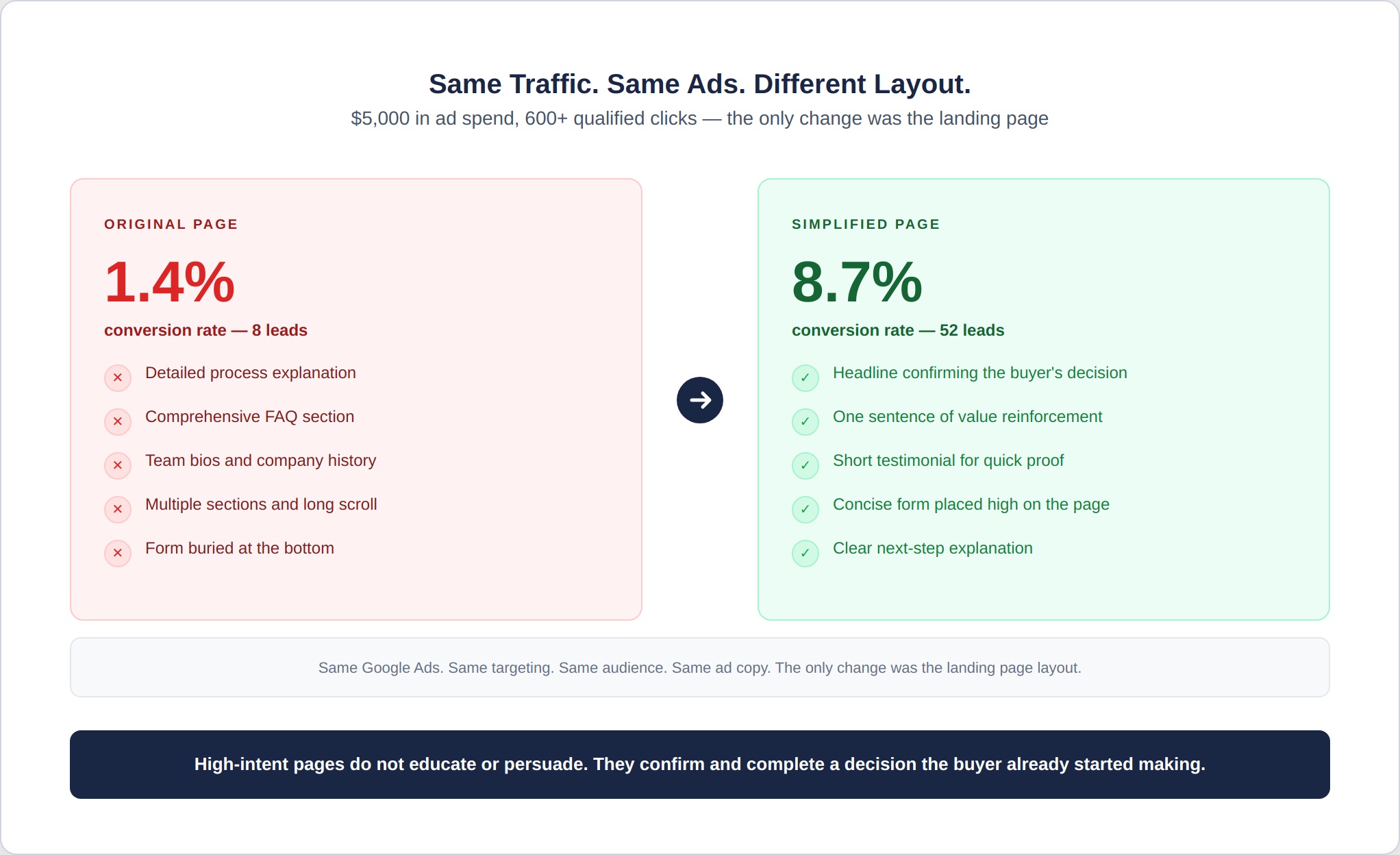
Your marketing director brought you in on a puzzling conversion issue. Everything about your Google Ads was performing as planned, sending qualified, high-intent traffic to your flagship consulting service. Yet, after $5,000 in ad spend and over 600 qualified clicks, the landing page produced a disappointing 1.4% conversion rate, yielding just 8 leads.
The marketing director’s observation was correct: “The right traffic and the correct people were landing on the website, so the ad copy is working. So there must be something about this landing page that is killing deals that we should be closing.” The landing page had:
- A professional design.
- Strong headlines
- An explanation of their process
- And listed all the required FAQs.
Yet, despite checking every box, the conversion rate lagged far behind expectations for such high-quality traffic.
The following week, your team replaced the entire page. Not with a better design. Not with stronger copy. Not with more testimonials or a longer FAQ. They replaced it with less. A headline confirming the buyer’s decision. One sentence. One testimonial. One form. One explanation of what happens next. That was the whole page. The conversion rate jumped to 8.7 percent. Same traffic. Same ads. Same audience. The only thing that changed was how little the page asked the buyer to read before taking action.
This improvement wasn’t about better design. It was about understanding what high-intent buyers need from a landing page layout—almost the opposite of what most pages provide.
In this article, I will break down what high-intent landing pages must accomplish, outline which layouts are consistently effective in B2B, and explain why layout only succeeds when matched to buyer psychology. At the end, you’ll find a summary of the most important points for building high-converting, high-intent landing pages.
Here is what most people get wrong about landing page layouts for high-intent traffic. The best layouts do not educate. They do not persuade. They confirm a decision the buyer had already started making before they clicked. That is it. The buyer needs three things. Reassurance that they are in the right place. Proof that others like them chose this, and it worked out. And a clear path to take the next step without overthinking it. Anything on the page that does not do one of those three things? It is not neutral. It is actively working against you by interrupting the momentum that brought them there.
Why Are Most Companies Asking the Wrong Question About Landing Page Layout?
There is no universally best landing page layout. Layouts work relative to four variables: buyer awareness, perceived risk, offer complexity, and the strength of the intent that brought the visitor to the page.
High-intent pages are not persuasion tools. Instead, you need to see them as confirmation tools. The buyer already believes the problem matters. Already knows a solution is needed. Already wants to move forward. That is why they clicked your ad in the first place. Nobody clicks a Google Ad for a consulting service out of idle curiosity. They clicked because they did the work. Researched the problem. Compared their options. Decided they are ready. Your page does not need to rebuild any of that. It just needs not to get in the way.
Your page’s job is not to rebuild that belief from scratch. It is to remove the last fraction of doubt standing between where the buyer is mentally and the action you want them to take.
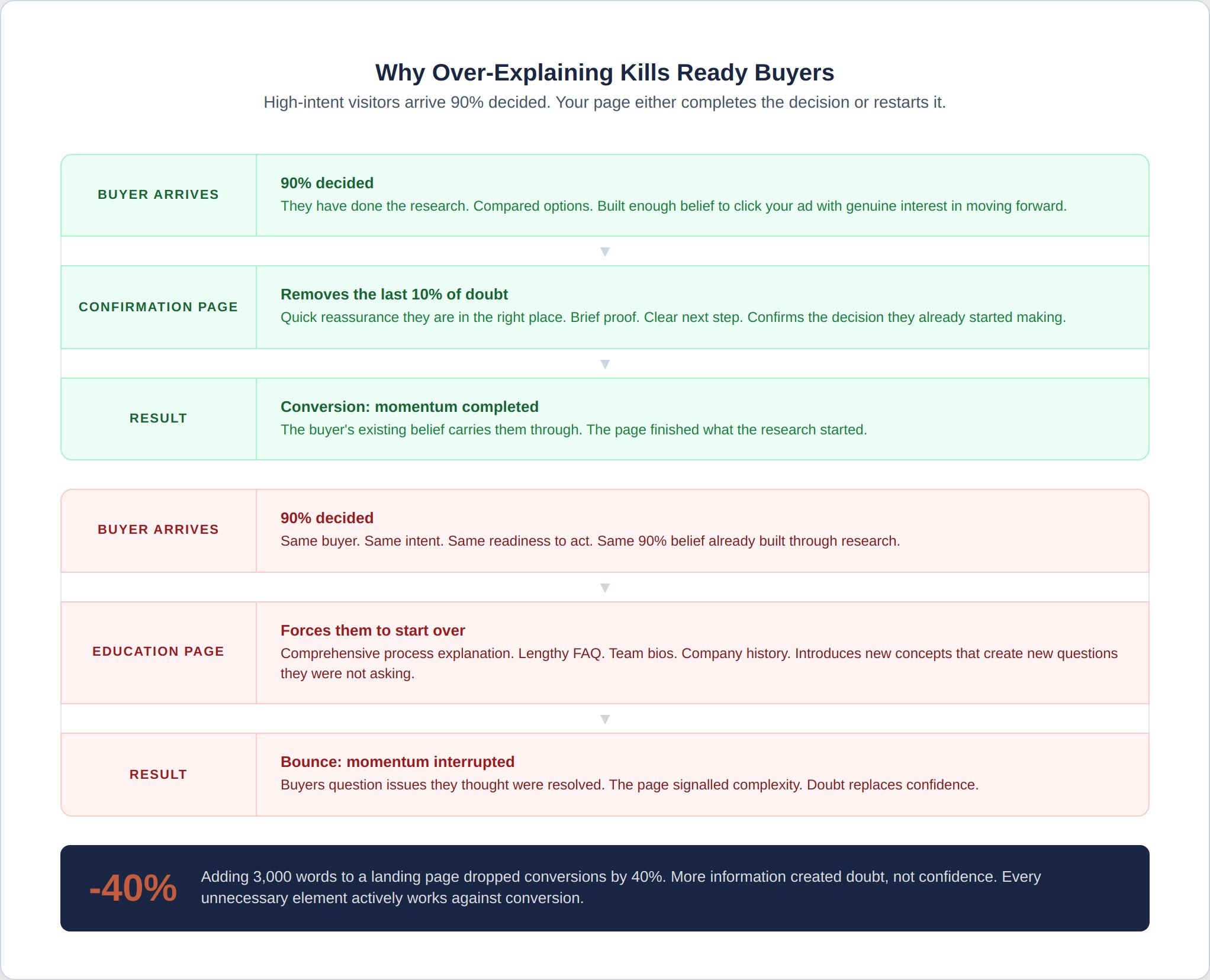
Think about what this means for how you design the page. When someone arrives having already done the work to get themselves 90 percent of the way to a decision, and your page makes them start over with a comprehensive education about the problem they already understand, you are not helping them. You are interrupting them. That interruption doesn’t feel like added value. It feels like the page wasn’t built for someone at their stage.
What Are High-Intent Buyers Actually Looking For on a Landing Page?
High-intent buyers arrive with momentum from research, conversations, referrals, or repeated exposure to your brand. They already know the problem matters and a solution is needed. They are inclined toward action.
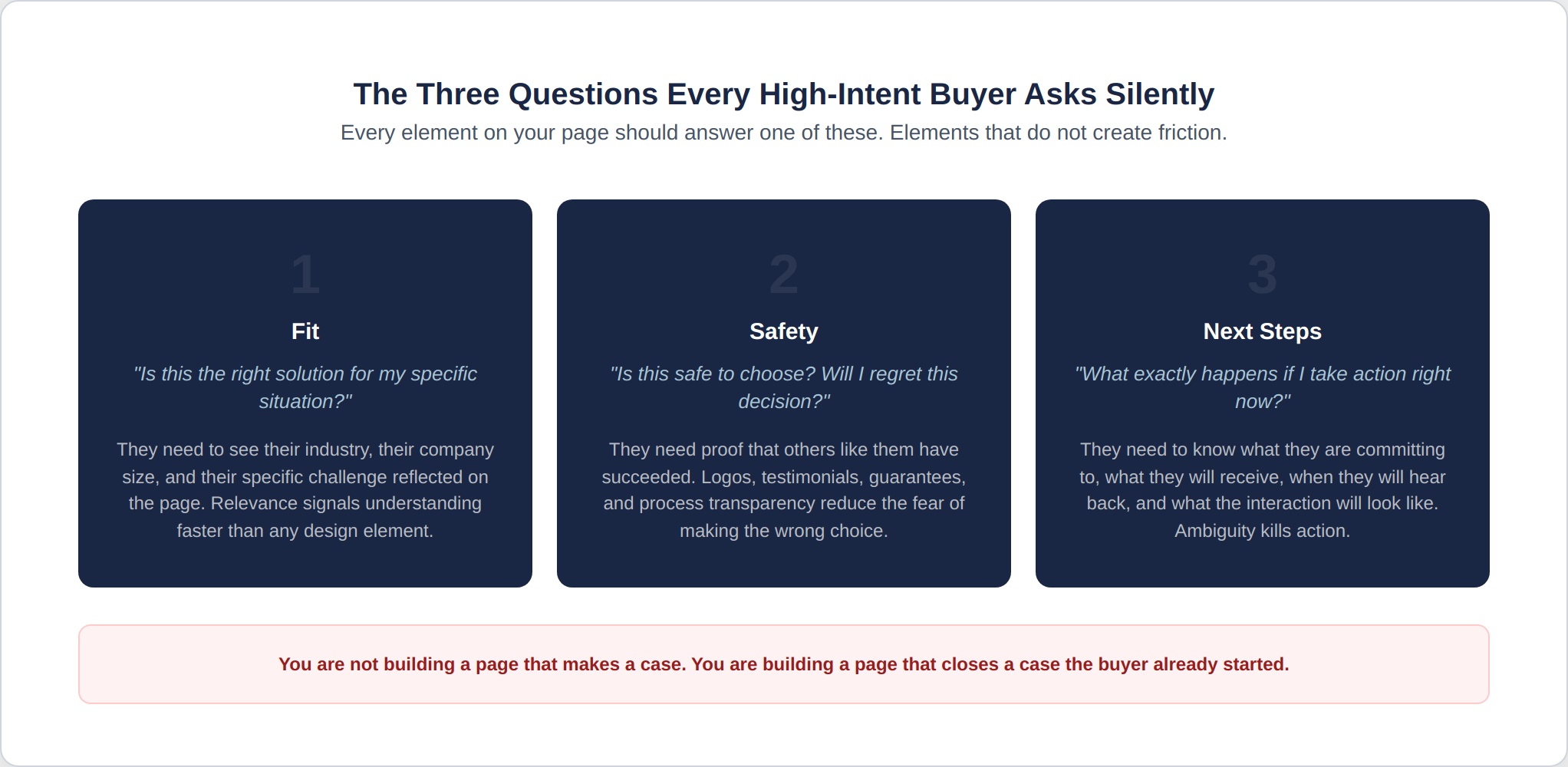
What they need from your page is not education. It is a reassurance. They are asking three specific questions silently as they scan your page:
- Is this the right fit for my specific situation?
- Is this safe to choose? Will I regret this decision?
- What exactly happens next if I take action right now?
One thing you must understand is that every element on your page should answer one of the buyer’s three core questions: fit, safety, and next steps. Elements that do not address these issues create friction and lower conversion rates. Streamline your page to address only these essential questions.
After working with teams across industries, this distinction alone changes everything about how high-intent landing page layouts should be designed. You are not building a page that makes a case. You are building a page that closes a case the buyer already started.
Why Does Over-Explaining Kill Ready Buyers?
The most common high-intent page failure is over-explaining.
Pages that should convert warm, ready traffic instead of repeat early-stage education the buyer has already completed. They introduce new concepts that create new questions the buyer wasn’t asking. They add sections that extend the page well past what the decision requires. They include secondary offers or alternative paths that dilute the primary action.
I tested this myself years ago. When running an A/B test, I added 3,000 extra words to a landing page.
I added what I thought was good content:
- Real explanations with detailed process breakdowns
- Thorough answers to common questions.
And during this test, conversions dropped by over 40 percent.
What was assumed was that more information would build more confidence. It did the opposite. Buyers started questioning things they hadn’t before. Started wondering if maybe this was more complicated than they thought. Started second-guessing a decision they had already made. The extra content did not reassure them. It unsettled them.
Every unnecessary element on a high-intent page is not neutral. It actively works against conversion by interrupting the buyer’s momentum.
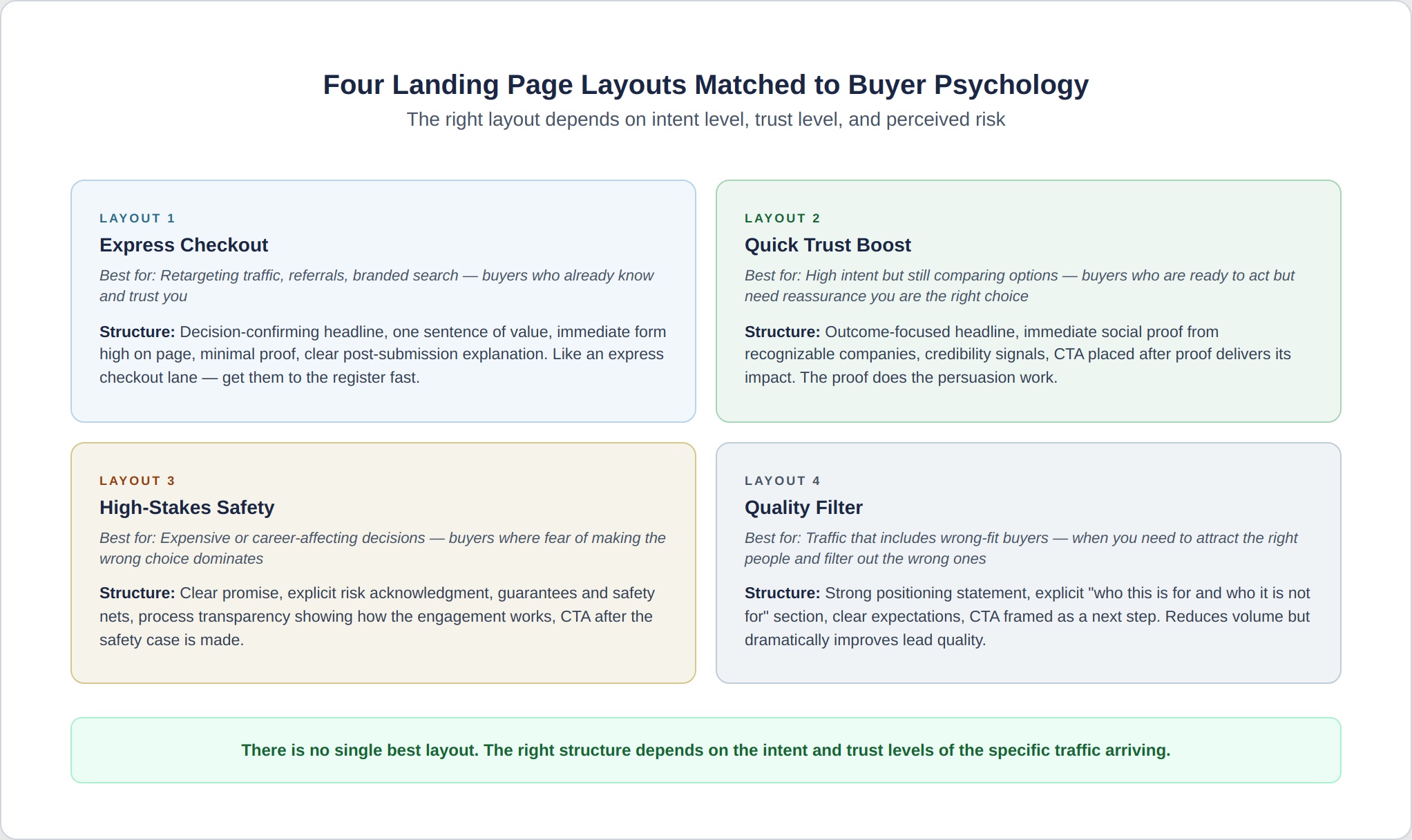
What Does the Express Checkout Layout Look Like?
This layout works best when intent is very high, and the visitor already knows your company. Retargeting traffic. Referral traffic. Branded search visitors who typed your company name into Google.
The structure is minimal by design:
- A clear headline that confirms the decision the buyer is making
- One or two sentences of value reinforcement
- An immediate CTA form is placed high on the page.
- Minimal supporting proof, just enough to maintain confidence
- A simple explanation of what happens after submission
Key takeaway: Express checkout layouts remove all friction for ready buyers. They do not build belief, and instead, they channel existing belief directly into action, which significantly increases conversion rates.
Think of this like an express checkout lane. The customer walks in knowing exactly what they want. You don’t show them the entire store. You get them to the register as quickly as possible.
How Does the Quick Trust Boost Layout Work?
This quick boost layout works when:
- There is strong buyer intent, but trust hasn’t been built.
- If the visitor is ready to purchase but hasn’t committed to your company.
- When they are comparing you to alternatives.
- If they need some type of reassurance that you are the right choice.
The structure puts proof at the center of the experience:
- A headline addressing the outcome they want
- Certifications, awards, or partnership logos
- Immediate social proof from recognizable companies
- Client results with before-and-after numbers.
- A clear CTA positioned after the proof delivers its impact.
- Minimal explanation because the proof does the persuasion work
These visitors are ready to purchase and just need to see that others like them have succeeded first. They need to see logos they recognize. They want to read or watch testimonials from real people like them. And want to see actual numbers that are specific enough to their situation, which look and feel credible.
All you need to do is add immediate, prominent, and specific reassurance to your landing page and watch visitory resistance drop fast.
How Do You Make High-Stakes Decisions Feel Safe Through Layout?
This layout works when the stakes are high enough that fear dominates the buyer’s psychology. The purchase is expensive. The outcome affects their career or reputation. The risk of making the wrong choice feels significant.
Here is how to start focusing on safety:
- Provide a clear promise about what the buyer will receive.
- Acknowledge the risks the buyer is worried about,
- Provide guarantees, risk reversals, or safety nets that make the downside manageable.
- Be transparent with your process and show exactly how the engagement works.
- Only when the case for safety has been made should you provide a CTA
When buyers are considering something expensive or consequential, fear is the primary emotion. Fear of wasting money. Fear of choosing poorly. Fear of looking foolish internally. You cannot ignore that fear; hope that enthusiasm overcomes it. You have to address it directly. Show them what happens if things don’t work out. Show them your guarantees. Show them the process that makes outcomes predictable. Make the risk feel manageable, and the decision becomes dramatically easier.
When Should You Use a Quality Filter Layout?
A situation may arise in which you get high-intent visitors to your website, but a high percentage of them are wrong-fit buyers. These people are genuinely interested in purchasing, but don’t match your ICP. Though their intent to purchase is real, their fit is poor, and converting them can be expensive downstream.
In order to filter out correctly, you can do the following:
- Have a strong positioning statement that clearly defines who you serve
- Explicitly outline who this is for and “who this is not for”.
- Provide clear expectations about what the engagement involves.
- Your CTA should be framed as a next step rather than a commitment.
This layout will reduce the total number of conversions, but that is the actual point. Nine times out of ten, sales teams prefer 20 qualified leads to 100 unqualified ones because conversations are better, close rates are higher, frustration is lower, and overall revenue increases.
Telling people not to proceed if they are not the right fit often increases conversion among those who are. When you are clear about who you serve, the right buyers feel more confident that you actually understand their situation and can deliver results.
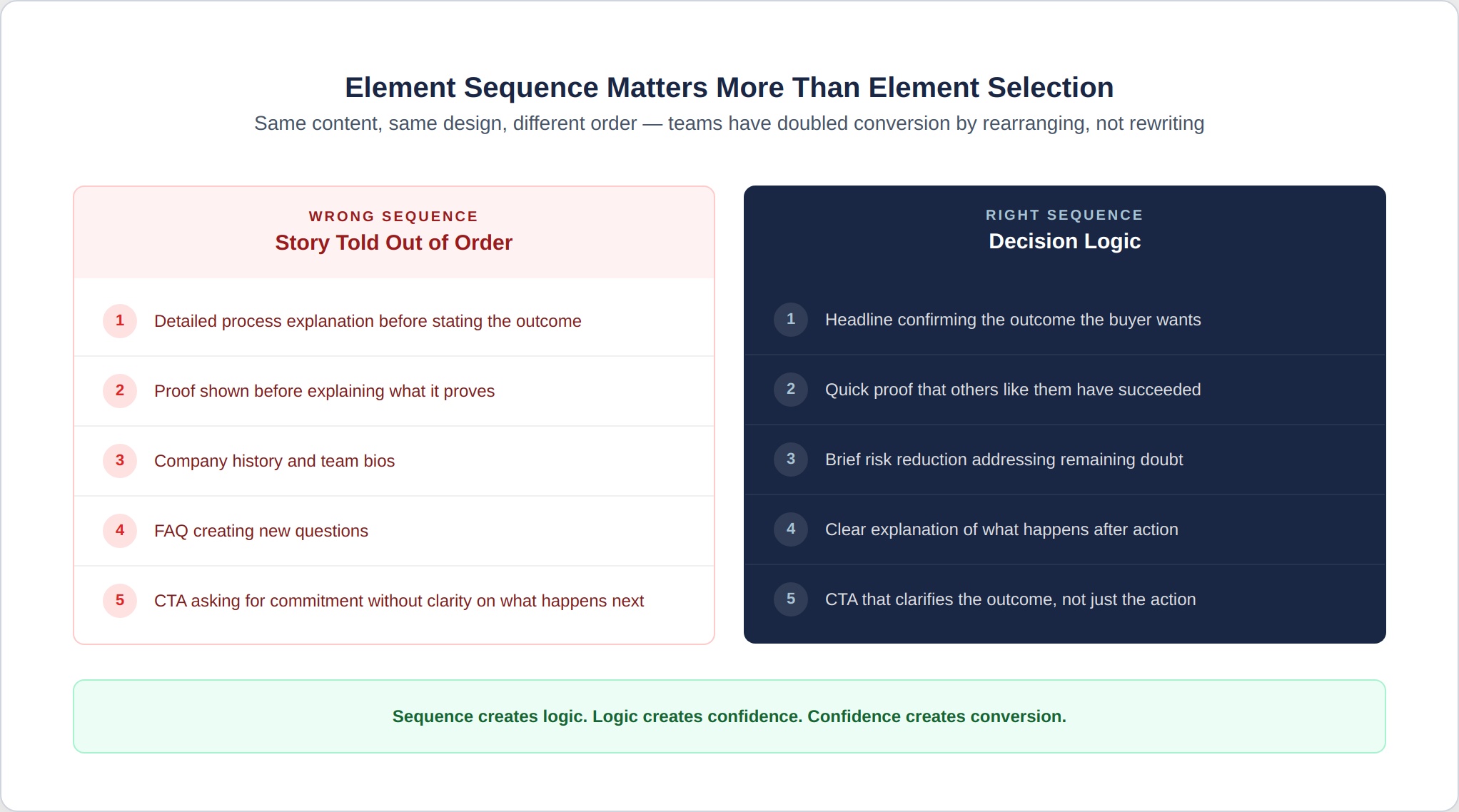
Why Does Element Sequence Matter More Than Element Selection?
Unfortunately, if you are not careful, even the correct elements in the wrong order can affect conversion rates.
If your page shows proof before explaining what it proves, the proof feels random and disconnected. If you ask for commitment before clarifying what the buyer is committing to, they hesitate. If you explain the mechanics of your process before confirming the outcome, the buyer gets lost in the details before they understand why the details matter.
Sequence creates logic. Logic creates confidence. Confidence creates conversion.
Time and again, I have seen teams rearrange the same page sections without adding or removing anything and double their conversion rate. Same content. Same design. Different order. The content was always strong. The sequence was telling the story out of order.
How Does Traffic Source Continuity Affect Landing Page Conversion?
High-intent pages do not exist in isolation. The buyer arrived from somewhere. A Google Ad. An email through ActiveCampaign or HubSpot. A referral link. A retargeting campaign through Meta Ads. Whatever brought them created a specific expectation about what they would find.
Now, if a situation arises where the page doesn’t match that expectation, it causes the brain to pause and think, “Did I click the wrong thing? Is this the same company? This isn’t what I expected.” That moment of confusion is enough to end the conversation.
Here are a couple of situations that can make this happen:
- When a high-intent Google Ad promises a fast implementation, but the page opens up to either a home page, an overview of your company’s history, or a methodology.
- When an email highlights a specific case study, and upon clicking the link, the landing page opens with a generic value proposition.
It is these mismatches that create hesitation at the exact moment you need the buyer’s confidence at its highest.
Continuity between the traffic source and landing page is not a nice-to-have. It is the foundation for every other page element.
Why Does Ugly and Relevant Beat Beautiful and Generic?
High-intent buyers respond to relevance, not aesthetics.
Here are a few things that get the customer moving to the next step:
- A page designed to use industry-specific language that the buyer recognizes, reference a specific challenge the buyer has searched for, and reframe the text and CTA around their particular situation will always outperform a beautifully designed page with generic messaging.
- When you start using personalization signals, it shows that you understand their situation. When a buyer sees their industry, their company size, and their specific challenge reflected on the page, they feel an immediate connection. “This was made for someone like me.” That feeling creates trust faster than any design element, testimonial, or badge.
But it doesn’t stop here.
- Generic pages, no matter how well-designed, feel like they were made for everyone. Seeing pages like this signals to buyers that this page was made for everyone, and not for anyone specifically.
There are many tools designed for dynamic personalization that match page content to visitor segments, but even without them, creating segment-specific landing pages rather than a single generic page produces dramatically better results.
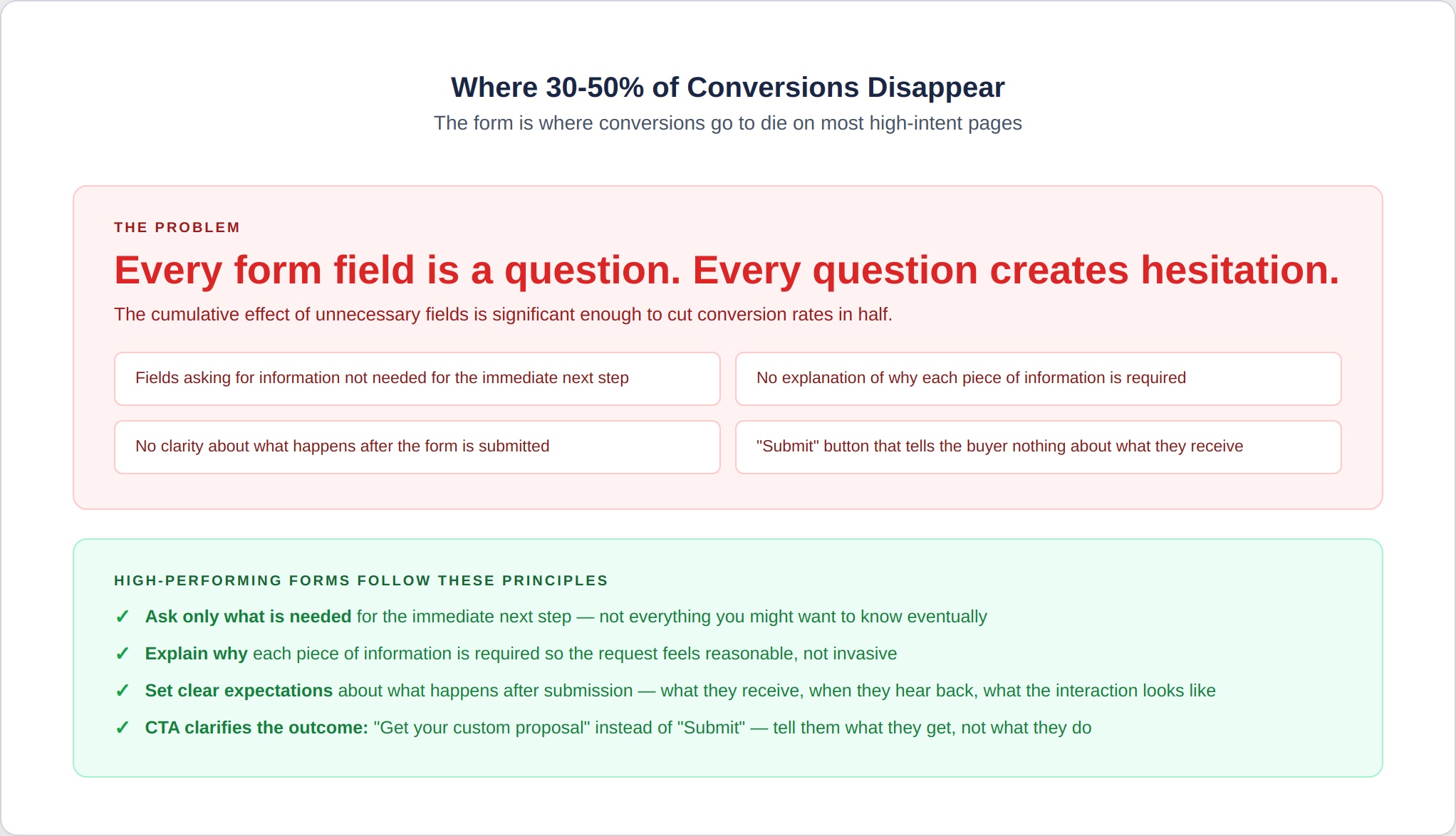
Where Do Thirty to Fifty Percent of Conversions Disappear?
The form is where conversions go to die on most high-intent pages.
Every form field is a question. Every question creates a micro-moment of hesitation. The cumulative effect of unnecessary questions is significant enough to halve conversion rates.
High-performing forms do the following:
- Ask only what is needed for the next step.
- Explain why each piece of information is required.
- Set clear expectations about what happens after submission.
- Specify what the buyer will receive.
- Let them know when they will hear back from you.
- Tell them what the next interaction will look like
The single most effective conversion improvement on most high-intent pages is reducing the number of form fields and adding a one-sentence explanation of the post-submission experience. There are many tools like Google Forms, Typeform, High Level Forms, or HubSpot Forms that support multi-step form interactions, which feel lighter than showing all fields at once. This multistep process can further reduce perceived friction.
What CTA Mistakes Cost Thousands in Wasted Traffic?
“Submit” is not a decision. “Send” is not a value proposition. “Get started” is ambiguous enough to create uncertainty.
Strong CTAs clarify the outcome, not the action:
- “Get your custom proposal.”
- “Schedule your 15-minute consultation.”
- “See how this works for your industry.”
The CTA is the last thing the buyer sees before deciding. If it creates even a moment of uncertainty about what happens next, that uncertainty is often enough to prevent the click.
The Bottom Line
The best landing page layouts that attract high-intent leads are not designed around creativity, trends, or templates. The landing pages that convert are about customer alignment.
- Alignment with where the buyer is mentally when they arrive.
- Alignment with the context that brought them to the page.
- Alignment with the specific stage of decision they are in.
The companies that convert high-intent traffic don’t ask how to redesign their pages. Instead, they ask what the last reason someone might hesitate is, and they remove it. Everything else, the layout, the sequence, the proof, the CTA, follows that reasoning.
What to Do Before You Redesign Another High-Intent Landing Page
Before changing layouts, testing colours, or adding more sections to a page that is underperforming with qualified traffic, you need to stop any surface-level changes.
Ask yourself these questions.
- Is this page confirming a decision the buyer has already started making, or is it forcing them to reconsider it by introducing education they have already completed?
- Does the sequence match how this specific visitor arrived, or does it restart the conversation from the beginning regardless of the buyer’s readiness?
- Are we reducing the final points of hesitation that stand between this buyer and action, or are we introducing new considerations they weren’t worried about?
After looking at hundreds of high-intent landing pages, what I found is that the layout is rarely the biggest problem. What I found is that growth slows when pages interrupt the momentum.
Issues arise when:
- On-page friction prevents visitors from completing a form,
- They treat every visitor as a cold prospect, regardless of how they arrived.
- Added elements serve the company’s desire to communicate rather than the buyer’s need to decide.
There is a better approach. Before adjusting the landing page:
- Identify the specific traffic source driving visitors.
- Figure out the level of awareness and trust they bring when they arrive.
- Map the two or three hesitations that remain for a buyer at that stage.
- Design the page to resolve those hesitations in the most direct sequence possible.
Do all of the above, then remove everything else, regardless of how important it seems internally.
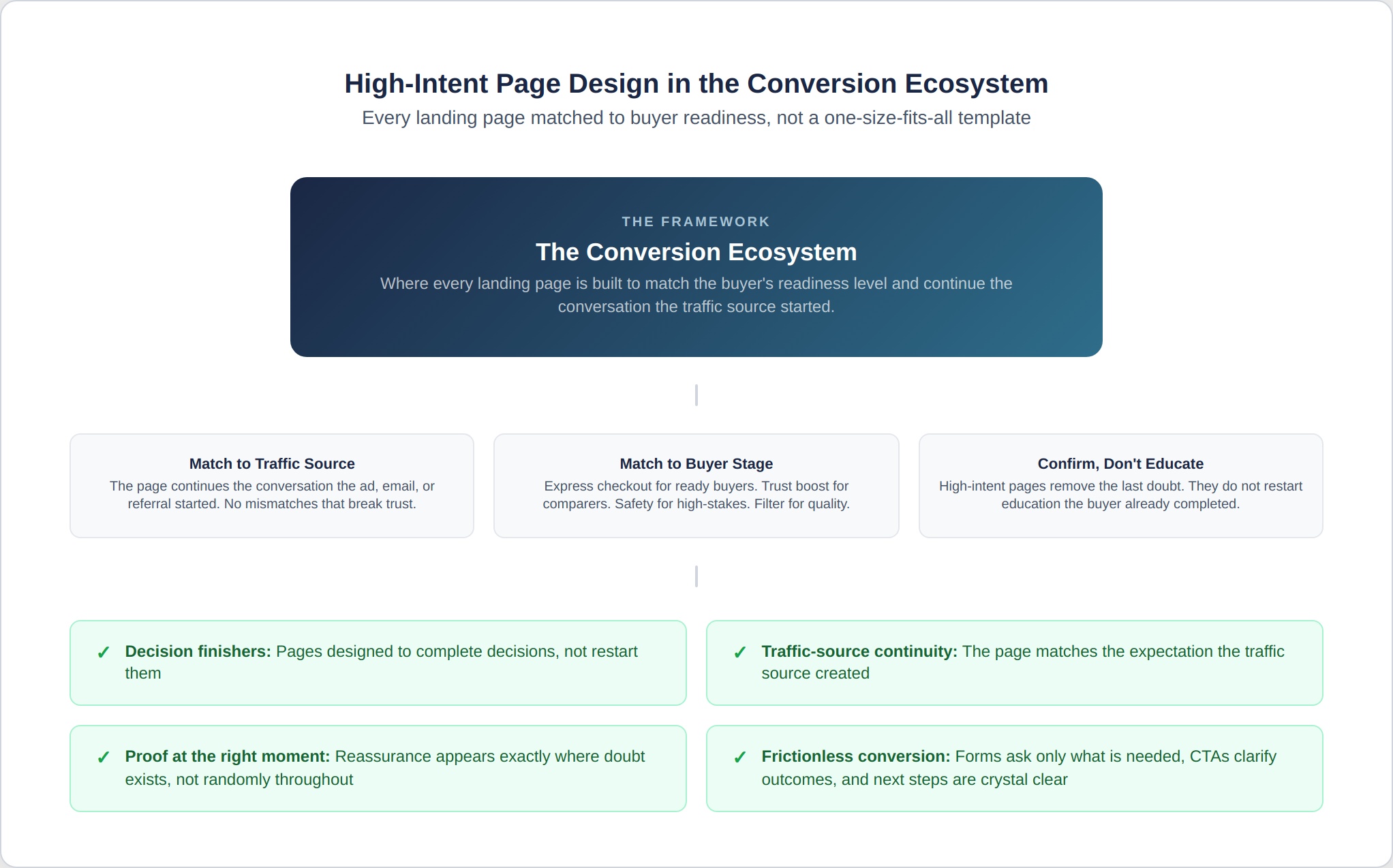
There is a reason why a high-intent landing page design is central to our conversion ecosystem.
- The conversion ecosystem strategy is designed to turn traffic into customers predictably.
- Every landing page is built to match the buyer’s readiness level.
- Landing pages are designed to continue the conversation started by the traffic source.
- Proof, reassurance, and risk reduction appear at the exact moments doubt exists.
- Where high-intent traffic converts at rates that justify the investment, because the page was designed to get prospects to make decisions.
Do you need help? If you need someone to diagnose your current landing pages, redesign high-intent layouts around buyer psychology, or build a conversion ecosystem that matches traffic quality with the right decision path, make sure to reach out. We can help you turn landing pages into decision finishers that convert the buyers you have already invested in reaching.
Frequently Asked Questions
What is the best landing page layout for high-intent leads?
The best layout depends on two things:
- the buyer’s level of awareness
- the risk they perceive.
For buyers who already know and trust your company, a minimal express checkout layout with a headline, brief value reinforcement, and immediate form outperforms everything else.
For buyers comparing options, a quick trust boost layout centred on social proof converts best.
There is no single best layout, because the right structure depends on the intent and trust levels of the specific traffic arriving.
Why is my landing page not converting high-intent traffic?
The most common cause of low conversions is over-explaining your product or service.
High-intent buyers arrive with the momentum to purchase, built through prior research.
Pages that force them to restart their education by introducing comprehensive process explanations, lengthy FAQ sections, and detailed company backgrounds interrupt that momentum. As a result, the buyer starts questioning things they had already resolved, and conversion rates drop even though the traffic is qualified.
How many form fields should a landing page have?
The best performing forms ask for only what is needed for the immediate next step.
What companies must understand is that every additional field creates a micro-moment of hesitation and reduces conversions. For most B2B landing pages targeting high-intent traffic, three to five fields are optimal. More important than field count is explaining what happens after submission, so the buyer knows exactly what they are agreeing to.
Does landing page design affect conversion rate?
A professionally designed page without underlying decision logic underperforms a simple page with strong alignment to buyer intent.
Here is what outperforms a polished landing page:
- Relevance that also includes industry-specific language
- Situation-specific framing of your product or service
- personalized CTAs.
The strongest pages combine clean design with precise psychological alignment. Design supports conversion but never drives it.
What is the difference between a persuasion page and a confirmation page?
A persuasion page builds belief from scratch for buyers who are not yet convinced. A confirmation page removes the last remaining doubts for buyers who already believe and are ready to act. High-intent landing pages should function as confirmation pages. Using a persuasion layout with high-intent traffic interrupts the buyer’s momentum and reduces conversion because the buyer is forced to repeat the education they have already completed.
How important is the message match between ads and landing pages?
Getting your message to match the buyer’s intent and level of awareness is the foundation of high-intent landing page conversion.
When the ad promises one thing, and the page delivers something different, the buyer experiences confusion that breaks trust at the worst time. When designed correctly, the page must continue the exact conversation the traffic source started. Mismatches between ad copy and landing page headlines are among the most common and fixable causes of poor conversion on otherwise well-designed pages.
Should I use a long-form or short-form landing page?
Choosing the type of landing page depends on intent and level of awareness.
Use short-form pages for high-intent traffic where belief already exists.
Use long-form pages for cold traffic that requires educating and persuading them before they take action.
The mistake most companies make is using long-form pages with high-intent visitors, forcing already-convinced buyers through extensive content that creates doubt rather than confidence. Match page length to the buyer’s readiness level.
What makes a good CTA on a landing page?
A strong CTA needs to explain the outcome rather than the action.
Buttons labelled “Submit” and “Send” tell the buyer nothing about what they receive.
However, buttons that say “Get your custom proposal” or “Schedule your fifteen-minute consultation” set clear expectations about what happens next.
The CTA is the last element before the buyer decides, and any ambiguity about the post-click experience reduces conversion.

