
Inside the AI Lead Generation System Nobody Gets to See

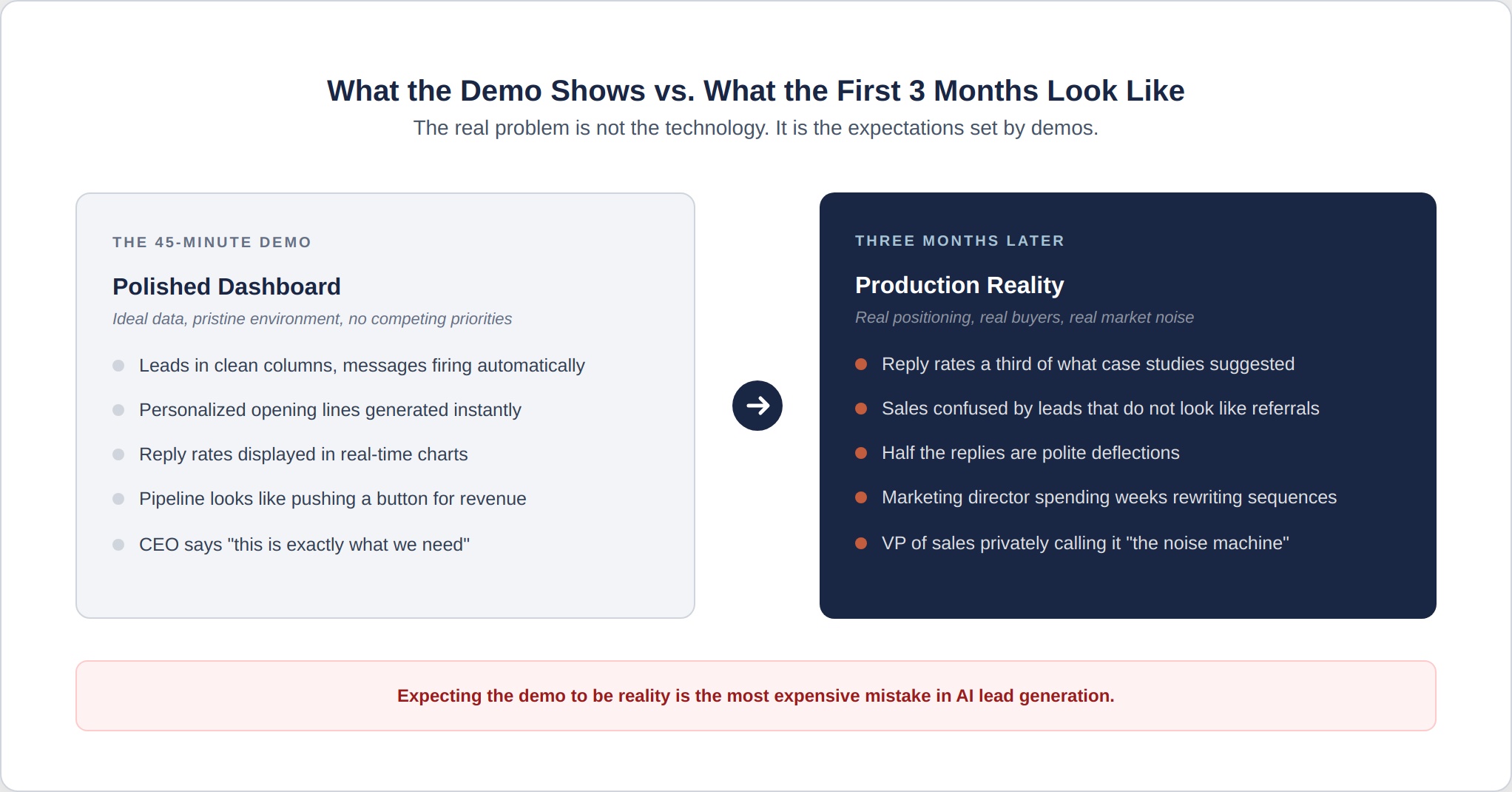
The demo was 45 minutes, and the sales rep went through slides showing polished dashboards and systems that sent personalized messages from the subject line to the body. Reply rates were displayed in real time, with charts and a pipeline view that made it seem as if pressing a button would generate revenue. Your CEO, amazed, said, “This looks like what we need.” Your VP of sales agreed, while your marketing director was already imagining what the quarterly report would look like. The rep closed his laptop, and before he took any questions, the team was already discussing whether to sign the annual contract today or wait till Monday.
Three months after the system was running, the dashboard showed the messages being sent, but the experience was nothing like the demo. The reply rates were a third of what the case study suggested, and sales were confused by the leads coming in because they didn’t look anything like the manually sourced prospects the sales team was used to. The replies were a mix of polite deflections and basic questions, suggesting they didn’t understand your company’s work. Your marketing director spent most of the week refining the targeting rules and rewriting the sequences because the initial versions weren’t resonating. Your VP started calling what was installed “The Noise Machine” in private conversations. Your CEO asked for a progress report, and nobody knew what to say because the numbers were terrible and nothing like what was shown during the demo.
That gap between the numbers in the demo and reality isn’t about the technology failing; it’s about a breakdown in expectations. The companies that deploy AI lead generation never see the real impact of the system until it gets integrated with the complexity of a business. Unclear positioning, resistance from sales teams, and buyer saturation who ignore automated messages can negatively affect the system’s performance.
Let me explain what a real AI lead generation system looks like once it is running, where the complexity hides, and what determines whether it becomes an asset or an expensive disappointment. There is a foundational issue a demo can’t give you because it doesn’t live in the demo environment.
Why Every Demo Hides the Hard Parts
Demos don’t lie. Instead, the show ideal data flowing through a pre-trained system in a clean environment with no competing priorities. That’s how they are designed to work, and it’s what must happen that way. You can’t demonstrate a system’s value by showing how messy it really gets in the first 90 days.
What demos fail to show is how the system behaves when it is merged with a company’s existing environment. This can include unclear positioning, sales teams with their own processes, resistance from sales teams to unqualified leads, and competing systems running the same AI outreach simultaneously. With skepticism growing as AI-generated messages flood people’s inboxes.
AI systems perform beautifully in isolation. Businesses do not. That gap between a controlled demo and your organization’s reality is where expectations break.
After working with teams deploying these systems, the most consistent surprise is how much of the system’s success depends on work that has nothing to do with the AI itself.
The Foundation Work Nobody Shows You
Once it is in production, AI lead generation is only as strong as its inputs. This is where most companies hit their first wall, and it hits much earlier than anyone anticipates.
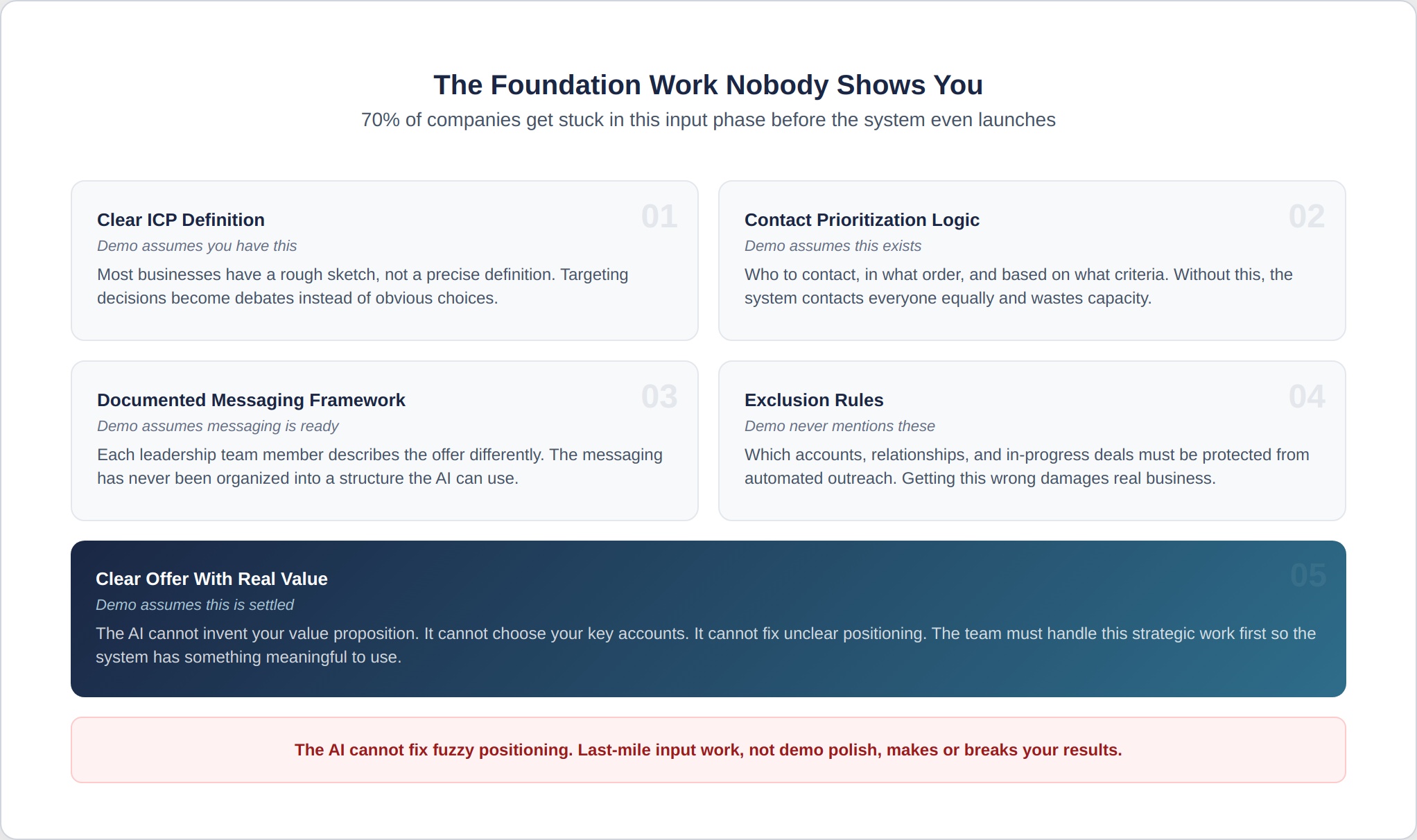
The demo assumes something that may not be true for all companies. It assumes that there is a clear ICP that you are targeting. It assumes that there is some logic within your accounts that can rank who gets contacted. There is also the belief that the offer is clear enough for the customer to see a real value proposition. By knowing this, you can create a hierarchy of messages with the required primary wording that customers can relate to, supporting angle messages that explain why your offer is beneficial to them, and an objection-aware system that helps customers overcome any roadblocks. Finally, there should be some time or rules that prevent automated outreach from reaching existing customers, active deals, or accounts that should not be contacted.
Most businesses are still negotiating these elements internally when they sign the contract. The ICP is a rough sketch rather than a precise definition. The offer has been described differently by each member of the leadership team. The messaging has never been codified into a framework that an AI system can execute against.
From what I see, over 70% of the companies I have worked with get stuck at this phase before they launch. The reality is that AI can’t fix problems that are not clearly defined. It doesn’t know how to fix vague positioning, it can’t invent a value proposition for your customers, and it can’t decide which accounts are the most valuable. This is something the yearm needs to define before AI can ever help you solve what you want.
This input phase is not exciting. It looks nothing like the demo. Yet, this phase is crucial, as it determines whether you will succeed or fail.
Why AI Does Not Write Your Messaging
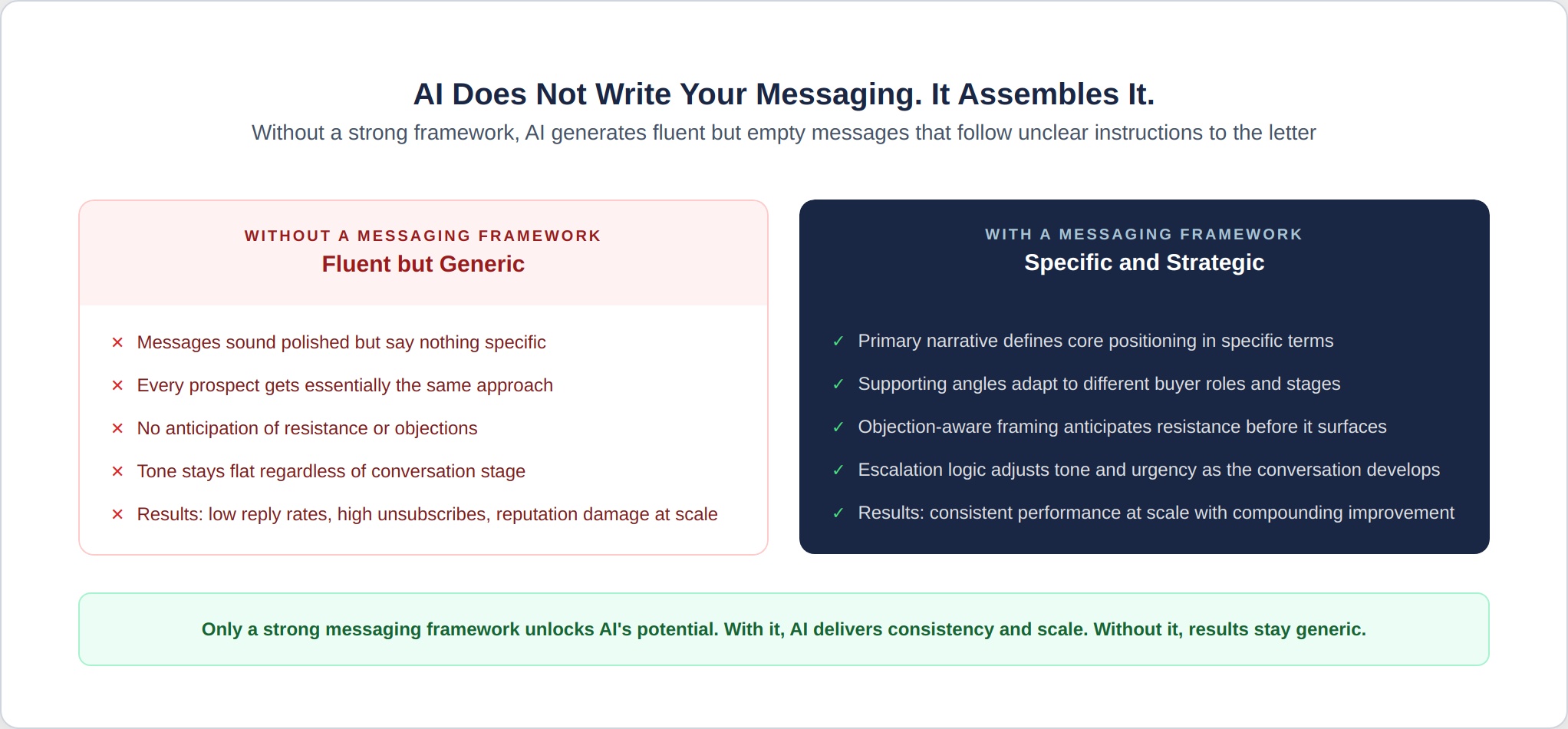
Here is the misconception that trips up nearly every company. AI does not “write messaging.” It assembles language around constraints you provide. The difference is enormous.
An AI system needs direction and a narrative that provides the necessary information about your core product, its positioning, and how it differs from the competition. The angles that support these claims are required so that it can inform the buyer who might have concerns, depending on their role within their company, what stage in the buying cycle they are at, or what their specific situation is. Objection awareness is also needed to anticipate any resistance that may arise before it surfaces. The logic and approach need to be flexible, adjusting to the conversation and urgency.
Without this in place, AI will produce surface-level answers. Messages that read well and sound professional, but don’t provide the buyer with anything that would move them to the next step. The answers are generic, and although the AI can deliver a response perfectly, it lacks the substance to elicit any action from the customer.
Now, if your messaging is built with a strong framework in mind, AI becomes powerful. It can execute and follow a framework across thousands of conversations without any human intervention. There isn’t a team of humans that can match the speed and accuracy of this type of AI framework. But in order to get this working, the framework must exist and be clearly defined. AI can’t do this for you. You need to spend the time to do this yourself.
The Layers of Complexity Hiding Under the Surface
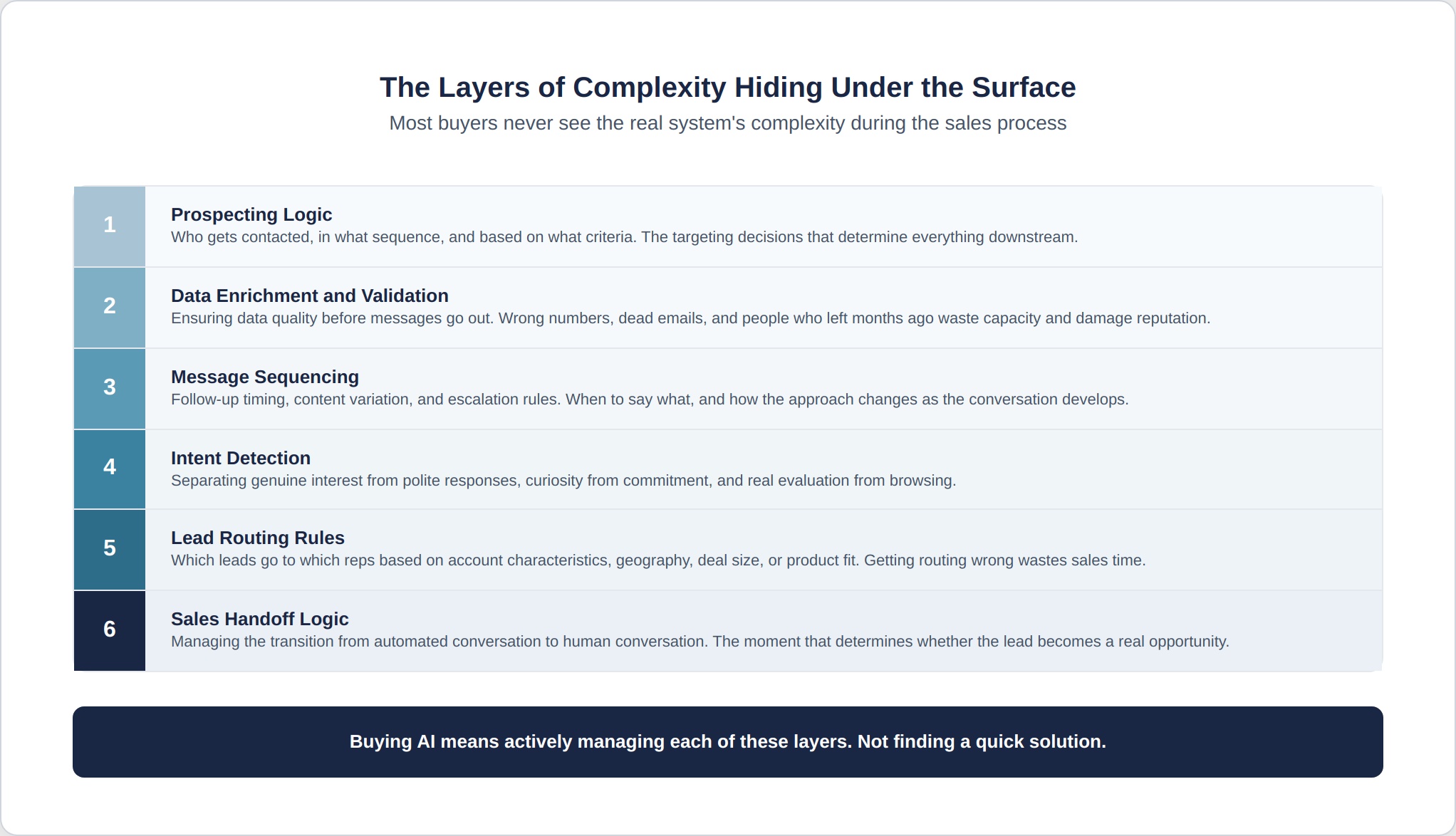
There are layers inside an AI lead generation system that buyers will never see during the buying cycle.
This includes prospecting logic that determines who to contact and in what sequence. Enrichment and validation that verfies data quality before messages go out in order to avoid contact info such as phone numbers or emails being incorrect, and contact verification to make sure you are not reaching out to those who left the ecosystem. Things such as messaging sequencing, content variation, and any escalation rules run in the background, while customer intent detection determines whether a person is interested, curious, or just evaluating. And finally, sales handoff logic is managed to ensure that rules correctly assign leads when human interaction is needed, and to determine which reps are the best fit based on account characteristics such as geography, deal size, or product fit.
Though each layer has trade-offs, as a company, you need to decide where handoffs occur. The companies that struggle with getting AI lead generation to work are the ones that thought all they had to do was press a button and everything would magically work. The companies that tend to succeed know that what they are getting is leverage that still needs active management across the decision points a buyer encounters.
When Sales Teams Get Confused by the Leads
AI-generated leads rarely look like manually sourced ones. This catches sales teams off guard more than any other aspect of deployment.
These leads often ask broader questions because they are earlier in their research process. They engage before they have fully defined their problem, which means they don’t articulate needs the way a late-stage inbound lead would. They require clarification before moving forward, as the initial conversation began with cold outreach rather than a warm referral. They move more slowly initially because trust hasn’t been established through the relationship-building that typically precedes a sales conversation.
Sales teams expecting “ready-to-buy” signals get frustrated. They compare these leads to the referrals and inbound inquiries they are used to and conclude that the AI leads are of low quality.
Here’s the critical distinction: real AI lead generation creates conversation starts—not purchase-ready decisions. These leads open the door to relationships, not immediate deals, and that shifts how sales must engage. Most companies fail to communicate this crucial point before deployment.
The Feedback Loop That Forms Whether You Want It or Not
Every AI lead-gen system generates some type of feedback. After the system sent the message, did the buyers respond? This is one of many parts of the system, but if you pay attention, patterns will emerge. It is working with this data that you figure out what needs to happen next. If no one is paying attention to or managing that feedback, the system will start to deteriorate.
Deterioration is gradual at first. It might start with response rates that no one can explain or messages that stop resonating with the buyer because other companies are using the same approach. Either way, if you are not paying attention, the number of unsubscribes will increase, trust will weaken, and performance will flatten out or even decline.
This isn’t something that can be ignored. The system can stay the same, but if the market changes and you don’t adapt, you won’t notice that what worked in month one no longer works in month four.
The best AI lead generation systems have ongoing reviews to prevent such situations. When you see a demo that shows perfect numbers, it’s because they don’t take into account these situations. Real systems put these situations in the forefront and fix any plateaus or unexpected declines.
The Work That Gets Redistributed, Not Eliminated
Though companies believe that AI lead generation will eliminate work, the reality is that it doesn’t. Instead, it redistributes certain aspects of the job to different parts of the organization.
In sales, they need to continuously review the system to define what “good” looks like so AI can refine its targeting. For marketing, they need to conduct continuous reviews to update messaging and ensure it resonates with customers. And for operations, they still need to manage the data to ensure it is usable, because bad data, when scaled, produces poor outreach. And on the leadership side, they need to manage expectations because the system they create rarely resembles what they were promised at the start.
Because of this redistribution of work, companies are usually caught off guard. They believe they invested in a system to get 100% of their time back, but instead, they are spending it differently. You never offload 100% of the work. Instead, 80% of it is redistributed, while the other 20% might increase efficiency. The work shifted from manual outreach to system management, feedback interpretation, and strategic refinement. This shift was never planned, yet the new work feels more like a burden than an investment.
What the First Three Months Actually Look Like
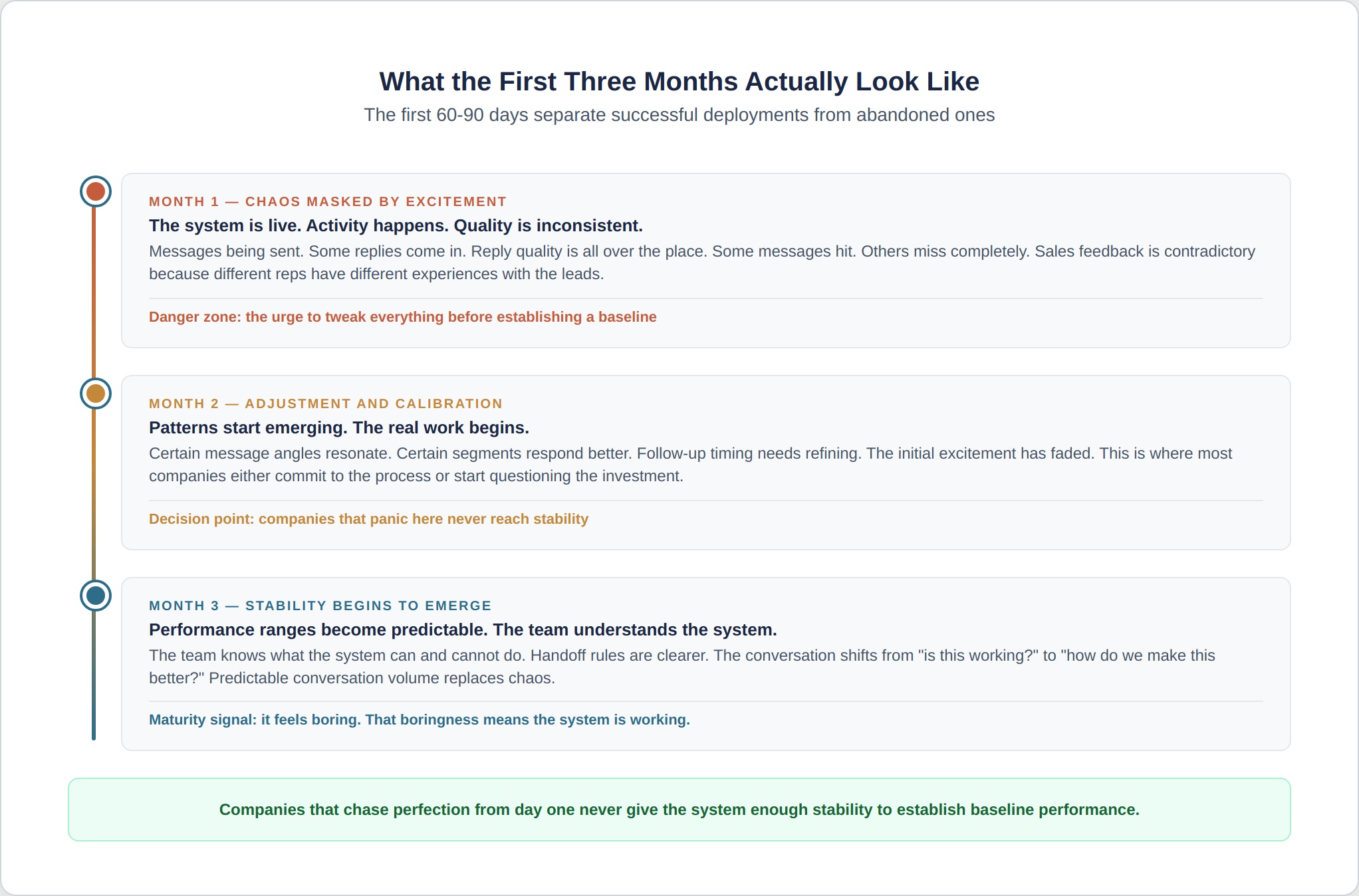
The chaos of month one is masked by the excitement of getting everything working. The system is live with messages being sent and replies coming in. There is activity, but the quality of the leads is inconsistent. Some messages hit the mark, while others miss the mark completely. Sales encounters different experiences with leads than they are used to.
The second month is when they begin to adjust, as they start to see patterns. The angles of the message they send start to resonate more. They look at the data and notice that certain segments respond better than others. Although the timing of the follow-ups needs refinement, they realize the system needs calibration. At this point, companies will either commit to the process or start questioning whether this was a worthwhile investment.
In month three, we see signs of stability if the company stays on course. Performance is within an acceptable range and becomes predictable. The team understands what the system can do and where it struggles to accomplish the required tasks, and therefore needs refinement. The handoffs between automation and sales have better-defined rules, and the conversation shifts from “is this working?” to “how do we make this better?”
From what I have seen, the first 60 to 90 days are what separate successful launches from abandoned ones. The companies that start to panic when calibration is needed, that tweak constantly, and chase perfection, never give the system enough stability to create a baseline for performance.
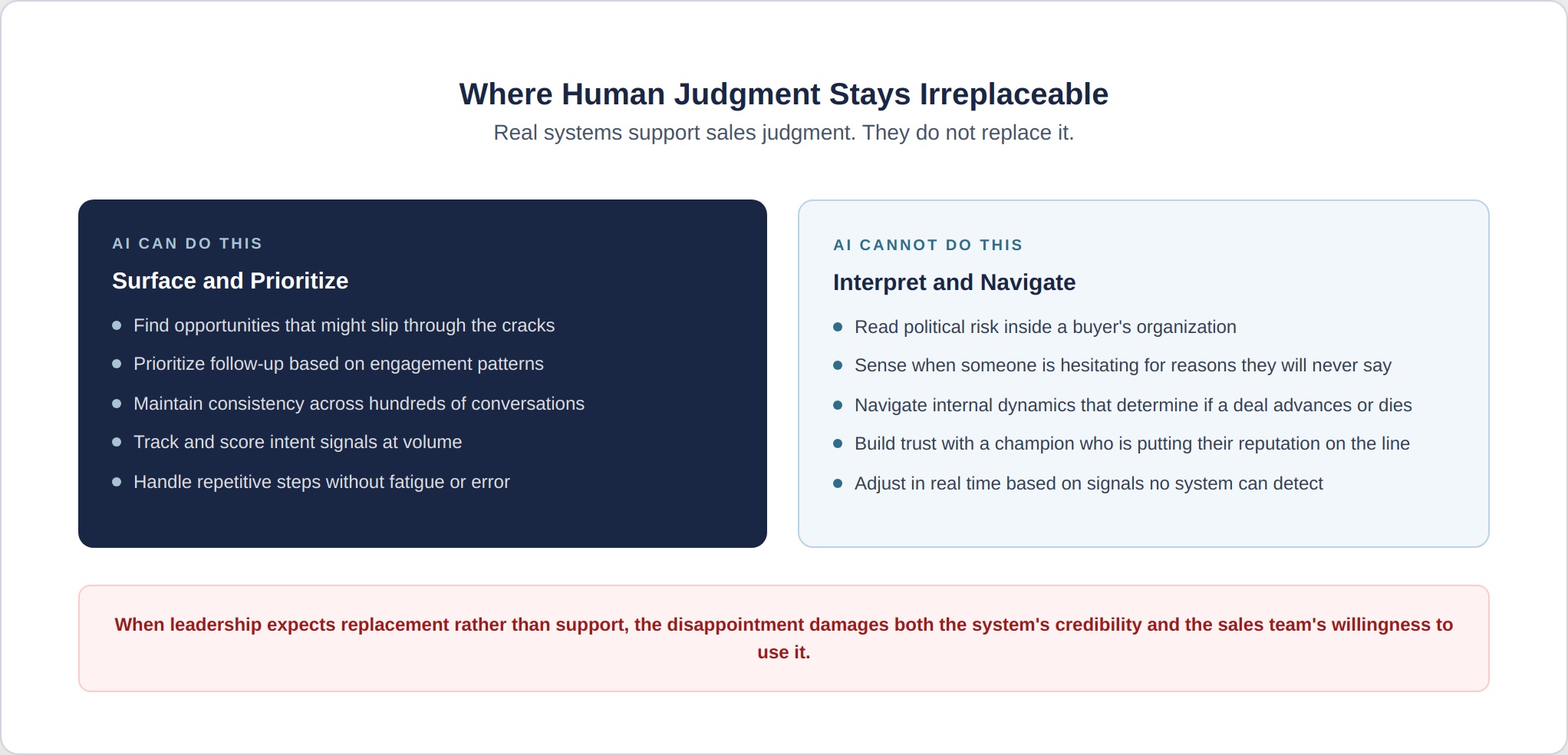
Where Human Judgment Remains Irreplaceable
How AI Reveals What Was Already Broken
AI acts like a stress test for your entire go-to-market strategy. It moves fast enough and reaches enough prospects to reveal problems that existed before the system was deployed but went unnoticed.
Confusion about a company’s ideal customer profile becomes apparent when the messages it generates attract companies that don’t fit that profile. These gaps in messaging occur when a buyer responds with unexpected or unanticipated questions. Situations can also arise in which sales process bottlenecks occur when leads don’t have a clear next step. When people start a conversation but never convert, the offer reveals that the value proposition doesn’t align with the lead’s expectations.
This exposure to what’s broken is sometimes unwelcome, but companies that want to incorporate AI need to treat it as valuable data to optimize the system. The companies that are not ready for this information blame the tech for the problems they are facing rather than looking within to fix them.
The Arms Race Buyers Are Already Winning
AI-driven outreach is being deployed across industries, and buyers are learning to adapt to what’s happening rather than being passive recipients. As they are exposed to more automation, they are becoming more skeptical and dismissing messages faster, because the volume of messages they receive has trained them to filter more aggressively. And during this time, they start testing the system’s credibility by asking questions only a knowledgeable human can answer.
Because of this, AI systems must evolve continuously to keep pace with buyers’ defences. Static automation that worked in the first month won’t even register by the sixth. As the market sees patterns in you and the competition, buyers put up their shields and start becoming immune to everything they see.
Without question, this arms race is the dynamic that nobody discusses during the sales process, but that determines long-term system viability.
What Success Actually Feels Like
Over time, a real system settles into something far less dramatic than the demo promised.
A company should expect an increase in conversations, but not explosive overnight growth. This reliable flow of conversations should be something the sales team can work with. From there, there should be clear handoff rules that the team understands and follows. Once the system has been running for a while, you can get clearer performance ranges to forecast against, and when the numbers dip, you know when adjustments are needed.
Nothing here is magical. Instead, it’s boring, and when it reaches that point, you know the system has matured. This stability happens after 4-6 months,, not 4-6 weeks, as some ‘companies’ images suggest, but once stable, you get real leverage. New conversations happen that would not have happened otherwise. The lead pipeline grows without burning out the team. And grow feels sustainable as more time passes.
The Bottom Line
Real AI lead generation systems are built, not bought. You can purchase the technology. The system around it, the inputs, the messaging framework, the human roles, the feedback loops, the calibration patience, the ongoing management, all of that must be built by your team based on your specific buyers, your specific positioning, and your specific sales reality.
If you want to succeed with AI lead generation systems, you need to understand a few things before signing any type of contract. First, you need to know that any demo or numbers you are given are about the system’s potential and are never a guarantee. Second, you need to plan for a calibration period. And finally, you need to be able to assign clear ownership for each part of the system. With this in mind, you can define the system’s inputs and know what to expect from its output.
Companies that fail expect the numbers provided during the demo to be accurate and sign the contract prematurely. Once they flip the switch and turn the system on, they wait for leads to come in, as they did during the demo. That expectation is the biggest and most expensive mistake a company can make.
What to Do Before You Decide on Any AI Lead Generation Solution
Before signing a contract, running a pilot, or restructuring your outbound strategy around AI, step back from the demo entirely.
Before you decide to move forward with any AI Lead Generation solution, you need to answer these questions:
- Are there clear, documented inputs for the system to run against, including an ICP, messaging framework, clarity, and exclusion rules, or are we expecting the system to figure these out for us?
- Do we know who will own optimizing the system, including tuning, message direction, and performance interpretation, once everything is running?
- Can the sales department handle more cold outreach, along with leads from other inbound sources, such as referrals?
- Are you prepared to spend 60 to 90 days calibrating the system to ensure results become more consistent and stable, and does leadership understand that timeline?
If those answers aren’t clear, the problem is not which platform to choose. The problem is the sequence. You are not yet ready to operate the system you are about to buy.
Most companies approach AI lead generation as a purchasing decision. Which vendor has the best features? Which platform has the most impressive case studies? Which demo looked the most compelling? Those are the wrong questions. The right question is whether your business has the strategic foundation, the operational discipline, and the leadership patience to turn a technology purchase into a functioning system.
But before you start evaluating a vendor to help you with your AI Lead Generation, you need to do some work internally. Start by defining your ICP with precision so that your targeting decisions are clear. Then move to the messaging framework so you know that AI has the structure it needs to execute, rather than creating generic copy. And finally, clarify your offer so that what you create has enough value for your customer that they have a reason to keep listening. Whether ownership of each item, messaging, direction, system optimization, exception handling, and performance is handled by one person or by an individual for each aspect needs to be defined.
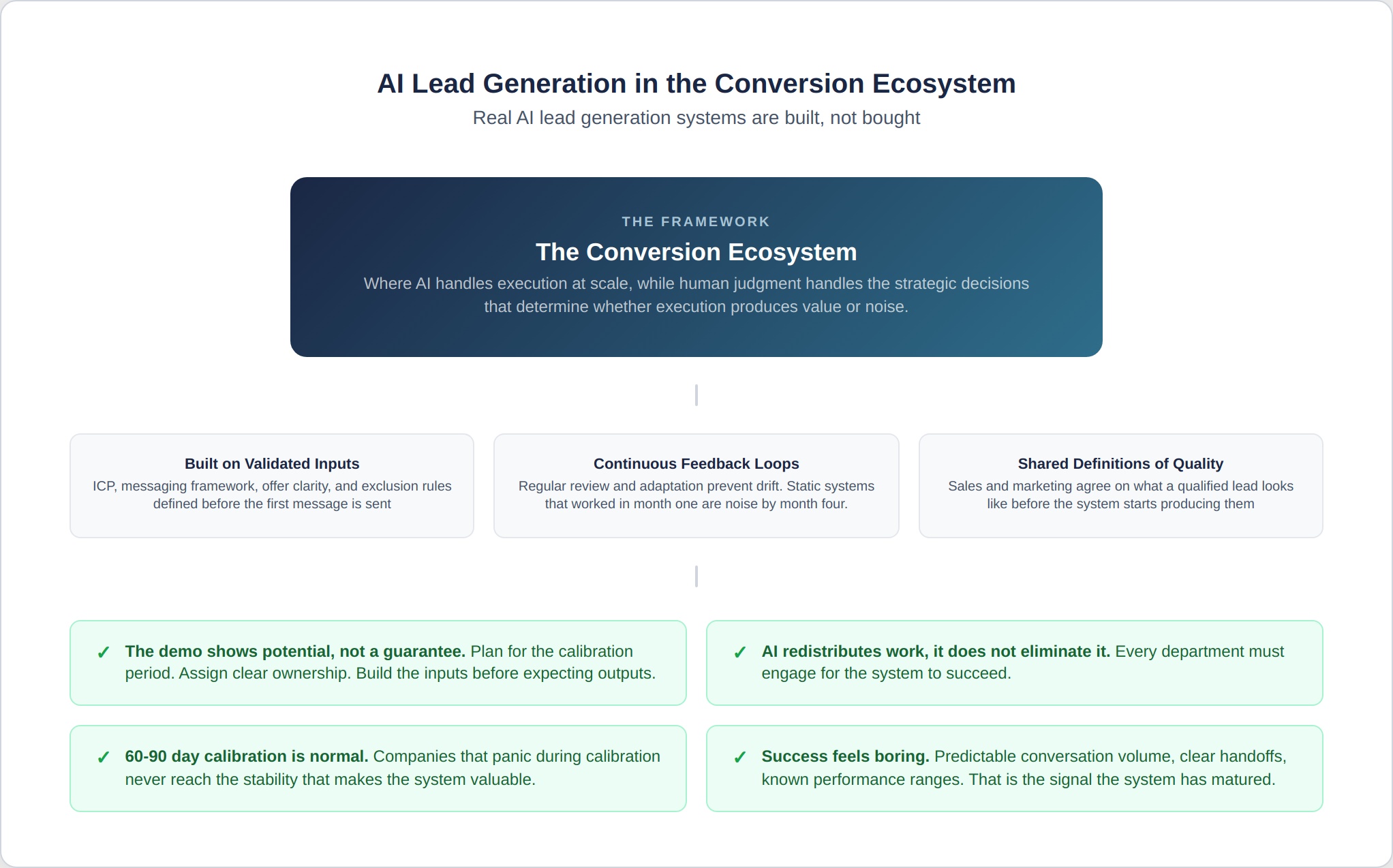
This is why AI lead generation is part of the AI Growth modules in what we call The Conversion Ecosystem. This is a complete systematic approach to digital marketing built for compounding growth. AI within the system knows how to execute the smallest tasks or multiple tasks at scale, while human judgment oversees the strategic decisions that determine whether it is executing correctly. The system is built on validated inputs rather than assumptions, and it avoids generic ones that may neglect actual situations you may encounter. Where feedback loops are integrated to ensure continuous improvement, and where sales and marketing share what defines a quality lead ready to be sent to the team for manual intervention. Without all of this, there will always be a gap between what was seen in a demo and what actually exists within a working .system
If you want help evaluating whether your business is ready to operate a real AI lead generation system based on your actual positioning, sales process, and team capacity, rather than what a demo implied, or if you need to build the strategic foundation that makes AI lead generation actually work, rather than just run, reach out. We can help you see the full picture before you commit and build the system the technology needs to produce results that match the investment.

