Avoid These Landing Page Mistakes: Expert Explains Why

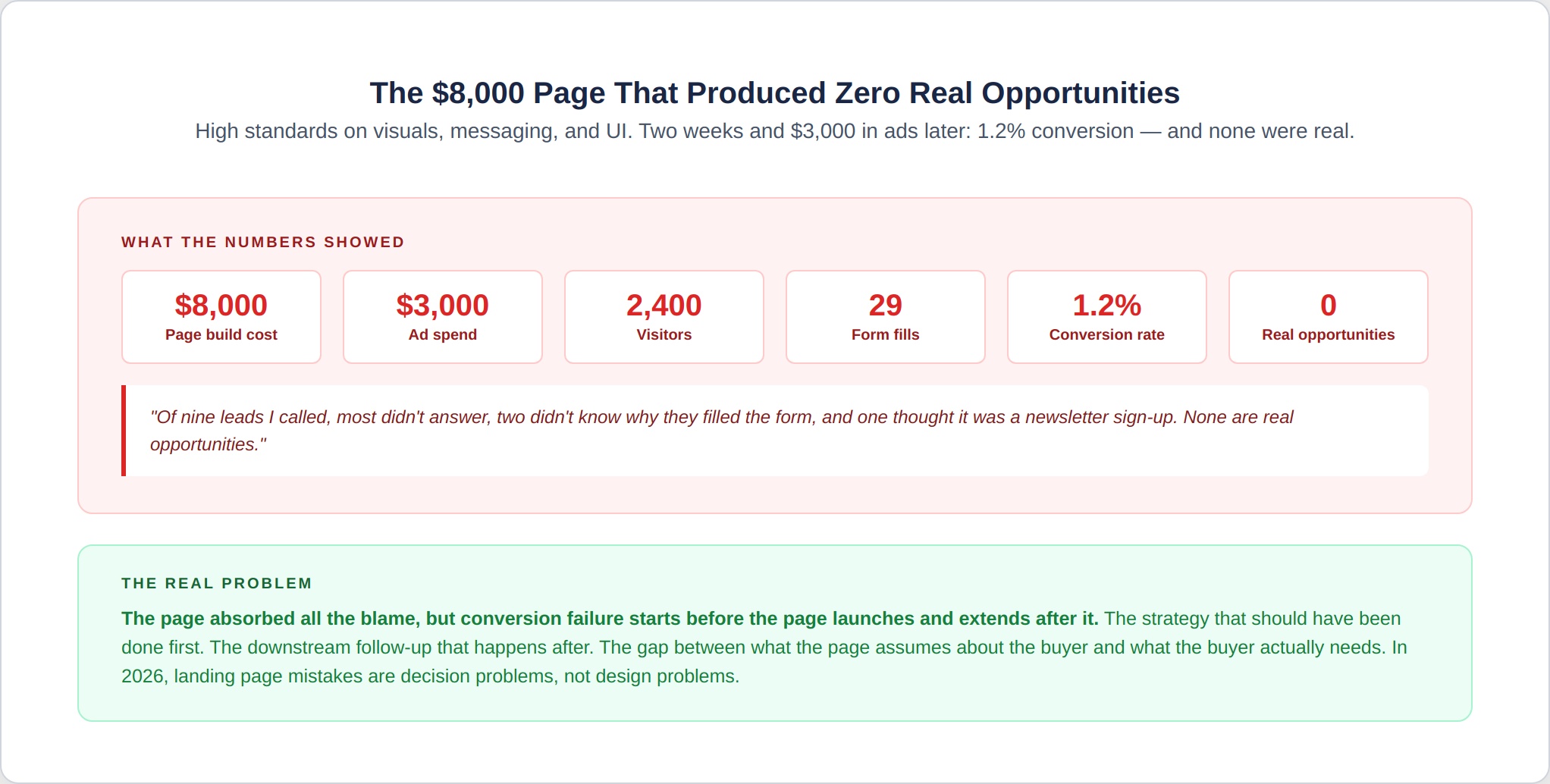
Your team spent 3 weeks and $8,000 building a new landing page for your flagship service offering. The designer nailed the visual direction. The copywriter produced clean, professional messaging. The developer built it on your best-performing template. You launched it on a Monday, pointed your paid campaigns at it, and waited. Two weeks and three thousand dollars in ad spend later, you pulled the analytics. Conversion rate: 1.2 percent. Twenty-nine form fills from 2,400 visitors. Your marketing director called an emergency meeting. The team spent an hour debating headline variations, button colours, and whether the hero image should show people or abstract graphics. Nobody asked the question that actually mattered. Your head of sales, sitting quietly in the corner, finally spoke up: “I’ve called nine of those twenty-nine leads. Six didn’t answer. Two couldn’t explain why they filled out the form. One said they thought they were signing up for a newsletter. None of them is a real opportunity.”
That moment reveals what most landing page conversations miss entirely. The problem with landing pages that don’t convert is almost never the page itself. The page is the most visible component, so it absorbs all the blame. But the conversion failure lives upstream in strategy, downstream in follow-up, and underneath everything in the gap between what the page assumes about the buyer and what the buyer actually needs.
Most teams respond to low conversion by redesigning, optimizing, and testing. New layouts. New headlines. New button colours. A/B tests that produce marginal differences and consume weeks of effort.
In 2026, landing page mistakes are rarely design problems. They are decision problems. The page doesn’t help the buyer make the specific decision they came to make, so they leave, not because the page looks wrong, but because it doesn’t resolve the hesitation that brought them there.
Let me explain why landing pages don’t convert, what is actually missing when buyers hesitate, and why optimization alone never fixes structural landing page mistakes. But there is a gap between how teams see their own pages and how buyers experience them that explains most conversion failures. Read on.
Why Do Landing Pages Fail When the Numbers Look Fine?
When it comes down to the success of a landing page, what businesses don’t notice is that low conversions don’t always look like a low percentage. Many pages “convert” on paper and still fail in practice.
This can show in many ways:
- Submissions that never turn into conversations.
- High engagement metrics with zero follow-up.
- Early interest that stalls the moment sales get involved.
Reps distrust the leads because experience has taught them that these submissions are worthless.
When these types of patterns appear, there isn’t anything wrong with the page being broken. There is something else going on strategically. A 5 percent conversion rate sounds reasonable, but when those leads ghost after the first call, can’t explain why they filled out the form, and never progress beyond initial contact, the conversion rate is only measuring activity, not buyer intent.
Companies can spend months optimizing a page that drives these conversions without realizing the goal is not how many people fill out the form, but how many of those people believe what you do can solve their problems.
Why Do Pages Designed for Attention Fail to Create Confidence?
Many landing pages focus on grabbing attention with bold headlines, strong claims, and polished visuals. These are great at catching the buyer’s attention and prompting them to read, but the goal of the page isn’t just to get attention. The goal is to create confidence in the company.
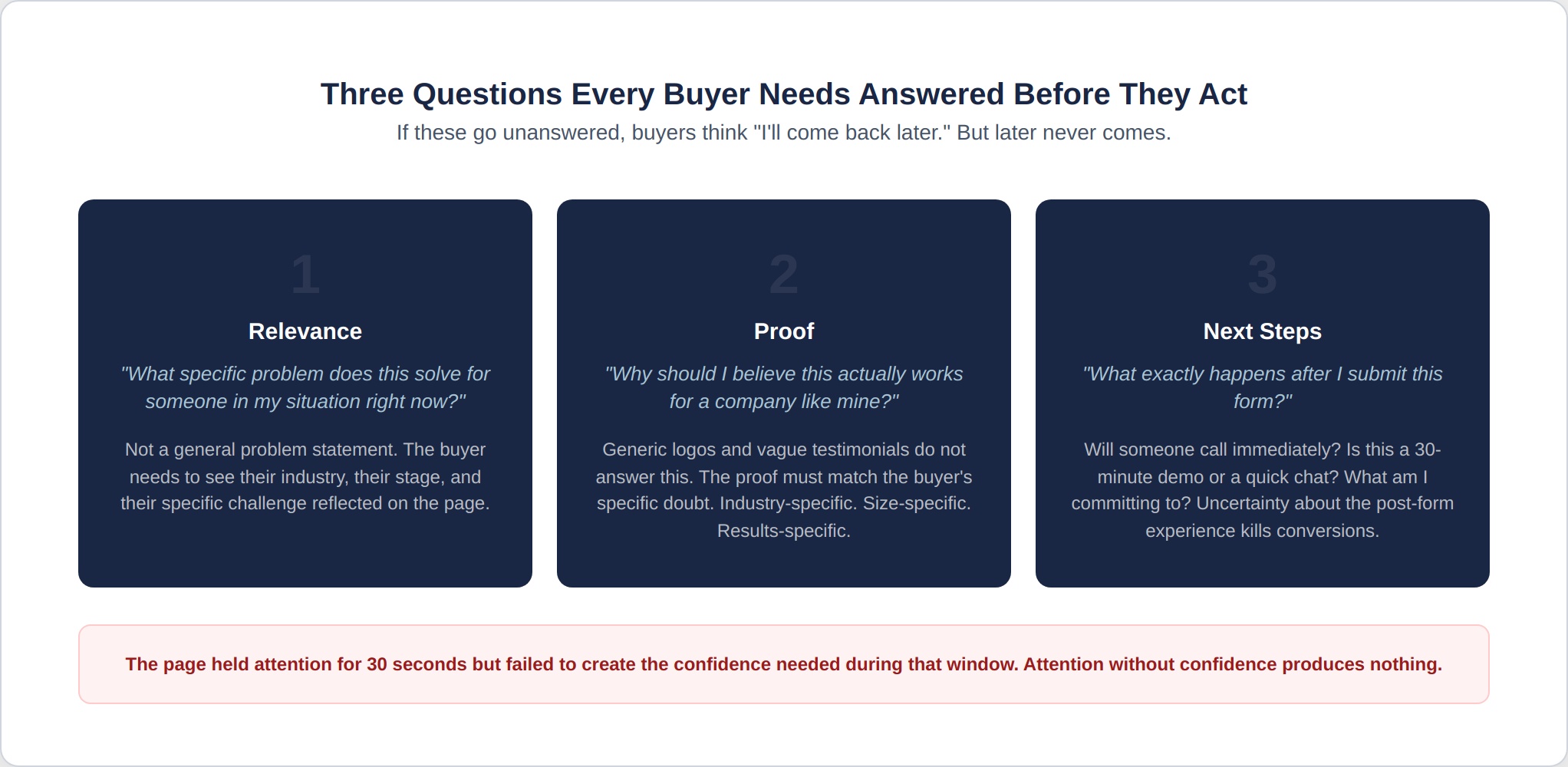
The majority of the landing pages I audit never answer the three questions every buyer wants to know:
1. What specific problem is this solving for someone in my situation right now?
2. Why should I believe this actually works for a company like mine?
3. What happens after I submit this form?
If these questions go unanswered, buyers delay and think, “I’ll come back to this later.” But later never comes.
The page held their attention for 30 seconds but failed to create the necessary confidence needed during that window of opportunity.
Think about what this means for how you work to evaluate the performance of a landing page. First, does the headline grab your attention? Second, does the design look professional? Third, did the buyer read most of the page?
But what really matters is: Did they find the answers they needed to feel safe enough to act? Unless you support this answer with your content, the landing page will fail.
What Happens When Promises Exist Without Process?
Promises are everywhere on landing pages. More leads. Higher growth. Better performance. Faster results.
What is almost always missing is process.
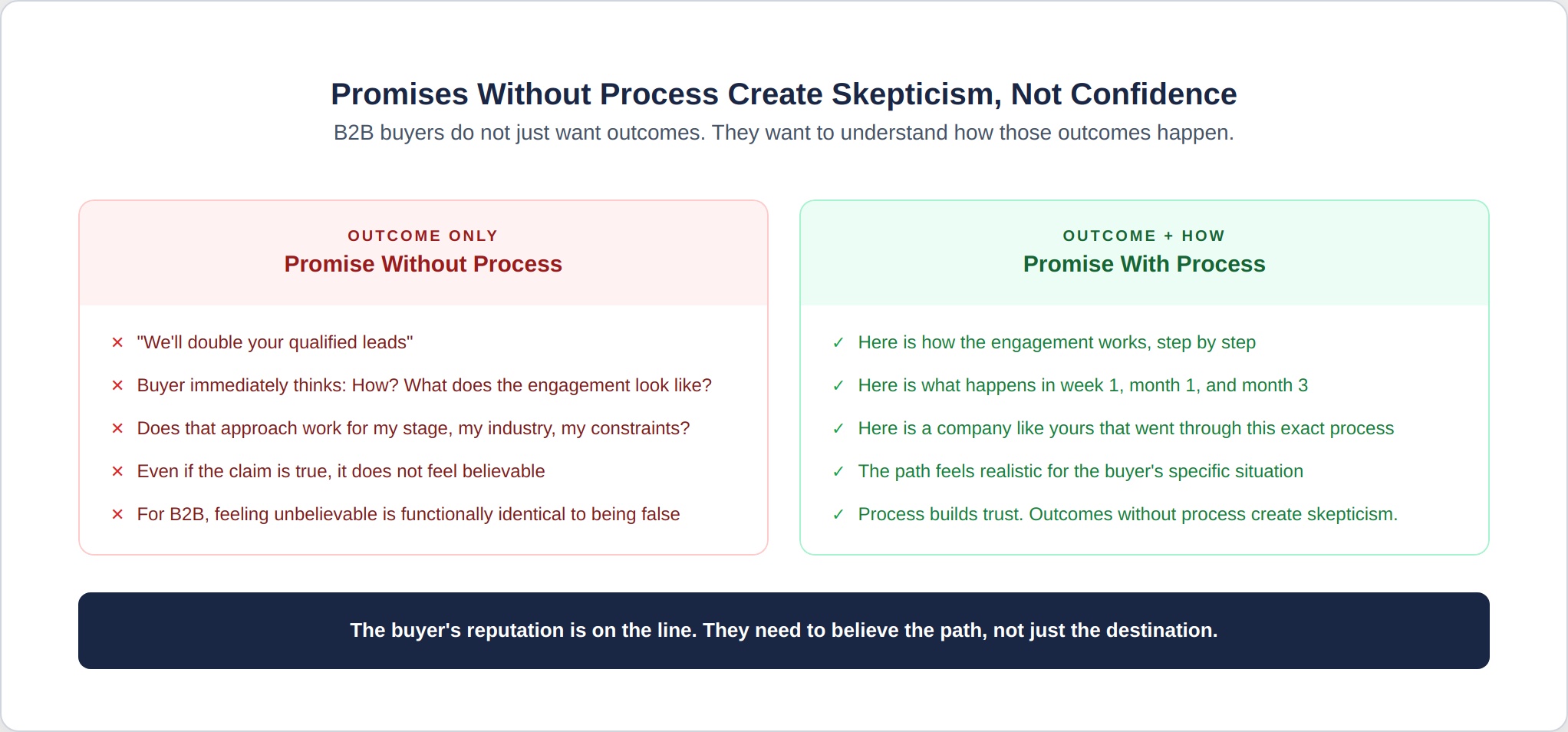
B2B buyers don’t just want outcomes. They want to understand how those outcomes happen and whether the path feels realistic for their specific situation. An outcome-focused page says, “We’ll double your qualified leads.” The buyer immediately thinks, “How? What does the actual engagement look like? Does that approach work for companies at my stage, in my industry, with my constraints?”
Without a basic explanation, the promise feels empty.
Even if the claim is true, it doesn’t feel believable. For B2B companies, where purchases are justified internally, and the buyer’s reputation is on the line, feeling unbelievable is functionally identical to being false.
Pages that focus only on outcomes without explaining how don’t convert as high as those that spend more time explaining the process. It is this process that builds trust. Focusing on outcomes without process just creates skepticism.
How Does Choice Paralysis Kill Landing Page Conversions?
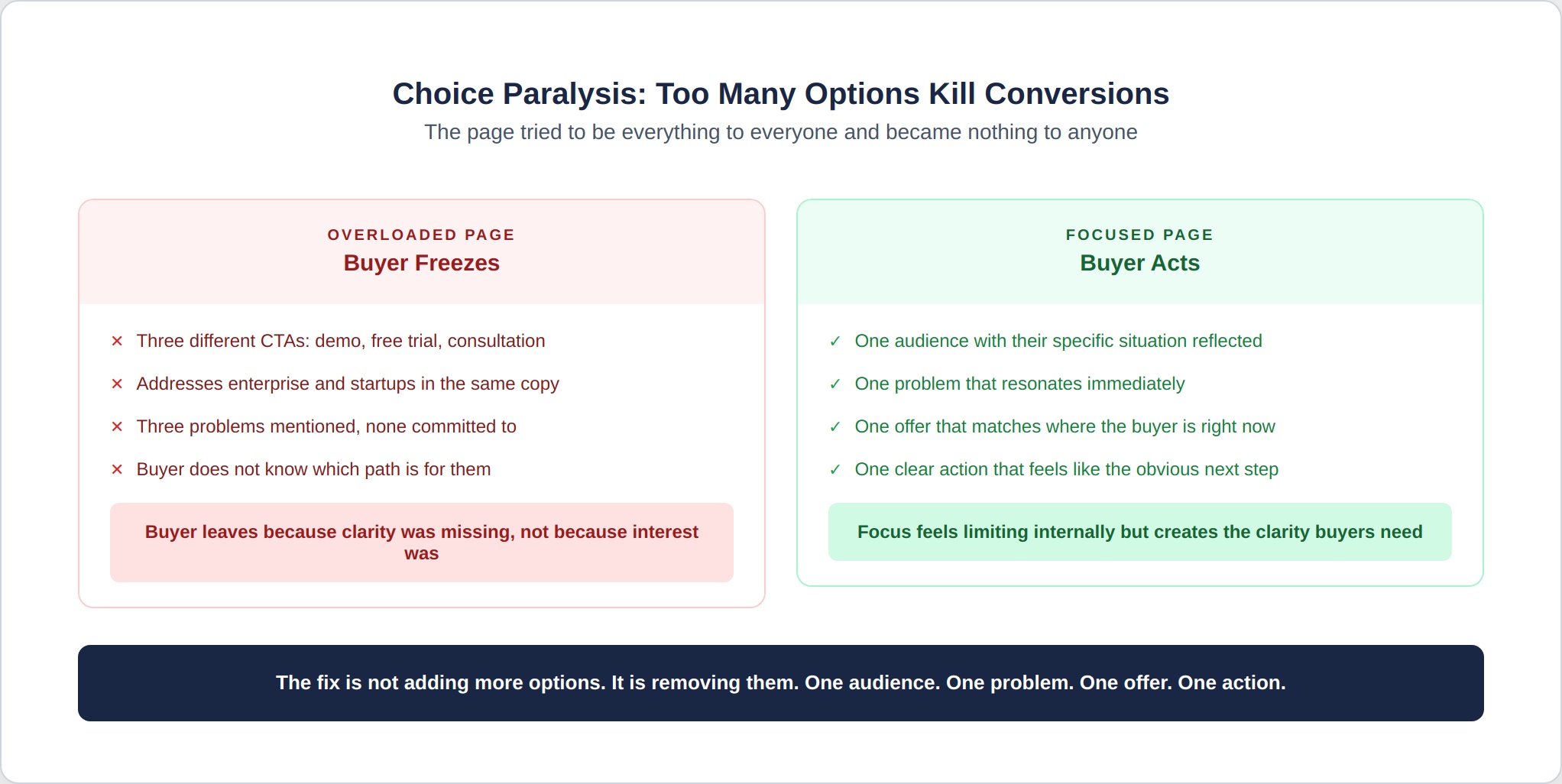
Many landing pages are overloaded. They try to serve multiple audiences simultaneously. They present multiple offers. They include multiple calls to action, hoping that one of them will resonate.
This creates choice paralysis. The buyer looks at the page and sees three possible next steps: a demo, a free trial, and a consultation. The page addresses enterprise buyers and startups in the same copy. Three different problems are mentioned without committing to any of them.
When this happens, the buyer freezes because they don’t know which path is for them. The page tried to be everything to everyone and became nothing to anyone.
Now here comes the good part. The fix is not adding more options. It is removing them. One audience. One problem. One offer. One action. That focus feels limiting internally, but creates the clarity that buyers need to act.
Why Does the Right Message at the Wrong Time Fail?
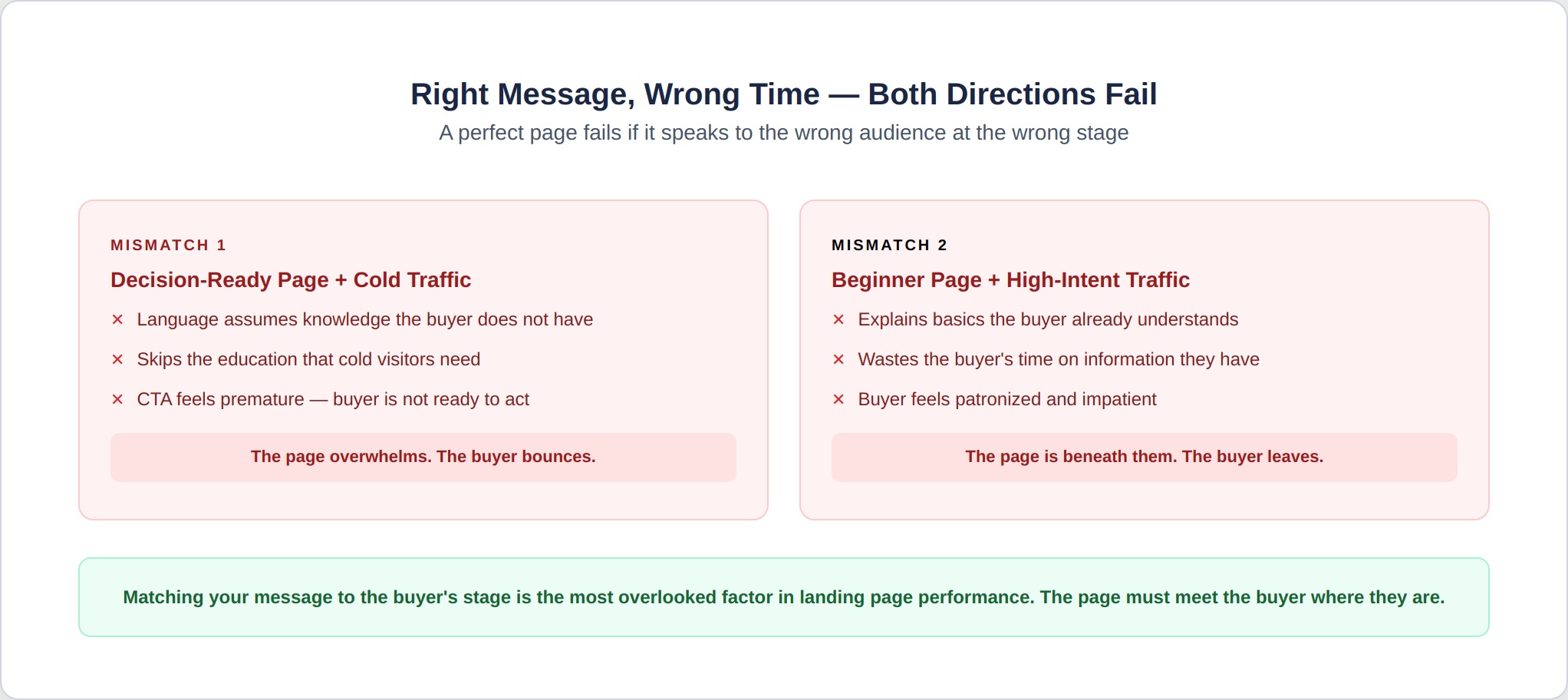
Many pages are well written for a specific type of buyer, but completely wrong for the traffic they actually receive.
A page written for decision-ready buyers fails with cold traffic from a broad awareness campaign. The language assumes knowledge the buyer doesn’t have. The information never lands, and the call to action feels premature.
A page written for early-stage explorers will fail when high-intent traffic visits the page. If a buyer already understands the basics, they are wasting their time on the landing page, which makes them feel patronized and impatient, and they leave.
The clear takeaway: matching your message to the buyer’s stage is crucial. A perfect page fails if it speaks to the wrong audience at the wrong time.
Why Does Your Team Think the Page Is Clear When Buyers Don’t?
Teams frequently say, “The page looks clear to us.”
That is exactly the problem.
Your team already knows what the offer is. They know how the process works and what happens after someone fills out the form. They can fill in every gap without thinking. They have lived inside this product and market for months or years.
The buyer is seeing this for the first time, so they don’t have your context. They don’t know your terminology. They can’t fill in the blanks. A page that feels clear to your team feels confusing to someone seeing it cold.
Landing pages that underperform are those where the team is confused about why conversion is low.
“It’s so clear!” they say.
And they are right, for someone with their context. The buyer has none. The gap between internal clarity and external experience is why landing pages fail.
How Do Forms Destroy Conversion Momentum?
Teams frequently say, “The page looks clear to us.”
That is exactly the problem.
Your team already knows what the offer is. They know how the process works and what happens after someone fills out the form. They can fill in every gap without thinking. They have lived inside this product and market for months or years.
The buyer is seeing this for the first time, so they don’t have your context. They don’t know your terminology. They can’t fill in the blanks. A page that feels clear to your team feels confusing to someone seeing it cold.
Landing pages that underperform are those where the team is confused about why conversion is low.
“It’s so clear!” they say.
And they are right, for someone with their context. The buyer has none. The gap between internal clarity and external experience is why landing pages fail.
How Do Forms Destroy Conversion Momentum?
Many landing pages lose conversions at the form itself. Not because the form is too long, although that matters, but because the form doesn’t explain what happens next.
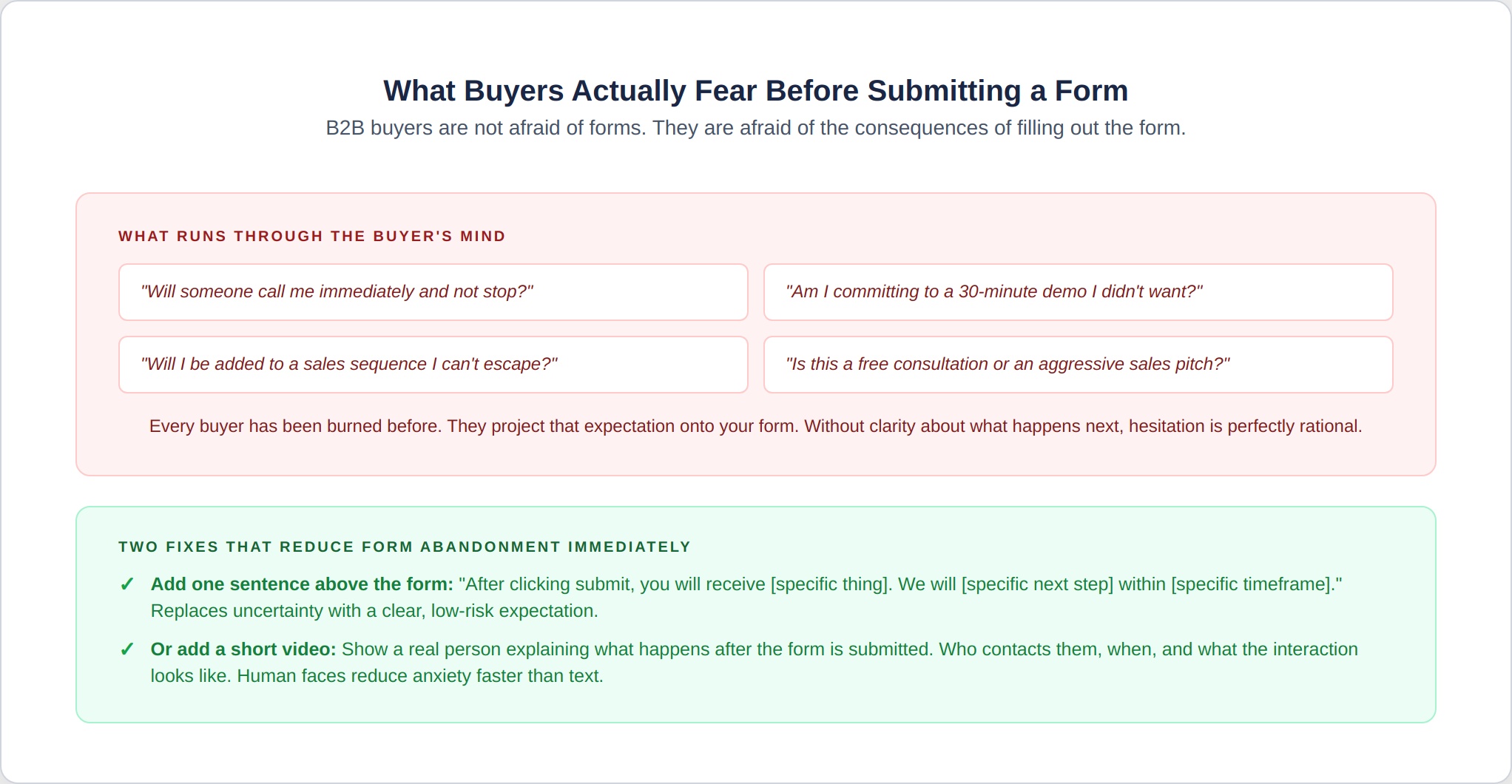
B2B buyers are not afraid of forms. They are afraid of the consequences of filling out the form.
“If I fill this out, will someone call me right away? Will I be added to a sales sequence? Am I committing to a thirty-minute demo, a discovery call, or an ongoing relationship? What exactly am I triggering?”
Without an explanation of what happens next, the buyer’s hesitation is perfectly rational.
They are being asked to submit personal information without knowing what they are agreeing to.
You can do this two ways. First, you can add this at the start of the form.
- “After clicking submit, you’ll receive x, y, and z .”
That sentence reduces form abandonment. What you are doing is replacing uncertainty with a clear, low-risk expectation.
Second, you can do the same thing in a video explaining what happens next.
Why Do Buyers Worry About What Comes After the Page?
Buyers think ahead. Before they fill out a form, they are already imagining the experience that follows. Who contacts them? How fast. What will that person ask? Whether the interaction will feel helpful or pressured.
The post-form experience needs to be clear. Every buyer has been burned before by “free consultations” that were turned into really aggressive sales pitches. Because of this, they project that expectation onto your form.
Your page can be perfectly designed. If the buyer anticipates a bad experience afterward, they won’t convert.
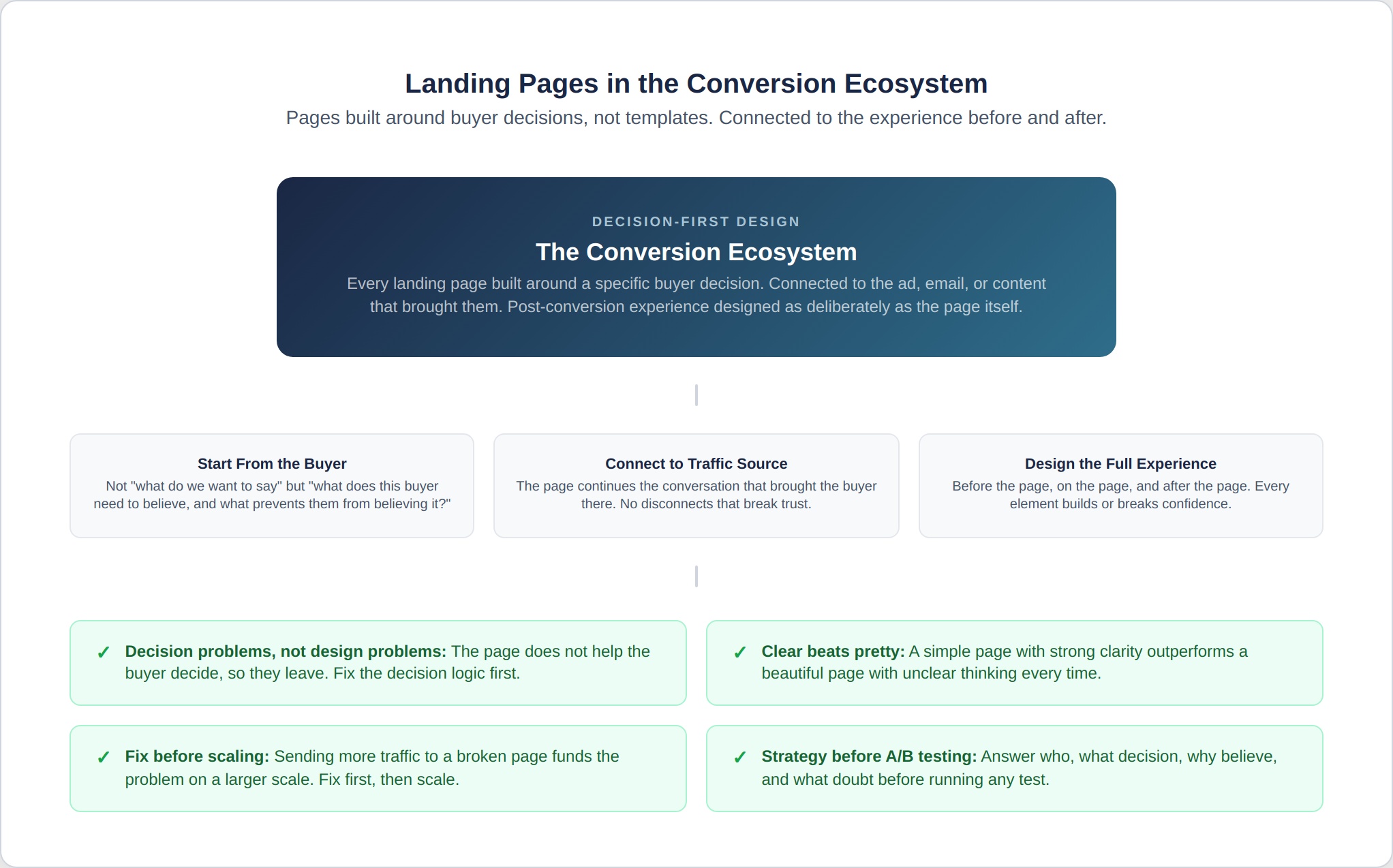
Pages don’t convert in isolation. They convert as part of an experience that extends before and after the page itself. The ad that brought them there. The content they consumed previously. The follow-up they expect afterward. Every element either builds or breaks the confidence the page needs to convert.
Why Don’t Generic Trust Elements Build Trust?
Logos. Testimonials. Security badges. Star ratings. These elements appear on nearly every landing page and, on most pages, do nothing for conversion.
Effective trust answers specific doubts. Has this worked for companies like mine? What happens if it doesn’t work? Is this provider credible in my specific context?
Displaying a row of Fortune 500 logos on a page targeting startups signals that you work with a different customer base.
A testimonial from a healthcare company on a page targeting law firms doesn’t reduce hesitation. It creates irrelevance.
Your content must address all the buyer’s questions.
- If buyers worry about implementation time, show a testimonial that highlights a fast, smooth setup.
- If they worry about ROI, show specific numbers from a company similar to theirs.
Match the proof to the doubt, and trust that elements actually work.
What Happens When the Page Doesn’t Match the Traffic Source?
Many landing pages exist in isolation from the rest of the buyer’s experience.
If the ad uses the keywords “fast implementation” but then talks about “comprehensive enterprise solutions.” The buyer’s brain stops. “Is this the same company? Did I click the wrong link?” That moment of confusion is enough to prompt them to question their choices internally. And that internal monologue makes them leave.
The email subject line promises a specific insight. The landing page opens with a generic company overview. The buyer expected one thing and received another. Trust fractures.
Without question, this disconnection between the traffic source and the landing page is one of the most common and most fixable landing page mistakes. The page needs to continue the conversation that brought the buyer there, not start a new one. When Google Ads or LinkedIn Ads drive traffic with a specific promise, the landing page must deliver on that exact promise within the first five seconds.
Why Does Sending More Traffic to a Broken Page Make Everything Worse?
Poor conversion is not neutral. Every visitor who lands on a page that doesn’t convert is a wasted investment. When companies respond to low conversion rates by increasing ad spend on platforms like Google Ads or Meta Ads to compensate, the waste scales proportionally.
If you have a page converting at 2 percent when it should convert at 10 percent, it means most of that advertising dollar is wasted. Scaling ad spend to that page doesn’t fix the problem. It funds the problem on a larger scale.
Focus on fixing the page first to get it to 10% and then scale traffic. The time and money spent optimizing this will save your company more money in the long run.
Why Does A/B Testing Waste Months on the Wrong Problem?
When conversions are low, teams focus first on optimization. Button colour tests. Headline variations. Layout rearrangements. Image swaps. Tools like Optimizely, VWO, or Google Optimize make testing easy. But easy testing applied to the wrong problem produces easy waste.
Moving straight to A/B testing assumes the core decision logic behind the page is correct and that only the page needs refinement.
But if the decision logic is broken, optimization produces waste instead of insight. You get small gains, but not the gains you would get if you fixed the structural problems.
Before A/B testing, you need to answer the questions that should have been completed before creating the page.
- Who is this page for?
- What decision are we asking them to make?
- Why would they believe us?
- What doubt is preventing action?
Those questions require strategic thinking, not A/B tests. But answering them honestly creates more improvement in a week than six months of testing ever could.
What Happens When Nobody Agrees on What Conversion Means?
What does “conversion” actually mean for your page? A form fill? A qualified conversation? Is a buyer ready for sales?
Without a clear definition shared between marketing and sales, pages are optimized for the wrong outcome. Marketing celebrates hitting lead targets. Sales complains that the leads are useless. Both are right from their own perspective. Nobody defined which outcome mattered before the page was built.
This is what happens:
- The marketing team produces more leads.
- The sales team rejects the quality of the leads.
- Revenue doesn’t move despite both teams working hard.
What the teams need to do is come together and then define the outcome first. Build the page to produce it. Then measure against that specific definition.
Why Beautiful Designs Don’t Save Unclear Thinking?
A great design supports clarity, but it never creates it.
A well-designed page without a strategy will still underperform. A visually simple page with strong clarity frequently outperforms it by wide margins. Beautiful design makes good messaging better. It cannot rescue bad messaging.
Visual sophistication and conversion rate are not as correlated as most teams assume.
The correlation between decision clarity and conversion rate is far stronger.
Pretty doesn’t mean profitable. Clear means profitable. Pretty and clear means highly profitable. Pretty and unclear means expensively disappointing.
The Bottom Line
Landing pages don’t fail because they lack polish, sophistication, or the right template. They fail because they don’t help the buyer make the specific decision they came to make. The headline might be wrong. The offer might be mismatched. The timing might be off. The trust elements might be generic. The form might create uncertainty. The follow-up might be unclear. But underneath all of those symptoms, the root cause is almost always the same. The page was built from the company’s perspective rather than the buyer’s decision-making process. The companies that build pages that convert consistently start from a different place. Not “what do we want to say?” but “what does this buyer need to believe, and what is preventing them from believing it right now?”
What to Do Before Redesigning or Driving More Traffic to a Failing Page
Before changing layouts, testing headlines, or increasing ad spend on a page that isn’t converting, pause and step back from the page itself and then look at:
- What specific decision is this page meant to move forward, and is that decision clear within the first five seconds?
- What doubt must be resolved before a buyer feels safe submitting the form, and does the page address that doubt explicitly?
- What experience does the buyer enter immediately after they convert, and is that experience explained on the page before they act?
Landing pages don’t fail because they lack polish. They fail because they lack clarity of decision and alignment with the rest of the buyer’s experience.
What most teams do is they see low conversion and immediately start redesigning. New layout. New images. New copy. All surface-level changes that don’t address the root cause. The root cause is almost always strategic.
Wrong audience. Wrong message. Wrong timing. Wrong offer. No amount of redesign fixes those issues.
To fix this answer:
- Who is the specific buyer this page serves?
- What single decision are we asking them to make?
- What stops a person from taking the next step?
- What can be done to prevent them from hesitating?
Write those answers out. Then evaluate whether the current page addresses them. If it doesn’t, the redesign should focus on decision support rather than aesthetics.
Before investing more time or budget, have your top sales rep read the landing page as if they were a prospect seeing it for the first time. Ask them what would make them hesitate. Ask them whether the page would make their sales conversations easier or harder. That feedback is more valuable than any A/B test because it comes from someone who talks to buyers every day.
Designing a landing page that performs is fundamental to our conversion ecosystem.
Our Conversion Ecosystem is a complete digital marketing strategy designed to turn traffic into customers predictably and repeatedly. Where every landing page is built around a specific buyer decision rather than a generic template. Where the page connects seamlessly to the ad, email, or content that brought the buyer there. Where trust elements address actual buyer doubts rather than filling space. Where the post-conversion experience is designed as deliberately as the page itself. Where optimization refines decision logic that already works rather than searching for improvements to a page that was never strategically sound.
Need help creating a new landing page? Trying to figure out why your landing page isn’t converting?
Reach out to us. We can help you turn pages into decision tools that move buyers forward, rather than traffic sinks that consume budget and produce leads that never become revenue.

